
Bloomberg

Australia’s Treasurer Says RBA Review to Guide Lowe Decision

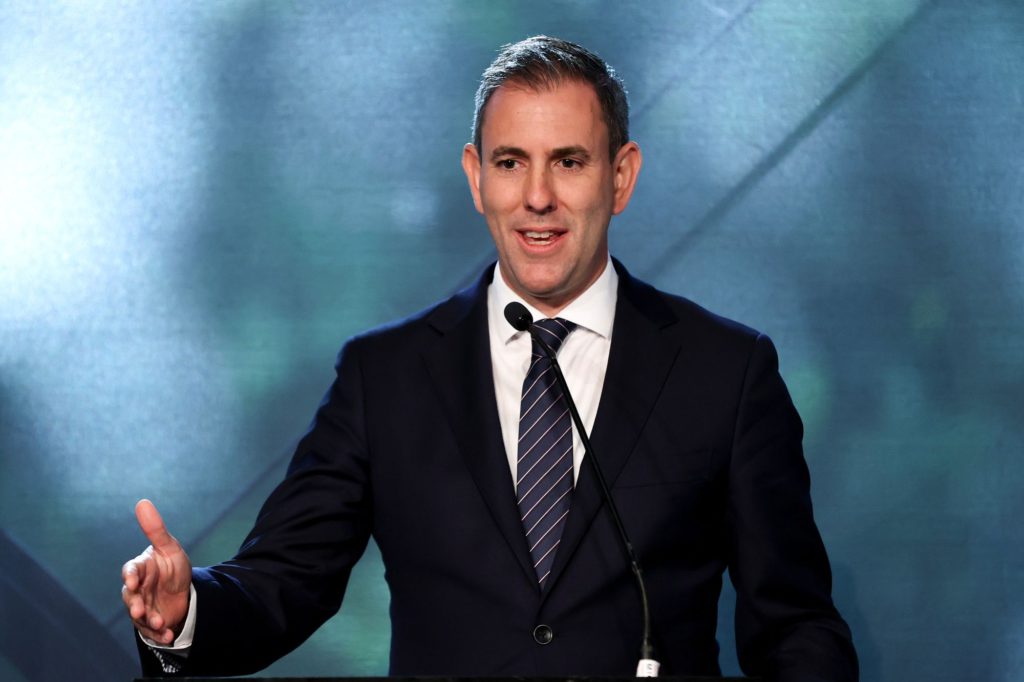
(Bloomberg) — Australian Treasurer Jim Chalmers said an independent review of the Reserve Bank will help guide his decision next year on whether to reappoint Governor Philip Lowe, whose term expires in September.

The results of the review will “feed into our thinking” about the RBA’s leadership, Chalmers told Australian Broadcasting Corp. radio on Thursday. 

“Not because we’ve asked for some kind of performance review of the governor, but because we want to learn from best practice and give the RBA the best structures and institutional settings we can,” he said.

The final report from the three-member panel is due in March and Chalmers said he’d consult with the prime minister and cabinet and make a decision on the governor’s reappointment around mid-2023. When asked if Lowe’s days as central bank chief might be numbered, Chalmers rejected the assertion. 

“That’s not what I’m trying to say,” he said. “We do have this really important review being handed to me in March and responded to some point. After that it would be strange, I think, not to factor in some of those conclusions in whatever we decide about the role of the governor.”

The RBA on Thursday released its 84-page response to questions from the review panel in which it addressed issues ranging from monetary policy decisions to communication and governance. Lowe has publicly argued that a flexible inflation targeting framework has been, and remains, appropriate for the bank. 

The central bank acknowledged in its submission that the board has been subject to a number of criticisms, including a “disorderly cessation” of its pandemic-era yield-target policy. 

The review also on Thursday published the submissions it had received.

Lowe has faced mounting criticism in recent years, ranging from the RBA failing to meet its 2-3% inflation target prior to the pandemic to then sticking with excessively easy policy as Covid receded and struggling to communicate clearly with the market and broader public. 

The RBA board’s composition has also come under scrutiny as it only includes one economist among six independent directors, suggesting its members aren’t qualified to push back against bank policy recommendations. 

The central bank this year delivered its sharpest annual policy tightening since 1989, having raised interest rates by 3 percentage points from a record low 0.1% in May to try to rein in escalating inflation pressures.

(Updates with submissions received by RBA review.)

More stories like this are available on bloomberg.com

©2022 Bloomberg L.P.

Sinopharm Weighing $4 Billion China TCM Take-Private Bid, Sources Say

(Bloomberg) — China National Pharmaceutical Group Co. is considering a revived bid for China Traditional Chinese Medicine Holdings Co. that could value the Hong Kong-listed drugmaker at around $4 billion, people with knowledge of the matter said.

The state-backed firm known as Sinopharm, which holds a controlling stake in China TCM, is talking with advisers about a new offer to potentially take the company private, the people said, after pulling a previous attempt last year. Sinopharm and its advisers are discussing a potential offer of about HK$6 for each China TCM share, while no final decision has been made, the people said.

A deal would be the biggest take-private for a Hong Kong-traded company since appliance maker Haier Electronics Group Co.’s $5 billion acquisition in 2020. The potential bid would give China TCM investors nearly a 60% premium to the traditional drugmaker’s closing share price on Wednesday of HK$3.77 each. 

Shares in China TCM climbed 17.2% Thursday after jumping as much as 28%, their largest intraday move since 2013. The company has a market value of HK$22.2 billion ($2.8 billion).

An offer could come as soon as in the coming weeks, the people said, asking not to be identified discussing private information. Deliberations are ongoing and details of the offer could change, said the people. 

A spokesperson for China TCM said in response to queries from Bloomberg News that the company hasn’t received any information that Sinopharm is considering taking China TCM private, and that it is untrue. Sinopharm didn’t immediately respond to requests for comment.

China TCM disclosed in 2021 that Sinopharm was exploring a proposal to take the company private, and in August that year announced that the owner had decided not to proceed. Sinopharm holds about 32% of China TCM’s shares.

The company produces Chinese traditional medicine herbs, granules, finished drugs and health supplements, according to its interim report. China TCM reported revenue of 5.9 billion yuan ($845 million) for the half-year ended June 30, down about 27% from the same period last year, the report shows.

Sinopharm’s business ranges from drugs to medical equipment. The company makes one of the inactivated Covid-19 vaccines distributed in China, its website shows.

–With assistance from Dong Lyu and Lorretta Chen.

(Updates with share move in fourth paragraph.)

More stories like this are available on bloomberg.com

©2022 Bloomberg L.P.

Facebook, Twitter Poised to Beat Suit Over Covid Misinformation

(Bloomberg) — Meta Platforms Inc. and Twitter Inc. can’t be held liable for misinformation posted by users about Covid-19 vaccines even if the posts violate company policies, a judge said.

In a tentative ruling Wednesday, a state judge in San Jose, California, based his ruling on the US Communications Decency Act. Section 230 of the law gives broad immunity to interactive computer services for content posted by third parties.

The proposed class-action lawsuit tried to get around law by claiming that Meta’s Facebook and Twitter breached their contracts with users by failing to enforce company policies for preventing the spread of misinformation.

Superior Court Judge Sunil Kulkarni said that no matter how the complaint was styled, it was still trying to hold the companies liable for third-party content, which Section 230 doesn’t allow.

Read More: Facebook Probe by DC Official Targets Vaccine Misinformation

The case is Ackers v. Facebook Inc., 21CV387172, California Superior Court, Santa Clara County (San Jose).

More stories like this are available on bloomberg.com

©2022 Bloomberg L.P.

Bigtincan’s Biggest Shareholder Objects to Capital Raising

(Bloomberg) — Australian sales software developer Bigtincan Holdings Ltd. has drawn opposition to a possible equity raising from its largest shareholder and suitor.

Technology investor SQN Investors LP sent a letter to the Bigtincan board Wednesday objecting to what it said would be a “potentially highly dilutive” and “value-destructive” move by the company. SQN lodged a take-private offer to the company last month valuing it at about A$442 million ($297 million). 

The Australian Financial Review reported on Wednesday that the company was weighing a A$30 million institutional placement. A representative for Bigtincan did not immediately respond to requests for comment.

Any move by the company to raise equity “would seem hasty and value-destructive following your receipt of our bona fide acquisition proposal that would offer the company and its shareholders a significant all-cash premium,” the fund said in the letter, obtained by Bloomberg News. The firm’s “financial profile as a public company is becoming increasingly untenable given its continued cash burn,” underscoring the conviction that the firm should go private, SQN said.

SQN offered in early November to take the company private for A$0.80 per share, an offer it said at the time represented a 46% premium to Bigtincan’s 30-day average price.

More stories like this are available on bloomberg.com

©2022 Bloomberg L.P.

Netherlands Plans Curbs on China Tech Exports in Deal With US

(Bloomberg) — Dutch officials are planning new controls on exports of chipmaking equipment to China, according to people familiar with the matter, potentially aligning their trade rules with US efforts to restrict Beijing’s access to high-end technology.

An agreement on the Dutch curbs could come as soon as next month, according to the people, who asked not to be identified given the sensitivity of the discussions, adding that negotiations are ongoing and no final decision has been made.

The Dutch foreign trade ministry and the White House’s National Security Council declined to comment.

Read more: Biden’s Chip Curbs Beat Trump in Forcing World to Align on China

The Dutch move, which would essentially codify and potentially expand its unofficial ban on some technology sales to China, is a step toward bulking up US efforts to limit Beijing’s chipmaking and military ambitions. 

The Netherlands and Japan are the world’s top suppliers, outside the US, of machinery and know-how needed to make advanced semiconductors, but Washington is yet to get those allies fully on board.

The new export limits under consideration by the Netherlands could bar the sale of equipment capable of making chips designated as 14 nanometers or those that are more advanced, according to the people, using a reference to the industry standard for measuring semiconductor technology. That move may put Dutch regulations at least partly in line with US restrictions announced Oct. 7.

The restrictions could hit Dutch firm ASML Holding NV, which is one the world’s most important suppliers of machines necessary to make advanced semiconductors and has been caught up in Washington’s efforts to limit Beijing’s ability to produce its own high-end chips. China accounted for about 15% of the firm’s revenue last year, according to its latest annual report.

Read more: US Pushes for ASML to Stop Selling Chipmaking Gear to China

It’s unclear yet what the new restrictions mean for ASML’s sales to China. Officials are still discussing the details, but the step may effectively stop exports of the company’s immersion lithography machines, its second-most advanced gear, for Chinese clients who use them in combination with tools from other suppliers to manufacture 14-nanometer chips or those that are more advanced.

Washington has some leverage over the Netherlands as ASML uses US-made components. Since early October, American officials have threatened that if allies do not comply with the new export-control measures, they could ban sale of foreign equipment that contains even the smallest amount of US technologies to China. 

Dutch officials are inclined to collaborate with the US on restricting China’s access to chip technologies because they share similar national-security concerns, the people said, echoing remarks by US officials including Commerce Secretary Gina Raimondo, whose department leads Washington’s efforts on export controls. 

Read more: Raimondo Says Allies, Firms Support US Controls on Tech to China

Senior US National Security Council official Tarun Chhabra and Under Secretary of Commerce for Industry and Security Alan Estevez traveled to the Netherlands in late November to discuss the export-control issues with Dutch officials, according to the people. 

Dutch Prime Minister Mark Rutte told Bloomberg Television last month that the Netherlands is coordinating on the issue with the US and Japan, as well as South Korea, another major semiconductor producer. 

Estevez said at an event in Washington on Tuesday that the US discussions with allies have been “very, very positive,” although calling them “a work in progress.”

“I don’t expect any other country to say ‘Hey, we’re going to come in and let the United States dictate our policies and our plans.’ However, these countries, our allies, share our values. They share the same threats that we see” from China, he said. 

The Commerce Department’s Bureau of Industry and Security, which Estevez leads, declined to comment further.

EXPLAINER: Why Making Computer Chips Has Become a New Arms Race

–With assistance from Diederik Baazil, Debby Wu, Natalia Drozdiak, Jillian Deutsch and Ian King.

More stories like this are available on bloomberg.com

©2022 Bloomberg L.P.

Arco Minority Shareholders Urge Rejection of Takeover Proposal

(Bloomberg) — A group of Arco Platform Ltd. shareholders sent a letter to directors urging them to reject a deal to take the company private, according to a copy of the communication reviewed by Bloomberg News.

Arisaig Partners, Gavea Investimentos and Hix Capital, which say they represent a collective ownership stake of 13%, wrote that if Arco agrees to a proposed takeover by Dragoneer Investment Group and General Atlantic LLC, it would “represent a callous mistreatment of minority shareholders,” according to the letter. The group described the $11-a-share offer price as “unfavorable,” adding that the value is not “anywhere close to acceptable” based on Arco’s history as a public company, earnings momentum, recent volume-weighted market price and peers. 

Read more: Go-Private Bid from General Atlantic, Dragoneer Propels Arco 

Representatives for Hix and Gavea declined to comment. Arisaig and Arco didn’t immediately respond to a request for comment. 

Shares in Sao Paulo-based Arco, a developer of educational software, closed Wednesday at $13.08, a premium over the tabled take-private offer. It has a market capitalization of roughly $744 million. 

More stories like this are available on bloomberg.com

©2022 Bloomberg L.P.

GameStop Reports Revenue Decline Amid Broader Gaming Slump

(Bloomberg) — GameStop Corp. posted the biggest quarterly drop in revenue in two years, showing the struggling video game retailer’s efforts to boost digital purchases haven’t compensated for a decline in physical sales.

Net sales fell 8.5% to $1.19 billion in the three months ended Oct. 29, lower than two analysts’ projections for $1.39 billion. The adjusted loss per share was 31 cents, worse than estimates for a 29 cent loss. Very few analysts cover the company, which is valued at $7 billion and whose stock is notoriously volatile. 

Ryan Cohen, who joined the board and became chairman last year, has been trying to revive growth at Grapevine, Texas-based GameStop, which has slowed as gamers shift from buying game discs to digital downloads. Making matters worse, GameStop’s retail business was quashed during Covid lockdowns and results have been further hampered by supply constraints on consoles. And the broader gaming industry is in decline, with overall spending down 5% in the third quarter from a year earlier, according to industry researcher NPD Group. 

Software sales declined 19% in the quarter to $352.1 million, while hardware and accessories sales fell 6.4% to $627 million. Collectibles were a bright spot, gaining 7.9% to $207.3 million.

Axios reported earlier this week that GameStop had started another round of job cuts, with an emphasis on the team building the company’s blockchain wallet. In July, GameStop also announced it was trimming an unspecified number of workers and ousted former Chief Financial Officer Mike Recupero. GameStop made no mention of job cuts in its earnings statement.

Cohen has been pushing GameStop into digital assets, but the strategy has proven to be a challenge. In September, the company announced a partnership with cryptocurrency exchange FTX US as part of its effort to shift into nonfungible tokens. The plan was to collaborate on new e-commerce and online marketing initiatives, and to carry FTX gift cards in select stores. But in November, FTX filed for Chapter 11 bankruptcy after imploding with $9 billion of liabilities, sending the crypto market into a tailspin.

GameStop doesn’t hold “a material balance of any token,” Chief Executive Officer Matt Furlong said in a call with analysts. “We have not and will not risk meaningful stockholder capital in the space,” Furlong added. He said he believes that there is still a future for the digital assets.

During the pandemic, GameStop became emblematic of the so-called meme-stock craze whereby retail traders bid up the price of certain companies, prompted by chatter on Reddit and other social media outlets, rather than business fundamentals. The shares, which are down 40% this year, fluctuated after the report and were up about 1% in extended trading Wednesday.

(Updates with comments from CEO in seventh paragraph)

More stories like this are available on bloomberg.com

©2022 Bloomberg L.P.

Texas Joins Other States in Banning TikTok From Government Devices

(Bloomberg) — The TikTok video platform has been banned on government-issued devices in Texas, adding to a growing list of states that have done the same in the past week amid concern that consumer data collected by the social-media app could be accessed by the Chinese government. 

Governor Greg Abbott ordered all state agencies to ban its officers and employees from downloading or using TikTok on government-issued devices including cell phones, tablets and desktop computers. The announcement follows similar actions taken by South Carolina, Maryland and South Dakota over the past week.

There’s been growing concern among US and state officials over TikTok’s data collection policies and it’s relationship to the Chinese government. TikTok is owned by Beijing-based ByteDance Ltd. 

“TikTok harvests vast amounts of data from its users’ devices — including when, where, and how they conduct Internet activity — and offers this trove of potentially sensitive information to the Chinese government,” Abbott said in a letter to state agency heads Wednesday.   

Officials including US Treasury Secretary Janet Yellen and FBI Director Chris Wray have also raised concerns the company could be a national security threat.

More stories like this are available on bloomberg.com

©2022 Bloomberg L.P.
Stock Traders Skittish With Worrisome Bond Signals: Markets Wrap

(Bloomberg) — The stock market came under pressure once again, with Treasuries signaling growing concern about a recession next year amid an aggressively tight Federal Reserve policy.

In a session marked by unnerving swings in both directions, the S&P 500 suffered a fifth straight loss. Oil erased its 2022 gains on easing demand for fuels. Economic jitters were palpable among bond traders, with a key segment of the US curve reaching a four-decade extreme. Treasury 30-year yields sank to the lowest since September.

To Nicholas Colas at DataTrek Research, the spread between two and 10-year rates is extremely wide — and is “clearly spooking” equity traders. That’s a signal that markets believe the Fed policy is “very, very restrictive,” he noted. Curve inversions have a track record of preceding economic downturns by 12 to 18 months.

“The last time we were here was at the start of the ‘Volcker recession,’” and his Fed was already cutting rates,” Colas said. “Now we have a Fed that is still talking about ‘higher for longer’ rates. Markets are essentially saying there will be another man-made economic contraction soon: the ‘Powell recession’.”

Ark Investment Management’s Cathie Wood said the bond market appears to show that the Fed is making a “serious mistake” with its monetary policy. Deflation is a much bigger risk than inflation, she noted in a series of Tweets.

Bond-market gauges of inflation expectations have declined in recent weeks. The 10-year breakeven rate for Treasury inflation-protected securities is hovering around 2.3%, down from 2.6% in late October.

Read: Citi’s Fraser Warns US Likely to Enter Recession Next Year

A measure of labor cost growth reinforced the narrative that’s been benefiting Treasuries for the past month — that inflation has peaked. Meantime, mortgage rates fell for a fourth week in a row, the longest such stretch of declines since May 2019, as the Fed has signaled it will soon slow down the pace of tightening.

“Investors are worrying both that the economy may be too strong and that it may be too weak at the same time,” said Ed Yardeni, president of his namesake research firm. “The yield-curve spread between the 10-year and two-year Treasuries suggests that the Fed’s monetary policy tightening cycle is almost over. That’s either because a recession is imminent or because inflation is likely to keep falling, maybe without a recession.”

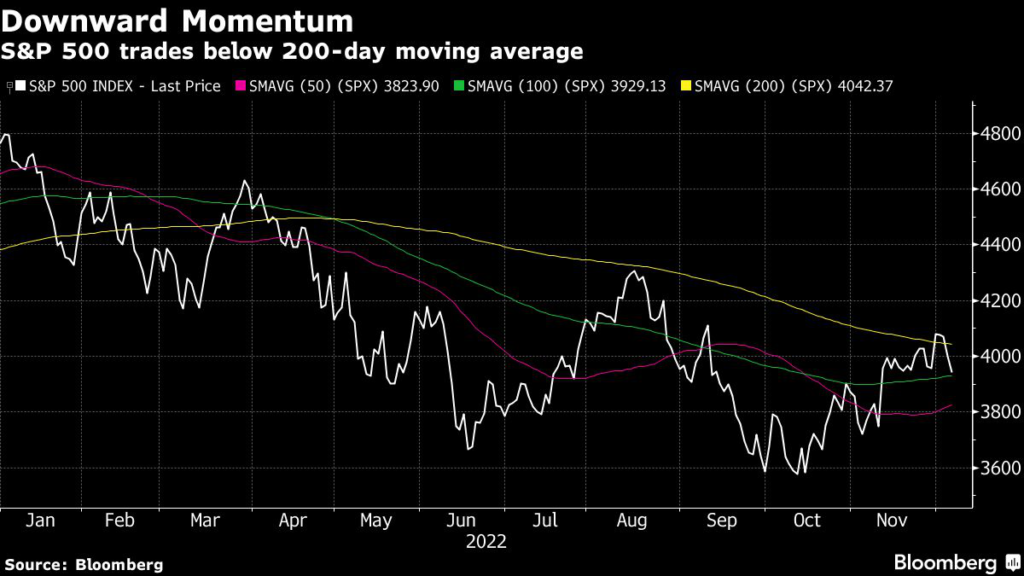
Those concerns are keeping the tug of war between equity bulls and bear in full force, with the latter having the upper hand. The S&P 500 this week breached a key uptrend line from its October lows, a sign that stocks still face more obstacles before there’s confirmation this year’s downtrend is broken.

To Savita Subramanian at Bank of America Corp., investors should stay invested in stocks despite growing warnings that the S&P 500 may sink to new lows in the first half of next year.

“Not having exposure to stocks and sticking all your money in bonds and cash is a mistake at this point,” she said. “I do think that we are going to go down and then up. The problem is, that is an increasingly consensus view. So I think the bigger risk heading into the first half is actually not being invested in equities.”

Also keeping a lid on risk assets Wednesday were comments from President Vladimir Putin, who warned that the threat of nuclear war in the world is rising, reiterating that Russia will defend itself and its allies “with all means if necessary.”

Key events this week:

  • ECB President Christine Lagarde speaks, Thursday
  • US initial jobless claims, Thursday
  • US PPI, wholesale inventories, University of Michigan consumer sentiment, Friday

Some of the main moves in markets:

Stocks

  • The S&P 500 fell 0.2% as of 4 p.m. New York time
  • The Nasdaq 100 fell 0.5%
  • The Dow Jones Industrial Average was little changed
  • The MSCI World index fell 0.4%

Currencies

  • The Bloomberg Dollar Spot Index fell 0.3%
  • The euro rose 0.4% to $1.0511
  • The British pound rose 0.7% to $1.2212
  • The Japanese yen rose 0.4% to 136.44 per dollar

Cryptocurrencies

  • Bitcoin fell 1% to $16,829.49
  • Ether fell 1.9% to $1,232.13

Bonds

  • The yield on 10-year Treasuries declined 12 basis points to 3.41%
  • Germany’s 10-year yield declined two basis points to 1.78%
  • Britain’s 10-year yield declined three basis points to 3.04%

Commodities

  • West Texas Intermediate crude fell 2.6% to $72.34 a barrel
  • Gold futures rose 1% to $1,799.90 an ounce

This story was produced with the assistance of Bloomberg Automation.

More stories like this are available on bloomberg.com

©2022 Bloomberg L.P.

Australia Central Bank Is Keeping Open Mind on Digital Currency

(Bloomberg) — Australia is keeping an open mind on a central bank digital currency, a senior Reserve Bank official said, while adding it remains to be convinced there’s a case for one in a country with easy financial and cash access. 

RBA Assistant Governor Brad Jones laid out the pros and cons of a CBDC in a speech in Sydney on Thursday, saying a digital currency could enhance the resilience of the money and payment systems, particularly as disruptions from extreme weather events become more common. 

“And cyber-induced disruptions represent a universal risk from which Australia is not immune,” he said.

Australia’s eastern seaboard has been hit by wild storms and flooding this year and climate scientists warn these events will become more common in a rapidly warming world. The country also recently suffered two high-profile hacking attacks involving SingTel Optus Pty Ltd and Medibank Pvt Ltd.

Jones also highlighted the most significant concerns around CBDCs for Australian policy makers:

  • the potential to disrupt bank intermediation and monetary policy transmission in normal times; and
  • the potential to give rise to bank runs in stressed conditions

He pointed out that 60% of Australia’s banking system funding is from low-cost deposits, saying there is a risk of a CBDC becoming the preferred source of liquidity holdings for households in normal times. 

While the threat is not unique to Australia, Jones said, such an outcome would disrupt monetary policy transmission and could damp banks’ ability to lend and build capital buffers. 

“The bottom line here is that much will depend on CBDC design choices, and there are many complex issues that would need to be carefully weighed ahead of any decision to proceed with issuing a CBDC,” Jones said. 

More stories like this are available on bloomberg.com

©2022 Bloomberg L.P.

Close Bitnami banner
Bitnami
