
Bloomberg

US Futures Slip as China Tension Boosts Havens: Markets Wrap

(Bloomberg) — US equity futures slid Tuesday amid escalating US-China tension over Taiwan and deepening worries about a global economic slowdown, driving investors into the safety of government bonds.

Nasdaq 100 contracts slumped 0.7% and those on the S&P 500 also fell as July’s equity market rebound stumbled into August. Stocks in Europe dipped, and equity markets in China and Hong Kong were the worst performers in Asia as security analysts outlined potential military responses from Beijing.

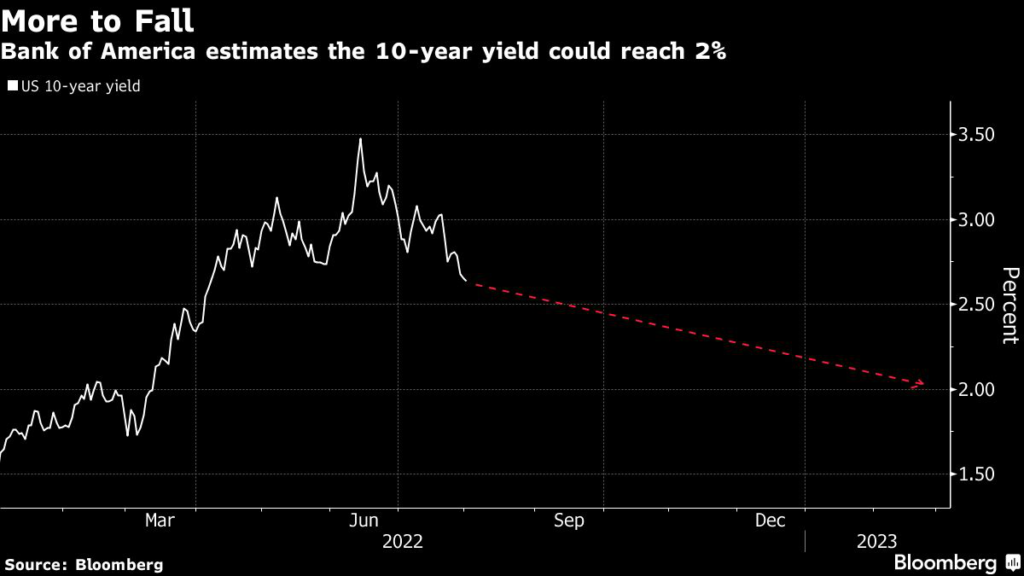
US Treasury 10-year yields dropped for a fifth day and approached 2.5%, a level last seen in April, while the Japanese currency advanced to the strongest level in two months.

US House Speaker Nancy Pelosi is set to land in Taiwan on Tuesday and would be the highest-ranking American politician to visit in 25 years. China views the island as its territory and has vowed an unspecified military response to any Pelosi visit.

“Investors are likely to wait and see how all these data and geopolitical developments will play out before adjusting their portfolio,” said Pierre Veyret, a technical analyst at ActivTrades. “Today’s price action can also be seen as a technical correction, with markets establishing a new floor level following the recent break-out of major resistances.”

Pelosi’s trip is creating a fresh pressure point for investors already dealing with the prospects of a US recession, worldwide rate hikes and inflation that risks becoming entrenched as Russia’s war in Ukraine exacerbates food shortages.  

“Over the long run we fear that a Taiwan war is more likely than not” according to Matt Gertken, chief geopolitical strategist at BCA Research Inc. He recommends government bonds over equities, US defensive sectors and haven assets.

China, which regards Taiwan as part of its territory, has vowed an unspecified military response to any Pelosi visit that risks sparking a crisis between the world’s biggest economies. Pelosi is expected to arrive at 10:20 p.m. local time via private plane at Songshan Airport, according to the Liberty Times, one of several media outlets linked to Taiwan’s ruling party. 

Investors are also keeping a wary eye out for more potentially hawkish comments from Federal Reserve officials about the need for higher interest rates to restrain elevated inflation. Expectations for how aggressive the Fed must be have receded because of recession risk, so any shift in those perceptions could stoke market volatility.

Goldman Sachs Group Inc. strategists led by Cecilia Mariotti said it was too soon for stock markets to fade the risks of a recession on expectations of a pivot in the Fed’s hawkish policy. JPMorgan Chase & Co. strategists, on the other hand, said the outlook for US stocks is improving for the second half of the year on attractive valuations and as the peak in investor hawkishness has likely passed.

The prospect of a demand slowdown has sapped oil, leaving it around $94 a barrel. Oilseed and grain futures fell after the first grain ship since Russia’s invasion left Ukraine, heralding some relief for a tight global food market.

This week’s MLIV Pulse survey is asking about your outlook for corporate bonds, mergers and acquisitions and health of US corporate balance sheets through the end of the year. It takes one minute to participate in the MLIV Pulse survey, so please click here to get involved anonymously. 

What to watch this week:

  • US JOLTS job openings, Tuesday
  • Chicago Fed President Charles Evans, St. Louis Fed President James Bullard due to speak at separate events, Tuesday
  • OPEC+ meeting on output, Wednesday
  • US factory orders, durable goods, ISM services, Wednesday
  • BOE rate decision, Thursday
  • US initial jobless claims, trade, Thursday
  • Cleveland Fed President Loretta Mester due to speak, Thursday
  • US employment report for July, Friday

Some of the main moves in markets:

Stocks

  • Futures on the S&P 500 fell 0.6% as of 8:31 a.m. New York time
  • Futures on the Nasdaq 100 fell 0.7%
  • Futures on the Dow Jones Industrial Average fell 0.5%
  • The Stoxx Europe 600 fell 0.5%
  • The MSCI World index fell 0.4%

Currencies

  • The Bloomberg Dollar Spot Index rose 0.2%
  • The euro fell 0.4% to $1.0217
  • The British pound fell 0.3% to $1.2215
  • The Japanese yen rose 0.7% to 130.74 per dollar

Bonds

  • The yield on 10-year Treasuries declined five basis points to 2.52%
  • Germany’s 10-year yield declined eight basis points to 0.70%
  • Britain’s 10-year yield declined 10 basis points to 1.71%

Commodities

  • West Texas Intermediate crude rose 0.6% to $94.49 a barrel
  • Gold futures rose 0.6% to $1,797.90 an ounce

More stories like this are available on bloomberg.com

©2022 Bloomberg L.P.
Uber Soars After Beating Estimates as Ridership Defies Inflation

(Bloomberg) — Uber Technologies Inc. reported revenue that beat analysts’ estimates, boosted by resilient demand from customers who continued to hail rides and order takeout food despite rising inflation. Shares jumped about 14% in early trading.

Revenue more than doubled to $8.1 billion in the second quarter, the company said Tuesday in a statement. That beat the $7.4 billion average projection from analysts, according to data compiled by Bloomberg. 

“Last quarter I challenged our team to meet our profitability commitments even faster than planned — and they delivered,” Chief Executive Officer Dara Khosrowshahi said in the statement. 

In the three months ended June 30, Uber reported gross bookings, which encompass ride hailing, food delivery and freight, increased 33% to an all-time high of $29.1 billion. Adjusted earnings before interest, tax, depreciation and amortization rose $873 million to $364 million, far exceeding expectations. 

Uber reported 122 million people used the platform monthly, surpassing the 120.5 million analysts expected. Khosrowshahi said the number of consumers and earners using Uber are both now at a record.

Uber and gig-economy peers like Lyft Inc. and DoorDash Inc. are confronting inflation levels that are the highest in four decades and the specter of an economic downturn that could damp demand, just as it was starting to recover after the rocky months of Covid shutdowns. At the same time, aggressive interest rate increases by the Federal Reserve have made unprofitable companies like these very much out of favor with investors.

Uber shares declined 43% this year through Monday’s close, while Lyft has lost 67% of its value. Lyft reports results on Thursday.

Khosrowshahi said in May the company is “recession resistant,” but it has still taken steps to keep costs in check, by treating “hiring as a privilege.” Lyft also said it plans to significantly slow hiring and cut expenses. 

Uber, which has struggled with a persistent shortage of drivers over the past year, has gradually decreased the extra spending on bonuses and incentives it was forced to offer to lure people back. Instead, the company has focused on improving its app by unlocking drivers’ ability to see a fare and a passenger’s destination. The imbalance between drivers and passengers has led to longer wait times and higher fares for customers. Rising fuel prices have led drivers to cut down on the number of hours they are on the road.

The company saw an acceleration in active and new driver growth, Khosrowshashi said on a conference call on Tuesday, adding that its global driver and courier base grew 31% from last year to almost 5 million.

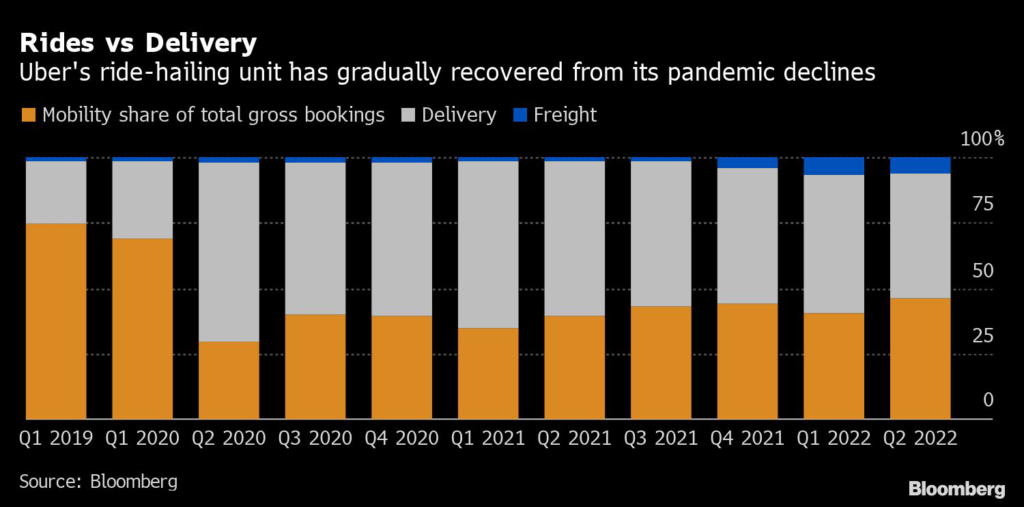
A key advantage against rival Lyft is Uber’s food-delivery business Uber Eats, which boomed during the pandemic just as ride-hailing demand cratered. Uber’s delivery arm, including restaurant, grocery items and alcohol, saw bookings increase 7% from a year ago to $13.9 billion. That missed the $14.4 billion analysts were expecting. Khosrowshahi cautioned that delivery bookings are expected to be “roughly flat” in the current period compared to the second quarter. Still, Uber is making more money from delivery than ever, in part because of contributions from its higher-margin advertising business.

Uber projected gross bookings of $29 billion to $30 billion in the third quarter and adjusted earnings before interest, tax, depreciation and amortization of $440 million to $470 million. That beat expectations of $391.6 million. 

In the second quarter, Uber recorded a net loss of $2.6 billion, or $1.33 a share, due to unrealized losses from stakes in Grab Holdings Ltd., Aurora Innovation Inc and Zomato Ltd. 

(Updates with CEO comments starting in 10th paragraph.)

More stories like this are available on bloomberg.com

©2022 Bloomberg L.P.

VW Orders $4 Billion Worth of Sensors From Israel’s Innoviz

(Bloomberg) — Volkswagen AG ordered $4 billion worth of lidar from Innoviz Technologies Ltd., sending the Israeli sensor supplier’s shares soaring in early trading.

The deal with VW’s software unit Cariad boosts Innoviz’s total future orders to $6.6 billion, and there’s potential for the amount to grow if the company ends up supplying to more VW group brands, Chief Executive Officer Omer Keilaf said in an interview. Innoviz shares surged as much as 46% to $5.83 before the start of regular trading Tuesday.

Innoviz, which also has a lidar agreement with BMW AG, will supply the sensors and integrate the software that makes them operate in VW’s vehicles. That’s a step up for Innoviz, which in the past relied on Magna International Inc. to embed its technology.

“Doing that vertical integration removes a lot of pressure for us, because we are able to reduce the pricing while still keeping a very nice margin for us,” Keilaf said.

Lidar — laser-based sensors that help vehicles detect their surroundings — are among the most expensive components that enable advanced driver-assistance features and autonomous driving systems. The slower-than-expected rollout of robotaxis has led a wave of lidar startups that have gone public to focus on selling carmakers hardware and software for features such as hands-free driving on highways.

Related: With Robotaxis Still a Distant Dream, Lidar Makes Itself Useful

Innoviz, which went public via a reverse merger last year, is hiring a third-party contractor to manufacture the lidar sensors, Keilaf said, declining to disclose the name of the company.

VW established Cariad in 2020 to consolidate its software efforts. The unit is working with Robert Bosch GmbH to bring hands-free driving functions to the carmaker’s fleet starting in 2023. VW swapped out its Chief Executive Officer Herbert Diess last month after software issues delayed important models.

(Updates with early trading in the first deck headline and first paragraph.)

More stories like this are available on bloomberg.com

©2022 Bloomberg L.P.
Gates-Led Fund Backs Robots to Automate Solar Panel Installation

(Bloomberg) — A Berkeley, California startup that automates solar panel installation has raised $44 million in a funding round co-led by Bill Gates’ Breakthrough Energy Ventures.

Terabase Energy has already developed software to design solar panels and improve their efficiency in changing weather conditions. It plans to use the new funding to scale up its system for mass installation, aiming to reduce the cost of developing utility-scale solar projects.

While there are existing methods to automate or digitize separate steps of solar construction and deployment, Matt Campbell, co-founder and chief executive officer of Terabase, says that the company automates the whole process. “The solar industry has come a long way, but the process by which projects are designed is largely manual,” Campbell said in an interview. Prelude Ventures co-led the funding round, and SJF Ventures also participated, bringing the total amount of capital raised to $52 million. 

The company finished its first commercial deployment of robots to install solar panels two weeks ago for a 400 megawatt project in central Texas, where robots installed 10 megawatts. “It’s a big stepping stone towards the future,” Campbell said. “Next year, we’re going to be scaling it to the hundreds of megawatts.” 

Terabase typically sets up a pop-up factory in the middle of a worksite. There, every 20 seconds, robotic arms attach solar panels that weigh almost a hundred pounds to a solar tracker, a steel structure that rotates panels to face the sun. The structure is then delivered to the solar array using special vehicles — these are not automated, but the company is developing an autonomous version, Campbell said. Automation can also help with the problem of finding workers willing to toil under the harsh sun, something that was an issue even before the unemployment rate fell so low, said Carmichael Roberts, who co-leads the investment committee at Breakthrough Energy Ventures.

“People don’t want those jobs, so we’ve got a bottleneck where it hurts our ability to deploy systems fast enough,” he said in an interview. “What you need is a way of leveraging automation.” 

More stories like this are available on bloomberg.com

©2022 Bloomberg L.P.
Crypto Firm Nomad Loses Nearly $200 Million in Bridge Hack

(Bloomberg) — Nomad, a bridge protocol for transferring crypto tokens across different blockchains, lost close to $200 million in a security exploit on Monday, according to security firm PeckShield Inc. 

The software system was drained of funds over hours and in small batches by various accounts, blockchain data shows. 

“An investigation is ongoing and leading firms for blockchain intelligence and forensics have been retained,” the company said in a statement. “Nomad’s goal is to identify the accounts involved and to trace and recover the funds.”

The attack makes Nomad the latest bridge to suffer an exploit this year. Bridges are software that enable different types of blockchains and their respective tokens to interoperate, rather than work in silos.

They have become frequent victims of hacks in recent years, with more than $1 billion stolen from bridges in 2022, according to a June report by forensics firm Elliptic. 

To convert one type of coin into another, a bridge service will typically “wrap” a cryptocurrency so that it can operate on another blockchain. The bridge will need to hold reserves to back the wrapped coins, creating a huge pool of tokens for hackers to target.

The complexity of bridge software can lead to errors and make them vulnerable for exploitation, said Mudit Gupta, chief information security officer at Polygon. Since bridges control huge amounts of assets, it also makes them an attractive target for hackers, he said.

Axie Infinity’s Ronin bridge lost about $600 million in March and Harmony’s Horizon was drained of $100 million in June. 

The hack comes days after Nomad, which describes itself as a “security-first” cross-chain messaging protocol, announced the full list of investors in its $22 million seed round led by Polychain Capital. Other backers include Ethereal Ventures, Hack VC, Coinbase Ventures and Crypto.com Capital.

Nomad’s protocol had a software bug that allowed users to withdraw more assets than were deposited in the bridge, said Elliptic Co-founder Tom Robinson.

“After the initial hack, upwards of 40 other exploiters – comprising MEV bots, flashbots, and independent exploiters – replicated the attack in a manner that quickly drained the bridge,” Robinson said.

One of the exploiters on Nomad was also involved in the $80 million hack from Rari Capital’s Fuse platform from April, according to PeckShield. 

(Adds context on bridge software in seventh paragraph.)

More stories like this are available on bloomberg.com

©2022 Bloomberg L.P.

Climate Bill Would Put US Back in Global Race for EV Leadership

(Bloomberg) —

This week, everyone working on energy and climate issues in the US is intensely focused on the Inflation Reduction Act, looking for smoke signals as to whether it will pass and if any modifications will be made.

The bill is a potential boon to many sectors of the green economy, including electric vehicles. Here are my team’s takeaways on some of the important EV-related aspects of the bill:

Tax Credit Extension

The revival of the $7,500 tax credit is a big deal, especially for Tesla, General Motors and Toyota. All three have sold at least 200,000 vehicles that were eligible for the incentive as the system is set up now. Once manufacturers cross that threshold, buyers of their cars start to receive reduced credits, and eventually none at all. Ford and Nissan are nearing this point, as well.

The bill would make the full incentive available again starting next year, and importantly, would allow consumers to access the perk at the point of sale instead of during tax season.

Automakers that have had sold fewer EVs might, in theory, be upset to see the 200,000-vehicle cap lifted, since it was bound to give them an advantage in the near term. But in practice, most should be happy to see the additional purchase support, since fuel economy regulations are set to tighten in the years ahead. This change will make it much easier to sell EVs and hit their targets.

While tax credits are important, it’s worth noting that Tesla buyers haven’t been eligible for federal tax credits for well over two years, and that hasn’t stopped the company from dominating the EV segment by accounting for more than 70% of battery-electric models sold in the US last year. Making products that consumers actually want is still more important than making products that qualify for tax credits.

Content Requirements

As my Bloomberg News colleagues have pointed out, the requirement that battery materials are sourced locally could be challenging for carmakers to navigate. There’s also a requirement that a share of other components are manufactured in North America.

In auto board rooms across the country this week, there are likely requests flowing down the organization and out to suppliers to determine which models will qualify and how quickly sourcing can be localized. BNEF’s analysis indicates mid-stream refining capacity for battery metals is more likely to be an issue than raw material supply.

A Boost for Commercial EVs

New commercial EV provisions allow vehicles weighing less than 14,000 pounds to claim the $7,500 clean car tax credit. Heavier vehicles can have the lesser of two amounts: 30% of the differential between the clean vehicle and a comparable internal combustion engine vehicle, or a $40,000 incentive.

This would fully cover the cost of a 150 to 250 kilowatt-hour battery pack today, and will do more in the future as prices come down. It would be an immediate and significant boost to the nascent commercial EV market in the US, which lags Europe and China in most segments.

The bill also includes $3 billion to help the US Postal Service decarbonize its fleet and shift to EVs. The Postal Service recently announced it was increasing the portion of its initial 50,000 mail-truck purchase from Wisconsin-based Oshkosh that will be electric to 50%, a major win for activists who fought against the initial decision to go almost exclusively with combustion vehicles.

Loan Programs

The package also includes $2 billion to help automakers retool and convert existing facilities to manufacture clean vehicles, and allows for as much as $20 billion in loans to help auto companies build new clean-vehicle facilities across the country. Ford, GM and Stellantis are likely to benefit from the conversion portion going into a contract-bargaining year with the United Auto Workers union. EV manufacturing in the US is already ramping up quickly, and this provision — which has largely flown under the radar — will further accelerate progress.

Importantly, many plants being built or retooled for EVs are in Republican states. For example, VW invested $800 million in its plant in Chattanooga, Tennessee, and just announced last week it has started producing the first ID.4 electric sport utility vehicles there. Having a strong EV manufacturing base in red states should help prevent EVs from being a political football as the next federal election cycle rolls around.

Outlook

A sense of scale is important here. The bill would extend EV tax credit availability out to 2032. Over that period, BNEF expects around 175 million light-duty vehicles will be sold in the US. As it stands now, a sizable and growing portion of those will be eligible for a tax credit.

There’s lots more to process — BNEF clients can access our full initial take here — but my initial feeling is that the bill, coupled with the stricter fuel-economy regulations the Biden administration is putting in place, should put the US right back in the race for EV leadership. China is off to a very strong head start, but these are still early days. Don’t count the US out.

More stories like this are available on bloomberg.com

©2022 Bloomberg L.P.

EA Seals Sponsorship Pact for Spain Football League

(Bloomberg) — Electronic Arts Inc. sealed an accord with LaLiga to sponsor Spain’s top football league, replacing Banco Santander SA, the country’s biggest bank.

Under the agreement, LaLiga competitions will carry the Californian firm’s EA SPORTS FC game brand, according to a statement from the two parties. Financial terms and the exact duration of the deal, which takes effect from the 2023-2024 season, weren’t disclosed. 

The partnership will allow the game publisher to link its well-known sports gaming franchise to one of Europe’s most prestigious football competitions featuring stars of the sport including Real Madrid’s Karim Benzema and FC Barcelona’s new signing Robert Lewandowski.

“LaLiga is incredibly important as we start and accelerate our football platform worldwide,” said David Jackson, VP of brand of EA SPORTS FC. “We have ambitions to grow our platform and engage millions and millions of fans all over the world.”

The new agreement will build on a relationship already in place between the two parties that was extended for 10 years in 2020 with EA as LaLiga’s official video-game partner.

Game Franchise

For EA, the Spanish sponsorship deal comes after it failed in May to reach a new licensing deal with FIFA to keep branding its football video-game franchise with the name of the sport’s world governing body.

LaLiga and Santander announced last month their decision to end their sponsorship arrangement, which began in the 2016/2017 season. 

LaLiga struck a 2 billion-euro ($2.1 billion) deal with CVC Capital Partners in December to invest in a newly-created subsidiary that gives it a share of broadcast revenue. 

The same month, Spanish phone company Telefonica SA and London-based streaming company DAZN Group Ltd. each won rights to broadcast about half of Spain’s top competition games for five years in an auction that valued the rights at 4.95 billion euros. In March, DAZN transferred broadcasting rights for the games to Telefonica in a deal valued at 1.4 billion euros. 

More stories like this are available on bloomberg.com

©2022 Bloomberg L.P.

Funding Disparity Widens for UK Female Fintech Founders in 2022

(Bloomberg) — Funding for UK female-driven fintechs dropped by two-thirds in the first half of this year compared with the same period last year, widening the gender investment gap in the male-dominated industry.

About $400 million was invested into fintechs founded or co-founded by women across 20 deals through June, according to an analysis compiled by Innovate Finance. That compares with $1.1 billion invested across 32 deals in the first half of 2021. The amount invested into UK fintechs founded by men rose 40% in the first six months of this year.

“Moving forward, we need to see less focus on mentorship and more checks being written,” said Nina Mohanty, founder of Bloom Money, a financial services app for migrants. “Women are over-mentored and under-funded; the lip service and glossy PR won’t cut it anymore.”

The disparity in financing for the year so far means investment in UK female-led fintechs make up only 4% of the total investments in UK fintechs — down from 15% in the first half of 2021.

The decline comes against a darkening economic backdrop. Some fintechs valuations are tumbling with soaring inflation, higher rates and looming recession pressures turning some investors off what they see as risky and potentially overpriced assets. 

Tough economic times are disproportionately bad news for female founders seeking funding, according to Anne Boden, founder of UK digital bank Starling and chair of a government-backed taskforce to boost women entrepreneurs.

“In boom times investors may be more willing to ‘take a chance’, as they see it, on investing in women entrepreneurs,” she said. “But when economic uncertainty arrives, they revert to type and turn off the taps to women-led businesses. Of course, they are wrong; there’s a growing body of evidence to suggest that enterprises with at least one woman leader, outperform the pack.”

The Innovate Finance fintech investment data, which includes accelerator, incubator, angel, seed, early and later stages venture capital, as well as private equity growth/expansion funding, is based on PitchBook data that specifically breaks down figures for female founders. 

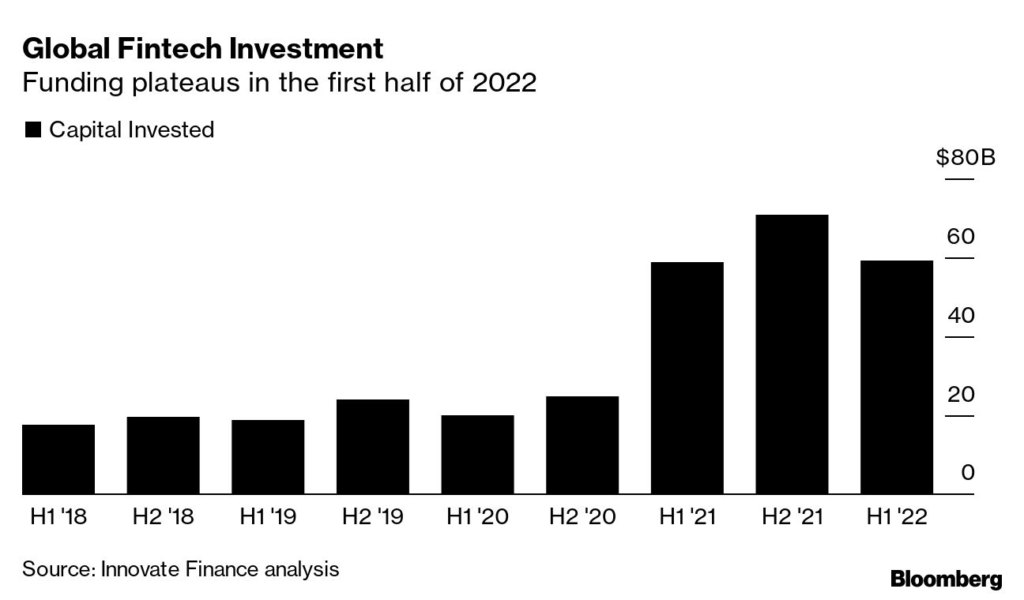
The drop in funding for the UK’s female fintech founders comes at a time when investment in UK fintech is bucking a decline in fundraising elsewhere. Total investment in fintechs globally was $59.2 billion in the first half of the year. Of this, the UK took in about $9.1 billion, a 24% year-on-year increase. In the US, fintech investments shrank by 10% to $25.1 billion.   

More stories like this are available on bloomberg.com

©2022 Bloomberg L.P.

World’s Most-Tracked Plane Is US Jet That May Be Carrying Pelosi

(Bloomberg) — The most-tracked aircraft in the world right now is a US Air Force jet that took off from Kuala Lumpur, as internet users seek to track US House Speaker Nancy Pelosi on a trip to Taiwan.

Almost 300,000 users are following every move of “SPAR19,” a US Air Force-operated Boeing C-40C, according to FlightRadar24. Taiwan’s Liberty Times newspaper had earlier reported that Pelosi is expected to arrive at 10:20 p.m. local time via private plane at Songshan airport in Taipei, which also hosts a military base.  

There is no official confirmation that Pelosi is on the plane. Her potential trip to Taiwan has infuriated Beijing, which views the island as its territory and has warned of consequences if the trip goes ahead.

FlightRadar24, a popular aircraft-tracking website, normally has several thousand users following aircraft of interest — including emergency incidents or inaugural flights.


The SPAR19 flight took off from Kuala Lumpur’s Subang Airport at approximately 3.40 p.m., but headed east toward Borneo island instead of northeast to Taiwan. 

The top 10 most-tracked flights in the world were going to Taiwan, according to FlightRadar24 data. The second most-tracked plane on Tuesday after SPAR19 was a China Airlines flight from Jakarta to Taipei, with almost 20,000 followers.

A representative for the flight tracking company couldn’t immediately respond to requests for comment.

Read this next: Putin’s War on Ukraine Shows Xi the Dangers of Attacking Taiwan

More stories like this are available on bloomberg.com

©2022 Bloomberg L.P.

Now Is Your Chance to Fix the Carbon Offset Market

(Bloomberg) —

Imagine a financial tool that solves three problems at once — it lowers greenhouse gases, rejuvenates forests and improves the lives of the poor. That’s the promise of carbon offsets, and it’s rarely been met.

Carbon offsets offer companies a cheap and easy way to buff their green credentials. In 2021, more than $1 billion worth of offsets were sold, and supporters want to grow the market 50-fold by the end of the decade. But that can only happen if offsets are seen as credible tender.

Last week, the Integrity Council for the Voluntary Carbon Market (ICVCM) released long-awaited guidance intended to clean up the unregulated market. It’s now seeking the public’s views to ensure offsets can live up to their true potential. You have until Sept. 27 to be heard.

It won’t be easy. The watchdog is walking a fine line “between ambition and staying relevant,” said Gilles Dufrasne, policy officer at Carbon Market Watch and a member of ICVCM’s expert panel. If strict criteria were applied, “no single carbon credit” would meet the Core Carbon Principles (CCPs) that the ICVCM has published.

The ICVCM’s ten principles each address a point of contention, from accounting concerns to longevity and transparency. Their launch has been stymied by false starts, as participants argued over the criteria for inclusion and how high to set the bar.

An offset is a promissory note that, in theory, represents a ton of carbon dioxide emissions removed, or not added, to the atmosphere in return for a payment. Companies often use them to scrub emissions off their carbon ledgers.

Since the first offset project was created in 1988 in a Guatemalan forest to compensate for emissions from a US coal power plant, offsets have been derived from hundreds of different project types — from wind farms to the destruction of refrigerants. The Paris Agreement in 2015 made them even more popular. You can find them on everything from an exchange-traded fund to an investment hedge. Some underpin cryptocurrencies. Others are used to make speculative bets.

The experimentation has led to market abuses. Major companies have claimed offsets based on forests that were at no risk of deforestation. Crypto initiatives aimed at absorbing bad offsets have ended up creating more bad offsets. The goal of transferring wealth to poor countries has instead helped middlemen in rich countries keep most of the spoils.

The CCPs are designed to tackle these issues, but there are worrisome gaps.

ICVCM takes no clear stance on one of the hottest points of contention in voluntary carbon markets today: how to prevent entities using the same offset twice, or what’s known as double counting. While United Nations rules will prevent two countries using the same units, there’s nothing to prevent a country and a company doubling up; the Council plans to do little about this.

“It’s disappointing to see yet another organization punting the issue of whether or not companies can offset their emissions with reductions already being counted by countries,” said Dufrasne.

Nor will ICVCM regulate who can make claims based on approved credits, deferring instead to a sister initiative, VCMI, which faces its own set of limitations. In effect, this means “one can use an ICVCM-approved credit for a purpose expressly rejected by the ICVCM,” said Danny Cullenward, policy director at US-based nonprofit CarbonPlan.

Even before the guidance was released, some offset trading platforms were promoting CCP-aligned products. “We will exercise our power to name and shame,” ICVCM chair Annette Nazareth said in April, in response to questions. The watchdog hasn’t yet named any entity for misusing the label.

The guidance also doesn’t make it easy to assess whether an offset is really achieving its purpose, experts say.

A key test is a concept called additionality — did the project contribute to reducing emissions specifically because of the money that the offsets provided? This measure is easy to fudge — and hard to verify — because the offset creator and other parties have varying levels of information available to them, the council itself writes. It’s currently unclear how ICVCM will handle this issue, said Cullenward, highlighting the risk that it’ll rely on old and largely discredited methods.

Another test is about permanence — can the offset outlive the effects of CO2 emissions, which typically linger in the atmosphere for hundreds of years? The timeframes are simply unfeasible, according to Dufrasne.  For example, no one can reasonably promise that trees in a forestry offsets project won’t be burned down in the next 100 years, even though they’ll need to be around longer than that to have the impact needed.

That’s why many participants would prefer the offsets market to be regulated instead of voluntary. “The best place for [these rules] is governments,” said ICVCM’s Nazareth, a former commissioner at the US Securities and Exchange Commission. But until governments step up, “we’re doing our level best to mimic what a government authority could do here.”

More stories like this are available on bloomberg.com

©2022 Bloomberg L.P.

Close Bitnami banner
Bitnami