Bloomberg

Amazon Says Its Planet-Warming Carbon Emissions Grew 18% in 2021

(Bloomberg) — Amazon.com Inc. said its carbon footprint grew 18% in 2021, as the company’s rapid growth during the pandemic overwhelmed nascent efforts to cut its contribution to the emissions warming the planet.

The world’s largest online retailer emitted 71.54 million metric tons of carbon-dioxide equivalent last year, Amazon disclosed on Monday in an updated edition of its sustainability report. That’s up about 40% since the company first disclosed the figure, with data from 2019. 

Amazon’s carbon intensity –- a measure that divides its emissions by gross merchandise sales –- fell 1.9%, an indication of the company’s success in delivering products and running its warehouses, data centers and offices more efficiently.

Amazon aims to become a “net zero” emitter of greenhouse gases by 2040. Besides cutting emissions with electric vehicles and other operational initiatives, Amazon plans to buy credits linked to projects that remove carbon from the atmosphere. The net-zero pledge presents a huge challenge for a company that seeks to grow like a startup and operates a cargo airline, a sprawling retail and logistics business, grocery stores and data centers. 

Amazon’s accounting of its carbon footprint includes emissions generated by its own offices and data centers, purchased electricity, tailpipe emissions from delivery partners and the manufacturing of Amazon-branded products, among other things. In contrast to some retailers, the Seattle company doesn’t attempt to account for the emissions that go into the manufacture of products it sells, with the exception of private-label merchandise. 

“The challenges we collectively face on the path to net-zero carbon are considerable,” Amazon said in its report. “Many new technologies are showing promise in their ability to reduce carbon emissions, but may still require significant development.”

More stories like this are available on bloomberg.com

©2022 Bloomberg L.P.

Nikola Buys Romeo Power for 11% of Battery Maker’s SPAC Valuation

(Bloomberg) — Nikola Corp. will acquire Romeo Power Inc. for a sliver of what the battery maker was worth when it merged with a special purpose acquisition company less than two years ago.

The all-stock transaction between two manufacturers that went public via blank-check deals in 2020 values Romeo Power at about $144 million, according to a statement Monday. That’s only about 11% of the roughly $1.33 billion value at which California-based Romeo Power agreed to merge with a SPAC.

Nikola and Romeo Power were among the litany of companies with little or no meaningful revenue to take advantage of a hot market for mergers that offer an alternative to initial public offerings and the ability to entice investors with forward-looking statements. Many of these companies have struggled to meet forecasts they made before combining with SPACs, which has sent share prices plummeting and drawn attention from securities regulators.

Read more: The SPAC era comes to a whimpering end

Romeo Power shares jumped as much as 30% to 72 cents on Monday in New York trading, while Nikola stock climbed as much as 5.1% to $6.54.

Nikola has sourced battery packs from Romeo Power for Tre electric trucks built in Germany by its partner Iveco Group NV, the commercial-vehicle maker spun off from CNH Industrial NV early this year. Nikola also recently started production at its own facility outside Phoenix, and Chief Executive Officer Mark Russell has said the company expects to deliver as many as 500 vehicles to customers this year.

Nikola is Romeo Power’s largest customer and has agreed to provide $35 million of interim funding to help its supplier keep operating until the deal closes. After ending the first quarter with just $41.3 million of cash, Romeo Power warned investors there was substantial doubt regarding its ability to continue as a going concern.

While Nikola is better positioned with more than $360 million of cash as of the end of March, it’s also looking for more money. The company has held, adjourned and rescheduled its annual meeting several times to allow investors additional chances to vote on a proposal to increase its number of shares of outstanding and raise capital. The next meeting is scheduled for Tuesday.

Related story: Nikola founder is said to block share sale

(Updates with background starting in the fifth paragraph.)

More stories like this are available on bloomberg.com

©2022 Bloomberg L.P.

Suspected North Koreans Steal Resumes, Seeking Crypto Jobs

(Bloomberg) — North Koreans are plagiarizing online resumes and pretending to be from other countries to get remote work at cryptocurrency firms to aid illicit money-raising efforts for the government, cybersecurity researchers say following a US warning on a similar scheme in May.

The fraudsters lift details they find on legitimate profiles on LinkedIn and Indeed for their resumes to get work at US cryptocurrency firms, according to security researchers at Mandiant Inc. One applicant identified by Mandiant on July 14 claimed to be an “innovative and strategic thinking professional” in the tech industry and an experienced software developer. “The world will see the great result from my hands,” the job seeker added in a cover letter.

Nearly identical language was found in another user’s profile.

The evidence detected by Mandiant reinforces allegations made by the US government in May. The US warned that North Korean IT workers are trying to obtain freelance employment abroad while posing as non-North Korean nationals, in part to raise money for government weapons development programs. The IT workers claim to have the kinds of skills necessary for complex work like mobile app development, building virtual currency exchanges and mobile gaming, according to the US advisory.

The North Korean IT workers were primarily located in China and Russia, with a smaller number in Africa and Southeast Asia, according to the US. They also target freelance contracts in wealthier nations, including in North America and Europe, and in many cases, present themselves as being South Korean, Japanese or even US-based teleworkers, according to the US warning.

According to the Mandiant researchers, by collecting information from crypto companies, North Koreans can gather intelligence about upcoming cryptocurrency trends. Such data – about topics like Ethereum virtual currency, nonfungible tokens and potential security lapses – could give the North Korean government an edge in how to launder cryptocurrency in a way that helps Pyongyang avoid sanctions, said Joe Dobson, a principal analyst at Mandiant. 

“It comes down to insider threats,” he said. “If someone gets hired onto a crypto project, and they become a core developer, that allows them to influence things, whether for good or not.” 

The North Korean government has consistently denied involvement in any cyber-enabled theft.

Other suspected North Koreans have fabricated job qualifications, with some users claiming on job applications to have published a white paper about the Bibox digital currency exchange, while another posed as a senior software developer at a consultancy focused on blockchain technology.

Mandiant researchers said they had identified multiple suspected North Korean personas on employment sites that have successfully been hired as freelance employees. They declined to name the employers.

“These are North Koreans trying to get hired and get to a place where they can funnel money back to the regime,” said Michael Barnhart, a principal analyst at Mandiant. 

In addition, North Korean users, claiming to have programming skills, have posed questions on the coding site GitHub Inc., where software developers publicly discuss their findings, about larger trends in the cryptocurrency world, according to the Mandiant researchers.

North Korean IT workers “target freelance contracts from employers located in wealthier nations,” according to the US’s 16-page advisory released in May. In many instances, the North Korean workers present themselves as South Korean, Chinese, Japanese or Eastern European and US-based teleworkers, according to the US advisory.

In April, Jonathan Wu, an executive at Aztec Network, a blockchain company, described the experience of conducting a job interview with a possible North Korean hacker as leaving him “a little shaken.” “Terrifying, hilarious and a reminder to be paranoid and triple-check your OpSec practices,” he wrote, in a Twitter thread. Neither Wu nor the company responded to messages seeking comment.

In a related tactic, suspected North Korean hackers have replicated Indeed.com and used it to gather information on website visitors, according to Alphabet Inc.’s Google. By setting up websites that appear to be real, spies can dupe job-seekers into sending their resume, thus beginning a conversation that could enable hackers to breach their machine or steal their data, according Ryan Kalember, executive vice president at the email security firm Proofpoint Inc.

Other fake domains, created by suspected North Korean operators, impersonated ZipRecruiter, a Disney careers page and a site called Variety Jobs, according to Google.

“We see a torrent of this every day,” said Kalember. “Their ability to come up with convincing cover companies is getting better and better.”

In February, the security firm Qualys Inc. said it detected a phishing campaign in which the so-called Lazarus Group, a name that the US government sometimes uses to describe Pyongyang-backed hackers, targeted job applicants who applied for roles at Lockheed Martin Corp.

The hackers sent individual messages that appeared to be from Lockheed Martin, using email attachments that appeared to include information from the company but in fact contained malicious software. The ruse followed similar efforts in which attackers posed as BAE Systems Plc and Northrop Grumman Corp., according to Qualys.

“If you look at the job listings, they’re appealing to people’s ego and the desire for money,” said Adam Meyers, senior vice president of intelligence at CrowdStrike Holdings Inc. “They’re capitalizing on that, but the fake job listings are an opening gambit for their broader cyberattacks and espionage.”

North Korea’s focus on stealing cryptocurrency comes after the country’s hackers spent years stealing money from the global financial system, Mandiant researchers said. After a notorious 2016 heist on Bangladesh Bank, where the US accused North Korean thieves of trying to steal close to $1 billion, global banks added safeguards meant to stop such breaches.

“The market has changed where banks are more secure, and cryptocurrency is a totally new market,” Dobson said. “We’ve seen them go after end-users, crypto exchanges and now the crypto bridges.”

(Updated throughout to include additional detail.)

More stories like this are available on bloomberg.com

©2022 Bloomberg L.P.

North Koreans Steal LinkedIn Resumes in Crypto Job Search Scam

(Bloomberg) — North Koreans are plagiarizing online resumes and pretending to be from other countries to get remote work at cryptocurrency firms to aid illicit money-raising efforts for the government, cybersecurity researchers say following a US warning on a similar scheme in May.

The fraudsters lift details they find on legitimate profiles on LinkedIn and Indeed for their resumes to get work at US cryptocurrency firms, according to security researchers at Mandiant Inc. One applicant identified by Mandiant on July 14 claimed to be an “innovative and strategic thinking professional” in the tech industry and an experienced software developer. “The world will see the great result from my hands,” the job seeker added in a cover letter.

Nearly identical language was found in another user’s profile.

The evidence detected by Mandiant reinforces allegations made by the US government in May. The US warned that North Korean IT workers are trying to obtain freelance employment abroad while posing as non-North Korean nationals, in part to raise money for government weapons development programs. The IT workers claim to have the kinds of skills necessary for complex work like mobile app development, building virtual currency exchanges and mobile gaming, according to the US advisory.

The North Korean IT workers were primarily located in China and Russia, with a smaller number in Africa and Southeast Asia, according to the US. They also target freelance contracts in wealthier nations, including in North America and Europe, and in many cases, present themselves as being South Korean, Japanese or even US-based teleworkers, according to the US warning.

According to the Mandiant researchers, by collecting information from crypto companies, North Koreans can gather intelligence about upcoming cryptocurrency trends. Such data – about topics like Ethereum virtual currency, nonfungible tokens and potential security lapses – could give the North Korean government an edge in how to launder cryptocurrency in a way that helps Pyongyang avoid sanctions, said Joe Dobson, a principal analyst at Mandiant. 

“It comes down to insider threats,” he said. “If someone gets hired onto a crypto project, and they become a core developer, that allows them to influence things, whether for good or not.” 

The North Korean government has consistently denied involvement in any cyber-enabled theft.

Other suspected North Koreans have fabricated job qualifications, with some users claiming on job applications to have published a white paper about the Bibox digital currency exchange, while another posed as a senior software developer at a consultancy focused on blockchain technology.

Mandiant researchers said they had identified multiple suspected North Korean personas on employment sites that have successfully been hired as freelance employees. They declined to name the employers.

“These are North Koreans trying to get hired and get to a place where they can funnel money back to the regime,” said Michael Barnhart, a principal analyst at Mandiant. 

In addition, North Korean users, claiming to have programming skills, have posed questions on the coding site GitHub Inc., where software developers publicly discuss their findings, about larger trends in the cryptocurrency world, according to the Mandiant researchers.

North Korean IT workers “target freelance contracts from employers located in wealthier nations,” according to the US’s 16-page advisory released in May. In many instances, the North Korean workers present themselves as South Korean, Chinese, Japanese or Eastern European and US-based teleworkers, according to the US advisory.

In April, Jonathan Wu, an executive at Aztec Network, a blockchain company, described the experience of conducting a job interview with a possible North Korean hacker as leaving him “a little shaken.” “Terrifying, hilarious and a reminder to be paranoid and triple-check your OpSec practices,” he wrote, in a Twitter thread. Neither Wu nor the company responded to messages seeking comment.

In a related tactic, suspected North Korean hackers have replicated Indeed.com and used it to gather information on website visitors, according to Alphabet Inc.’s Google. By setting up websites that appear to be real, spies can dupe job-seekers into sending their resume, thus beginning a conversation that could enable hackers to breach their machine or steal their data, according Ryan Kalember, executive vice president at the email security firm Proofpoint Inc.

Other fake domains, created by suspected North Korean operators, impersonated ZipRecruiter, a Disney careers page and a site called Variety Jobs, according to Google.

“We see a torrent of this every day,” said Kalember. “Their ability to come up with convincing cover companies is getting better and better.”

In February, the security firm Qualys Inc. said it detected a phishing campaign in which the so-called Lazarus Group, a name that the US government sometimes uses to describe Pyongyang-backed hackers, targeted job applicants who applied for roles at Lockheed Martin Corp.

The hackers sent individual messages that appeared to be from Lockheed Martin, using email attachments that appeared to include information from the company but in fact contained malicious software. The ruse followed similar efforts in which attackers posed as BAE Systems Plc and Northrop Grumman Corp., according to Qualys.

“If you look at the job listings, they’re appealing to people’s ego and the desire for money,” said Adam Meyers, senior vice president of intelligence at CrowdStrike Holdings Inc. “They’re capitalizing on that, but the fake job listings are an opening gambit for their broader cyberattacks and espionage.”

North Korea’s focus on stealing cryptocurrency comes after the country’s hackers spent years stealing money from the global financial system, Mandiant researchers said. After a notorious 2016 heist on Bangladesh Bank, where the US accused North Korean thieves of trying to steal close to $1 billion, global banks added safeguards meant to stop such breaches.

“The market has changed where banks are more secure, and cryptocurrency is a totally new market,” Dobson said. “We’ve seen them go after end-users, crypto exchanges and now the crypto bridges.”

(Updated throughout to include additional detail.)

More stories like this are available on bloomberg.com

©2022 Bloomberg L.P.

Avatel Nears $1 Billion Deal for Spain Fiber Firm Lyntia

(Bloomberg) — Avatel Telecom is close to agreeing an acquisition of a local fiber-optic broadband operator in Spain from Antin Infrastructure Partners SA, people familiar with the matter said.

The Spanish carrier is putting the final touches on a 1 billion-euro ($1 billion) takeover of Lyntia Access, according to the people. A deal is expected to be completed in the fourth quarter, the people said, asking not to be identified discussing confidential information.

Specialist infrastructure and pensions funds have been piling into fiber broadband in search of stable, long-term returns. The trend has been especially acute in Spain, which has the biggest fiber network in Europe.

Discussions are ongoing and may still be delayed, the people said. Representatives for Avatel, Lyntia and Antin declined to comment. 

In the last 12 months, KKR & Co. struck a roughly 1 billion-euro deal for 49% of Reintel, the wholesale fiber operator owned by Spain’s Red Electrica Corp., and Ardian SAS bought another wholesale fiber firm, Adamo. Telefonica SA agreed last month to sell a 45% stake in a newly-created rural fiber unit called Bluevia. 

Like the Telefonica unit, Avatel is largely focused on areas with low population density. The purchase of Lyntia will allow Avatel, one of the biggest fiber operators in rural Spain, to enter the wholesale market.

Antin agreed earlier this year to sell Lyntia Networks, which serves corporate clients, to Axa IM Alts and Swiss Life Asset Managers for about 2 billion euros. Antin initially sought to offload the two Lyntia units together, before deciding to split them up to attract more interest. 

(Lyntia comment in fourth paragraph)

More stories like this are available on bloomberg.com

©2022 Bloomberg L.P.

Musk Sued by Twitter Investor Over Busted $44 Billion Deal

(Bloomberg Law) — A Twitter Inc. shareholder hit Elon Musk with a proposed class action, effectively joining the tech giant’s bid to block the world’s richest man from backing out of his pledge to pay $44 billion to acquire the influential social networking platform.

The lawsuit was filed in Delaware Chancery Court—the same forum that’s set to hold a fast-tracked trial in October of Twitter’s claims against Musk—by an investor who holds 5,500 Twitter shares. In addition to Musk, it names as defendants two “corporate acquisition entities” related to the deal.

The suit, docketed July 29, targets Musk’s “lame rationales for reneging on his contract,” accusing the billionaire of fabricating excuses to get out of the buyout. Like Twitter’s earlier suit, it seeks a court order compelling Musk to consummate the transaction.

Musk formally answered Twitter’s suit July 29 in a court filing that remains under seal.

Tesla Inc., the electric vehicle maker run by Musk, didn’t immediately respond Monday to a request for comment on his behalf. Tesla isn’t named as a defendant.

Investor Luigi Crispo’s allegations echo Twitter’s claim that Musk is exploiting phony concerns about spam and “bot” accounts as a bogus pretext for backing out of the deal without a valid legal basis.

Musk, meanwhile, says Twitter has breached its obligation to be truthful in deal-related disclosures by stating without proof that bots account for about 5% of its daily users.

Cause of Action: Breach of contract; breach of fiduciary duty.

Relief: Specific performance, damages, costs, fees, and interest.

Attorneys: The investor is represented by Prickett, Jones & Elliott PA and Scott & Scott Attorneys at Law LLP.

The case is Crispo v. Musk, Del. Ch., No. 2022-0666, 7/29/22.

To contact the reporter on this story: Mike Leonard in Washington at mleonard@bloomberglaw.com

To contact the editors responsible for this story: Rob Tricchinelli at rtricchinelli@bloomberglaw.com; Andrew Harris at aharris@bloomberglaw.com

(Updates with additional lawsuit details.)

More stories like this are available on bloomberg.com

©2022 Bloomberg L.P.

With $208 Billion Between Them, Asia Richest Men Face Off

(Bloomberg) — In June, Indian billionaire Mukesh Ambani and his aides ran into an unexpected dilemma when debating where to train the dealmaking lens of his empire next.

Ambani’s Reliance Industries Ltd. was contemplating buying a foreign telecommunications giant, when word reached them that Gautam Adani — who had overtaken Ambani as Asia’s richest man a few months earlier — was planning to bid in the first big sale of 5G airwaves in India, according to people familiar with the matter. 

Ambani’s Reliance Jio Infocomm Ltd. is the top player in India’s mobile market, while the Adani Group doesn’t even have a license to offer wireless telecommunications services. But the very idea that he might be circling ground so core to Ambani’s ambitions put the tycoon’s camp on high alert, according to the people, who asked not to be named discussing information that isn’t public. 

One set of aides advised Ambani to pursue the overseas target and diversify beyond the Indian market, while another counseled conserving funds to fend off any challenge on the home turf, according to people familiar with the discussions. 

Ambani, worth almost $90 billion, ultimately never bid for the foreign firm, partly, the people said, because he decided it would be more astute to retain financial firepower in case of a challenge from Adani, who has seen the world’s largest wealth gain this year — to $118.3 billion, based on data from the Bloomberg Billionaires Index.

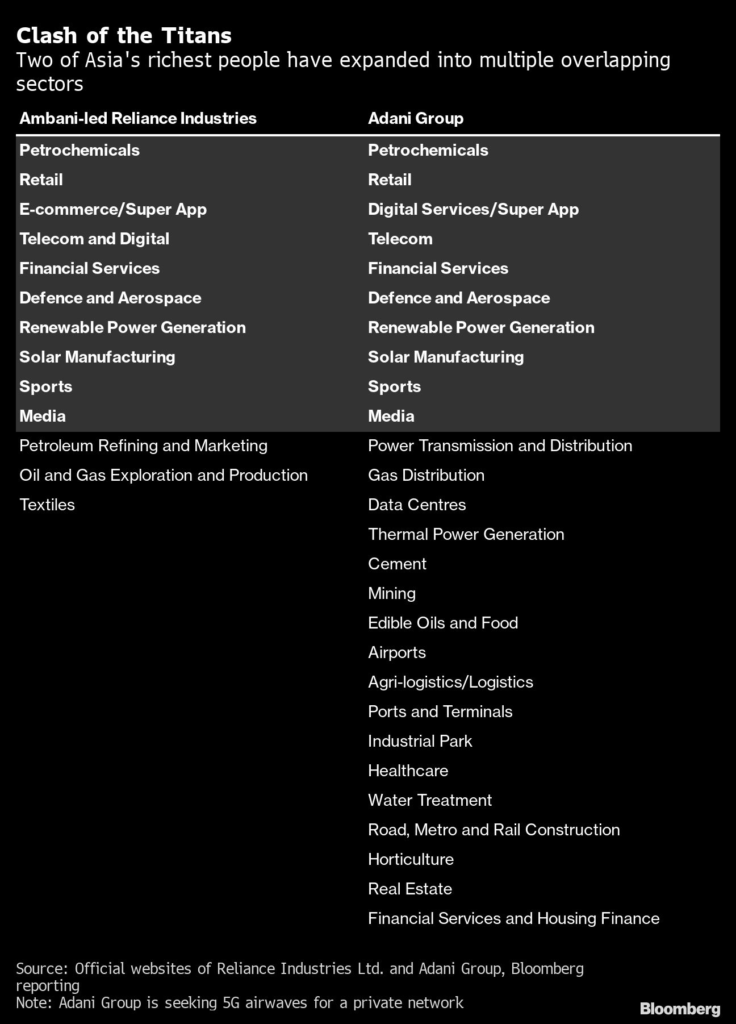
After peacefully expanding in their respective domains for over two decades, Asia’s two richest men are increasingly treading the same ground, as Adani in particular sets his sights beyond his traditional areas of focus. 

Billionaire Dynasties

That’s setting the stage for a clash with widening implications both beyond India’s borders, as well as at home as the $3.2 trillion economy embraces the digital era, triggering a race for riches beyond the commodity-led sectors where Ambani and Adani made their first fortunes. The opportunities emerging — from e-commerce, to data streaming and storage — are reminiscent of the US’s 19th century economic boom, which fueled the rise of billionaire dynasties like the Carnegies, Vanderbilts and Rockefellers. 

The two Indian families are similarly hungry for growth and that means they’re inevitably going to run into each other, said Arun Kejriwal, founder Mumbai investment advisory firm KRIS, who has been tracking the Indian market and the two billionaires for two decades. 

“Ambanis and Adanis will cooperate, co-exist and compete,” he said. “And finally, the fittest will thrive.”

Representatives from Adani’s and Ambani’s companies declined to comment for this story. 

In a public statement on July 9, the Adani Group said that it has no intention of entering the consumer mobile space currently dominated by Ambani, and will only use any airwaves purchased at the government auction to create “private network solutions,” and for enhancing cybersecurity at its airports and ports. 

Despite such commentary, speculation is rife that he might eventually venture into offering wireless services for consumers.

“I don’t underestimate a calculated entry by Adani into the consumer mobile space later to compete with Reliance Jio, if not now,” said Sankaran Manikutty, a former professor at the Indian Institute of Management in Ahmedabad, who remains a visiting faculty member there and has worked extensively on family businesses, telecommunications and strategy in emerging economies. 

Reliance Jio emerged the top buyer in India’s airwaves auctions that concluded Monday, spending a little more than $11 billion. Adani’s firm, in line with its earlier guidance, bought spectrum for just 2.12 billion rupees ($27 million), allaying fears at least for now of another disruption.


For decades, Adani’s business were focused on sectors like ports, coal mining and shipping, areas that Ambani stayed clear of amid its own heavy investments in oil. But over the past year, that’s changed dramatically. 

In March, the Adani Group was said to be exploring potential partnerships in Saudi Arabia, including the possibility of buying into its mammoth oil exporter, Aramco, Bloomberg News reported. A few months before that, Reliance — which still gets a majority of its revenue from businesses related to crude oil — scrapped a plan to sell a 20% stake in its energy unit to Aramco, gutting a transaction that was two years in the pipeline.

The two billionaires also have significant overlap in green energy, with each pledging to invest more than $70 billion in a space that’s heavily tied to the priorities of Indian Prime Minister Narendra Modi’s government. Meanwhile, Adani has begun signaling deep ambitions in digital services, sports, retail, petrochemicals and media. Ambani’s Reliance either already dominates these sectors or has big plans for for them.

In telecommunications, if Adani does start to target consumers in a big way, history suggests that prices could plunge amid the early phase of competition but rise again if the two companies secure a duopoly, with India’s wireless space currently dominated by three private players. When Ambani made his initial foray into telecoms in 2016, he offered free calls and very cheap data, an audacious move that saw costs across the board drop for consumers, but they are increasing again as he’s cemented his control.

On the surface the two men appear quite different. Ambani, 65, inherited Reliance from his father, while Adani, 60, is a self-made businessman. But they also have some remarkable similarities. 

Largely media shy, both men have a history of being fiercely competitive, disrupting most sectors they set foot in and then dominating them. Both have excellent project execution skills, are extremely detail oriented and dogged in pursuing business goals with a track record of delivering on big projects, analysts and executives who have worked with them say. 

Both hail from the western province of Gujarat, Modi’s home state. They have also both dovetailed their business strategies closely with the prime minister’s national priorities. 

Not all Adani’s dealmaking overlaps with Reliance, and he’s raced ahead with outlays on M&A even as Ambani has stayed cautious on spending heavily overseas amid the uncertain global outlook. Adani Group acquired the Haifa port in Israel in July for $1.2 billion. In May, he bought Holcim’s Indian cement units for $10.5 billion.

For now, most of Adani’s new forays are so nascent that the full impact is hard to immediately gauge. Yet analysts are in agreement that the two men are likely to play a big role in reshaping the Indian business landscape, potentially leaving increasingly vast portions of the economy in the hands of two families. 

That could have marked consequences in a nation that has only seen income disparity widen over the course of the pandemic. 

While India’s current economic advance is similar to America’s so-called Gilded Age in the 19th century, the South Asian country now faces risks of rising inequality, said Indira Hirway, director of the Centre For Development Alternatives in Ahmedabad.

“Rapid diversification and overlaps between them can lead to duopoly if they work together, hurting the smaller firms in these sectors,” Hirway said. “If they start competing, it can impact the equilibrium of the business landscape as both conglomerates will be fighting for resources and raw materials.”

(Updates with details of India 5G auction wins in the 14-th paragraph.)

More stories like this are available on bloomberg.com

©2022 Bloomberg L.P.

With $208 Billion Between Them, Asia’s Richest Men Face Off

(Bloomberg) — In June, Indian billionaire Mukesh Ambani and his aides ran into an unexpected dilemma when debating where to train the dealmaking lens of his empire next.

Ambani’s Reliance Industries Ltd. was contemplating buying a foreign telecommunications giant, when word reached them that Gautam Adani — who had overtaken Ambani as Asia’s richest man a few months earlier — was planning to bid in the first big sale of 5G airwaves in India, according to people familiar with the matter. 

Ambani’s Reliance Jio Infocomm Ltd. is the top player in India’s mobile market, while the Adani Group doesn’t even have a license to offer wireless telecommunications services. But the very idea that he might be circling ground so core to Ambani’s ambitions put the tycoon’s camp on high alert, according to the people, who asked not to be named discussing information that isn’t public. 

One set of aides advised Ambani to pursue the overseas target and diversify beyond the Indian market, while another counseled conserving funds to fend off any challenge on the home turf, according to people familiar with the discussions. 

Ambani, worth almost $90 billion, ultimately never bid for the foreign firm, partly, the people said, because he decided it would be more astute to retain financial firepower in case of a challenge from Adani, who has seen the world’s largest wealth gain this year — to $118.3 billion, based on data from the Bloomberg Billionaires Index.

After peacefully expanding in their respective domains for over two decades, Asia’s two richest men are increasingly treading the same ground, as Adani in particular sets his sights beyond his traditional areas of focus. 

Billionaire Dynasties

That’s setting the stage for a clash with widening implications both beyond India’s borders, as well as at home as the $3.2 trillion economy embraces the digital era, triggering a race for riches beyond the commodity-led sectors where Ambani and Adani made their first fortunes. The opportunities emerging — from e-commerce, to data streaming and storage — are reminiscent of the US’s 19th century economic boom, which fueled the rise of billionaire dynasties like the Carnegies, Vanderbilts and Rockefellers. 

The two Indian families are similarly hungry for growth and that means they’re inevitably going to run into each other, said Arun Kejriwal, founder Mumbai investment advisory firm KRIS, who has been tracking the Indian market and the two billionaires for two decades. 

“Ambanis and Adanis will cooperate, co-exist and compete,” he said. “And finally, the fittest will thrive.”

Representatives from Adani’s and Ambani’s companies declined to comment for this story. 

In a public statement on July 9, the Adani Group said that it has no intention of entering the consumer mobile space currently dominated by Ambani, and will only use any airwaves purchased at the government auction to create “private network solutions,” and for enhancing cybersecurity at its airports and ports. 

Despite such commentary, speculation is rife that he might eventually venture into offering wireless services for consumers.

“I don’t underestimate a calculated entry by Adani into the consumer mobile space later to compete with Reliance Jio, if not now,” said Sankaran Manikutty, a former professor at the Indian Institute of Management in Ahmedabad, who remains a visiting faculty member there and has worked extensively on family businesses, telecommunications and strategy in emerging economies. 

Reliance Jio emerged the top buyer in India’s airwaves auctions that concluded Monday, spending a little more than $11 billion. Adani’s firm, in line with its earlier guidance, bought spectrum for just 2.12 billion rupees ($27 million), allaying fears at least for now of another disruption.


For decades, Adani’s business were focused on sectors like ports, coal mining and shipping, areas that Ambani stayed clear of amid its own heavy investments in oil. But over the past year, that’s changed dramatically. 

In March, the Adani Group was said to be exploring potential partnerships in Saudi Arabia, including the possibility of buying into its mammoth oil exporter, Aramco, Bloomberg News reported. A few months before that, Reliance — which still gets a majority of its revenue from businesses related to crude oil — scrapped a plan to sell a 20% stake in its energy unit to Aramco, gutting a transaction that was two years in the pipeline.

The two billionaires also have significant overlap in green energy, with each pledging to invest more than $70 billion in a space that’s heavily tied to the priorities of Indian Prime Minister Narendra Modi’s government. Meanwhile, Adani has begun signaling deep ambitions in digital services, sports, retail, petrochemicals and media. Ambani’s Reliance either already dominates these sectors or has big plans for for them.

In telecommunications, if Adani does start to target consumers in a big way, history suggests that prices could plunge amid the early phase of competition but rise again if the two companies secure a duopoly, with India’s wireless space currently dominated by three private players. When Ambani made his initial foray into telecoms in 2016, he offered free calls and very cheap data, an audacious move that saw costs across the board drop for consumers, but they are increasing again as he’s cemented his control.

On the surface the two men appear quite different. Ambani, 65, inherited Reliance from his father, while Adani, 60, is a self-made businessman. But they also have some remarkable similarities. 

Largely media shy, both men have a history of being fiercely competitive, disrupting most sectors they set foot in and then dominating them. Both have excellent project execution skills, are extremely detail oriented and dogged in pursuing business goals with a track record of delivering on big projects, analysts and executives who have worked with them say. 

Both hail from the western province of Gujarat, Modi’s home state. They have also both dovetailed their business strategies closely with the prime minister’s national priorities. 

Not all Adani’s dealmaking overlaps with Reliance, and he’s raced ahead with outlays on M&A even as Ambani has stayed cautious on spending heavily overseas amid the uncertain global outlook. Adani Group acquired the Haifa port in Israel in July for $1.2 billion. In May, he bought Holcim’s Indian cement units for $10.5 billion.

For now, most of Adani’s new forays are so nascent that the full impact is hard to immediately gauge. Yet analysts are in agreement that the two men are likely to play a big role in reshaping the Indian business landscape, potentially leaving increasingly vast portions of the economy in the hands of two families. 

That could have marked consequences in a nation that has only seen income disparity widen over the course of the pandemic. 

While India’s current economic advance is similar to America’s so-called Gilded Age in the 19th century, the South Asian country now faces risks of rising inequality, said Indira Hirway, director of the Centre For Development Alternatives in Ahmedabad.

“Rapid diversification and overlaps between them can lead to duopoly if they work together, hurting the smaller firms in these sectors,” Hirway said. “If they start competing, it can impact the equilibrium of the business landscape as both conglomerates will be fighting for resources and raw materials.”

(Updates with details of India 5G auction wins in the 14-th paragraph.)

More stories like this are available on bloomberg.com

©2022 Bloomberg L.P.

Tom Brady-Backed Hero Bread in Talks to Raise Convertible Note

(Bloomberg) — Hero Bread, which makes low-carbohydrate loaves, tortillas and buns, is in talks to raise a convertible note, according to a person with knowledge of the matter, making it the latest startup to seek non-traditional funding as private markets sputter.

The note is poised to convert at either a $400 million valuation or a 20% discount to the company’s next funding round, said the person, who asked not to be identified because the talks aren’t public. A representative for San Francisco-based Hero Bread declined to comment.

The company has raised more than $30 million from investors including GreatPoint Ventures, DNS Capital and Marc Benioff’s Time Ventures. Its athlete backers include Tom Brady and Kevin Durant.

Hero’s products are made by replacing standard flour with plant-based proteins and fibers, resulting in breads with only zero to one grams of net carbohydrates, compared with more than 20 grams of carbohydrates for a slice of conventional white bread. They’re also higher in protein. The company currently sells sliced white bread, tortillas and buns for hot dogs and burgers, but has plans to expand, founder and Chief Executive Officer Cole Glass said in June.

“We are doing everything you can imagine with flour,” he said in an interview at the time, adding that whole wheat and rye variations are planned.

Sandwich rolls made by Hero Bread are available at more than 1,600 Subway shops. The company plans to have its products in grocery stores by the end of the year, Glass said in June.

More stories like this are available on bloomberg.com

©2022 Bloomberg L.P.

Ambani’s Jio Top Buyer in Record $19 Billion India Airwave Sale

(Bloomberg) — Billionaire Mukesh Ambani-led Reliance Jio Infocomm Ltd. spent more than $11 billion, emerging the top buyer in India’s airwaves auction as it sought to cement its edge over the rivals.

The South Asian nation sold spectrum, including 5G airwaves, worth 1.5 trillion rupees ($19 billion) across multiple bands, India’s telecom minister Ashwini Vaishnaw told reporters in New Delhi on Monday, confirming the government’s forecast of a record collection. Reliance Jio, India’s largest wireless operator, bought 24,740 megahertz of airwaves for 880.78 billion rupees, he said.

Smaller rivals Bharti Airtel Ltd. and Vodafone Idea Ltd. spent 430.8 billion rupees and 188 billion rupees respectively as some of the country’s richest tycoons faced off for 5G rights that could decide who dominates the digital era in a country of billion-plus people.

Adani Data Networks Ltd., the surprise entrant from Gautam Adani’s conglomerate, bought airwaves across six Indian states for 2.12 billion rupees in its debut auction, allaying fears of a bigger telecom play for now. The firm, controlled by Asia’s richest person, had said it was buying airwaves to build a private 5G network after the initial frenzy around its entry last month.

The latest auction spending by Ambani’s retail-to-refining conglomerate underscores its transformation from being an energy giant to a tech titan — a process that can be accelerated with the help of speedy 5G airwaves. Bharti and Vodafone Idea also need 5G networks to claw back market share from Reliance Jio as well as bolster their profits. 

‘Lion’s Share’

“The current auctions have played out much as they would have, with the incumbents divvying up the lion’s share in proportion to their size and scale,” said Utkarsh Sinha, managing director at Bexley Advisors, a boutique investment bank in Mumbai.

 While Adani’s entry probably urged the operators to to bid “more aggressively,” the ports-to-power group “bid the way they said they would — for private networks.”

Source: Telecom Minister briefing, company statements

Reliance Jio will “roll-out the world’s most advanced 5G network across India,” it said in a statement, adding that its “unique 700 MHz spectrum footprint will make it the only operator providing true 5G services across India.” It has started field trials for 5G services and plans to launch nationwide operations very soon, parent Reliance Industries Ltd. said last month.

Bharti followed “a deliberate strategy” to acquire spectrum at a “substantially lower relative cost” compared to its competition, Chief Executive Officer Gopal Vittal said in a statement Monday. “This will allow us to raise the bar on innovation” and provide the best 5G experience in India, he said.

Vodafone Idea, a joint venture between Vodafone Group Plc and billionaire Kumar Mangalam Birla’s Aditya Birla Group, bought airwaves to strengthen its pan-India 4G services as well as “embark on its 5G roll-out journey,” it said in a statement. The smallest of three private sector operator is also relying on parent Vodafone’s global experience in deploying 5G services.

Mapping Ambitions

It also marked the first time the Adani Group and Ambani-led firms were vying for the same asset, making it a keenly watched contest as telecom operators and analysts tried to map the former’s ambitions in the sector. Ambani disrupted India’s telecom sector in 2016 with ultra-cheap services and has dominated it since.

The airwave auction will bolster the Narendra Modi-led government’s finances at a time when it seeks funds to tame inflation and rein in the fiscal deficit. The bidding amount surpassed estimates by rating company ICRA Ltd., which said in June that the spectrum sale could raise as much as 1.1 trillion rupees. 

The Indian government managed to sell 51,236 megahertz of telecom airwaves, or 71% of the 72,098 megahertz that was put on the block by the end of the seventh day in an auction that started July 26. India offered airwaves for a 20-year tenure in frequency bands ranging from 600 megahertz to 26 gigahertz and has eased payment terms. 

The companies can make full or part upfront payment for the total bid amount within 10 days of auction completion leading to lesser financial outgo. The buyer will also have an option to avail a moratorium, offered by the government, for the corresponding number of years of payment. The second option is to make payment in 20 equal annual installments.

India will get 133.65 billion rupees upfront from the auction, the minister said.

(Updates with details throughout.)

More stories like this are available on bloomberg.com

©2022 Bloomberg L.P.

Close Bitnami banner
Bitnami