
Bloomberg

Asia Stocks Weather Growth Woes, Dip in US Futures: Markets Wrap

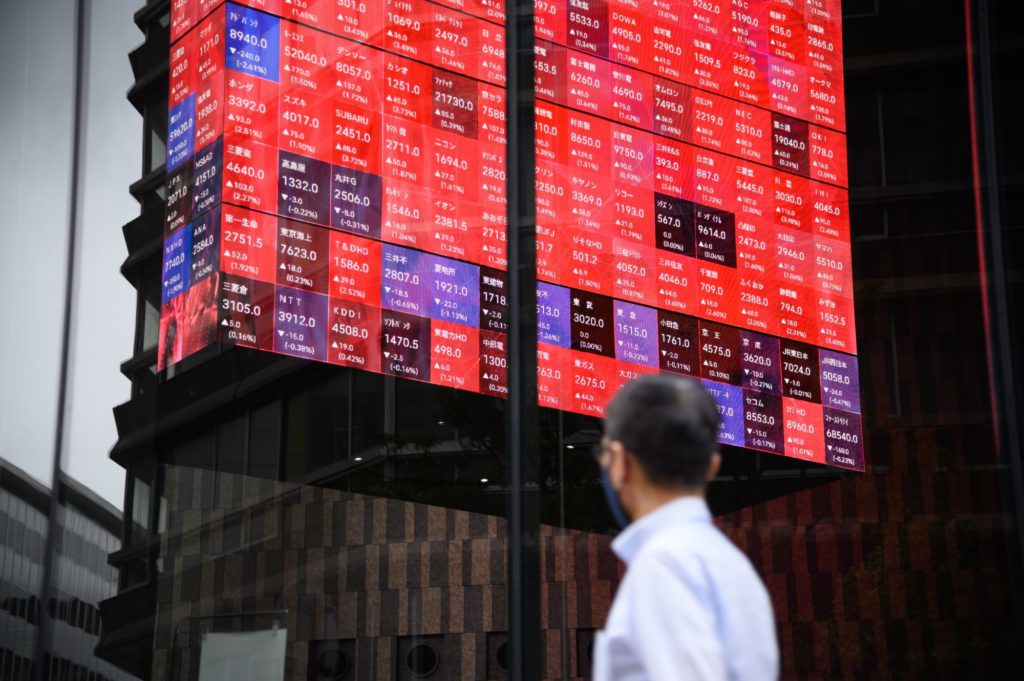
(Bloomberg) — Most Asian stocks rose Monday, weathering risks from China as well as a drop in US equity futures amid a reminder from Federal Reserve officials that interest rates need to go up to quell elevated inflation.

An Asia-Pacific share index added 0.6%, led by Japan. S&P 500, Nasdaq 100 and European contracts were in the red. The mixed picture follows the best month for global equities since 2020, which helped pare their drop this year to 15%.

Recent developments underlined the economic challenges facing China, including shrinking property sales and a contraction in factory activity that highlighted the cost of Beijing’s preference for mobility curbs to tackle Covid. The parlous backdrop may stoke speculation that more stimulus is needed.

Meanwhile, Fed Bank of Minneapolis President Neel Kashkari said Sunday the US central bank is committed to reaching its long-term inflation goal of 2%. Before that, Fed Bank of Atlanta President Raphael Bostic said the monetary authority has further to go in raising borrowing costs.

Treasury yields inched higher but at about 2.67% the 10-year rate is well down from June’s peak near 3.50%. The yen jumped for a fourth session versus the greenback. Oil, gold and Bitcoin all retreated. 

The risk of a recession has cooled expectations for how sharply the Fed has to hike rates to tame inflation. That spurred a July rebound in stocks and bonds. But market jumps that ease financial conditions can imperil the goal of curbing demand to contain the cost of living, adding pressure on the central bank.

“We are in a bear market rally,” Barbara Ann Bernard, founder of hedge fund manager Wincrest Capital Ltd., said on Bloomberg Radio, adding she foresees a deceleration in expectations for corporate earnings.

Investors are also monitoring US House Speaker Nancy Pelosi’s trip to Asia. A statement from her office skipped any mention of a possible stopover in Taiwan. A visit may stoke US-China tension over the island.

Taiwan’s currency slid past 30 per dollar for the first time since 2020. Asia’s manufacturing slowdown is weighing on export-reliant economies like Taiwan. 

What to watch this week:

  • Airbnb, Alibaba and BP are among earnings reports
  • PMIs from US and euro area, among others, Monday
  • US construction spending, ISM manufacturing, Monday
  • Reserve Bank of Australia rate decision, Tuesday
  • US JOLTS job openings, Tuesday
  • Chicago Fed President Charles Evans, St. Louis Fed President James Bullard due to speak at separate events, Tuesday
  • OPEC+ meeting on output, Wednesday
  • US factory orders, durable goods, ISM services, Wednesday
  • BOE rate decision, Thursday
  • US initial jobless claims, trade, Thursday
  • Cleveland Fed President Loretta Mester due to speak, Thursday
  • US employment report for July, Friday

Some of the main moves in markets:

Stocks

  • S&P 500 futures fell 0.4% as of 7:11 a.m. in London. The S&P 500 rose 1.4% on Friday
  • Nasdaq 100 futures dropped 0.4%. The Nasdaq 100 rose 1.8% on Friday
  • Japan’s Topix index climbed 1%
  • South Korea’s Kospi was steady
  • Australia’s S&P/ASX 200 index increased 0.7%
  • China’s Shanghai Composite index rose 0.2%
  • Hong Kong’s Hang Seng index added 0.1%
  • Euro Stoxx 50 futures were down 0.2%

Currencies

  • The Bloomberg Dollar Spot Index fell 0.1%
  • The euro was at $1.0222
  • The Japanese yen was at 132.58 per dollar, up 0.5%
  • The offshore yuan was at 6.7650 per dollar, down 0.2%

Bonds

  • The yield on 10-year Treasuries rose two basis points to 2.67%

Commodities

  • West Texas Intermediate crude was at $97.52 a barrel, down 1.1%
  • Gold was at $1,760.32 an ounce, down 0.3%

More stories like this are available on bloomberg.com

©2022 Bloomberg L.P.
Thai Crypto-Bourse Deal Stuck in Due Diligence, Co-Founder Says

(Bloomberg) — A deal to sell a majority stake in Thailand’s largest crypto exchange to the nation’s oldest bank remains stuck in due diligence more than eight months after the plan was unveiled, according to the platform’s co-founder.  

The proposal with SCB X Pcl that helped propel Bitkub Online Co. into a so-called unicorn has yet to be wrapped up, according to Jirayut Srupsrisopa, chief executive officer of Bitkub Capital Group Holdings. 

“I can’t mention about the deal publicly yet because it’s under the due-diligence process,” Jirayut said in an interview with Bloomberg TV on Monday. “But everything is still in the same timeline. That’s all I can mention about the deal.”

Bangkok-listed SCB X, the parent of Siam Commercial Bank Pcl, agreed to acquire 51% in Bitkub Online for 17.9 billion baht ($490 million) in November. The lender, which has signaled ambitions of becoming a regional provider of fintech services, has also cited due diligence as a reason for the delay.


The global crypto ecosystem has struggled with the meltdowns of several digital tokens, several bankruptcy filings and debt restructurings — all of which have prompted heightened scrutiny from regulators. The Thailand unit of crypto exchange Zipmex recently halted customer withdrawals and filed for moratorium from creditors. 

ALSO READ: Why Crypto Flinches When SEC Calls Coins Securities: QuickTake

Bitkub has also been subject to greater regulatory oversight, with Thailand’s Securities and Exchange Commission slapping a 24 million baht fine on the company and two officials for violating trading rules. Jirayut said the fine hasn’t affected the company.

“No investor was affected by that practice and we have been measuring the daily active users and it hasn’t affected the company much,” he said. “Actually Bitkub controls almost 100% of the market now,” with many Thai traders having migrated their business in the wake of Zipmex’s troubles.

Bitkub’s coin is down about 85% from its all-time high and was at about $2.60 on Monday, according to CoinGecko.

Southeast Asia’s second-largest economy is looking to tighten regulations to bolster oversight on crypto firms and ring-fence small investors from the volatile asset, SEC Secretary-General Ruenvadee Suwanmongkol said in an interview last month.  

“Our main focus will be to provide more protection for small investors, some of whom are putting most of their savings into these assets,” Ruenvadee said. 

More stories like this are available on bloomberg.com

©2022 Bloomberg L.P.
Musk May Keep Selling Tesla, With or Without Twitter: MLIV Pulse

(Bloomberg) — Investors expect Elon Musk to sell more shares of his electric carmaker Tesla Inc. by the end of 2022, according to the latest MLIV Pulse survey.

About 75% of 1,562 respondents, who include portfolio managers and retail traders, say Musk won’t end up owning Twitter Inc. — a deal that led him to offload about $8.5 billion of Tesla shares in April. A third of respondents predict he will settle with the social-media company for more than $1 billion rather than seeing through his $44 billion takeover at $54.20 per share, while 27% think a judge will order him to pay the $1 billion breakup fee.

Musk will likely sell shares regardless of what happens with the Twitter deal,” said Mike Loukas, chief executive officer of TrueMark Investments, echoing the sentiment of 68% of those surveyed. “But if investors read too much into it, they’re likely not seeing the forest through the trees.”

That could signal further pain for Tesla stock, which is down about 16% this year, more than the 13.3% decline in the S&P 500. The Austin-based company has been roiled by supply-chain shortages, Covid-related lockdowns in China, and confusion surrounding Musk’s pursuit of Twitter.

Musk, 51, is the world’s richest person, with a $260 billion fortune derived largely from his stake in Tesla. But he’s been shedding shares as of late: He conducted a Twitter poll in November about selling 10% of his position, then proceeded to sell more than 15 million shares over the next couple of months.

Musk offloaded about 9.4 million Tesla shares in April after his deal to buy Twitter, amounting to $25 billion worth of stock sold in the span of six months. He’s now attempting to back out of the agreement, which will be the subject of a fast-tracked October trial in Delaware Chancery Court.

Resolution Relief

Whatever the outcome, investors expect that Tesla shareholders will welcome an end to the matter.

“If his stock sale is accompanied by a definitive agreement that puts the Twitter mess behind him, Tesla could rally,” said Steve Sosnick, chief strategist at Interactive Brokers. “A definitive end to Twitter would remove a distraction and theoretically allow Musk to focus more on Tesla.”

Read more: Option Bets Rise on Twitter Gains as Musk Legal Battle in Focus

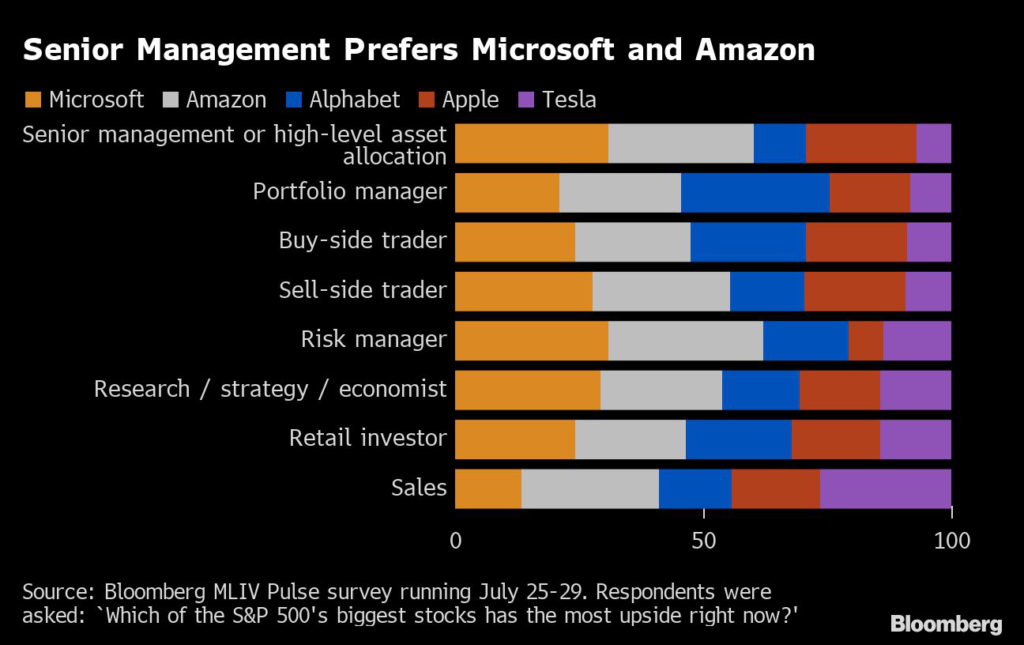
Still, survey respondents are less confident in Tesla’s upside relative to four other megacaps in the S&P 500. About a quarter said Microsoft Corp. offered the most potential, roughly the same share as Amazon.com Inc. Alphabet Inc. got 21% of the vote while Apple Inc. received 18%. Tesla came in last, with 12.5%.

The threat of competition for electric vehicles looms large, with most global automakers working on their own EVs. The macro backdrop is also challenging, with the US economy shrinking for two straight quarters.

Those wider concerns were on the minds of the investors who responded to the survey, resulting in a cautious note. They expect value stocks to perform better than growth shares over the next six months, though the largest technology companies are more likely than not to post at least modest gains from here through year-end.

“Any tech monopoly is going to be a flight for safety,” Alex Moazed, the chief executive officer of Applico, said in a Bloomberg TV interview. “Investors want to put their money in the less risky places that can still grow.”

As for Musk, his time atop the Bloomberg Billionaires Index may be short-lived. After taking the No. 1 spot last year after Tesla’s huge rally, just over 50% of respondents say he will lose that position by the end of 2023. By comparison, almost 33% say he’ll hold on until 2025 or later.

Grace Capital’s Cate Faddis and Loup Ventures’ Gene Munster will take your questions in our live blog, MLIV Pulse Q&A: Musk, Tesla and Twitter. Tune in on Aug. 2 at 10 a.m. New York time, and send advance questions to TOPLive@bloomberg.net.

Subscribe to MLIV surveys at NSUB MLIVPULSE.

(Adds story tout on option bets on Twitter after the eighth paragraph.)

More stories like this are available on bloomberg.com

©2022 Bloomberg L.P.
China’s Home Sales Slump Further During Mortgage Boycotts

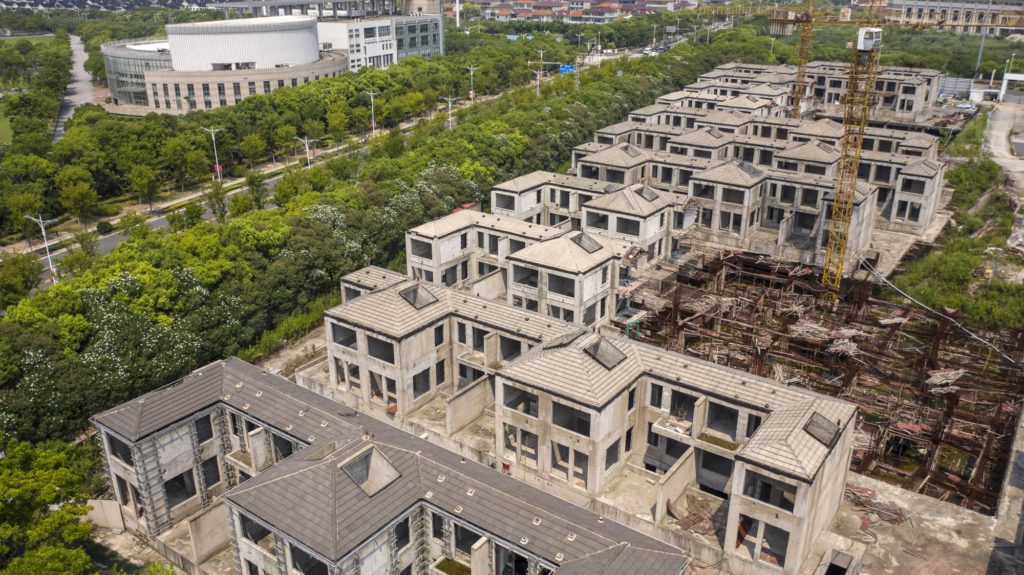
(Bloomberg) — China’s top 100 developers saw home sales slump further in July, indicating a widening mortgage boycott crisis emerging around the country has further weighed on buyer confidence.

Combined contract sales plunged 39.7% from a year earlier to 523.1 billion yuan ($78 billion), according to preliminary data compiled by China Real Estate Information Corp., as demand remained stagnant amid an economic downturn despite government efforts to stimulate purchases.

Chinese developer shares fell after the figures provided the first reading on property purchases since homebuyers nationwide began refusing to pay mortgages on stalled projects. A revival of home sales is needed to generate cash for debt-laden developers like China Evergrande Group and reduce mounting pressure on banks and the economy. 

“Overall market demand and purchasing power have been overdrawn, while the industry confidence is also at a low level,” CRIC said in the report. “Developers are still facing heavy de-stocking pressure in the short term.” 

The year-on-year decline in home sales was smaller than the previous month’s 43% decrease, CRIC said in its report. From a month earlier, they fell 28.6%, reversing a June rebound. Combined sales plummeted 49% in the first seven months.

Developers’ Sales Woes

Sales are likely to remain soft in August on dampened buyer sentiment, and developers face more liquidity challenges, said Griffin Chan, an analyst at Citigroup Inc. “More comprehensive and coordinated measures are needed,” he said.

A Bloomberg Intelligence gauge of Chinese property developer shares slid as much as 2.3% to the lowest level since March. The drop also followed news that Evergrande failed to deliver a preliminary restructuring plan by the end of July as promised, instead laying out principles for a future debt overhaul. 

The Chinese government has been racing to rescue its all-important real estate sector as a long-standing crackdown on leverage and speculation hits demand. Authorities have cut borrowing costs and down payments among other measures to shore up a sector that accounts for about a quarter of the world’s second-largest economy.

Financial regulators have also urged banks to boost lending to builders to help finish projects, while the Politburo, the Communist Party’s top decision-making body, last month vowed to maintain real-estate market stability. Authorities are considering a plan to seize undeveloped land from distressed real estate firms to help finance the completion of stalled building work, people familiar with the matter said last week.

What Bloomberg Intelligence Says

Mortgage-payment boycotts for unfinished projects could prompt buyers to defer or cancel purchase plans, or pivot to secondhand homes or state-owned developers’ presold projects. Uncertainty over construction halts is poised to weaken the home-price outlook and investor demand. 

–Kristy Hung, real estate analyst

Click here to read the research

China’s overall property loans rose at the slowest rate on record as of the end of June, as banks were cautious about lending to cash-strapped developers while household demand for mortgages was weak. New home prices fell for a 10th straight month in June.

CRIC said local authorities around the country are expected to further ramp up property policy stimulus, with the country’s second-, third- and fourth-tier cities expected to further ease restrictions.

Cities under heavy pressure from the property slump will likely implement fiscal measures to stimulate home buying and stabilize market expectations, the report said, adding that ensuring delivery of housing projects would be an important task for builders as stressed at the latest Politburo meeting. 

(Updates with analysts’ comments in sixth and 10th paragraphs)

More stories like this are available on bloomberg.com

©2022 Bloomberg L.P.
Taiwan Dollar Slides as Growth, Geopolitical Risks Sap Sentiment

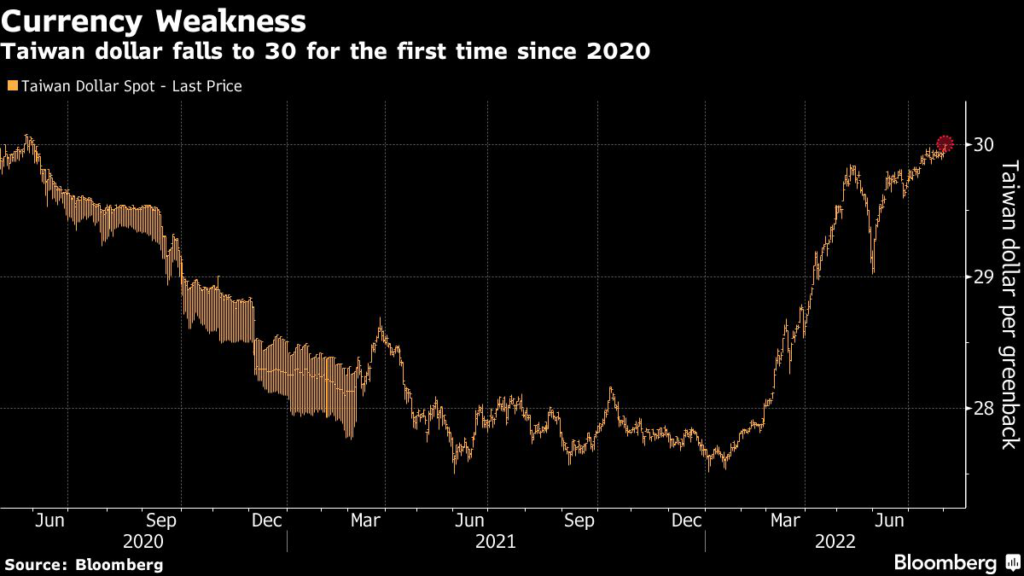
(Bloomberg) — The Taiwan dollar slid past a key psychological level of 30 per US dollar for the first time since June 2020 as a double whammy of heightened geopolitical risks and weaker economic growth weigh on the currency.

The currency fell as much as 0.2% to 30.008 per dollar. That’s because sentiment turned cautious amid US House Speaker Nancy Pelosi’s potential visit to the island and as data showed manufacturing activity was the weakest since May 2020. 

“There may be some political risk priced into the Taiwan dollar due to Pelosi’s visit to Asia,” said Khoon Goh head of Asia research at Australia & New Zealand Banking Group. “This is the main reason why the Taiwan dollar has underperformed in the region despite the greenback being weaker,” he said, adding that the surprise drop in Taiwan’s purchasing managers index further into contraction territory also probably weighed on the currency.

The US House Speaker left Taiwan out of the itinerary in a statement on Sunday announcing the trip, which will also include stops in Japan, South Korea and Malaysia. Yet speculation is still rife that Pelosi would visit Taiwan at some point this week, risking a heavy-handed response from China, which regards the self-governing island as its territory.

“The underperformance in the Taiwan dollar is reflecting heightened geopolitical risk, rather than fundamentals,” Frances Cheung, rates strategist at Oversea-Chinese Banking Corp. in Singapore. “Unfortunately this kind of sentiment appears to be self-fulfilling in that the resulting equity outflows are putting pressure on the local currency.”

Taiwan’s currency retraced some of its early loss to trade at 29.998 per US dollar at 12:44 pm in Hong Kong. Exporters sold the greenback above 30, according to traders who are not authorized to speak publicly, while state-backed banks haven’t been seen offering dollar liquidity, they said. 

However, the downside risk for the currency is high as indicated by its one-month implied volatility, which has risen in the last four sessions from a five-month low touched last week. 

ING Bank NV has a bearish outlook on the currency based on fundamentals and weak demand for semiconductors. “That’s driven mainly from weak demand for smart devices due to lower purchasing power in mainland China and high inflation in US and Europe,” said Iris Pang, chief China economist at the bank.

(Updates throughout.)

More stories like this are available on bloomberg.com

©2022 Bloomberg L.P.

Tesla Inks Battery Materials Deals With Two China Suppliers

(Bloomberg) — Tesla Inc. has signed new long-term deals with two of its existing Chinese battery-materials suppliers, the latest move by automakers to secure supplies amid intensifying competition.

Zhejiang Huayou Cobalt Co. and CNGR Advanced Material Co. signed pricing agreements with the electric-vehicle giant for supplies until the middle of this decade, according to separate stock-exchange statements from the companies. The deals are for ternary precursor materials — chemical cocktails that are key to storing energy in lithium-ion batteries.

The announcements come as major automakers look to scoop up battery metals in the face of a looming shortage. General Motors Co. unveiled deals to buy inputs ranging from lithium to cathode materials last week, shortly after Ford Motor Co. revealed a list of suppliers with raw materials including Argentinean lithium and Indonesian nickel.

Huayou Cobalt will supply the materials to Tesla from July 1, 2022 to the end of 2025. The miner said the prices of the products will be subject to market prices for nickel, cobalt and manganese, as well as refining fees. CNGR will supply the EV automaker between 2023 and 2025. 

Shares of Huayou Cobalt and CNGR jumped more than 9% each on Monday morning. 

The transition to cleaner energy is boosting demand for battery ingredients, while supply has been hampered by Covid-related logistical woes and a lack of investment. That’s pushing up the prices of the raw materials and is denting profitability for some carmakers.

Both Huayou and CNGR were among a list of direct suppliers named by Tesla in its 2021 annual impact report. CNGR said in its statement that it supplied Tesla from 2020 until this year.

(Adds share price moves in fifth paragraph)

More stories like this are available on bloomberg.com

©2022 Bloomberg L.P.
China Property Shares Drop to Five-Month Low as Crisis Spreads

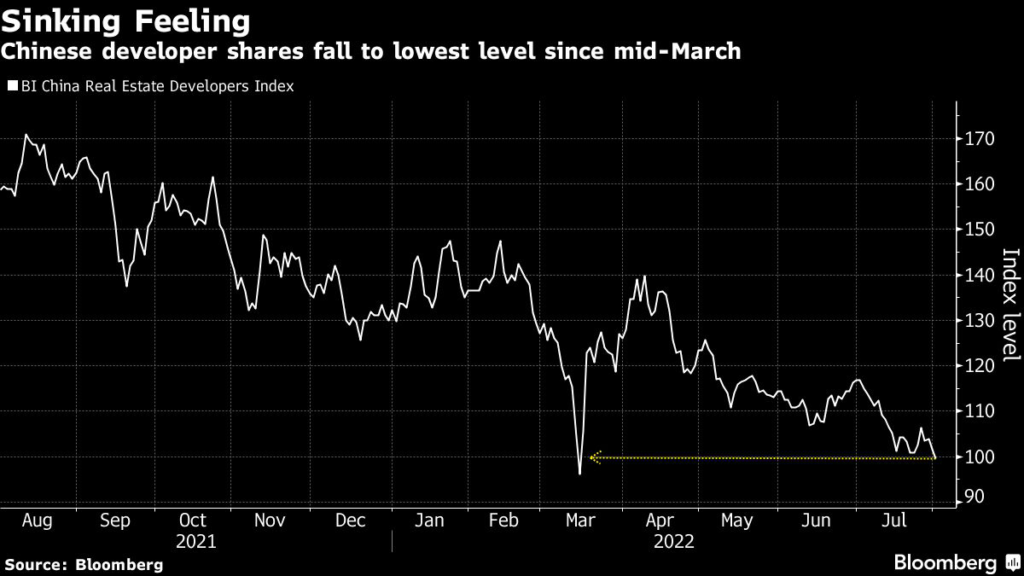
(Bloomberg) — A worsening crisis in China’s real estate sector is dragging industry shares to the lowest in almost five months, with home sales slumping further and setbacks spreading at the nation’s most indebted developer.

A Bloomberg Intelligence index of developer stocks dropped as much as 2.3% to the lowest level since March 16. Guangzhou R&F Properties Co. and Country Garden Holdings Co. led the declines, each losing at least 6%. 

The industry’s outlook turned darker after data showed home sales in the country extended a plunge amid a widening mortgage boycott, while China Evergrande Group failed to unveil a long-promised restructuring framework on time. Investor confidence also weakened on news of a plan mulled by authorities to seize distressed developers’ idle land to help complete stalled projects, a move that could cost creditors access to some of builders’ most valuable assets.

“Recent developments show that it’s almost impossible for defaulted developers to make a turn-around,” said Li Kai, founding partner of Beijing Shengao Fund Management Co. “More restructurings are in sight. The reality is that developers will have to accept huge discounts in asset disposal, which implies lower recovery ratio for creditors.”

China’s junk dollar bonds, dominated by notes of developers, were little changed Monday morning, according to credit traders. Total returns for these notes fell 7.9% in July, the biggest loss since February and a record-extending 11th-straight drop, according to a Bloomberg index. 

The latest weakness in developer stocks followed fresh signs of trouble in China’s property sector and its broader economy. Combined contract sales by the country’s top 100 developers fell 39.7% on year in July, according to preliminary data compiled by China Real Estate Information Corp. Factory activity in the world’s No. 2 economy also unexpectedly contracted last month, highlighting the fragility of a recovery amid sporadic Covid outbreaks.

Also weighing on investor mood is news that China is considering a plan to seize undeveloped land from distressed real estate companies and use it to help finance the completion of stalled housing projects. While the initiative would help appease angry buyers of unfinished homes, it may potentially remove a key source of assets for creditors seeking to limit losses during a debt restructuring.   

In the latest indication of the protracted nature of debt overhauls in China, Evergrande failed to deliver a ‘preliminary restructuring plan’ it had promised by the end of July and instead pledged to announce a specific one within this year. 

At the epicenter of the sector’s debt crisis, Evergrande also said separately that a unit will need to sell shares in a regional bank after losing an arbitration ruling. 

“Generally, the delay in announcing a detailed plan is disappointing, though unfortunately investors have few options other than to wait,” said Shu Hui Woon, credit analyst at Lucror Analytics. “There could be more winding-up petitions if Evergrande drags the process further.” 

The unit’s stake sale in Shengjing Bank Co., a local lender in northeastern China, may prompt more onshore creditors to protect their interests, Woon said. 

(Updates with analyst comments and more details)

More stories like this are available on bloomberg.com

©2022 Bloomberg L.P.
Pakistan OneLoad Raises Funds as Fintech Competition Picks Up

(Bloomberg) — Pakistan’s fintech OneLoad, which targets micro-retailers, has raised $11 million to fund a growth phase as it focuses on tapping the world’s third-largest unbanked population.

The latest investment round was led by Sarmayacar and Shorooq Partners, with participation from the Bill & Melinda Gates Foundation’s Strategic Investment Fund, its first investment in Pakistan. OneLoad’s android application, used by mainly by small shopkeepers, is the largest non-banking digital transaction platform in Pakistan and serves several million customers each month. It partners with banks and telecom companies to offer services including payments, cash deposits and lending.

The company hopes to become the “largest banking platform in the country for the unbanked world, the financially excluded market,” Muhammad Yar Hiraj, founder and chief executive officer at OneLoad said in an interview. “The aim is to become the largest micro branch for the the unbanked without actually owning any branch.” 

OneLoad operates through its 40,000 agents and did about $100 million in transactions last year. The company wants to increase daily transaction to one million a day from the current level of up to 400,000, said Hiraj. 

Pakistan, the world’s fifth-most populous nation, came into the spotlight with record funding of about $350 million flowing to startups last year. A flurry of fintechs are emerging in the country, which has an unbanked population of 110 million adults, third only to India and China, according to the World Bank.

While Pakistan has seen an increase in digital payments during the pandemic, only 1% of almost $4 trillion of payments are made digitally. Fintech company Dbank pulled off the nation’s largest early-stage fundraising round last month, which also marked venture giant Sequoia Capital’s entry in Pakistan. Another fintech startup, SadaPay, is projected to be the fastest-growing mobile wallet in the world in the five years to 2025, research from London-based fintech company Boku Inc. said last year.

OneLoad plans to increase its shopkeepers and serve daily wage workers unlike most of its competitors, who are chasing tech-savvy users.

The startup’s existing backer Systems Ltd. participated in the funding round along with commercial banks that provided debt funding, said Hiraj. The World Bank’s International Financial Corporation is also an existing investor.

“We cannot have financial inclusion without solid infrastructure that integrates in people’s daily lives, if the products we build don’t seamlessly integrate with people’s every day, we will not achieve that,” said Tamer Azer, Partner at Shorooq Partners. “This is what we learned in Egypt and this is what we see as a tremendous opportunity in Pakistan as well.”

More stories like this are available on bloomberg.com

©2022 Bloomberg L.P.
Tighter Bank Rules Give Dubai’s Crypto Shops a New Allure

(Bloomberg) — Sign up for our Middle East newsletter and follow us @middleeast for news on the region.

In the lobby of a Dubai skyscraper, a doorman fields queries about an increasingly popular crypto shop, directing clients to office 501, down a grubby corridor on the fifth floor. 

Inside, staff are busy operating Coinsfera, an over-the-counter exchange that’s emerging as a favorite for Russians, Iranians and others who struggle to transfer money through banks due to Western sanctions or local restrictions, according to bankers, lawyers and crypto executives familiar with the matter.

The OTC structure allows customers to buy crypto assets back home with local currency and sell them for hard cash in Dubai. At Coinsfera, the process takes minutes and involves checking an identity document and answering few questions, according to customers and staff. 

Clients include ordinary folks dabbling in crypto or navigating capital controls and restrictions that don’t target them but can complicate banking. Sanctioned Russians have, however, flown to Dubai for big OTC transactions, three of the people said. 

Scrutiny

Since there are no international sanctions on Russia and the UAE has not imposed its own penalties on the country or on Russian individuals sanctioned elsewhere, neither Coinsfera nor other OTC shops are prohibited from doing such business.

Because trades are cash-based and not reported publicly, it’s unclear how much money is being moved using crypto as a conduit or what proportion of it might pique the interest of regulators. 

Yet the OTC trade is adding to international scrutiny over potentially illicit money flows through the United Arab Emirates, which was given a gray-list designation by the Paris-based Financial Action Task Force in March.

A spokesperson said Coinsfera has offices in Istanbul and Dubai and screens potential clients fully, checking identification and following procedures aimed at combating illicit flows. 

The company also helps clients buy and sell real estate and luxury watches using digital currency and had faced no issues with clients or from authorities, the spokesperson said in an emailed response to questions. 

A spokesperson for the UAE executive office responsible for combating money laundering and terrorist financing (AML/CFT) said a framework governing virtual assets was being finalized, warning that any firm or individual that doesn’t comply risks being prosecuted, fined or having their licenses revoked. 

Dubai government spokespeople didn’t respond to a request for comment. 

Crypto Hub

The rise of OTC shops — Coinsfera is one of dozens — coincides with Dubai’s declared push to transform itself into a global crypto hub. The UAE’s business capital has attracted more than 1,000 blockchain firms in the past year, from major exchanges like Binance and FTX to the embattled hedge fund Three Arrows Capital.

The Collapse of Three Arrows Capital Became a Crypto Contagion

Unlike centralized exchanges, where trades can be tracked on the blockchain, OTC transactions are often conducted through offline crypto storage systems, or “cold wallets,” so there’s no public order book, allowing clients to buy and offload assets without much of a paper trail. 

The shops make their money by charging commission — 3% at Coinsfera — much like the traditional currency exchange kiosks found at airports and tourist hotspots. That means they’re less exposed to the volatility that’s plagued crypto markets, even profiting during the recent rout as panicked investors rushed to sell. 

Karin Veri, a Dubai-based entrepreneur from Saint Petersburg who invests in the stablecoin Tether, said she visits Coinsfera monthly. 

“It’s all very fast,” she said. “When friends and family come to visit, it’s an easy way to get cash out in just a few minutes.” 

The company’s Dubai branch is also a favorite online, boasting a perfect 5.0 rating on Google with more than 600 reviews.

“In theory, Western officials should be unhappy with a gray-listed country with inadequate oversight going full force to expand crypto offerings,” said Jodi Vittori, a professor at Georgetown University who studies the nexus of financial flows and US national security.

Russian Money

Years before the world turned its attention to Russian money flows to Dubai, it was already established as a back door for sanctioned countries like Iran to access Western markets. 

Since Vladimir Putin’s Feb. 24 invasion of Ukraine, it’s emerged along with Turkey as a destination for funds being moved out of Russia or Western nations that are freezing Russian assets and scrutinizing transactions.  

It’s an extension of Dubai’s role as a tax-free magnet for wealthy businesspeople looking to protect their assets by buying high-end property. 

The US Treasury Department has sanctioned several Dubai-based trading entities over their links to Russia and Iran in recent months, but has not targeted its crypto firms. 

In June, Deputy Treasury Secretary Wally Adeyemo visited the UAE and Turkey, relaying the Biden administration’s concerns about potential Russian sanctions evasion including via virtual assets, people familiar with the matter said. A UAE delegation followed that up days later with a trip to Washington, according the state news agency WAM. 

Russian Yachts and Money Are Going Where US Influence Has Waned 

A US Treasury spokesperson said it was imperative for financial institutions, including virtual asset providers, to comply with international financial regulations. The US Treasury has ways to target those facilitating sanctions evasion, the spokesperson said. 

A UAE government official said the country was “committed to working closely with international partners to combat the cross-border threats of illicit activity in the crypto industry and uphold the integrity of the financial system.” 

More Competition

Many such crypto shops are based in Dubai’s Jumeirah Lakes Towers, the high-rise development where Coinsfera operates within the Dubai Multi Commodities Centre free zone. 

Coinsfera’s website says it’s been operating in several countries since 2015.

Turkey’s trade registry shows Coinsfera was established three years ago by Geray Gerayli, an Azerbaijani citizen, as a joint stock company. It lists Gerayli as the firm’s only manager. 

Efforts to reach Gerayli through his company email address and his colleagues at Coinsfera were unsuccessful.

In Dubai, a DMCC corporate register simply lists the parent company: A to Z Globe DMCC. That’s the name outside the Coinsfera office. 

A DMCC spokesperson said the free zone works with regulators to ensure “our jurisdiction provides a robust operating environment.”

With the rapid growth of crypto in Dubai, Coinsfera regularly adds to its niche services.

A company advertisement in May said it could serve “citizens of different nations – Russia, Europe, Canada and Nigeria – where there is high crypto activity” and support clients “in search of expensive luxury villas.” 

More stories like this are available on bloomberg.com

©2022 Bloomberg L.P.

US Futures Dip, Stocks Mixed on Fed, China Caution: Markets Wrap

(Bloomberg) — US equity futures fell and Asian stocks were mixed Monday, hampered by the challenges swirling around China and a reminder from Federal Reserve officials that their key objective is to fight high inflation.

S&P 500 and Nasdaq 100 contracts were in the red, while Japan countered losses in Hong Kong to help MSCI Inc.’s Asia-Pacific share index edge up.

Recent developments underlined the economic challenges facing China, including shrinking property sales and a contraction in factory activity that highlighted the cost of Beijing’s preference for mobility curbs to tackle Covid. 

Meanwhile, Fed Bank of Minneapolis President Neel Kashkari said Sunday the central bank is committed to reaching its long-term inflation goal of 2%. Before that, Fed Bank of Atlanta President Raphael Bostic said the monetary authority has further to go in raising borrowing costs.

Treasury yields inched higher but at about 2.67% the 10-year yield is well down from June’s peak near 3.50%. The yen jumped for a fourth session versus the greenback. Oil, gold and Bitcoin all retreated. 

A slowing economy has cooled expectations for the scale of Fed interest-rate hikes needed to tame inflation, spurring a July rebound in both stocks and bonds. But officials may be wary of market jumps that ease financial conditions and thus imperil the goal of squeezing demand to fight price pressures.

“We are in a bear market rally,” Barbara Ann Bernard, founder of hedge fund manager Wincrest Capital Ltd., said on Bloomberg Radio, adding she foresees a deceleration in expectations for corporate earnings.

Investors are also monitoring US House Speaker Nancy Pelosi’s trip to Asia. A statement from her office skipped any mention of a possible stopover in Taiwan. A visit may stoke US-China tension over the island.

Taiwan’s currency slid past 30 per dollar for the first time since 2020. Asia’s manufacturing slowdown is weighing on export-reliant economies like Taiwan. 

What to watch this week:

  • Airbnb, Alibaba, BP and HSBC are among earnings reports
  • PMIs from US and euro area, among others, Monday.
  • US construction spending, ISM manufacturing, Monday.
  • Reserve Bank of Australia rate decision, Tuesday.
  • US JOLTS job openings, Tuesday.
  • Chicago Fed President Charles Evans, St. Louis Fed President James Bullard due to speak at separate events, Tuesday.
  • OPEC+ meeting on output, Wednesday.
  • US factory orders, durable goods, ISM services, Wednesday.
  • BOE rate decision, Thursday.
  • US initial jobless claims, trade, Thursday.
  • Cleveland Fed President Loretta Mester due to speak, Thursday.
  • US employment report for July, Friday.

Some of the main moves in markets:

Stocks

  • S&P 500 futures fell 0.5% as of 12:49 p.m. in Tokyo. The S&P 500 rose 1.4% on Friday
  • Nasdaq 100 futures dropped 0.4%. The Nasdaq 100 rose 1.8% on Friday
  • Japan’s Topix index climbed 0.7%
  • South Korea’s Kospi was steady
  • Australia’s S&P/ASX 200 index increased 0.3%
  • China’s Shanghai Composite index rose 0.1%
  • Hong Kong’s Hang Seng index lost 0.3%
  • Euro Stoxx 50 futures were down 0.3%

Currencies

  • The Bloomberg Dollar Spot Index fell 0.1%
  • The euro was at $1.0224
  • The Japanese yen was at 132.61 per dollar, up 0.5%
  • The offshore yuan was at 6.7581 per dollar, down 0.1%

Bonds

  • The yield on 10-year Treasuries rose two basis points to 2.67%

Commodities

  • West Texas Intermediate crude was at $97.32 a barrel, down 1.3%
  • Gold was at $1,761.66 an ounce, down 0.2%

More stories like this are available on bloomberg.com

©2022 Bloomberg L.P.

Close Bitnami banner
Bitnami