
Bloomberg

With $208 Billion in Fortunes Ambani and Adani Start to Face Off

(Bloomberg) — In June, Indian billionaire Mukesh Ambani and his aides ran into an unexpected dilemma when debating where to train the dealmaking lens of his empire next.

Ambani’s Reliance Industries Ltd. was contemplating buying a foreign telecommunications giant, when word reached them that Gautam Adani — who had overtaken Ambani as Asia’s richest man a few months earlier — was planning to bid in the first big sale of 5G airwaves in India, according to people familiar with the matter. 

Ambani’s Reliance Jio Infocomm Ltd. is the top player in India’s mobile market, while the Adani Group doesn’t even have a license to offer wireless telecommunications services. But the very idea that he might be circling ground so core to Ambani’s ambitions put the tycoon’s camp on high alert, according to the people, who asked not to be named discussing information that isn’t public. 

One set of aides advised Ambani to pursue the overseas target and diversify beyond the Indian market, while another counseled conserving funds to fend off any challenge on the home turf, according to people familiar with the discussions. 

Ambani, worth almost $90 billion, ultimately never bid for the foreign firm, partly, the people said, because he decided it would be more astute to retain financial firepower in case of a challenge from Adani, who has seen the world’s largest wealth gain this year — to $118.3 billion, based on data from the Bloomberg Billionaires Index.

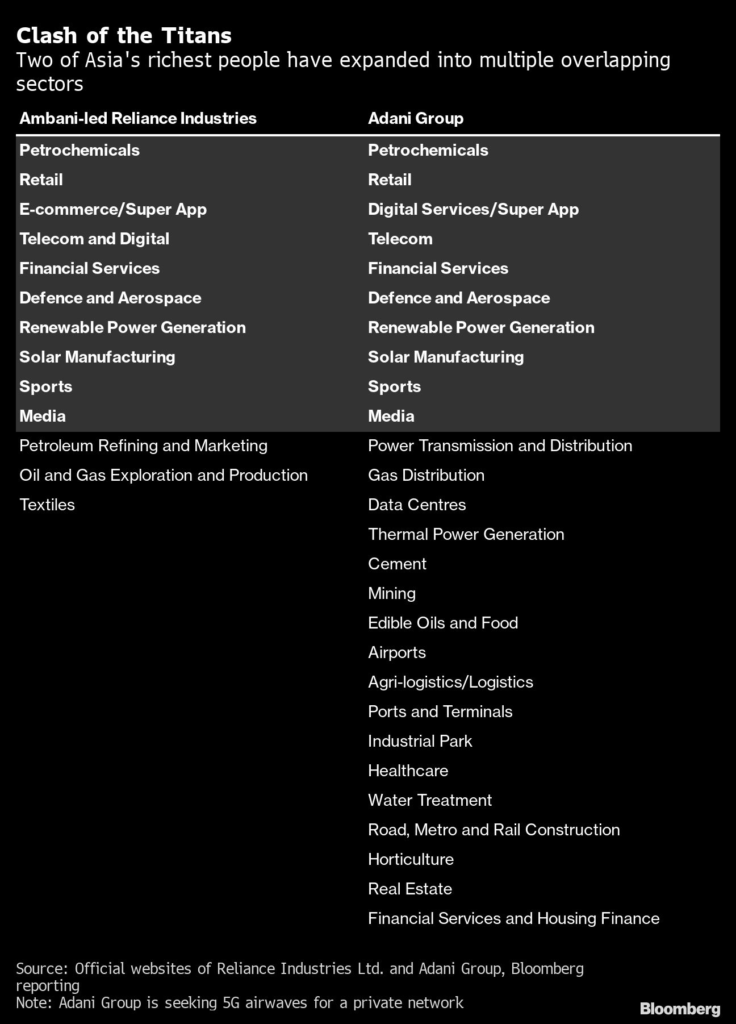
After peacefully expanding in their respective domains for over two decades, Asia’s two richest men are increasingly treading the same ground, as Adani in particular sets his sights beyond his traditional areas of focus. 

Billionaire Dynasties

That’s setting the stage for a clash with widening implications both beyond India’s borders, as well as at home as the $3.2 trillion economy embraces the digital era, triggering a race for riches beyond the commodity-led sectors where Ambani and Adani made their first fortunes. The opportunities emerging — from e-commerce, to data streaming and storage — are reminiscent of the US’s 19th century economic boom, which fueled the rise of billionaire dynasties like the Carnegies, Vanderbilts and Rockefellers. 

The two Indian families are similarly hungry for growth and that means they’re inevitably going to run into each other, said Arun Kejriwal, founder Mumbai investment advisory firm KRIS, who has been tracking the Indian market and the two billionaires for two decades. 

“Ambanis and Adanis will cooperate, co-exist and compete,” he said. “And finally, the fittest will thrive.”

Representatives from Adani’s and Ambani’s companies declined to comment for this story. 

In a public statement on July 9, the Adani Group said that it has no intention of entering the consumer mobile space currently dominated by Ambani, and will only use any airwaves purchased at the government auction to create “private network solutions,” and for enhancing cybersecurity at its airports and ports. 

Despite such commentary, speculation is rife that he might eventually venture into offering wireless services for consumers.

“I don’t underestimate a calculated entry by Adani into the consumer mobile space later to compete with Reliance Jio, if not now,” said Sankaran Manikutty, a former professor at the Indian Institute of Management in Ahmedabad, who remains a visiting faculty member there and has worked extensively on family businesses, telecommunications and strategy in emerging economies. 


For decades, Adani’s business were focused on sectors like ports, coal mining and shipping, areas that Ambani stayed clear of amid its own heavy investments in oil. But over the past year, that’s changed dramatically. 

In March, the Adani Group was said to be exploring potential partnerships in Saudi Arabia, including the possibility of buying into its mammoth oil exporter, Aramco, Bloomberg News reported. A few months before that, Reliance — which still gets a majority of its revenue from businesses related to crude oil — scrapped a plan to sell a 20% stake in its energy unit to Aramco, gutting a transaction that was two years in the pipeline.

The two billionaires also have significant overlap in green energy, with each pledging to invest more than $70 billion in a space that’s heavily tied to the priorities of Indian Prime Minister Narendra Modi’s government. Meanwhile, Adani has begun signaling deep ambitions in digital services, sports, retail, petrochemicals and media. Ambani’s Reliance either already dominates these sectors or has big plans for for them.

In telecommunications, if Adani does start to target consumers in a big way, history suggests that prices could plunge amid the early phase of competition but rise again if the two companies secure a duopoly, with India’s wireless space currently dominated by three private players. When Ambani made his initial foray into telecoms in 2016, he offered free calls and very cheap data, an audacious move that saw costs across the board drop for consumers, but they are increasing again as he’s cemented his control.

On the surface the two men appear quite different. Ambani, 65, inherited Reliance from his father, while Adani, 60, is a self-made businessman. But they also have some remarkable similarities. 

Largely media shy, both men have a history of being fiercely competitive, disrupting most sectors they set foot in and then dominating them. Both have excellent project execution skills, are extremely detail oriented and dogged in pursuing business goals with a track record of delivering on big projects, analysts and executives who have worked with them say. 

Both hail from the western province of Gujarat, Modi’s home state. They have also both dovetailed their business strategies closely with the prime minister’s national priorities. 

Not all Adani’s dealmaking overlaps with Reliance, and he’s raced ahead with outlays on M&A even as Ambani has stayed cautious on spending heavily overseas amid the uncertain global outlook. Adani Group acquired the Haifa port in Israel in July for $1.2 billion. In May, he bought Holcim’s Indian cement units for $10.5 billion.

For now, most of Adani’s new forays are so nascent that the full impact is hard to immediately gauge. Yet analysts are in agreement that the two men are likely to play a big role in reshaping the Indian business landscape, potentially leaving increasingly vast portions of the economy in the hands of two families. 

That could have marked consequences in a nation that has only seen income disparity widen over the course of the pandemic. 

While India’s current economic advance is similar to America’s so-called Gilded Age in the 19th century, the South Asian country now faces risks of rising inequality, said Indira Hirway, director of the Centre For Development Alternatives in Ahmedabad.

“Rapid diversification and overlaps between them can lead to duopoly if they work together, hurting the smaller firms in these sectors,” Hirway said. “If they start competing, it can impact the equilibrium of the business landscape as both conglomerates will be fighting for resources and raw materials.”

(Updates wealth numbers for the two tycoons in the fifth paragraph.)

More stories like this are available on bloomberg.com

©2022 Bloomberg L.P.

Tesla Inks Battery Materials Deals With Two Chinese Suppliers

(Bloomberg) — Tesla Inc. has signed new long-term deals with two of its existing Chinese battery-materials suppliers, the latest move by automakers to secure supplies amid intensifying competition.

Zhejiang Huayou Cobalt Co. and CNGR Advanced Material Co. signed pricing agreements with the electric-vehicle giant for supplies until the middle of this decade, according to separate stock-exchange statements from the companies. The deals are for ternary precursor materials — chemical cocktails that are key to storing energy in lithium-ion batteries.

The announcements come as major automakers look to scoop up battery metals in the face of a looming shortage. General Motors Co. unveiled deals to buy inputs ranging from lithium to cathode materials last week, shortly after Ford Motor Co. revealed a list of suppliers with raw materials including Argentinean lithium and Indonesian nickel.

Huayou Cobalt will supply the materials to Tesla from July 1, 2022 to the end of 2025. The miner said the prices of the products will be subject to market prices for nickel, cobalt and manganese, as well as refining fees. CNGR will supply the EV automaker between 2023 and 2025.

The transition to cleaner energy is boosting demand for battery ingredients, while supply has been hampered by Covid-related logistical woes and a lack of investment. That’s pushing up the prices of the raw materials and is denting profitability for some carmakers.

Both Huayou and CNGR were among a list of direct suppliers named by Tesla in its 2021 annual impact report. CNGR said in its statement that it supplied Tesla from 2020 until this year.

More stories like this are available on bloomberg.com

©2022 Bloomberg L.P.
China’s Rebound Remains Fragile as Factories, Property Slump

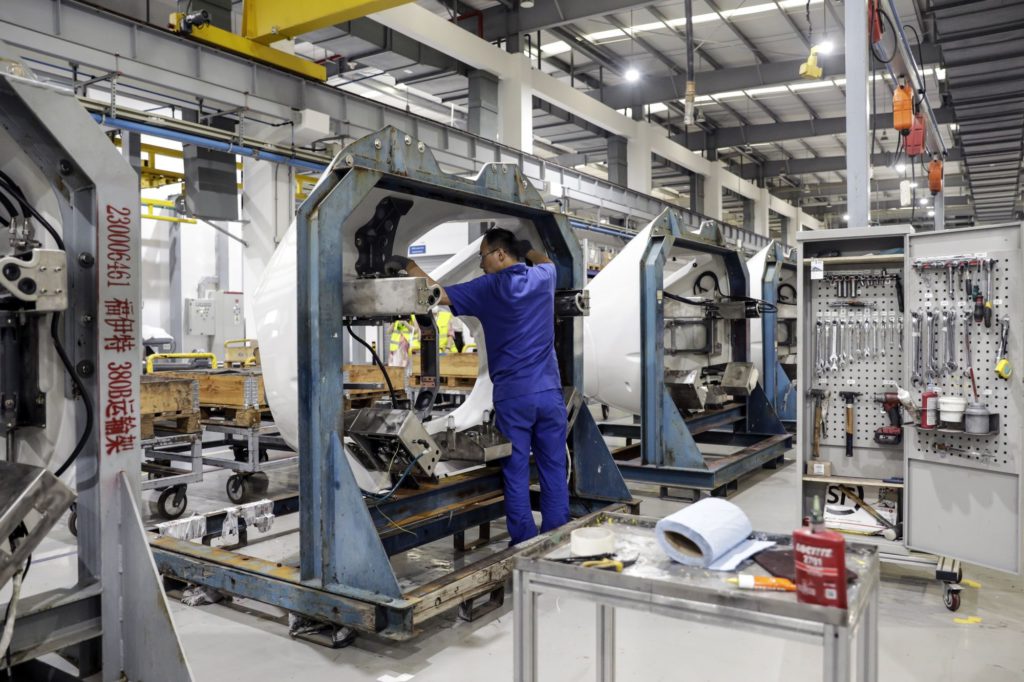
(Bloomberg) — China’s factory activity unexpectedly contracted in July while property sales continued to shrink, highlighting the fragility of the economy’s recovery amid sporadic Covid outbreaks and adding to calls for more policy stimulus to fuel growth.

The official manufacturing purchasing managers index fell to 49 from 50.2 in June, the National Bureau of Statistics said Sunday, dropping below the 50-mark that indicates a contraction in activity. A private survey on Monday also showed a weakening in factory production, while separately, data from China’s top 100 property developers showed the housing market continued to slump last month.

The economy’s recovery remains fragile as the government sticks to its strict Covid Zero approach of tightening restrictions when virus outbreaks occur. A recent flareup in the southern manufacturing hub of Shenzhen impacted factory operations there, raising concerns about disruptions to global supply chains.

“The slowdown was led by production and new orders, signaling disruptions to supply and unstable domestic demand recovery,” said Liu Peiqian, chief China economist at NatWest Group Plc. “Covid-related policies continue to dampen the momentum of recovery and more easing policies are needed to stabilize the domestic demand in coming months.”

The Caixin manufacturing PMI, based on a survey of mainly smaller and privately-owned businesses, also showed a weakening in sentiment. The index dropped to 50.4 last month from June’s 51.7, missing the median estimate of 51.5 but staying above the 50 dividing line, Caixin and S&P Global said in a statement Monday. 

The yield on China’s 10-year government bond fell 2 basis points to 2.73% as of 10:37 a.m., set for the lowest since late May, while futures on notes of the same tenor rose as much as 0.2% to a fresh high since February 8.

GDP growth in the second quarter was the slowest since the initial Wuhan outbreak, and economists expect full-year expansion could reach just 4% or below this year. With the property market continuing to weigh on the growth outlook, economists say the need for more policy stimulus remains strong.

The Communist Party’s top decision makers last week signaled a softening on the government’s growth target of around 5.5%, although they failed to announce any new stimulus policies to boost the recovery.  


Citigroup Inc. economists including Yu Xiangrong wrote in a note that the property market and fiscal policy are the top two venues for stimulus in the coming months. 

The government has also sped up infrastructure spending to help spur growth in the second half. China’s state economic planner said the acceleration of construction of major infrastructure projects can provide important support for stabilizing the economy. The third quarter is a critical window of economic stabilization and recovery, it said.

The PMI data showed the sluggishness in manufacturing was broad-based, with activity among large, medium and small sizes all contracting. The non-manufacturing PMI, which measures activity in the construction and services sectors, continued to expand, although at a weaker pace.  

The NBS cited various reasons for the slide in manufacturing, including seasonal factors and a drop in high-energy consuming industries. New orders and new export orders for both manufacturing and non-manufacturing all contracted in July. 

“Insufficient market demand is the main difficulty faced by manufacturing enterprises at present, and the foundation for the recovery of manufacturing industry needs to be consolidated,” the bureau said in a statement.

What Bloomberg Economics Says…

China’s recovery is sputtering after only a short spurt in the wake of Shanghai’s reopening. A surprise drop in July’s official manufacturing PMI into contraction more than reversed June’s rise — underlining an abrupt loss of momentum. Scattered Covid-19 outbreaks and fresh strains in the property sector are clearly taking a toll on the economy.

Chang Shu and David Qu

For the full report, click here


On the Caixin PMI, Wang Zhe, a senior economist at Caixin Insight Group, said the data indicates “a slowing recovery,” with electricity shortages and Covid oubreaks “among factors that cut into market demand and confidence in July.”

The housing market continues to weigh on China’s outlook. Sales at China’s top 100 developers fell 39.7% from a year earlier, only narrowing slightly from a drop of 43% in the previous month, according to data released by China Real Estate Information Corp.

“Missing the annual growth target this year is almost certain,” NatWest’s Liu said. “Therefore the focus should instead be if and how China would be able to stabilize its growth closer to long term potential in the second half of the year.”

(Updates with Caixin manufacturing PMI and economist quote.)

More stories like this are available on bloomberg.com

©2022 Bloomberg L.P.

Korea Exports Extend Gains, Suggesting Global Resilience

(Bloomberg) — South Korea’s exports extended gains in July, suggesting ongoing resilience in a global economy that’s under pressure from elevated energy prices, rising interest rates and China’s virus restrictions.

Overseas shipments climbed 9.4% from a year earlier, just shy of a forecast 10% gain, government data showed Monday. Average daily shipments, which take into account one less business day than a year earlier, rose 14.1%, it said.

Korea’s overall imports advanced 21.8% in July, resulting in the second-largest trade deficit on records dating back to 2000, and the longest monthly streak of shortfalls since the 2008 global financial crisis.

The data showed semiconductor shipments — Korea’s largest single source of income — edged up just 2.1%, while exports to China slid 2.5%. By contrast, sales to the US surged 14.6% to breach $10 billion for the first time ever.

That may signal a reorientation in international supply chains as China maintains its strict Covid Zero policy and the US tries to draw its allies closer to ensure the security of components and production.

“A lot of what has been going to the US via China is now directly going to the US,” said Cho Chuel, an analyst at the Korea Institute for Industrial Economics & Trade. “Covid lockdowns have eroded China’s role as a manufacturing hub this year while investment in the US is drawing exports.”

South Korea’s trade data are an early indicator of global economic activity as its manufacturers are positioned widely across supply chains. Concerns about the global outlook have increasingly weighed on Korean exporters including Samsung Electronics Co., the world’s largest memory-chip producer.

Covid lockdowns in China have increased disruptions to global supply, while Russia’s war on Ukraine has amplified the already high price of energy that Korean exporters rely on to manufacture goods.

A steady trade performance has given the Bank of Korea confidence to keep tightening monetary policy to cool inflationary pressures and shore up the won. The central bank will hold a policy meeting later this month after raising the benchmark interest rate by a half-percentage-point in July.

Separately, South Korea’s July manufacturing purchasing managers’ index fell to 49.8 in July, the weakest reading since September 2020, according to S&P Global. A result above 50 signals an expansion while anything less than 50 means a contraction.

Today’s report from the trade ministry also showed:

  • Oil products jumped 86.5% and automobile shipments advanced 25.3% in July from a year earlier.
  • Sales of ships rose 29.2% and exports of rechargeable batteries increased 11.8%.
  • Crude prices climbed 41.4% and gas prices jumped 113.9% from a year earlier, contributing heavily to the trade deficit
  • Exports to the US have grown for almost two years in a row while shipments to the Association of Southeast Asian Nations and India have increased for 17 months in a row.

(Updates with economist comment, PMI numbers and other details)

More stories like this are available on bloomberg.com

©2022 Bloomberg L.P.
Japan’s Startup Push May Take Decades to Work, Entrepreneur Says

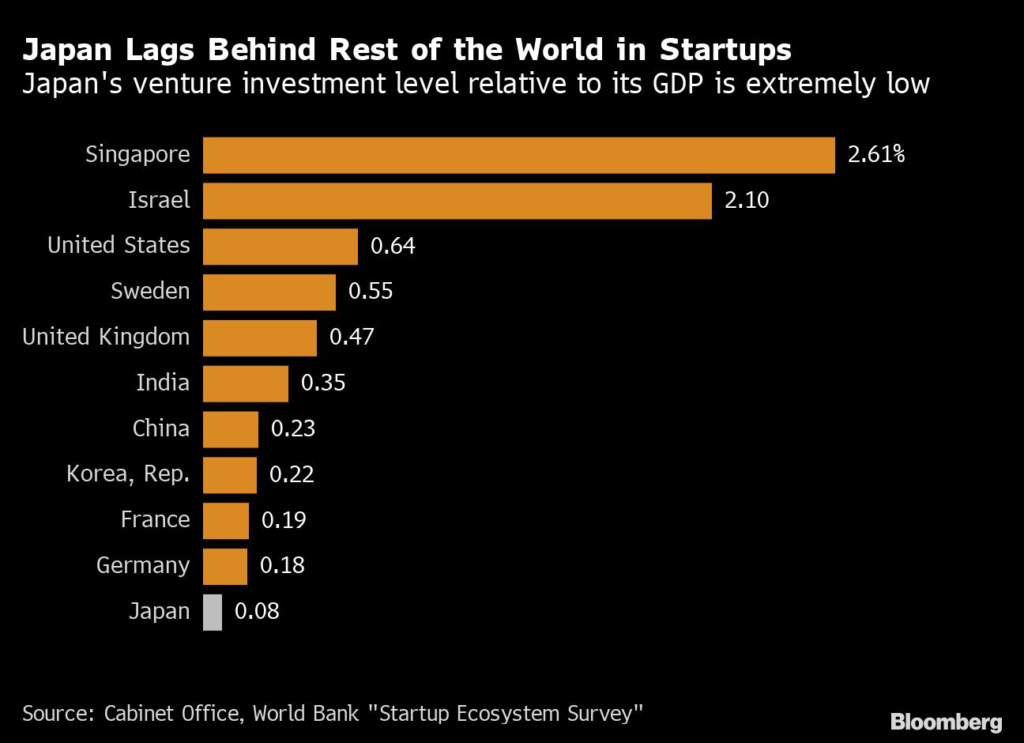
(Bloomberg) — Japan’s push to turbocharge its startup ecosystem as part of Prime Minister Fumio Kishida’s New Capitalism agenda will need at least a decade to bear fruit, according to a Japanese entrepreneur and angel investor.

A five-year goal has been set to boost the number of Japanese startups by tenfold and help entrepreneurs secure funding from the likes of the Government Pension Investment Fund and insurance companies. A ministerial post was created to promote startups, while the Japan Exchange Group Inc. has said it will explore ways to help them file for initial public offerings.

But building a vibrant venture capital ecosystem takes time, said Yo Shibata, an angel investor who is also co-founder of enterprise software startup Tailor, which in June secured seed funding from US accelerator Y Combinator. Even with Kishida’s plan, Japan will not see a significant rise in the number of startups for another 10 to 20 years, he said, adding that support needs to be sustained longterm. 

“Young people want to become entrepreneurs when they see the people around them building new companies,” said Shibata, who helped launch Nihon Kotsu Co.’s taxi deployment app to fight off Uber Technologies Inc. in Japan. “You need to keep creating success stories over a decade or two, so that those entrepreneurs in turn support or invest in a new generation of startups. That’s how you create a virtuous cycle.”

Japan has a dearth of so-called unicorns, or startups valued at $1 billion or more, with many of them unable to grow globally due to barriers such as language. SoftBank Group Corp.’s Vision Fund — the world’s largest technology investor — long-ignored startups in its home country on the grounds that their growth was dwarfed by their US and Chinese counterparts.

“The Japanese market isn’t as big as the US or China, where winning just the home market will take you to the global level,” Shibata said on Bloomberg Television. It’s also not as small as South Korea or Taiwan, where startups are forced to target overseas markets for meaningful growth, he said. “Japan is in a Goldilocks zone in a bad way where you can be fairly successful in Japan but not enough to take you to the global level.”

This is not the Japanese government’s first attempt at cultivating a startup culture. In 2003, under then-Prime Minister Junichiro Koizumi, the government launched “Dream Gate” — an incubation center that promised advice, training and networking events for would-be entrepreneurs. That push failed to gain momentum, Shibata said.

The Silicon Valley ecosystem was created over decades, as first the Cold War and then the Space Race propelled billions of dollars of government money into research labs and universities in northern California. The Cold War’s demise prompted top-tier talent from the defense sector to pursue ventures there.

Although cautioning that creating startups by itself will not lead to Japan’s economic recovery, injecting more capital into new entrants would help them challenge existing companies and give rise to innovation, said Yuji Honjo, a professor of commerce at Chuo University.

“I’m not sure if we can be the next Silicon Valley but we are on the trajectory to have more startups,” Shibata said. “It just needs more time.”

More stories like this are available on bloomberg.com

©2022 Bloomberg L.P.
Sony Dives Most in Months After Gaming Slump Spurs Outlook Cut

(Bloomberg) — Sony Group Corp. fell as much as 7% after the Tokyo-based tech giant trimmed its profit outlook, reflecting the impact of recession fears on the global gaming industry.

The stock slid its most in almost six months in early trading. Sony said on Friday it now expects 1.11 trillion yen ($8.3 billion) in operating profit this fiscal year, down from 1.16 trillion yen previously. The gaming and network services group, which houses the PlayStation business, accounted for the full revision, taking a 16% cut from 305 billion yen to 255 billion yen.

Sony Drops as Games Remain a Concern After Results: Street Wrap

Sony also revised its outlook on costs related to the acquisition of Bungie Inc., the weaker yen and lower expectations for third-party software sales on the platform.

The company’s games business underwhelmed in the April-June quarter with 47.1 million PlayStation 4 and 5 titles sold, down from 63.6 million a year earlier. Play time across PlayStation products plunged 15% in the quarter, Chief Financial Officer Hiroki Totoki said, and PlayStation Plus members fell slightly to 47.3 million.

“Although they may blame weaker PS5 sales growth of just over 4% YoY for this, the real reason looks to be higher development costs the firm has assumed through its aggressive acquisition of game developers,” said Amir Anvarzadeh at Asymmetric Advisors. “What we think is crucial going forward is how much its newly launched game streaming service, where users have access to hundreds of older games, will eat into its game software sales.”

Read more: Sony Cuts Profit Outlook on Weaker PlayStation Prospects

Investors had sought signs that Sony can weather the current macroeconomic uncertainty by relying on businesses beyond the keystone PlayStation arm. But the company also cut its sales forecast for the  image sensors business.

Supply chain snarls will likely continue to trouble electronics makers this year as the re-emergence of Covid infections and Russia’s invasion of Ukraine affect shipping, production capacity and the cost of materials. South Korean giant Samsung Electronics Co. said last week it’s adjusting its forecast on a near-daily basis because of the high degree of geopolitical volatility and economic uncertainty. 

Sony’s April-June operating profit of 307 billion yen beat average estimates of 286.7 billion. Movies and music results were boosted by the yen’s weakness and Sony said it now expects higher revenue from its music division because of the positive currency impact. Revenue from streaming services and anime content helped sustain the good results.

Video Games May Have Lost Their Recession-Proof Armor: Game On

More stories like this are available on bloomberg.com

©2022 Bloomberg L.P.
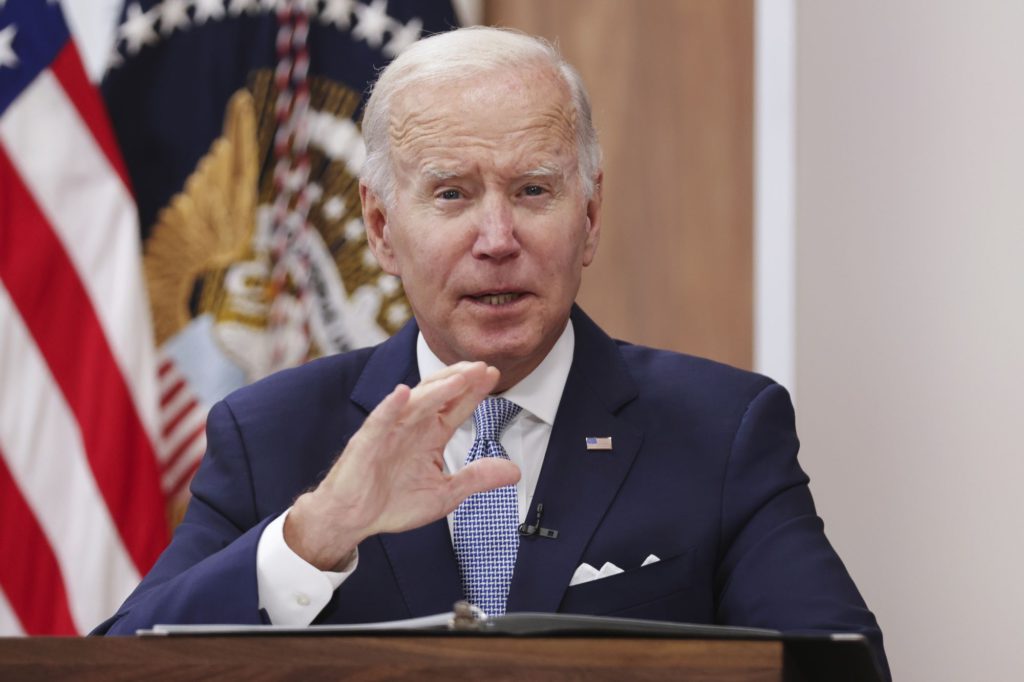
Biden’s Covid ‘Rebound’ Case Keeps Him at the White House Again

(Bloomberg) — President Joe Biden tested positive again for Covid-19 in a so-called “rebound” case seen in people who take the antiviral drug Paxlovid.

Biden, 79, isn’t experiencing symptoms after getting a positive rapid test on Saturday morning, but will resume isolation at the White House, his physician Kevin O’Connor said in a letter released by the White House.  

The test once again disrupted Biden’s schedule after he resumed in-person events this week. Trips on Sunday to his hometown of Wilmington, Delaware, and on Tuesday to Michigan to celebrate the passage of a bill to subsidize US semiconductor production were canceled, according to the White House. 

“I’m feeling fine, everything’s good,” Biden said in a video posted Saturday to his Twitter account that showed him without a face mask on a balcony. He said he’ll work from home “for the next couple days.”

O’Connor said the president “has experienced no reemergence of symptoms and continues to feel quite well” and “there is no reason to resume treatment at this time, but we will obviously continue close observation.” 

Biden said he also canceled an afternoon trip to Capitol Hill to meet families advocating for legislation to bring expanded benefits to veterans exposed to toxic burn pits, which Senate Republicans stalled this week. He said he connected with the families via video call.

The US Centers for Disease Control and Prevention recommend that people who test positive again after receiving Pfizer Inc.’s Paxlovid treatment isolate for at least five days.

Biden took Paxlovid, a five-day treatment course that has been shown to sharply reduce symptoms, after first testing positive on July 21. He concluded the drug therapy Monday evening and tested negative each of the four days after that. 

A small percentage of Covid patients who take Paxlovid later test positive in rebound cases, like Biden, which are typically associated with few or no symptoms. 

Pfizer Chief Scientific Officer Mikael Dolsten said on Thursday that the company was working with the Food and Drug Administration to finalize plans for a study of Paxlovid “retreatment” among those who experience rebound.

Read More: Biden Ditches Mask at Meeting Despite Doctor’s Assurances 

When Biden resumed in-person public events this week after testing negative, he flouted CDC guidance saying that people recovering from Covid should continue wearing a mask for 10 days following the onset of symptoms. 

The president attended an economic briefing indoors on Thursday with Treasury Secretary Janet Yellen, Commerce Secretary Gina Raimondo, Council of Economic Advisers Chairwoman Cecilia Rouse and several other White House aides, in addition to Marriott International Inc. CEO Tony Capuano. Biden entered the room with a mask but then took it off and shook hands with several participants. He later sat at a desk that was distanced from others. 

“They were socially distanced, they were far enough apart, so we made it safe for them to be together,” White House Press Secretary Karine Jean-Pierre said Thursday when asked why Biden went maskless at the event. 

CDC guidelines don’t say that social distancing is a criterion for allowing people who recently tested negative to be maskless in public settings.

(Updates with Biden canceling meeting with veterans advocates in sixth paragraph. A previous version corrected the date of Biden’s initial positive Covid test.)

More stories like this are available on bloomberg.com

©2022 Bloomberg L.P.

Crypto Wallet Maker Ledger Seeks New Funding at Higher Valuation

(Bloomberg) — Ledger, which makes hardware wallets for crypto investors, is in talks to raise at least $100 million in a funding round that will give it a higher valuation than what it commanded at its most recent financing, according to people familiar with the plans who declined to be identified discussing confidential matters.

A Ledger spokesperson declined to comment.

The company, which last raised $380 million in June 2021 at a valuation of more than $1.5 billion, is seeking more funds at a time when crypto venture capital investing has cooled down in response to the downturn in digital-assets prices. But while some companies have seen their funding talks fall apart, other crypto startups, including Aptos Labs and Magic Eden, have managed to secure fresh capital at higher valuations. 

In Ledger’s case, the company’s business is growing, the people said, as an increasing number of crypto investors look to store their own coins instead of delegating the task to third parties following recent liquidity troubles at crypto exchange Zipmex and the bankruptcies of broker Voyager Digital and lender Celsius Network. A heightened desire for security is also helping drive Ledger’s business, one of the people said. 

Started in 2014, Ledger has sold about 3 million hardware wallets to date that let people store their own crypto, according to its website. It has more than 300 employees in Paris and several other cities, the website said. In addition to wallets, the company also offers a slew of crypto-related services and has been making a push to become a more mainstream consumer brand. Most recently, Ledger launched a nonfungible token marketplace on Monday and said the platform will feature NFT collections from major brands and artists.

More stories like this are available on bloomberg.com

©2022 Bloomberg L.P.
Revenge of Old World Economy as Big Oil’s Cash Flow Rivals Tech

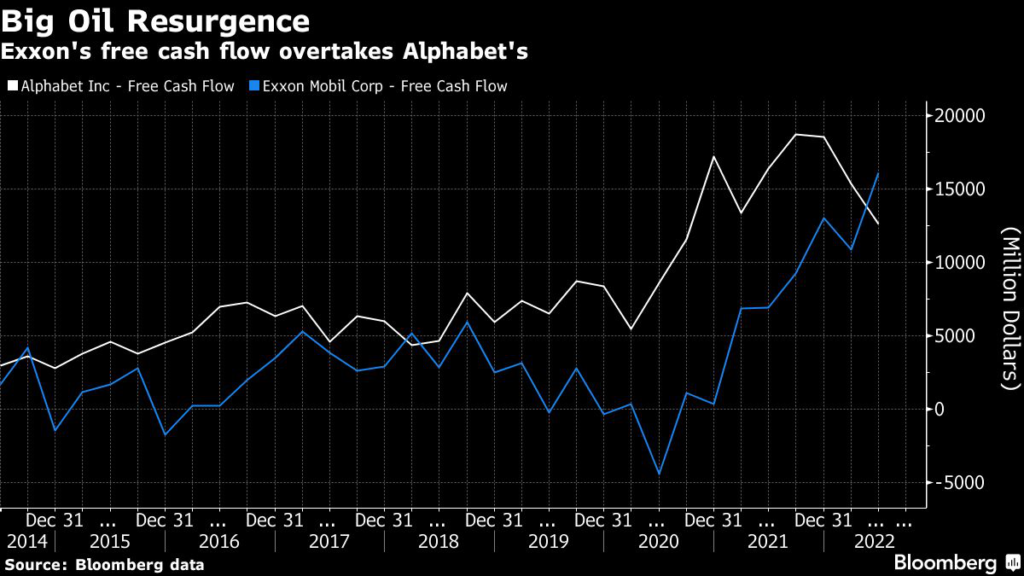
(Bloomberg) — Exxon Mobil Corp.’s cash haul overtook that of Alphabet Inc. for the first time since 2018, proving the oil giant is back in the big league just a year after suffering one of the biggest activist shareholder upsets in corporate history. 

Exxon, which lost money for the first time in its history during the pandemic, now ranks as the S&P 500 Index’s third-largest generator of free cash flow, behind only Apple Inc. and Microsoft Corp, according to data compiled by Bloomberg. 

In another sign of oil’s resurgence, Chevron Corp. jumped up in the ranks with a cash inflow that surprised analysts who were already expecting a record quarter. 

It’s a trend that Jeff Currie, Goldman Sachs Group Inc.’s chief commodity strategist, calls the “revenge of the old economy.” Though accelerated by Russia’s invasion of Ukraine, the seeds of current energy rally were sewn by the investor preference for tech-stocks over commodities in the past decade, Currie says, leading to anemic investment in hard energy assets like mines, oil fields, and refineries. 

As consumers feel the pinch of elevated fuel prices, oil explorers — especially those that prioritized crude and natural gas over renewables — are best-placed to benefit. 

“Exxon and Chevron showed a good example of the scale of shareholder returns that they can generate at $100-a-barrel oil,” said Matt Murphy, a Calgary-based analyst at Tudor, Pickering, Holt & Co. “It will catch the radar of investors who are looking for some yield as we move deeper into the recessionary environment.”

Executives at both companies said they don’t see much evidence of fuel-demand destruction even as recession fears mount. 

“I wouldn’t tell you that we’re seeing something that I would say, we are in a recession or near recession,” Exxon Chief Executive Officer Darren Woods said during a call with analysts. 

Exxon, Chevron, Shell Plc and TotalEnergies SE all reported record profits this week. All of them expanded share buybacks except Exxon, which tripled repurchases earlier in the year. 

It’s a stark reversal from much of the last decade when the sector was hammered for focusing on megaprojects, woeful financial performance and failing to advance the energy transition away fossil fuels. 

Exxon is probably the best example of the turnaround. Just a year ago, its three biggest investors handed the board a damaging defeat in electing three new directors after an acrimonious activist campaign by Engine No. 1. 

Sign up here for Elements, Bloomberg’s daily energy and commodities newsletter.

The US oil titan subsequently locked in capital spending at historically low levels and slashed costs, leaving it well-positioned to reap the benefits from soaring commodity prices. Exxon is up 58% this year. 

Woods said his plan to lift production, panned by investors and environmentalists when it was announced in 2018, is now paying off because it built cash-generating assets. “I got a lot of pressure on this, and criticism, spending that money upfront,” he said. “I think that was the right strategy.”

Investors are starting to notice. The top 10 best performers in the S&P 500 Index are all energy companies and the sector now accounts for 4.5% of the index, more than double its pre-pandemic weighting. The 10 worst include former tech superstars Netflix Inc. and Meta Platforms Inc.

“We have record free cash flow yields across the entire old economy,” Currie said on Bloomberg TV last month. “We’ve favored short-cycle iPhones over copper mines for the last decade, and this is the shortages we’re ending up with.”   


More stories like this are available on bloomberg.com

©2022 Bloomberg L.P.
UK Pressed Over Conflict of Interest Risk for OneWeb Deal

(Bloomberg) —

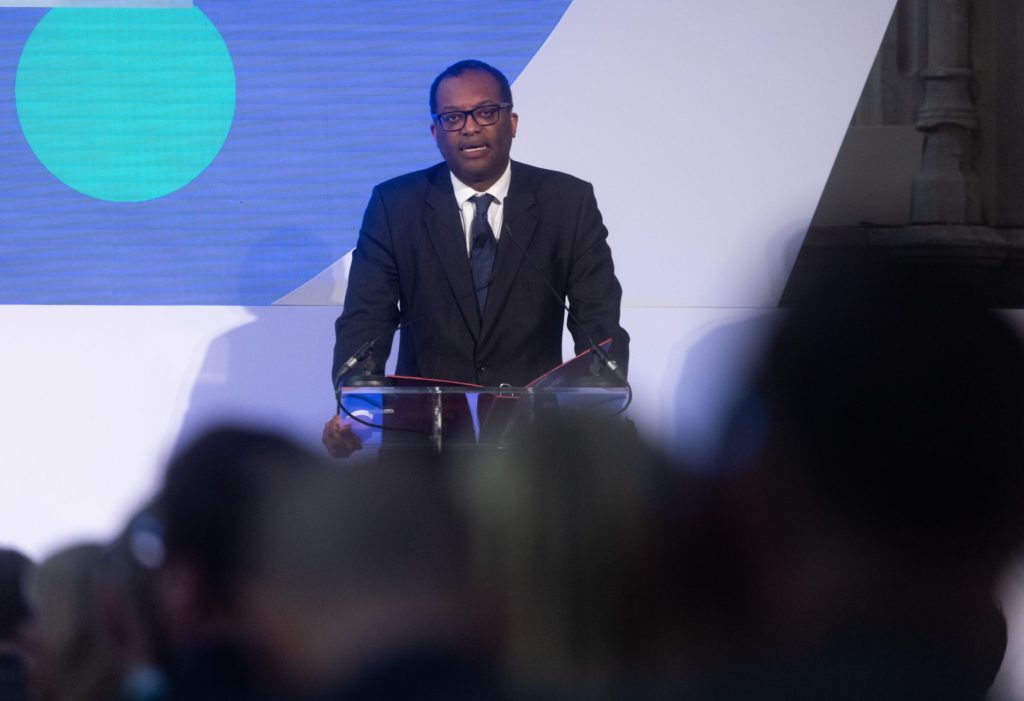
The minister in charge of the UK’s OneWeb stake is also responsible for approving its merger with France’s Eutelsat Communications SA, creating a conflict of interest, according to the head of an influential committee of lawmakers.

“You are clearly conflicted in this process as both the decision maker under the National Security and Investment Act and the government lead for our shareholding in OneWeb,” Darren Jones, chair of Parliament’s committee for Business, Energy and Industrial Strategy, wrote in a letter to Business Secretary Kwasi Kwarteng on Friday. 

New UK takeover laws that came into effect in January grant officials new national security powers to review corporate deals, including the ability to pull apart acquisitions retrospectively. Jones asked Kwarteng to explain by Aug. 12 how he’ll manage the alleged conflict and confirm that his committee will be given “enhanced scrutiny” of the deal.

“We have steps in place to prevent a conflict of interest for decisions undertaken within the remit of the National Security and Investment Act, with procedures that allow a decision to be delegated to avoid a conflict of interest,” a BEIS spokesman said by email.

“We have steps in place to prevent a conflict of interest for decisions undertaken within the remit of the National Security and Investment Act, with procedures that allow a decision to be delegated to avoid a conflict of interest.”

The UK bought OneWeb out of bankruptcy in 2020 in a controversial $500 million bet with taxpayers’ money on its constellation of small satellites that beam internet connections from low-earth orbit. On Tuesday Eutelsat and OneWeb agreed to merge to better compete with other ventures like Elon Musk’s Starlink — giving Britain and Eutelsat shareholder France significant stakes and board seats in the process.

A separate minister in Kwarteng’s Department for Business, Energy and Industrial Strategy would be responsible for the national security review, according to a person familiar with the business secretary’s thinking, who asked not to be named because the discussions are private.

In the letter, Jones also asked Kwarteng to address concerns about Eutelsat’s role in broadcasting Russian TV, “allegedly including propaganda about the Russian war in Ukraine,” and Eutelsat’s minority shareholding by the Chinese government.

(Added quote from BEIS spokesman after third paragraph.)

More stories like this are available on bloomberg.com

©2022 Bloomberg L.P.

Close Bitnami banner
Bitnami
