

Bloomberg

Kentucky Flooding Death Toll Rises to 15 and Is Expected to Grow

(Bloomberg) — Kentucky’s death toll from record flooding has risen to 16 people and many more are missing as incessant rain inundates homes, washes away roads and forces residents to seek shelter on rooftops.

“We have 16 confirmed fatalities, and folks that is going to get a lot higher,” Kentucky Governor Andy Beshear said Friday in a briefing.

As many as 28 roads in eastern Kentucky have been closed by debris, and officials are worried the Panbowl Lake Dam near Jackson could breach, Beshear said. More than 23,000 homes and businesses across the state are without power, and in some areas natural gas service has been cut and mobile phone service is down.

President Joe Biden has approved disaster funds for the state, which seven months earlier suffered from the worst tornado strike in Kentucky’s history.

Torrential rains have swept across the central US, setting records earlier this week in Missouri and causing destructive flooding in mountainous areas of eastern Kentucky and West Virginia. The floods have left many residents trapped as roads have been washed away. Sixteen shelters have been set up and at least two state parks have been opened for residents. 

Last December, more than 75 people were killed and hundreds were hurt when a powerful tornado ripped across western Kentucky. Many Federal Emergency Management Agency crews on hand to help recovery efforts from the tornado are now shifting to deal with the floods. 

“Governor, my heart aches for you going through so much tragedy again so soon,” FEMA Administrator Deanne Criswell said at the briefing. The agency is sending additional search-and-rescue teams to hunt for missing residents.

In neighboring West Virginia, Governor Jim Justice declared a state of emergency in six counties across the state due to the same heavy rains. National Guard units from West Virginia and Tennessee have arrived to help with search-and-rescue operations. At least 294 people have been plucked from flood waters so far, with as many as 100 taken by air.

While the rain will taper off Friday, rivers and streams are still struggling with the deluge and it is likely heavy downpours will return next week, said Zach Taylor, a senior branch forecaster at the US Weather Prediction Center.

“We are still looking a pretty serious situation across eastern Kentucky,” Taylor said. “Unfortunately there will be additional heavy rainfall going into Sunday and Monday.”

The North Fork Kentucky River in Jackson jumped 37.5 feet (11.4 meters) in under 33 hours as rains came down, according to the National Weather Service.

More than 7.25 inches of rain has fallen in Jackson so far this week, setting records for the dates on Tuesday, Wednesday and Thursday. Taylor said 9 to 10 inches of rain fell across a narrow band of Kentucky through the week.

There may be a little more as a frontal boundary moves south through the area. That boundary will rebound, bringing more heavy rain to start next week.

“It looks like it is going to rain a lot on Monday and Tuesday,” Beshear said.

(Updates deathtoll in first paragraph and other details throughout.)

More stories like this are available on bloomberg.com

©2022 Bloomberg L.P.

Evergrande Offers Restructuring Principle as Crisis Grows

(Bloomberg) — China Evergrande Group, the world’s most indebted developer at the center of a broader debt crisis in the country’s property industry, unveiled preliminary principles for the restructuring of its offshore debt. 

The company said that it may offer some assets outside of China to repay creditors, including shares of its electric vehicle and property management services. It added that it will try to announce a specific restructuring plan within 2022, according to a filing. 

Evergrande previously told investors it was on track to deliver a preliminary restructuring proposal by the end of July, after defaulting on dollar-bond payments late last year. The lack of further details will likely disappoint creditors who had hoped for concrete measures to salvage the world’s most indebted developer. 

Evergrande’s fate has broader implications for China’s $50 trillion financial system, and could send ripples across banks, trusts and millions of home owners. The sheer size of its liabilities of about $300 billion has left global investors worried that any collapse could spark financial contagion and curb growth in the world’s second-largest economy, which depends on the housing market for about a quarter of gross domestic product.

The restructuring will include Evergrandes’ offshore notes, debt obligations of its subsidiaries, and repurchase obligations by its unlisted online sales platform FCB Group, it said. 

Evergrande says “the principle of fair treatment of creditors will be reflected in the restructuring proposal.”

The company Chief Executive Officer Shawn Siu said that Evergrande will focus on completing construction projects, and won’t sacrifice the interest of onshore investors, according to an interview with 21st Century Business Herald. When asked why the restructuring plan fell short of market expectations, Siu said that the company encountered complicated and challenging matters, asking for more patience. 

The property giant’s liquidity scares started in 2020. It recently suffered its first rejection from local creditors to extend a note payment, which may result in a landmark onshore default. A string of other builders have added to record nonpayments since last year after a government crackdown on excessive leverage and speculation on housing. 

President Xi Jinping’s government is trying to strike a balance between curbing debt at acquisitive and leveraged private companies, while limiting the economic fallout. Xi is seeking to rein in ballooning borrowings and the billionaire class as part of his “common prosperity” campaign to reduce a yawning wealth gap. That’s led to a record wave of dollar bond defaults by developers.

Liquidity crunches have prompted developers to stall many projects across the country and leave fees unpaid. Unprecedented mortgage and loan boycotts have erupted across the country from angry homebuyers and suppliers. In one example of how this is all cascading, a group of small businesses and suppliers that said they’d stop paying their own debts blamed Evergrande for leaving them out of pocket. 

“The whole pyramid is collapsing now,” said Anne Stevenson-Yang, co-founder of J Capital Research Ltd. “What’s different is that things are worse now because of the Evergrande crisis a year ago, which is spreading its tentacles throughout the Chinese economy.”

(Updates with details about Evergrande’s announcement)

More stories like this are available on bloomberg.com

©2022 Bloomberg L.P.

Carson Block SEC Payout Mystery Deepens With Suit Outing Him

(Bloomberg Law) — Carson Block seemed an unlikely candidate for a multimillion-dollar SEC whistleblower award in March, and not just because he was under Justice Department investigation for potential stock manipulation.

For starters, the information he provided the SEC in 2011 wasn’t confidential, but instead had been blasted to thousands through emails and social media in a report he made public before sending to investigators. Block, the CEO of short selling firm Muddy Waters Inc., didn’t submit the required whistleblower tip form until years after the deadline outlined in the whistleblower program law, and then only after the commission finished its investigation of the company his online report exposed.

Yet a lawsuit filed in New York state court this week revealed that Block was the recipient of a $14 million award from the Securities and Exchange Commission in March, under a program designed to reward knowledgeable insiders who send confidential tips about corporate fraud.

The SEC paid him for a report he gave away for free a decade earlier, even though agency staff said he didn’t qualify for an award. The commission has given awards on less than 1% of the tips it receives.

The revelation sheds rare light on the SEC program, which keeps secrets well beyond its mandate to protect whistleblowers and often ignores its own rules when deciding who should get bounties that can top $100 million, according to a Bloomberg Law investigation.

It’s not clear why it took the commission 11 years to decide on Block’s award or why the SEC would reward him when, as reported by Bloomberg News, he was under investigation by the Department of Justice for some practices connected to short selling of stock.

‘There is No Explanation’

The SEC by law must keep whistleblowers’ names secret, but Block was identified when the co-author of his research report filed the lawsuit seeking half of Block’s award. Kevin Barnes said in the complaint that he deserves equal credit for the report and that his own whistleblower claim was denied after the SEC said he never filed a formal tip.

Barne’s attorney, David Slarskey, said he had no idea why it took the SEC over a decade to resolve the case.

“There is no explanation for why the SEC recognized Mr. Barnes as an author of the report, and noted his claim, but did not compensate him with part of the award,” Slarskey wrote in a statement on his client’s behalf. “Even more than that, though, Carson Block used Mr. Barnes and his work to obtain this windfall. That isn’t fair either.”

Block, through a spokesperson, declined to comment. The SEC did not respond to a series of questions from Bloomberg Law asking about its decision to award Block the money or the identity of Block’s lawyer.

As a short-seller, Block makes money by driving down share prices of public companies. In 2011, he and Barnes sent a scathing critique of a China-based company called Focus Media on social media, to journalists, and to their contacts at the SEC.

It worked. Focus Media shares plummeted 40% when it published on Nov. 21, 2011, costing shareholders $1.3 billion and driving up the value of their positions.

He didn’t file the required whistleblower tip form until 2015, after the SEC finished its investigation and had leveled a $55.6 million fine. Records indicate at least some of Block’s tip was accurate.

The SEC final order said that when the men finished the report, they sent it to thousands of people using “iContact email push notification, social media postings and significant media coverage.” Three days later Block sent it to contacts at the SEC who were not involved with the whistleblower program.

Keith Bishop, an attorney at Allen Matkins specializing in securities law, criticized the Block decision.

“This case illustrates that a government program that hands out millions of dollars while cloaked in secrecy at best invites mistrust and at worst malfeasance,” Bishop wrote in an email.

Simple Contract Case

While the staff recommended rejecting both men, the commission decided to give Block the entire pot even while acknowledging it wouldn’t typically waive the filing requirements.

The lawsuit is a simple contract case, hinging on what the men agreed to at the time and whether Barnes should get half of the award. But the few pages of information tucked into a court summons provide an inside look at the SEC process that has long been kept secret.

The whistleblower program’s staff found that Block’s late filing was disqualifying, and also concluded Block didn’t provide the agency original information as required by the law, since it had already been published and rocked the stock market.

But the commission disagreed and decided to pay for information that was already easily available to their investigators, while acknowledging it wouldn’t typically waive filing requirements in similar situations.

Claimants like Block, referred to in the SEC documents as Claimant 1, who have lawyers who understand the filing requirements “are not entitled to the automatic waiver,” the commission wrote. It also found that Block’s email blasts to unnamed SEC staff “warrant the exercise of our exemptive authority so as to find Claimant 1 eligible for an award.”

To contact the reporter on this story: John Holland at jholland1@bloombergindustry.com

To contact the editor responsible for this story: Gary Harki at gharki@bloombergindustry.com

More stories like this are available on bloomberg.com

©2022 Bloomberg L.P.
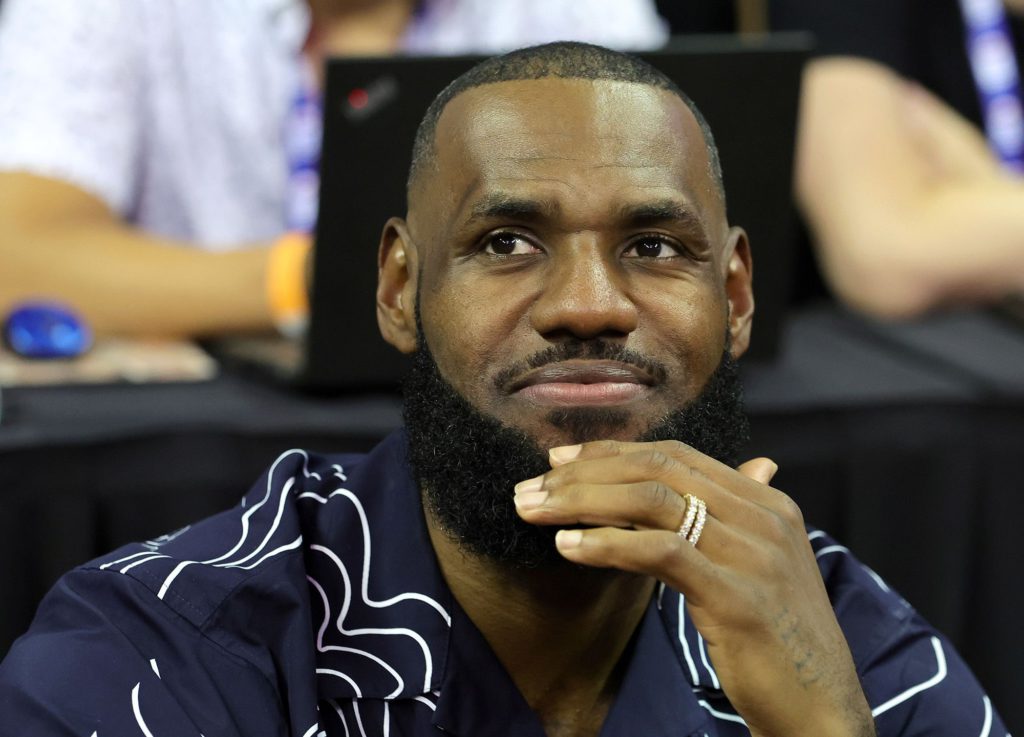
LeBron James Invests in Canyon Bikes to Help Fund US Expansion

(Bloomberg) — Los Angeles Lakers basketball star LeBron James is betting on the boom in cycling with an investment in Germany’s Canyon Bicycles GmbH. 

Canyon has raised 30 million euros ($30.5 million) from LRMR Ventures, the family office of James and sports marketing businessman Maverick Carter, and US private equity firm SC Holdings, according to a statement Friday. 

Both LRMR and SC will be passive minority investors and not join the Canyon board. James has not entered into any commercial agreement with the company.

“While we were not actively looking for new investors, LRMR and the SC team immediately understood our mission to build the world’s most inspiring and innovative bike company,” Canyon’s founder Roman Arnold said in the statement.

Founded in the 1980s, Canyon manufactures a range of mid-level to high-performance road, race and mountain bikes. The brand is the official partner of the pro racing group Movistar Team and Canyon//SRAM Racing women’s team. Richard Antonio Carapaz Montenegro won the prestigious Giro d’Italia in 2019 on a Canyon bike.

The Koblenz, Germany-based company is looking to expand its presence in the US, where it already generates about 25% of sales. Canyon revenue hit 416 million euros in 2020, a year in which bikes became an essential form of transport and exercise for people during Covid-19 pandemic lockdowns. 

Canyon has also been chasing growth in the market for hybrid bikes, which boost power with an electric motor and remove some of the effort from cycling.

More stories like this are available on bloomberg.com

©2022 Bloomberg L.P.
Intel CEO Says Third Quarter Is ‘Bottom’ After Dour Forecast

(Bloomberg) — Intel Corp. Chief Executive Officer Pat Gelsinger slashed sales and profit forecasts for the rest of the year, conceding that the struggling chipmaker needs more time to make its products competitive while assuring investors that the current quarter will be the nadir. The shares tumbled 11% Friday morning, the most in nine months.

The company, which in April had reiterated its annual sales forecast, reported steeply lower second-quarter results and said revenue this year will be as much as $11 billion less than projected, buffeted by a slackening economy and server market-share losses. The CEO of the biggest maker of computer processors essentially asked for more patience, saying he’s fixing execution issues that have dogged product releases since before he took over last year, and expressed confidence in his strategy to regain industry leadership.

“It feels like they’re clearing out a lot of the bad news,” said Matt Bryson, an analyst at Wedbush Securities, who added that the company should have cut projections several quarters ago. “If you believe in Intel, you believe in Intel in 2024, or 2025 or 2026.”

Revenue in 2022 will now be as low as $65 billion, the company said. That represents a potential decline of as much as 13% from 2021.

While investors had anticipated that a PC slump would weigh on Intel’s second-quarter performance, an unexpected 16% drop in revenue from expensive server chips that power data centers dragged down overall sales and profit. Prices are falling and customers have been turning to rival providers for their orders, Intel said.

The majority of Intel’s shortfall was caused by a slowdown in the economy, but the company’s failure to produce better products on time also contributed to the miss, Gelsinger said. The current quarter will be the low point for Intel’s performance, he said, as its customers that are working through unused stockpiles of chips haven’t been placing new orders and will soon need to resume those purchases.

“We feel very confident that it’s the bottom,” Gelsinger said in an interview.

The shares have slipped 23% so far this year, yet they found further to fall after markets closed on Thursday. Intel stock slid as low as $35.11 following the report, after closing at $39.71 in New York. 

On Thursday, Gelsinger said a delayed server product hurt Intel in the recent quarter, a result of the legacy of projects begun before he rejoined the company last year. Gelsinger sought to emphasize that under his watch as CEO, which began early last year, the company is improving its execution, and new products he has overseen will appear on time and perform as promised.

In the second quarter, revenue fell 22% to $15.3 billion, significantly below the average analyst estimate of $18 billion. Per-share profit excluding some items was 29 cents, Intel said, while analysts had predicted 69 cents. Sales in the current period will be as low as $15 billion, compared with projections of $18.7 billion, and gross margin will narrow to 47%.

The CEO said he is not backing off a plan to spend heavily on improving Intel’s manufacturing technology, building new products and getting into new markets to chase future opportunities. The “austerity” of the decline in the economy and Intel’s performance will help the company place its big bets more strategically, while cutting back on areas that aren’t key to its future, he said.


Gelsinger’s push to restore Intel’s manufacturing prowess got a boost this week, when the US Senate and House passed legislation that includes $52 billion in grants and incentives for domestic semiconductor manufacturing. Intel, which has announced new plants in Arizona and Ohio in an attempt to compete directly with Taiwan Semiconductor Manufacturing Co., has told investors that government subsidies will help cushion the impact of the multibillion-dollar investments on its overall financial picture.

In the meantime, the company expects to record restructuring charges in the current period, Chief Financial Officer Dave Zinsner said on a conference call, saying that details would be disclosed later.

Read more: Gartner Slashes Chip Industry Forecast After PC Demand Slumps

Second-quarter sales for Intel’s data-center division — where the company generates an outsize portion of profit — slid to $4.6 billion, missing the average analyst estimate of $6.04 billion. The company expects its data-center business to grow more slowly than the overall server market this year, Gelsinger said.

“It’s not a fact we like,” he said.

Client computing, Intel’s PC-chip unit, saw sales plummet 25% to $7.7 billion, compared with an average projection of $8.76 billion.

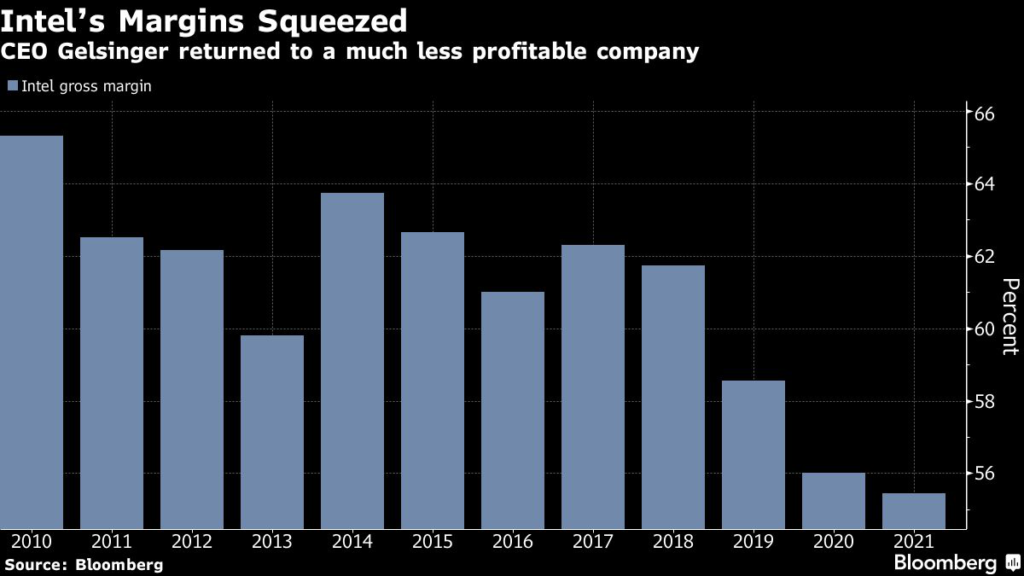
The company’s new target for 2022 revenue is $65 billion to $68 billion. Gross margin, a measure of profitability that represents the percentage of sales left after deducting production costs, will be 49% for the year, 9.1 points narrower than a year earlier and 3 points shy of what the company had targeted. That metric of profitability, once touted as an indication of Intel’s strength, is being squeezed by increasing competition, and is now more than 10 points narrower than the company’s annual gross margins for much of the past decade.

Shareholders initially welcomed Gelsinger’s aggressive plans to invest heavily to make Intel’s products and manufacturing technology more competitive. The latest results may add to escalating investor concern about how much it will cost and how long it may take to win back market share lost to Advanced Micro Devices Inc., Nvidia Corp. and TSMC. In the company’s statement Thursday, Gelsinger acknowledged the challenge.

“This quarter’s results were below the standards we have set for the company and our shareholders,” he said. “We must and will do better.”

(Updates with market trading)

More stories like this are available on bloomberg.com

©2022 Bloomberg L.P.
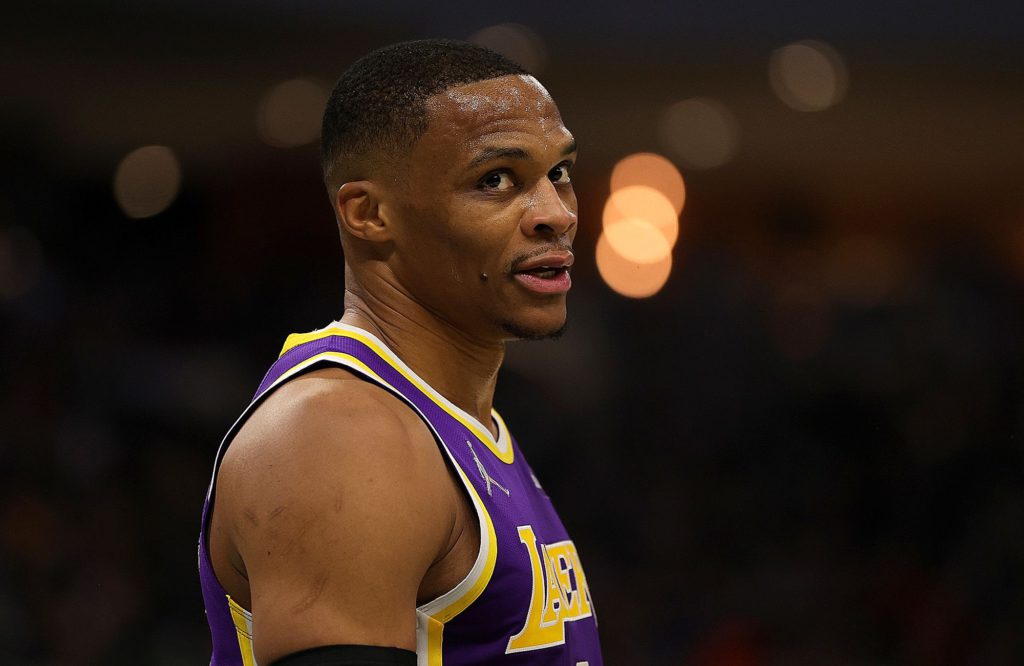
Russell Westbrook Gets Into Ad Game With New Media Venture

(Bloomberg) — Basketball star Russell Westbrook is getting into the digital media sector, adding a new division to his business as he enters the advertising industry.

The Los Angeles Lakers point guard, who makes investments and signs partnership deals through his Russell Westbrook Enterprises, is linking up with digital marketer Causal IQ to help connect advertisers with multicultural audiences through a new venture called RW Digital. Financial terms of the arrangement weren’t disclosed.

The business is staffed by dedicated teams from both companies and uses the ad-tech firm’s back-end infrastructure. Early clients include PepsiCo Inc., AT&T Inc.,  American Airlines Group Inc. and A+E Networks.

RWE is now involved in several business lines such as real estate, venture capital, insurance, education and fashion line Honor the Gift, which has collaborated with the likes of Nike Inc.’s Jordan brand and the NBA’s players union. Westbrook has also been in media, producing a History Channel documentary that debuted in May.

“We’ve been keeping so much stuff quiet,” Westbrook said. “People just see me on the court, but I want to build an enterprise that’s done the right way.”

Westbrook, 33, has been an active investor in the latter stages of his career, putting money into businesses like social network Triller Inc., Flow Beverage Corp. alkaline spring water, Health House fitness and data-science firm Tulco Holdings. Last year, he invested in Varo Bank and took on an advisory role at the digital banking company.

The nine-time All-Star is heading into his 15th season in the league as trade rumors run wild in the offseason, when he has a bit more time to work on expanding his businesses. 

“I’m locked in year-round,” said Westbrook. “This is an important thing for me, for my future, for my legacy, for our kids.”

More stories like this are available on bloomberg.com

©2022 Bloomberg L.P.
Gen Z Uses TikTok Like Google, Upsetting the Old Internet Order

(Bloomberg) — Google is for search. TikTok is for entertainment. At least that’s how it used to be.

But for the rising generation of teens and young adults, TikTok is becoming the place to find information, taking on the functions of established internet giants. The service, which boasts more than a billion users, is more than just an app where 10-to-25-year-olds watch video clips, and the older guard is taking notice.

TikTok’s sales are forecast to triple to $12 billion this year, according to EMarketer — paltry next to Google and Facebook, but big for a 5-year-old company. A third of its users are members of Gen Z, who number 67 million in the U.S. alone. That demographic is still forming shopping habits, making them crucial prospects for advertisers and technology companies. The younger users’ affinity for an upstart is also offering tech companies a counterpoint to critics who say they violate antitrust law.

“I wouldn’t be in the career position I’m in now at my current job, if it wasn’t for TikTok,” said Ezinne Ogbonna, 24, a software salesperson in the Dallas area. “I actually found a training program through someone’s TikTok, did the training program and then landed the job that I have now.”

Roughly 40% of young people today use TikTok or Instagram, owned by Facebook parent Meta Platforms Inc., over Google when searching for lunch recommendations, Prabhakar Raghavan, a Google senior vice president, said in an interview with TechCrunch this month. The data come from a survey of U.S. users ages 18 to 24. The search giant, which is facing multiple antitrust lawsuits, points to such findings to call out the strength of its competition. 

“We keep learning, over and over again, that new internet users don’t have the expectations and the mindset that we have become accustomed to.” Raghavan said in the interview. “The queries they ask are completely different.”

Read more: Google is remaking search, maps for TikTok generation

That was true for Leia Getahoun, who arrived in New York over the Juneteenth weekend for the start of an internship. With TikTok, the 20-year-old California college senior accessed search results created by average consumers or newly connected friends. The 15-second clips meant she didn’t waste time opening multiple tabs, suffer through longer videos or sort through years-old clippings.

“It’s my first week in New York, and I’m like, ‘OK, where are the good clubs that will have a lot of Black people and good music,’” Getahoun said. “After looking around I went to an event in the city that I found on TikTok and had so much fun, the atmosphere was great.”

Not everyone is so enamored with TikTok, which is owned by China’s ByteDance Ltd. US regulators have raised questions about whether data on American users ends up in the hands of the Chinese government. Management of the service has said China-based employees can access information from US users, but denied it goes to the Chinese Communist Party. The app has been downloaded more than 320 million times in the U.S., according to researcher Sensor Tower.

But for businesses looking to connect with young consumers, a key target for marketers, TikTok provides ready access — fronted by a “For You Page” where users see recent postings and advertising.

Courtney Blagrove and Zan B.R., founders of Whipped Urban Dessert Lab, the world’s first oat-milk ice cream shop, learned first hand how TikTok can help their business. The sisters’ store on New York’s Lower East Side had been open for just two weeks when the pandemic struck. When they finally got back open, they hired a social media manager to boost their presence on places like TikTok.

Carmel Drizzle

Short clips of caramel sauce being drizzled over a fresh scoop of ice cream or cookie crumbles falling from a cup have attracted more than 73,000 TikTok users to follow the ice-cream alternative.

“Social media was extremely important for us, not only for people to be able to see your product when they can’t experience it for themselves, but also for mass messaging,” B.R. said.

Nearly a year after ramping up their presence, sales are up 150% from 2021, and the store now serves roughly 500 customers in a day, often with lines wrapping around the corner. Appearing on a user’s “For You Page” allows small businesses to attract viewers and potential customers from across the nation and the world.

“It’s a business’s dream for customers to request your presence,” Blagrove said. 

To the young users of TikTok, the appeal is the clips — an entertaining, visual answer to their queries.

“We’re just like kids who don’t like to read books,” said Getahoun, who attends the University of California at Berkeley. “You give them a picture book and suddenly they start seeing the vision.”

More stories like this are available on bloomberg.com

©2022 Bloomberg L.P.
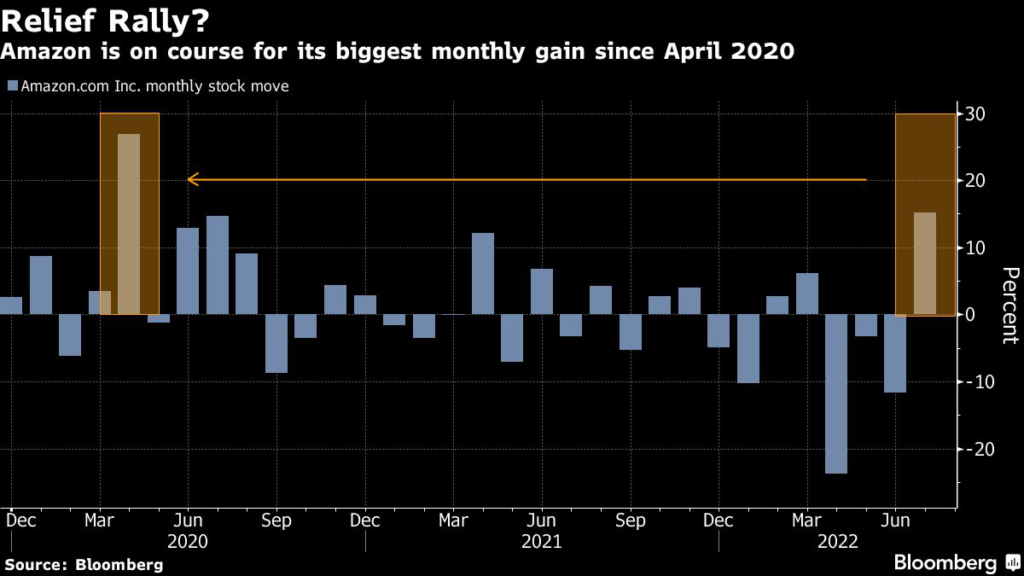
Amazon, Apple Poised to Add $170 Billion After Resilient Results

(Bloomberg) — Amazon.com Inc. and Apple Inc. are set to add nearly $170 billion in market value Friday after they joined technology peers Alphabet Inc. and Microsoft Corp. in assuaging investor concerns by reporting higher revenue even as consumers curb their spending amid rising inflation. 

Amazon shares jumped as much as 12% on Friday, their biggest move since Feb. 4, while Apple advanced 3.6%. 

Amazon expanded both its e-commerce and cloud-computing businesses, with Bloomberg Intelligence analysts noting that the company’s performance proves that “it is better positioned to weather inflationary pressures and benefits from a more-affluent customer contrary to Walmart.”

Meanwhile, Apple beat analysts’ revenue expectations thanks in part to higher iPhone sales at a time when global smartphone shipments are falling globally. To be sure, Apple reported an 11% decline in net income, however, the overall results were better than feared. 

“Apple appears to be seeing no meaningful impact on its iPhone business in the current macro environment,” Piper Sandler analyst Harsh Kumar wrote in a research note. Also, restrictions on production in China eased at the end of the quarter, which “allowed some pent-up demand to be met,” he said.

Through Thursday’s close, shares of both companies have risen 15% in July. Amazon is poised for it largest monthly advance since April 2020, while Apple is on course for its biggest monthly gain since August of that year.

Alphabet and Microsoft rose 0.4% and 0.6%, respectively. 

(Updates stock moves throughout.)

More stories like this are available on bloomberg.com

©2022 Bloomberg L.P.
Apple, Alphabet Earnings Fuel Megacap Stock Recovery

(Bloomberg) — Earnings reports from the biggest technology companies show that the group is navigating the tough economic environment better than smaller rivals, fueling a rebound in stock prices and encouraging investors about the outlook for the second half.  

Results from companies including Amazon.com Inc., Alphabet Inc. and Microsoft Corp. have lifted the Nasdaq 100 Index by 11% in July, adding about $1.5 trillion to its market value and putting it on a pace for its biggest monthly advance since November 2020. Facebook owner Meta Platforms Inc. has been the notable exception. 

“The leading companies have been putting up some of the better numbers this season, and their position as secular growth leaders still seems intact,” said Mitch Rubin, chief investment officer at RiverPark Funds. “It has been an incredibly painful road, in terms of sticking it out and owning these names, but I think this quarter marks an important inflection point.”

Here’s a look at the megacap results that came out this week:

Apple Inc.

The iPhone maker’s results beat expectations, in what was seen as a relief given concerns over supply chain issues and falling consumer spending. The stock gained 2.1% on Friday. It has risen 18% in July, its biggest monthly gain since August 2020.

Apple is showing signs of supply chain improvements in China, which bodes well for the coming period, which are seasonally its biggest quarters, Bloomberg Intelligence analyst Anurag Rana said. 

Microsoft

The initial reaction to Microsoft’s report was decidedly mixed, after both sales and earnings came in below expectations, hurt by foreign-exchange headwinds, an issue it had warned about in early June. However, the stock saw a dramatic turnaround after it gave a robust forecast for the fiscal year, with revenue and operating income seen increasing at a double-digit pace.

That Microsoft, which has a market value above $2 trillion, can steadily deliver such sizable growth is a key reason why investors continue to gravitate toward the stock.

“We’re still looking for growth, but the number of choices we have for that is rapidly narrowing,” said Patrick Burton, a portfolio manager at Winslow Capital Management, which oversees about $26 billion. “In this uncertain environment, we’re narrowing our focus to the names that can meet expectations or guide in line. That means names like Microsoft, Alphabet or Amazon.”

Shares rose 0.3% on Friday.

Alphabet

The Google parent reported revenue that was roughly in line with expectations, easing concerns about the market for online advertising. Those concerns had risen after a disastrous report from Snap Inc., although Alphabet’s Search business pointed to resilience even in a weaker backdrop.

“Search is doing much better than other forms of digital ads, so it didn’t see the weakness that Meta or Snap saw,” said Winslow’s Burton. The stock is attractive at about 17 times estimated earnings, he said. That’s below its 10-year average and the Nasdaq 100’s multiple of 21 times.

“I think you’ll see both growth and value investors moving into Alphabet,” he said.

Alphabet Rises With Search a Bright Spot of Results: Street Wrap

Shares fell 0.1% on Friday but are up 4.6% in July. It is on track for its first positive month since March, as well as its biggest monthly gain since October.

Amazon.com

The e-commerce company delivered a blowout report and gave a strong sales forecast, easing concerns about the impact that inflation is having on consumer spending. The stock gained 11%. For the month, it is up about 28%, putting it on track for its biggest one-month gain since 2007.

Meta Platforms Inc.

The Facebook parent has struggled throughout 2022, and this week’s results did little to change that narrative. The company reported its first drop in revenue ever and forecast a further fall in sales in the current period. 

Meta’s outlook did not look as dire as that of Snap, but it is also not proving to be as resilient as Alphabet’s Search business as the economic backdrop weakens.

Shares fell 1.8% on Friday. For the month, Meta is down 2% and on track for a fourth straight monthly decline. That would represent its longest such streak since 2018. 

Tech Chart of the Day

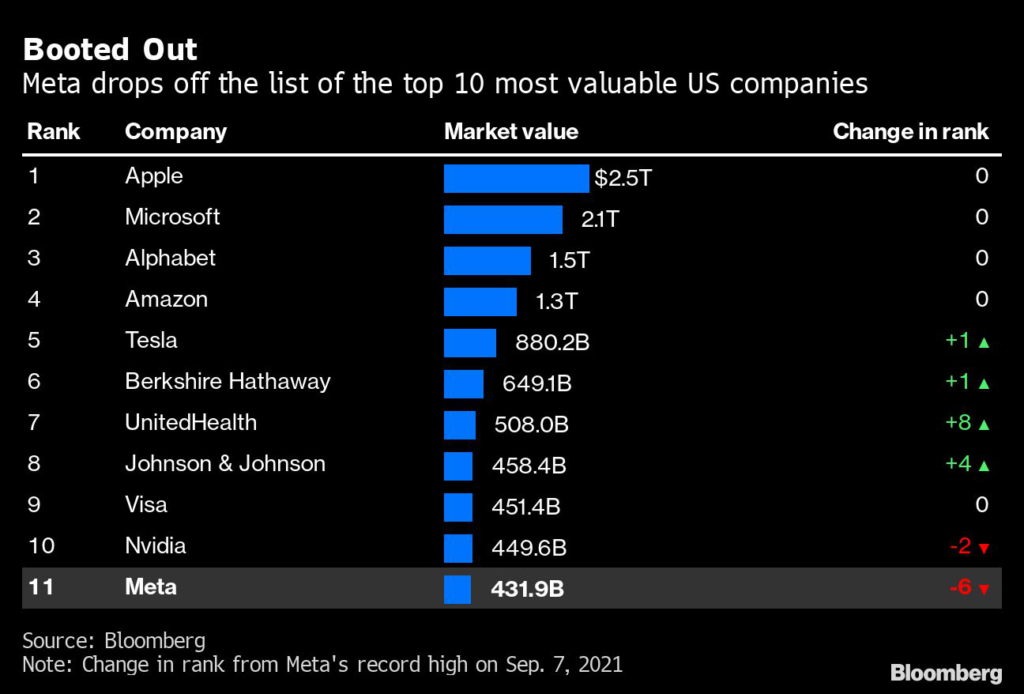
Meta’s losses have pushed the company out of the country’s list of the 10 largest companies by market value. Meta is down almost 60% from its peak in September; the market value lost by the company since then would represent the sixth-biggest company in the US, according to data compiled by Bloomberg. 

Top Tech Stories

  • Apple’s fiscal third-quarter revenue and profit narrowly topped analysts’ estimates, with iPhone sales holding up better than expected. Though Chief Executive Officer Tim Cook decried a “cocktail of headwinds” hampering Apple’s business, he predicted that sales would begin to pick up in the coming months.
    • Apple will be “deliberate” with spending decisions as it confronts an economic slowdown, Cook said in an interview with Bloomberg Television.
  • Global smartphone shipments fell to their lowest quarterly number in two years after consumer confidence was sapped by inflation and recession fears.
  • Amazon showed its e-commerce and cloud-computing businesses can churn out revenue even as consumers worry about inflation and the company gets serious about curtailing expenses.
    • Amazon will continue to hire software engineers, particularly for its Amazon Web Services and advertising businesses, but will be cautious about hiring for other departments, Chief Financial Officer Brian Olsavsky said.
  • Intel Corp. Chief Executive Officer Pat Gelsinger slashed sales and profit forecasts for the rest of the year, conceding that the struggling chipmaker needs more time to make its products competitive while assuring investors that the current quarter will be the nadir.
  • Xiaomi Corp. is facing difficulties getting regulatory approval for its electric vehicle project in China, an unexpected hurdle for the smartphone giant’s $10 billion carmaking endeavor.
  • Elon Musk said in Twitter posts that inflation might be trending down, noting that more Tesla Inc. commodity prices are trending down than up.
  • Roku Inc. slumped 25% in late trading after saying advertisers are pulling back on spending due to economic concerns, adding to jitters about the slowing growth of marketing budgets.
  • Hollywood movies will start playing in China again this year, with one of the most anticipated new films, “Avatar: The Way of Water,” among those likely to get released there, Imax Corp. Chief Executive Officer Rich Gelfond told investors Thursday.
  • Hosiden Corp., a major assembler of Nintendo Co.’s Switch console, withdrew its fiscal year sales forecast, citing difficulties procuring electronic components.
  • Krafton Inc. plunged its most in more than five months after India ordered Google to remove its blockbuster Battlegrounds Mobile game from app stores, spurring concerns about whether foreign firms can compete in the growing market.

(Updates to market open.)

More stories like this are available on bloomberg.com

©2022 Bloomberg L.P.

Musk-Twitter Trial to Start Oct. 17, Delaware Judge Rules

(Bloomberg) — Twitter Inc.’s lawsuit against billionaire Elon Musk over a canceled $44 billion buyout of the social-media platform is set for a five-day trial starting Oct. 17 in Delaware, a judge ruled. 

The decision late Thursday by Delaware Chancery Court Judge Kathaleen St. J. McCormick comes after Musk’s lawyers claimed Twitter wanted an Oct. 10 start date “without justification.” Twitter said it wasn’t opposed to Oct. 17 as long as it was assured of a full five-day trial. 

McCormick agreed earlier this month to fast-track the trial over the Musk’s failed deal to acquire Twitter for $54.20 a share, which he nixed over claims that usage statistics for the social-media platform are inflated by spam and robot accounts.

Twitter claimed Musk, the world’s richest person, was dragging his feet on setting the schedule and lobbed a letter onto the court docket without sharing it with his opponents. McCormick, in her eight-page order, warned both sides that any pre-trial information exchanges “should not be requested or withheld in an effort to inflict unreasonable demands on or extract unreasonable benefits from the opposing party.”

Twitter’s lawyers say they’ll need only four days to proves Musk is misusing questions about spam and robot accounts as a pretext to walk away from the deal. The company said it had turned over all its information about those accounts and it is seeking to force the billionaire, who co-founded Tesla Inc., to consummate the acquisition.

Musk counters in court filings Twitter’s handover of the so-called bots material hasn’t been robust and that the company’s mishandling of that data provides a legitimate basis for his cancellation of the buyout.

The case is Twitter v. Musk, 22-0613, Delaware Chancery Court (Wilmington). 

(Updates with excerpt out of judge’s order in fourth paragraph)

More stories like this are available on bloomberg.com

©2022 Bloomberg L.P.

Close Bitnami banner
Bitnami
