Bloomberg

Next Installment of Behind the Editor’s Desk at Bloomberg Crypto

  • Listen to Bloomberg Crypto on the iHeartRadio App
  • Listen to Bloomberg Crypto on Apple Podcasts
  • Listen to Bloomberg Crypto on Spotify  

(Bloomberg) — Those who are new to the world of crypto might find themselves intimidated by (or attracted to!) the volatility, complexity, and  frantic pace of an asset class that quite literally never sleeps. There are those who believe crypto and the blockchain will redefine our collective futures, and those who argue it’s just a set of solutions in search of a problem. 

The job of Bloomberg editors is to assess all these perspectives and determine how (and whether) they become stories.  

This episode of “Friday in the Editor’s Room” features a conversation with Crypto Senior Editors Anna Irrera, based in London,  and Philip Lagerkranser, based in Zurich. 

Follow us on Twitter @crypto, and subscribe to the Bloomberg Crypto Newsletter at https://bloom.bg/cryptonewsletter

More stories like this are available on bloomberg.com

©2022 Bloomberg L.P.

Chinese Government Asked TikTok for Stealth Propaganda Account

(Bloomberg) — A Chinese government entity responsible for public relations attempted to open a stealth account on TikTok targeting Western audiences with propaganda, according to internal messages seen by Bloomberg.

The attempt, which met with push-back from TikTok executives, highlights the internal tensions within the fast-growing social media app, owned by Beijing-based ByteDance Inc., which has constantly attempted to distance itself from Chinese state influence.

In an April 2020 message addressed to Elizabeth Kanter, TikTok’s head of government relations for the UK, Ireland, Netherlands and Israel, a colleague flagged a “Chinese government entity that’s interested in joining TikTok but would not want to be openly seen as a government account as the main purpose is for promoting content that showcase the best side of China (some sort of propaganda).”

The messages indicate that some of ByteDance’s most senior government relations team, including Kanter and US-based Erich Andersen, Global Head of Corporate Affairs and General Counsel, discussed the matter internally but pushed back on the request, which they described as “sensitive.” TikTok used the incident to spark an internal discussion about other sensitive requests, the messages state.

“We declined to offer support for this request, as we believed the creation of such an account would violate our Community Guidelines,” said a TikTok spokeswoman, who downplayed the incident as an informal request from a friend of an employee.

TikTok has rules against “coordinated inauthentic behavior,” where accounts conceal their true identity to exert influence or sway public opinion, and against political advertising, the spokeswoman said. 

TikTok does allow some Chinese government entities, including the Chinese embassy in the US, to have verified accounts. The company is planning to expand its state-controlled media policy, which labels state-run accounts, in the “coming months” to include other government entities, the spokeswoman added. 

Kanter and Andersen declined to comment. The Chinese government did not respond to a request for comment. 

The messages have emerged in the same week that UK foreign secretary Liz Truss pledged to crack down on Chinese-owned companies including TikTok during a head-to-head debate with Rishi Sunak as part of their campaign to succeed Boris Johnson as Prime Minister.

Chinese Foreign Ministry spokesman Zhao Lijian criticized the remarks made by Truss on Monday.

“I want to make it clear to certain British politicians that making irresponsible remarks about China, including hyping up the so-called China threat, cannot solve one’s own problems,” Zhao said during a regular news briefing in Beijing on Tuesday.

The extent to which the Chinese government exerts influence over ByteDance has been a source of tension for TikTok as it has expanded internationally. In September 2020, the Trump administration accused TikTok of being “a mouthpiece” for the Communist Party as part of an ultimately push to shut down the app in the US if it wouldn’t sell to an American owner. 

The same month, the Australian Strategic Policy Institute said in a report that TikTok often buries or hides words reflecting political movements, including criticism of Vladimir Putin, as well as hashtags relating to gender and sexual orientation or religion in most countries where it operates. At the time, TikTok strenuously denied it would cooperate with any demands from China’s regime.

A sea of government apparatus, state-sanctioned influencers and hawkish news outlets use social entertainment platforms like Douyin, the Chinese version of TikTok, Bilibili Inc. and Weibo Corp. to push propaganda to China’s young people.

The Youth League, the Communist Party’s branch for younger members, is among Douyin’s top creators, with about 8 million followers, double those of Taylor Swift.

Douyin, available in local app stores, is run as a separate entity. Both TikTok and Douyin focus on short-form video making and sharing, but Douyin has content controls to comply with Chinese law.

The Chinese government wanted advice on how to run an account that was engaging for a Western audience and that “they also mentioned payment,” according to the messages seen by Bloomberg.

More stories like this are available on bloomberg.com

©2022 Bloomberg L.P.

Kenya Says Flutterwave, Chipper Cash Not Licensed Operators

(Bloomberg) — Flutterwave Inc. and Chipper Cash are not licensed to operate as payments service providers in Kenya, central bank Governor Patrick Njoroge said.

“Flutterwave is not licensed to operate as a remittance provider or for that matter as a payments service provider in Kenya,” Njoroge told reporters in a virtual briefing in the capital, Nairobi. “They are not licensed to operate and therefore they shouldn’t be operating, and Chipper Cash we could also say the same,” he said. 

The central bank’s comments follow a Kenyan court order earlier this month freezing for 90 days multi-currency bank accounts linked to transactions by Flutterwave Payment Technology Ltd. on suspicion of money laundering.

Olugbenga Agboola and Iyinoluwa Samuel Aboyeji are named as shareholders of the company that was registered in Kenya in February 2017, court documents show. 

The central bank didn’t immediately respond to questions about how the financial technology companies have been able to facilitate payments since registering as businesses in the country.

Flutterwave Denies Impropriety After Kenyan Court Freezes Funds

Chipper Cash, which has operations in seven African countries including Uganda and Nigeria, has so far raised a total of $305 million since its launch three years ago and is valued at $2 billion.

Uganda Warns Investors Against Unlicensed Chipper Cash Trading

Flutterwave submitted its application for a Payment Service Provider license to the central bank in 2019, a company representative said. It entered the market through partnerships with licensed banks and mobile network operators, according to an emailed response to queries.

“We have been in constant engagement with the Central Bank of Kenya to ensure that we provide all the requirements, and we look forward to receiving our license,” it said. “We are committed to operating within the stipulated laws, regulations, and industry standards in Kenya.”  

Chipper Cash didn’t immediately respond to Bloomberg’s requests for comment.

(Updates with Flutterwave comments from 7th paragraph.)

More stories like this are available on bloomberg.com

©2022 Bloomberg L.P.

Apple Narrowly Tops Estimates as iPhone Fares Better Than Feared

(Bloomberg) — With investors on edge about an economic slowdown, Apple Inc. offered just enough good news Thursday to calm fears — and bought itself some time to ready a wave of new products. 

The company’s fiscal third-quarter revenue and profit narrowly topped analysts’ estimates, with iPhone sales holding up better than expected. Though Chief Executive Officer Tim Cook decried a “cocktail of headwinds” hampering Apple’s business, he predicted that sales would begin to pick up in the coming months.

“This quarter has ultimately been a reflection of our resilience and our optimism,” Cook said on a conference call with analysts. “As we look forward, we’re clear-eyed about the uncertainty in the macro environment. Yet we remain ever focused on the same vision that has guided us from the beginning.”

The shares gained 2.5% in pre-market trading on Friday. Apple had fallen 11% this year through Thursday’s close, dragged down by a broader slide among tech stocks. 

Apple warned earlier this year that the third quarter would be a rough stretch, with supply chain snags cutting sales by $4 billion to $8 billion. But in typical Apple fashion, the reality was better than expected. The constraints ultimately cost the company less than $4 billion, Cook said during the call. And that number will be lower in the current period.

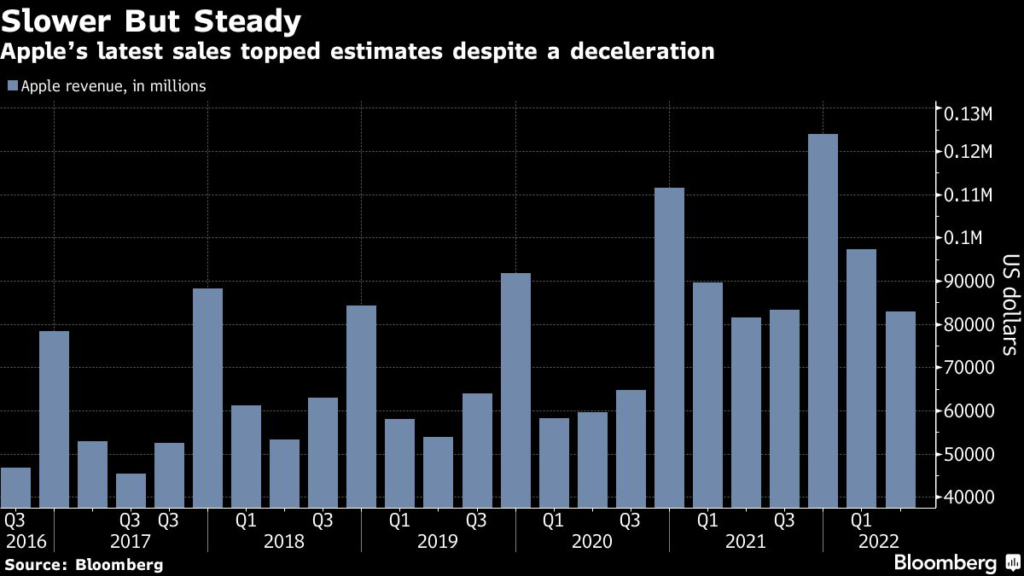
Revenue rose 2% to $83 billion in the third quarter, which ended June 25, compared with an average analyst prediction of $82.8 billion. Earnings amounted to $1.20 a share, topping the $1.16 projection.

Apple’s iPhone and iPad both performed better than feared during the quarter, though other products — including Macs and wearables — fell short of projections. Services, a key growth area for Apple, narrowly missed estimates. 

Still, the iPhone numbers suggest that Apple is weathering a slowdown in smartphone spending. Amazon.com Inc., which also reported quarterly results Thursday, provided its own reassurance to wary tech investors with stronger-than-expected sales and an upbeat forecast.

Cook acknowledged in an interview with Bloomberg Television’s Emily Chang that the company was dealing with “some softness” and a slower economy, but said he expects revenue to pick up again in the fourth quarter. Apple didn’t provide specific guidance for the period, continuing an approach it adopted at the beginning of the pandemic.

Though it’s faring better than some tech peers, Apple has grown more cautious as it confronts a sputtering economy. The iPhone maker is planning to slow hiring and spending for some teams in 2023, Bloomberg reported earlier this month.


Apple struggled to get enough supply last quarter after China’s Covid-19 precautions shuttered some factories and hamstrung deliveries. Those problems have eased but aren’t over.

China’s tough stance against the virus has led to some production restrictions for supplier Foxconn as recently as this week. The manufacturer, along with several others in the region, was forced to operate within a “closed loop” system for seven days. That means factory workers can’t have contact with people outside of their plants for that period.

The strong dollar also threatens to eat into sales. And Cook noted that supply constraints may have masked whether consumer demand is softening. Because Apple struggled to get enough inventory, it’s hard to judge whether some of it might have gone unsold. 

With the Mac and iPad, “we didn’t have enough product to test the demand,” he said.

The third quarter is typically one of Apple’s slower sales periods, and the company had little in the way of new products to offer. It released an updated iPhone SE back in March and is expected to launch fresh iPhones in September, missing the quarter that just ended. 

Even so, the iPhone generated $40.7 billion last quarter, beating estimates of about $39 billion.

Qualcomm Inc. had stoked investors’ fears about the smartphone market on Wednesday, when the chipmaker said consumers’ appetite for the devices had slowed. But the company said demand was particularly weak for low-end and mid-tier phones running Android, rather than the iPhone.

Last quarter’s sales from digital services like iCloud, AppleCare, Apple TV+ and Apple Music climbed 12% to $19.6 billion during the period. That made it Apple’s fastest-growing category, but the division came up shy of Wall Street predictions of about $19.7 billion.

Apple’s wearables, home products and accessories — the division that includes its smartwatch, HomePod, AirPods and Beats headphones — had sales of $8.08 billion last quarter. Wall Street had called for about $8.8 billion. 

Apple generated $7.38 billion from the Mac, badly missing predictions of about $8.45 billion. The company launched new MacBook Pro and MacBook Air models in July, but those didn’t contribute to the latest results because the quarter ended in June. That means many consumers probably stopped buying the old versions of the products — Apple’s two most popular Macs — hurting that category.

Without supply constraints, the Macs would have come out sooner. Earlier in 2022, Apple’s main manufacturing partners for laptops were shuttered in China due to the Covid lockdowns. That delayed the release of the new MacBook Air and MacBook Pro by several weeks. 

The Cupertino, California-based company is planning a slew of new Macs over the next several months, including high-end MacBook Pros, an iMac, upgraded Mac minis and a revamped Mac Pro, Bloomberg has reported.

The iPad, which was a strong performer at the height of Covid-19 lockdowns, has been slipping back toward pre-pandemic levels. Still, it generated $7.22 billion last quarter, above the $6.93 billion estimate. The company last updated the iPad in March with a new iPad Air model with an M1 chip. And it’s planning faster iPad Pro models for later this year. 

The ongoing Covid restrictions in China have sparked concerns about the effect on consumer spending there. In a sign that Apple has had to get more aggressive in that market, it’s currently cutting the price of the iPhone, Apple Watch and AirPods in China for a few days as part of a rare sale. 

Apple generated $14.6 billion from the country in the third quarter, down from a year earlier but better than analysts had projected.

Chief Financial Officer Luca Maestri said that Apple would see accelerated growth in the fourth quarter compared with the third, but that the services business would slacken. The company blamed a digital advertising slump for that slowdown. Still, Maestri said that Apple has over 860 billion paid subscriptions across its platforms, including its own services and third-party offerings on the App Store.

Asked about mergers, Cook said that the company is “constantly surveilling” the market for acquisitions but that Apple wouldn’t buy a company just for additional revenue. He said he wouldn’t rule out any big deals in the future, though.

“We would buy something that is strategic for us,” he said.

(Updated with shares.)

More stories like this are available on bloomberg.com

©2022 Bloomberg L.P.

Amazon Shows It Can Generate Sales While Slowing Spending

(Bloomberg) — Amazon.com Inc. showed its e-commerce and cloud-computing businesses can churn out revenue even as consumers worry about inflation and the company gets serious about curtailing expenses. Investors sent shares up more than 12% in pre-market trading on Friday.

Amazon reported second-quarter sales Thursday that topped analysts’ estimates and gave a revenue forecast for as much as 17% growth in the current period.

While he focuses on rekindling sales, Chief Executive Officer Andy Jassy is determined to unwind a pandemic-era expansion that saddled Amazon with a surfeit of warehouse space and too many employees. Fulfillment expenses increased 14% to $20.3 billion, virtually the same as the previous three-month period, and less than analysts predicted. At the same time, the former Amazon Web Services leader will spend money on the profitable market-leading cloud unit to take advantage of the potential for growth.

“Despite continued inflationary pressures in fuel, energy and transportation costs, we’re making progress on the more controllable costs we referenced last quarter, particularly improving the productivity of our fulfillment network,” Jassy said in the statement.

Chief Financial Officer Brian Olsavsky pointed out that Amazon added jobs at the slowest rate since 2019 — now employing more than 1.52 million full- and part-time workers — and its total workforce was about 100,000 less than the previous quarter. Capital expenses on warehouses and transportation are coming down, but the company is spending more on AWS, including for engineers and data centers, he said.

“We know AWS is a huge opportunity” and governments and companies are still early on the demand curve, Olsavsky said.

AWS generated sales of $19.7 billion in the period ended June 30, topping analysts’ average estimate of $19.4 billion. The company now has 34% of the almost $55 billion market for cloud infrastructure services, according to Synergy Research Group. Advertising services, another cash cow, increased 14% to $8.76 billion.

With costs rising, Amazon in February increased the price of a Prime membership in the US, then followed this week with similar hikes in Europe. It didn’t faze consumers. Subscription revenue rose 14% to $8.72 billion, reversing three straight quarters of slowing growth.

What Bloomberg Intelligence Says:

“Better-than-expected 2Q results and upbeat 3Q sales guidance shows Amazon is better positioned to weather inflationary pressures and benefits from a more-affluent customer. That’s contrary to Walmart, which is seeing consumers shift to lower-margin categories.”

— Poonam Goyal, BI senior retail industry analyst

Click here to read the research.

“The next two quarters feature Prime Day events that should recharge e-commerce momentum,” said Andrew Lipsman, an analyst at Insider Intelligence. “This will boost growth and reduce membership churn, while giving a jolt to the advertising business that’s increasingly responsible for Amazon’s bottom line. It looks like Amazon is finally primed to turn the corner after a rocky couple of quarters.”

With online sales slowing, Jassy is seeking new sources of revenue. Earlier this month, Amazon announced it would buy primary-care company One Medical in a cash deal with an equity value of $3.49 billion. The startup operates clinics in cities across the US and furthers Amazon’s push into the health care industry.

In the quarter, sales increased 7.2% to $121.2 billion. Amazon said it had a net loss of $2 billion, or a loss of 20 cents a share, compared with net income of $7.8 billion, or 76 cents a share, in the quarter a year earlier. The company attributed the loss to its investment in electric-vehicle maker Rivian Automotive Inc.

Operating income in the current quarter will range from break-even to $3.5 billion on sales that may be as much as $130 billion, the Seattle-based company said. Analysts, on average, projected a profit of $3.83 billion on sales of $127 billion, according to data compiled by Bloomberg.

Shares rose to a high of $139.39 in extended trading after closing at $122.28 in New York. The shares have dropped almost 27% this year amid a broader market downturn.

“It’s important for Jassy to reinforce their commitment to retail and acknowledge that they need to get spending to be more correlated to revenue growth,” said Michael Pachter, an analyst at Wedbush Securities Inc.

(Updated with shares)

More stories like this are available on bloomberg.com

©2022 Bloomberg L.P.

The Crypto Collapse Has Flooded the Market With Rolex and Patek

(Bloomberg) —

The collapse in cryptocurrencies is easing supply of the most sought after watches on the second-hand market, depressing prices for hard-to get-Patek Philippe and Rolex models.

The supply of trophy watches such as the Rolex Daytona or Patek Nautilus 5711A “is now much larger,” online-watch trading platform Chrono24 said in an emailed statement. 

The recent swoon in cryptocurrency valuations “has directly impacted pricing of luxury watches from brands like Rolex and Patek Philippe,” said the company, which is based in Karlsruhe, Germany, and has more than half a million watches listed for sale on its website.

The price decline for the most sought after models is the latest indication that the once soaring second-hand luxury watch market is starting to lose pace. Surging valuations for crypto currencies had minted a new class of luxury buyers, leading to an unprecedented price increase for models particularly from brands like Rolex, Audemars Piguet and Patek. Now that many digital tokens have been hammered, these consumers are going into reverse.

Chrono24 Co-CEO Tim Stracke said the pullback for some models represents a consolidation as prices for the most sought after timepieces fall closer in line with similar watches.

At the same time, Stracke said trading volumes on the platform, which links dealers or private sellers with buyers, have jumped more than 50% in the first half of the year.

The price of a Patek Philippe Nautilus 5711A, which sells for about $35,000 at retail, surged to $240,000 in the first quarter, according to Chrono24. Now the blue-dialed steel sports watch is fetching about $190,000. 

Chrono24 has seen price increases for watches like the Girard-Perregaux Laureato as well as many Cartier and Breitling models. Demand has also risen for nearly all models from the Omega Speedmaster collection, the result of a collaboration with sister brand Swatch, Chrono24 said.

Chrono24, which is mulling a potential IPO, said it expects a further increase in overall sales transacted on the site in the second half of the year. 

More stories like this are available on bloomberg.com

©2022 Bloomberg L.P.

Zilingo COO Quits in Latest Blow for Singapore Startup

(Bloomberg) — The chief operating officer of Zilingo Pte has resigned from the company after a tenure during which the fashion e-commerce startup rose to prominence before plunging into a crisis.

Aadi Vaidya, who joined the company in 2015 and became the COO two years later, confirmed his resignation when contacted by Bloomberg News. Friday is his last day at the company, Vaidya said in his response.

“I have resigned and decided to move on from Zilingo,” he said. “It was a place that shaped me both personally and professionally and gave me great colleagues and friends. I feel now is the time to move on, clear my head and reset priorities for the future.”

It marks the latest high-level departure at the troubled company. Chief Executive Officer Ankiti Bose was dismissed in May after an investigation by an independent firm into complaints of financial irregularities. Chief Financial Officer Ramesh Bafna, a former CFO of fashion e-commerce platform Myntra, also left in May, a mere two months after joining the startup.

The exits put the company under the leadership of Dhruv Kapoor, co-founder and chief technology officer who owns about 8% of Zilingo. Vaidya has a 2% stake in the company. Kapoor has been trying to draw investment to keep the company afloat.

Read more: Zilingo’s Board to Weigh Options Including Liquidation or Buyout

More stories like this are available on bloomberg.com

©2022 Bloomberg L.P.

Sony Cuts Profit Outlook on Weaker PlayStation Prospects

(Bloomberg) — Sony Group Corp. cut its profit outlook as its PlayStation division faltered and game sales slumped.

The Tokyo-based entertainment conglomerate said on Friday that it now expects 1.11 trillion yen ($8.3 billion) in operating profit, down from 1.16 trillion yen previously. The gaming and network services group, which houses the PlayStation business, accounted for the full revision, taking a 16% cut from 305 billion yen to 255 billion yen.

Sony revised its outlook on costs related to its acquisition of Bungie Inc., the weaker yen and lower expectations for third-party software sales on the platform. The company’s games underwhelmed in the April-June quarter with 47.1 million sales of PlayStation 4 and 5 titles, down from 63.6 million in the same period a year ago. Play time across PlayStation products was down 15% in the quarter, Chief Financial Officer Hiroki Totoki said, and PlayStation Plus members fell slightly to 47.3 million.

Sony’s PlayStation 5 hardware production has been limited by chronic supply chain bottlenecks exacerbated by extended Covid-19 lockdowns in China over the past three months. The company sold 2.4 million PlayStation 5 units in the period, slightly better than the 2.3 million from a year ago.

“While we stand pat on our projection of selling 18 million units of PS5 this fiscal year, conditions surrounding PlayStation 5 are improving,” Totoki said on an investor call after the earnings were released. “We plan to front-load shipments for the year-end shopping season.”

The company’s April-June operating profit of 307 billion yen beat average estimates of 286.7 billion. Movies and music results were boosted by the yen’s weakness and Sony said it now expects higher revenue from its music division because of the positive currency impact. Revenue from streaming services and anime content helped sustain the good results.

Investors will be looking for signs that Sony can weather the current macroeconomic challenges by relying on the rest of its portfolio beyond the keystone PlayStation business. Camera image sensors, Sony’s other big hardware initiative, also got a cut in its sales forecast, however Sony maintained its profit outlook for the division on the expectation of a sustained foreign exchange tailwind.

Supply chain snarls will likely continue to trouble electronics makers this year as the re-emergence of Covid infections and Russia’s invasion of Ukraine affect shipping, production capacity and the cost of materials. South Korean giant Samsung Electronics Co. said a day earlier that it’s adjusting its forecast on an almost daily basis because of the high degree of geopolitical volatility and economic uncertainty. Component makers, logistics specialists and manufacturing machinery providers have expressed skepticism that the supply chain can return to normal operation this year.

Read more: Vital TSMC Supplier Warns of Chip Material Price Hikes Into 2023

(Updates with CFO comments)

More stories like this are available on bloomberg.com

©2022 Bloomberg L.P.
Renault Moves Past Russia Loss With Improved 2022 Outlook

(Bloomberg) — Renault SA raised its outlook for the year as the struggling French automaker sought to draw a line under a costly withdrawal from Russia that led to a first-half loss.

The manufacturer expects group operating returns of more than 5%, up from a previous goal of 3% as new models and better pricing improve profitability, Renault said Friday. The worse-than-expected net loss of 1.36 billion euros ($1.4 billion) stemmed from a 2.2 billion-euro writedown on the value of its Russian operations.

“We are now able to absorb the most serious shocks,” Chief Executive Officer Luca de Meo said during a presentation, noting that the company still has work to do to catch up with competitors.

The better prospects for the year may see de Meo achieving a 5% mid-decade profitability target years in advance. 

The shares rose as much as 5.3% in early Paris trading, trimming losses since the start of the year to 5.9%.

While the results surpassed expectations by many measures, the company remains “a work in progress” compared to other automakers, RBC analyst Tom Narayan wrote in a note. 

Like rivals, Renault is benefiting from selling fewer vehicles at higher prices along with its own revamped portfolio that includes the Megan and Arkana E-Tech models. Renault stuck to its previous forecast that chip shortages will shave production by around 300,000 this year. Vehicle sales dropped nearly 30% to around 1 million during the period due to the retreat Russia, which was its second biggest market, and an inability to produce some vehicles due to a shortage in components. 

Renault’s improved margin of 4.7% for the first half still falls well short of the double-digit result reported Thursday by bigger European mass market competitor Stellantis NV for the same period. 

What Bloomberg Intelligence Says:

Renault’s 1H operating margin of 4.7% — a 160-bps beat, despite exiting its profitable Russian business — and raised full-year margin guidance (by 200 bps to 5%-plus) increases our optimism for a 50% uplift to 2022 consensus Ebit. The 2H outlook is strong on easing supply constraints and pent-up demand, though 2023 downside risks include recession concerns, falling asset prices and waning consumer confidence.

— Michael Dean, BI automotive analyst

The carmaker also upgraded its prediction for automotive operational free cash flow for the year to more than 1.5 billion euros, a big jump from the previous “positive” guidance.

Renault made an early 1 billion-euro repayment of state-backed pandemic loans and plans to write a similar check in the second half, pledging to reimburse the entire loan by the end of 2023 “at the latest.”

As part of the shift to EVs, the carmaker is planning to carve out electric and combustion-engine businesses, having promised to give details in the fall.  

The move would be aimed at regaining lost ground to rivals Volkswagen AG and Stellantis. Renault relies heavily on the flagging European market and on Japanese partner Nissan Motor Co., which is also emerging from a difficult period. 


(Adds shares and analyst comment from fifth paragraph.)

More stories like this are available on bloomberg.com

©2022 Bloomberg L.P.
US Futures Rally on Earnings, Fed Outlook; Yen Up: Markets Wrap

(Bloomberg) — US equity futures rallied Friday on positive earnings from Amazon.com Inc. and Apple Inc. and expectations of shallower Federal Reserve monetary tightening, a prospect that’s also supporting Treasuries.

Nasdaq 100 contracts added more than 1% after the US stock market hit a seven-week high Thursday. Amazon jumped over 13% in extended trading, while Apple also advanced, after their revenues beat estimates.

The tone was more somber in Asia, hampered by a tumble in Chinese tech shares that dragged Hong Kong toward a correction of more than 10% from a June high. A downbeat economic growth assessment from China’s top leaders and a lack of new stimulus policies contributed to the dour regional mood.

A jump in Treasuries has left the 10-year yield near the lowest since April. Data showing a second straight quarterly US economic contraction supported arguments that inflation will cool and that the Fed will become less aggressive.

The yen strengthened 1% as the dollar retreated. Oil hovered around $97 a barrel. Gold edged higher. Bitcoin breached the $24,000 level, on course for its best month since 2021.

Global shares are set for a second weekly advance, paring this year’s rout to about 16%. The risk is that the recent bout of optimism eventually gets a reality check if inflation stays stubbornly elevated, leaving interest rates higher than investors would like amid an economic downturn.

“At some point, the Fed will pivot policy and that should be better for risk markets, but in the meantime, they’re so bent on quelling inflation that we prefer not to buy the dip here,” Thomas Taw, head of APAC iShares Investment Strategy at BlackRock Inc., said on Bloomberg Radio.

Second-quarter US gross domestic product fell an annualized 0.9% after a 1.6% drop in the first three months of the year. Back-to-back quarters of decline define a recession in most parts of the world, but in the US it’s not official until economists at the National Bureau of Economic Research deem it so.

Swaps tied to Fed meeting dates anticipate a peak in the fed funds rate of about 3.25% around year-end, less than a percentage point above its current level, followed by reductions next year to shore up growth. Such pricing is a major bone of contention for market participants.

“Market pricing is overdone and the terminal rate should move closer to 3.5%-3.75%” as inflation remains too high amid strong labor and wage trends, wrote Priya Misra and Gennadiy Goldberg, strategists at TD Securities.

Elsewhere, a call between US President Joe Biden and China’s Xi Jinping underlined bilateral tension even as the leaders sought an in-person meeting.

Here are some key events to watch this week:

  • Euro-area CPI, Friday
  • US PCE deflator, personal income, University of Michigan consumer sentiment, Friday

Musk, Tesla and Twitter are this week’s theme of the MLIV Pulse survey. Also share your views on the S&P 500’s biggest stocks. Click here to get involved anonymously.

Some of the main moves in markets:

Stocks

  • S&P 500 futures rose 0.8% as of 7:28 a.m. in London. The S&P 500 rose 1.2%
  • Nasdaq 100 futures rose 1.5%. The Nasdaq 100 rose 0.9%
  • Japan’s Topix index shed 0.4%
  • South Korea’s Kospi index added 0.5%
  • Hong Kong’s Hang Seng index fell 2.3%
  • China’s Shanghai Composite index was down 0.8%
  • Australia’s S&P/ASX 200 index climbed 0.8%
  • Euro Stoxx 50 futures were up 0.8%

Currencies

  • The Bloomberg Dollar Spot Index fell 0.5%
  • The euro was at $1.0249, up 0.5%
  • The Japanese yen was at 132.59 per dollar, up 1.3%
  • The offshore yuan was at 6.7467 per dollar

Bonds

  • The yield on 10-year Treasuries fell about two basis points to 2.66%
  • Australia’s 10-year yield dropped 15 basis points to 3.06%

Commodities

  • West Texas Intermediate crude was at $96.98 a barrel, up 0.6%
  • Gold was at $1,766.70 an ounce, up 0.6%

More stories like this are available on bloomberg.com

©2022 Bloomberg L.P.

Close Bitnami banner
Bitnami