Bloomberg

Indonesia Resumes Sending Workers to Malaysia After Agreement

(Bloomberg) — Indonesia will resume sending workers to Malaysia on Aug. 1, ending a two-week halt after the both sides agreed to resolve labor issues. 

Malaysia conceded a number of problems that prevented the country from complying with bilateral agreements on the protection and hiring of Indonesian workers, according to a statement from the Indonesian manpower ministry. 

Ministers from the two countries met on Thursday to discuss the issue and signed a joint statement to ensure existing labor accords are implemented, allowing the Indonesian government to move toward ending its suspension.

Indonesia to Temporarily Halt Sending More Workers to Malaysia

Malaysia, which relies on migrant labor from countries including Indonesia, continues to struggle with a shortage of workers in key sectors including palm oil, manufacturing and semiconductors.

In a joint statement issued after the meeting, both countries agreed to commit to the use of a single hiring system for the placement of Indonesian workers. 

More stories like this are available on bloomberg.com

©2022 Bloomberg L.P.

Sony Cuts Profit Outlook on Lower PlayStation Prospects

(Bloomberg) — Sony Group Corp. cut its profit outlook for the fiscal year, with its PlayStation division expected to contribute less than previously forecast.

The Tokyo-based entertainment conglomerate said on Friday that it now expects 1.11 trillion yen ($8.3 billion) in operating profit, down from 1.16 trillion yen previously. The gaming and network services group, which houses the PlayStation business, accounted for the full revision, going down from 305 billion yen to 255 billion yen. Sony cited costs related to its acquisition of Bungie Inc. and lower expectations for third-party software sales on the platform as reason for the change.

The company’s April-June operating profit beat estimates, coming in at 307 billion yen, higher than the average analyst estimate of 286.7 billion. Investors will be looking for signs that Sony can weather the current macroeconomic challenges by relying on the rest of its portfolio beyond the keystone PlayStation business. 

The outlook downgrade comes after Sony’s hardware production was limited by chronic supply chain bottlenecks exacerbated by extended Covid-19 lockdowns in China. The company sold 2.4 million PlayStation 5 units in the period, slightly better than the 2.3 million from a year ago.

Supply chain snarls will likely continue to trouble electronics makers this year as the re-emergence of Covid infections and Russia’s invasion of Ukraine affect shipping, production capacity and the cost of materials. South Korean giant Samsung Electronics Co. said a day earlier that it’s adjusting its forecast on an almost daily basis because of the high degree of geopolitical volatility and economic uncertainty. Component makers, logistics specialists and manufacturing machinery providers have expressed skepticism that the supply chain can return to normal operation this year.

Read more: Vital TSMC Supplier Warns of Chip Material Price Hikes Into 2023

(Updates with more details from announcement)

More stories like this are available on bloomberg.com

©2022 Bloomberg L.P.

Phone Shipments Plunge to Pandemic Lows as Demand Ebbs

(Bloomberg) — Global smartphone shipments fell to their lowest quarterly number in two years after consumer confidence was sapped by inflation and recession fears.

The quarter to June saw a 9% drop to roughly 290 million units shipped, market trackers Canalys, Counterpoint and IDC said, with Chinese vendors leading the declines. Market leader Samsung Electronics Co. retained the top spot with about 62 million units while Apple Inc. held second, followed by Xiaomi Corp., Oppo and Vivo. The Chinese trio each registered double-digit drops in shipments with Xiaomi down 25%, according to the data.

Prolonged Covid-19 lockdowns in Shanghai and Beijing took a toll on domestic sales in China, while the wider market is now challenged by a glut of lower-priced devices and a reluctant consumer, the analysts found.

“Supply chain shortages are no longer the most pressing issue as component orders are being cut rapidly and suppliers have started to be concerned about oversupply,” Canalys analyst Toby Zhu wrote in a report. “Geopolitical issues, a dip in consumer confidence and high inflation will continue to damage future market performance, despite upcoming new launches and festival sales in the second half of 2022.”

Samsung downgraded its mobile market forecast for the second half of the year to either flat or slight growth, the South Korean company said after reporting earnings on Thursday. The caution about weaker demand was echoed by Apple’s post-earnings conference call, where Chief Executive Officer Tim Cook pointed to macroeconomic headwinds, the sales pause in Russia and disruption in China for the poor performance of Apple Watch and Mac products in the quarter.

In the Chinese market, smartphone shipments fell almost 15% in the June quarter, according to IDC. The one brand that swam against the tide was Honor: the Huawei Technologies Co. spinoff almost doubled its shipment in China to 13.1 million units, thanks to new devices targeting the entry-level market, IDC said.

(Adds IDC data in second, sixth paragraphs)

More stories like this are available on bloomberg.com

©2022 Bloomberg L.P.

Xiaomi’s $10 Billion Car Project Hits Regulatory Barrier

(Bloomberg) — Xiaomi Corp. is facing difficulties getting regulatory approval for its electric vehicle project in China, an unexpected hurdle for the smartphone giant’s $10 billion carmaking endeavor.

The Beijing-based company has been talking to officials at the National Development and Reform Commission about the licensing for months without success, according to people familiar with the matter.

Xiaomi is one of the later would-be entrants to a Chinese EV sector already teeming with rivals, including longer-established names BYD Co. and Nio Inc. But billionaire co-founder Lei Jun, who has said EVs will be his final startup endeavor, hopes Xiaomi’s expertise in connected technologies and building loyal user communities can translate in the world’s biggest EV market. But the longer the delay in securing a license, the bigger the head start its rivals will gain.

The smartphone and electronics maker is pursuing new growth areas after logging its first sales decline on record in the first quarter. While some Xiaomi executives are hopeful the authority will eventually green-light the EV project, others worry the process will delay the company’s plans, said one of the people, who asked not to be named discussing internal matters. Xiaomi incorporated its EV subsidiary in September 2021, allowing the company to begin the application process.

Shares of Xiaomi fell as much as 5.4% on Friday in Hong Kong. A company representative declined to comment. The NDRC didn’t immediately respond to a fax seeking comment.

What Bloomberg Intelligence Says

Xiaomi’s difficulty in securing a carmaking license in China, as reported by Bloomberg News, could hinder its EV development and postpone the debut planned for 2024. The delay could prolong the drag from hefty R&D expenses as well as fixed asset investments and may weigh on its market share as China’s EV segment is getting increasingly crowded with fast-growing rivals Nio, Xpeng and Li Auto. 

– Steven Tseng and Sean Chen, analysts

Click here for the research.


China has been stepping up scrutiny of the EV sector, after a rush into the industry led to a spate of high-profile bankruptcies. New EV applicants are asked to submit a series of documents to prove their financial and technological capabilities, and the review process can take months. The government also sometimes rejects applications, with companies then back at square one when it comes to the regulatory process.

The absence of a carmaking license has had limited impact on Xiaomi’s EV development efforts for now, said one of the people. The EV division has more than 1,000 employees and Xiaomi has said it plans to mass produce its first vehicle in 2024. It has acquired land in the southeastern suburbs of Beijing for an assembly plant, and bought EV startups to add technology.

In early 2021, Lei pledged to invest about $10 billion over 10 years to make Xiaomi-branded cars. The 52-year-old has largely retreated from the public eye to spend time on the EV project.

China’s electric car market is already crowded, with Tesla Inc., Nio and Warren Buffett-backed BYD among the biggest players. A growing number of tech companies from Baidu Inc. to Huawei Technologies Co. are exploring business opportunities in autonomous driving, smart cockpit and power management technologies.

(Updates with share action and analyst’s comment starting in fifth paragraph)

More stories like this are available on bloomberg.com

©2022 Bloomberg L.P.

Renault Moves Past Russia Loss With Improved Outlook

(Bloomberg) — Renault SA raised its outlook for the year as the struggling French automaker sought to draw a line under a costly withdrawal from Russia that led to a first-half loss.

The manufacturer expects group operating returns of more than 5%, up from a previous goal of 3% as new models and better pricing improve profitability, Renault said Friday. The worse-than-expected net loss of 1.36 billion euros ($1.4 billion) stemmed from a 2.2 billion-euro writedown on the value of its Russian operations.

“Despite all the headwinds related to the stop of the activity in Russia, the semiconductor crisis and cost inflation, the group continues to improve its operating performance,” Chief Executive Officer Luca de Meo said.

The better prospects for the year may see de Meo achieving a 5% mid-decade profitability target years in advance.  

Like rivals, Renault is benefiting from selling fewer vehicles at higher prices along with its own revamped portfolio that includes the Megan and Arkana E-Tech models. Renault stuck to its previous forecast that chip shortages will shave production by around 300,000 this year. Vehicle sales dropped nearly 30% to around 1 million during the period due to the retreat Russia, which was its second biggest market, and an inability to produce some vehicles due to a shortage in components. 

Renault’s improved margin of 4.7% for the first half still falls well short of the double-digit result reported Thursday by bigger European mass market competitor Stellantis NV for the same period. 

The carmaker also upgraded its prediction for automotive operational free cash flow for the year to more than 1.5 billion euros, a big jump from the previous “positive” guidance.

Renault made an early 1 billion-euro repayment of state-backed pandemic loans and plans to write a similar check in the second half, pledging to reimburse the entire loan by the end of 2023 “at the latest.”

As part of the shift to EVs, the carmaker is planning to carve out electric and combustion-engine businesses, having promised to give details in the autumn.  

The move would be aimed at regaining lost ground to rivals Volkswagen AG and Stellantis. Renault relies heavily on the flagging European market and on Japanese partner Nissan Motor Co., which is also emerging from a difficult period. 


(Adds details on loan repayment in eight paragraph)

More stories like this are available on bloomberg.com

©2022 Bloomberg L.P.

Nintendo Supplier Withdraws Outlook Citing Chips Uncertainty

(Bloomberg) — Hosiden Corp., a major assembler of Nintendo Co.’s Switch console, withdrew its fiscal year sales forecast citing difficulties procuring electronic components.

The Osaka-based company said uncertainty about its own and its clients’ ability to secure sufficient chips pushed it to retract its previous outlook in a filing to the Tokyo Stock Exchange Thursday. More than half of Hosiden’s revenue comes from its Nintendo business, according to company documents, suggesting Switch console production may be falling behind schedule.

Nintendo reports earnings on Wednesday. The company has said it plans to sell 21 million Switch units in the fiscal year ending March. A company representative declined to comment.

Hosiden shares surged as much as 14% in Tokyo on Friday after the assembler reported better-than-forecast earnings for the April-June period and consequently upgraded its forecast for the half-year term ending September. The weakened yen boosted those results, however currency volatility and semiconductor procurement uncertainty made it unfeasible to offer a reasonable projection for the full year, the company said.

“The newest outlook by Hosiden shows production is likely to decline in the July-September quarter from April-June, which should be the other way around for the entertainment business, which tends to ramp up output in the buildup to the year-end holiday season,” Toyo Securities analyst Hideki Yasuda said. “This suggests its client’s fiscal year plan is becoming harder to achieve.”

(Updates with Nintendo response in third paragraph)

More stories like this are available on bloomberg.com

©2022 Bloomberg L.P.

Alibaba Slumps 5% as Traders Assess Earnings Risk, Ant Report

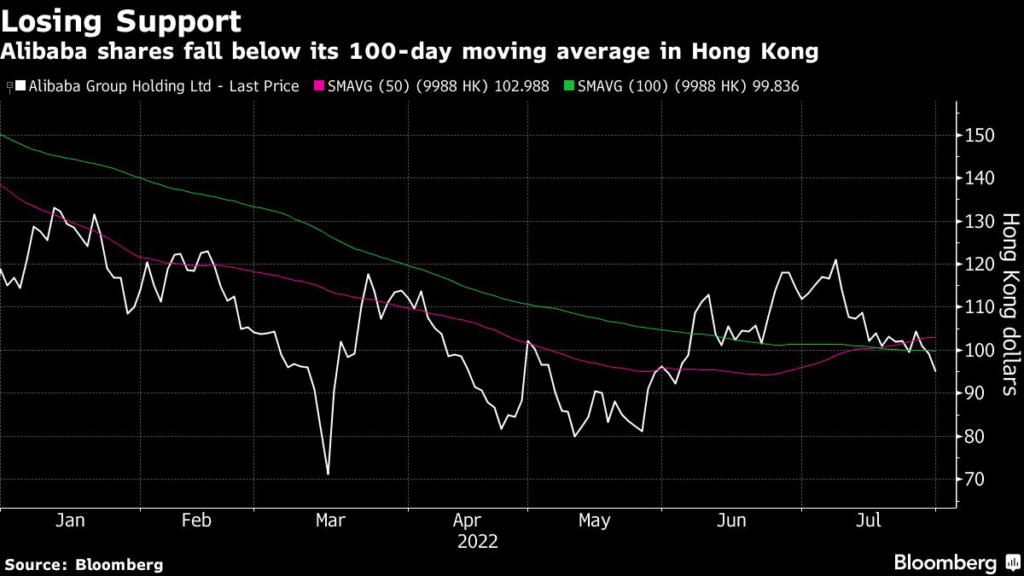
(Bloomberg) — Alibaba Group Holding Ltd. fell for a third straight day as investors assessed the impact of Jack Ma reportedly ceding control of his fintech arm, and as worries over its earnings dragged. 

Shares were down as much as 5.5% in Hong Kong on Friday, among the biggest decliners on the Hang Seng Tech Index. The tech giant is expected to report its first-ever negative quarterly revenue growth next week.  

Selloff continued as traders debated the implications of a report that Ma may give up his reign over Ant Group Co., a third of which is owned by Alibaba. While the move can clear some regulatory headwinds for both entities, a change in leadership may delay the initial public offering of Ant.

“On top of earnings concern, there are some worries that the listing timetable for Ant might be delayed by Jack Ma’s decision,” said Kenny Wen, head of investment strategy at KGI Asia in Hong Kong. “It’s hard for A-share companies to obtain approval if there is a change in key shareholding structure within three years.”

Read: Ma Ceding Ant Grip to Ease Risks, Caution Remains: Street Wrap

Alibaba now trades more than 9% below its Tuesday close, when its plan to shift its Hong Kong listing to primary buoyed optimism over mainland capital inflow. 

KGI Asia’s Wen also cited Hangzhou city’s market regulator warning online food delivery platforms including Ele.me, which is controlled by Alibaba, over a price war as negative for the stock. 

The Hang Seng Tech Index fell as much as 3.6% to trade below its 50-day moving average. Other big decliners included JD Health International Inc. and Kuaishou Technology. 

More stories like this are available on bloomberg.com

©2022 Bloomberg L.P.

Jack Ma Escapes Beijing’s Crosshairs by Giving Up His Power

(Bloomberg) — Jack Ma is taking a weeks-long tour in Europe after largely disappearing from public view for almost two years, adding to signs that China’s government is easing pressure on the entrepreneur as he steps back from a business empire that had made him one of the country’s most powerful people.

The 57-year-old co-founder of Alibaba Group Holding Ltd. has popped up at restaurants in Austria, toured a university in the Netherlands to learn about sustainable agriculture and docked his yacht off the Spanish island of Mallorca, according to reporting by Bloomberg and local media.

While it’s not Ma’s first trip outside China since he criticized Communist Party officials in 2020 over regulation of his fintech giant Ant Group Co., it’s a stark change from the days when the billionaire was being advised by the government to not leave the country. In one sign of how skittish investors had been about the tycoon’s fate as recently as two months ago, Alibaba shares briefly lost $26 billion after a state media report that authorities had imposed curbs on a person surnamed Ma. Subsequent information made clear the report was referring to someone else.

Ma has had to make significant concessions to get out of the government dog house. After regulators torpedoed Ant’s hotly anticipated initial public offering in 2020, the company overhauled operations to comply with tighter controls and have discussed regularly with the country’s central bank how to “rectify” operations. In its early years, Ant’s success in services like digital payments and money market deposits threatened the dominance of major state-backed banks.

Read more: Ma Ceding Ant Control Would Cut Risk, Boost Alibaba: Street Wrap

Ant has also verbally signaled to regulators that Ma intends to cede his control over the company, according to people familiar with the matter, adding they have conveyed those plans to officials and the central bank for years. One proposal under consideration involves transferring Ma’s shares to other executives so the company can be overseen by a committee, one of the people said.

In a filing this week, Alibaba reiterated that Ma “intends to reduce and thereafter limit his direct and indirect economic interest in Ant Group over time” to a percentage that does not exceed 8.8%. Ma currently holds 50.52% voting rights in Ant.

“A significant key man risk will be removed from the neck of Ant” if Ma cedes control, said Justin Tang, the head of Asian research at United First Partners. 

Representatives from Ant, Alibaba and Ma’s foundation didn’t immediately respond to requests for comment. China’s central bank didn’t respond to a faxed request for comment.

The Wall Street Journal reported earlier that Ant told regulators Ma intends to give up control and could transfer some of his voting power to other top executives. Alibaba’s Hong Kong-listed shares fell 4% as of 9:49 a.m. on Friday.

Ma holds no management titles at Ant and giving up control of the company would cause little disruption for daily operations because he hasn’t been deeply involved for years, people familiar with the matter said, requesting not to be named discussing private information. Ma originally ended up with majority voting control as Ant was separated from Alibaba in a complex transaction aimed at minimizing conflicts with China’s regulations. 

Ma’s decisions now may be a way to align with President Xi Jinping’s vision of achieving “common prosperity.” His companies are trying to meet the demands of China’s watchdogs, who have pledged to curb the “reckless” expansion of technology firms. 

Read more: China’s Tech Moguls See $80 Billion of Wealth Evaporate in 2021

The Communist Party’s evolving stance toward the private sector has become one of the most closely watched developments in global markets in recent years, with some observers going as far as to call China’s sprawling internet sector uninvestable.

Even before Ma drew the ire of Chinese regulators, he had been distancing himself from the twin empires of e-commerce giant Alibaba and Ant. Ma stepped down as CEO of Alibaba in 2013 and then as chairman in 2019. He said as early as in 2014 he intended to reduce his stake in Ant to no more than 8.8% and he intends to donate 611 million shares to charity. 

The ownership changes could delay the revival of Ant’s much anticipated IPO. China’s securities regulations state that companies can’t list on the A-share market if the controlling shareholder has changed in the past three years. The Nasdaq-like STAR market has a two-year waiting time, while Hong Kong’s is one year.

“While there will be a waiting period for Ant with this change, it will make little difference as the weak markets will mean that Ant is in no rush to be listed,” Tang said. 

Ant is currently waiting for the central bank to agree to review its application for a financial holding license, a key step for the company to move forward for any chances of going public. 

Once valued at $300 billion, Ant’s projected worth has plummeted after regulators curbed operations at the company’s most profitable units including consumer lending. Bloomberg Intelligence analyst Francis Chan estimated in June that Ant is worth about $64 billion.

As part of Ant’s restructuring, the company has ramped up its capital base to 35 billion yuan ($5.2 billion) and has moved to build firewalls in an ecosystem that once allowed it to direct traffic from payment platform Alipay, with a billion users, to services like wealth management and consumer lending.

Assets under management at its proprietary money-market fund Yu’ebao — once the world’s largest — dropped about 35% from a peak in March 2020 to 813 billion yuan as of June.

While Ant said in June it has no plans to initiate an IPO, the company’s Chairman Eric Jing said last year that it would eventually go public.

“Jack Ma was already not holding any title in Alibaba. I don’t see this having a major impact on the company’s operations,” said Jian Shi Cortesi, investment director at GAM Investment Management in Zurich. But it will lead “investors to focus more on the company’s development rather than focusing on Jack Ma.”

What It Would Take for Jack Ma’s Ant to Reboot an IPO: QuickTake

More stories like this are available on bloomberg.com

©2022 Bloomberg L.P.

US Futures Rise on Earnings, Cooling Fed-Hike Bets: Markets Wrap

(Bloomberg) — US equity futures climbed Friday on positive earnings from Amazon.com Inc. and Apple Inc. and expectations of shallower Federal Reserve monetary tightening, a prospect that’s also supporting sovereign bonds.

Nasdaq 100 contracts added more than 1% after the US stock market hit a seven-week high Thursday. Amazon jumped over 13% in extended trading, while Apple also advanced, after their revenues beat estimates.

But Asian bourses were more mixed, hampered by a decline in Hong Kong and hesitant performance in China. Traders were parsing a downbeat economic growth assessment from China’s top leaders at a key meeting and a lack of new stimulus policies. 

Treasuries trimmed a rally that’s left the 10-year yield close to lowest level since April. Bonds jumped in the Wall Street session on data showing a second consecutive quarterly contraction in the US economy, which bolstered the view that inflation will cool and that the Fed will become less aggressive.

A dollar gauge was steady, oil topped $97 a barrel and gold dipped. Bitcoin slipped back after breaching $24,000.

Global shares are on course for a second weekly advance, paring this year’s rout to about 16%. The risk is that the recent bout of optimism eventually gets a reality check if inflation stays stubbornly elevated, leaving interest rates higher than investors would like amid an economic downturn.

“At some point, the Fed will pivot policy and that should be better for risk markets, but in the meantime, they’re so bent on quelling inflation that we prefer not to buy the dip here,” Thomas Taw, head of APAC iShares Investment Strategy at BlackRock Inc., said on Bloomberg Radio.

Second-quarter US gross domestic product fell an annualized 0.9% after a 1.6% drop in the first three months of the year. Back-to-back quarters of decline define a recession in most parts of the world, but in the US it’s not official until economists at the National Bureau of Economic Research deem it so.

Swaps tied to Fed meeting dates anticipate a peak in the fed funds rate of about 3.25% around year-end, less than a percentage point above its current level, followed by reductions next year to shore up growth. Such pricing is a major bone of contention for market participants.

“Market pricing is overdone and the terminal rate should move closer to 3.5%-3.75%” as inflation remains too high amid strong labor market and wage trends, Priya Misra and Gennadiy Goldberg, strategists at TD Securities, wrote in a note.

Elsewhere, a call between US President Joe Biden and his Chinese counterpart Xi Jinping underlined bilateral tension even as the leaders told aides to plan an in-person meeting.

Here are some key events to watch this week:

  • Euro-area CPI, Friday
  • US PCE deflator, personal income, University of Michigan consumer sentiment, Friday

Musk, Tesla and Twitter are this week’s theme of the MLIV Pulse survey. Also share your views on the S&P 500’s biggest stocks. Click here to get involved anonymously.

Some of the main moves in markets:

Stocks

  • S&P 500 futures rose 0.6% as of 10:57 a.m. in Tokyo. The S&P 500 rose 1.2%
  • Nasdaq 100 futures rose 1.3%. The Nasdaq 100 rose 0.9%
  • Japan’s Topix index was little changed
  • South Korea’s Kospi index added 0.8%
  • Hong Kong’s Hang Seng index fell 0.4%
  • China’s Shanghai Composite index was up 0.2%
  • Australia’s S&P/ASX 200 index climbed 0.8%
  • Euro Stoxx 50 futures were up 0.8%

Currencies

  • The Bloomberg Dollar Spot Index was little changed
  • The euro was at $1.0197
  • The Japanese yen was at 134.50 per dollar, down 0.2%
  • The offshore yuan was at 6.7487 per dollar, down 0.1%

Bonds

  • The yield on 10-year Treasuries climbed two basis points to 2.70%
  • Australia’s 10-year yield dropped 11 basis points to 3.09%

Commodities

  • West Texas Intermediate crude was at $97.22 a barrel, up 0.8%
  • Gold was at $1,753.68 an ounce, down 0.1%

More stories like this are available on bloomberg.com

©2022 Bloomberg L.P.

Congress Wants Answers on a ‘Significant’ Cyberattack on Courts

(Bloomberg) — Three hostile foreign actors breached the federal courts document management system via “an incredibly significant and sophisticated” cyberattack more than 18 months ago, the chairman of the House Judiciary Committee said on Thursday.

Representative Jerrold Nadler, a New York Democrat, said on Thursday that his committee learned in March of “the startling breadth and scope of the courts’ documents management system security failure.” He added the hack had a “disturbing impact” on both pending civil and criminal litigation and national security.

In January 2021, the Administrative Office of the US Courts said it was investigating “an apparent compromise” in its electronic case filing system, which enables attorneys to file case documents such as pleadings, motions and petitions with courts online. The office said the breach occurred as a result of vulnerabilities in its electronic case filing system that risked compromising sensitive sealed filings.

Sealed filings aren’t publicly available and can be kept from view due to a range of concerns spanning confidential personal and business information or national security secrets.

Matthew Olsen, assistant attorney general for the National Security Division at the Department of Justice, cited hacking threats from China, Russia, Iran and North Korea in response to Nadler’s concerns during a Thursday committee hearing, saying the challenge when it comes to nation-state cyber activity is “significant.” He referred to an ongoing investigation into the matter but gave no details. Nadler didn’t name the three hostile foreign actors or say how he learned of their alleged role. 

Senator Ron Wyden, an Oregon Democrat, said the federal judiciary has yet to publicly explain what happened and has refused multiple requests to provide unclassified briefings to Congress. On Thursday, he accused the federal judiciary of concealing what happened and demanded more information.

“I write to express serious concerns that the federal judiciary has hidden from the American public and many members of Congress the serious national security consequences of the courts’ failure to protect sensitive data to which they have been entrusted,” Wyden said in a letter to the director of the Administrative Office of the US Courts.

Wyden said the judiciary’s decentralized court system is flawed and has opposed congressional efforts to modernize, creating unmanageable security risks. He urged the federal judiciary to adopt a set of mandatory cybersecurity standards and audits that all federal courts would be required to follow.

Nadler said the breach wasn’t related to a cyber-espionage campaign that was revealed in December 2020 and affected nine federal agencies — including the Department of Justice — and about 100 businesses. US officials blamed that attack, which partially relied on installing malicious code in updates for software made by SolarWinds Corp., on Russian state-sponsored hackers. 

In January 2021, an Administrative Office spokesperson told Bloomberg Law that they believed the apparent compromise was tied to the broader SolarWinds-related hacks.

“As we said in January 2021, the Judiciary faces a significant threat to our electronic case management system,” the office said in a statement released later on Thursday. “Since that time, we have taken and continue to take significant actions to protect our systems and the sensitive information they contain.”

The statement did not say whether the breach referred to at the hearing was believed to be connected to the one disclosed last year.  

(Updates with courts office statement, in final two paragraphs.)

More stories like this are available on bloomberg.com

©2022 Bloomberg L.P.

Close Bitnami banner
Bitnami