Bloomberg

South Korea’s Chip Stockpile Swells in Warning Sign for Exports

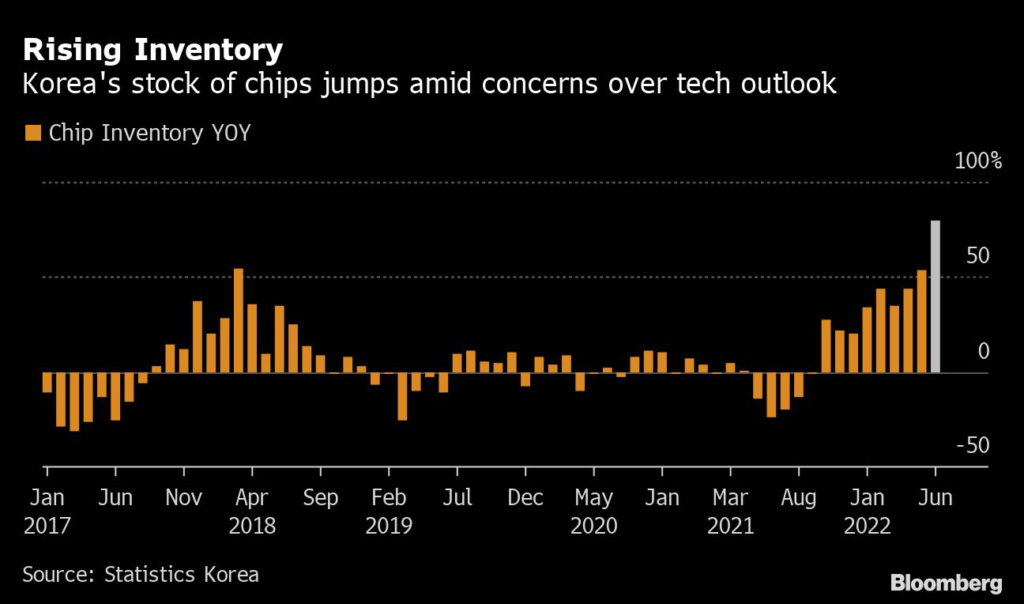
(Bloomberg) — South Korea’s semiconductor stockpiles expanded at the fastest pace in more than six years, adding to concern about the outlook for exports that drive the country’s economic growth.

Nationwide inventory soared 79.8% in June from a year earlier, the statistics office said Friday, up from a 53.8% jump in May. At the same time, both production and shipments decelerated, suggesting a slowdown in the nation’s most profitable industry.

The result casts a pall over the outlook for an economy where the central bank is in the midst of a yearlong tightening cycle. Memory chips are sold worldwide and underpin the strength of the won, which has been one of Asia’s worst performing currencies this year as trade deficits mount.

South Korea was in the midst of a two-year export slump when chip inventories soared by 104.1% in April 2016.

The accumulation in stockpiles comes as Samsung Electronics Co. and SK Hynix Inc., two of the world’s largest memory-chip producers, warn future sales may weaken, adding to concerns about a global slowdown as inflation spurs global central banks to tighten.

Read More: Samsung’s Profit Is Latest Tech Casualty to Recession Fears

The two firms’ shares prices have still gained in recent weeks as investors bet the companies will cut capital spending, a move that would eventually tighten supply. The tiny components are used in everything from smartphones to laptops and cars.

South Korea’s overall industrial production rose 1.4% in June from a year earlier, less than the 2.1% forecast by economists.

More stories like this are available on bloomberg.com

©2022 Bloomberg L.P.

Intel Gives Dour Forecast; CEO Says Third Quarter Is ‘Bottom’

(Bloomberg) — Intel Corp. Chief Executive Officer Pat Gelsinger slashed sales and profit forecasts for the rest of the year, conceding that the struggling chipmaker needs more time to make its products competitive while assuring investors that the current quarter will be the nadir.

The company, which in April had reiterated its annual sales forecast, reported steeply lower second-quarter results and said revenue this year will be as much as $11 billion less than projected, buffeted by a slackening economy and server market-share losses. The CEO of the biggest maker of computer processors essentially asked for more patience, saying he’s fixing execution issues that have dogged product releases since before he took over last year, and expressed confidence in his strategy to regain industry leadership.

“It feels like they’re clearing out a lot of the bad news,” said Matt Bryson, an analyst at Wedbush Securities, who added that the company should have cut projections several quarters ago. “If you believe in Intel, you believe in Intel in 2024, or 2025 or 2026.”

The company’s shares tumbled as much as 12% in late trading after it gave disappointing sales and profit estimates for the current period and reduced forecasts for the year. Revenue in 2022 will now be as low as $65 billion, the company said. That represents a potential decline of as much as 13% from 2021.

While investors had anticipated that a PC slump would weigh on Intel’s second-quarter performance, an unexpected 16% drop in revenue from expensive server chips that power data centers dragged down overall sales and profit. Prices are falling and customers have been turning to rival providers for their orders, Intel said.

The majority of Intel’s shortfall was caused by a slowdown in the economy, but the company’s failure to produce better products on time also contributed to the miss, Gelsinger said. The current quarter will be the low point for Intel’s performance, he said, as its customers that are working through unused stockpiles of chips haven’t been placing new orders and will soon need to resume those purchases.

“We feel very confident that it’s the bottom,” Gelsinger said in an interview.

The shares have slipped 23% so far this year, yet they found found further to fall in late trading Thursday. Intel stock slid as low as $35.11 following the report, after closing at $39.71 in New York. 

On Thursday, Gelsinger said a delayed server product hurt Intel in the recent quarter, a result of the legacy of projects begun before he rejoined the company last year. Gelsinger sought to emphasize that under his watch as CEO, which began early last year, the company is improving its execution, and new products he has overseen will appear on time and perform as promised.

In the second quarter, revenue fell 22% to $15.3 billion, significantly below the average analyst estimate of $18 billion. Per-share profit excluding some items was 29 cents, Intel said, while analysts had predicted 69 cents. Sales in the current period will be as low as $15 billion, compared with projections of $18.7 billion, and gross margin will narrow to 47%.

The CEO said he is not backing off a plan to spend heavily on improving Intel’s manufacturing technology, building new products and getting into new markets to chase future opportunities. The “austerity” of the decline in the economy and Intel’s performance will help the company place its big bets more strategically, while cutting back on areas that aren’t key to its future, he said.


Gelsinger’s push to restore Intel’s manufacturing prowess got a boost this week, when the US Senate and House passed legislation that includes $52 billion in grants and incentives for domestic semiconductor manufacturing. Intel, which has announced new plants in Arizona and Ohio in an attempt to compete directly with Taiwan Semiconductor Manufacturing Co., has told investors that government subsidies will help cushion the impact of the multibillion-dollar investments on its overall financial picture.

In the meantime, the company expects to record restructuring charges in the current period, Chief Financial Officer Dave Zinsner said on a conference call, saying that details would be disclosed later.

Read more: Gartner Slashes Chip Industry Forecast After PC Demand Slumps

Second-quarter sales for Intel’s data-center division — where the company generates an outsize portion of profit — slid to $4.6 billion, missing the average analyst estimate of $6.04 billion. The company expects its data-center business to grow more slowly than the overall server market this year, Gelsinger said.

“It’s not a fact we like,” he said.

Client computing, Intel’s PC-chip unit, saw sales plummet 25% to $7.7 billion, compared with an average projection of $8.76 billion.

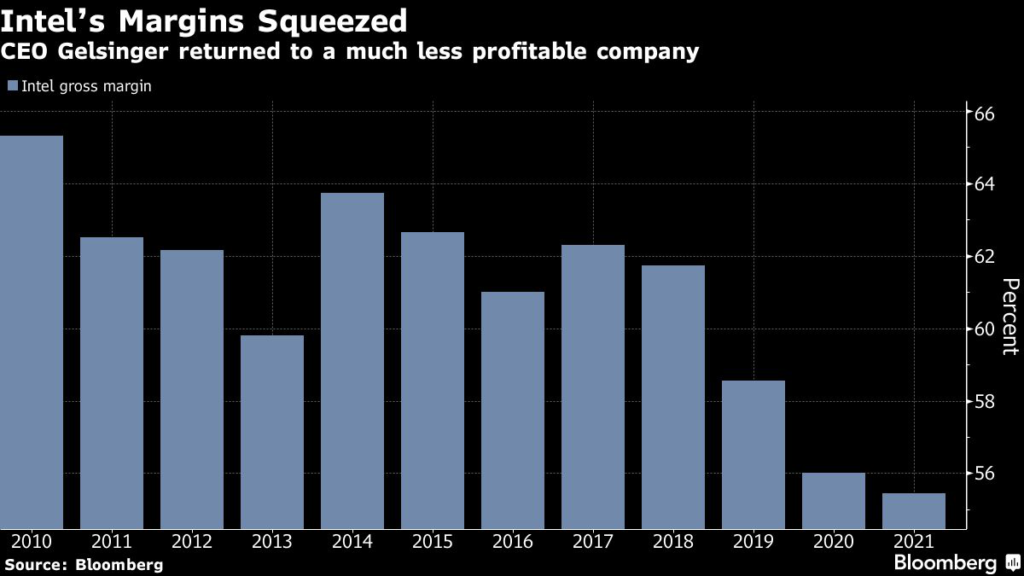
The company’s new target for 2022 revenue is $65 billion to $68 billion. Gross margin, a measure of profitability that represents the percentage of sales left after deducting production costs, will be 49% for the year, 9.1 points narrower than a year earlier and 3 points shy of what the company had targeted. That metric of profitability, once touted as an indication of Intel’s strength, is being squeezed by increasing competition, and is now more than 10 points narrower than the company’s annual gross margins for much of the past decade.

Shareholders initially welcomed Gelsinger’s aggressive plans to invest heavily to make Intel’s products and manufacturing technology more competitive. The latest results may add to escalating investor concern about how much it will cost and how long it may take to win back market share lost to Advanced Micro Devices Inc., Nvidia Corp. and TSMC. In the company’s statement Thursday, Gelsinger acknowledged the challenge.

“This quarter’s results were below the standards we have set for the company and our shareholders,” he said. “We must and will do better.”

More stories like this are available on bloomberg.com

©2022 Bloomberg L.P.

US Demands Voyager Clarify Client Funds Are Not FDIC Insured

(Bloomberg) — Bankrupt crypto platform Voyager Digital LLC must correct “false and misleading statements” that suggested its customers were covered by Federal Deposit Insurance Corporation protection, US officials said on Thursday. 

Voyager, one of the latest casualties of the turmoil in crypto markets, had publicly said in some materials that any US dollars deposited with the firm are covered by FDIC insurance, thanks to its partnership with Metropolitan Commercial Bank. The FDIC said earlier this month that while the bank is insured, Voyager is not. Therefore deposit insurance does not protect Voyager customers against the digital-asset firm’s default.

In a joint statement on Thursday, the Federal Reserve and FDIC said it had issued a letter demanding that Voyager stop making such claims and correct previous statements.     

“These representations are false and misleading,” the regulators said. “Based on the information gathered to date, it appears that these representations likely misled and were relied upon by customers who placed their funds with Voyager and do not have immediate access to their funds.”

A representative for Voyager declined to comment. 

Wording posted in 2019 on a company web page stated that this protection would take effect in the “rare event your USD funds are compromised due to the company or our banking partner’s failure,” according to the Wayback Machine, which keeps an archive of Internet content. The wording has since been changed. 

Normally such insurance would cover as much as $250,000 in losses per depositor — sometimes more if a customer holds several different types of accounts. 

In May, the FDIC approved regulations clarifying the regulator’s procedures for taking action against firms and people who make misleading claims about deposit insurance.  

(Updates with Voyager declining to comment.)

More stories like this are available on bloomberg.com

©2022 Bloomberg L.P.
Roku Craters on Weak Outlook, Adding to Advertising Worries

(Bloomberg) — Roku Inc. slumped 25% in late trading after saying advertisers are pulling back on spending due to economic concerns, adding to jitters about the slowing growth of marketing spending.

Shares of the maker of streaming-TV devices fell to $63.35 in late trading after the company reported disappointing second-quarter results. The stock had already declined 63% this year as enthusiasm ebbed on Wall Street for the online video industry.

Roku sells ads for its own Roku Channel and splits some inventory with other streaming services on its devices. During the latter half of the second quarter, Roku said, many advertising clients slowed down or altogether stopped buying spots in the scatter market, where companies charge higher rates for last-minute purchases. Roku reported total revenue of $764.4 million, while analysts had estimated $804.1 million on average. Its forecast for the third quarter of $700 million was about $200 million short of projections.

“It was a challenging quarter for Roku for how significant the pullback was,” Chief Financial Officer Steven Louden said in an interview. “The severity of the pullback in the ad market was not expected”

Tech and media companies have reported mixed results for advertising in the quarter, making it difficult to gauge the health of the market. Alphabet Inc. and Spotify Technology SA have surpassed expectations, while Meta Platforms Inc. and Snap Inc. have come up short. Traditional media companies including Walt Disney Co. and Comcast Corp. have raked in record commitments for ad sales under contract.

The question for advertisers is whether it’s still effective to market to consumers if they rein in spending amid record inflation. One of the major ad agencies Interpublic Group, raised its forecast for the year last week, but Chief Executive Officer Philippe Krakowsky predicted there would be a “flight to quality” to the most effective media platforms if the economy worsens.

“What can I not afford to turn off? Where am I getting the best returns? What makes the most sense?” he said. “It would be about the quality of the back end and the data you’re seeing as a result of making that investment.”

More stories like this are available on bloomberg.com

©2022 Bloomberg L.P.
US, China Economic Woes Point to End of Taiwan’s Chip-Led Boom

(Bloomberg) — Sign up for the New Economy Daily newsletter, follow us @economics and subscribe to our podcast.

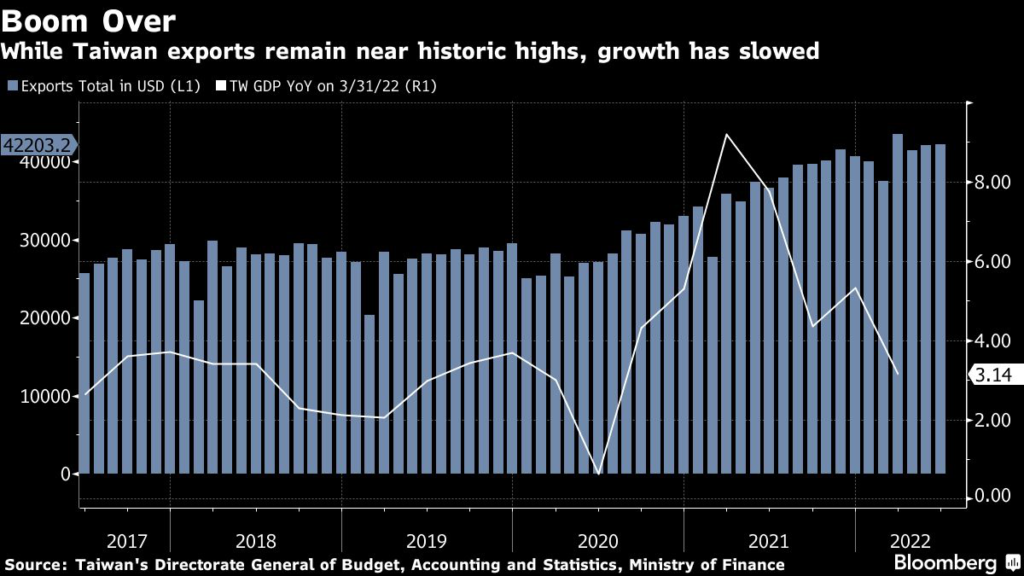
Taiwan’s trade-reliant economy is coming back down to Earth after a banner year for growth as its biggest export markets slow and global demand for electronics and semiconductors starts to wane.

Economists expect gross domestic product grew 3.15% in the second quarter from a year ago. That would be slightly better than the 3.14% expansion from the January-to-March period, but well below the numbers recorded in 2021. Taiwan reports its latest GDP data on Friday. 

“Taiwan was in an enviable position during the global Covid shock, but higher inflation and weaker demand worldwide are now faltering its growth prospects,” said Gary Ng, senior economist at Natixis SA. “The once-booming semiconductor industry will also face downside risks as consumers turn cautious.”

China and the US are Taiwan’s two largest export markets, which combined account for just over half of the island’s overseas shipments.

An economic slowdown in the US has sparked recession talk as officials struggle to rein in the highest inflation in 40 years without cratering the economy. 

The Chinese economy, meanwhile, has been weighed down by ongoing Covid outbreaks and resulting regional lockdowns, leading economists to downgrade their forecasts for growth in 2022 to 3.9% in a recent Bloomberg survey. 

Chips Are Down

Global demand for semiconductors kicked off a surge in factory expansion in Taiwan in 2021. Private sector fixed capital investment rose 19.9% last year to be the largest single contributor to the 6.57% growth in GDP. In the first quarter of this year, though, the pace of investment slowed to 6.6%. 

Gartner Inc. is predicting an abrupt end to one of the chip industry’s biggest boom cycles: The research firm sees global sales slowing much more rapidly than previously forecast, slashing its outlook for semiconductor revenue growth to just 7.4% in 2022, down from the 14% it predicted three months ago. Sales will likely decline 2.5% next year, the company said in a report published Wednesday.  

Taiwan Semiconductor Manufacturing Co.’s most recent outlook suggests firms are weighing the uncertainty. While the world’s largest contract chipmaker raised its 2022 revenue forecast earlier this month, it also said it plans to delay some capital spending by as much as 9% from its earlier guidance. 

Factory data in Taiwan underscores the concerns about the broader economy. Manufacturing output grew just 0.51% in June, according to the Economics Ministry, the weakest growth since January 2020.

The painful adjustment may only be temporary, according to Woods Chen, chief economist at Yuanta Securities Investment Consulting. He sees a positive outcome for Taiwan after its chip manufacturers managed to secure a greater global market share while their competitors struggled during the pandemic. 

“The most recent boom has slowed as companies around the world manage their inventories in the post-Covid era, which may have an impact on Taiwan for three or four quarters,” he said. “But Taiwan now has a head start in the post-Covid world. Exports will continue to drive the economy but even more concentrated in the electronics sector and being concentrated in a future trend is a good thing.”

More stories like this are available on bloomberg.com

©2022 Bloomberg L.P.

Computers Outperform Humans for Accuracy on US GDP Forecasts

(Bloomberg) — Need to gain a sense of where US economic growth is now and where it is likely to be in the future? 

It might be better to look at calls from largely automated computer models rather than economists, judging by estimates of second-quarter gross domestic product ahead of the acutal results released Thursday.

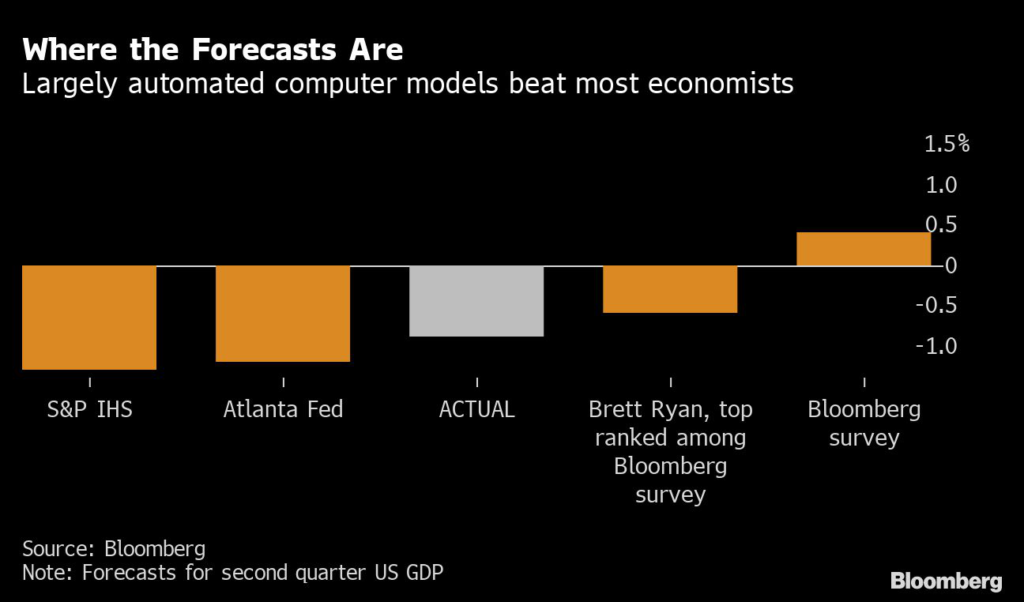
The US economy contracted for a second straight quarter, with GDP falling at a 0.9% annualized rate from the first three months of the year, the Commerce Department’s preliminary estimate showed. The median estimate in a Bloomberg survey was for expansion of 0.4%, and of the 74 projections by economists, 23 were for a decline. 

Forecasts in so-called “nowcast” models, however, were closer to the outcome. The Federal Reserve Bank of Atlanta’s GDPNow index, for example, saw a 1.2% decline.  

Another similar computer model scored a direct hit: The estimate from S&P Global Market Intelligence, initially conceived by Monetary Policy Analytics Inc. — co-founded by former Fed Governor Larry Meyer — predicted a 0.9% second-quarter contraction. Its clients include governments, banks and the Fed itself, which uses the data to glean insight on where the economy is going. 

The latest GDP report was closely watched, given that two consecutive quarters of shrinkage is one rule of thumb that many use to gauge whether an economy is in a recession. The official determination of ends and beginnings of business cycles is made by a group of academics at the National Bureau of Economic Research. 

Nowcast gauges have gained bigger followings as their accuracy improves, and the estimates they produce hew more closely to outcomes as they accumulate data. GDPNow, for instance, had forecast a 1.8% decline earlier in the week, but adjusted to reflect the 1.2% drop by Wednesday. 

The S&P model produces projections that are within about 1.2 percentage points of actual GDP about three months before the Bureau of Economic Analysis release, with the gap narrowing to about half a percentage point closer to the release date, said Ben Herzon, an executive director at the firm.  

Model Workings

We use the “bean-counter method,” said Herzon. “What we do is look at the BEA source data and replicate their methodology.” The trick is estimating values for the latest month of data that haven’t yet been publicly released, he said.

The Atlanta Fed’s GDPNow model is largely publicly available and also mimics the methods used by the BEA to estimate real GDP growth. One key difference is that it isn’t subject to judgmental adjustments. 

“The average absolute error of final GDPNow forecasts is 0.84 percentage point,” according to the Atlanta Fed, which emphasizes that the result isn’t an official forecast by the bank, its president, the Fed system, or the Federal Open Market Committee.  

The historically most accurate forecaster for GDP in the Bloomberg survey, Brett Ryan at Deutsche Bank AG, called for a 0.6% contraction. Deutsche Bank also has a nowcast GDP tracker that aggregates other models and weighs them “in a way that has been optimal historically,” Matt Luzzetti, a New York-based senior US economist at the firm, said in an interview at Bloomberg’s Washington office. 

The Bloomberg Economics nowcast for US GDP pointed to a negative print of 1.5% and compared with Bloomberg economists’ official forecast of 0.7% expansion.

Other Fed banks also have various models such as the Chicago Fed national activity index, the Philadelphia Fed monthly coincident index and Aruoba-Diebold-Scotti business conditions index to help gauge economic activity.

For the third quarter, as things stand today, the JPMorgan Chase & Co. nowcast shows US GDP expanding 1%, while the S&P model sees a 0.9% increase. The Atlanta Fed will issue its first third-quarter estimate on Friday, and wlil update the model more than 30 times until they cumulate with the final third-quarter GDP release on Dec. 22.  

More stories like this are available on bloomberg.com

©2022 Bloomberg L.P.
Cloud Software Is Top Bet for $16 Billion New Zealand Manager Morrison

(Bloomberg) — The New Zealand fund manager that was an early champion of investing in renewable energy has picked its next major investing opportunity.

Cloud-based technology and software services are the infrastructure of the digital era, with resilient earnings that will attract aggressive long-term capital, Morrison & Co. Chief Investment Officer Will Smales said in an interview Wednesday in Sydney.

“If you think about Microsoft Azure or Amazon Web Services, you can’t buy them because they’re huge and public, but those cloud computing platforms are infrastructure in the sense they’re supporting the modern world,” Smales said. 

“If you look at the stack of priorities for a business, some parts of the software system that keep the lights on are as important as their power or water,” he said.

The firm, which today manages NZ$25 billion ($16 billion) on behalf of clients including sovereign wealth funds, pension funds and endowments, already has plenty of assets on the more tangible side of digital infrastructure.

A Morrison-led group acquired US provider FiberLight earlier this month, marking the firm’s first North American bet on fiber infrastructure. The purchase, valuing the firm at about $1 billion including debt, adds to a A$3.6 billion ($2.5 billion) deal agreed in April for Australian fiber cabling firm Uniti Group Ltd. It will also manage a A$2.8 billion stake in the phone towers arm of Telstra Corp., Australia’s biggest telecommunications company, acquired in June by an investor group.

First mover

Morrison’s track record lends credibility to its bold software bet. The fund’s first wind turbine investment was more than three decades ago, Smales observed. It established itself in New Zealand with Infratil Ltd., an infrastructure conglomerate focused on renewables that Morrison took public in 1994 and continues to manage. Infratil’s overall annual return after tax is 18.7%, according to its website.

“One thing about Morrison is that we’ve been prepared to invest time and money early into sectors,” Smales says. The firm was one of the first investors into data centers in Australia, and is pushing into the health-care sector with a focus on medical imaging, he added.

Infratil acquired diagnostic imaging clinic operator QScan Group Holdings Pty in 2020 for A$290 million and Pacific Radiology Group Ltd. last year for as much as NZ$350 million.

Last year Morrison opened an office in New York, where Smales is based, adding to its London office started in 2018. Each have a staff of 15 today, and the firm wants its trans-Atlantic portfolio to account for almost half its total holdings within three years, up from less than a fifth today. 

“We’ve built our capability quite clearly in our backyard,” Smales said. “New Zealand can export something other than milk powder and the All Blacks.”

More stories like this are available on bloomberg.com

©2022 Bloomberg L.P.
A Sexual Assault Case Shakes Hockey’s Upper Echelon in Canada

(Bloomberg) — Canada defeated Sweden to win the world junior hockey championship in January 2018, a victory watched by a huge audience in a hockey-obsessed country. 

Five months later, members of that celebrated team attended a charity event in an Ontario city, where they allegedly sexually assaulted a young woman in a hotel room. The accusation and the cover-up are now shaking the upper echelons of hockey in Canada.

The government has launched a forensic audit of Hockey Canada, the sport’s governing body. Several large companies including Bank of Nova Scotia and Telus Corp. have frozen, withdrawn or redirected millions of dollars in sponsorship and funding. And lawmakers are now asking whether anything can be done to clean up the rot inside the nation’s favorite sport.

Hockey Canada has paid out C$8.9 million ($6.9 million) to settle more than 20 claims of sexual misconduct since 1989, officials told a parliamentary hearing on Wednesday. Some of that money came from an “equity fund” that was partly funded by registration fees of young players — without the knowledge of the families paying them. 

Hockey Canada Chief Executive Officer Scott Smith, who testified for more than two hours on Wednesday, was told by multiple lawmakers that he should resign. He has been in the job less than four weeks, when he replaced Tom Renney, a former New York Rangers coach. 

“We have lost confidence in Hockey Canada. I think it is time for new leadership,” Peter Julian, a New Democratic Party lawmaker from the Vancouver suburbs, said.

One of the payments was to the woman in the 2018 incident, which allegedly involved eight junior hockey players. The woman filed suit for C$3.55 million and settled for an undisclosed amount. She said in court documents that Hockey Canada was aware of the alleged assaults and that it failed to properly investigate the accused players, who have never been publicly named.

“Why did you not continue to investigate if you really wanted to change the culture of hockey?” Karen Vecchio, a Conservative member of parliament from Ontario, pressed Smith during Wednesday’s hearing. 

Not a ‘Real Investigation’

Earlier testimony from Hockey Canada officials had left lawmakers stunned: Smith said only 12 or 13 of the 19 players were interviewed in the organization’s initial probe. They also said that they were unable to determine who was involved, and that no players had been suspended.

“That’s a sign that this wasn’t a real investigation,” said Ann Pegoraro, Lang Chair in Sport Management at the University of Guelph. “If you don’t make it mandatory to be part of an investigation into a complaint of this nature, then you’re essentially telling them it’s OK.”

That prompted the federal government to freeze its funding of Hockey Canada and launch the audit. Then came the corporate backlash. 

Scotiabank was the first to move, halting its top-tier sponsorship and marketing events. Telus, Restaurant Brands International Inc.’s Tim Hortons chain and Imperial Oil Ltd.’s Esso brand followed. Sports equipment maker Bauer Hockey joined the list last week, halting its financial support for the world junior championships. 

Electronic Arts Inc., maker of a video game series based on the National Hockey League, called the allegations “deplorable” and said that it intends to shift funds to national teams including the Canadian women’s national hockey team.

With business development and partnerships accounting for 43% of Hockey Canada’s budget, corporate sponsors have significant influence on the organization. 

“They’re the lever that made Hockey Canada stand up and change,” Pegoraro said. “It’s an indication that we needed corporations to be our moral guide in this, versus individuals inside that entity or inside the sport system. It’s going to take a while for Hockey Canada to build back trust with those sponsors.”

Character Screening 

Smith, who has been with Hockey Canada since the 1990s, is counting on contrition and a new set of policies to quell the controversy. The organization’s new plan includes mandatory sexual assault prevention training, “character screening” for elite players and the threat of lifetime bans for players who refuse to participate in investigations, among other steps.

“My attitude is also focused going forward on delivering on an action plan to ensure that these events never happen again,” Smith testified. 

For many, those measures are far from enough. Marie-Philip Poulin, the only hockey player ever to score in four straight Olympic finals, posted a letter to Smith and other Hockey Canada executives on behalf of the women’s national team. 

“There is much more work and action needed to fully address the underlying issues in order to ensure that a new Hockey Canada emerges from this crisis,” the letter said. It’s time, the players added, “to have women sitting at the table.”  

More stories like this are available on bloomberg.com

©2022 Bloomberg L.P.
Ethereum Leads Crypto Rally on Software-Upgrade Optimism

(Bloomberg) — Cryptocurrencies rallied for a second day, with Ethereum-related tokens leading gains, as risk aversion eases and optimism grows about the long-anticipated software upgrade of the blockchain network. 

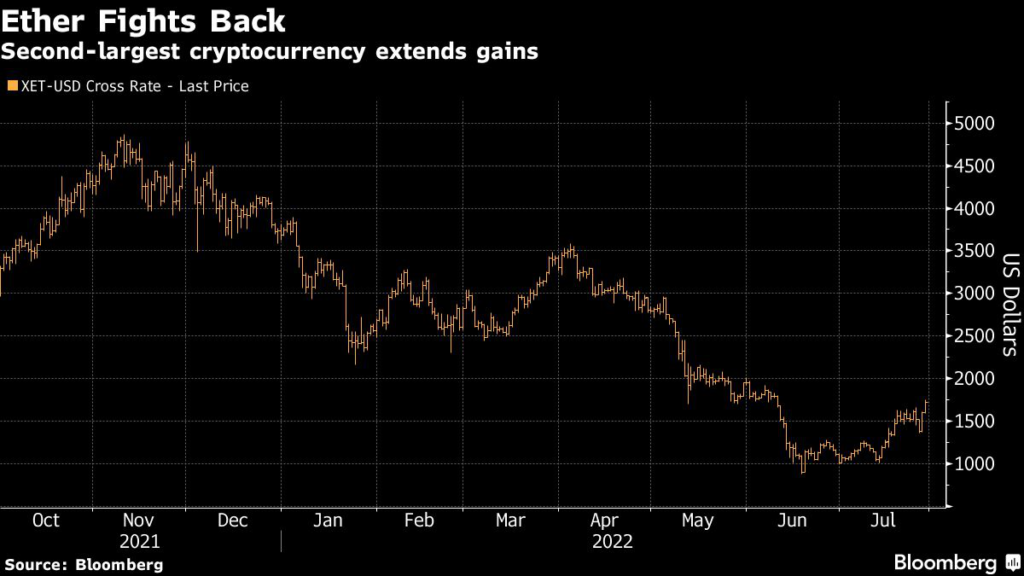
Ether, the native token of Ethereum, jumped as much as 11% to $1,783, and surged 29% on an intraday basis since Tuesday, the biggest two-day gain since January 2021. The digital token is still down about 50% this year. 

Bitcoin rallied as much as 6.2% to $24,195. Its two-day gain of 15% is the largest on an intraday basis since June 20. The largest digital token by market value is down 48% since December. 

The rally signals growing confidence that Ethereum’s move from the current system of using miners to a more energy-efficient system using staked coins is nearing. The switch to this so-called proof-of-stake system is expected to take place in September. This week, Ethereum developers have signaled continued progress in testing the new system, and they are holding a series of events for prospective stakers and other community members in the coming weeks.  

“The Ethereum merge will turn the protocol into a proof-of-stake chain and provide more utility for the token, changing the tokenomics, and providing excitement for further decentralization for Ethereum going forward,” said Paul Veradittakit, a partner at Pantera Capital.

More Ethereum-related assets extended gains Thursday. Uniswap, a decentralized crypto exchange that’s most popular on Ethereum, saw its token jump nearly 36%. Ethereum Classic — which branched out from Ethereum several years ago — rallied nearly 38%, and Lido DAO’s LDO token rose about 53%, according to CoinMarketCap. Lido issues a derivative of Ether.

Work on the Merge has been going on for years, and it’s been delayed many times. It was most recently expected to take place in June, but was delayed once again.

Altcoins can sometimes outperform the original token during risk-on stretches, though they can also be much more volatile on the way down — they tend to suffer greater losses during tougher times.

Meanwhile the broader crypto market continued to benefit from traders dialing back wagers on Federal Reserve hikes after an ugly economic reading fueled concern about a US recession. The Fed’s attempt to control inflation has spooked crypto investors this year as the central bank raises interest rates, turning investors away from riskier investments such as crypto. 

“Market is outperforming right now on macro outlook,” said Katie Talati, director of research at Arca. “Many are now speculating that the Fed will take a more dovish stance and will slow any further rate hikes for this year.”  

More stories like this are available on bloomberg.com

©2022 Bloomberg L.P.

Apple Will Be ‘Deliberate’ With Spending as It Confronts Economic Slowdown, CEO Says

(Bloomberg) — Apple Inc. will be “deliberate” with spending decisions as it confronts an economic slowdown, Chief Executive Officer Tim Cook said in an interview with Bloomberg Television alongside third-quarter earnings results. 

“We believe in investing through downturns — we’ve always done that. We’ve always found out that it made us stronger on the other side,” Cook said on Thursday. “That’s the frame of mind we go into with this one. Obviously we’re being deliberate in our decisions of where to invest.”

Apple Inc. reported third-quarter results that narrowly beat Wall Street estimates, lifted by better-than-expected iPhone sales. But some categories, such as the Mac and wearables, didn’t fare as well as projected.

In the interview, Cook said that he expects revenue to accelerate in the fourth quarter despite seeing “some softness in some areas.” He said that he believes “macroeconomic headwinds” affected the company in the third quarter, including in its wearables and digital advertising businesses. He said that supply constraints hit the Mac and iPad during the third quarter as well, but demand for the iPad remained strong. 

In China, the company saw “significant improvement” in June for both supply and demand, Cook said.

“In the run-up to June 18, which is a key shopping holiday in China, we had some really strong results.” He also said Apple’s four-day iPhone discount sale in the region, starting Friday, has “zero to do with clearing inventory.” 

Bloomberg reported earlier this month that Apple would slow spending and hiring across some of its teams in 2023.

More stories like this are available on bloomberg.com

©2022 Bloomberg L.P.

Close Bitnami banner
Bitnami