Bloomberg

Cboe Partners With Snowflake to Move Corporate Data to Cloud

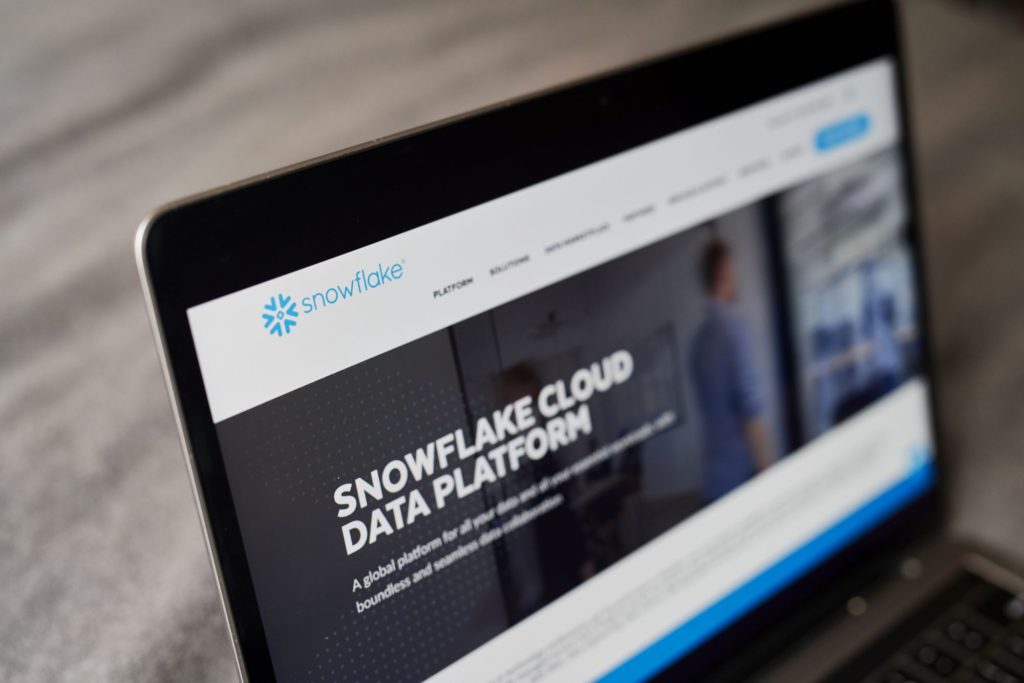
(Bloomberg) — Cboe Global Markets Inc. is working with Snowflake Inc. to shift its corporate data and analytics software to the cloud, as exchanges elect to offload certain technology functions to outside firms.

Cboe plans to integrate more capabilities through Snowflake’s service, and to use the technology firm as a security blanket to detect and respond to potential cybersecurity attacks, the Chicago-based exchange said. Snowflake’s platform can create a more seamless experience for users, said Eileen Smith, senior vice president of data and analytics at Cboe. 

“The cloud is elastic, expandable and global, allowing us to distribute data that is easily accessible to market participants” around the world, Eileen Smith said in an interview. 

The move its the latest among exchanges that have expand into cloud-based software and data analytics. Last year, Nasdaq Inc. and CME Group Inc. announced plans with Amazon.com Inc. and Alphabet Inc.’s Google to move their data and eventually trading services to the cloud. 

Cloud computing allows companies to outsource processing and data storage to the big tech firms rather than operating the systems in-house, and has been one of the fastest-growing areas of tech. Cloud providers have been pushing into financial services, an industry that has lagged other markets because banks and other financial firms face unique regulatory and security requirements.

“Exchanges collect a lot of data which they can modernize and monetize,” said Rinesh Patel, global head of financial services at Snowflake. “Data that moves physically creates a level of complexity. Moving to the cloud provides a better data experience and deepens the connection between market participants.”

Read More: Nasdaq’s Cloud Commits to New Jersey, Avoiding Big Trader Hassle

Cboe, previously known as the Chicago Board Options Exchange, launched its own cloud-based market data streaming service last year with the goal to increase distribution of real-time information around the world. The partnership with Bozeman, Montana-based Snowflake builds upon those efforts, and will focus specifically on enhancing Cboe’s internal data and analytics capabilities, executives said. 

The partnership is expected to improve Cboe’s capabilities so it can analyze data, derive analytics and “provide intelligence both internally and for customers,” the company said Thursday in a statement.

(Updates with statement in final paragraph.)

More stories like this are available on bloomberg.com

©2022 Bloomberg L.P.

Stocks Defy Naysayers as Fed-Hike Premium Shrinks: Markets Wrap

(Bloomberg) — The stock rally gained traction, defying calls from skeptics in the aftermath of the Federal Reserve decision, with traders paring bets on rate hikes as the drumbeat of recession grew louder amid an ugly economic print.

Equities climbed to a seven-week high, led by defensive groups, which are often sought after during challenging times. Bond yields sank, and swaps referencing policy meeting dates showed bets the fed funds rate will peak around 3.25% before the end of 2022, less than 100 basis points above its current level. In late trading, Amazon.com Inc. and Apple Inc. jumped, while Intel Corp. slid after reporting results.

Investors continued to embrace the idea the Fed could soon reduce the pace of tightening as data signaled the economy is losing momentum heading into the back half of the year. That was a day after Jerome Powell’s remarks that hikes would slow at one point, which sparked a powerful market reaction that was bashed by Fed watchers saying traders got it all wrong as tighter financial conditions are needed to vanquish inflation.

“Bad news is becoming good news,” said Michael Arone, chief investment strategist at State Street Global Advisors. “When the economy is slowing, inflation measures will likely fall. That will bring the end of the tightening cycle nearer and markets will like that.”

For LPL Financial’s Jeffrey Roach, the Fed will likely interpret the drop in real growth as confirmation to slow down the pace of tightening. “Front-loading rate hikes eventually mean smaller hikes in the near future,” he added. FHN Financial’s Chris Low said that based on Powell’s comments Wednesday, officials will not stop hiking just because the economy is shrinking. 

“They need to see real progress against inflation before they stop raising rates,” Low noted. “With that in mind, this recession will get deeper before the economy starts to heal.”

Read: Yellen Says US Economy Not Seeing Recession Conditions Now

Other corporate highlights:

  • Honeywell International Inc.’s profit topped estimates as a rebound in air travel and oil-and-gas investment helped spur sales.
  • Hertz Global Holdings Inc. soared as the rental-car giant’s earnings beat estimates with revenue jumping on higher prices and rebound in travel.
  • Harley-Davidson Inc. gained as profit and revenue beat estimates, a sign that a turnaround plan is helping the motorcycle maker overcome supply-chain headaches.
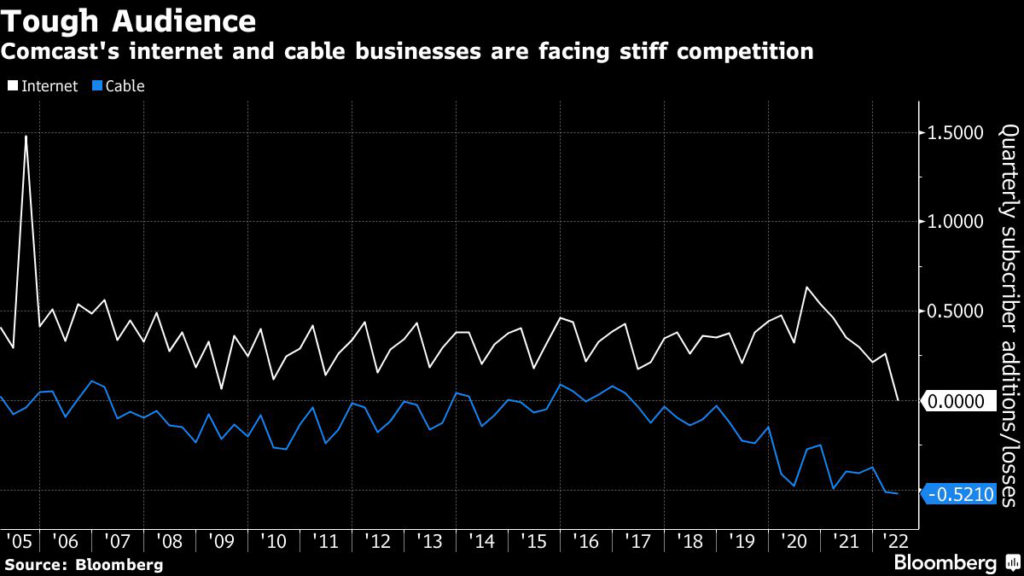
  • Comcast Corp. sank after its prized internet business added no new customers last quarter, its worst performance in decades.
  • Southwest Airlines Co. said it’s facing high costs and delays in aircraft deliveries from Boeing Co., tarnishing a quarter in which the carrier topped Wall Street’s profit expectations.

Here are some key events to watch this week:

  • Euro-area CPI, Friday
  • US PCE deflator, personal income, University of Michigan consumer sentiment, Friday

Musk, Tesla and Twitter are this week’s theme of the MLIV Pulse survey. Also share your views on the S&P 500’s biggest stocks. Click here to get involved anonymously.

Some of the main moves in markets:

Stocks

  • The S&P 500 rose 1.2% as of 4 p.m. New York time
  • The Nasdaq 100 rose 0.9%
  • The Dow Jones Industrial Average rose 1%
  • The MSCI World index rose 1.3%

Currencies

  • The Bloomberg Dollar Spot Index fell 0.2%
  • The euro fell 0.1% to $1.0186
  • The British pound was little changed at $1.2166
  • The Japanese yen rose 1.7% to 134.29 per dollar

Bonds

  • The yield on 10-year Treasuries declined 11 basis points to 2.67%
  • Germany’s 10-year yield declined 12 basis points to 0.83%
  • Britain’s 10-year yield declined nine basis points to 1.87%

Commodities

  • West Texas Intermediate crude fell 0.1% to $97.12 a barrel
  • Gold futures rose 2% to $1,772 an ounce

More stories like this are available on bloomberg.com

©2022 Bloomberg L.P.

Intel-Backed Video Platform Kaltura Gets Third Bid From Panopto

(Bloomberg) — Privately held Panopto Inc. is offering to buy its Intel Corp.-backed rival, Kaltura Inc., in a deal that would value the video platform provider at $383 million. 

Panopto, an education software maker owned by private equity firm K1 Investment Management, said in a letter to Kaltura’s board Thursday that it’s prepared to pay $3 a share in cash for the company, a 27% premium to Thursday’s closing price. The proposal is the firm’s third since early June, with Kaltura’s board rejecting the two previous offers.

Tobi Hartmann, Panopto’s chief executive officer, said the premium his company is offering would be even higher if it weren’t for K1 purchasing 4.8 million Kaltura shares from July 7 to July 25, which drove up its stock price over a 13-day period. The shares, which closed July 6 at $1.72, fell 0.8% to $2.36 Thursday, giving Kaltura a market value of $301 million.

K1 now owns a 7% stake in Kaltura, according to people familiar with the matter who asked not to be identified because the information was private. That would make it a top-five holder in the company, according to data compiled by Bloomberg.

‘Driving the Future’

Panopto sees video as “driving the future of learning, work, and connectivity, globally,” Hartmann said in the letter, a copy of which was reviewed by Bloomberg News. He added that Kaltura’s management and employees would be an important part of a combined business.

A representative for Kaltura didn’t immediately respond to a request for comment.

Hartmann said that if Kaltura’s business was combined with Panopto, it would create a strong, global competitor in the video industry. Combined, the two companies could improve their overall product, audience experience and drive greater engagement from college students, employees and others, he said. 

Kaltura’s shares have fallen 76% since its initial public offering last July as the company’s sales growth slowed and it continued to burn through cash. CEO Ron Yekutiel said on a conference call in May that Kaltura was facing several headwinds, including lower-than-expected sales, a reduced need for its professional services, and an undisclosed, major customer reducing its business in the first quarter. Yekutiel said he believed sales growth would pick up in the second half of the year.

‘Remain Committed’

Hartmann said Panopto’s proposal, backed financially by itself and K1, would provide Kaltura’s investors with an opportunity to realize “extraordinary value in a turbulent financial environment.”

“While we are disappointed that the board has to date decided to reject our revised proposal without engaging in a meaningful dialogue, we remain committed to pursuing a transaction between our two businesses,” he said. 

More stories like this are available on bloomberg.com

©2022 Bloomberg L.P.

Comcast’s Internet Business Stalled by Housing Slowdown

(Bloomberg) — Comcast Corp. had its worst one-day drop in more than 13 years after its prized internet business added no new customers last quarter, an absence of growth not seen in decades, due to a housing slowdown and heavy competition.

The largest US cable TV provider had added broadband customers in every quarter since at least 2005, according to data compiled by Bloomberg. Analysts were looking for around 83,000 new subscribers in the second quarter, and none of them predicted the gain would be in fact, zero.

The shares fell 9.1% to $39.41 Thursday in their biggest slump since December 2008. Rival Charter Communications Inc., which reports earnings on Friday, tumbled 8.5%.

“We expect the stock to face pressure absent forward-looking comments that suggest an improvement in broadband trends,” New Street Research analyst Jonathan Chaplin wrote of Comcast.

As home buying slows and competition among fiber and wireless broadband providers intensifies, the prospects of Comcast and its cable peers returning to prepandemic internet growth has become more challenging.

Comcast executives said on a call with analysts that they won’t “chase” price cuts in the face of cheaper competition. They view the downturn in broadband growth as a short-term issue that has been compounded by a slowdown in the US economy. Fewer people buying homes and moving resulted in a dropoff of new installations.

Cable TV isn’t faring any better with the influx of streaming services. Comcast shed a record 521,000 video subscribers in the second quarter, a bigger loss than analysts had projected.

Subscribers to the Peacock streaming service also “stayed relatively flat” in the second quarter, Comcast said in a statement. The money-losing service had seen a surge earlier this year due to the Olympics.

Bright Spot

At the same time, profit is outpacing Wall Street expectations. Earnings, excluding some items, were $1.01 in the quarter, topping the average analyst estimate of 91 cents. Revenue also came in slightly ahead of estimates for the period.

On the wireless front, Comcast’s Xfinity Mobile continues to gain customers. The company added 317,000 new mobile subscribers, beating the 308,000 average estimate.

Another bright spot: NBCUniversal, Comcast’s entertainment division, generated better-than-expected results, thanks in part to theme parks, which outperformed for a second straight quarter, and the success of movies including “Jurassic World: Dominion.”

(Updates trading in first and third paragraphs.)

More stories like this are available on bloomberg.com

©2022 Bloomberg L.P.

Biden Says ‘No Surprise’ GDP Slowing, Urges Congress to Act on Energy, Taxes

(Bloomberg) — President Joe Biden touted low unemployment, job creation and foreign investment as signs the US isn’t in a recession following disappointing economic data — and urged Congress to pass legislation he said would counteract soaring inflation. 

Federal Reserve Chairman Jerome Powell “and many of the significant banking personnel and economists say we’re not in a recession,” Biden told reporters at the White House Thursday before ticking off the data points he said showed the strength of the US economy. He added: “That doesn’t sound like a recession to me.”

The president urged Congress to approve a broad tax, climate and health care deal Senate Democrats unveiled Wednesday, calling it “the strongest bill you can pass to lower inflation, cut the deficit, reduce health care costs, tackle the climate crisis and promote energy security.”

“Experts, even some experts who have criticized my administration in the past, agree that this bill will reduce inflationary pressures on the economy,” he said. 

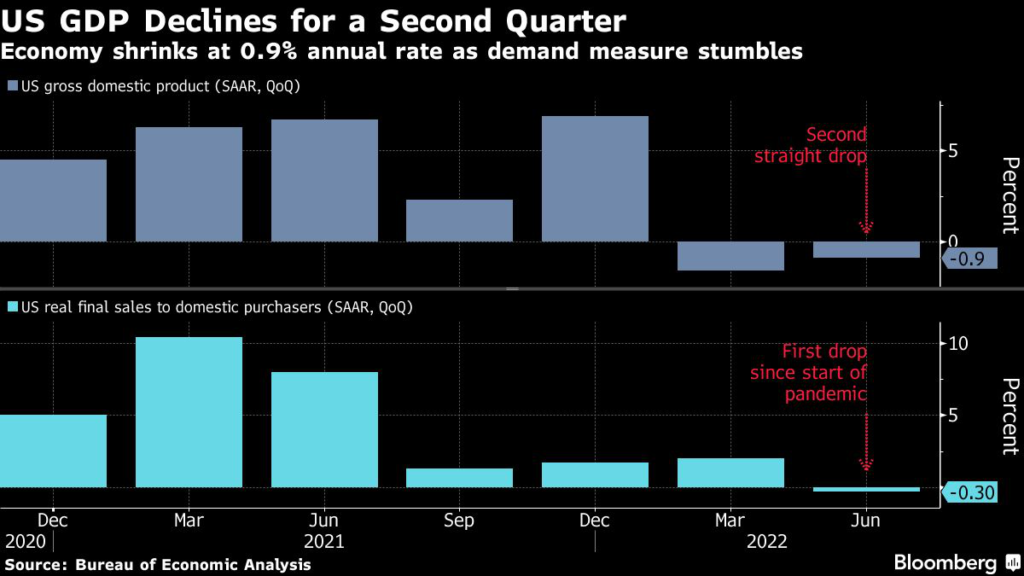
Biden’s comments were the latest White House effort to push back against Republican assertions the US has tipped into recession after data released Thursday showed gross domestic product has now contracted for two consecutive quarters, a scenario that’s referred to as a “technical recession.” 

Traditionally in the US, the National Bureau of Economic Research determines when a recession officially has happened. The NBER committee that makes such a call doesn’t believe in “the two-quarter-declining GDP rule,” President and Chief Executive Officer James Poterba said via email after the data was released.

Three GOP senators, including Ted Cruz of Texas, hammered the message through a bit of political theater, proposing a resolution in the Senate “to affirm the historic definition of an economic recession.” The White House is seeking to “avoid bad headlines” and “rewrite the facts” they said in a statement.

Messaging Battle

“We are in a recession,” House GOP leader Kevin McCarthy said shortly after in a speech in the chamber. “This news is a grim milestone that points towards more hardship, more suffering, and more pain for the American people.”

The battle over economic messaging has heated up heading into November’s midterm elections, which could see Republicans take back control of Congress. While the White House has pointed to a robust job market as a sign of strength, Republicans have hammered Biden on inflation at a four-decade high.  

“It’s no surprise that the economy is slowing” after the economy rebounded last year and the Federal Reserve raised interest rates, Biden said in a statement, but added that the country is “on the right path.”

At a Thursday afternoon meeting with economic aides and a group of chief executive officers — included from Bank of America Corp, Marriott and Corning Inc. — Biden acknowledged that Americans were downbeat about the state of the economy despite some positive indicators. 

“I take it very seriously the confidence level of the American people in the economy, and they’re so down,”  Biden said at the event. “There’s reason to be down.”

Biden urged lawmakers to swiftly pass the budget package that prominent Democratic senators announced Wednesday, which will encourage clean energy development and raise taxes on corporations. He called a provision that would direct the government to negotiate with drugmakers for lower prices on certain medicines a “god-send” for low-income families. 

Policy Hopes

He also lauded House passage of Thursday of legislation that includes $52 billion in grants and incentives for domestic semiconductor manufacturing, 

The budget deal has once again raised hopes that Biden will be able to enact one more major policy bill that may reverse sliding poll numbers and buoy Democrats’ chances in the midterms. It remains unclear if Democrats will be able to pass it. Senator Joe Manchin, who killed the previous effort, announced the package in an agreement with Majority Leader Chuck Schumer.

Powell said Wednesday that he doesn’t believe the US economy is in recession because of positive indicators, such as employment. Treasury Secretary Janet Yellen on Thursday also said the US is avoiding a recession, but is facing a slowdown that’s needed to ease inflation.

Yellen, speaking at the event with CEOs, reiterated the administration’s commitment to fight rising consumer prices. 

“Inflation remains unacceptably high,” Yellen said, adding that it’s “our administration’s top priority to bring it down.” 

(Adds details of Biden event with CEOs, starting in 11th paragraph)

More stories like this are available on bloomberg.com

©2022 Bloomberg L.P.

House Approves $52 Billion Bill to Help Chip Manufacturers

(Bloomberg) — The US House of Representatives passed a bill that includes $52 billion in grants and incentives for domestic semiconductor manufacturing, sending it to President Joe Biden for his signature and delivering a win for his administration more than a year after legislation was first introduced in Congress.

“This legislation is a major victory for American families and the American economy,” House Speaker Nancy Pelosi said in a statement before the vote. “Once enacted, the Chips and Science Act will bolster our nation’s production of semiconductor chips — reinvigorating American manufacturing and creating nearly 100,000 good-paying, union jobs.”

The 243 to 187 vote attracted support from 24 Republicans who defied a last-minute push from GOP leaders to oppose the bill. House Minority Leader Kevin McCarthy initially took a hands-off approach to the bill but decided late Wednesday to whip against it after Senate Democrats announced a surprise agreement on a separate tax and spending bill that Republicans oppose. 

The chips measure, the result of lengthy House-Senate negotiations, has been presented as both a way to reinvigorate the US industrial base and fortify the country’s national security interests against future supply chain disruptions overseas, where the vast majority of advanced semiconductors are currently produced. In addition to semiconductor funding, the bill includes money for research and workforce training and 5G wireless technology.

“We are ushering in a bold and prosperous future for American science and innovation,” Texas Democrat Eddie Bernice Johnson, the chair of the House Science Committee, said in a statement. 

The bill includes legislation from Representatives Michael McCaul, a Texas Republican, and Doris Matsui, a California Democrat, to provide grants and incentives to semiconductor companies to build fabrication facilities, or “fabs,” in the US. That measure was combined with provisions from the Science Committee, along with several other measures.

McCaul called the bill “critical national security legislation” vital to helping the US counter China.

Still, McCarthy and other Republicans opposed the legislation, with some criticizing it for not being tough enough on China. Representative Jim Banks of Indiana, the chairman of the Republican Study Committee, called it a “fake China bill” in a tweet. McCarthy, in a speech on the House floor Thursday, called the subsidies for semiconductor manufacturing “corporate welfare.”

‘Chips and Science’: Tech Bill Loses Name Inspired by WWII Icon

More stories like this are available on bloomberg.com

©2022 Bloomberg L.P.

Advertisers Are Struggling with Instagram’s TikTok Clone, Reels

(Bloomberg) — Reels — the short videos that Facebook and Instagram are pushing — are getting more popular, parent company Meta Platforms Inc. says. The hard part will be turning that attention into advertising revenue.

Advertisers say that the format, which Facebook copied from ByteDance Ltd.’s hot app TikTok, is difficult to get right. Videos are more complicated than still images, the cultural trends are always changing, and users expect Reels to be entertaining, enjoyable and relevant to each individual person— including the ads — as they take up an entire phone screen.

“You have to make more compelling content because the consumer, the viewer — their guard against bad content is up higher than ever,” says Barry Hott, an advertising consultant whose clients spend hundreds of thousands of dollars on digital ads per month.

Meta executives Wednesday asked for patience, after reporting the company’s first-ever decline in quarterly revenue. Meta has been pushing Reels in order to keep up with shifting consumer tastes and ensure that users will remain engaged with its apps. If attention doesn’t grow, advertising revenue doesn’t either. 

The first step of the process has worked: Reels led people to spend more time on Facebook and Instagram, the company said Wednesday. Users are spending 30% more time on Reels than they did in the prior quarter. But until advertising spending follows, the shift is hurting Meta’s business in the short term, by cannibalizing attention from features where the company makes a more predictable stream of revenue, Meta explained.

It’s a rough time to reinvent the business, as advertisers are cutting their budgets in general due to economic uncertainty. “We could mitigate the short term headwind by pushing less hard on growing Reels,” Meta Chief Executive Officer Mark Zuckerberg acknowledged on a call with analysts. “But that would be worse for our products and business longer term.” 

Reels, like TikTok videos, go viral when they capture the attention of people who don’t follow their creator. That raises the bar for what’s considered a good Reel. “The best way for clients to look at it is: Make something that’s entertaining first, and think of it as an ad definitely second,” said Gil David, founder of the advertising firm Run DMG, who said most marketers post the same ads to both Facebook and TikTok. Because Reels require an extra investment in creativity, adoption of the format is slow for many marketers. David said that his clients set aside money for ads that run in both Reels and Stories — a disappearing post format Meta launched in 2016. Reels only makes up 5% to 10% of that pot.

Terry Whalen, who runs a boutique digital advertising firm focused on ecommerce companies called Sum Digital, has seen the same. The firm’s clients spend about 6% of their collective Stories and Reels budget on Reels ads right now, up from just 1% at the beginning of the year. It’s still a very small piece of advertisers’ overall strategy, with the format accounting for less than 1% of clients’ overall ad spending in the first half of the year, he said.

Meta acknowledges the challenges.  “The idea is to help businesses really easily create those Reels ads, really easily test them, so they can iterate and keep improving as we do this,” Chief Operating Officer Sheryl Sandberg said Wednesday. The company said so far, Reels are generating ad revenue at an implied rate of $1 billion a year and growing at a faster clip than it saw a few years ago with Stories.

Officially, the company encourages advertisers to “test and learn,” by doing things like placing Reels ads into existing campaigns and letting its artificial intelligence ranking system put more money behind the videos that perform best. It’s also rolled out a program called Reels School, a workshop that trains businesses on how to use the product. On Wednesday’s call, Sandberg also said the company is investing in artificial intelligence that will help turn static images with music into something with motion that looks more like a video. 

Unofficially, some Meta employees have encouraged advertisers to test short-form video ads on TikTok first, and bring the best-performing ones over to Reels, according to multiple ad buyers. While it may lead to more revenue for TikTok in the short term, the thinking inside Meta is that it will weed out the bad ads before they ever get to Meta’s products. 

The company cares about the quality of Reels in part because it’s making another simultaneous big bet: filling users’ feeds with content from accounts they don’t already follow. That way, the algorithm can start to suggest new content people haven’t asked for, in a bid to keep their attention for longer. Right now about 15% of the content in a Facebook users’ feed is from accounts they don’t follow; on Instagram, the percentage is higher. Meta said the proportion will more than double by the end of next year. 

The algorithmic change has spurred intense backlash from users, prompting Adam Mosseri, the head of Instagram, to pull back temporarily, according to a Platformer report Thursday. “We definitely need to take a big step back and regroup,” Mosseri told Platformer. “It’s super important for us to explain our reasoning, to set expectations, to talk about where we’re going before we go.”

Still, Instagram is turning more videos into Reels. On the app, every video someone posts that’s less than 15 minutes long will be automatically branded a Reel. If it’s made by a public account and lasts fewer than 90 seconds, it will be eligible for distribution beyond the person’s followers, Instagram said this month. A top priority is improving artificial intelligence tools that can better identify users’ interests and the content they’d be interested in. Reels and AI made the short-list of places the business will continue investing in, even as it cuts back on spending writ large amid broader economic uncertainty. 

Even if an advertiser hits exactly the right notes with their Reel, the success isn’t necessarily repeatable. “The niche nature of audiences plus the speed at which the tone changes is kind of head spinning,” said Natalie Silverstein, chief innovation officer at influencer marketing firm Collectively Inc. “Something that was fine a month ago is now super cringe.” 

Marketers that don’t want to take the plunge into the new format risk losing some access to Meta’s 2.9 billion daily users. “I think we’re on track here,” Zuckerberg said, “we just need to push through this one.”

(Updates with pullback of algorithmic change in the 13th paragraph.)

More stories like this are available on bloomberg.com

©2022 Bloomberg L.P.

Stocks Push Higher in Bad-News-Is-Good-News World: Markets Wrap

(Bloomberg) — The stock rally gained traction, defying calls from skeptics in the aftermath of the Federal Reserve decision, with traders paring bets on rate hikes as the drumbeat of recession grew louder amid an ugly economic print.

Equities rose to a seven-week high, led by defensive groups, which are often sought after during challenging times. Tech underperformed before Apple Inc. and Amazon.com Inc.’s results. US yields sank, while swaps referencing policy meeting dates showed bets the fed funds rate will peak around 3.25% before the end of 2022, less than 100 basis points above its current level.

The US economy is losing momentum heading into the back half of the year, highlighted by the government’s latest report card that showed weaker consumer spending and declines in business and residential investment. The data was released a day after the central bank raised rates by 75 basis points and Chair Jerome Powell said a similar move was possible again — rejecting speculation the US is in recession.

“Bad news is becoming good news,” said Michael Arone, chief investment strategist at State Street Global Advisors. “When the economy is slowing, inflation measures will likely fall. That will bring the end of the tightening cycle nearer and markets will like that.”

For LPL Financial’s Jeffrey Roach, the Fed will likely interpret the drop in real growth as confirmation to slow down the pace of tightening. “Front-loading rate hikes eventually mean smaller hikes in the near future,” he added. FHN Financial’s Chris Low said that based on Powell’s comments Wednesday, officials will not stop hiking just because the economy is shrinking. 

“They need to see real progress against inflation before they stop raising rates,” Low noted. “With that in mind, this recession will get deeper before the economy starts to heal.”

Read: Yellen Says US Economy Not Seeing Recession Conditions Now

Corporate Highlights:

  • Honeywell International Inc.’s profit topped estimates as a rebound in air travel and oil-and-gas investment helped spur sales.
  • Hertz Global Holdings Inc. soared as the rental-car giant’s earnings beat estimates with revenue jumping on higher prices and rebound in travel.
  • Harley-Davidson Inc. gained as profit and revenue beat estimates, a sign that a turnaround plan is helping the motorcycle maker overcome supply-chain headaches.
  • Comcast Corp. sank after its prized internet business added no new customers last quarter, its worst performance in decades.
  • Southwest Airlines Co. said it’s facing high costs and delays in aircraft deliveries from Boeing Co., tarnishing a quarter in which the carrier topped Wall Street’s profit expectations.

Here are some key events to watch this week:

  • Euro-area CPI, Friday
  • US PCE deflator, personal income, University of Michigan consumer sentiment, Friday

Musk, Tesla and Twitter are this week’s theme of the MLIV Pulse survey. Also share your views on the S&P 500’s biggest stocks. Click here to get involved anonymously.

Some of the main moves in markets:

Stocks

  • The S&P 500 rose 1.2% as of 2:49 p.m. New York time
  • The Nasdaq 100 rose 0.8%
  • The Dow Jones Industrial Average rose 1.1%
  • The MSCI World index rose 1.2%

Currencies

  • The Bloomberg Dollar Spot Index fell 0.1%
  • The euro fell 0.3% to $1.0168
  • The British pound fell 0.2% to $1.2136
  • The Japanese yen rose 1.5% to 134.46 per dollar

Bonds

  • The yield on 10-year Treasuries declined nine basis points to 2.70%
  • Germany’s 10-year yield declined 12 basis points to 0.83%
  • Britain’s 10-year yield declined nine basis points to 1.87%

Commodities

  • West Texas Intermediate crude fell 0.5% to $96.75 a barrel
  • Gold futures rose 1.7% to $1,767.80 an ounce

More stories like this are available on bloomberg.com

©2022 Bloomberg L.P.
Microsoft Army-Goggle Concerns Remain, Senate Funding Panel Says

(Bloomberg) — The Senate panel that oversees defense spending made deep cuts to the US Army’s fiscal 2023 procurement request for Microsoft Corp.’s combat goggle system, citing unresolved technical concerns.

The Appropriations Defense Subcommittee cut $350 million from the Army’s procurement request for more than $400 million in fiscal 2023 for the Integrated Visual Augmentation System, or IVAS, a customized version of Microsoft’s HoloLens goggles.

The panel “remains concerned that IVAS continues to face software, hardware and user-acceptance challenges that the Army has not sufficiently addressed,” it said Thursday when Democrats released a proposed $808.6 billion Pentagon spending bill for the coming year, up from President Joe Biden’s request of $773 billion.

The goggles would let commanders project information onto a visor in front of a soldier’s face and incorporate features such as night vision. It’s a customized version of the company’s HoloLens goggles. The Army has projected spending as much as $21.9 billion on 121,500 devices, spare parts and support services over a decade if all options are exercised. 

The defense spending panel said it was encouraged by the Army’s decision last year to extend testing and evaluation for an additional 10 months. It said the device has the potential to improve soldiers’ battlefield capabilities while representing an important step in the Pentagon’s efforts to “engage with non-traditional defense contractors” such as Microsoft that are “capable of delivering innovative capabilities that meet warfighter requirements.”

In June, the Senate panel’s House counterpart already adopted a proposal to cut all but $24.2 million of the Army’s request for the fiscal year that begins Oct. 1, citing “questions still outstanding regarding the production viability” of the goggles. 

More stories like this are available on bloomberg.com

©2022 Bloomberg L.P.
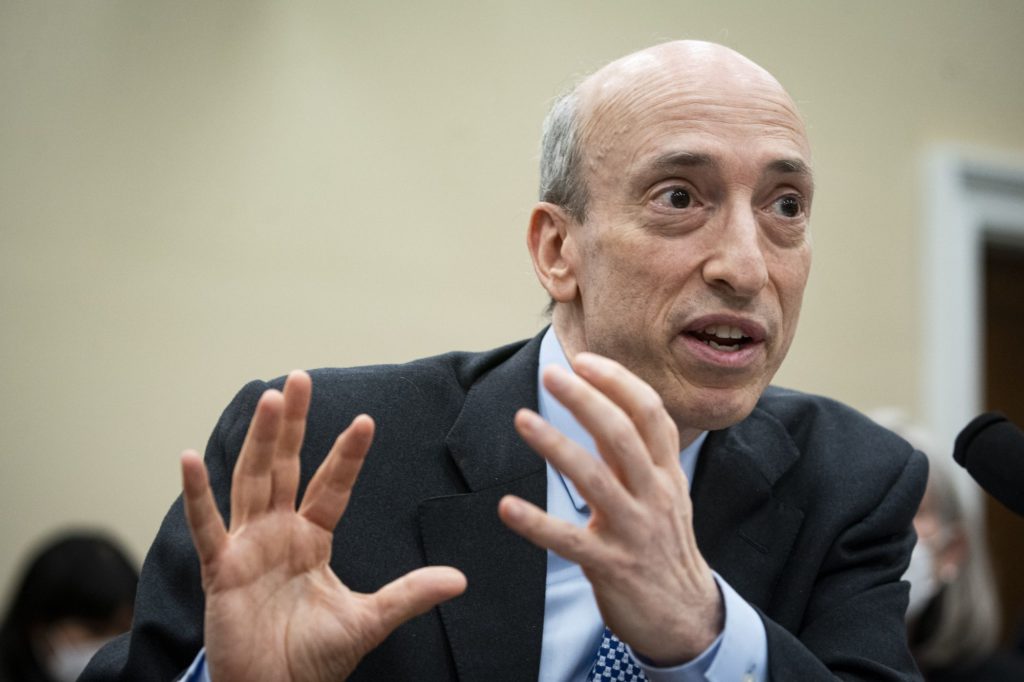
SEC’s Gensler Steps Up Push to Get Crypto Exchanges to Register With Regulator

(Bloomberg) — US Securities and Exchange Commission Chair Gary Gensler is stepping up his push to get crypto trading platforms to register with the Wall Street regulator. 

Gensler said in a video released on Thursday that he’s asked the agency’s staff to work with digital-asset exchanges so that they are “regulated much like securities exchanges.” Officials at the markets watchdog are also developing ways to get certain coins  to be registered as securities, he said. 

“Look, there’s no reason to treat the crypto market differently just because a different technology is used,” he said. 

Agency staff are also considering whether to address potential conflicts of interest when crypto platforms also serve as market-makers, he said. Gensler has previously raised concerns that some platforms are shirking rules and may be betting against their own customers. 

Bloomberg News reported earlier this week that SEC has been investigating Coinbase Global Inc., the US’s biggest crypto exchange, for potentially listing unregistered securities.

More stories like this are available on bloomberg.com

©2022 Bloomberg L.P.

Close Bitnami banner
Bitnami