

Bloomberg

ADHD Startups Are Cut Off by Rite Aid, Adding to Pharmacy Bans

(Bloomberg) — Rite Aid Corp. pharmacies are no longer filling prescriptions for controlled substances like Adderall from clinicians working with mental telehealth startups Cerebral Inc. and Done.

The retail pharmacy chain, which has over 2,350 locations across the US, adopted the policy earlier this year, Rite Aid spokesperson Catherine Carter said in an email Thursday. 

The halt means that many major US pharmacy companies, including CVS Health Corp. and Walmart Inc., have ceased filling controlled substance prescriptions from the two companies’ clinicians. The Wall Street Journal previously reported that some Walgreens Boots Alliance Inc. locations had also stopped filling prescriptions for the companies. 

“In light of Rite Aid’s decision, Cerebral is doing everything possible to ensure these patients get access to medications that their health care providers have determined they need,” said Dan Childs, an outside spokesman for Cerebral. A representative for Done didn’t immediately respond to a request for comment.

Cerebral and Done employ health professionals who see patients online and write prescriptions for conditions such as ADHD, also known as attention-deficit/hyperactivity disorder. Bloomberg previously reported on what some patients and employees said were too-loose practices around prescribing the drugs.

Cerebral is being investigated by the U.S. Attorney’s Office for the Eastern District of New York for possible violations of the Controlled Substances Act, and by the Federal Trade Commission for its business practices. The company hasn’t been accused to breaking the law, and has previously said it would cooperate with investigators. 

Cerebral providers stopped prescribing most controlled substances to new patients in May and the company said they would stop writing these prescriptions for existing patients starting in October. 

Walgreens, in a statement, said that it reviews prescriptions “to ensure they have been issued for a legitimate medical purpose.” It didn’t comment on whether it had banned controlled substance prescriptions from Cerebral or Done. “If a prescription presents red flags that cannot be resolved, our pharmacists will not fill it,” the company said.

More stories like this are available on bloomberg.com

©2022 Bloomberg L.P.
Three Arrows Liquidators May Try to Force Founders to Cooperate

(Bloomberg) — Liquidators overseeing the wind-down of Three Arrows Capital may soon try to force founders Kyle Davies and Su Zhu to help clean up the mess left behind by the crypto hedge fund’s collapse.

Zhu and Davies have so far provided “rather selective and piecemeal disclosures” about the fund’s assets, attorney Adam Goldberg said on behalf of the liquidators in a bankruptcy hearing Thursday. Without further cooperation, lawyers will try to compel the founders to turn over more information with assistance from US Bankruptcy Judge Martin Glenn, he said. 

“The founders have not made themselves available for any discussions or interviews with the liquidators whether formal or informal,” Goldberg told Glenn in a hearing held remotely Thursday. “They do continue to conceal their whereabouts.”

The liquidators — appointed by a judge in the British Virgin Islands — have so far gained control of more than $40 million of the fund’s assets. But that’s a drop in the bucket compared to what Three Arrows owes creditors — more than $2.8 billion of claims are already on file, and the figure is expected to rise significantly. 

The liquidators expect to ask Glenn for help compelling Zhu and Davies to hand over information in the coming days, Goldberg said. 

Neither Zhu nor representatives for the founders immediately responded to requests for comment on Thursday. 

The case is Three Arrows Capital Ltd and Russell Crumpler, 22-10920, U.S. Bankruptcy Court for the Southern District of New York (Manhattan).

More stories like this are available on bloomberg.com

©2022 Bloomberg L.P.

Supergrids Are Critical to the Climate Fight. But There’s a Problem

(Bloomberg) — In a world that’s effectively burning with massive heatwaves, unprecedented wildfires and drought, the increasing toll of the climate crisis has become readily apparent. If a global green pivot is to happen, power grids must become “supergrids,” continent-spanning networks that can move clean energy thousands of miles.

The good news is transmission technology that’s critical to making that happen is here. The bad news is that politics and people still stand in the way. On this episode of “Power Moves,” we explore how a method of electrical grid transmission that fell out of favor during the 20th century—direct current—has returned to help turn the tide against global warming. If only we let it, that is.

As the world tries to solve the puzzle of decarbonization, we’ve come to understand that new wind and solar capacity won’t be enough. We also need to build infrastructure that can move huge amounts of electricity over long distances, transferring power from the windy and sunny places where it’s generated to the population centers where it will be used. And to do so without losing too much of it along the way.

To that end, companies and governments all over the world are planning long-distance transmission lines that will ultimately comprise “supergrids,” electricity networks that will span continents, oceans and ultimately the entire planet. The technology that makes this possible— high-voltage direct current—is now ready for primetime.

Progress varies widely by region, however.  Europe is perhaps furthest along, with numerous interconnectors enabling the trading of electricity across borders, broadening the market for renewable energy produced in high-wind areas like the North Sea. China meanwhile is in the process of building so-called “ultra-high voltage” lines that will bring many hundreds of gigawatts of renewable energy from its wide open West to the cities and industrial centers of the East. But in other places there are obstacles. Building massive power lines through skeptical landowners’ property has proved a tough sell in America, and linking the power systems of less-than-friendly nations—like China and the US, for example—is an even bigger challenge.

More stories like this are available on bloomberg.com

©2022 Bloomberg L.P.

Cardboard Boxes Pile Up as Inflation Dents Online Spending

(Bloomberg) — Even the humble cardboard box isn’t immune to inflation.

Demand for boxes was lower than expected in the second quarter and will likely remain flat as Americans shift their spending habits, International Paper chief financial officer Tim Nicholls said Thursday. Inventory is piling up as rising costs for consumer goods prompt people to spend more money on things like travel, he said. 

The move is a stark reversal from earlier this year, when stretched supply chains created a shortage of packing materials. The pandemic fueled higher demand for cardboard boxes as people stuck at home ordered goods via e-commerce. 

“I think it’s a reaction to inflation,” Nicholls said Thursday in an earnings call. “Inflation is real and people are making choices.”

More stories like this are available on bloomberg.com

©2022 Bloomberg L.P.
Instagram Launches Survey to Study Race and Improve User Experience

(Bloomberg) — Instagram knows it doesn’t have the best grasp on how different communities — particularly communities of color — use and are affected by the photo-sharing app, so they’re launching a study to better understand their user base. 

The Meta Platforms Inc.-owned social platform is launching an optional, anonymous survey to log US users’ racial and ethnic identification, which researchers at partner organizations will study based on other user habits and experiences. The company said in a statement on Thursday that the effort follows “requests made by the civil rights community, academics and regulators,” and that it hopes the project will inform how some users’ posts and videos are ranked algorithmically, and lead to a more inclusive product overall. 

The questionnaire will be conducted by the digital survey company YouGov, and its analysis will be spearheaded by researchers at Northeastern University, Texas Southern University, the University of Central Florida and Oasis Labs. The company said users’ data will not be stored or linked to their accounts, and neither responses or a lack thereof will affect a person’s user experience on the app.

Users for years have levied complaints that Instagram and other social media platforms aren’t doing enough to stamp out racism and bias. Meta, previously known as Facebook, first announced it would study the way racial bias impacts its algorithms in July 2020. The initiative came after activists staged global protests denouncing anti-Black racism and police brutality in the wake of the murder of George Floyd, a Black man, by a White police officer.

In a post published that June, Adam Mosseri, who was chief executive officer of Instagram at the time, said the app was “a platform that stands for elevating Black voices, but at the same time Black people are often harassed, afraid of being ‘shadowbanned’, and disagree with many content takedowns.” He characterized the protests as “a moment when people around the world are rightfully demanding actions over words, and we owe the same to our community.”

More stories like this are available on bloomberg.com

©2022 Bloomberg L.P.
Ted Baker Shareholders Revolt Against Executive Bonus Proposal

(Bloomberg) — Ted Baker Plc has been hit by investor opposition to its executive pay plans, the latest in a series of shareholder revolts at British companies.

About 31% of investors voted against the fashion retailer’s remuneration report, according to a statement Thursday. The policy seeks to pay Chief Executive Officer Rachel Osborne and Chief Financial Officer Marc Dench bonuses reaching as much as 150% of base salary, increasing to as much as 200% “in exceptional circumstances.” 

The board said it was disappointed with the high protest vote and will work with investors in the coming months to better understand the reasons behind it. 

Ted Baker shares have lost more than 90% of their value in the past four years. The retailer has been running a protracted sales process with little success so far. Last month its preferred bidder walked away and it has yet to decide whether to proceed with other non-binding proposals it has received.

Osborne has been seeking to revive the company by cutting debt and product markdowns, boosting online sales and refreshing the brand. Founder Ray Kelvin departed in 2019 after being accused of inappropriate hugs and other behavior in the workplace, which he denied. 

This AGM season, Boohoo Group Plc, Ocado Group Plc, Informa Plc, and Whitbread Plc among others have faced shareholder revolts over pay and bonuses. Earlier this month J Sainsbury Plc won a battle against a group of shareholders calling on the UK’s second-largest grocer to adopt a voluntary standard for employers to raise low-paid workers’ wages.

Osborne will receive a salary of £535,000 in 2023, a pay rise of 2% on this year, and Dench will be paid £350,000, a decline of 11% on his predecessor’s salary.

More stories like this are available on bloomberg.com

©2022 Bloomberg L.P.
Treasuries Jump as Traders Pare Fed Bets After GDP: Markets Wrap

(Bloomberg) — Treasuries surged after an ugly reading on the US economy fueled concern about a recession, potentially complicating the Federal Reserve’s resolve to aggressively raise rates to fight inflation.

The two-year yield sank as much as 19 basis points and the 10-year rate slipped to the lowest since April. Swaps referencing policy meeting dates show bets the fed funds rate will peak around 3.3% before the end of 2022 — less than 100 basis points above its current level. The S&P 500 whipsawed, while the Nasdaq 100 underperformed as Meta Platforms Inc. reported its first-ever quarterly sales drop before Apple Inc. and Amazon.com Inc.’s results.

The drumbeat of recession grew louder after the economy shrank for a second straight quarter as inflation undercut consumer spending and Fed hikes stymied businesses and housing. The data was released a day after the central bank raised rates by 75 basis points and Chair Jerome Powell said a similar move was possible again — rejecting speculation the US is in recession.

“Both growth and inflation dynamics are likely to be signaling that a less aggressive approach from the Fed is required as we move into 2023,” said Hugh Gimber, global market strategist at J.P. Morgan Asset Management. “For markets, earnings forecast downgrades in order to better reflect the weaker macro backdrop still pose a risk over the coming months, but investors will take some comfort from the fact that the most aggressive moves from the Fed may now be behind us.”

For LPL Financial’s Jeffrey Roach, the Fed will likely interpret the drop in real growth as confirmation to slow down the pace of tightening. “Front-loading rate hikes eventually mean smaller hikes in the near future,” he added. Meantime, FHN Financial’s Chris Low said that based on Powell’s comments on Wednesday, officials will not stop hiking just because the economy is shrinking. 

“They need to see real progress against inflation before they stop raising rates,” Low noted. “With that in mind, this recession will get deeper before the economy starts to heal.”

Read: US Mortgages Rates Dip to 5.3% in First Decline Since Early July

Corporate Highlights:

  • Hertz Global Holdings Inc. soared after the rental-car giant’s earnings beat estimates with revenue jumping on higher prices and rebound in travel.
  • Harley-Davidson Inc. gained as profit and revenue beat estimates, a sign that a turnaround plan is helping the motorcycle maker overcome supply-chain headaches and a temporary production shutdown.
  • Comcast Corp. sank after its prized internet business added no new customers last quarter, its worst performance in decades.
  • Southwest Airlines Co. said it’s facing high costs and delays in aircraft deliveries from Boeing Co., tarnishing a quarter in which the carrier topped Wall Street’s profit expectations.

Here are some key events to watch this week:

  • Euro-area CPI, Friday
  • US PCE deflator, personal income, University of Michigan consumer sentiment, Friday

Musk, Tesla and Twitter are this week’s theme of the MLIV Pulse survey. Also share your views on the S&P 500’s biggest stocks. Click here to get involved anonymously.

Some of the main moves in markets:

Stocks

  • The S&P 500 was little changed as of 11 a.m. New York time
  • The Nasdaq 100 fell 0.4%
  • The Dow Jones Industrial Average was little changed
  • The Stoxx Europe 600 rose 0.8%
  • The MSCI World index rose 0.4%

Currencies

  • The Bloomberg Dollar Spot Index was little changed
  • The euro fell 0.4% to $1.0155
  • The British pound fell 0.2% to $1.2129
  • The Japanese yen rose 1.5% to 134.55 per dollar

Bonds

  • The yield on 10-year Treasuries declined 11 basis points to 2.67%
  • Germany’s 10-year yield declined 13 basis points to 0.81%
  • Britain’s 10-year yield declined 10 basis points to 1.86%

Commodities

  • West Texas Intermediate crude was little changed
  • Gold futures rose 2% to $1,771.70 an ounce

More stories like this are available on bloomberg.com

©2022 Bloomberg L.P.
Meta Falls as Sales Miss Estimates in First-Ever Quarterly Drop

(Bloomberg) — Meta Platforms Inc., the social media giant that includes Facebook and Instagram, reported its first-ever quarterly sales decline, citing advertisers’ shrinking budgets.

Meta revenue slipped to $28.8 billion in the second quarter, missing the $28.9 billion average analyst estimate. The company’s forecast for the current period also fell short. The shares fell as much as 8.7%, the biggest drop in two months. 

The company’s advertising sales efforts are hitting a number of snags. Marketers are spending less due to various economic pressures, leaving Meta and its peers to compete for the smaller budgets. Apple Inc.’s privacy rules have made ads on Facebook and Instagram less effective. 

Meanwhile, in an effort to compete with TikTok, the social networks have been showing more users short-form videos called Reels, a format advertisers are still becoming comfortable with. It’s not making as much money off of that attention.

Revenue for the current quarter will be $26 billion to $28.5 billion, falling short of the $30.3 billion analyst estimate, the company said Wednesday in a statement.


“We seem to have entered an economic downturn that will have a broad impact on the digital advertising business,” Chief Executive Officer Mark Zuckerberg said on the earnings call. “The situation seems worse than it did a quarter ago.”

Every day, 2.88 billion people are using one of Meta’s social networks, slightly below the 2.91 billion average analyst estimate.

Meta is undergoing a period of immense change, with Zuckerberg trying to rally his employees to work more diligently to retain users, attract young people and prevent a migration to ByteDance Ltd.’s popular TikTok app. Meta put more Reels in its apps, and started paying creators to post them. 

The company also made a significant change to the social apps’ algorithms, to focus on showing people new kinds of content from those they don’t follow. Right now about 15% of the content in a Facebook users’ feed is from accounts they don’t follow; on Instagram, the percentage is higher. Meta said the proportion will more than double by the end of next year. Zuckerberg called the change “one of the main transformations in our business right now.”

Investors are focusing on the fact that Facebook ads have declined in price by 14%, according to Bloomberg Intelligence Senior Technology Analyst Mandeep Singh. “That tells you they are making their numbers by increasing ad loads,” or the frequency of ads shown to users for each post. If they have to resort to that, then “they have an engagement problem,” Singh said. 

Meta’s executives sought to reassure investors that Reels is helping increase engagement on its apps — even if it cannibalizes some of the existing products as it grows — and will eventually help with revenue. Reels is currently bringing in advertising revenue at an implied rate of $1 billion a year, the company said. 

Some of Meta’s competitors are also being hit by the slowdown in advertising spending. Alphabet Inc.’s Google, the market leader, saw an increase in ad sales, especially in search ads where marketers pay for direct-response advertising. But Snap Inc. and Twitter Inc. both struggled to meet sales goals; Twitter’s revenue declined.

To combat the slump, Facebook has tried to rein in costs by slowing hiring and focusing on fewer priorities, like developing its short-form video strategy and its algorithmic recommendation engine. 

The company is still investing in the Metaverse, the immersive virtual-reality world that Zuckerberg thinks we will eventually work, shop and communicate through. But the spending has slowed; some projects, like a watch that could take photos, were shelved. The Reality Labs division, focused on virtual and augmented reality, posted revenue up 48% to 452 million, boosted by headset sales. The unit also reported a loss of $2.81 billion, wider than a year earlier. 

The results marked Chief Operating Officer Sheryl Sandberg’s last earnings report; she departs the company in September. Chief Financial Officer David Wehner will become the company’s chief strategy officer, and Susan Li, the current vice president of finance, will be the new CFO.

More stories like this are available on bloomberg.com

©2022 Bloomberg L.P.

El Salvador’s Bitcoin Bet Is Working, Finance Minister Says

(Bloomberg) — El Salvador’s finance minister defended the country’s strategy to adopt Bitcoin as legal tender even as critics urge the nation to ditch the experiment as the cryptocurrency world suffers through a bear market. 

Almost a year into the country’s bet on Bitcoin, Alejandro Zelaya said the digital currency has brought financial services to a largely unbanked population and attracted tourism and investments. While its use as a means of exchange is low, he said he remains a believer in digital money and added the government is still planning to issue a Bitcoin-backed bond using blockchain technology. 

“For some, it’s something new and something they don’t entirely understand, but it’s a phenomenon that exists and is gaining ground and will continue to be around in the coming years” Zelaya said in an interview on Wednesday. 

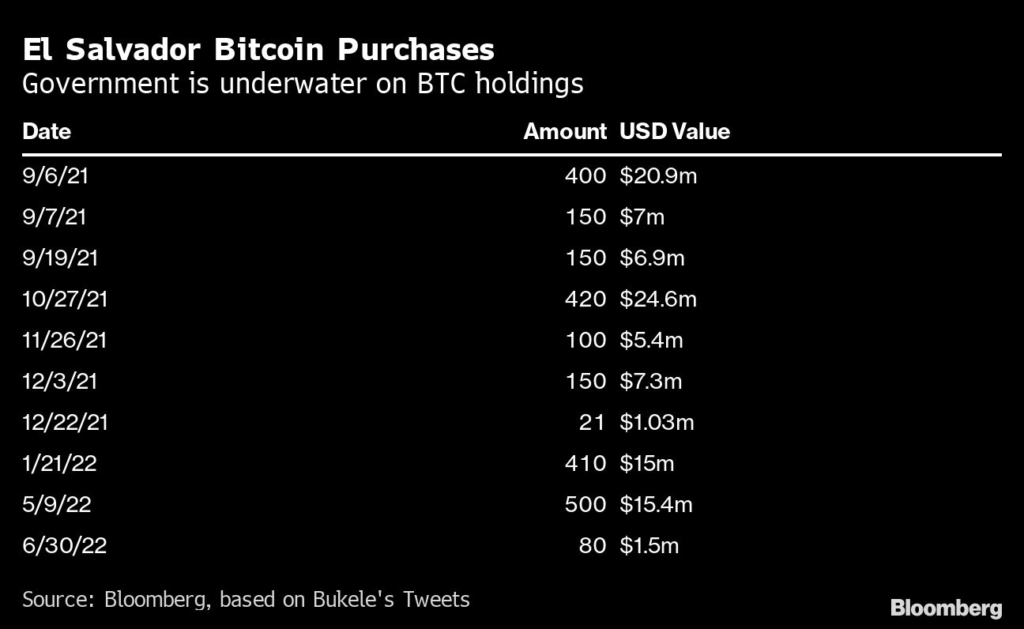
The government has purchased 2,381 Bitcoin with public funds, which, today, are worth about 50% less than what authorities paid for them, according to calculations by Bloomberg based on tweets by President Nayib Bukele. A survey by the U.S. National Bureau of Economic Research found that most businesses and consumers in El Salvador still prefer to use hard currency to pay for goods and services and send remittances. The International Monetary Fund has urged the nation to strip Bitcoin of its legal standing. The government is negotiating a $1.3 billion extended fund facility with the IMF, but no deal has yet been reached. 

Still, Zelaya said he sees a future where digital tokens play a bigger part. 

“We aren’t going to have results overnight. We can’t go to bed poor and wake up millionaires.” Zelaya said. “New technologies have shown how people in previous years were afraid of things like websites and digital business, but it’s been shown through time that reality imposes itself.”

Bitcoin’s price dive has delayed the administration’s plans to issue a $1 billion Bitcoin-backed bond, but the government still plans to push ahead with the sale when market conditions improve, Zelaya said. He said the government is still moving forward with plans to build “Bitcoin City” and will announce additional Bitcoin-related projects in the coming months. 

“I believe in the traditional, international monetary system just as I believe that new technologies are going to help human beings in the future,” Zelaya said.  “So, I think making that transition is vital and it would be wrong of us to not pursue financial innovation that could benefit El Salvador.”

More stories like this are available on bloomberg.com

©2022 Bloomberg L.P.

Apple Stock Surge Raises Stakes as Earnings Loom

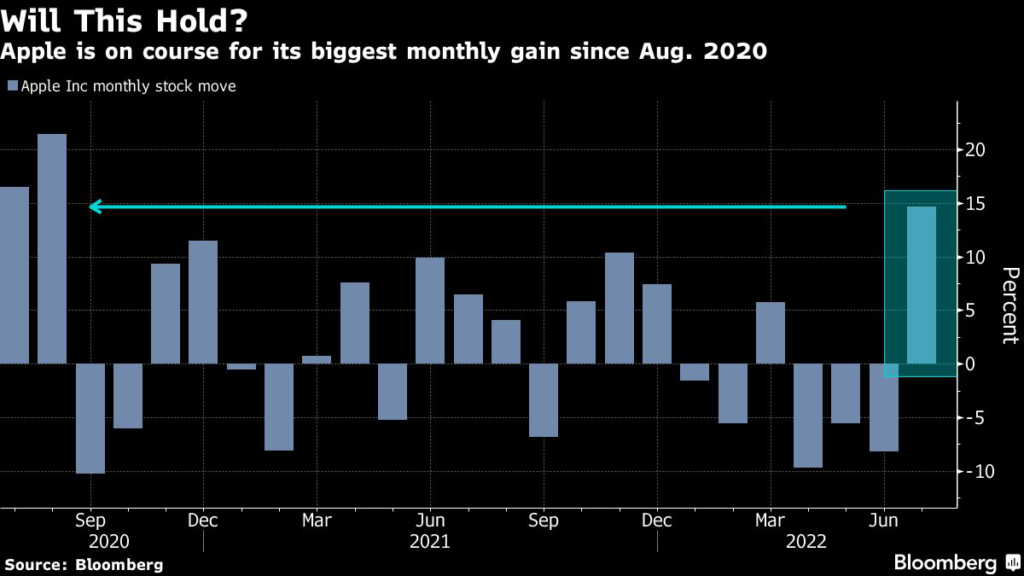
(Bloomberg) — Even as Apple Inc. contends with rising inflation, cooling consumer demand, the strengthening dollar and lockdowns in China, its share price has surged in recent weeks and is heading for its biggest monthly gain in almost two years, up 15% in July.

The shares have beaten those of Microsoft Corp., Alphabet Inc. and Amazon.com Inc. this month, and also are dwarfing gains in the S&P 500 and Nasdaq 100 indexes. With the US flirting with a recession and data showing the economy shrinking for a second straight quarter, Apple is a household name investors are comfortable with. 

“Apple is outperforming because it’s a place of safety for investors,” said Gene Munster, who covered Apple and Google during his 21-year career as an analyst at Piper Jaffray Cos. before co-founding venture-capital firm Loup Ventures. “Every company will be impacted by the upcoming slowdown. Apple should fare better.”

The rally means investor expectations are high for the company’s quarterly earnings, due after the market close Thursday. Surprisingly positive results from Microsoft and Google parent Alphabet also have upped the ante for Apple.  

To be sure, sales growth at Apple has been slowing for five straight quarters, with the company warning in April that supply issues stemming from lockdowns in China would curb revenue by $4 billion to $8 billion in the third quarter that ended June 30 — leading analysts to project the smallest revenue increase since 2020. 

The bullish case hinges on the slowdown not getting much worse, so Wall Street will be listening closely as Chief Financial Officer Luca Maestri outlines trends for the current quarter and possible further effects from China and supply issues. 

With inflation surging, consumers are more mindful of expensive buys like smartphones, tablets and laptops. Mid-tier smartphone makers have seen a dip in demand, and global handset shipments fell 9% in the second quarter, according to estimates from Counterpoint Research. Apple is still finding ways to fuel demand for its line of premium products. 

“Chinese brands were impacted due to weaker demand amid lockdowns in parts of China, but in the US, we’re still seeing the demand for Apple devices holding up, driven by strong carrier promotions,” said Hanish Bhatia, an analyst at Counterpoint. 

Apple also has joined Microsoft and Alphabet in slowing hiring and reining in spending as it braces for an economic downturn. The company hasn’t issued a formal financial outlook since the onset of the pandemic. 

This year’s market selloff has made Apple stock relatively cheaper at about 24 times estimated earnings, though the shares are comfortably above their 10-year average of 16.6 times. Meanwhile, the Nasdaq 100 sits at 21 times estimated profit.

“Apple still can get into large markets around wellness, AR and auto that can keep the company’s growth rates moving higher for the next decade,” Munster said. “That means investors can sleep well at night, and that is the core reason why shares of Apple have outperformed.”

Tech Chart of the Day

Three out of the four major US social media companies have reported results, and it’s clear that the slowing economy and cooling ad spend are hurting their businesses. Shares of Snap Inc. tumbled 39% following its quarterly report, while those of Meta Platforms Inc. are down 8.1% Thursday after the Facebook owner posted its first-ever sales decline. Only Twitter Inc., which received a takeover bid from billionaire Elon Musk in April, is outpacing the tech-heavy Nasdaq 100 Index this year.   

Top Tech Stories

  • Meta Platforms, the social media giant that includes Facebook and Instagram, reported its first-ever quarterly sales decline, citing advertisers’ shrinking budgets.
  • The Senate on Wednesday passed legislation that includes $52 billion in grants and incentives for US semiconductor manufacturing, an industry that has steadily lost ground to foreign competitors in recent years.
    • Samsung Electronics Co.’s quarterly profit missed estimates after cooling demand for consumer gadgets hit its chip division, spurring concern about the outlook for Big Tech in 2022.
    • Qualcomm Inc., the biggest maker of chips that run smartphones, gave a lackluster forecast for the current period, saying a weakening economy will hurt consumer spending on mobile devices.
    • Intel Corp. is set to report second-quarter results Thursday, giving investors an update on both the state of the personal-computer market and the threat from rival Advanced Micro Devices Inc.
  • The euphoria surrounding Alibaba Group Holding Ltd.’s primary listing plan has evaporated in just two sessions, as focus shifts to the firm’s earnings announcement due next week.
  • Apple has enlisted one of Lamborghini’s top car-development managers in a sign that it’s stepping up work on a self-driving electric vehicle, according to people with knowledge of the situation.
  • ServiceNow Inc., a maker of business workflow software, declined in extended trading after reducing its full-year revenue forecast on the strength of the dollar and a potential pullback in demand.
  • Twitter snapped back at billionaire Elon Musk over accusations it’s being intransigent on setting a specific trial date and isn’t agreeing to hand over documents.

(Updates stock move and adds GDP data in second paragraph.)

More stories like this are available on bloomberg.com

©2022 Bloomberg L.P.

Close Bitnami banner
Bitnami