Bloomberg

Gartner Slashes Chip Industry Forecast After PC Demand Slumps

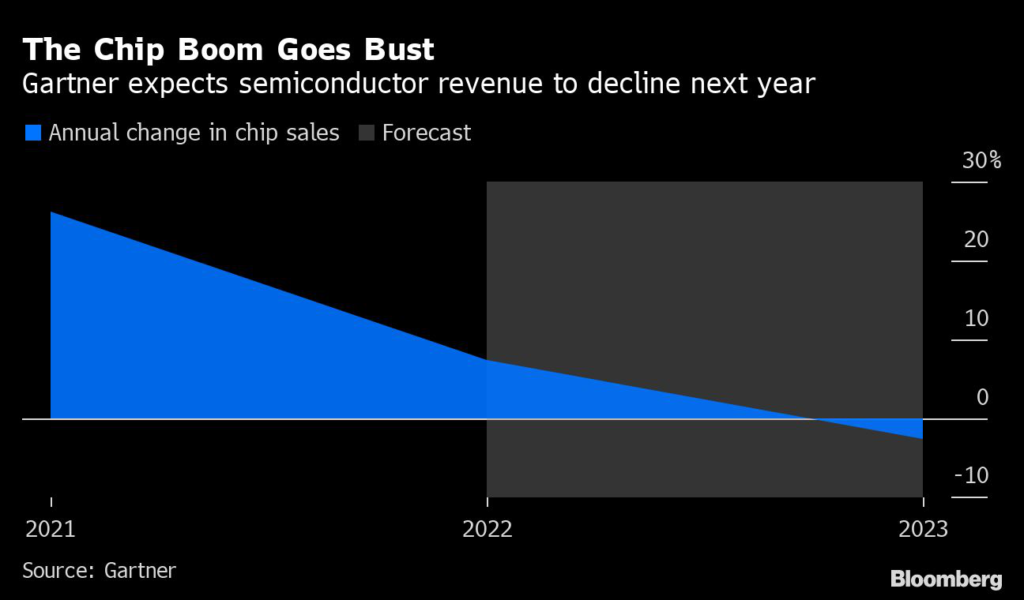
(Bloomberg) — Chip sales are growing much more slowly than expected and will begin to decline in 2023, according to Gartner Inc., marking an abrupt end to one of the industry’s biggest boom cycles.

Global semiconductor revenue will increase just 7.4% in 2022, the research firm projected in a report Wednesday. That’s roughly half the 14% rate that Garner was predicting three months ago and is far off the 26% growth that the chip business posted in 2021.

“The global semiconductor market is entering a period of weakness, which will persist through 2023 when semiconductor revenue is projected to decline 2.5%,” Richard Gordon, a Gartner analyst, said in the report. “We are already seeing weakness in semiconductor end markets, especially those exposed to consumer spending.”

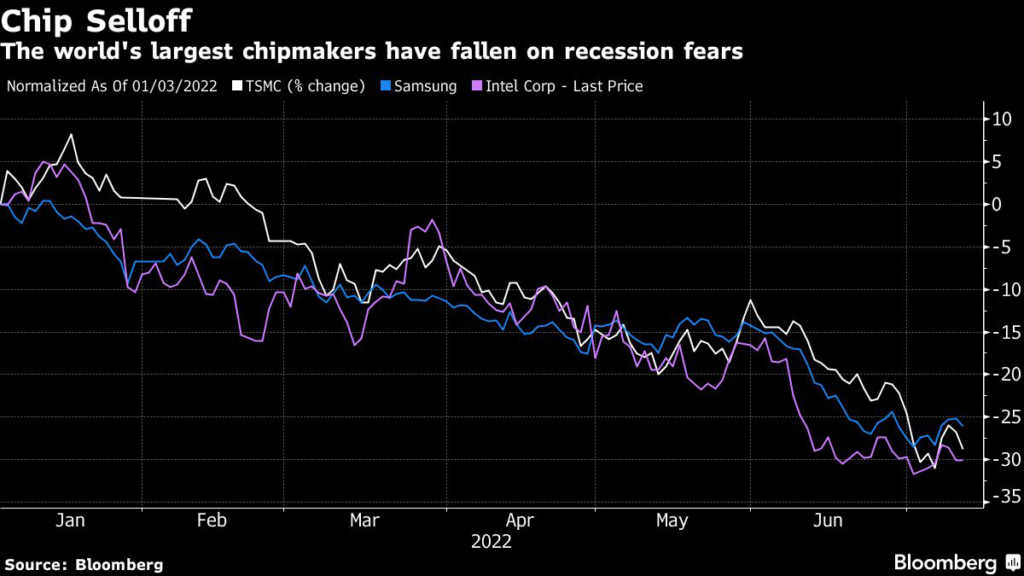
Gartner’s new outlook underscores the concerns that have led investors to dump chip stocks this year. After a run-up during Covid-19 lockdowns, the personal-computer market is now contracting again, dragging down chips along with it. And smartphone sales are faltering as consumers delay purchases because inflation is hurting their spending power. 

PC shipments will contract 13% in 2022 after two years of growth, Gartner predicts. Chip revenue from that market will shrink 5.4%. Smartphone sales, meanwhile, will climb just 3.1% this year after surging almost 25% in 2021. 

While the appetite for chips used in consumer goods has slackened, demand for semiconductors in data centers is still strong. That market will grow 20% this year, Gartner said. Automotive demand also remains a highlight, with the amount of chips per vehicle continuing to increase. Semiconductor content per vehicle will grow to $931 in 2025 from $712 in 2022, Gartner said.

More stories like this are available on bloomberg.com

©2022 Bloomberg L.P.

Solar Power Equipment Prices Keep Rising in Clean Energy Threat

(Bloomberg) — Solar power equipment makers continued to lift prices this week as soaring polysilicon costs spread through the supply chain and threaten to slow clean energy deployment.

Tongwei Co. on Monday increased prices for solar cells by 3.2% to 4.1% depending on their size, while Longi Green Energy Technology Co. lifted wafer prices 3.3% to 4.3% Tuesday. The increases came after prices of polysilicon, the key material in both products, rose 15% since mid-May amid factory shutdowns due to accidents and planned maintenance. 

The average cost of the most expensive grade of polysilicon remained at 297.6 yuan ($44) per kilogram on Wednesday, according to the China Silicon Industry Association. The level was unchanged as no deals were signed this week, and the association said prices will grow further in August as supplies are tight.

Higher costs have begun to suppress demand, especially for giant utility-scale solar farms in China that are price-sensitive. Still, Tongwei and Longi’s increases indicate that there are still buyers willing to pay the higher rates, especially with power-generating fossil fuels like coal and natural gas trading at record highs this year.

“The ability for wafer makers like Longi to lift product price quotes also implies strong demand,” Dennis Ip, an analyst with Daiwa Capital Markets, said in a research note.

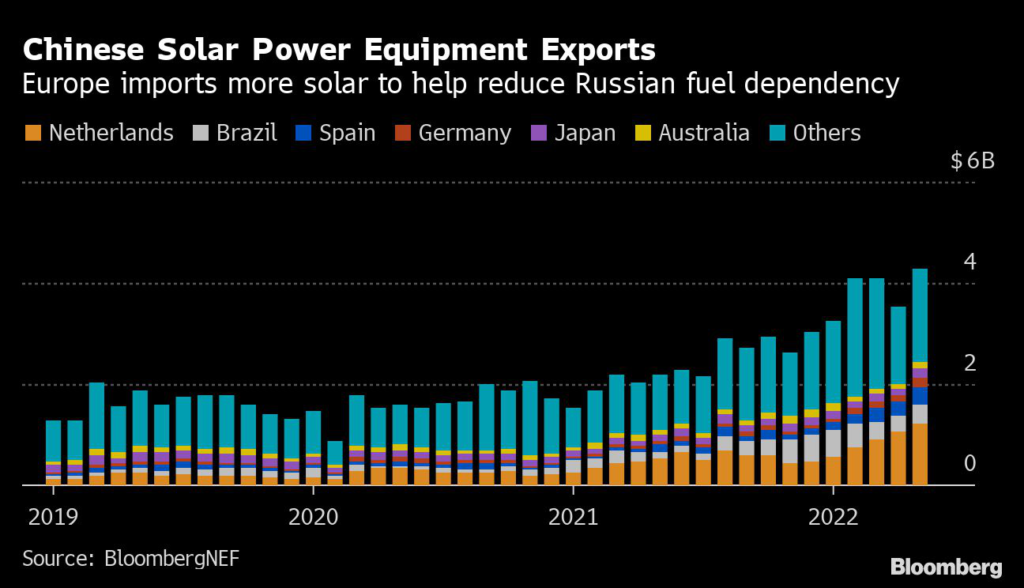
Chinese solar exports have surged this year, especially to Europe, as countries there try to speed up their energy transitions to wean themselves off Russian energy sooner following the invasion of Ukraine. Total exports in May were $4.3 billion, nearly doubling from the previous year.

The polysilicon market is expected to remain tight through September, according to Daiwa, before new capacity comes online in the fourth quarter and loosens production bottlenecks.

(Adds polysilicon price in third paragraph.)

More stories like this are available on bloomberg.com

©2022 Bloomberg L.P.

US Futures Jump on Earnings Amid Countdown to Fed: Markets Wrap

(Bloomberg) — US equity futures rallied Wednesday as a batch of resilient company earnings helped alleviate some of the wider caution in markets ahead of a pivotal Federal Reserve monetary-policy meeting.

Contracts on the tech-heavy Nasdaq 100 added 1.5%, while S&P 500 futures were up almost 1%. Microsoft Corp. jumped in extended US trading on a strong sales forecast, while Google parent Alphabet Inc.’s revenues assuaged investors’ worst fears. European contracts ticked higher.

Still, the mood remains edgy ahead of a much-anticipated Fed interest-rate increase — part of a global wave of monetary tightening to quell inflation that’s stoking concerns about a worldwide economic slowdown.

A gauge of Asian shares retreated amid falls in Hong Kong, tracking a close in the red for US stocks Tuesday before earnings lifted spirits after the bell. Australia’s bond yields and the currency declined on lower than expected inflation.

Treasury yields were little changed as traders brace for a widely telegraphed 75 basis-point Fed hike later Wednesday. The dollar dipped, oil was around $95 a barrel and Bitcoin peeked above $21,000.

The projected Fed move to tackle price pressures would cement a combined 150 basis points increase over June and July — the steepest rise in rates since the 1980s, when then chairman Paul Volcker wrestled with sky-high inflation.

The key question is whether Chair Jerome Powell’s policy signals validate or refute scaled-back bets projecting a 3.4% peak fed funds rate around year-end and cuts in 2023 to shore up an economy at risk of recession. 

“The Fed hasn’t even gotten to neutral yet,” Jason England, global bonds portfolio manager at Janus Henderson Investors, said on Bloomberg Television. “For them to start easing already or for them to start seeing eases priced in is, I think, a little premature.”

IMF Warning

Monetary tightening, Europe’s energy woes amid Russia’s invasion of Ukraine and China’s property sector and Covid challenges are among the risks darkening the global outlook. The International Monetary Fund warned the world economy may soon be on the cusp of an outright recession.

US company earnings are providing a sliver of hope — more than three-quarters of firms that have reported so far either beat or met expectations. But there are doubts about how long they can weather economic challenges.

“Inflation is hurting companies and the question is whether these policy rate hikes are going to do anything to alleviate the pain,” Quadratic Capital Management founder Nancy Davis said on Bloomberg Television. 

Elsewhere, President Joe Biden will speak with Chinese leader Xi Jinping on Thursday amid fresh tensions over Taiwan. The White House is also considering whether to lift some tariffs on Chinese imports to stem inflation. 

Here are some key events to watch this week:

  • Apple, Amazon, Meta earnings due this week
  • Fed policy decision, briefing, Wednesday
  • Australia CPI, Wednesday
  • US GDP, Thursday
  • Euro-area CPI, Friday
  • US PCE deflator, personal income, University of Michigan consumer sentiment, Friday

Musk, Tesla and Twitter are this week’s theme of the MLIV Pulse survey. Also share your views on the S&P 500’s biggest stocks. Click here to get involved anonymously.

Some of the main moves in markets:

Stocks

  • S&P 500 futures rose 0.9% as of 7 a.m. in London. The S&P 500 fell 1.2%
  • Nasdaq 100 futures increased 1.5%. The Nasdaq 100 fell 2%
  • Japan’s Topix index rose 0.1%
  • Australia’s S&P/ASX 200 index climbed 0.3%
  • South Korea’s Kospi index declined 0.1%
  • China’s Shanghai Composite Index was little changed
  • Hong Kong’s Hang Seng Index fell 1.1%
  • Euro Stoxx 50 futures rose 0.3%

Currencies

  • The Bloomberg Dollar Spot Index dipped 0.2%
  • The euro was at $1.0146, up 0.3%
  • The Japanese yen was at 136.92 per dollar
  • The offshore yuan was at 6.7632 per dollar, up 0.1%

Bonds

  • The yield on 10-year Treasuries was little changed at 2.80%
  • Australia’s 10-year yield fell seven basis points to 3.28%

Commodities

  • West Texas Intermediate crude was at $95.82 a barrel, up 0.9%
  • Gold was at $1,719.10 an ounce

More stories like this are available on bloomberg.com

©2022 Bloomberg L.P.

Mercedes Raises Outlook Despite Inflation, Supply-Chain Woes

(Bloomberg) — Mercedes-Benz AG raised its outlook on resilient sales of new, high-priced models that are helping the luxury-car maker overcome economic turbulence including Europe’s worsening energy crisis and high inflation. 

The world’s biggest luxury-car maker now expects group profit to be slightly higher than last year, rather than unchanged, while returns from carmaking are seen at between 12% to 14%, slightly higher than before, the company said Wednesday. Mercedes also reported second-quarter results that beat expectations.

“We are enhancing our vigilance and resilience to manage increasingly complex macroeconomic and geopolitical challenges,” Chief Executive Officer Ola Kallenius said in a statement. “At the same time, we have good reasons to remain confident, with ongoing strong demand, a fresh vehicle portfolio and further key product launches this year.”

A worsening economic climate weighing on consumers are combining with the ongoing struggles to procure enough semiconductors for automakers. Ongoing pandemic lockdowns in China preventing people from buying cars are another threat. Even so, Mercedes predicted healthy demand for its models during the second half of the year with solid order books indicating demand continues to outstrip available cars. 

Like other carmakers, Mercedes is prioritizing production of their most lucrative models as chip supply remains a headache. While availability continues to be tight, automakers are seeing signs of the jam easing. Volvo Cars this month said improvements late in the second quarter were helping production resume.

At Mercedes, deliveries fell 7% during the second quarter because of a lack of chips and logistical challenges. 

Mercedes also has taken further steps to keep its operations running due to the threat of gas rationing in Germany after Russia’s decision to cut supplies through a key Baltic sea pipeline have raised fears of an abrupt halt of deliveries during winter. The Sindelfingen plant, where the company makes the high-end electric EQS, S-Class and Maybach, can now function without natural gas, a fuel typically used in automaker’s paint operations. 

(Updates with commentary on second-half outlook in fourth paragraph)

More stories like this are available on bloomberg.com

©2022 Bloomberg L.P.
UK’s Development-Finance Arm Plans $6 Billion African Investment

(Bloomberg) — British International Investment Plc, the UK government’s development-finance arm, plans to invest $6 billion over the next five years in Africa in areas ranging from renewable power and digital infrastructure to supporting women-owned businesses. 

The spending, which is part of a $10 billion global program, includes a $76 million contribution toward a planned $500 million fund being raised by Old Mutual Ltd.’s African Infrastructure Investment Managers that was announced on Wednesday.

“Investment priorities will be driven by the size of the economy, and the development needs in that economy,” BII Chief Executive Officer Nick O’Donohoe said in an interview.

BII’s investment plans come as a host of development finance institutions ranging from France’s Proparco to Germany’s KFW Group jostle to provide the finance needed to address climate change concerns in Africa and to meet digital connectivity needs. The region needs as much as $108 billion in infrastructure investment a year, according to the African Development Bank. 

BII, formerly known as CDC Group, is restricted to investing in the private sector and while it will focus on the “powerhouse” markets of Ethiopia, Kenya, Nigeria and Egypt, some money will go to South Africa because of its drive to attract climate finance, he said. 

The institution last week agreed to provide Oslo-based energy producer Scatec ASA with about $157 million in debt and equity finance for a solar and battery-storage project in South Africa.   

The investment firm, which is fully-owned by the UK government, has made significant equity investments in African companies such as Liquid Telecom, the continent’s biggest fiber company, and Globeleq, a power producer. Bloomberg this week reported that BII has hired Rothschild & Co. to review how to grow the latter business. Options include bringing on a third investment partner.

“We have been a significant investor in power in Africa, originally in fossil-fuel power, and over the last three or four years, almost exclusively renewable power,” said O’Donohoe. 

Over the next five years, at least 30% of BII’s total new commitments by value will be in climate finance, he said. 

BII’s plans also include “actively investing” in funds, said O’Donohoe. FMO, a Dutch-government controlled entrepreneurial development bank, invested $40 million into the Old Mutual fund alongside BII. 

More stories like this are available on bloomberg.com

©2022 Bloomberg L.P.
Sub-Sea Cable Firm OMS Weighs $300 Million Malaysia IPO, Sources Say

(Bloomberg) — OMS Group Sdn., a Malaysia-based company that installs cable underwater, is weighing a listing in Kuala Lumpur as soon as next year that could raise as much as $300 million, according to people with knowledge of the matter.

The company is working with financial advisers on the planned first-time share sale, said the people, who asked not to be identified as the process is private. It is seeking a valuation of over $1 billion based on strong earnings growth and increased spending among telecommunications operators on digital infrastructure, the people said.

OMS had asked banks to submit proposals for the potential first-time share sale and was considering venues including Australia, Hong Kong, Malaysia and Singapore for a listing, Bloomberg News reported in October. 

Should the offering take place, it would give a boost to first-time share sales in the Southeast Asian nation. At $300 million, the initial public offering would be Malaysia’s biggest in over a year, after Mr D.I.Y. Group Bhd.’s $363 million listing in October 2020, according to data compiled by Bloomberg.

Deliberations are ongoing and the size as well as timing of the IPO could still change, the people said. 

OMS is exploring an IPO in the region, a company representative said in a statement responding to a query from Bloomberg News. Following the company’s recent private funding rounds, there has been continued interest from investors, according to the statement.

Sub-Sea Spending

Technology and telecom firms are spending on ambitious undersea projects in Asia as increasing digitalization in the region sparks demand for infrastructure. Last year Alphabet Inc.’s Google and Facebook Inc. joined a new sub-sea cable system for 2024 dubbed Apricot, linking Japan, Singapore, Taiwan, Guam, the Philippines and Indonesia. Nippon Telegraph & Telephone Corp. will build a 10,000 kilometre cable linking Japan to California, the company announced earlier this month.

OMS Group, with offices in Malaysia, Singapore and Indonesia, has done sub-sea cable installation and maintenance projects for the past three decades, including the Papua New Guinea National Submarine Fiber Cable Network and the South-East Japan Asia Japan Cable System 2, according to its website. 

The company’s fleet includes Cable Vigilance, a 5,448 gross tonnage cable-laying and repair ship, which launched on Tuesday in Dunkirk, France, according to a LinkedIn post. 

More stories like this are available on bloomberg.com

©2022 Bloomberg L.P.
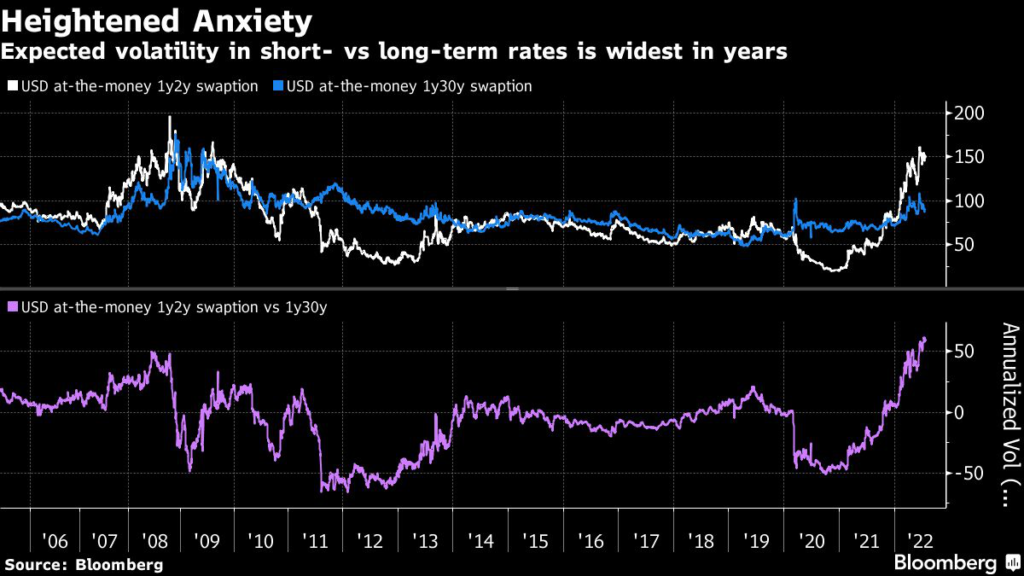
US Futures Up on Earnings; Asia Stocks Dip Pre-Fed: Markets Wrap

(Bloomberg) — US equity futures rallied Wednesday after resilient earnings from Google parent Alphabet Inc. and an upbeat outlook from Microsoft Corp. helped alleviate some of the wider caution in markets.

Contracts on the tech-heavy Nasdaq 100 added over 1%, while S&P 500 futures were up more than 0.5%. Microsoft jumped in extended trading on a strong sales forecast, while Alphabet’s revenues assuaged investors’ worst fears.

Still, the mood remains edgy ahead of a much-anticipated Federal Reserve interest-rate increase — part of a global wave of monetary tightening to quell inflation that’s stoking concerns about a worldwide economic slowdown.

Asian shares retreated amid falls in Hong Kong, tracking a close in the red for US stocks Tuesday before earnings lifted spirits after the bell. Australia’s bond yields and currency declined on lower than expected inflation.

Treasury yields were little changed as traders brace for a widely telegraphed 75 basis-point Fed hike later Wednesday. The dollar dipped, oil was around $95 a barrel and Bitcoin peeked above $21,000.

The projected Fed move to tackle price pressures would cement a combined 150 basis points increase over June and July — the steepest rise in rates since the 1980s, when then chairman Paul Volcker wrestled with sky-high inflation.

The key question is whether Chair Jerome Powell’s policy signals validate or refute scaled-back bets projecting a 3.4% peak fed funds rate around year-end and cuts in 2023 to shore up an economy at risk of recession. 

“The Fed hasn’t even gotten to neutral yet,” Jason England, global bonds portfolio manager at Janus Henderson Investors, said on Bloomberg Television. “For them to start easing already or for them to start seeing eases priced in is, I think, a little premature.”

IMF Warning

Monetary tightening, Europe’s energy woes amid Russia’s invasion of Ukraine and China’s property sector and Covid challenges are among the risks darkening the global outlook. The International Monetary Fund warned the world economy may soon be on the cusp of an outright recession.

US company earnings are providing a sliver of hope — more than three-quarters of firms that have reported so far either beat or met expectations. But there are doubts about how long they can weather economic challenges.

“Inflation is hurting companies and the question is whether these policy rate hikes are going to do anything to alleviate the pain,” Quadratic Capital Management founder Nancy Davis said on Bloomberg Television. 

Elsewhere, President Joe Biden will speak with Chinese leader Xi Jinping on Thursday amid fresh tensions over Taiwan. The White House is also considering whether to lift some tariffs on Chinese imports to stem inflation. 

Here are some key events to watch this week:

  • Apple, Amazon, Meta earnings due this week
  • Fed policy decision, briefing, Wednesday
  • Australia CPI, Wednesday
  • US GDP, Thursday
  • Euro-area CPI, Friday
  • US PCE deflator, personal income, University of Michigan consumer sentiment, Friday

Musk, Tesla and Twitter are this week’s theme of the MLIV Pulse survey. Also share your views on the S&P 500’s biggest stocks. Click here to get involved anonymously.

Some of the main moves in markets:

Stocks

  • S&P 500 futures rose 0.7% as of 12:46 p.m. in Tokyo. The S&P 500 fell 1.2%
  • Nasdaq 100 futures increased 1.3%. The Nasdaq 100 fell 2%
  • Japan’s Topix index was little changed
  • Australia’s S&P/ASX 200 Index was steady
  • South Korea’s Kospi index declined 0.5%
  • China’s Shanghai Composite index dropped 0.1%
  • Hong Kong’s Hang Seng index fell 1.6%
  • Euro Stoxx 50 futures rose 0.1%

Currencies

  • The Bloomberg Dollar Spot Index dipped 0.1%
  • The euro was at $1.0145, up 0.3%
  • The Japanese yen was at 136.89 per dollar
  • The offshore yuan was at 6.7684 per dollar

Bonds

  • The yield on 10-year Treasuries was at 2.80%
  • Australia’s 10-year yield fell seven basis points to 3.27%

Commodities

  • West Texas Intermediate crude was at $95.26 a barrel, up 0.3%
  • Gold was at $1,717.38 an ounce

More stories like this are available on bloomberg.com

©2022 Bloomberg L.P.

South Korea Requires Terra Founder to Notify When He’s Back

(Bloomberg) — South Korean prosecutors confirmed that they would require Do Kwon, the founder of cryptocurrency startup Terraform Labs, to notify authorities when he returns to the country, as they investigate allegations of illegal activity behind the collapsed stablecoin TerraUSD.  

DongA Ilbo earlier reported that the Ministry of Justice had approved prosecutors’ requests that Kwon be required to notify authorities upon entering South Korea. Authorities also banned Kwon’s co-founder Daniel Shin from leaving the country, the report said, citing unidentified sources.

“The report is not wrong,” the Southern District Prosecutors Office said via a text message. It did not elaborate, and it was unclear what authorities planned to do when Kwon returns. 

Kwon, who is widely believed to be in Singapore, was unavailable for comment, while the justice ministry declined to confirm the report. 

South Korea’s prosecutors have conducted raids on 15 areas, including crypto exchanges and Shin’s home. Authorities banned current and former employees of Terraform Labs from leaving the country in June, while a KBS TV report said prosecutors summoned a former official at the company’s unit for questioning.

Some investors filed a complaint with South Korean prosecutors in May, alleging Kwon and his company had committed fraud and engaged in illicit fundraising. Prosecutors are also looking into whether Kwon evaded taxes by moving profits from cryptocurrency transactions to an offshore account, local news agency Yonhap reported. 

Policymakers around the world have focused on stablecoins following the turmoil in the crypto markets, most notably the collapse of the TerraUSD token in May. 

More stories like this are available on bloomberg.com

©2022 Bloomberg L.P.
Apple Supplier SK Hynix’s Outlook Sours as Tech Demand Wanes

(Bloomberg) — South Korean chipmaker SK Hynix Inc. warned of waning memory growth and rising inventories, becoming the latest tech giant to sound the alarm over global economic uncertainty.

The downbeat sentiment came after the Apple Inc. supplier logged a 56% jump in second-quarter profit on resilient demand and a weak Korean won on Wednesday. But executives said they see a slowdown in demand from its main growth engines of PCs, smartphones and servers.

Recession concerns are prompting businesses to tighten costs, Chief Marketing Officer Kevin Noh said at a post-earnings news conference, adding that chip shipment growth forecasts for the current quarter have to be revised down. 

“Market growth for the year is going to be a lot lower than our expectations earlier in the year,” Noh said. With inventories likely to trend above average throughout the market, “it is inevitable that the capex for next year has to be adjusted significantly.” 

The company said it will decide on its 2023 capex plan as early as late-August — ahead of its usual schedule. Hynix is considering slashing its 2023 capital expenditure by about 25%, joining US rival Micron Technology Inc. in cutting investment on fab expansions, Bloomberg News reported this month. 

Over the longer term, however, SK Group Chairman Chey Tae-won promised in a call with President Joe Biden that the group would invest $15 billion to build an advanced packaging and testing facility and support research programs in the US. The US is debating a bipartisan bill to bolster its semiconductor industry and fight Chinese competition by reducing its reliance on Asia.

Shares in Hynix fell as much as 1.3% after the news, while the benchmark Kospi index was little changed.

Predictions of a global recession have grown, and tech giants from Apple to Microsoft Corp. are pushing back spending and hiring plans for the next year. That has prompted Hynix and its rivals Samsung Electronics Co. and Micron to pledge to protect profitability and manage chip supply to keep prices stable.

The market faces a potential glut of NAND as appetite for gadgets wanes. NAND flash prices are projected to fall by as much as 13% in the current quarter, and that may continue throughout the year, according to TrendForce.  

“Inventory problems have bubbled over upstream onto the supply side and sellers are under increased pressure to sell,” the Taiwan-based market research firm said in a note. 

Hynix’s operating income rose to 4.2 trillion won ($3.2 billion) in the three months ended in June, narrowly beating analyst estimates of a 4.1 trillion won profit. Sales increased 34% from a year ago to 13.8 trillion won, missing the estimated 14.3 trillion won.

More stories like this are available on bloomberg.com

©2022 Bloomberg L.P.
Japan’s Crypto Groups Call for Tax Cuts to Stem Talent Outflow

(Bloomberg) — Crypto lobbying groups in Japan plan to ask the government to ease corporate tax rules that’s seen to be stunting the local digital asset industry’s growth. 

Two of the top bodies — the Japan Cryptoasset Business Association and the Japan Virtual and Crypto assets Exchange Association — are preparing to submit a proposal to the Financial Services Agency asking it to make it cheaper for companies to issue and hold crypto tokens, according to an internal memo seen by Bloomberg. 

The groups will ask the government to stop taxing paper gains on crypto holdings if firms own them for purposes other than short-term trades, according to the memo. Currently, profit from cryptocurrency holdings, including unrealized gains, is subject to corporate tax of about 30%. 

This can make it expensive for companies to hold onto digital coins once they’re issued, raising the bar for launching crypto projects. The levy also applies to so-called governance tokens, which allow holders to participate in business decisions by offering them voting powers.

The calls from the crypto industry will be a test for how committed Prime Minister Fumio Kishida’s government is to developing Japan’s so-called Web3 business as part of an initiative announced last month. High taxes, which are particularly burdensome for many cash-strapped startups, have already made some Japanese firms relocate to countries such as Singapore.

A spokesman for JCBA said the two organizations plan to submit the proposal to the FSA agency as early as this week, though declined to comment on the contents of the request. JVCEA declined comment. 

The FSA has been discussing the need of a corporate tax change with the crypto industry, said an official who declined to be named because of the agency’s policy. The regulator hasn’t determined whether to include this proposal in its annual revision suggestions to be submitted in August to the tax authorities, though isn’t ruling it out, the official said.

Push for Change

“Japan is an impossible place to do business,” said Sota Watanabe, chief executive officer of Web3 infrastructure developer Stake Technologies Pte., who moved his company to Singapore partly because of higher taxes. “The global battle for a Web 3.0 hegemony is under way, and yet, Japan isn’t even at the start line.” 

The lobby groups also plan to ask authorities to set a uniform 20% income tax on individual investors’ earnings from cryptocurrencies, instead of them being subject to rates that can reach as high as 55%, according to the memo. 

Some politicians have already raised this need for digital technology to drive growth in the Asian nation. Masaaki Taira, an outspoken crypto supporter in the ruling Liberal Democratic Party, has been pushing fellow lawmakers and the finance ministry for changes to stem the outflow of digital talent. 

Japan’s annual tax discussions usually begin in the summer after representative bodies of industries submit proposals to government offices in charge. The Liberal Democratic Party’s powerful tax panel makes decisions near the end of the year. 

More stories like this are available on bloomberg.com

©2022 Bloomberg L.P.
Close Bitnami banner
Bitnami