
Bloomberg

North Korea’s Economy Fails to Rebound Before 2022 ‘Fever’ Surge

(Bloomberg) — North Korea’s economy failed to rebound last year as the impact of pandemic measures on trade continued to weigh, with the prospects for growth this year clouded by a surge in virus cases that was finally recognized publicly by Kim Jong Un’s regime.

Gross domestic product in North Korea contracted 0.1% in the 12 months through December, according to South Korea’s central bank Wednesday. North Korea’s economy already shrank 4.5% in 2020 as the pandemic prompted the official closure of its border with China, triggering its worst slump in decades.

The figures hint at the continued blow to the North’s economy from the fallout of Covid-19 even before Kim acknowledged rocketing cases of “fever” in May. Recognition of the outbreak likely meant virus infections had mushroomed beyond a scale that could be ignored.

The Bank of Korea’s figures are among the very few regular estimates of North Korea’s economy. The North’s economic performance is extremely difficult to gauge given the lack of official data and a lack of clarity over how successfully Pyongyang is evading sanctions and how much money it may be generating from activities such as alleged online fraud and cryptocurrency theft.

North Korea has also repeatedly shown that it puts its military objectives ahead of any goals for wider economic development for its population at large. That makes its GDP performance, however accurate it may be, a poor indicator of how Kim will conduct policy. 

North Korea’s trade fell 17.3% in 2021 to $710 million, the BOK said. Exports, almost all of which are destined for China, the country’s biggest ally, slid 8.2%.

The fever outbreaks have emerged as the largest threat this year to North Korea’s economy. Kim has called the spread the biggest turmoil since the nation’s founding, invoking the nightmare of the 1990s famine estimated to have killed as many as millions of people.

While Pyongyang says it had the flareup under control by the end of May after a lockdown for most of the month, the impact will likely have slowed any recovery in the economy this year. Daily infections reportedly peaked at just under the 400,000 mark earlier that month. There was no outside verification of the numbers provided by North Korea.

Even the spread of milder strains of the virus may have caused a higher incidence of serious illnesses and deaths among North Korea’s unvaccinated population than they caused in other countries where most people had been given multiple shots to protect them.

The country also lacks basic equipment and materials such as respirators and oxygen to deal with serious virus cases. Pyongyang has also spurned offers from other countries to provide medical supplies and personnel.

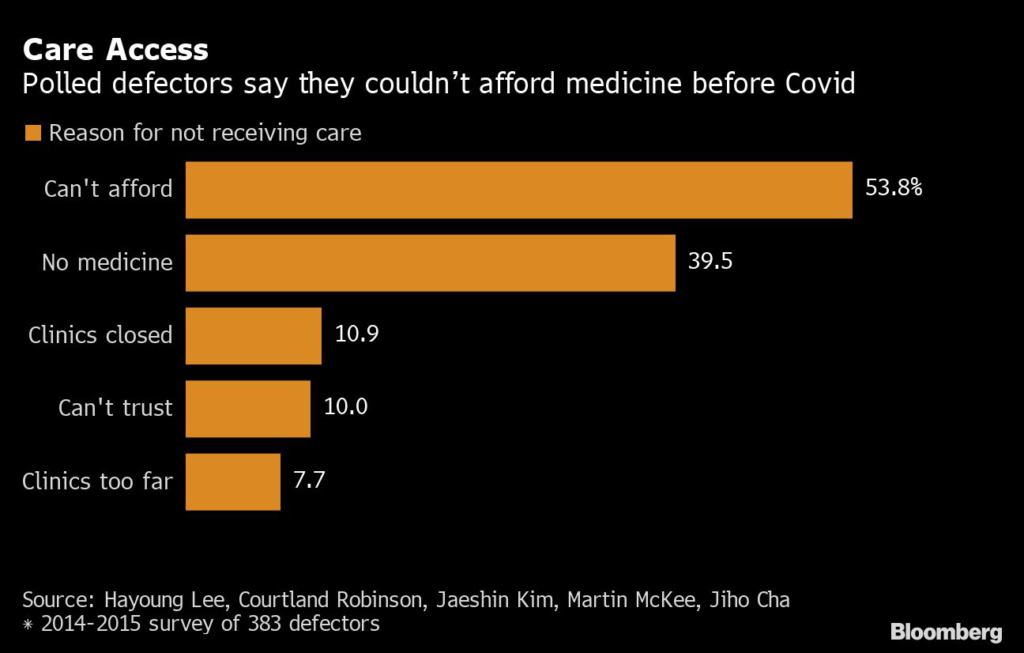
A large portion of North Korea’s population also struggles to gain adequate medical care. A 2020 study shows most North Koreans can’t afford medical help and, even if they did, supplies are lacking.

Still, North Korea says its fatality rate from the outbreak is far lower than that in South Korea. That has raised questions about the veracity of the claims.

Nevertheless, the country’s ability to mobilize its military to help enforce some of the world’s toughest controls on civilian travel between cities, likely made it easier to stem the transmission of the virus. But more restrictions also likely meant more constraints on the flow of goods essential to the economy and the livelihood of its people.

Below are further details from the BOK, which bases its calculations on data obtained from a range of South Korean agencies:

  • Per capita income in North Korea was estimated at 1.42 million won ($1,083) in 2021, or about 3.5% that of South Korea, the BOK said.
  • The agricultural and fisheries industry grew 6.2% last year.
  • Mining — a key source of income until sanctions started to sap demand for its iron ore, minerals and other resources — contracted 11.7%
  • Manufacturing industry shrank 3.3%, while the services industry contracted 0.4%.
  • Gas, water works and electricity industries grew 6%.

More stories like this are available on bloomberg.com

©2022 Bloomberg L.P.
Senate Sets Up Vote on $52 Billion for Semiconductor Industry

(Bloomberg) — A $52 billion boost to the US domestic semiconductor industry moved one step closer to reality Tuesday when the Senate advanced legislation providing grants, incentives and tax breaks to the sector and set it up for final passage this week. 

“It’s a major step for our economic security, our national security, our supply chains and, in fact, for America’s future,” Senate Majority Leader Chuck Schumer said Tuesday on the Senate floor before a procedural vote on the bill. “With this bill we will reawaken the spirit of discovery, innovation, invention and optimism that made America the envy of the world.”

Tuesday’s 64-32 vote was to end unlimited debate, a necessary step before it can be considered on the floor. Schumer said senators should expect to vote on passage of the bill soon. From there, the House is expected to take up the legislation and pass it, likely before the end of the week, sending it on to President Joe Biden for his signature.

Surface-to-Air Missiles Need Chips Too, Pentagon Tells Congress

In addition to the $52 billion in grants and subsidies the bill would funnel to semiconductor manufacturers who build facilities in the US, the legislation also includes funding for research and workforce training as well as money for 5G wireless technology. It also includes a 25% tax credit for semiconductor manufacturing which contributes to a the total of $79 billion that the legislation would contribute to the deficit. 

“The logic — the economic and national security logic — of this bill and this vote are overwhelming,” Brian Deese, the director of the National Economic Council, said.

Some Republicans, however, remain unconvinced and complain about the cost. House Minority Leader Kevin McCarthy told reporters on Tuesday night that he would vote no. “Our biggest concern is all this mandatory spending, you have no control over it, it just automatically goes,” he said. “I think that’s wrong.”

He added, however, that he and other congressional Republican leaders would not be pushing their members to vote against the measure. 

(Updates with McCarthy planning to vote no, in final two paragraphs.)

More stories like this are available on bloomberg.com

©2022 Bloomberg L.P.
Alphabet, Microsoft Spur Hope Big Tech Can Handle Slow Economy

(Bloomberg) — Alphabet Inc., Microsoft Corp. and Texas Instruments Inc. posted double-digit quarterly revenue growth on Tuesday and expressed optimism about the coming months, reassuring investors who had been fretting that the technology industry was poised for a dour second half.

Shares of all three companies rallied in late trading, spurring S&P 500 futures and giving a boost to tech peers. The earnings reports from the trio of industry giants set the tone for a week that will include results from heavy hitters like Meta Platforms Inc., Qualcomm Inc., Apple Inc., Amazon.com Inc. and Intel Corp. 

Microsoft gave an encouraging sales forecast for the current fiscal year, soothing fears that the strong US dollar and a weakening economy would ravage sales. Chip manufacturer Texas Instruments also offered a bullish forecast, indicating that sales and profit this quarter would likely exceed Wall Street estimates. And Alphabet, the parent company of search giant Google, managed to post advertising revenue that surpassed analysts’ expectations.

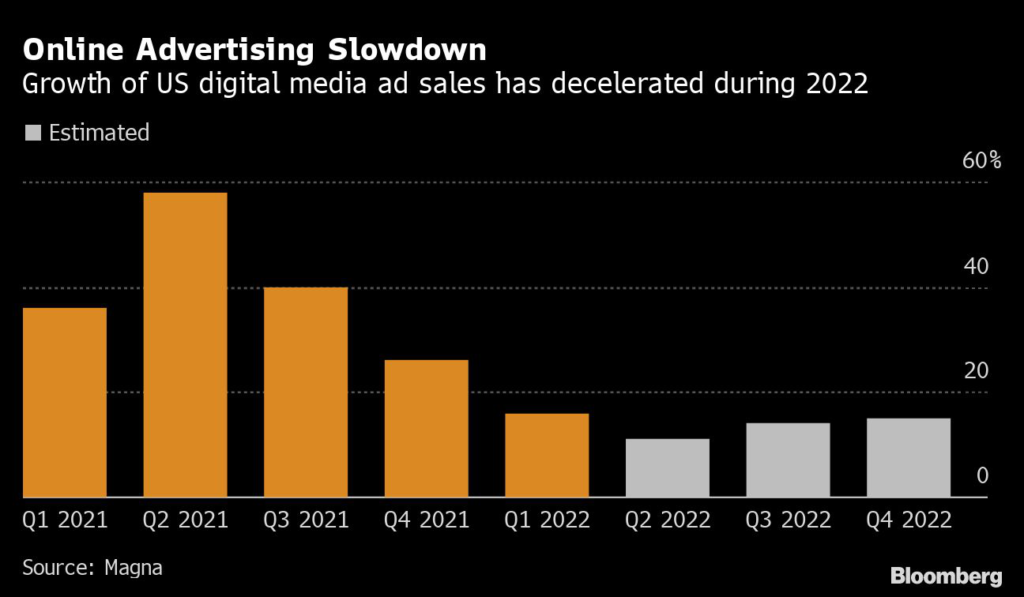
An online advertising slowdown had been a particular concern of investors, who dragged down shares of Snap Inc. and Twitter Inc. following their earnings reports last week.

“I would construe this report as a sigh of relief,” Dan Morgan, a senior portfolio manager at Synovus Trust Co., said of Alphabet’s results. “You’re looking at an environment where the overall ad spend rates are definitely slowing down, yet Google still was able to deliver above and beyond.”

The three reports reflected underlying resilience, if not outright strength, in four of the industry’s main pillars: digital advertising, cloud computing, information-technology spending and chips. Still, it wasn’t all good news. The surging US dollar, which reduces the value of foreign sales, is eroding revenue — especially at Microsoft. And Texas Instruments saw weaker demand for chips in consumer products.

Alphabet missed analysts’ estimates for its YouTube and its cloud businesses. The company’s earnings also came in light: Profit was $1.21 a share, compared with an estimate of $1.32.

The companies also pointed to growth roadblocks looming in the coming months. Advertisers have begun to pull back on spending, exercising caution in an uncertain economic environment. Alphabet Chief Financial Officer Ruth Porat used the term “ad pullback” several times on a conference call with analysts. “It’s clear Google has its work cut out for it in the back half of the year,” said analyst Evelyn Mitchell of Insider Intelligence.

Even so, investors were cheered by the overall tone of Google’s remarks. The market for search advertising is more resilient than that of ads on social media, insulating Google’s business relative to competitors like Snap and Facebook.

At Microsoft, the company signed a record number of Azure cloud contracts worth more than $100 million and $1 billion, CFO Amy Hood said in an interview. Commercial bookings, a measure of future sales to corporate customers, were “significantly” better than the company expected, rising by 25%, an indication corporate demand for Microsoft software remained strong in the quarter, Hood added.

Texas Instruments, one of the world’s biggest chipmakers, said demand for semiconductors used in industrial machinery and vehicles was strong. It also saw a rebound in China after that country began lifting Covid-related lockdowns in the country, which had shuttered factories.

South Korean chipmaker SK Hynix Inc. delivered strong results as well, helped by the flip side of a strong US dollar. The weaker Korean won — along with resilient demand — contributed to a 56% gain in profit last quarter. Still, the company was circumspect about the future, saying it would “carefully” review its 2023 investment plan.

Investors will get deeper insight into the underlying health of digital advertising, chips and IT spending Wednesday, when Meta and Qualcomm and ServiceNow Inc. release their latest numbers.

More stories like this are available on bloomberg.com

©2022 Bloomberg L.P.
New Hong Kong Rules Will Create 1,300 Board Seats for Women

(Bloomberg) — As a woman who sits on multiple boards of Hong Kong-listed companies, Susanna Chiu is a rarity in the city.

Despite efforts to improve gender diversity on corporate boards, many local companies still rely on old-boy networks to fill directorships, said Chiu, the first woman to be president of the Hong Kong Institute of Certified Public Accountants.

Chiu, 62, is a board member of cosmetics retailer Bonjour Holdings Ltd., where she is chief financial officer, and a director at four other Hong Kong-listed companies.

“The female talent pool is here,” she said. “You just need to open your eyes.”

That’s a message that more companies will need to accept, with new Hong Kong stock exchange rules creating more than 1,300 director positions exclusively for women by the end of 2024. The move follows a global trend toward more diverse boardrooms already well under way in places like Australia, the US and Europe. 

Starting this month, the exchange requires any company seeking to list in Hong Kong to have at least one director of a different gender to the board majority. In January, the exchange set a three-year deadline for every listed company, new or old, to ensure gender diversity on its board.

The rule aligns with similar efforts globally. Securities Commission Malaysia last year updated its corporate governance code, saying that at least 30% of directors should be female; companies that don’t meet that target should disclose how they’ll get there within three years. The European Union on June 7 reached a political agreement on a law to require listed companies to move toward 40% female representation in non-executive director positions by 2026.

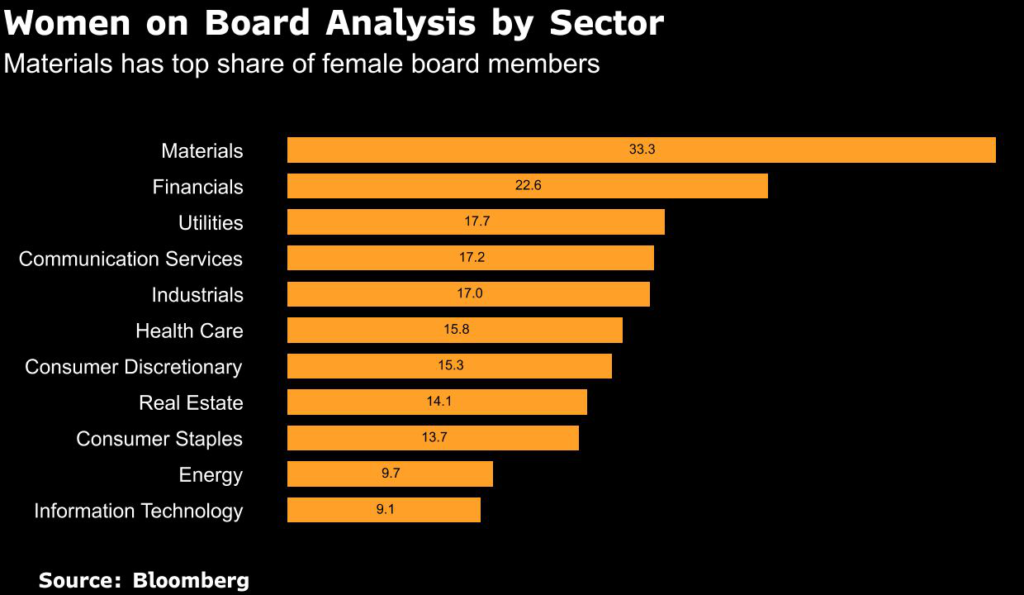
Among companies listed in Hong Kong, women hold about 16% of board seats, according to the stock exchange. Blue chips do slightly better, with about 17% for members of the benchmark Hang Seng Index in the second quarter of 2022, according to data compiled by Bloomberg News.  

Frozen Out

The changes could open up many new opportunities for women who until now have been largely frozen out of the financial hub’s boardrooms, according to Nasrine Ghozali, chief risk officer of Oasis Management Co. and member of the steering committee of the 30% Club Hong Kong, which advocates for more gender diversity on boards.

“The new rules are creating some momentum for companies to finally consider diverse board candidates,” she said. “For many years, Hong Kong has been lagging, globally and regionally, so it’s great to see finally some progress.”

Out of more than 2,500 companies listed on the exchange, 815 had no female directors at all, according to an April 2021 consultation paper from the Hong Kong bourse.  

Those companies will need to find women to serve on their boards, Ghozali said, as will the 180 or so companies that typically list each year in Hong Kong.

That translates into more than 1,300 board seats for women, she said.

Untapped Talent Pools

So far, that hasn’t generated much demand at the Hong Kong Independent Non-Executive Director Association, which keeps an active “talent pool” archive featuring gender and professional field filters, said president Roy Lo.

Companies tend to “tap the network of the major shareholder or the chairman,” said Lo. “It needs to evolve.”

Women held four more seats on the boards of companies in the Hang Seng Index in the second quarter from the previous three-month period, the biggest increase in two quarters, the data compiled by Bloomberg show. The average number of female directors was unchanged at 1.8, out of an average board size of 11.2.

  • The percentage of female directorships increased to 16.5% from 15.7%
    • That’s above the 14% of women on boards of Nikkei 225 companies in Japan, and below the 35% of women on boards of S&P/ASX 200 members in Australia, 32% of the S&P 500 in the U.S. and 39% of the Stoxx 600 in Europe
  • Five Hang Seng Index companies increased the number of women on their boards; the top companies by market capitalization were China Mobile Ltd., Xinyi Solar Holdings Ltd. and CSPC Pharmaceutical Group Ltd.
    • China Mobile, Xinyi Solar and CSPC Pharma no longer have all-male boards
  • HSBC Holdings Plc was the only company to reduce the number of female directors
  • Hang Seng Bank Ltd. has the highest percentage of women on its board
  • The information technology sector led the net gain in female board members, with one woman added to the boards at Xinyi Solar and Lenovo Group Ltd.
  • Financials notched a net decline of one female director, with HSBC Holdings losing a female board member


  • There are eight HSI companies above the key threshold of 30% female board membership
    • Seven companies, including Meituan, BYD Co. and Xiaomi Corp., do not have any female board members
  • The Bloomberg Gender-Equality Index dropped 15% in the second quarter, outperforming the MSCI World Index, which fell 16%

HSI companies with the highest and lowest percentage of female board members:


To see the percentage of women on a company’s board: FA ESGG

To see more on the Bloomberg Gender-Equality Index: GEI

To see more on Bloomberg’s ESG fields and sustainable finance solutions: BESG


(Adds international context. An earlier version of this story corrected the spelling of Susanna Chiu’s surname in a photo caption)

More stories like this are available on bloomberg.com

©2022 Bloomberg L.P.

Schumer Tells Donors Tech Antitrust Measure Is Unlikely to Pass

(Bloomberg) — Senate Majority Leader Chuck Schumer told a group of donors that he doesn’t believe that there are enough votes in the Senate to pass a piece of antitrust legislation intended to pare back the power of the largest technology companies, according to people familiar with his remarks.

Schumer was asked about the measure, the American Choice and Innovation Online Act, during a question and answer session at a fundraiser on Tuesday evening at Bistro Bis, a restaurant near Capitol Hill.

He called the bill a “high priority,” but said the Senate doesn’t have the 60 votes needed to approve it. Schumer had previously affirmed that he was working with the legislation’s lead Democratic sponsor in the Senate, Amy Klobuchar of Minnesota, but he has not said publicly that he doesn’t think the bill can pass. He had earlier pledged to bring the legislation to a vote early this summer.

The bill would prevent Apple. Inc., Alphabet Inc.’s Google, Meta Platforms, Inc. and Amazon from using their gatekeeper power to discriminate against rivals.

Schumer told the donors that people have urged him to put the bill on the floor, a strategy that would put pressure on undecided lawmakers to vote in favor. He added, however, that he does not believe that would be effective.

The bill’s co-sponsors have maintained that they have the votes to pass the bill with votes from both Democrats and Republicans. And support for the legislation has been growing. On Tuesday, the National Federation of Independent Business, which represents small businesses across the country, announced that it’s backing the bill.

Klobuchar, referring to Schumer, said in a statement on Tuesday night that “we were promised a vote on this bill and we take him at his word.”

“We have growing momentum and the support to pass the bill despite the fact that the companies have spent an atrocious amount of money on lobbyists and TV ads spreading false information,” she added.

A spokesman for Schumer referred to his recent comment that he was working with Klobuchar and reaffirmed his support.

While advocates hold out hope that the measure could be approved in September, the window is narrowing before lawmakers turn their attention to campaigning for the November midterm elections.

Schumer made the remarks while a group of roughly two dozen protesters gathered outside of Bistro Bis, an effort to pressure Schumer into holding the vote on the tech legislation. The protesters held signs that read “Stop Chuckin’ up to Big Tech!” and chanted, “Hold the vote!”

“This is a bipartisan priority,” said Jon Schweppe, director of policy and government affairs at the American Principles Project, a right-leaning group that advocates for antitrust reform. “The fact is that by a lot of peoples’ estimations, the votes are there so it’s down to Chuck Schumer.”

The fundraiser for Schumer’s political action committee, held at a pivotal moment before the congressional August recess, had a suggested contribution of $2,500 or $5,000. Attendees included lobbyists for Microsoft Corp., American Express. Co. and Procter & Gamble Co.

Representative Ken Buck, a Colorado Republican, made an appearance at the a happy hour for the protesters, which took place before the group moved to the front of Bistro Bis.

Schumer left the fundraiser after the protest dissipated.

More stories like this are available on bloomberg.com

©2022 Bloomberg L.P.

Taiwan Logistics Firm Morrison Express Weighs $1 Billion Sale, Sources Say

(Bloomberg) — Morrison Express Corp., a Taiwanese logistics company, is considering a sale of the business amid interest from potential buyers, according to people familiar with the matter.

The closely-held company is working with a financial adviser on a strategic review that may lead to the sale of a majority stake in the business, the people said, asking not to be identified because the matter is private. A transaction could value the Taipei-based firm at about $1 billion, the people said.

Other firms in the industry, as well as investment funds, have shown early interest in buying Morrison, the people said. A minority stake sale and a broader partnership agreement could also be an option, the people said.

Founded in 1972 and named after the highest mountain in Taiwan, Morrison has expanded over the years from its roots as a freight forwarder focused on the route between Taiwan and the US to become a global player, according to its website.

It now has a presence in five continents, offering logistics services including air and ocean freight forwarding, customs brokerage, warehousing and distribution for industries such as automotive, health care, manufacturing and industrial, technology and retail and consumer. With its head office in Taipei, Morrison added a US headquarters in El Segundo, California in 1990 and its European headquarters in Luxembourg two years later.

Considerations are preliminary and the company could still decide against pursuing a transaction, the people said. A representative for Morrison declined to comment.

Logistics assets have attracted deal activity since Covid-19 spurred a surge in online shopping. JD Logistics Inc. said in March it agreed to buy Chinese logistics firm Deppon Logistics Co. for about $1.4 billion as the delivery arm of China e-commerce giant JD.com Inc. seeks to boost its network infrastructure.

Last year, South Korea’s CJ Logistics Corp. and partners sold its Chinese unit CJ Rokin Logistics Supply Chain Co. to FountainVest Partners for about $662 million. Shanghai Zhengming Modern Logistics Co., a Chinese cold-chain logistics company backed by buyout firms, has also been exploring strategic options including a sale, Bloomberg News has reported.

(Updates with regional offices in fifth paragraph.)

More stories like this are available on bloomberg.com

©2022 Bloomberg L.P.

Microsoft Shares Rise on Upbeat 2023 Sales Growth Forecast

(Bloomberg) — Microsoft Corp. gave an upbeat sales forecast for the fiscal year that just began, easing investor concerns about growth that had flared up following a lackluster fourth-quarter earnings report. Shares jumped more than 5% in late trading, reversing earlier declines.

On a conference call Tuesday, the software giant said it expects revenue and operating income to increase at a double-digit pace for fiscal 2023, which ends next June. Currency fluctuations will cut sales by about 4% for the year and about 5% in the current quarter, Microsoft executives said, tempering worries that the strong US dollar would have an even bigger impact on the value of overseas sales.

The forecast was “shockingly strong,” said Dan Ives, an analyst at Wedbush. The forecast “will be the guidance heard around the world and Street.”

Microsoft said it is attracting more large deals to its Azure cloud-computing software and moving clients to pricier versions of Office cloud programs. The company’s expenses will decelerate as the year goes on and as the pace of hiring slows after it adds a planned 11,000 workers in the current period. The turbulent economic picture will lead some customers to gravitate to Microsoft’s products and to cloud software more generally because it can help them control what they’re spending on technology, Chief Executive Officer Satya Nadella said on the call.

“Coming out of this macroeconomic crisis, the public cloud will be even a bigger winner,” Nadella said.

Microsoft shares rose as high as $269.41 in extended trading following the forecast. They had dropped about 2% immediately following the earnings report, after falling to $251.90 at the close in New York. While the stock jumped 51% in 2021, it has fallen 25% so far this year amid a rout in large technology stocks.

Earlier, the company reported fourth-quarter sales and profit that fell short of analysts’ projections, held back by unfavorable currency exchange rates and weaker demand for cloud-computing services, personal-computer software and advertising on its online properties.

Revenue in the fourth quarter, which ended June 30, rose 12% to $51.9 billion, the software maker said in a statement. Net income rose to $16.7 billion, or $2.23 a share. On average, analysts had estimated sales of $52.4 billion and $2.29 a share in earnings, according to a Bloomberg survey. Revenue growth in Azure cloud-computing services slowed to 40%, a closely watched rate that also missed predictions.

The surging US dollar, which reduces the value of foreign sales, hurt revenue and profit in the recent quarter, prompting Microsoft to cut its forecasts in early June. The company has slowed hiring in some divisions, like Azure and Office, which makes PC productivity software. Overall sales rose the least since September 2020, with Azure growth rates continuing to tick lower and the broader personal-computer market on track for an annual decline. Demand slowed further in the last few weeks of Microsoft’s quarter, as customers delayed purchases in anticipation of a possible global recession, said Derrick Wood, an analyst at Cowen.

“Post-Memorial Day, things started getting slower and you started hearing more cautious buying behavior and longer sales cycles,” Wood said.

Analysts predicted Azure revenue would rise 44%, according to a note from Jefferies. In the fiscal third quarter, the division posted growth of 46%. 

Excluding the impact of currency, Azure growth was 1% lower than forecast in April, Chief Financial Officer Amy Hood said in an interview. Still, the company signed a record number of Azure contracts worth more than $100 million and $1 billion, she said. 

Commercial bookings, a measure of future sales to corporate customers, were “significantly” better than the company expected, rising by 25%, an indication corporate demand for Microsoft software remained strong in the quarter, she said. 

“We do the majority of our commercial bookings business in June,” Hood said. “It was a record quarter for us and much better than we had planned.”

Redmond, Washington-based Microsoft in June reduced its sales and profit forecast for the fourth quarter, blaming the stronger US dollar for a revenue hit of $460 million. The software giant on Tuesday said currency impacts in the period were even steeper than it projected. The war in Ukraine prompted the company to scale back in Russia, leading to accounting charges of $126 million. Additionally, hardware-production shutdowns in China and a worsening PC market hurt sales of the Windows operating system software to computer makers.

Microsoft also recorded $113 million in severance payments in the recent period. Earlier this month, Microsoft said it cut less than 1% of its 180,000-person workforce, affecting groups such as consulting and customer solutions, but said it planned to finish the current fiscal year with increased headcount. The company has also eliminated many open jobs and slowed hiring including in units that make Azure, Windows, Office and security software. These hiring constraints will continue for the foreseeable future, the company said last week.

Microsoft’s overall revenue from cloud products, which includes Azure and web-based versions of Office software, rose 28% to $25 billion, the company said in slides posted on its website.

Google parent Alphabet Inc., which also reported earnings Tuesday, has sounded a similar note of caution on hiring, as have Apple Inc. and Amazon.com Inc. — and shareholders are scrutinizing technology industry numbers closely for signs of wilting demand. Social media companies Twitter Inc. and Snap Inc. last week reported disappointing sales — and Microsoft said lower advertising spending hurt results at its LinkedIn professional network and in the Search division.

Global PC shipments dropped more than 15% in the quarter, according to IDC, although they remain above pre-pandemic levels. Microsoft has been able to post higher PC software revenue by shipping more versions of higher-priced corporate versions of its programs.

On the call, Microsoft executives said they expect weakness in the PC and ad markets to persist.

(Updates with comment from analyst in third paragraph, CEO in fifth paragraph.)

More stories like this are available on bloomberg.com

©2022 Bloomberg L.P.

Google Reassures Wall Street With Ad Business Showing Resilience

(Bloomberg) — Google parent Alphabet Inc. reported second-quarter revenue that met analysts’ expectations, reflecting the internet giant’s resilience amid slowing growth in advertising. 

Revenue, excluding payments to distribution partners, was $57.5 billion in the quarter, the company said Tuesday in a statement. Analysts had projected $58 billion, according to data compiled by Bloomberg. Shares rose about 5% in extended trading.

Google’s sales gains indicate the company’s advertising business — especially its search ads — may be positioned to weather a crunch in marketing spending, which has affected smaller competitors including Snap Inc. and Twitter Inc. By contrast, Google’s ad sales beat analysts’ expectations. The company is nevertheless remaining cautious, and temporarily paused hiring.

On the company earnings call, Chief Executive Officer Sundar Pichai referenced the company’s vigilance amid economic uncertainty and a pullback in spending from advertisers, saying Google would continue to invest, but would do so “responsibly.”

Chief Financial Officer Ruth Porat said data on the macroeconomic environment “remains complicated” in an interview with Bloomberg Television. At the same time, Porat said Google was “very pleased” with its performance in search, the growth of which was especially driven by the travel and retail industries.

The performance reflected “elevated consumer online activity and broad-based strength in advertiser spend,” she said in the statement.

Google shares rose as much as 5.7% in after-hours trading. The stock has fallen 27% so far this year. 

“I would construe this report as a sigh of relief,” said Dan Morgan, a senior portfolio manager at Synovus Trust Company. “I think the fact that ad revenues beat in a very hostile environment has to be a feather in its cap that Google can deliver, even when competitors are really struggling.”

In spite of Google’s strong results on advertising, it slightly missed analysts’ expectations on YouTube and its cloud business. Profits disappointed too; net income was $16 billion, or $1.21 a share, missing analysts’ average projection of $1.32 a share.

YouTube generated ad revenue of $7.34 billion, compared with analysts’ average estimate of $7.47 billion. The app is increasingly competing for advertising dollars and attention with ByteDance Ltd.’s TikTok, while managing the effects of Apple’s privacy requirements for its apps, which have made it harder to target advertising. 

Google’s closely watched cloud division, which has yet to turn a profit, generated $6.3 billion in revenue and lost $858 million, up from a loss of $591 million during the same quarter last year. Although Google is a distant third in the cloud market, trailing Amazon.com Inc. and Microsoft Corp., the effort is nonetheless viewed as one of the company’s best bets for growth as the core search business matures. 

Pichai touted the business’ “strong momentum and substantial market opportunity” on the call.

Search and other related businesses posted second-quarter sales of $40.7 billion. Analysts, on average, estimated $40.3 billion. 

Google still has a sizeable cash pile, with cash and equivalents of $125 billion – though this pile has declined for a third straight quarter, falling from $134 billion at the end of the first quarter. 

The company is also battling a number of lawsuits and regulatory threats, including a federal antitrust lawsuit over its dominance of the online advertising market, which is expected to emerge in the coming weeks.

Earlier this month, Bloomberg News reported that the US Department of Justice was poised to rebuff Google’s offer of splitting off its ads business in a new company under the Alphabet umbrella.

(Updates with executive quotes starting in the fourth paragraph)

More stories like this are available on bloomberg.com

©2022 Bloomberg L.P.
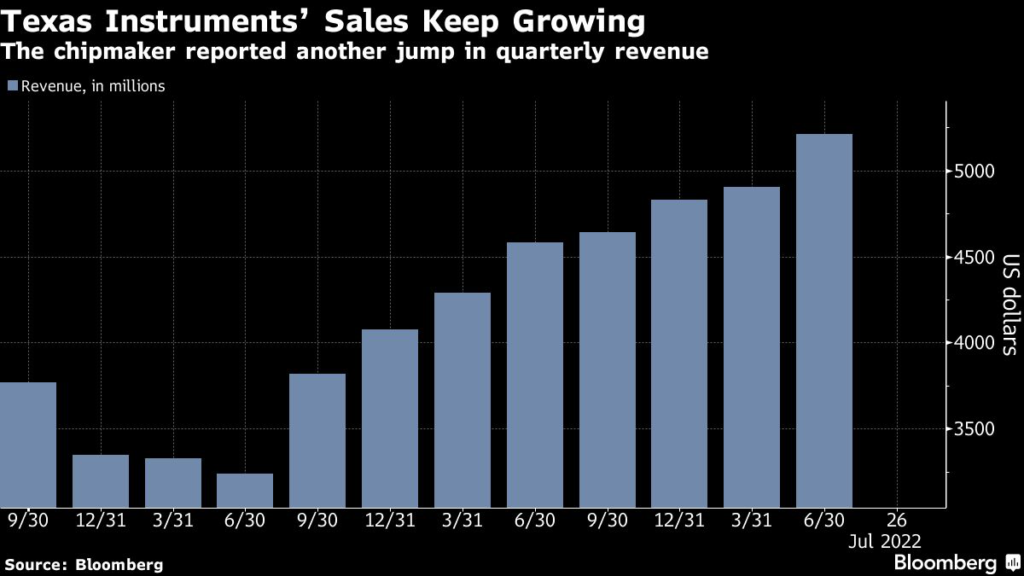
Texas Instruments’ Rosy Forecast Counters Fears of Slowdown

(Bloomberg) — Texas Instruments Inc., the maker of chips used in everything from washing machines to satellites, gave a bullish forecast for the current period, countering concern that a slowing economy is hurting demand for electronics.

Third-quarter revenue will be $4.9 billion to $5.3 billion, Texas Instruments said in a statement Tuesday. That compares with the $4.94 billion average estimate from analysts. Profit will be as much as $2.51 a share, the company said, ahead of projections.

That helped lift the stock 2.6% in extended trading Tuesday and gave a boost to shares of chipmakers such as Qualcomm Inc. and Intel Corp., which also report their results this week. Chips stocks had fallen sharply in regular trading.

The outlook offered a ray of optimism for chip investors, who have grown more bearish about the industry this year. The Philadelphia Stock Exchange Semiconductor Index has fallen 30% in 2022, worse than the performance of major indexes, hurt by concerns that a multiyear boom in demand is weakening. Already, Texas Instruments was down less than its peers this year, sliding 15% through Tuesday’s close. 

Texas Instruments has the biggest customer and product lists in the chip industry, making its reports an indicator of demand across the economy. The Dallas-based company had previously cut back its projections, citing Covid-related lockdowns in China that hampered its customers. Now that factories there are back in production, more orders are being filled.

Chips used in industrial machinery and vehicles provided strong growth in the quarter, Chief Financial Officer Rafael Lizardi said in an interview. Consumer products didn’t fare as well, though.

“We did see weakness in personal electronics,” Lizardi said. “At this point many companies have talked about that so it’s not a surprise.” 

Lizardi declined to make specific predictions about markets or the chip industry as a whole saying instead Texas Instruments will continue to invest in industrial and automotive products undaunted by outside circumstances. 

“There’ll be a recession at some point in the future, maybe it’s this year or the next or in 2025,” he said. “We’ll deal with it at the time.”


Automotive revenue jumped more than 20% in the second quarter. More broadly, the company saw a resurgence in orders at the end of the three-month period, when owners of factories located in China were able to start taking deliveries again following lockdowns.

Second-quarter net income rose to $2.45 a share from $2.05 a share a year earlier, beating estimates. Revenue rose 14% to $5.2 billion. Texas Instruments had posted double-digit percentage increases for six straight quarters coming in to Tuesday’s results.

One of the pioneers of the chip industry, Texas Instruments is the largest maker of analog and embedded processing chips, which are part of products as varied as factory equipment and space hardware.

Texas Instruments’ management generally declines to give predictions about future demand for electronics, maintaining instead that the company can still sell the inventory it produces at some point in the future. Its products, unlike digital chips such as microprocessors, take years to become obsolete, meaning that rising stockpiles aren’t the danger sign they are in other parts of the chip business. The company still doesn’t have enough inventory, executives said Tuesday.

Texas Instruments manufactures about 80% of its chips in its own factories, and the company is investing to expand that footprint. That’s caused some analysts to express concern that the chipmaker will have less cash available for share repurchases and dividends — benefits that made its stock a long-term investor favorite.

Texas Instruments said it wants even more in-house production to avoid the woes of other chipmakers, which are reliant on outsourced manufacturing and have struggled with shortages during the pandemic.

(Updates with CFO comments from sixth paragraph.)

More stories like this are available on bloomberg.com

©2022 Bloomberg L.P.

Twitter Shareholders Will Get Say on Elon Musk Deal in September

(Bloomberg) — Twitter Inc. shareholders will get their say in September on Elon Musk’s proposed acquisition of the social media company.

Investors will be asked to consider and vote on Musk’s $54.20-a-share offer at a special meeting scheduled Sept. 13 at 10 a.m. Pacific time, the company said Tuesday in a regulatory filing.

Musk, who agreed to buy Twitter for $44 billion in cash and take the company private, is now seeking to cancel the deal. Twitter has sued to force the billionaire Tesla Inc. chief executive officer to go through with the purchase.

Earlier, Twitter said it spent $33.1 million through June 30 dealing with Musk’s proposed acquisition.

Other than that spending, the terms of the merger agreement haven’t affected the company’s financial statements, Twitter said in a separate regulatory filing.

More stories like this are available on bloomberg.com

©2022 Bloomberg L.P.

Close Bitnami banner
Bitnami
