Bloomberg

Viasat Explores Sale of Part of Government Services Unit

(Bloomberg) — Viasat Inc., the geostationary satellite company, is considering a sale of part of its government services unit, according to people with knowledge of the matter.

The company is working with an adviser to field interest for the part of division that provides encryption technology, which could fetch as much as $1.8 billion, said the people, who asked not to be identified because they weren’t authorized to speak publicly. 

The business, which is likely to attract interest from other defense companies and private equity firms, generates about $120 million in annual earnings before interest, taxes, depreciation, and amortization, the people said. The unit provides products that help clients including the government encrypt communications. 

Viasat hasn’t made a final decision to pursue a sale and its plans could still change, the people said.

“Viasat does not comment on speculation or rumors related to potential company acquisition or sales transactions,” a representative for the Carlsbad, California-based company said in an emailed statement. 

Viasat rose 2.3% to close at $28.68 in New York trading Tuesday, giving the company a market value of about $2.2 billion. 

The deliberations come as Viasat seeks to complete of its purchase of peer Inmarsat Group Holdings Ltd., creating a company with a fleet of 19 satellites, with 10 more under construction for launch in the next three years. That transaction was seen by the market as an attempt to counter rising competition from firms including Elon Musk’s Starlink and OneWeb, which is partly backed by the UK government.

The UK’s Competition and Markets Authority has opened an investigation into Viasat’s acquisition of Inmarsat. 

More stories like this are available on bloomberg.com

©2022 Bloomberg L.P.

Star Wars Knights of the Old Republic Game Paused Amid Studio Shakeup

(Bloomberg) — A hotly anticipated new Star Wars game is in serious trouble, according to people familiar with the project.

Star Wars Knights of the Old Republic, a remake of a 2003 role-playing game, is delayed indefinitely as developers at Austin, Texas-based Aspyr Media try to figure out what comes next. Aspyr also abruptly fired the game’s art director and design director this month. In a series of meetings throughout July, Aspyr’s two studio heads told employees that the project is on pause and that the company will look for new contracts and development opportunities, said the people, who were not authorized to speak publicly about the situation. Knights of the Old Republic was to be one of the first modern Star Wars console games released outside of Electronic Arts Inc., which had previously held the exclusive licensing rights. That deal expires in 2023, opening the door for new Star Wars games from outside companies like Aspyr, Ubisoft Entertainment SA and Quantic Dream SA.

The game was announced last September and has been in development for nearly three years at Aspyr, which was purchased by Sweden’s Embracer Group AB last year. Aspyr, founded in 1996, was best known as a service shop that brought existing video games to other platforms, such as iOS, including the original Knights of the Old Republic games.

On June 30, Aspyr finalized a demo of the game, known as a vertical slice, to show to production partners Lucasfilm Ltd. LLC and Sony Group Corp. The developers were excited about it and felt like they were on track, according to a person familiar with the project, so they were shocked by what happened next.

The following week, the company fired design director Brad Prince and art director Jason Minor. Neither responded to requests for comment, but Minor suggested on a social media page that his dismissal was unexpected. 

Representatives for Aspyr and Embracer didn’t immediately respond to requests for comment.

Aspyr’s studio heads told staff that the vertical slice wasn’t where they wanted it to be and that the project would be paused, according to two people who were in the meeting. One person familiar with the discussions suggested that a disproportionate amount of time and money had gone into the demo and that the project’s current course wasn’t sustainable. Another point of contention may be the timeline. At the outset of development, Aspyr told staff and partners it would release the game by the end of 2022, according to two people familiar with production. Developers said a more realistic target now would be 2025.

The fate of Star Wars Knights of the Old Republic remains unclear. In May, Embracer announced that Saber Interactive would also join the project. Some at Aspyr believe that Saber, which has mainly been doing outsourcing work for the project, may take it over completely.

More stories like this are available on bloomberg.com

©2022 Bloomberg L.P.

El Salvador Bonds Surge on Bukele’s Plan for Buyback at Market Prices

(Bloomberg) — El Salvador President Nayib Bukele announced plans to buy back the nation’s dollar-denominated bonds due in 2023 and 2025, spurring a double-digit jump the price of the junk-rated securities.

Bukele on Tuesday said in a series of tweets that he sent two bills to lawmakers that would lock in plans for a “transparent, public and voluntary” purchase offer that will start in six weeks for the government debt at market prices. Finance Minister Alejandro Zelaya said the nation would use special drawing rights dispersed by the International Monetary Fund, multilateral funding, and a new bond deal with the central bank to finance the purchases. 

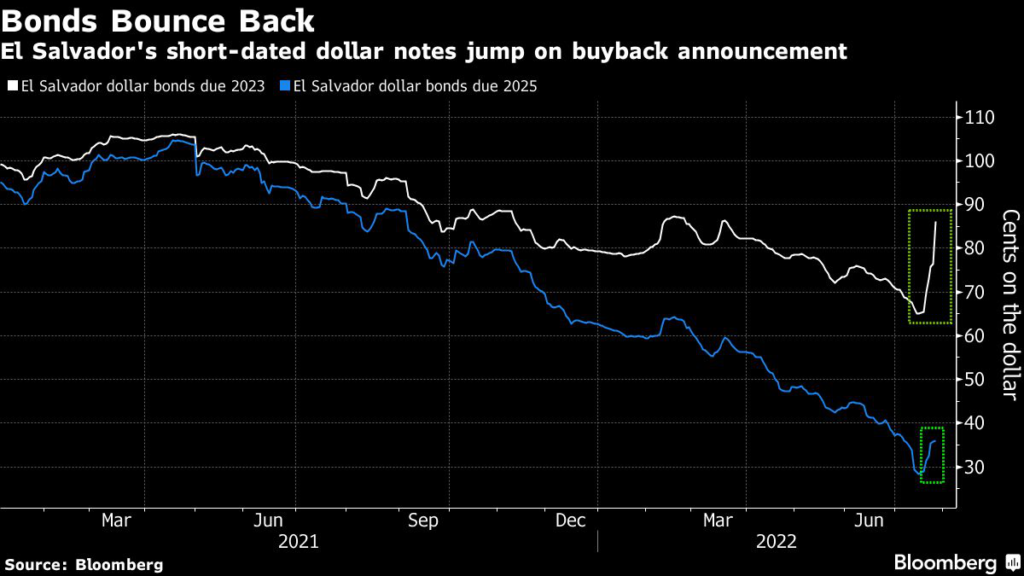
The nation’s dollar bonds set to mature in January 2023 rose nearly 10 cents after the announcement to 86 cents, according to indicative prices compiled by Bloomberg. The 2025 notes, meanwhile, were up 16 cents to be quoted at 52 cents, the highest since mid-April.

Bukele’s Nuevas Ideas party holds a two-thirds majority in El Salvador’s unicameral legislature, meaning the bills can be swiftly approved. Ernesto Castro, president of the legislative assembly, said the bills will be introduced Tuesday and submitted for discussion and approval to the floor, saying the step was important for the country.

There’s $1.6 billion outstanding in bonds due 2023 and 2025 combined, and Bukele promised to buy them back at their market prices, acknowledging prices may rise once the buyback begins. 

Guillermo Guerrero, an analyst at EMFI Group Limited, said he expects prices on the front-end notes to move closer to par as long as the offer is seen as credible. The nation’s bonds have been trading at levels considered in distress, with some traders wary of the government’s financing options. 

The question now turns to whether Bukele moves to buy back all of the $1.6 billion in short-term bonds. For Nathalie Marshik, a managing director for fixed income at Stifel Nicolaus & Co., the answer is: “Probably not.”

“Early indication is that there is about $560 million available for the buyback,” she said. “We don’t know yet what the allocation will be between the 2023s and 2025s.”

The country is approaching its one-year anniversary of adopting Bitcoin as legal tender, a move that — along with a shake-up in the top courts — stoked some uncertainty among both credit rating agencies and money managers. El Salvador is one of the emerging-market nations most vulnerable to a default, according to a Bloomberg Intelligence analysis earlier this month.

Read More: Morgan Stanley Says Buy Salvadoran Bonds Battered by Bitcoin Bet 

“It makes a lot of sense given the depressed prices of Salvadoran bonds, but I think the government would have obtained better results in terms of saving resources if it had conducted the buyback in a covert way,” said Ramiro Blazquez, head of research and strategy at BancTrust. “There are still many details that we don’t know, such as the magnitude of the buyback. But it’s definitely good news since it sets a floor to prices and it will do much to ease default fears.” 

More stories like this are available on bloomberg.com

©2022 Bloomberg L.P.

Glossier Strikes Deal With Sephora in First Retail Partnership

(Bloomberg) — Glossier, the direct-to-consumer beauty brand, is joining forces with Sephora to mass market its popular products. 

The deal is the brand’s first-ever partnership with a retailer. Beginning early next year, Glossier will appear in stores across the US and Canada and will be sold on Sephora.com and the Sephora app, Glossier said in a statement. The move looks to capture existing customer interest: Glossier says inquiries of whether the brand is available at Sephora have jumped 200% in the last year. 

“Glossier is one of the most searched brands at Sephora.com that is not currently part of the Sephora portfolio,” the statement said.  

Founded in 2014 by Emily Weiss as a maker of skin-first makeup, the company sells products through its website and company-owned stores in Los Angeles, Miami, Seattle and London. Additional locations are planned for Brooklyn, D.C., Philadelphia and Atlanta by the end of the year, with a return in 2023 to New York’s Soho, where the brand opened its first store in 2018. 

The company went through a restructuring at the beginning of the year, laying off more than a third of its workforce. In May, Weiss stepped down as chief executive officer and Nike veteran Kyle Leahy took the helm with the intention of extending Glossier’s distribution through wholesale partners globally.

In April, Glossier signed a deal with teenage pop star Olivia Rodrigo to collaborate on products and promote the brand. 

Sephora is owned by the luxury holding company LVMH and has more than 2,700 stores in 35 countries worldwide, with over 500 stores across the Americas. 

More stories like this are available on bloomberg.com

©2022 Bloomberg L.P.

Coinbase Faces SEC Probe on Crypto Listings; Shares Tumble

(Bloomberg) — Coinbase Global Inc. is facing a US probe into whether it improperly let Americans trade digital assets that should have been registered as securities, according to three people familiar with the matter. The company’s shares dropped 21%.

The US Securities and Exchange Commission’s scrutiny of Coinbase has increased since the platform expanded the number of tokens in which it offers trading, said two of the people, who asked not to be named because the inquiry hasn’t been disclosed publicly. The probe by the SEC’s enforcement unit predates the agency’s investigation into an alleged insider trading scheme that led the regulator last week to sue a former Coinbase manager and two other people. 

“We are confident that our rigorous diligence process — a process the SEC has already reviewed — keeps securities off our platform, and we look forward to engaging with the SEC on the matter,” Chief Legal Officer Paul Grewal said on Twitter. The SEC declined to comment.

The drumbeat in Washington for US regulators to do more to oversee crypto has grown louder as digital currencies have tumbled from all-time highs, erasing hundreds of billions of dollars in market value. SEC Chair Gary Gensler has homed in on trading platforms and argued that they should do more to protect retail investors.

As the largest US trading platform, Coinbase lets Americans trade more than 150 tokens. If those products were deemed securities, the firm could need to register as an exchange with the SEC. Coinbase shares fell $14.14 to $52.93 in New York, leaving the stock down 79% this year.

Coinbase has repeatedly sparred with the agency over how it oversees the industry, and the firm last week called on the SEC to propose clearer rules. Meanwhile, after taking a relatively cautious approach for years, Coinbase has boosted its token offerings. 

Tensions bubbled up further July 21 when the SEC accused one of the company’s former employees of violating its insider-trading rules by leaking information to help his brother and a friend buy tokens just before they were listed on the platform. While the agency didn’t allege wrongdoing by Coinbase, the SEC said it had determined that nine of the dozens of digital tokens the men traded were securities — including seven the exchange says it lists. 

Federal prosecutors in Manhattan also charged the three men with wire fraud conspiracy and wire fraud. 

In response, Coinbase put out an entry on its blog titled: “Coinbase does not list securities. End of story.” Grewal pointed out that the Justice Department chose not to file securities fraud charges, despite reviewing the same facts as the SEC. He also said that before listing tokens, Coinbase analyzes whether an asset could be considered a security and “also considers regulatory compliance and information security aspects of the asset.”

Investigations by the SEC’s enforcement unit can lead to the regulator suing companies or individuals. 

Coinbase, which went public last year, previously acknowledged that it has faced scrutiny from the regulator. In its first-quarter earnings report, the firm said it had “received investigative subpoenas from the SEC for documents and information about certain customer programs, operations, and intended future products, including the company’s stablecoin and yield-generating products.”

To decide if a digital asset is a security, the SEC applies a legal test, which comes from a 1946 US Supreme Court decision. Under that framework, the agency considers a token generally to be under SEC purview when it involves investors kicking in money to fund a company with the intention of profiting from the efforts of the organization’s leadership. 

Gensler has long argued that many cryptocurrencies come under the regulator’s jurisdiction and that firms offering them should register with his agency. 

However, the SEC mostly hasn’t said specifically which coins are securities, and exchanges decide whether to list an asset. Platform operators are seeking to avoid offering those deemed securities because doing so could trigger investor-protection rules, some of which crypto enthusiasts say are incompatible with digital assets. 

(Updates with closing share prices, starting in the first paragraph)

More stories like this are available on bloomberg.com

©2022 Bloomberg L.P.

Stocks Drop Before Fed; QQQ Climbs in Late Trading: Markets Wrap

(Bloomberg) — Stocks slumped after paltry economic figures and a weaker outlook from the world’s largest retailer underscored the impacts of inflation pressures on consumer spending, with recession fears running rampant as the Federal Reserve gets ready to deliver another jumbo-sized hike.

Walmart Inc.’s rout engulfed industry peers, with Morgan Stanley saying its forecast is a “potential warning signal” for Amazon.com Inc.’s merchandise margins. In late trading, a $166 billion exchange-traded fund tracking the Nasdaq 100 (QQQ) rose as Google’s parent Alphabet Inc. and Texas Instruments Inc. surged after earnings. Microsoft Corp. fell amid its slowest sales growth since 2020.

Traders also braced for another 75-basis-point hike by Fed officials on Wednesday, with a combined increase of 150 basis points over June and July representing the steepest rise in rates since the early 1980s when then chairman Paul Volcker was battling sky-high inflation. Dimming views on the economy sank US consumer confidence to the lowest level since February 2021, while a gauge of new home sales fell for the fifth time this year.

Read: IMF Cuts World GDP Outlook a Third Time as Inflation, Rates Jump

US officials are likely to stay hawkish for longer amid persistently high inflation, according to Goldman Sachs Group Inc. strategists, the latest to enter the debate around a potential central bank pivot as growth slows. They echoed the views from Morgan Stanley’s Michael Wilson, who noted Monday it’s too early to expect the Fed to stop hiking. Meantime, JPMorgan Chase & Co. strategists said bets that prices have peaked will lead to a Fed pivot and improve the picture for equities in the second half.

“A soft landing feels like a long shot from here,” wrote Seema Shah, chief global strategist at Principal Global Investors. “In the last 11 tightening cycles, the Fed has only skirted recession three times (1965, 1984 and 1994). In each of those cycles, inflation was lower and the Fed funds rate was meaningfully higher at the point of liftoff, so Fed tightening didn’t need to be as dramatic as it does today.”

Other corporate highlights:

  • United Parcel Service Inc. posted disappointing package deliveries.
  • General Motors Co. reported weaker profit than analysts’ estimates as semiconductor shortages kept production volumes in check.
  • 3M Co. plans to spin off its multibillion-dollar health-care operations.
  • McDonald’s Corp. and Coca-Cola Co.’s sales exceeded expectations.
  • General Electric Co. beat estimates for profit and reported surprise positive cash flow as sales at the key jet-engine division soared.
  • Archer-Daniels-Midland Co. sees robust demand for food crops through at least the end of 2022 after posting its record profit.
  • Coinbase Global Inc. is facing a US probe into whether it improperly let Americans trade digital assets that should have been registered as securities, according to three people familiar with the matter.

The annual summer lull combined with steadily deteriorating economic conditions and recession fears are also keeping junk-bond borrowers on the sidelines, with the month-to-date supply at $1.06 billion, the slowest July at least since 2006.

Read: Goldman Sees Imminent End to ‘Uncomfortably Low’ Bill Supply

Here are some key events to watch this week:

  • Apple, Amazon, Meta earnings due this week
  • Fed policy decision, briefing, Wednesday
  • Australia CPI, Wednesday
  • US GDP, Thursday
  • Euro-area CPI, Friday
  • US PCE deflator, personal income, University of Michigan consumer sentiment, Friday

Musk, Tesla and Twitter are this week’s theme of the MLIV Pulse survey. Also share your views on the S&P 500’s biggest stocks. Click here to get involved anonymously.

Some of the main moves in markets:

Stocks

  • The S&P 500 fell 1.2% as of 4 p.m. New York time
  • The Nasdaq 100 fell 2%
  • The Dow Jones Industrial Average fell 0.7%
  • The MSCI World index fell 0.9%

Currencies

  • The Bloomberg Dollar Spot Index rose 0.4%
  • The euro fell 1% to $1.0117
  • The British pound fell 0.2% to $1.2023
  • The Japanese yen was little changed at 136.82 per dollar

Bonds

  • The yield on 10-year Treasuries was little changed at 2.80%
  • Germany’s 10-year yield declined nine basis points to 0.92%
  • Britain’s 10-year yield declined two basis points to 1.92%

Commodities

  • West Texas Intermediate crude fell 1.8% to $94.96 a barrel
  • Gold futures fell 0.2% to $1,733.70 an ounce

More stories like this are available on bloomberg.com

©2022 Bloomberg L.P.
Shopify Tumbles Most Since May After Staff Cuts and CEO’s Gloomy Outlook

(Bloomberg) — Canadian e-commerce firm Shopify Inc. will cut about 10% of its workforce Tuesday, as Chief Executive Officer Tobi Lutke acknowledged the company’s decision to expand rapidly coming out of the Covid-19 pandemic didn’t pay off.

The move will eliminate about 1,000 jobs out of 10,000 or so total employees at Shopify. Most of the affected roles are in recruiting, support and sales, Lutke said in a memo on the company’s website.

Shopify tumbled 14% to $31.55 in New York, the biggest drop since May 5. The Wall Street Journal reported the job cuts earlier Tuesday.

“We bet that the channel mix — the share of dollars that travel through e-commerce rather than physical retail — would permanently leap ahead by five or even 10 years” because of the pandemic, Lutke wrote. 

“It’s now clear that bet didn’t pay off. What we see now is the mix reverting to roughly where pre-Covid data would have suggested it should be at this point.”

Shopify was among the hottest pandemic stocks in 2020 and 2021 as online shopping boomed. It came crashing down this year, hampered by an economic slowdown and an easing of Covid-19 restrictions. Shopify shares have fallen 77% this year.

The Ottawa-based company reported a huge profit miss in the first quarter, and analysts have cut their expectations for the second quarter results, which are scheduled for Wednesday before markets open. 

The move boosts the likelihood that Shopify will lower its full-year outlook, according to RBC Capital Markets analyst Paul Treiber. During first-quarter results in May, the company said it had expected merchants to join its platform at the same rate as in 2021.

“Since Shopify reinvests all the gross profit that it generates back into the business, the reduction of headcount increases the likelihood that the company reduces its FY22 outlook,” Treiber said in a note to clients.

Analysts expect $1.33 billion in revenue for the period ended June 30, which would be an 11% increase from the first quarter.

For those losing jobs this week, Shopify will pay at least 16 weeks of severance and extend additional benefits, including an allowance to buy laptops and temporary coverage of home internet costs, a spokeswoman for the company said.

(Updates with closing share price)

More stories like this are available on bloomberg.com

©2022 Bloomberg L.P.

Race to Secure Battery Metals Heats Up as GM, Ford Ink Deals

(Bloomberg) — Undeterred by the slowing global economy, buyers of key components in the powering of electric vehicles are stepping up efforts to lock in supplies, with two of the world’s biggest automakers signing direct deals with producers of so-called battery metals.

General Motors Co. announced three deals Tuesday for supplies of raw materials needed to build a million EVs a year. Less than a week ago, Ford Motor Co. revealed a list of suppliers of inputs ranging from Argentine lithium to Indonesian nickel — enough to build 600,000 EVs a year.

The world’s shift into electric vehicles means demand growth for lithium, nickel, cobalt and other key ingredients in EV batteries is outpacing supply that’s been hampered by Covid-related logistical woes and a general lack of investment, pushing up prices. There are also growing concerns over China’s dominance of refining and manufacturing capacity of the materials. Reliance on the Asian nation is now seen as a vulnerability amid trade and political tensions that are spurring a rethink of global supply lines.

“These deals underscore the importance of locking in long-term and diverse sources of raw materials,” said Chris Berry, president of House Mountain Partners, an industry consultancy. “Access to the raw materials is going to be very interesting to watch in the back half of this decade.”

Automakers are facing delayed deliveries across the EV space, exacerbating supply-surety concerns. That’s propelling them to demonstrate supply chain management. “Announcing agreements with materials producers can be a differentiating factor for the progression of EV manufacturers,” said David Deckelbaum, an analyst at Cowen and Co.

The first of GM’s new arrangements for its next-generation EVs is with LG Chem Ltd. to supply 968,000 metric tons of cathode material through 2030. The second is a multi-year agreement with Livent Corp. to secure lithium. The third is a venture with Posco Chemical Co. to supply cathode materials from 2023 to 2025.

Chief Financial Officer Paul Jacobson told Bloomberg TV in an interview that these supply deals will enable GM to build a million EVs a year by 2025.

The Detroit-based automaker is building four U.S. battery cell plants, with the first to open “in a matter of weeks,” James Cain, executive director of finance and sales communications, said in an emailed message. A second will open in 2023 and a third in 2024, he said.

Ford said it secured enough battery supply to build more than half a million electric vehicles annually by late next year, a quantum leap above the 27,140 battery-powered cars it sold in the US last year. It has signed contracts with suppliers representing 60 gigawatt hours of annual battery capacity.  The two carmakers’ suppliers mostly have or will have regional facilities to provide materials, highlighting efforts to rely less on Chinese refining and manufacturing. 

“Regionalized supply chains are becoming a reality,” Berry said. “All of the talk about strategic vulnerability is slowly being turned into action and this is perhaps the most encouraging aspect of these off-take deals.” 

Read more: How a Battery Metals Squeeze Puts EV Future at Risk: QuickTake

(Adds details on GM announcement seventh and eighth paragraphs.)

More stories like this are available on bloomberg.com

©2022 Bloomberg L.P.
Cryptocurrencies Slump While US Regulatory Scrutiny Increases

(Bloomberg) — Bitcoin sank to a more than one-week low, buffeted by investor skittishness ahead of a looming Federal Reserve interest-rate hike and amid harsher regulatory scrutiny of the cryptocurrency sector.

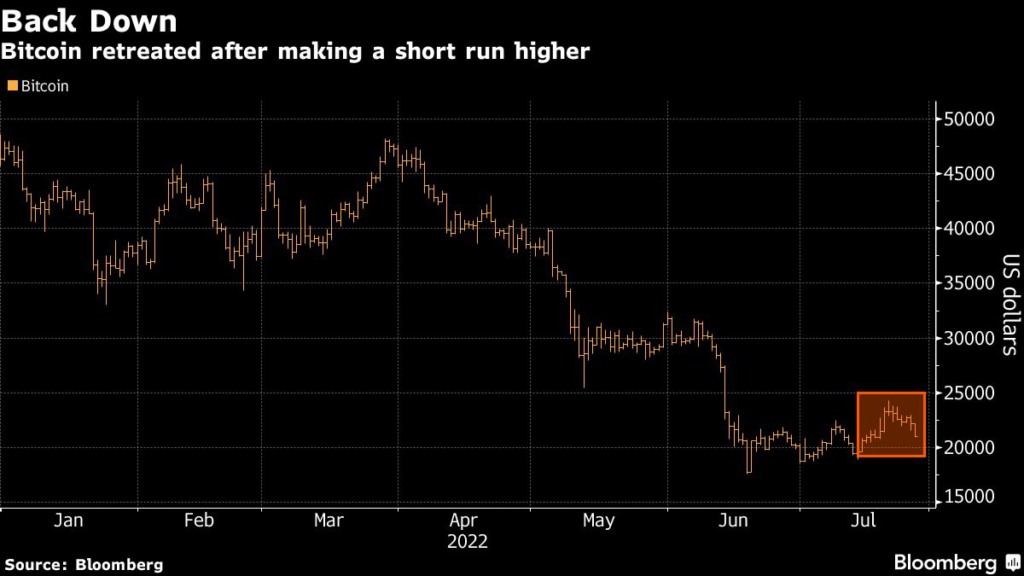
The largest token dropped as much as 6.5% on Tuesday and was trading at around $20,904 as of 2:53 a.m. in New York. The MVIS CryptoCompare Digital Assets 100 gauge shed more than 5%, while recent high flyers Polygon and Ether was down about 10%. 

The retreat has put a dent in expectations for a sustained Bitcoin rebound and returned the token to a trading range between roughly $19,000 and $22,000. Risk appetite is generally on the back foot before an expected 75 basis-point Fed rate increase Wednesday, part of a tightening cycle that’s sapping liquidity.

“We’ve had some stabilization over the past few weeks and that gave some folks confidence that perhaps a bottom was being put in place,” Katie Stockton, co-founder of Fairlead Strategies, said on Bloomberg Television. “We’re not so convinced.”

Rising interest rates and high-profile meltdowns like that of crypto hedge fund Three Arrows Capital have pummeled digital tokens this year. Bitcoin is down 55% since the start of 2022.

“Macro drivers haven’t flipped for people to really go long, bear market squeezes are always very vicious,” said Patrick Chu, head of institutional coverage of APAC at OTC trading platform Paradigm.

The turmoil is leading to ever greater regulatory oversight of the industry.

Coinbase Global Inc., for instance, is facing a US probe into whether it improperly let Americans trade digital assets that should have been registered as securities, according to people familiar with the matter. Coinbase shares fell as much as 20%. Rival exchange Kraken is being investigated by the Treasury Department over whether it allowed users in Iran to trade on the platform, The New York Times reported, citing people familiar with the matter.  

Read more: Coinbase Faces SEC Investigation on Cryptocurrency Listings 

Adding to the uncertainty about crypto assets’ direction is the backdrop of geopolitical tensions, with Russia cutting gas supplies to Europe and rising food prices sparking concerns about instability in developing markets. The US dollar is up against all major developed-market currencies this year, providing another headwind for digital tokens. 

“Rising geopolitical tensions might provide some underlying support for the dollar, which could drag down risk appetite, which would weigh on cryptos,” said Edward Moya, senior markets analyst at Oanda. 

More stories like this are available on bloomberg.com

©2022 Bloomberg L.P.

SoftBank Managing Partners Pipilis, Varma to Join Misra-Led Firm

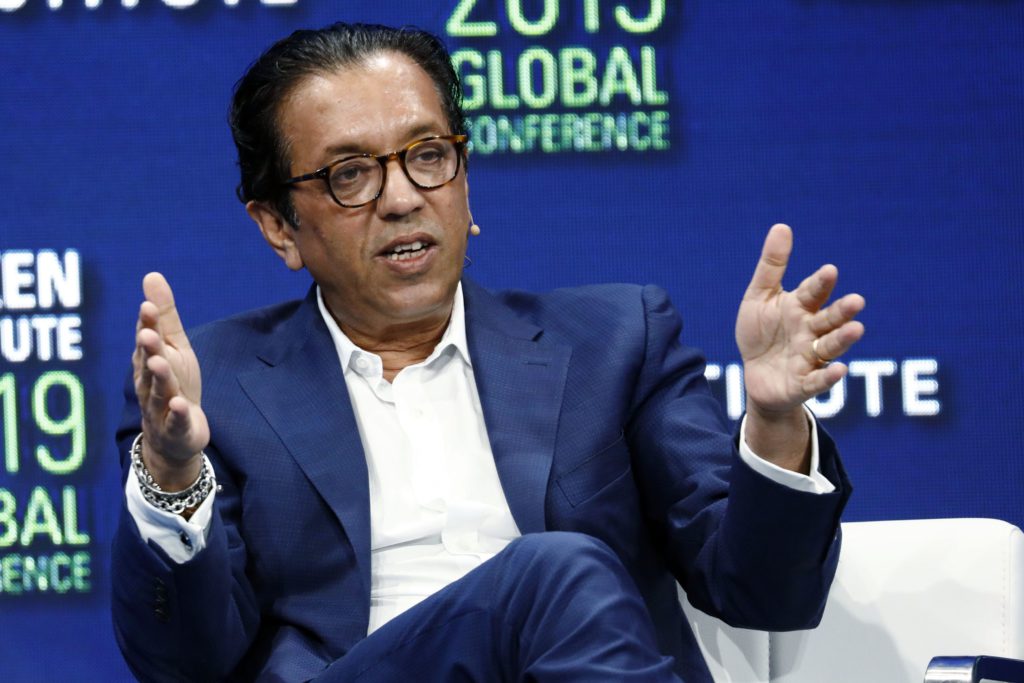
(Bloomberg) — A pair of managing partners who help oversee SoftBank Group Corp.’s Vision Fund and Vision Fund 2 are leaving to join a new investment firm led by the platform’s key architect Rajeev Misra, according to people with knowledge of the matter. 

Yanni Pipilis and Munish Varma, both managing partners at SB Investment Advisers, which oversees SoftBank’s Vision Fund operation, notified their teams of their pending departures to the new startup, said the people, who requested anonymity as the communications are private. Their exits are slated to occur in coming weeks, after a period of transition, some of the people said. 

The Misra-led platform will have a flexible mandate and the ability to invest in both the debt and equity of public and private companies. Abu Dhabi conglomerate Royal Group, which is led by Sheikh Tahnoon Bin Zayed Al Nahyan, and ADQ, one of the the emirate’s sovereign wealth funds, have committed capital to the new venture, Bloomberg News has reported. Mubadala, an anchor investor in the first Vision Fund, is also set to invest, according to people with knowledge of the matter. 

A SoftBank representative didn’t immediately provide comment. A representative for Pipilis and Varma declined to comment.

Pipilis was CEO of a special purpose acquisition company, SVF Investment Corp. 3, which merged with warehouse automation specialist Symbiotic Inc. Misra and Varma are CEOs of SVF Investment Corp. and SVF Investment Corp. 2 respectively, both of which are yet to merge with a target. 

Read more: SoftBank’s Rajeev Misra Said to Step Back to Launch New Fund 

Pipilis has worked with more than 60 of SoftBank’s portfolio companies including Jobandtalent, CMR Surgical Ltd. and Rimac, according to its website. Varma has worked with at least 40 companies, such as Delhivery Ltd., Lenskart, Policybazaar and FirstCry, the SoftBank website shows. 

More stories like this are available on bloomberg.com

©2022 Bloomberg L.P.
Close Bitnami banner
Bitnami