
Bloomberg

Tech-Led Rout Deepens in Jittery Earnings Season: Markets Wrap

(Bloomberg) — Stocks dropped after paltry economic figures and a weaker outlook from the world’s largest retailer underscored the impacts of inflation pressures on consumer spending, with recession fears running rampant as the Federal Reserve gets ready to deliver another big rate hike.

Walmart Inc.’s selloff dragged down industry peers, with Morgan Stanley saying its forecast is a “potential warning signal” for Amazon.com Inc.’s merchandise margins. Economic barometer United Parcel Service Inc. slumped on disappointing package deliveries. The Nasdaq 100 slid 2% ahead of earnings from Microsoft Corp. and Google’s parent Alphabet Inc. Defensive groups like health care and utilities climbed. The dollar rose.

“From the corporate perspective today, what’s driving the red is disappointing guidance from Walmart, which brings into question the resiliency of earnings,” said Angelo Kourkafas, investment strategist at Edward Jones. “We’ve been talking to our clients about earnings estimates and how, even though we don’t expect a deep recession, we think that earnings estimates are elevated given the challenging macroeconomic backdrop.”

Traders also braced for another 75-basis-point hike by Fed officials on Wednesday, with a combined increase of 150 basis points over June and July representing the steepest rise in rates since the early 1980s when then chairman Paul Volcker was battling sky-high inflation. Dimming views on the economy sank US consumer confidence to the lowest level since February 2021, while a gauge of new home sales fell for the fifth time this year.

Read: IMF Cuts World GDP Outlook a Third Time as Inflation, Rates Jump

US officials are likely to stay hawkish for longer amid persistently high inflation, according to Goldman Sachs Group Inc. strategists, the latest to enter the debate around a potential central bank pivot as growth slows. Their opinion aligns with Morgan Stanley’s Michael Wilson, who also noted Monday it’s too early to expect the Fed to stop hiking. Meantime, JPMorgan Chase & Co. strategists said bets that prices have peaked will lead to a Fed pivot and improve the picture for equities in the second half.

“A soft landing feels like a long shot from here,” wrote Seema Shah, chief global strategist at Principal Global Investors. “In the last 11 tightening cycles, the Fed has only skirted recession three times (1965, 1984 and 1994). In each of those cycles, inflation was lower and the Fed funds rate was meaningfully higher at the point of liftoff, so Fed tightening didn’t need to be as dramatic as it does today.”

Other corporate highlights:

  • General Motors Co. reported weaker profit than analysts’ estimates as semiconductor shortages kept production volumes in check. The automaker also warned it is bracing for tougher times ahead for the economy.
  • 3M Co. plans to spin off its multibillion-dollar health-care operations, a move that could leave the manufacturer flush with cash as it copes with shifting economic currents that have sapped its profits.
  • McDonald’s Corp. reported sales that topped estimates as consumers continue eating out despite higher prices.
  • Coca-Cola Co.’s sales exceeded expectations and the company raised its full-year guidance.
  • General Electric Co. beat Wall Street’s expectations for profit and reported surprise positive cash flow as sales at the key jet-engine division soared.
  • Archer-Daniels-Midland Co. posted its highest profit ever for a second quarter as soybean processing boosted earnings.
  • Coinbase Global Inc. is facing a US probe into whether it improperly let Americans trade digital assets that should have been registered as securities, according to three people familiar with the matter.

The annual summer lull combined with steadily deteriorating economic conditions and recession fears are also keeping junk-bond borrowers on the sidelines, with the month-to-date supply at $1.06 billion, the slowest July at least since 2006.

Here are some key events to watch this week:

  • Alphabet, Apple, Amazon, Microsoft, Meta earnings due this week
  • Fed policy decision, briefing, Wednesday
  • Australia CPI, Wednesday
  • US GDP, Thursday
  • Euro-area CPI, Friday
  • US PCE deflator, personal income, University of Michigan consumer sentiment, Friday

Musk, Tesla and Twitter are this week’s theme of the MLIV Pulse survey. Also share your views on the S&P 500’s biggest stocks. Click here to get involved anonymously.

Some of the main moves in markets:

Stocks

  • The S&P 500 fell 1.3% as of 2:33 p.m. New York time
  • The Nasdaq 100 fell 2.1%
  • The Dow Jones Industrial Average fell 0.7%
  • The MSCI World index fell 1%

Currencies

  • The Bloomberg Dollar Spot Index rose 0.4%
  • The euro fell 1% to $1.0121
  • The British pound fell 0.1% to $1.2029
  • The Japanese yen was little changed at 136.68 per dollar

Bonds

  • The yield on 10-year Treasuries declined one basis point to 2.79%
  • Germany’s 10-year yield declined nine basis points to 0.92%
  • Britain’s 10-year yield declined two basis points to 1.92%

Commodities

  • West Texas Intermediate crude fell 1.7% to $95.01 a barrel
  • Gold futures fell 0.2% to $1,733.40 an ounce

More stories like this are available on bloomberg.com

©2022 Bloomberg L.P.
Google Asked to Prove It’s Not Suppressing Anti-Abortion Search Results

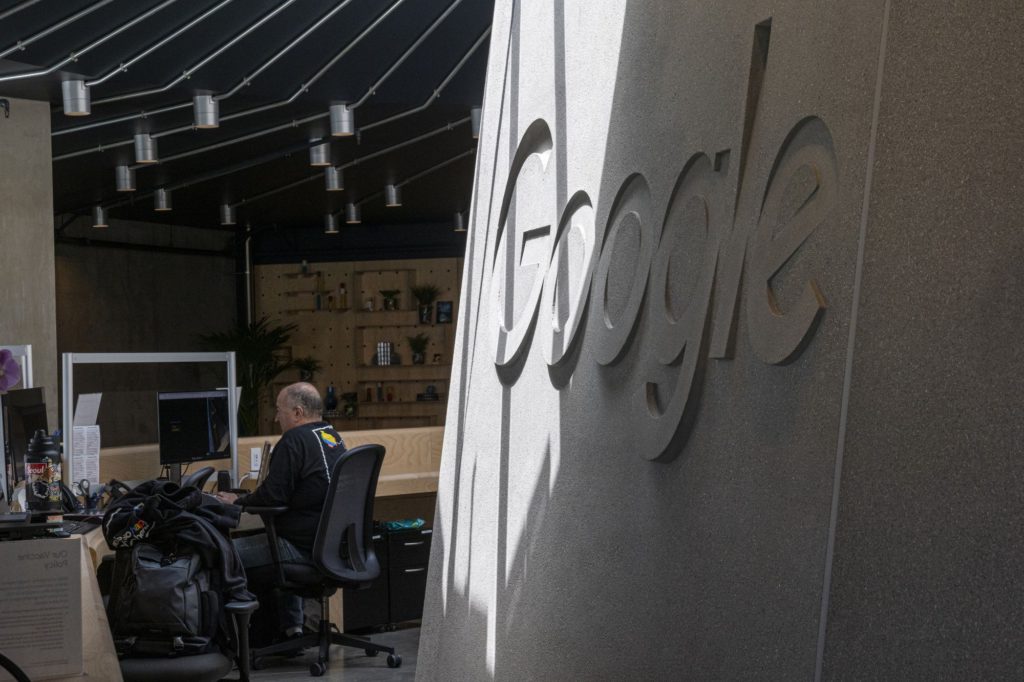
(Bloomberg) — Republican attorneys general from 17 US states are asking Alphabet Inc.’s Google to provide assurances that the search giant isn’t suppressing results for crisis pregnancy centers in favor of abortion clinics.  

The letter, part of a campaign spearheaded by Virginia Attorney General Jason Miyares, asks Google to resist a June 17 call from Democratic lawmakers to “limit the appearance of pro-life clinics” in search results. The legislators had written to Alphabet chief executive officer Sundar Pichai about “disturbing” reports of Google’s search results for “abortion” and “abortion pill” directing people to crisis pregnancy centers, which attempt to steer women away from abortions.

They had asked Alphabet to limit results for those centers for people seeking abortion services or to provide disclaimers that indicate such organizations do not offer abortion care. 

“Google appears to have caved to those demands,” Texas Attorney General Ken Paxton said in the statement Tuesday. Alphabet has not announced any changes to searches related to reproductive health care in the last month and results for abortion still regularly serve up crisis pregnancy centers.  Google didn’t respond to a request for further comment and the Texas attorney general’s office did not immediately respond to questions asking what changes he was referring to in his comments. 

Technology giants are also facing questions about whether they will hand over user data to authorities in states that have banned or severely limited abortion. A majority of states either already have or will add laws that restrict access to abortion now that there are no federal protections, according to the Kaiser Family Foundation. 

Read more: Will big tech protect abortion seekers? Investors want to know. 

Google said earlier this month it will automatically delete records of user visits to sensitive locations, including abortion clinics. The Republican attorneys general accused the search giant “religious discrimination” if it is suppressing results for the pro-life centers because they are often faith-based services. The letter asks Alphabet if its treating crisis pregnancy centers “any differently” than they were before. They gave the search giant 14 days to respond. The letter came from a mix of states where abortion is banned, such at Texas and Mississippi, and others such as Virginia and Montana, where abortion is not restricted. 

More stories like this are available on bloomberg.com

©2022 Bloomberg L.P.
Meta Hikes VR Headset Prices About $100 as Production Costs Grow

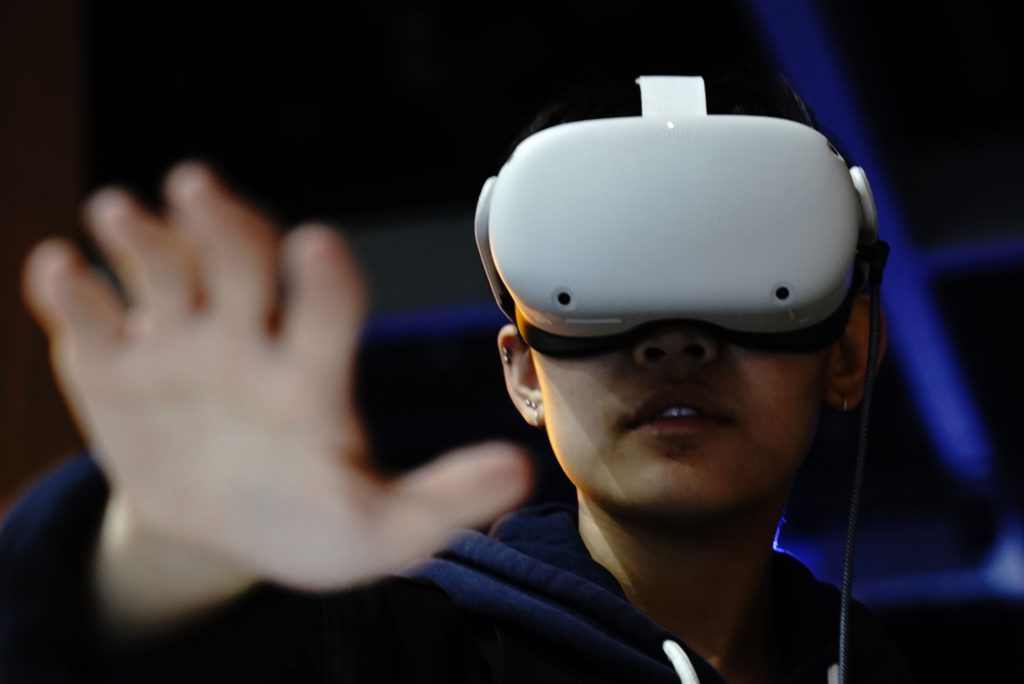
(Bloomberg) — Facebook parent company Meta Platforms Inc. is increasing the price of the company’s Quest 2 virtual reality headsets in the face of higher production costs, making a ticket to the metaverse a bit more expensive. 

The Meta Quest 2 headset will cost $400 starting in August, about $100 more than the current 128-gigabyte model. The 256GB model will also increase in price by roughly $100 and will now cost $500. Meta is also raising the prices for accessories and refurbished units, according to a blog post.

“The costs to make and ship our products have been on the rise,” the company said. “By adjusting the price of Quest 2, we can continue to grow our investment in groundbreaking research and new product development that pushes the VR industry to new heights.”

Meta’s Reality Labs, its augmented and virtual reality division, has become a key priority as the company shifts its business toward the metaverse — a group of connected virtual worlds. It’s been a costly undertaking. That division reported an operating loss of $10.2 billion in 2021, and Chief Executive Officer Mark Zuckerberg has said that investments in virtual and augmented reality will lead to “significant” losses early on. 

Those losses have become more notable given the broader economic slowdown. Meta has been forced to scale back costs, including hiring, as it copes with record inflation in the U.S., supply chain snags caused by the global pandemic and a war in Europe. The challenges have hurt online advertising spending, Meta’s biggest source of revenue. 

Earlier this year, Reality Labs pulled back on some projects — including a smartwatch prototype it hoped would compete with Apple Inc.’s Apple Watch — in part because of cost-cutting measures. 

Meta is still looking to expand in some areas, though. The company is in talks to potentially acquire AdHawk Microsystems, a startup focused on eye-tracking technology for smart glasses, Bloomberg reported.

In Meta’s blog post announcing the price hike, the company touted its success thus far in virtual reality and said that the increased prices would help the company continue to innovate. Meta also said it will include the VR game Beat Saber along with every new headset purchase. 

More stories like this are available on bloomberg.com

©2022 Bloomberg L.P.
Mexico’s ‘Super Peso’ Shocks Traders Who Had Bet on Wipeout

(Bloomberg) — Amid the carnage in emerging-market currencies this year, there’s been a surprisingly resilient outlier: the Mexican peso.

It’s held up as almost every peer succumbed to the dollar’s relentless push higher, an outperformance so stark that a few analysts have taken to calling it the “super peso.” 

Some of the strength stems from fairly typical drivers — a tight fiscal policy and interest-rates increases that have lifted the carry trade. But another key factor is expectations for a sea change in global trade in coming years that could bring a surge in foreign direct investment.

Mexico is luring factories from China as higher wages and a jump in transportation costs undermine what had been its competitive advantages. A Covid-induced aversion to far-flung supply chains is also pushing companies to move operations from Asia to nearer the US — the world’s biggest market — a shift known as “nearshoring.” Adding to those logistics concerns are the strict shutdowns as part of China’s Covid Zero policy and concerns that China could make a move against Taiwan that would spur sanctions from Western countries.

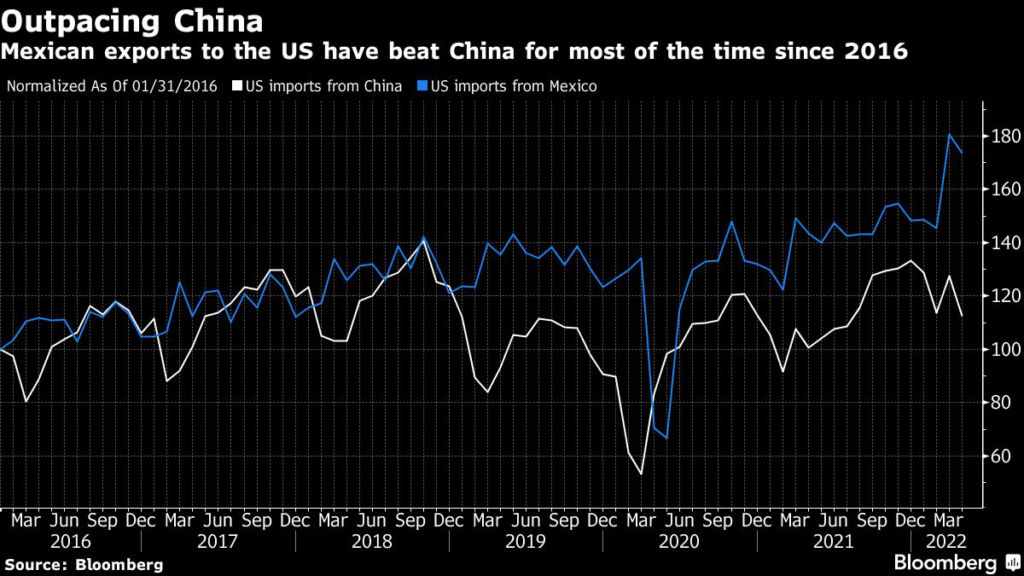
It’s the beginning of a turnaround from two decades ago, when China joined the World Trade Organization and quickly displaced Mexico as the top manufacturing hub for US companies. Now, Mexico’s exports to the US are narrowing the gap with China, and the currency market is being roiled, shocking investors who at the end of last year were forecasting the peso would be one of the world’s biggest losers in 2022.

“Mexico is beginning to reclaim the competitive advantages it lost decades ago,” said Hari Hariharan, the chief executive officer of New York-based hedge fund NWI Management. “This is going to be a decade of an ascent of Mexico at the expense of China.”

The shift can also be seen in the Mexican peso’s performance against China’s yuan. Since the height of the pandemic selloff in March 2020, the peso has rallied about 15% versus its Chinese counterpart, one of the best performances among major currencies. Nearshoring will accelerate this trend in the coming decade, according to Hariharan.

The boom can be seen across Mexico’s industrial north. From Tijuana on the West Coast to Matamoros at the southern tip of Texas, bulldozers and excavators are everywhere. At least six suppliers for Tesla Inc. — Taiwanese companies EnFlex Corp. and Quanta Computer, French firm Faurecia SE, Germany’s ZF Friedrichshafen AG and APG Mexico — have set up in the state of Nuevo Leon since 2021. 

Meanwhile, China’s Contemporary Amperex Technology Co., the world’s biggest maker of batteries for electric vehicles, is considering locations in Mexico for a plant to supply automakers, Bloomberg reported this month.

In a year during which the dollar has climbed to a record in its best annual run since 2015, the peso has gained less than 1% to about 20.4 per dollar, marking the second-best performance among major currencies behind Brazil’s real.

Still, some skeptics doubt the shift to Mexican production will be significant enough to form the basis for long-term gains for the currency.

The dollar value of Mexico’s exports to the US still trail China’s by a large margin, even as the gap grows ever narrower. And there have been times in the past when analysts thought Mexico was poised for a breakout that didn’t come to fruition. Most notably, the predictions surfaced in 2007 and 2008 as surging oil prices raised transportation costs, then again when US President Donald Trump rattled trade relations with China during his tenure in office.

More recently, Mexican President Andres Manuel Lopez Obrador’s nationalist energy policies and skirmishes with companies have been seen as a deterrent to investment. Last week, the US said Mexico’s energy policies violated North America’s free-trade deal, though there was little fallout in the peso market. 

In the first quarter of this year, Mexico reported a record inflow of $19.4 billion in foreign direct investment, up 5.8% from the same period of last year after excluding one-off mergers. Vacancy rates at industrial parks in Juarez, Reynosa and Monterrey hit record lows in the first quarter on nearshoring demand, Credit Suisse analysts said in a June report. During his trip to Washington this month, Lopez Obrador forecast US investment in the country would reach $40 billion between now and 2024. 

Mexico’s exports to the US have been growing faster than its Asian rival’s for most of the time since 2016. The Inter-American Development Bank in June 2022 estimated nearshoring could add up to $35.3 billion a year more in annual exports from Mexico.

Mexico exported $422 billion to the US in the past 12 months, $121 billion less than China. That gap was almost $200 billion four years ago. 

The transformation of supply chains will take time but the snarls caused by China’s zero-Covid policy will push companies to diversify operations on a “just-in-case basis,” said John Paul Lech, a portfolio manager at Matthews International Capital Management in San Francisco. 

“Mexico is in a good position,” Lech said. “Nearshoring could be a theme that impacts Mexico over longer durations of time.”

Peso Undervalued

The peso’s relatively cheap valuation is an additional lure for foreign investors. On a trade-weighted basis, the currency has been on the weaker side of its 10- and 20-year averages since 2015, according to data compiled by Bank for International Settlements. China’s trade-weighted exchange rate, on the other hand, now hovers near seven-year highs.

“We see the issue of nearshoring as a medium- to long-term positive factor for the MXN,” HSBC FX strategists Joseph Incalcaterra and Clyde Wardle wrote in a July 14 note. 

While US recession risks may weigh on the peso in the short term, resilient balance of payment flows should allow the currency to outperform regional peers, they wrote. The bank sees the peso gaining about 6% to 19.25 per dollar by the end of next year, they wrote.

(Updates peso price in 10th paragraph)

More stories like this are available on bloomberg.com

©2022 Bloomberg L.P.
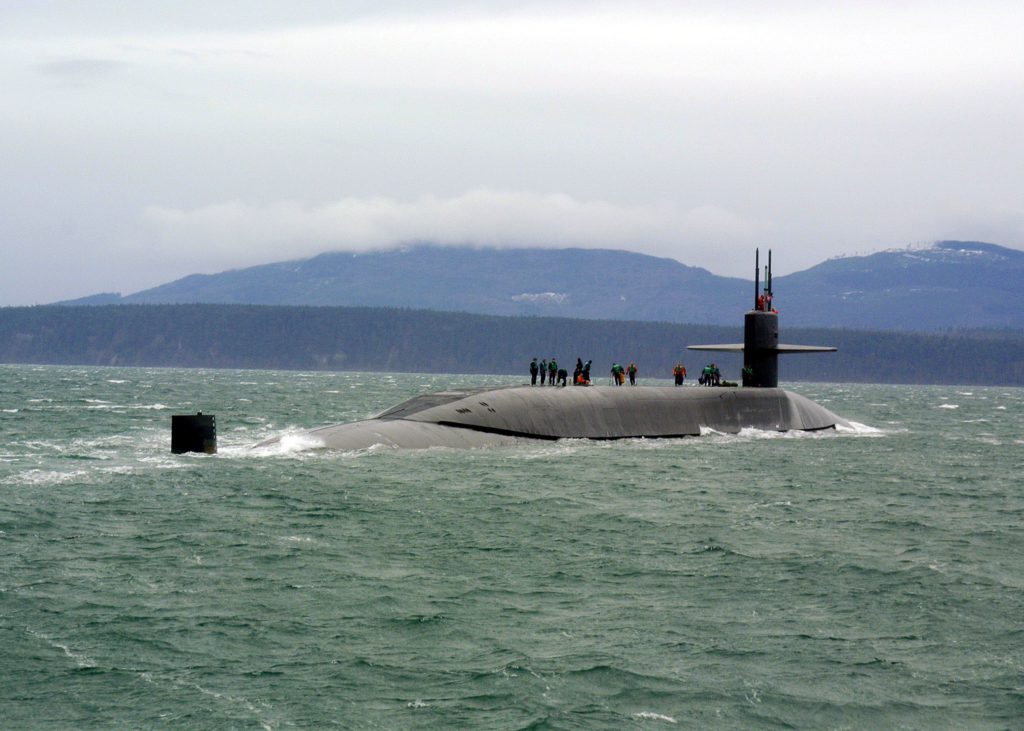
Submarine Contractor Sets Sights on Building First US Next-Generation Nuclear Reactor

(Bloomberg) — A defense contractor that supplied components for the earliest nuclear submarines will be tapping its military expertise to enter the race to build the next generation of nuclear reactors.

BWX Technologies Inc. expects to complete a working prototype of a small, advanced reactor under a $300-million contract with the US Department of Defense. Providing power plants to the military will facilitate the company’s efforts to build a commercial version that could be ready by the end of the decade, according to Joe Miller, president of BWX’s advanced technologies unit.

BWX is part of a wave of companies developing small nuclear plants that are expected to be faster and cheaper to build than the conventional reactors widely used today. While there’s a growing sense that these advanced reactors could offer a key tool in the fight against climate change, the technology remains unproven and there are daunting hurdles in bringing it to market.

Still, the Lynchburg, Virginia-based company says that having a working system will help when it eventually seeks government approval for a commercial design. Its efforts are building on a long legacy of nuclear projects that originated within the military before shifting to civilian use.

“The whole nuclear industry is a creation of the military,” Chris Gadomski, lead nuclear analyst for BloombergNEF, said in a Monday interview. “It’s a very smart strategy.”

The BWX reactor will have 1 to 5 megawatts of capacity, far smaller than commercial reactors operated by utilities that are typically about 1,000 megawatts. It will be small enough to deliver in four standard shipping containers and can be assembled on-site, Miller said in one of the first in-depth interviews since the deal was announced in June. The reactor can run for three years without being refueled—a major advantage over the 750-kilowatt diesel generators it’s expected to replace—and could power a wide variety of military sites including bases, ports or hospitals. Some facilities might use more than one system.

While there’s growing interest in carbon-free nuclear power as a key tool in the battle against climate change, there’s also concern that building new conventional reactors can be costly and slow. The next generation of small plants is expected to address those issues, but the technology is still years away from becoming a reality.

BWX has been working on nuclear technology for decades. The company provided components for the Manhattan Project in the 1940s that developed the first atomic bombs. In the 1950s, it designed parts for the first nuclear submarine and then manufactured components of the world’s first commercial reactor in Shippingport, Pennsylvania. Today, the firm supplies a variety of nuclear products and services for government and civilian projects, including naval vessels.

BWX expects to deliver the prototype to Idaho National Laboratory for testing in 2024, and it will likely be the first such small reactor in the US. Testing may take up to two years, and if all goes well, any branch of the military will be able to start using it in the field. The company plans to develop a commercial version of the reactor, a process that will probably require a few additional years to complete, putting it on track for use around 2030.

One of the major challenges will be securing the required US Nuclear Regulatory Commission permit, though Miller said having military systems in operation would validate the technology and provide “a huge leap forward in the licensing process.”

More stories like this are available on bloomberg.com

©2022 Bloomberg L.P.

For Audi’s 2023 Q4 e-Tron, It’s What’s on the Inside That Counts

(Bloomberg) — Barry Hoch, a tall fellow in a button-down shirt and a Michigan accent, has been talking for an hour about the 2023 Audi Q4 e-Tron he developed as Audi’s senior director of product planning.

But as we walk around Audi’s third new EV model, parked in the street near the beach in Santa Monica, Calif., his Midwestern monotone shifts decidedly into something resembling excitement.

“See that line, how sharp that edge is?” he says, eagerly pointing to the ridge that flows around the middle of SUV’s rear quarter panel. “See how that tow hook is hidden so perfectly down there? That’s some guy in Germany showing off.”

Then he flicks the back of his fingers in an arch out from underneath his chin: “This is the German version of flexing on Tesla.”

It’s rare to see such posturing about an entry-level SUV. Usually brands as varied as Tesla, BMW, and Maserati, all produce family haulers that are ubiquitous blobs about as exciting as toasters. But with carefully considered details inside and out, the newest member of Audi’s electric e-Tron family is a welcome addition to the otherwise humdrum segment.

Electric, Normalized

Audi’s Q4 model line joins the GT and e-Tron lines of electric vehicles. It comes in two forms: the Q4 e-Tron, which has a more traditional rear end shaped like a softly rounded rectangle, and the Q4 e-Tron Sportback, which has a rear roofline that slopes more abruptly down from the top, cutting visibility slightly but making the vehicle look sportier on the whole.

I drove the Q4 e-Tron Sportback, which costs $3,000 more than the estimated $55,000 price tag of the regular version. It had a few upgrades, like 20-inch wheels, and drops an inch of headroom in the rear. They both get 241 miles of driving range and can do 0-60mph in 5.8 seconds. Top speed is 112mph. I prefer how the Sportback looks and would willingly pay the small premium to get it.

Driving the e-Tron Sportback through the hills in Cornell, Calif., felt as unremarkable as driving, say, an Audi Q3 through the hills in Cornell, Calif. This is a good thing. It means Audi was able to match the prompt acceleration, responsive braking, and intuitive handling as its conventional SUV in this lithium-ion marvel. There’s no drama here—just German engineering excellence.

I was happy to find that the regenerative braking in the e-Tron could be adjusted to allow me to coast like a normal person rather than abruptly slowing to regain energy at the expense of my back and nerves. I’m not a fan of what automakers are trying to market as “one-pedal driving”—it’s like trying to make how it feels to drive a golf cart seem novel, even desired. It’s not.

I completed a 65-mile hilly drive with even thinking about battery life; I estimate my range dropped about 50-55 miles total, having regained some mileage via braking. Charge time to full, had I needed it, would have been just over seven hours on a level-two charger like the kind some people have at home, Audi says. If you use a DC fast charger, that time is cut to one hour for a full charge. 

Inside the e-Tron

The Q4 e-Tron’s driving range falls short compared with the 300-plus ranges boasted by the Tesla Model X, Cadillac Lyriq, and BMW iX. But it was the attention paid to the interior setup and build quality that made it feel superior to the Tesla and Cadillac, and on par with the BMW.

For instance: Unlike the top of the Lucid Air (and Hummer EV, for that matter), the Q4 e-Tron offers a clear glass top that opens and has a sunshade—critical elements the others missed and a welcome boon for those of us at all concerned about sunstroke, skin cancer, and generally overheating in a greenhouse of a car. “We spent a lot of time trying to convince guys who live in cloudy areas of Europe that a sunshade is important,” Hoch said. 

The steering wheel’s rounded square shape, and a healthy mix of touchscreens, buttons, and knobs, gave the Q4 e-Tron a futuristic but familiar feel. Over-the-air software updates to refine such things as the entertainment are forthcoming; so is a RWD version, in 2023. 

It all feels more high-end than the Cadillac Lyriq I recently drove, though less fussy than some of the Mercedes SUVs can feel. The Q4 e-Tron is the first vehicle to offer a sound system from the well-regarded home audio company Sonos. You can customize the headlights to illuminate in the shape of a handful of designs. Cruising through the hills in Topanga Canyon, I decided had found the Goldilocks of infotainment setups.

There were lots of practical considerations, too. Bottle holders set flush to the inside of each door. The sideview mirrors are shifted out and down,  to allow more sightlines around the front and sides of the vehicle. Ample head- and legroom even in back of the Sportback—yes, of course I tried it—all felt derived from people who had known and lived with this SUV in real-life settings on a daily basis.

There’s up to 54.4-cubic feet of storage in the rear with the seats folded flat; a sensor on the rear door handles will unlock those first, rather than just the driver’s door, for when you want to load the back seat full of groceries or children before you get inside. It felt like the moms and dads in the world had sat down and made a list of all the things they wanted in an electric SUV, then made that. For what is considered an entry-level version of a luxury SUV, you get a lot for your money. 

Plenty of Fish in the Sea

I still don’t understand why, years after Audi introduced its first electric vehicle, and with more than 10 variants of its electric vehicles now available, more people don’t know about them. When I ask my friends, practically none of whom are car people, which EV they want, they say Tesla by default. I can only assume that Tesla’s decade-long head start in creating the EV segment and the cartoonishly outsize life, personal and private, of its founder, Elon Musk, has created such awareness of the brand that other automakers who make superior EVs will simply require some time for perception to match reality.

Audi spokespeople say the Q4 e-Tron is not intended to “steal customers from Tesla,” as spokesman Mark Dahnke told me the other day. Those most likely to buy it are consumers who already trust Audi for its well-made, smart, cool-looking vehicles—and those who are put off by Musk’s antics.

Either is reason enough to get inside the Q4 e-Tron. Once you’re behind the steering wheel, the vehicle speaks for itself. After the somewhat lackluster Lyriq, which was the last electric SUV I drove, and tired of those ubiquitous Teslas I see all around California, the Audi Q4 e-Tron is like a sweet exhale. I practically wanted to embrace it.  


More stories like this are available on bloomberg.com

©2022 Bloomberg L.P.
India Expects Record 5G Revenue After $18 Billion Bids Received

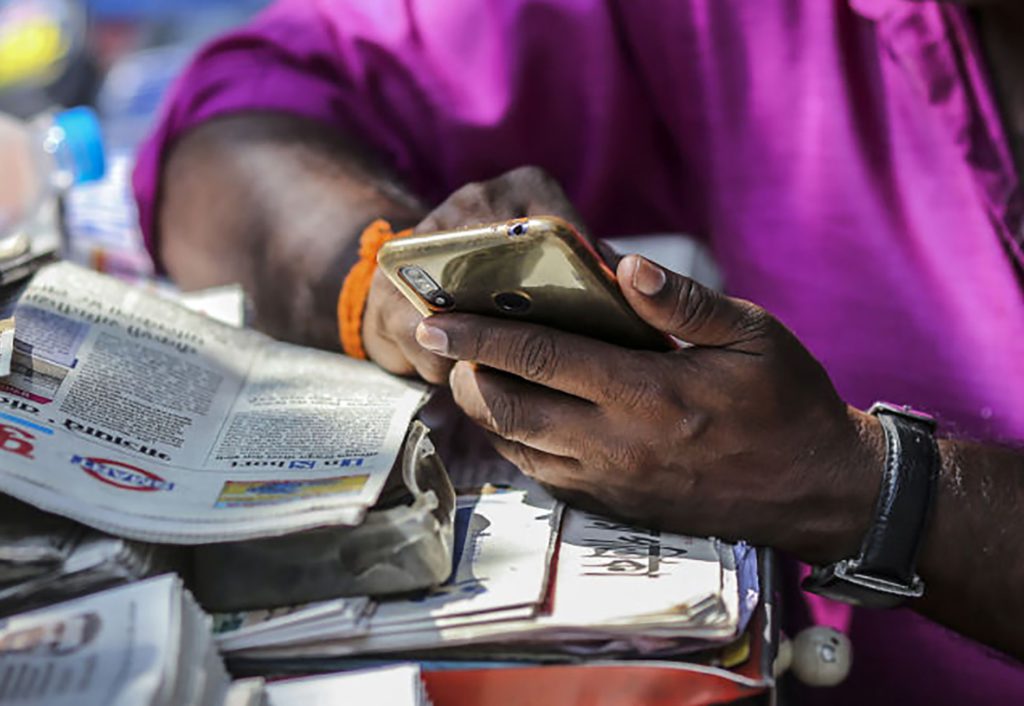
(Bloomberg) — India received bids worth 1.45 trillion rupees ($18.2 billion) on the first day of an auction for 5G airwaves where firms led by some of Asia’s richest men, including Mukesh Ambani and Gautam Adani, competed for rights that could decide who dominates the digital era.

The sale will probably fetch record revenue, Telecom Minister Ashwini Vaishnaw told reporters in New Delhi, adding the auction is expected to be over on Wednesday.

Final auction proceeds as well as details on the top bidder will emerge on Wednesday.

The ministry aims to allocate spectrum to wireless carriers by Aug. 15 and sees the ultra-speedy 5G services beginning in some Indian cities by September or October, the minister said.

The airwaves sale will be a big financial boost for Prime Minister Narendra Modi’s government as it looks to tame inflation and rein in the fiscal deficit. ICRA Ltd., a local rating company, estimated in June that the airwaves sale could raise as much as 1.1 trillion rupees.

Closely Scrutinized

While Ambani’s Reliance Jio Infocomm Ltd. paid the highest pre-auction deposit signaling it’s likely to be the most aggressive bidder, it is the surprise entrant Adani Data Networks Ltd. whose bids will be closely scrutinized as rivals try to map out its telecom ambitions even though it said it was buying airwaves only to build a private 5G network.

Reliance Jio’s smaller rivals Bharti Airtel Ltd., led by billionaire Sunil Mittal, and Vodafone Idea Ltd. — a joint venture between Vodafone Group Plc and Kumar Mangalam Birla’s group — are the other bidders.

India’s Richest Men and the $2 Customer: Andy Mukherjee

The latest auction also marks the first time Adani and Ambani-led firms are vying for the same asset, making it a keenly watched contest. Adani is entering a sector that Ambani disrupted in 2016 and has dominated since.

India has placed 72 gigahertz of airwaves on the block for a 20-year tenure in various frequency bands ranging from 600 megahertz to 26 gigahertz. It also eased payment terms for wireless operators as India tries to catch up with other countries, such as South Korea and China, that have had 5G networks for years. 

More stories like this are available on bloomberg.com

©2022 Bloomberg L.P.

Big Tech, Retailers Bearing Brunt of Stock Selling: Markets Wrap

(Bloomberg) — Stocks dropped after paltry economic figures and a weaker outlook from the world’s largest retailer underscored the impacts of inflation pressures on consumer spending, with recession fears running rampant as the Federal Reserve gets ready to deliver another big rate hike.

Walmart Inc.’s new forecast knocked down industry peers, with Morgan Stanley saying the news is a “potential warning signal” for giant Amazon.com Inc.’s merchandise margins. Economic barometer United Parcel Service Inc. slumped as package deliveries fell more than expected. The tech-heavy Nasdaq 100 underperformed, with giants Microsoft Corp. and Google’s parent Alphabet Inc. set to report their numbers after the market close. Treasury yields slid and the dollar rose.

Traders also braced for another 75-basis-point hike by Fed officials on Wednesday, with a combined increase of 150 basis points over June and July representing the steepest rise in rates since the early 1980s when then chairman Paul Volcker was battling sky-high inflation. Dimming views on the economy sank US consumer confidence to the lowest level since February 2021, while a gauge of new home sales fell for the fifth time this year.

“A soft landing feels like a long shot from here,” wrote Seema Shah, chief global strategist at Principal Global Investors. “In the last 11 tightening cycles, the Fed has only skirted recession three times (1965, 1984 and 1994). In each of those cycles, inflation was lower and the Fed funds rate was meaningfully higher at the point of liftoff, so Fed tightening didn’t need to be as dramatic as it does today.”

Read: IMF Cuts World GDP Outlook a Third Time as Inflation, Rates Jump

The Fed’s rate hikes are wearing out their welcome in bond markets, with a measure of the yield curve that Chair Jerome Powell has highlighted as a recession indicator sending out a warning message. The difference between rates on where three-month bills are now and where they will be in 18 months has tumbled about 95 basis points in July, the biggest monthly decline in data starting in 1996.

US officials are likely to stay hawkish for longer amid persistently high inflation, according to Goldman Sachs Group Inc. strategists, the latest to enter the debate around a potential central bank pivot as growth slows. Their opinion aligns with Morgan Stanley’s Michael Wilson, who also said Monday it’s too early to expect the Fed to stop hiking. Meantime, JPMorgan Chase & Co. strategists noted bets that prices have peaked will lead to a Fed pivot and improve the picture for equities in the second half.

Other corporate highlights:

  • General Motors Co. reported weaker profit than analysts’ estimates as semiconductor shortages kept production volumes in check. The automaker also warned it is bracing for tougher times ahead for the economy.
  • 3M Co. plans to spin off its multibillion-dollar health-care operations, a move that could leave the manufacturer flush with cash as it copes with shifting economic currents that have sapped its profits.
  • McDonald’s Corp. reported sales that topped estimates as consumers continue eating out despite higher prices.
  • Coca-Cola Co.’s sales exceeded expectations and the company raised its full-year guidance.
  • General Electric Co. beat Wall Street’s expectations for profit and reported surprise positive cash flow as sales at the key jet-engine division soared.
  • Archer-Daniels-Midland Co. posted its highest profit ever for a second quarter as soybean processing boosted earnings.
  • Coinbase Global Inc. is facing a US probe into whether it improperly let Americans trade digital assets that should have been registered as securities, according to three people familiar with the matter.

The annual summer lull combined with steadily deteriorating economic conditions and recession fears are also keeping junk-bond borrowers on the sidelines, with the month-to-date supply at $1.06 billion, the slowest July at least since 2006.

Here are some key events to watch this week:

  • Alphabet, Apple, Amazon, Microsoft, Meta earnings due this week
  • Fed policy decision, briefing, Wednesday
  • Australia CPI, Wednesday
  • US GDP, Thursday
  • Euro-area CPI, Friday
  • US PCE deflator, personal income, University of Michigan consumer sentiment, Friday

Musk, Tesla and Twitter are this week’s theme of the MLIV Pulse survey. Also share your views on the S&P 500’s biggest stocks. Click here to get involved anonymously.

Some of the main moves in markets:

Stocks

  • The S&P 500 fell 1% as of 11:28 a.m. New York time
  • The Nasdaq 100 fell 1.6%
  • The Dow Jones Industrial Average fell 0.5%
  • The Stoxx Europe 600 was little changed
  • The MSCI World index fell 0.8%

Currencies

  • The Bloomberg Dollar Spot Index rose 0.4%
  • The euro fell 0.9% to $1.0124
  • The British pound fell 0.2% to $1.2024
  • The Japanese yen was little changed at 136.63 per dollar

Bonds

  • The yield on 10-year Treasuries declined four basis points to 2.75%
  • Germany’s 10-year yield declined nine basis points to 0.93%
  • Britain’s 10-year yield declined two basis points to 1.91%

Commodities

  • West Texas Intermediate crude fell 0.5% to $96.19 a barrel
  • Gold futures fell 0.1% to $1,734.60 an ounce

More stories like this are available on bloomberg.com

©2022 Bloomberg L.P.

Morgan Stanley Hires Deutsche Bank Semiconductor Banker Lagos

(Bloomberg) — Morgan Stanley has hired Marco Lagos, a semiconductor banker from Deutsche Bank AG, according to people familiar with the matter.

Lagos, who was head of semiconductor, electronics and IP investment banking, is set to join Morgan Stanley in September, some of the people said, asking not to be identified because the appointment hasn’t been made public.

Representatives for Morgan Stanley and Deutsche Bank declined to comment. Lagos didn’t immediately respond to a request for comment.

Lagos joined Deustche Bank in 2018 after working at Credit Suisse for more than a decade, his LinkedIn profile shows. 

Earlier this month, Deutsche Bank hired BMO Capital Markets investment banker Robert Lee to cover the chip industry. 

Deutsche Bank Hires BMO Banker Lee for Semiconductor Dealmaking

More stories like this are available on bloomberg.com

©2022 Bloomberg L.P.

BlackRock-Backed Round Values Cyber Firm Acronis at $3.5 Billion

(Bloomberg) — Cybersecurity provider Acronis raised $250 million in new funding from institutional investors earlier this year to expand its business, including through acquisitions and hiring.

The fresh investment valued the company at more than $3.5 billion, an Acronis representative said in a statement. BlackRock Inc. was among those to participate in the deal, according to people familiar with the matter, who asked not to be identified discussing confidential information.

A spokesperson for BlackRock declined to comment. 

Acronis was last valued at $2.5 billion in May 2021 after receiving a $250 million investment from CVC Capital Partners VII and others. It’s also previously raised funding from Goldman Sachs Group Inc. 

News of the funding comes as startups such as Klarna Bank AB slash their valuations against a backdrop of rising interest rates. Cybersecurity companies have benefited from a boom in demand as tensions between Russia and the West over the invasion of Ukraine have fueled fears of attacks in NATO countries. 

Goldman-Backed Acronis Scores CVC Funds at $2.5 Billion Value

Founded in Singapore in 2003 and incorporated in Switzerland five years later, Acronis offers a variety of cybersecurity and data protection products for businesses and individuals. It has more than 2,000 employees and offices across 34 locations, and says its solutions are used by 5.5 million home users and 500,000 companies. Clients include sports teams such as American football’s Chicago Bears and baseball’s Boston Red Sox, according to the company’s website.

More stories like this are available on bloomberg.com

©2022 Bloomberg L.P.

Close Bitnami banner
Bitnami