Bloomberg

NXP Semiconductors Gives Bullish Forecast on Industrial and Auto Market Demand

(Bloomberg) — NXP Semiconductors NV, the second-biggest supplier of chips to the automotive industry, gave a strong forecast for the current quarter driven by demand for components used in cars. 

Third-quarter revenue will be $3.35 billion to $3.5 billion, NXP said Monday in a statement. That compares with an average analyst estimate of $3.32 billion. Gross margin, or the percentage of sales remaining after deducting the cost of production, will be as high as 58.3%. Analysts has projected a margin of 57.6%.

NXP is completely sold out through the end of 2022, Chief Executive Officer Kurt Sievers told Bloomberg on Tuesday. The company is “very cautious” with regards to high inflation, Covid-19 lockdowns in China, the war in Ukraine and a possible energy crisis, he said. 

“It’s a bit of a schizophrenic situation,” Sievers said. “I am still in my seat, fighting customer shortages; while, of course from a macro perspective, you would assume the world is going under.”

Shares of NXP gained as much as 2.2% to $177.88 in New York on Tuesday. The stock has lost about 23% of its value this year, in line with a slide in chip industry stocks.

NXP generates about half its revenue from the sales of chips used in autos. The Eindhoven, Netherlands-based company has posted rapid growth fueled by the increasing use of semiconductors in vehicles. That’s continuing as the supply of the electronic components still can’t meet all of the industry’s orders. 

Like many other chipmakers, NXP doesn’t manufacture all of its semiconductors in-house, instead outsourcing production to suppliers such as Taiwan Semiconductor Manufacturing Co. Those foundries are swamped with orders they’re struggling to fill.

NXP, in its statement, cited continued strong demand in the markets for auto, industrial and connected devices. 

In the period ended July 3, NXP reported sales increased 28% to $3.31 billion. Gross margin was 57.8%, minus certain items. The figures beat analysts’ estimates.

(Updates with CEO quote in third, fourth paragraphs; adds shares in fifth.)

More stories like this are available on bloomberg.com

©2022 Bloomberg L.P.

Shopify Will Cut 10% of Its Staff, With Most Workers Gone by Day’s End

(Bloomberg) — Canadian e-commerce firm Shopify Inc. will cut about 10% of its workforce Tuesday, as Chief Executive Officer Tobi Lutke acknowledged the company’s decision to expand rapidly coming out of the Covid-19 pandemic didn’t pay off.

The move will eliminate about 1,000 jobs out of 10,000 or so total employees at Shopify. Most of the affected roles are in recruiting, support and sales, Lutke said in a memo posted on the company’s website.

Shopify tumbled as much as 17% to $30.55, the biggest intraday drop in almost three months. The Wall Street Journal reported the job cuts earlier Tuesday.

“We bet that the channel mix — the share of dollars that travel through e-commerce rather than physical retail — would permanently leap ahead by five or even 10 years” because of the pandemic, Lutke wrote. 

“It’s now clear that bet didn’t pay off. What we see now is the mix reverting to roughly where pre-Covid data would have suggested it should be at this point.”

Shopify was among the hottest pandemic stocks in 2020 and 2021 as online shopping boomed. It came crashing down this year, hampered by an economic cool-down and an easing of Covid-19 restrictions. Shopify shares have fallen 73% this year as of Monday’s close.

The Ottawa-based company reported a huge profit miss in the first quarter, and analysts have cut their expectations for the second quarter results, which are scheduled for Wednesday.

The move boosts the likelihood that Shopify will lower its full-year outlook, according to RBC Capital Markets analyst Paul Treiber. During first-quarter results in May, the company said it had expected merchants to join its platform at the same rate as in 2021.

“Since Shopify reinvests all the gross profit that it generates back into the business, the reduction of headcount increases the likelihood that the company reduces its FY22 outlook,” Treiber said in a note to clients.

Analysts expect $1.33 billion in revenue for the period ended June 30, up just 11% from the first quarter.

For those losing jobs this week, Shopify will pay at least 16 weeks of severance and extend additional benefits, including an allowance to buy laptops and temporary coverage of home internet costs, a spokeswoman for the company said.

(Updates with analyst commentary starting in the eighth paragraph.)

More stories like this are available on bloomberg.com

©2022 Bloomberg L.P.

Bitcoin Sinks to One-Week Low as Another Fed Rate Increase Looms

(Bloomberg) — Bitcoin sank to a more than one-week low, buffeted by investor skittishness ahead of a looming Federal Reserve interest-rate hike and amid harsher regulatory scrutiny of the cryptocurrency sector.

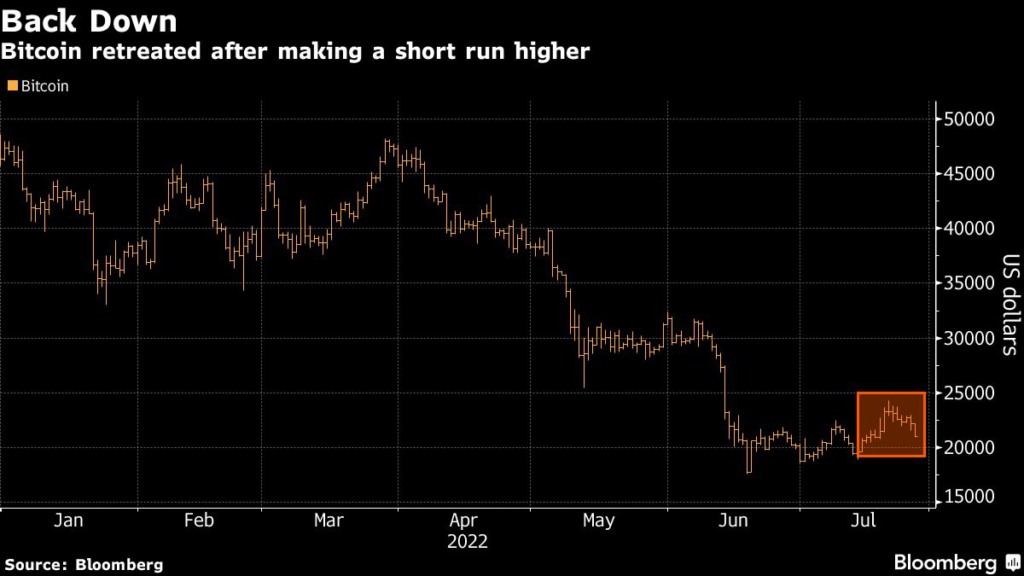
The largest token dropped as much as 6.2% on Tuesday and was trading at around $20,924 as of 10:02 a.m. in New York. The MVIS CryptoCompare Digital Assets 100 gauge shed more than 5%, while recent high flyers Polygon and Ether was down about 10%. Equity markets were mostly lower in the US and Europe. 

The retreat has put a dent in expectations for a sustained Bitcoin rebound and returned the token to a trading range between roughly $19,000 and $22,000. Risk appetite is generally on the back foot before an expected 75 basis-point Fed rate increase Wednesday, part of a tightening cycle that’s sapping liquidity.

“We’ve had some stabilization over the past few weeks and that gave some folks confidence that perhaps a bottom was being put in place,” Katie Stockton, co-founder of Fairlead Strategies, said on Bloomberg Television. “We’re not so convinced.”

Rising interest rates and high-profile meltdowns like that of crypto hedge fund Three Arrows Capital have pummeled digital tokens this year. Bitcoin is down 55% since the start of 2022.

“Macro drivers haven’t flipped for people to really go long, bear market squeezes are always very vicious,” said Patrick Chu, head of institutional coverage of APAC at OTC trading platform Paradigm.

The turmoil is leading to ever greater regulatory oversight of the industry.

Coinbase Global Inc., for instance, is facing a US probe into whether it improperly let Americans trade digital assets that should have been registered as securities, according to people familiar with the matter. Coinbase shares fell as much as 12%. 

Read more: Coinbase Faces SEC Investigation on Cryptocurrency Listings 

Adding to the uncertainty about crypto assets’ direction is the backdrop of geopolitical tensions, with Russia cutting gas supplies to Europe and rising food prices sparking concerns about instability in developing markets. The US dollar is up against all major developed-market currencies this year, providing another headwind for digital tokens. 

“Rising geopolitical tensions might provide some underlying support for the dollar, which could drag down risk appetite, which would weigh on cryptos,” said Edward Moya, senior markets analyst at Oanda. 

More stories like this are available on bloomberg.com

©2022 Bloomberg L.P.

UPS Shares Sink as Delivery Volume Drops More Than Expected

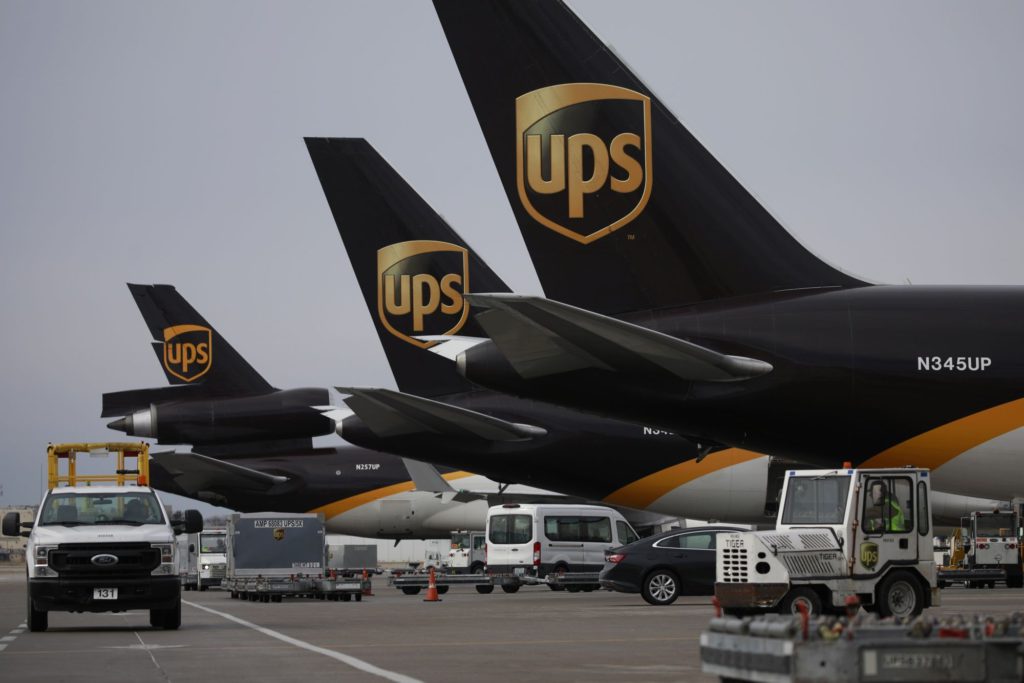
(Bloomberg) — United Parcel Service Inc.’s package deliveries declined more than expected during the second quarter, driving the shares down even as higher prices helped boost sales and profit. 

Average daily package volume fell 4% in the US and more than 13% for its international business, UPS said in a statement on Tuesday, as buying patterns shift back toward spending on services and as consumers tighten their belts amid a worldwide surge of inflation. UPS shares, which had slipped 12% this year through Monday’s close, fell 3.8% to $180.84 at 9:55 a.m. in New York.

Chief Executive Officer Carol Tome’s strategy has been to break from UPS its tendency to chase volume at any cost. Since she took over in June 2020, the courier has been focused on more profitable customers, such as health care and small businesses. The courier’s margins have been helped by higher prices and limits on discounts traditionally given to large-volume customers. 

“We expected volume levels to decline from last year. They did, but more than we planned,” Tome said in a conference call with analysts. “Despite the decline in volume, we continue to win in the most attractive parts of the market.”

After struggling to keep up with surging demand during the height of the pandemic, UPS is now adjusting to a slowdown of package deliveries. People are now spending less on goods delivered to their homes and more toward services, such as going to concerts and eating out. Giant retailer Walmart Inc. reflected a change in consumer behavior Monday by cutting its profit outlook, saying shoppers are focusing on lower-margin essentials. 

Amazon.com Inc. is one of the large customers for which the courier is throttling package volume. Revenue and volume from the e-commerce giant, UPS’s largest customer, is declining and will be less than 11% of total revenue by the end of this year. Amazon accounted for 11.7% of UPS’s total revenue in 2021 and 13.3% in 2020. 

Beating Estimates

Adjusted earnings were $3.29 a share in the second quarter, up from $3.06 a year earlier, Atlanta-based UPS said. Analysts had predicted $3.15 a share. Sales were $24.8 billion, just a bit ahead of the average estimate of $24.6 billion. 

The courier’s adjusted operating profit margin was 14.4%, up from with 14% a year earlier. Margins were driven by increased revenue per package, spurred by both price increases and a shift to higher value packages. Revenue per package jumped almost 12% in the US and surged almost 15% for the international business. 

UPS reiterated its 2022 financial targets for an adjusted operating margin of 13.7% and revenue of about $102 billion. The company raised its goal for share repurchases this year to $3 billion from $2 billion in April.

“Increasing its share buyback by 50% to $3 billion provides us with some confidence about the sustainability of some of these initiatives and long-term profitability of the company through the economic cycle,” said Lee Klaskow, an analyst for Bloomberg Intelligence.

Earlier this month the International Monetary Fund cut its growth projections for the US economy this year to 2.3% from 2.9%, warning that a surge in inflation poses risks to both the country and the global economy. Government data due this week could show the US economy contracted for a second straight quarter, stoking the debate a possible recession. 


(Updates with CEO comment in fourth paragraph, shares in the sixth)

More stories like this are available on bloomberg.com

©2022 Bloomberg L.P.

York Space Systems Is Said to Weigh Possible $1.5 Billion Sale

(Bloomberg) — Closely held satellite developer York Space Systems is considering options including a sale, according to people with knowledge of the matter.

The company is working with an adviser to examine strategic options, with a sale expected to value York at about $1.5 billion, said the people, who asked not to be identified because they weren’t authorized to speak publicly. The Denver-based company is expected to attract interest from other aerospace and defense groups, the people said. 

A representative for York didn’t immediately respond to requests for comment.

A sale would continue a string of aerospace and defense deals in the past year, including Viasat Inc. agreeing to buy Inmarsat Group Holdings for $4 billion and Carlyle Group Inc.’s agreement to take ManTech International Corp. private in a deal valued at $3.9 billion, according to data compiled by Bloomberg. Most recently, Eutelsat Communications SA on Monday confirmed an earlier Bloomberg News report that it’s in talks to combine with UK satellite rival OneWeb Ltd.

York, founded in 2015, makes satellites for a range of uses, including communications and weather monitoring, for civilian and government agencies, including the US Defense Department, according to its website.

The company said in a statement in April that it anticipates hiring as many as 450 employees in the Denver area over the next two years to meet increasing demand. York projects revenue growth of 250% revenue in 2022, the third consecutive year-over-year gain of more than 230%.

More stories like this are available on bloomberg.com

©2022 Bloomberg L.P.

3M Soars Most Since Pandemic’s Start on Health-Care Spinoff Plan

(Bloomberg) — 3M Co. plans to spin off its multibillion-dollar health-care operations, a move that could leave the manufacturer flush with cash as it copes with shifting economic currents that have sapped its profits.

The dramatic step, which sent 3M’s shares up the most since the early days of the pandemic, will reshape a company known for diverse product lines, from electronic components to dental adhesives to Post-it notes. It will retain a stake of 19.9% in the medical-supplies business initially and sell off the holding over time, 3M said Tuesday in a statement.

The company, based in St. Paul, Minnesota, has underperformed in recent years amid supply-chain challenges, currency fluctuations and rising costs. A spinoff could boost 3M’s sagging value, bolster its capital allocation strategy and give it “a liquidity war chest,” according to a note from Bloomberg Intelligence analysts Monday. The independent health business could be worth as much as $45 billion, they said.

The move came as 3M began Chapter 11 proceedings for a separate earplug business that had been the subject of multiple lawsuits. The steps announced Tuesday collectively address two of the main points of contention over Chief Executive Officer Mike Roman’s leadership of 3M, shoring up the balance sheet and beginning to resolve the sprawling liabilities — including from its production of so-called forever chemicals — hanging over the company.

3M’s shares jumped 5.7% at 9:42 a.m. in New York after gaining as much as 8.6%, the biggest intraday advance since March 2020. The stock had tumbled 24% this year through Monday, worse than the decline in the S&P 500 Index.

Industrial Breakups

While not a wholesale breakup, 3M’s spinoff reflects a trend among industrial companies to split their operations to bring more focus. General Electric Co. is separating its power and health-care businesses, while United Technologies recently hived off its elevator and air-conditioner operations before merging with Raytheon.

With about $8.6 billion in sales last year, 3M’s health-care unit accounted for almost one-quarter of the company’s total revenue. The division makes products across markets, including surgical supplies, bandages and biopharmaceuticals.

The tax-free transaction is expected to be completed by the end of 2023, subject to final approval from the board and regulators.

The spinoff was revealed along with other significant announcements Tuesday, including second-quarter earnings results. The company cut its full-year sales and profit forecasts as the surging value of the US dollar added to pressures from snarled supply chains, inflation and softening demand in some of its key markets.

3M also said in a separate statement that it’s taking steps to resolve litigation related to its Combat Arms Earplugs, with its Aearo Technologies business voluntarily initiating Chapter 11 proceedings. 3M will committing $1 billion to fund a trust to resolve claims related to the earplugs worn by military personnel.

The bankruptcy maneuver drew criticism from US military veterans suing the company. The action “is further proof that they value their profits and stock price more than the well-being of veterans who fought and served our country,” Bryan Aylstock, the court-appointed lead plaintiffs’ counsel in a lawsuit against 3M, said in a statement. He added that they will argue for the bankruptcy court to deny 3M’s petition.

More stories like this are available on bloomberg.com

©2022 Bloomberg L.P.

Ask IMF Chief Economist Your Questions on the Latest Global Economy Report

(Bloomberg) — The International Monetary Fund published its World Economic Outlook update today, analyzing an uncertain future as countries like the US teeter on the edge of an economic recession and inflation pain is felt across the globe.

IMF Chief Economist Pierre-Olivier Gourinchas joins Odd Lots podcast host, Tracy Alloway, and Bloomberg’s IMF reporter, Eric Martin, for a conversation analyzing the report tomorrow. 

Tune into Bloomberg’s Twitter Space on Wednesday, July 27 at 9 a.m. in New York for the conversation. 

Have questions for Gourinchas? Submit yours in advance using this form, or send a direct message to Bloomberg’s @business Twitter account. Live questions will also be accepted during the conversation with the hashtag #WEO. 

Read More: IMF Cuts World GDP Outlook a Third Time as Inflation, Rates Jump

More stories like this are available on bloomberg.com

©2022 Bloomberg L.P.

Newly Cheap Microsoft Is Still a Favorite Growth Play for Investors

(Bloomberg) — In a world of sputtering growth for technology companies, some investors are gravitating toward Microsoft Corp. as the closest thing to a safe bet.

The attractions those bulls see should be on display in the Redmond, Washington-based company’s fourth-quarter results after the market close Tuesday: Wall Street expects Microsoft will report earnings growth of 6% and a 14% increase in revenue, extending a years-long streak of double-digit sales expansion. 

While Microsoft hasn’t been immune to this year’s tech stock selloff, the company has a reputation for durable growth, thanks to business software and cloud-computing offerings that analysts see as mission critical for corporations, making customers unlikely to drop them in a downturn. And the stock looks like more of a bargain than it did during the 2021 tech surge.

“Within the sector it looks pretty strong, and the valuation is supported by real improvements in the fundamentals,” said Hal Reynolds, who oversees more than $15 billion as chief investment officer at Los Angeles Capital Management. “That a name like this is now more attractively priced makes it easier to move back into the sector.”

The stock fell 1.5% on Tuesday. Microsoft shares have fallen about 24% this year, a smaller drop than the Nasdaq 100 Index and the iShares Expanded Tech-Software Sector ETF. The stock now fetches 24 times estimated earnings, below its five-year average of 27.4.

In early June, Microsoft pared its fourth-quarter outlook, and the company also is slowing hiring in its security software and Azure cloud businesses, given weaker economic conditions. 

Analysts and investors have largely brushed these issues off, noting the lower outlook was credited to the impact of a stronger dollar, as opposed to weakening fundamentals, while the hiring slowdown will limit expenses. More than 90% of analysts recommend buying the stock, and it’s the second-highest-rated tech stock in the Nasdaq 100, after Crowdstrike Holdings Inc.

The spending pullback shows the company is “pulling the levers it needs to pull in order to protect its earnings and margins,” said Matt Peron, director of research at Janus Henderson.

While Wall Street remains largely positive on the long-term outlook for software in general, analysts have been lowering their expectations as they brace for a potential recession. Analysts predict software and services companies will report 2022 earnings growth of 13.6%, down from the 14.8% pace expected in late January, according to data compiled by Bloomberg Intelligence.

The consensus view for Microsoft’s fourth-quarter earnings have dropped by 2.9% over the past three months, according to data compiled by Bloomberg, while the consensus for revenue is down 0.6%. However, should revenue come in close to expectations, it would extend a streak of double-digit growth that began in 2017 — an impressive feat for the world’s third-biggest company, with a market capitalization of $1.9 trillion.

“For a gigacap like Microsoft to grow at a double-digit pace like this is pretty amazing, especially since you’re paying a reasonable multiple for it,” said Janus Henderson’s Peron. “Why not have that at the core of your portfolio?”

Tech Chart of the Day

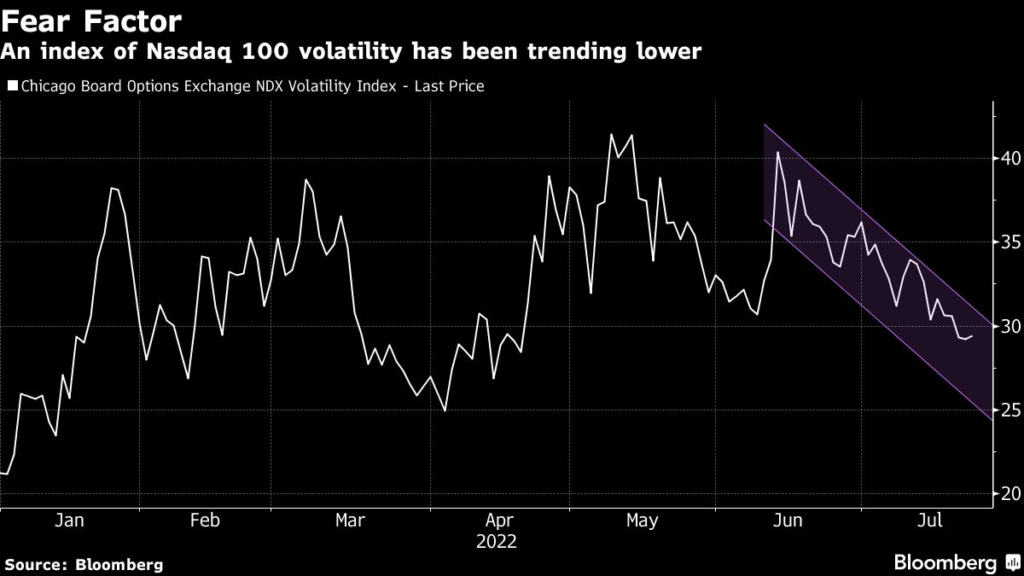
The CBOE NDX Volatility Index has been moving lower, ending below 30 on Monday, compared with a peak above 40 in mid-June. This could be a sign of weakness ahead for the Nasdaq 100 Index, according to Nicholas Colas, co-founder of DataTrek Research. “Market ‘fear’ has waned down to levels consistent with near-term tops in US equity market indices, regardless of market cap or type,” he wrote in a report Monday.

Top Tech Stories

  • Alibaba Group Holding Ltd. will seek a primary listing in Hong Kong, entrenching the financial hub’s status as an alternative to US markets ahead of a potential exodus of Chinese companies from New York.
    • JD.com Inc. and Baidu Inc. are among Chinese firms that may follow Alibaba in applying for a Hong Kong primary listing, as they seek to attract mainland investors and hedge against the risk of being kicked off US exchanges.
    • Alibaba has removed all executives of financial affiliate Ant Group Co. from its partnership, shaking up a key structure that maintains control of the e-commerce giant.
  • Coinbase Global Inc. is facing a US probe into whether it improperly let Americans trade digital assets that should have been registered as securities, according to three people familiar with the matter. The company said it’s confident it didn’t do so.
  • Meta Platforms Inc. is considering whether to acquire AdHawk Microsystems Inc., a Canadian developer of eye-tracking technology for augmented and virtual reality headsets, according to people familiar with the matter.
  • US lawmakers are eying votes before November’s midterm elections on legislation that marks the first major effort by Congress to regulate big tech since the inception of the internet.
  • Eutelsat Communications SA and OneWeb Ltd. are set to combine in an all-share deal valuing the UK satellite operator at $3.4 billion, a step toward creating a European champion to rival the likes of Elon Musk’s SpaceX.
  • Steve Jobs’s Apple-1 Computer prototype is being auctioned by Boston-based RR Auction, with current bids at $278,005. Bidding ends on Aug. 18. RR Auction sold the Apple-1 computer in September 2018 for $375,000.
  • NXP Semiconductors NV, the second-biggest supplier of chips to the automotive industry, gave a strong forecast for the current quarter driven by demand for components used in cars.

(Updates to market open.)

More stories like this are available on bloomberg.com

©2022 Bloomberg L.P.

Alibaba Seeks Primary Hong Kong Listing as US Exit Looms

(Bloomberg) — Alibaba Group Holding Ltd. will seek a primary listing in Hong Kong, entrenching the financial hub’s status as an alternative to US markets ahead of a potential exodus of Chinese companies from New York.

The switch could provide a template for the roughly 200 US-traded Chinese companies from JD.com Inc. to Baidu Inc. that face delisting should Washington and Beijing fail to agree on allowing US regulators to review their financial audits. It also paves the way for investors in China to directly buy shares of the country’s most prominent e-commerce company for the first time. 

A primary listing would allow Alibaba to seek inclusion in the Stock Connect link with the Shanghai and Shenzhen exchanges. That could expand the $285 billion giant’s investor base after a year-long selloff triggered by China’s economic slowdown and Beijing’s crackdown on its most powerful internet firms.

The move, expected by year-end, will grant hundreds of millions of investors in mainland China direct access to one of the country’s most storied names, which in 2014 made waves when it debuted in New York as the largest-ever initial public offering. Alibaba’s action could encourage peers to follow suit, helping cement Hong Kong as an alternative venue now that American regulators are threatening to toss Chinese companies off US bourses unless they comply with auditing rules.


Alibaba rose as much as 6.5% in Hong Kong on Tuesday, while its US-listed stock rose 3% as trading opened in New York. Bourse operator Hong Kong Exchanges and Clearing Ltd. climbed more than 3.9%. SoftBank Group Corp., Alibaba’s largest shareholder, rose more than 3% in Tokyo.

“The timing may be right for investor interest as it aligns with the fading of the tech regulatory crackdown,” said Marvin Chen, a strategist at Bloomberg Intelligence. “More broadly, Alibaba is paving a path for US ADRs to move away from US exchanges, introduce domestic capital, and to be less reliant on global foreign investors.”

The US and China have been at odds for two decades over a legal requirement that American regulators get full access to inspect audit work papers. That measure is meant to protect investors from accounting fraud and other malfeasance. Securities and Exchange Commission Chair Gary Gensler said this month it’s unclear if American and Chinese authorities will reach a deal to avoid a congressionally imposed 2024 deadline for kicking businesses off the New York Stock Exchange and Nasdaq.

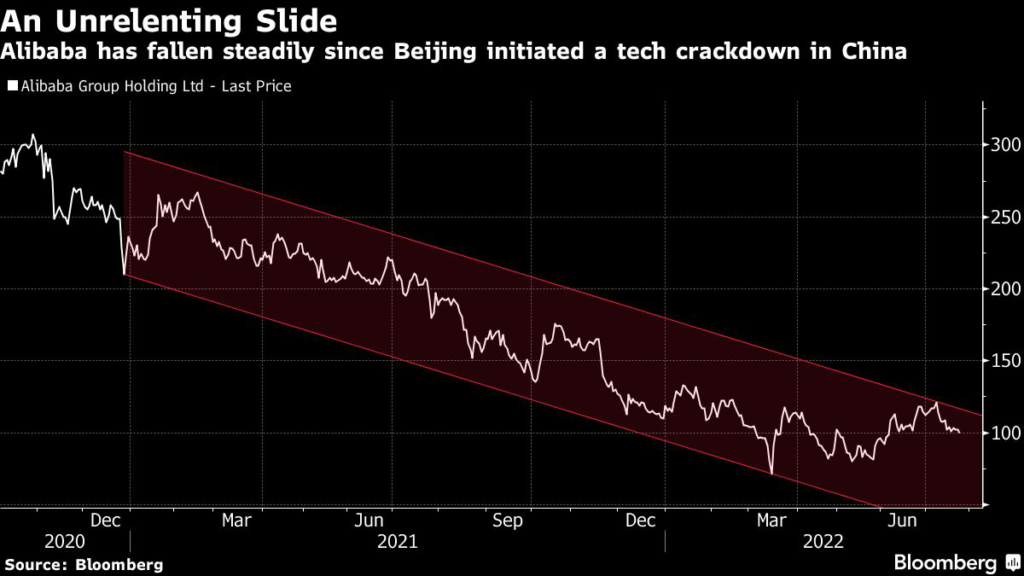
The threat of losing direct access to US investors has weighed on Chinese stocks. Alibaba itself has shed some two-thirds of its value since a 2020 peak, pummeled by a regulatory crackdown that sought to rein in anti-competitive behavior across the internet sector. It currently has a secondary listing on the Hong Kong bourse, but has seen a rise in public float and transaction volume on the exchange there, it said in a statement on Tuesday. Its average daily trading volume in Hong Kong was about $700 million, compared to about $3.2 billion in the US.

“Alibaba’s move might point to internet companies preparing for a fall-back position, in case they have to delist from the US,” said Redmond Wong, market strategist at Saxo Capital Markets.

HKEX Chief Executive Officer Nicolas Aguzin has said more companies with secondary shares in Hong Kong are considering primary listings, while others may be forced to do so by market rules as more of their volume migrates to the city. 

The prospect of Stock Connect inclusion for companies like Alibaba has been a subject of intense speculation among traders in Hong Kong, which currently excludes companies with both secondary listings and weighted voting rights from its mainland trading links. It highlights the urgency to seek new investors ahead of possible delistings from American exchanges.

Alibaba filed its annual financial report in a form 20-F to the SEC on Tuesday. The filing could signal that Alibaba might be added to the SEC’s list of companies that may be removed from US exchanges as a result of Beijing’s refusal to allow US officials to review their auditors’ work. Firms are added to the list in a rolling process based on when they report their annual financials through an auditing firm.

What Bloomberg Intelligence Says

Alibaba’s proposed primary listing in Hong Kong would facilitate stock purchases by mainland Chinese via a Stock Connect program, and over time could lead to a significant rise in mainland money in the stock vs. levels with its current secondary listing. Management will therefore showcase the firm’s growth engines and developments on the mainland more actively, we believe; this could help allay concern about Alibaba’s longer-term outlook amid uncertainty over the Chinese economy and regulation.

– Catherine Lim, analyst

Click here for the research.

While some market participants had hoped the exchange would relax rules that bar such companies, a primary listing is emerging as an alternative path. Bilibili Inc. in July won shareholder approval to convert its secondary Hong Kong listing status to dual-primary, while Zai Lab Ltd. completed the procedure in June before joining the Stock Connect scheme in July.

A dual-primary listing on the Hong Kong Exchange is often more costly and requires stricter reporting rules than a secondary listing. Companies need to provide to the exchange an expected date when they will fulfill requirements, and a detailed plan for and arrangements on how it will comply with the rules.

Unlike companies with a primary listing, firms with a secondary listing in the city are exempted from certain rules and don’t have to disclose things such as financial guarantees provided to affiliates and stock pledges made by the controlling shareholder.

But more stringent regulations shouldn’t be the main reason to prevent Chinese firms from seeking dual primary listings because they need exposure to international investors, according to Ken Wong, Asian equity fund specialist at Eastspring Investments.

Alibaba’s move “is nothing that we are totally surprised about,” Wong said. “A lot of other companies will want to do the same,” he said, “especially now with such a large name doing so.”

Other Chinese companies have opted to list directly in Hong Kong under dual-primary status. That was the case for electric vehicle makers XPeng Inc. and Li Auto Inc., which began trading in the Asian financial hub over the past year.

“This is a massive move for Alibaba, given it is the biggest secondary listing in Hong Kong,” said Willer Chen, an analyst at Forsyth Barr Asia Ltd. Inclusion in the Stock Connect “can lead to a more diversified investor base for Alibaba.”

(Updates with filing form 20-F in 12th paragraph)

More stories like this are available on bloomberg.com

©2022 Bloomberg L.P.

Banks Get Algo-Trading Tool With No Coding Needed Through BestEx Research

(Bloomberg) — BestEx Research Group LLC, which operates a trading platform driven by algorithms, is offering an electronic tool to banks so they can build their own algos without having to write the code themselves.

The technology firm’s new tool, Strategy Studio, gives buy-side clients and brokers the ability to build algos, helping cut costs and time, said Hitesh Mittal, BestEx’s founder and chief executive officer. Each algo can be matched to a bank or broker-dealer’s trading objectives. 

“In the next decade I think banks are going to be buyers rather than builders in trading,” Mittal said in an interview.

Commissions for algo trading are expected to increase to $34 billion next year, according to researcher Chartis, with Wall Street trading more and more asset classes, including foreign exchange, fixed income and options, algorithmically.

BestEx, based in Stamford, Connecticut, is targeting its new product to electronic-trading units at banks that serve clients in equities, futures and fixed-income markets. It has five financial firms, including Bank of Nova Scotia, currently using the new software, and two additional top-tier banks signed up for futures trading, Mittal said. Over the next two years, BestEx intends to persuade at least 10 banks to build their custom offerings on top of the firm’s existing algo-management system. 

Banks are setting aside hundreds of millions of dollars to build trading platforms to give clients fast, efficient technology. Goldman Sachs Group Inc., Morgan Stanley and other Wall Street giants pulled in $29 billion in trading revenue in the second quarter, a 21% increase that exceeded analysts’ estimates, with JPMorgan Chase & Co. leading the pack.

BestEx said it’s offering its algo-trading product at a lower cost than it would take banks to build their own offerings internally. The firm’s one-year subscription will cost an average of $1 million a year, depending on the size and complexity of the bank, Mittal said.

“Even though banks have the money, it’s hard to innovate at larger corporations, so we believe the next generation of algorithmic trading will come from independent firms like ours with more flexibility,” he said. 

Founded in 2017, BestEx developed a cloud-based platform that offers trading for equities, futures and foreign exchange. Last year, it launched a futures algorithm, which aims to cut transaction costs through a model that factors in volatility, volume, spreads and other variables across exchanges.

More stories like this are available on bloomberg.com

©2022 Bloomberg L.P.

Close Bitnami banner
Bitnami