
Bloomberg

Shopify Stock Seen Carrying Weight of Canada Curse Into 2023

(Bloomberg) — The curse of Canadian mega-cap technology stocks hit Shopify Inc. this year, and analysts see little relief ahead for the e-commerce company’s shareholders. 

Shopify shares have tumbled 70% in 2022 and brokerages see a gain of only 2.2% for the Ottawa-based company’s shares in the next year. That’s the lowest expected return among this year’s 10 worst-performing Canadian and US tech companies with market values of $20 billion or more.

A huge rally early in the pandemic made Shopify the third technology business since 2000 to become Canada’s most valuable company. Its rise and subsequent fall is an echo of its two predecessors: Nortel Networks Corp., a darling of the dot-com era, later went bankrupt. BlackBerry Ltd. lost its dominance in smartphones and the stock has collapsed 96% from its 2008 heyday. 

“Shopify has suffered alongside other high-growth tech stocks over the course of the past year,” said Sylvia Jablonski, chief investment officer of Defiance ETFs. The stock soared during the last couple of years “around the idea that e-commerce was really the only commerce due to Covid.” 

The company’s C$57.6 billion market value ranks it 14th in size in Canada, according to data compiled by Bloomberg. At its peak in November last year, Shopify was the biggest, at C$268.7 billion.

Shopify lets merchants set up websites for online sales, allowing them to manage inventory and process payments, among other things. The business boomed during the pandemic, only to come crashing down this year, hampered by an economic slowdown and an easing of Covid-19 restrictions.  

“Selling shovels to miners in an e-commerce gold rush is the perfect business,” Michael Morton, an analyst at MoffettNathanson, wrote in a note. “Shopify seized the opportunity and now powers 11% of all U.S. e-commerce.” 

The business, though, is becoming more capital intensive, and there are questions around its profitability, said Morton, who has a market perform rating on the stock. 

Now that business is slowing, Shopify, like other big technology companies, is cutting jobs, acknowledging that its decision to expand rapidly coming out of the pandemic didn’t pay off. The company, which had net income of $2.9 billion last year, is forecast to lose $3.1 billion in 2022.

After the battering that Shopify’s stock has taken this year, bulls are hoping it can avoid the fate of Nortel and BlackBerry of sinking into irrelevance or worse. Shopify is second only to Amazon.com Inc. in the still-growing e-commerce industry, and it’s “miles ahead” of competitors like Wix.com Ltd., said Charlie Miner, senior analyst at Third Bridge.

Shopify’s stock is still up 1,600% from its 2015 initial public offering price. 

“As Covid tailwinds continue to subside, Shopify must find new ways to boost revenue from existing customers,” Miner said. “Shopify is caught between having to decide whether to appease investors in the short term and cut costs or continue its aggressive growth strategy.”


Tech Chart of the Day

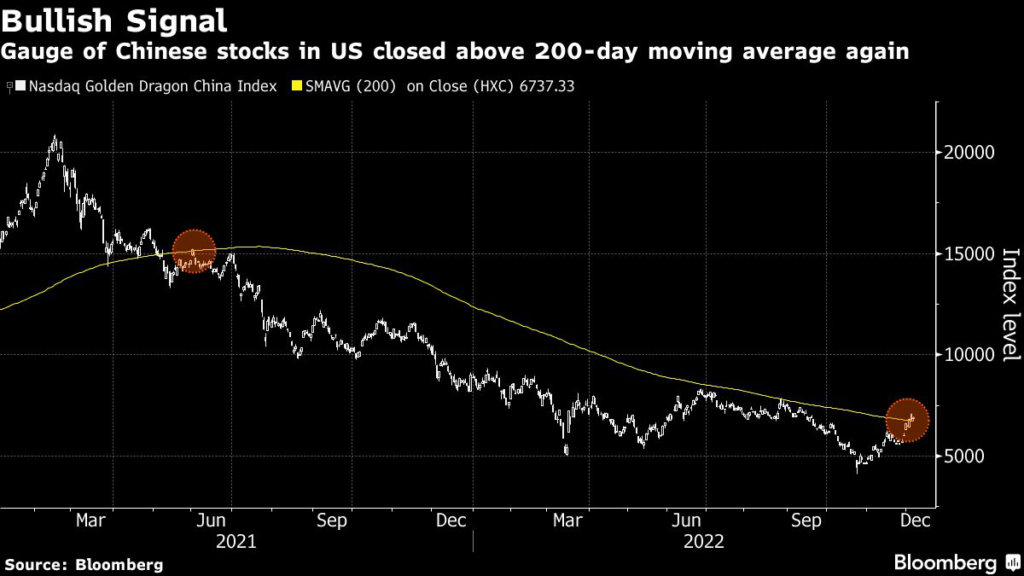
Optimism over China’s reopening has driven a gauge of US-listed Chinese stocks to close above its 200-day moving average, a key technical resistance level, for the first time since June 2021. The Nasdaq Golden Dragon China Index, which consists of 65 Chinese stocks including internet giants such as Alibaba Group Holding Ltd. and JD.com Inc., has rallied more than 50% from a low in October. That said, with the index approaching overbought levels, it fell 3.5% in early Wednesday trading even after Beijing eased Covid restrictions further

Top Tech Stories

  • Apple Inc. has scaled back ambitious self-driving plans for its future electric vehicle and postponed the car’s target launch date by about a year to 2026, according to people with knowledge of the matter.
  • Microsoft Corp. and Nintendo Co. agreed to a 10-year deal to bring Call of Duty to Nintendo gaming platforms, signaling a willingness to share one of the game industry’s most important titles at a time of growing consolidation in the industry.
    • Microsoft executives are set to meet with US Federal Trade Commission Chair Lina Khan and other commissioners Wednesday to make its final case in favor of its deal to buy gaming studio Activision Blizzard Inc., a person familiar with the meetings said.
  • Mobile industry bellwether Murata Manufacturing Co. expects Apple to reduce iPhone 14 production plans further in the coming months because of weak demand, which would force the supplier to again cut its outlook for its handset-component business.
  • Pinterest Inc. added a board seat for Elliott Investment Management as part of a cooperation agreement with the activist investor, the social-media company said Tuesday.
  • Thoma Bravo LLC raised $32.4 billion for three new tech-focused funds in one of the biggest hauls by a private-equity firm this year even as some rivals struggle to close out funding rounds.
  • Jim Baker, Twitter Inc.’s deputy general counsel, was pushed out of the company over his handling of information, Elon Musk said in a tweet. “In light of concerns about Baker’s possible role in suppression of information important to the public dialogue, he was exited from Twitter today,” Musk said.
    • Musk on Tuesday criticized San Francisco Mayor London Breed following a report the city is investigating Twitter for setting up bedrooms at its headquarters, saying the company was being unfairly attacked for “providing beds for tired employees.”
  • Adobe Inc. has eliminated about 100 jobs, concentrated in sales, joining many other tech companies in using staff cuts to reduce expenses.

–With assistance from Tom Contiliano and Henry Ren.

(Updates to market open.)

More stories like this are available on bloomberg.com

©2022 Bloomberg L.P.

Cryptos Are the ‘Bubble of a Generation,’ ECB’s Panetta Says

(Bloomberg) — Crypto-assets that promised radical change in how people pay, save and invest have turned into the “bubble of a generation,” highlighting the need for stricter regulation and risk management, according to European Central Bank Executive Board member Fabio Panetta.

Bitcoin has lost some two-thirds of its value over the past year, rendering true an argument policymakers have long made: products like it are much too volatile to be considered currency. With the broader crypto industry in a tailspin after the recent collapse of FTX, calls are getting louder to find better ways to control it.

“It is now obvious to everyone that the promise of easy crypto-money and high returns was a bubble doomed to burst,” Panetta said Wednesday in a speech in London. “It turns out that crypto-assets are not money. Many are just a new way of gambling.”

He argued that there’s an “urgent need” for regulation to protect consumers from the risks of crypto-assets globally. That includes defining minimum requirements for firms’ risk management and corporate governance, as well as reducing the run and contagion risks of stable coins, he said. Crypto-assets should also be taxed according to their social costs, according to Panetta.

“But regulation will not turn risky instruments into safe money,” he warned. “Instead, a stable digital finance ecosystem requires well-supervised intermediaries and a risk-free and dependable digital settlement asset, which only digital central bank money can provide.”

The ECB is currently exploring the benefits and drawbacks of issuing a digital euro and indicated that it could launch it as early as the middle of this decade.

More stories like this are available on bloomberg.com

©2022 Bloomberg L.P.

Uber Launches Robotaxis But Driverless Fleet Is ‘Long Time’ Away

(Bloomberg) — Uber Technologies Inc. is launching its first robotaxi service, reaffirming the company’s commitment for a self-driving taxi fleet even as the hype around autonomous vehicles fades. 

The San Francisco-based company is partnering with Motional, which is an autonomous driving joint venture between Hyundai Motor Co. and Aptiv Plc, to allow customers to hail self-driving rides in Las Vegas, the companies said in a statement Wednesday. The launch is part of a 10-year deal that will pair Motional’s all-electric IONIQ 5 robotaxis with Uber’s ride-hailing and delivery platform. The partnership began testing driverless food deliveries on Uber Eats in Santa Monica, California in May. 

People in Las Vegas can be paired with a Motional autonomous vehicle through the Uber app when they hail a ride. If an AV is available to complete the trip, Uber will match the rider to the vehicle and the person will have an opportunity to opt-in before the trip is confirmed and dispatched to pick them up. The robotaxi project will expand eventually to Los Angeles, the companies said.

Uber sold its autonomous vehicle division two years ago and the latest partnership signifies the company is forging ahead even as others scale back. Ford Motor Co. and Volkswagen AG-backed Argo AI shut down in November and this week Apple Inc. scaled back self-driving plans for its future electric vehicle and postponed the car’s target launch date by about a year to 2026, Bloomberg reported.

“Autonomous vehicles are still a reality we can expect but it’s not going to happen overnight,” Noah Zych, global head of autonomous mobility and delivery at Uber, said in an interview. “The way we look at it at Uber, it’s going to be a hybrid network with a mix of driverless cars and human drivers, for a very, very long time,” he said.

Both Uber and Lyft Inc. have shifted their strategy for advancing self-driving cars in recent years amid increasing pressure to focus more on profitability and less on costly bets. By partnering with autonomous vehicle technology companies, the ride-hailing giants have kept a stake in the sector without having to bring the research and development in-house. Lyft also teamed up with Motional for a self-driving ride-hail service in Las Vegas in August.


(Adds Uber executive’s quote in sixth paragraph.)

More stories like this are available on bloomberg.com

©2022 Bloomberg L.P.
VW Tries to Fix Electric Shift With New SUV, Factory Revamp

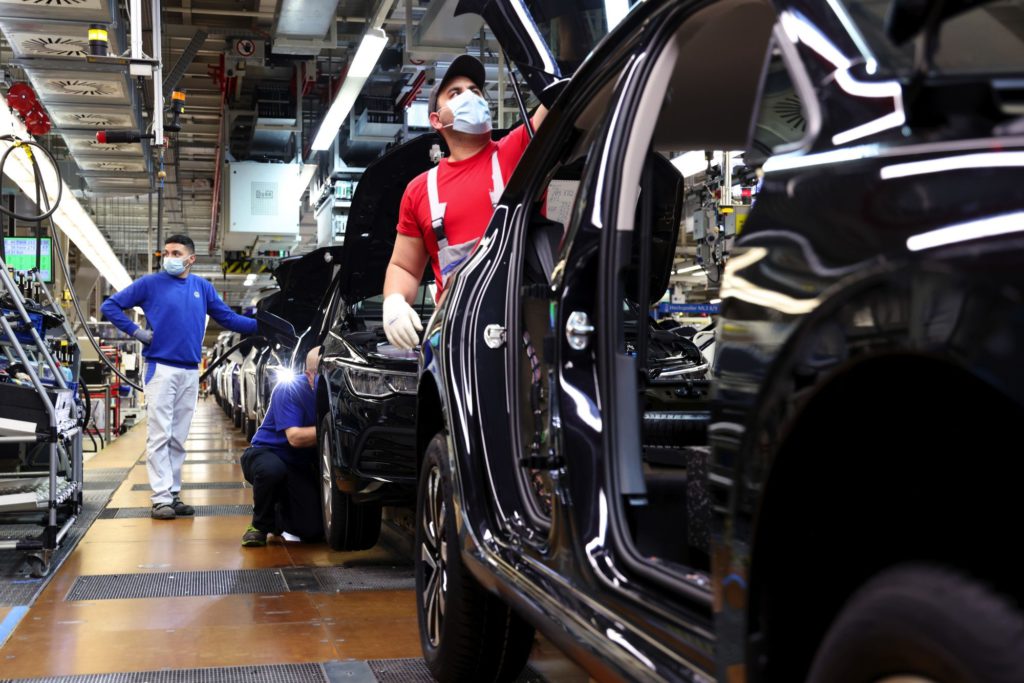
(Bloomberg) — Volkswagen AG is overhauling its main factory in Germany to make two additional battery cars as Europe’s biggest automaker tries to get its electric shift back on track.

VW will assemble a revamped version of the ID.3 hatchback at its Wolfsburg site starting next year and a new electric sport utility vehicle sometime after late 2025. The decision to make two more battery-powered models at the facility casts doubt over an earlier plan for a new €2 billion EV plant nearby.

“We intend to bolster the competitiveness of this factory further and give the workforce a concrete long-term perspective,” Thomas Schaefer, who heads the company’s main VW brand, said in a statement on Wednesday.

Chief Executive Officer Oliver Blume is under pressure to turn around VW’s EV push, which has been plagued by internal discord and software fumbles that delayed the launch of key Audi and Porsche models. Blume has been reevaluating some of the strategies set out by his predecessor Herbert Diess, who pushed for projects at an ambitious speed and brushed over internal in-fighting in a bid to catch up with Tesla Inc.

Fixing the software issues is among Blume’s most pressing tasks since he took over in September. The CEO plans to push back the key Trinity electric-car project by at least two years because of software delays, Bloomberg reported last month. It remains unclear if VW will go through with plans to build the new EV factory in Wolfsburg, for which construction was due to start next year. VW is spending €460 million by early 2025 to retool its existing plant in the city.

The Trinity project “will get underway in line with staggered software development,” VW said in the statement. “A decision on where the vehicle will be built in Wolfsburg has not yet been taken.”

The developments are a sobering reminder that the industry is in the midst of a challenging transition. VW, BMW AG and Mercedes-Benz AG are pouring more than €100 billion into scaling up an entirely new infrastructure of assembly platforms, battery plants and software to deliver a new generation of EVs. The hope is that these will lead on driving range as well as digital offerings.

Blume plans to present a status update on his plans for a more realistic software rollout to the supervisory board on Dec. 15, people familiar with the deliberations said. The speed with which VW’s Cariad unit can develop different software platforms will determine which EVs can be built in which factories, the people said, asking not to be named because the discussions are private.

“Volkswagen’s bureaucracy and complexity is clearly a big obstacle for good execution,” said Patrick Hummel, an analyst at UBS. “They need to revisit what is realistic for them — otherwise your going with an overconfident strategy in a high-risk, highly uncertain time.”

(Updates with executive quote in third paragraph.)

More stories like this are available on bloomberg.com

©2022 Bloomberg L.P.
Exposure to White Supremacist Ideologies in Online Games Surged in 2022

(Bloomberg) — White-supremacist ideas gained significant exposure through online video games this year, particularly among adults, according to a new report from the Anti-Defamation League. 

One in five adults reported being confronted with White supremacist ideologies, more than double the rate a year earlier. At the same time, 15% of teen and pre-teen gamers surveyed said they interacted with people who “believe that White people are superior to people of other races and that white people should be in charge,” according to the report.

Gamers heard White-supremacist views most often in Activision Blizzard Inc.’s Call of Duty, Take-Two Interactive Software Inc.’s Grand Theft Auto, Riot Games’Valorant and Epic Games Inc.’s Fortnite. 

“Gaming companies aren’t doing very much” to stop it, said Daniel Kelley, director of strategy and operations at the ADL’s Center for Technology & Society, noting that Roblox Corp. is the only “major gaming company that has an explicit anti-extremism policy.” Released Wednesday, the ADL surveyed 2,134 Americans who play video games.

When reached for comment on the ADL report, Epic Games referred to its community guidelines, which prohibit discrimination and harassment. Activision Blizzard spokesperson Joe Christinat also referenced Call of Duty’s code of conduct, which prohibits harassment and discrimination. “Our games are designed for joy and connection,” Christinat said. “There is no room for hate. We strongly support the important work of the ADL and have appreciated our collaboration. We look forward to deepening our work with them and others to eliminate hate together.” 

A spokesperson for Riot Games said “creating a safe and inclusive environment for all players is core to our mission,” adding that the company is taking “active measures to prevent and combat any such behavior in our games. That said, we know this is a space where the work is never finished, so we’ll continue to be vigilant in making gaming a positive experience for everyone.” The spokesperson noted the company has several policies and technologies to fight discrimination and harassment. 

Take-Two didn’t immediately respond to a request for comment.

Critics and researchers are increasingly scrutinizing the role online games play in catalyzing hateful ideologies. Several terrorists behind deadly mass shootings have referenced their affinity for online gaming, including the accused attacker behind 10 deaths in Buffalo earlier this year. Billions of people across the world play video games and research is lacking on whether exposure to White supremacist beliefs is more prevalent in online games than elsewhere on the internet.

“White supremacists and extremists are pushing their ideas into the mainstream across society, including online games,” said Jonathan Greenblatt, ADL chief executive officer, in a statement. “We know that what starts online doesn’t always end online — It can have deadly consequences in our communities. Online gaming companies have the ability to better moderate their content but most have fully abdicated any responsibility to protect users and their communities.”

Researchers complain it’s more challenging to analyze connections between online video games and White-supremacist ideology due to gaming companies’ reluctance to release data on the topic. Kelley said gaming companies don’t have a standard way to measure the frequency and spread of extremist activities. “We may need to explore a legislative fix where game companies provide information,” that could be compared with social media platforms, he said in an interview.

In September, the Department of Homeland Security awarded a $700,000 grant to the Middlebury Institute’s Center on Terrorism, Extremism, and Counterterrorism to study whether extremists are exploiting online spaces to radicalize gamers — a notion that hasn’t been proven on a large scale. Decades of research has debunked the idea that violent video games inspire violent behavior. 

The ADL’s survey also noted that 86% adults and three out of five teens and pre-teens had been harassed in an online multiplayer game in 2022. In 2019, 65% of adult online multiplayer gamers had experienced “severe harassment,” while in 2022, that number is 77%, according to the report. 

(Updates with response from Riot Games in sixth paragraph)

More stories like this are available on bloomberg.com

©2022 Bloomberg L.P.

JPMorgan Backs Startup That Wants to Fix Copper Shortage

(Bloomberg) — JPMorgan Chase & Co. is backing a startup that aims to close the looming global supply gap for copper, the metal that’s critical for the clean-energy economy.

MineSense Technologies Ltd raised $42 million in an investment round led by JP Morgan Asset Management’s sustainable growth equity team, according to a statement Wednesday. The privately-held company uses a combination of software and hardware to help mining firms more precisely and quickly measure ore, which increases production and reduces waste. The funds will be used to increase the commercial deployment of MineSense’s product.

The Vancouver-based company’s technology has boosted output at existing mines by 5% to 25%, according to the statement. The company has bigger ambitions, aiming to fill up to 10% of the global copper supply gap, according to MineSense Chief Executive Officer Jeff More.

A historic deficit is looming for copper, the metal that’s used in electric vehicles and power grids, amid an increase in government and corporate climate pledges and a lack of existing supply. The world is set for a shortage of as much as 10 million metric tons of copper in 2035, according to an industry-funded study from S&P Global.

Read More: Copper’s massive supply shortfall 

The Vancouver-based startup has already deployed its technology in major copper mines, including Chile’s Collahuasi, one of the world’s largest copper mines that’s jointly owned by Anglo American Plc, Glencore Plc and Mitsui & Co. They also operate in the Antamina mine in Peru, which is jointly owned by Teck Resources Ltd., BHP Group Ltd., Glencore and Mitsubishi Corp.

More stories like this are available on bloomberg.com

©2022 Bloomberg L.P.
Nigeria Caps ATM Cash Withdrawals at $45 Daily to Push Digital Payments

(Bloomberg) — Nigeria’s central bank slashed the daily withdrawal limit from automatic teller machines in a bid to boost digital payments in Africa’s most-populous nation. 

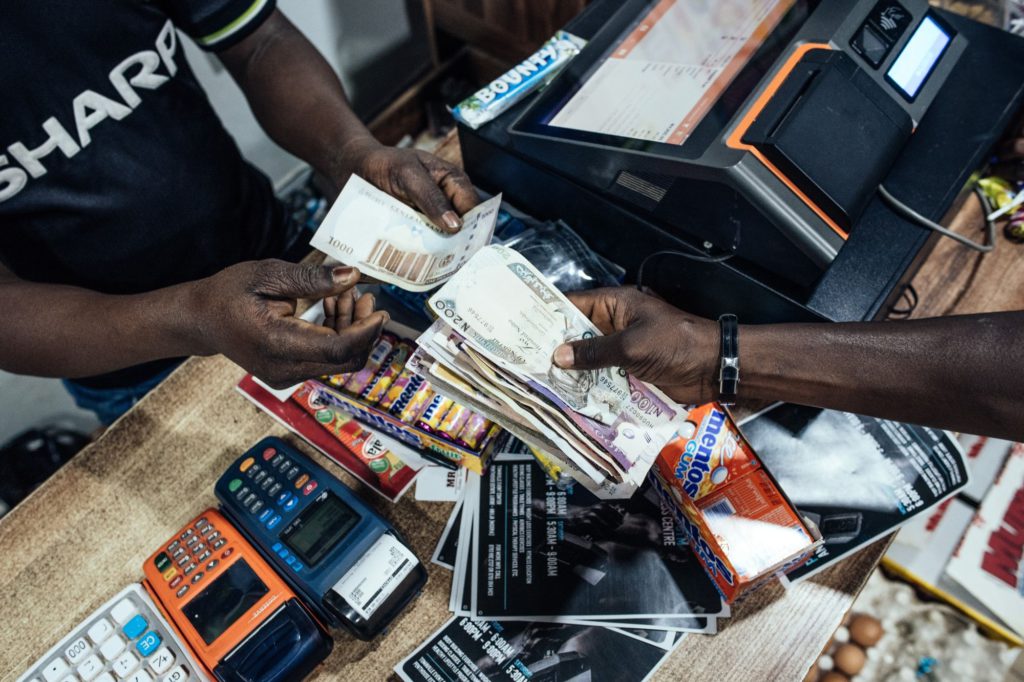
The Central Bank of Nigeria capped the maximum customer withdrawal at 20,000 naira ($44.97) a day, down from the previous limit of 150,000 naira, according to a circular sent to lenders on Tuesday. Weekly cash withdrawals from banks are restricted to 100,000 naira for individuals and 500,000 naira for corporations, and any amount above that limit will attract a fee of 5% and 10%, respectively, the central bank said.

The action is the latest in a string of central bank orders aimed at limiting the use of cash and expand digital currencies to help improve access to banking. In Nigeria’s largely informal economy, cash outside banks represents 85% of currency in circulation and almost 40 million adults are without a bank account. 

The central bank last month announced plans to issue redesigned high value notes from mid-December to mop up excess cash and it’s given residents until the end of January to turn in their old notes. The bank also plans to mint more of the eNaira digital currency, which was launched last year but has faced slow adoption.

In rules that take effect on Jan. 9, the Abuja-based bank banned the cashing of checks above 50,000 naira over-the-counter and set a limit of 10 million naira on checks cleared through the banking system. Cash withdrawals from point-of-sale terminals have been capped at 20,000 naira daily. 

Banks can only load their ATMs with 200 naira denominations and below while individuals and corporates can cash a maximum of 5 million naira and 10 million naira in  “compelling circumstances not exceeding once a month,” and subject to due diligence on the transaction and the payment of processing fees, the central bank said. A written approval of a bank’s CEO is also required to make such a withdrawal.   

“Customers should be encouraged to use alternative channels—Internet banking, mobile banking apps, USSD, cards, POS, eNaira to conduct their banking transactions,” the central bank said on Tuesday.

(Updates with exceptions to the withdrawal limits in penultimate paragraph)

More stories like this are available on bloomberg.com

©2022 Bloomberg L.P.
Vodafone’s Top Shareholder Rules Out Bid After Raising Stake

(Bloomberg) — Vodafone Group Plc’s largest shareholder boosted its stake in the telecommunications giant, but said it doesn’t intend to make an offer for the British firm that’s lost a quarter of its value so far this year. 

Abu Dhabi’s Emirates Telecommunications Group Co., also known as Etisalat, said it now owns 11% of Vodafone, up from 10% earlier. It will be restricted from submitting a bid for the rest of Vodafone for six months under the UK Takeover Code.

Bloomberg reported on Thursday that the Abu Dhabi phone operator is studying the feasibility of an offer for part or all of Vodafone’s stake in Johannesburg-listed Vodacom Group.

Shares in Vodafone pared losses of as much as 3.3% and were trading 3.4% up at 91.47 pence in London on Wednesday. The stock has lost a third of its value since May, when the Middle Eastern firm snapped up a 9.8% stake for $4.4 billion at about 130 pence a share.

Vodafone’s share price has underperformed the rest of the industry this year, even as the sector lost value as a whole, falling more than the Stoxx Europe 600 Telecommunications Price Index.

Read More: Vodafone CEO Nick Read Ousted After 44% Collapse in Shares

More stories like this are available on bloomberg.com

©2022 Bloomberg L.P.
Venture Capital Deals Set for Worst Drop in Over Two Decades

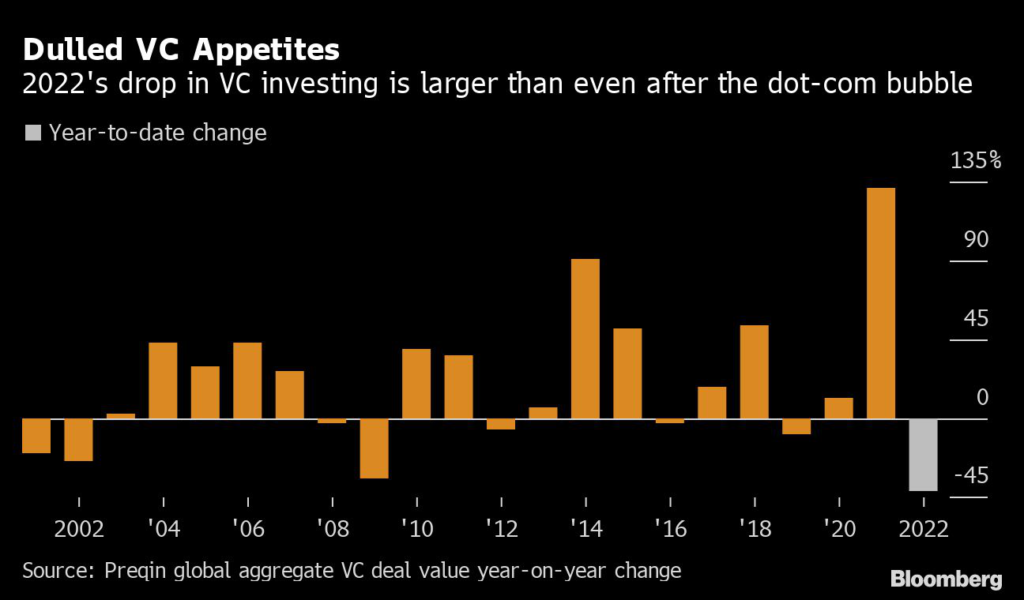
(Bloomberg) — Venture capital investments are on track for the sharpest drop in more than two decades this year, surpassing the declines of the dot-com crash and the financial crisis amid rising interest rates, macroeconomic uncertainties and a public market downturn. 

The value of new VC deals globally is down 42% in the first 11 months of this year compared to last, to $286 billion, according to research firm Preqin. That’s the deepest slump the researchers have recorded yet, surpassing the nadirs of the early 2000s and the 34% collapse after the 2008 financial crisis.

Venture capitalists, who ratcheted up spending over the last decade, are pulling back after rising interest rates put a premium on capital and challenged the tech industry’s growth-at-all-costs mindset. Deal activity dropped sharply in the two biggest venture markets, with declines in aggregate deal value of 50% in China and 45% in the US so far this year. 

“The tides are changing,” said Evan Thorpe, principal at SixThirty Ventures, a US firm that invests globally in early-stage startups. “We’re seeing a big comedown from the peaks of last year.”

Several of the biggest startup backers have retreated after high-profile troubles at their portfolio companies. Sequoia Capital, one of the giants of Silicon Valley, plunged into crypto this year with a new $600 million fund — only to see the effort backfire with the blowup of the FTX exchange. The firm wrote off the full value of its investment in FTX, as did SoftBank Group Corp. and Tiger Global Management, the two most aggressive supporters of new technology in recent years. 

Read more: ‘The Reset Has Arrived’ for the Technology Industry, VCs Warn

Another factor is a mismatch in expectations. Venture firms are unwilling to invest at the lofty valuations of years past after a correction in public markets, while many founders are holding out for better terms.

“There’s a pricing gap between buyers and sellers,” Yan Guo, principal at global alternatives investor LGT Capital Partners, said on a recent panel. “Many private companies are still held at 2021 valuations, while public comparables have corrected significantly this year. As a result, buyers would require a steeper discount, but many sellers are not ready to embrace this reality.”

The US has tried to tame rising inflation through a series of interest-rate hikes this year that have rapidly cut the easy funding of recent times. Startups around the world are being asked to show a clear path to profitability, in many cases sooner than they had previously planned for.

“The market is de-risking overall,” said David Chang, founding partner of Hong Kong-based Mindworks Capital. As interest in volatile sectors like crypto and blank-check companies has dried up, limited partners at VC outfits are looking for surer bets. “Most LP and capital are on the sideline and waiting for signals for any correction.”

China’s venture landscape has been disrupted by a multiyear regulatory crackdown on the tech sector and severe lockdown measures to limit the spread of Covid-19. Abrupt restrictions on movement in and around big cities have hampered regular economic activity and business across industries in the country. China-focused fundraising dropped by 81% this year, according to Preqin.

Venture capitalists tend to be optimistic about the long-term, however. This downturn is sure to be temporary and may end up benefiting the tech ecosystem by ushering in more realistic expectations, said Edith Yeung, partner at Race Capital. 

“The worst time could be the best time to invest in tech,” she said. “I am bullish on overall early-stage tech startups and technology advancement.”

More stories like this are available on bloomberg.com

©2022 Bloomberg L.P.
Etisalat Weighs Investment in Vodafone’s African Business

(Bloomberg) — Emirates Telecommunications Group Co. is exploring a potential investment in Vodafone Plc’s African business as it seeks to boost its international footprint, people familiar with the matter said. 

The Abu Dhabi carrier is studying the feasibility of an offer for part or all of Vodafone’s stake in Johannesburg-listed Vodacom Group Ltd., the people said, asking not to be identified because the information is private. 

Vodafone owns roughly 60% of the company. Shares of Vodacom jumped 7.1% as of 1:38 p.m. Wednesday in South Africa, on track for the biggest daily gain since March 2020, giving it a market value of about $14.4 billion. Vodafone shares pared earlier losses and were down 0.1% in London. 

Etisalat is also weighing the possibility of combining some of its own African operations with Vodacom or buying Vodacom assets in specific countries, the people said. It’s in the early stages of weighing which path to pursue, and could also consider other forms of cooperation, according to the people.

Any tie-up would bring together the biggest Middle Eastern telecom operator with the second-biggest African carrier by market value. Vodafone has been steadily consolidating its interests on the continent under Vodacom, which provides telecom services in countries including South Africa, Tanzania and the Democratic Republic of Congo. 

Etisalat became Vodafone’s largest shareholder earlier this year and is keen to leverage this position as it plots an expansion of its own business in Africa, according to the people. 

Deliberations are ongoing and there’s no certainty they’ll lead to any transactions. A spokesperson for Etisalat said the group is scanning the market for opportunities in line with its strategy to grow in part through acquisitions, though there is “no such project in progress at the moment.” 

Representatives for Vodafone and Vodacom declined to comment. 

Etisalat disclosed in May that it had spent $4.4 billion for a 9.8% stake in Vodafone. It announced Wednesday it had it increased its holding to 11%. The Middle Eastern company is the controlling shareholder of North African carrier Maroc Telecom, which has a market value of about $9.5 billion in Casablanca. 

Telecom companies in the Middle East have been stepping up dealmaking this year. Etisalat has been working to boost its shareholding in Saudi Arabia’s Mobily, while Qatar’s Ooredoo QPSC is working on a sale of its network towers and is also considering carving out its data center unit.

What Bloomberg Intelligence says:

Etisalat’s possible acquisition of Vodafone’s 60% stake in African carrier Vodacom (reported by Bloomberg News) may face many obstacles as the governments of Morocco, South Africa and Kenya — as well as regulatory and competition authorities — would need to sign off. An agreement could yield considerable synergies for Etisalat, with emerging-market telecom and mobile-money expertise adding value to its operations outside the UAE.

—John Davies, BI telecoms analyst

Vodacom Deal a Good Fit for Etisalat But May Face Hurdles: React


–With assistance from Ruth David and Abeer Abu Omar.

(Updates with share move in third paragraph.)

More stories like this are available on bloomberg.com

©2022 Bloomberg L.P.

Close Bitnami banner
Bitnami
