Bloomberg

Vodafone and Three UK Battle Roadblocks to Mobile Tie-Up

(Bloomberg) — Vodafone Group Plc and Three UK are battling to overcome a raft of regulatory and political hurdles threatening to derail efforts to create Britain’s largest mobile operator, people familiar with the matter said.

Discussions between Vodafone and Three’s owner CK Hutchison Holdings Ltd. have been delayed in recent weeks by considerations about the integration and impact of their proposed tie-up, the people said, asking not to be identified discussing confidential information. Things have been further complicated by news that Vodafone’s Chief Executive Officer Nick Read will stand down at the end of the year, they added. 

High on the agenda has been the potential response of competition watchdogs to any move that would see a smaller rival taken out of the market, according to the people. 

Vodafone and CK Hutchison are keen to head off antitrust concerns that fewer network providers would mean less pressure to reduce prices, at a time when double-digit inflation is squeezing British consumers. They want to show any merger would boost rural 5G rollout in the UK, the people said.

Shares of Vodafone fell for a fifth day on Wednesday, dropping as much as 3.3% to hit the lowest intraday level since September 1997.

Representatives for CK Hutchison and Vodafone declined to comment.

Vodafone and CK Hutchison confirmed they were in discussions about merging their UK businesses in October. Under proposed terms disclosed at the time, Vodafone would own 51% of the new venture, with the rest held by Hong Kong-based CK Hutchison.

While CK Hutchison has operated Three in Britain for almost 20 years, the companies have also become sensitive to China’s increasing influence in Hong Kong and whether this could stir UK political intrigue in a deal, the people said. In 2020, the UK banned the installation of 5G equipment from China’s Huawei Technologies Co. and last month blocked a Chinese-owned firm’s takeover of a semiconductor wafer factory in Wales under new stronger takeover rules.

Vodafone and CK Hutchison are eager to pitch the fact that CK Hutchison has operated other important UK infrastructure, including ports and power networks, for years without issue as a way of assuaging any concerns among British policymakers, according to the people. 

Pressure to find resolutions to these issues is only likely to grow following the departure of Read, with one influential Vodafone shareholder already signaling he wants to see the carrier streamline its operations. On Monday, Telecom tycoon Xavier Niel said he was ready to advise the Vodafone board to sell off business and create a leaner operation. Niel’s investment vehicle Atlas Investissement revealed a 2.5% stake in Vodafone in September.

During his time in charge, Read struggled to finalize deals that would have reduced the number of players in Vodafone’s key markets in the UK, Italy and Spain. He will exit the company after failing to halt a years-long slide in its share price.

–With assistance from Dinesh Nair.

(Updates with share move in fifth paragraph.)

More stories like this are available on bloomberg.com

©2022 Bloomberg L.P.

Tesla Starts EV Sale in Thailand in Challenge for Chinese Rivals

(Bloomberg) — Tesla Inc. opened bookings for its cars in Thailand on Wednesday, becoming the latest entrant into Southeast Asia’s largest market for passenger electric cars currently dominated by its Chinese rivals. 

The US automaker will start delivering its Model 3 and Model Y cars in the first quarter of next year, Yvonne Chan, Tesla’s country director for Thailand, told reporters at a launch event in Bangkok. 

Tesla will also open its first service center in Thailand in the first quarter of 2023 and its first super-charger facility will be functional by February. At least 10 more super charging sites will be opened in Bangkok next year, Chan said. 

Tesla’s foray into Thailand — its second in the region after Singapore — comes as competition is heating up with Chinese players such as Great Wall Motor, BYD and Hozon already battling for a share of the fast-growing EV market. 

READ: China Electric Carmakers Eye Detroit of Asia in Next Sales Push

The Model 3 is priced from 1.76 million baht ($50,200) and Model Y from 1.96 million baht, according to Chan. Dozens of prospective buyers flocked to Bangkok’s Siam Paragon shopping mall on Wednesday to inquire about prices and view the cars on display. 

“Buying a Tesla car means buying its ecosystem,” said Nonnalin Thugsoonthorn, a Bangkok-based investment strategist, who is looking to replace her combustion engine car with the Tesla Model 3. “I’m very happy with the price and the quality.” 

Tesla will compete with cars such as Great Wall Motor’s Ora Good Cat that’s priced from 763,000 baht and benefits from a slew of tax incentives offered by Thai government to promote electric vehicles. 

Chan didn’t say if Tesla plans to set up a plant in Thailand, the region’s largest auto manufacturing hub. BYD, which started selling its first electric SUVs in Thailand last month, has chosen the country for its first overseas EV car plant. It is scheduled to begin manufacturing in 2024, mostly for exports to Southeast Asia and Europe. 

Thailand, a longstanding auto manufacturing powerhouse, has a comprehensive supply chain that feeds scores of factories, mainly owned by Japanese companies, producing internal combustion engine cars. But the Thai government has said it wants 30% of its total car output to be electric by 2030, and earlier this year allocated about 43 billion baht through 2025 to promote the use of EVs.

Tesla registered its Thai unit in April with a capital of 253 million baht, according to the nation’s commerce ministry. It has also advertised more than a dozen jobs for its operations. 

More stories like this are available on bloomberg.com

©2022 Bloomberg L.P.

Big ESG Funds Are Doing Worse Than the S&P 500

(Bloomberg) — Funds linked to environmental, social and governance principles are by definition supposed to minimize risks tied to those three factors. In 2022, the approach did little to help protect investors from the brutal slide in the financial markets.

The 10 largest ESG funds by assets have all posted double-digit losses, with eight of them falling even more than the S&P 500’s 14.8% decline. The laggards include BlackRock Inc.’s $20.7 billion iShares ESG Aware MSCI USA exchange-traded fund (ESGU) and Vanguard Group’s $5.9 billion ESG US Stock ETF (ESGV).

The $6 billion Brown Advisory Sustainable Growth Fund (BAFWX) was the worst performer of the bunch, having slumped 28.1% this year as of the close of business on Dec. 5. The fund had more than two-fifths of its assets in software, semiconductor and internet stocks as recently as the end of October. The once high-flying technology sector has been particularly hard hit this year amid rising interest rates, inflationary concerns and the possibility of a US recession.

It’s been a “bad year for growth stocks” and the Brown Advisory fund is the most “growth-oriented” of the 10 funds on the list, said Jon Hale, director of sustainability research for the Americas at Morningstar Inc. The Parnassus Core Equity, Pioneer and TIAA Social Choice Equity are more “value” focused, seeking shares that trade at low levels relative to earnings and other financial metrics. As a result, this group reported slightly smaller losses, he said.

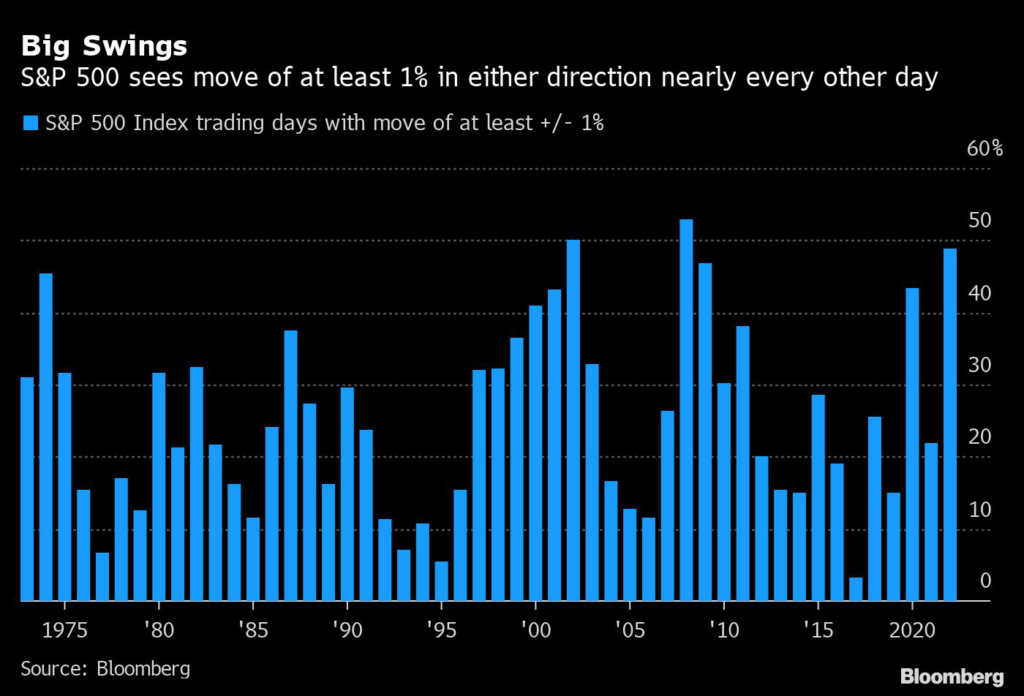
The fund declines are occurring during the most turbulent period for the S&P 500 since the global financial crisis of 2008. The US index has posted a move of at least 1%—both up and down—on almost half of trading days since the start of the year.

While few of the biggest funds measure their performance against the S&P 500, the index is the most widely followed stock benchmark in the US. Of the 10 largest ESG funds by assets, just one is a fixed-income fund, according to data compiled by Morningstar Direct. The $5.9 billion TIAA-CREF Core Impact Bond Fund (TSBIX) has dropped 13% this year, less than the equity funds.

The performance of the 10 largest funds compares with the average 12% decline of ESG-labeled stock funds with more than $500 million of assets so far in 2022, according to data compiled by Bloomberg.

Despite the losses, a paper released this month by the National Bureau of Economic Research said that investors are willing to be charged “higher fees for ESG-oriented index funds in exchange for their financial and non-financial benefits.”

The Harvard Business School professors who helped write the study entitled How Do Investors Value ESG found that investors will—on average—pay 20 basis points more a year for funds with an ESG mandate as opposed to funds without an ESG mandate.

“When we incorporate the possibility that investors are willing to accept lower financial returns in exchange for the psychic and societal benefits of ESG, we find that the implicit value that investors place on ESG stocks is higher still,” the authors wrote.

For ESG optimists, the NBER report helps explain why money keeps rolling into ESG funds despite the bad performance. This year, a net $44 billion has gone into ESG-labeled ETFs, Bloomberg data show.

Whether that trend continues almost definitely depends on how much patience investors have if losses keep mounting.

Bloomberg Green publishes Good Business every week, providing unique insights on ESG and climate-conscious investing.

More stories like this are available on bloomberg.com

©2022 Bloomberg L.P.

Uber Rolls Out Robotaxis Even as Self-Driving Car Hype Wanes

(Bloomberg) — Uber Technologies Inc. is launching its first robotaxi service, reaffirming the company’s commitment for a self-driving taxi fleet even as the hype around autonomous vehicles fades. 

The San Francisco-based company is partnering with Motional, which is an autonomous driving joint venture between Hyundai Motor Co. and Aptiv Plc, to allow customers to hail self-driving rides in Las Vegas, the companies said in a statement Wednesday. The launch is part of a 10-year deal that will pair Motional’s all-electric IONIQ 5 robotaxis with Uber’s ride-hailing and delivery platform. The partnership began testing driverless food deliveries on Uber Eats in Santa Monica, California in May. 

People in Las Vegas can be paired with a Motional autonomous vehicle through the Uber app when they hail a ride. If an AV is available to complete the trip, Uber will match the rider to the vehicle and the person will have an opportunity to opt-in before the trip is confirmed and dispatched to pick them up. The robotaxi project will expand eventually to Los Angeles, the companies said.

“Motional has proven themselves to be an industry leader, steadily and safely progressing autonomous technology towards a driverless future,” Noah Zych, global head of autonomous mobility and delivery at Uber, said in the statement. 

Uber sold its autonomous vehicle division two years ago and the latest partnership signifies the company is forging ahead even as others scale back. Ford Motor Co. and Volkswagen AG-backed Argo AI shut down in November and this week Apple Inc. scaled back self-driving plans for its future electric vehicle and postponed the car’s target launch date by about a year to 2026, Bloomberg reported.

Both Uber and Lyft Inc. have shifted their strategy for advancing self-driving cars in recent years amid increasing pressure to focus more on profitability and less on costly bets. By partnering with autonomous vehicle technology companies, the ride-hailing giants have kept a stake in the sector without having to bring the research and development in-house. Lyft also teamed up with Motional for a self-driving ride-hail service in Las Vegas in August.


More stories like this are available on bloomberg.com

©2022 Bloomberg L.P.

Thoma Bravo Raises $32.4 Billion for Three Tech-Focused Funds

(Bloomberg) — Thoma Bravo LLC raised $32.4 billion for three new tech-focused funds in one of the biggest hauls by a private-equity firm this year even as some rivals struggle to close out funding rounds.

The Chicago-based company’s latest fundraising was 42% higher than its previous efforts, which closed with $22.8 billion in 2020, according to Jennifer James, the firm’s chief operating officer and head of investor relations. 

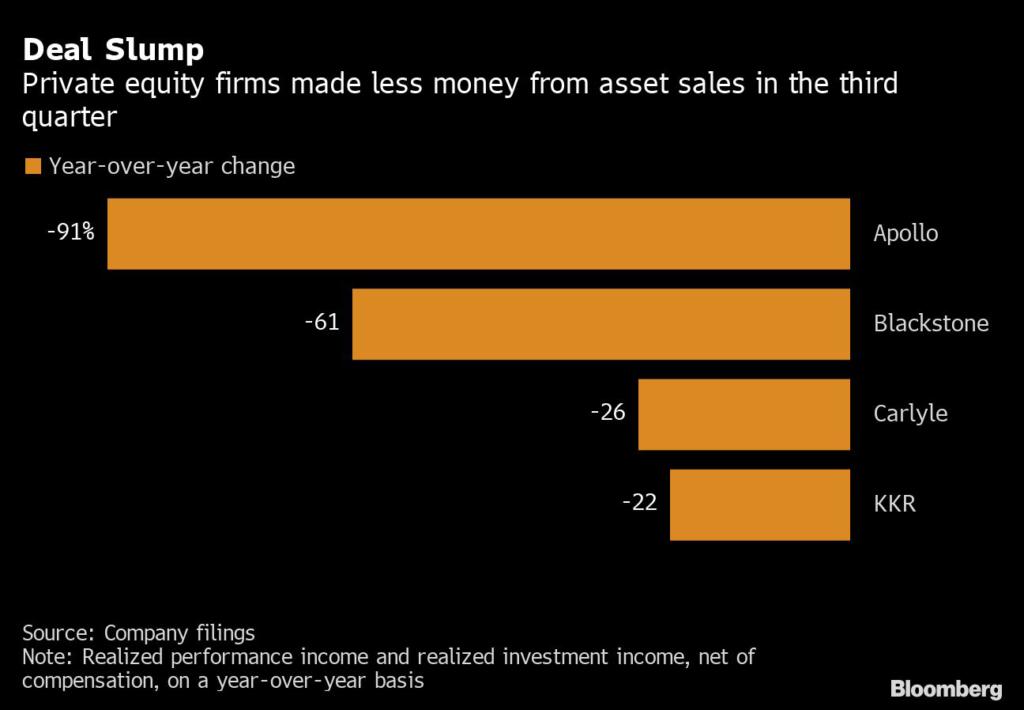
The massive fundraise comes amid one of the most challenging years for private-equity firms following several years of strong investor interest buoyed by market rallies and low interest rates. Apollo Global Management Inc. for instance has pushed back the timeline for its $25 billion fund and will continue collecting money into next year. 

Thoma Bravo collected $24.3 billion for its main buyout fund, known as the Thoma Bravo Fund XV, making the new vehicle 36% larger than its predecessor. The firm also raised $6.2 billion for the Thoma Bravo Discover Fund IV, which makes mid-market investments, and $1.8 billion for the Thoma Bravo Explore Fund II, which invests in the lower end of the market. 

The firm, which runs more than $120 billion in assets, took 10 months to raise the funds, and nearly all investors in predecessor funds committed capital to the new ones, according to James. 

The firm’s fundraising didn’t appear to be hampered by its investment in FTX Trading Ltd., the operator of crypto exchange FTX.com, which collapsed this month. Thoma Bravo declined to comment on the FTX investment, which saw the firm participate through its growth fund in a $900 million Series B fundraising in July last year.

Opportunities

The current market conditions, while challenging, provided Thoma Bravo an opportunity to buy software companies at better prices, James said. The software sector will continue to be resilient as more companies focus on digital transformation, she said.

“Software facilitates workflow automation, security, data management and more – thereby increasing productivity and making software an outperformer during inflationary times,” James said. 

Read More: Apollo, Carlyle See Buyout Fundraising Slow With Markets on Edge

Thoma Bravo also took advantage of the volatility in public markets that has pushed the tech-heavy Nasdaq index down almost 30% this year. It took private seven companies representing more than $26 billion in combined deal value this year, James said. These included digital identity company ForgeRock Inc.; Denver-based Ping Identity Holding Corp., and cybersecurity firm SailPoint Technologies Holdings Inc.

Deal making in private-equity is at its lowest in two years, though Thoma Bravo managed to exit several of its investments this year. Those included the sale of Barracuda Networks Inc., a cybersecurity service provider, to KKR & Co., and Kofax Ltd., a maker of automation software for digital workflow. The Thoma Bravo buyout funds distributed over $8 billion to its limited partners this year, James said. 

As of March 31, Thoma Bravo’s Fund XIV generated an internal rate of return of 1.8% since inception, according to documents from the Santa Barbara County Employees’ Retirement System. Its Fund XIII, which closed with $12.6 billion in 2019, generated an IRR of about 42% as of March 31, the documents showed.

The firm, with offices in Miami and San Francisco, was co-founded by Orlando Bravo and Carl Thoma.

More stories like this are available on bloomberg.com

©2022 Bloomberg L.P.

Saudis Roll Out Red Carpet for Xi Jinping as Gulf Looks Past US

(Bloomberg) — Two months after snubbing US President Joe Biden’s pleas for oil, Saudi Arabia is rolling out the red carpet for his Chinese counterpart, Xi Jinping.

Xi will visit Saudi Arabia for several days starting Wednesday, during which he will take part in a regional summit with Saudi Crown Prince Mohammed bin Salman and other Arab leaders, the kingdom’s SPA state news agency said, promising agreements worth some $30 billion.  Energy and infrastructure deals will top the agenda, according to two people briefed on the plans.

Xi is due in Riyadh on the same day China signaled a definitive shift away from its strict Covid Zero policy that had triggered recent protests. The summit allows the Chinese leader to look beyond domestic concerns while giving both Xi and Prince Mohammed a chance to showcase the Gulf’s deepening ties with Beijing, underlining just how far US-Saudi relations have sunk.

“This visit is the culmination or crowning of a deep strengthening in relations over the last few years,” said Ali Shihabi, a Saudi commentator and advisory board member for the kingdom’s Neom megaproject. “The US is concerned about this but cannot slow this already strong relationship down.” 

EXPLAINER: Understanding the Ups and Downs of US-Saudi Relations

The summit will be “a landmark in the history of Sino-Arab relations,” Chinese Foreign Ministry spokeswoman Mao Ning told a regular briefing in Beijing on Wednesday ahead of Xi’s trip, describing the meeting as a “strategic choice” to strengthen cooperation as the world enters “a new era of turbulence and change.”

US-Saudi ties have certainly run into turbulence lately, with a low point in October when Biden accused Riyadh of allying with Russia on oil production cuts, vowing “consequences.” However, relations have been fraying for some time as the US shifts its global focus to the competition with China.

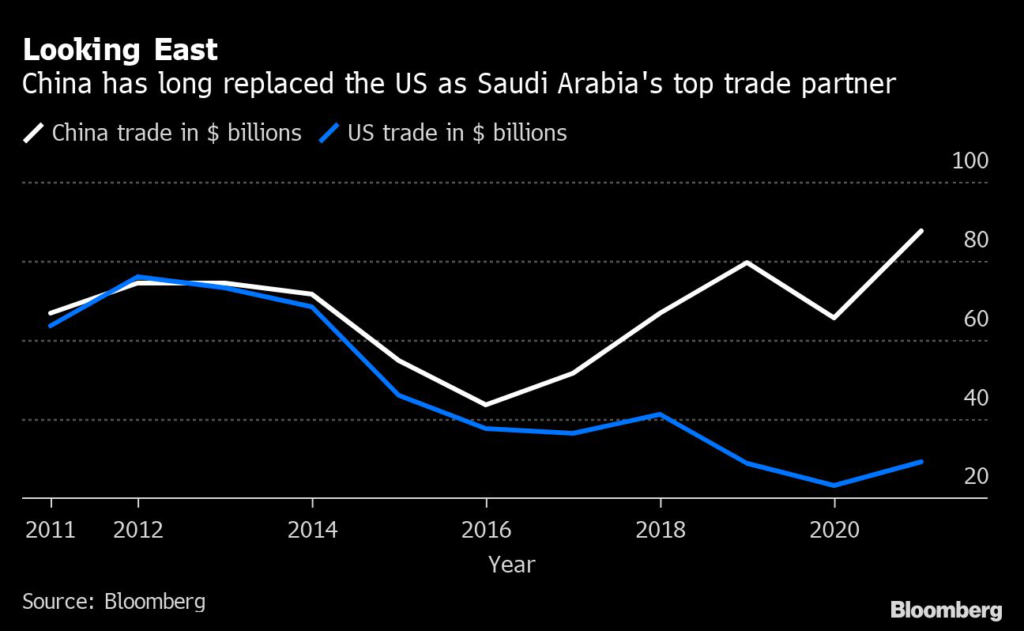
It’s a decade since the US was Riyadh’s biggest trading partner, and in that time not only has China leapfrogged America, but so too have India and Japan. Total US-Saudi trade shrank from some $76 billion in 2012 to $29 billion last year.

That’s in part because the US shale industry means it no longer imports much Middle East oil; China is Saudi Arabia’s top crude customer now —  and regional oil exporters will be keen for information on China’s plans for lifting Covid restrictions.

Read how China’s factories are struggling with the slow dismantling of Covid curbs

Yet Washington has also riled Saudis with its attempts — now all but dead — to return to the nuclear deal with Iran, a regional Saudi rival, while Riyadh’s powerful alliance with Russia and other oil exporters in OPEC+ is another point of friction.  

“For the Arab states, it’s about alternatives, in all possible ways”

“It’s high time we stopped seeing this as being purely about economic and commercial relations,” said Cinzia Bianco, a visiting fellow at the European Council on Foreign Relations, who focuses on the Gulf. “For the Arab states, it’s about alternatives, in all possible ways.”

Beijing has been picking up some of that economic and political slack.

In the past six months, Janes IntelTrak Belt & Road Monitor reported a surge of activity across the Middle East by US-blacklisted telecoms firm Huawei Technologies Co.; that State Grid Corporation of China was looking at investment opportunities in regional electricity transmission and distribution; and Saudi Arabia and China agreed to coordinate their investments in Belt and Road Initiative participating nations. The countries will sign pacts for the further “harmonization” of the Belt and Road Initiative with Saudi Arabia’s own Vision 2030 development plan, the SPA agency said. 

Talks on a free trade agreement between China and the six-nation Gulf Cooperation Council are entering a “final stage,” China’s ambassador to the United Arab Emirates Zhang Yiming said last month. He even mentioned a memorandum on moon exploration signed with the UAE.

Gulf states view the US as an increasingly unreliable partner and “want to capitalize on a new global multipolar landscape that presents fresh opportunities,” said Elham Fakhro, a research fellow at Exeter University’s Centre for Gulf Studies. In doing so, they might “strengthen their own bargaining power with the United States,” she said.

Still, the US maintains a significant troop presence in Saudi Arabia and across the region, and there are limits to how far Gulf states will look elsewhere.

It’s seen as unlikely, for example, that Saudi Arabia will move forward with the idea of accepting yuan payments instead of the dollar for oil, the two people briefed on the preparations said, referring to reports earlier this year. Diplomats and analysts said at the time the reports should be seen as a political message to the US, rather than the kingdom’s plans.

Whereas Donald Trump chose Riyadh for his first overseas trip as president, Biden came to office pledging that he’d treat the crown price as a pariah for his part in the murder of columnist Jamal Khashoggi.

But faced with high inflation going into the midterm elections, he swallowed his pride and visited the kingdom in July seeking help to lower global oil prices. 

He appeared to make some headway, expressing optimism Riyadh would take steps to comply — only for Saudi Arabia and OPEC+ to then announce production cuts. A furious Biden said it was time for the US to rethink the relationship.

Buoyed by higher oil revenues spurred by Russia’s war, the Saudi crown prince has cast the kingdom as a growing power capable of standing up to US pressure.

China has cheered on from the sidelines: Foreign Minister Wang Yi praised the kingdom’s “independent energy policy” and efforts to stabilize the international energy market after meeting with his Saudi counterpart in October. Wang also thanked Riyadh for “long-term and firm support” on matters including Taiwan, Xinjiang, Hong Kong and human rights — all touchstone issues for the US.

China Praises Saudi Arabia’s ‘Independent’ Energy Policy

“There’s a real synergy to the relationship,” said Jonathan Fulton, a nonresident senior fellow at the Atlantic Council focused on China’s relations with the Gulf. 

Whereas “the US keeps talking about a great power game” and focusing on counterterrorism, China has been helping address domestic concerns. The upshot is it’s less about China trying to replace the US than the two countries playing completely different games when it comes to the Middle East, he said.  

Since China held its last biennial dialog with Arab states in July 2020, Saudi Aramco revived discussions to build a multi-billion dollar refining and petrochemicals complex in China.

Saudi Arabia started working with Huawei to develop artificial intelligence systems and the kingdom’s using Chinese expertise to make its own drones. It’s even been reported to be manufacturing ballistic missiles with China’s help, according to a U.S. intelligence assessment.

It’s not all one way, though. High oil prices hurt China as well as the US, and Beijing nurtures close relations with Iran, a key Saudi rival. China cannot just replicate US military support for the region. 

The US isn’t asking countries to choose between Washington and Beijing but asking them to be “mindful” of the relationships they’re developing, Derek Chollet, a counselor at the US State Department, told a briefing in Kuwait ahead of Xi’s visit. 

“Our assessment is that China, in its efforts to build relations in this region, does not have an interest in building mutually beneficial partnerships,” he said. 

–With assistance from Jing Li, Alfred Cang, Matthew Martin and Fiona MacDonald.

(Adds China Covid Zero policy shift, Foreign Ministry comments starting in third paragraph.)

More stories like this are available on bloomberg.com

©2022 Bloomberg L.P.

The Vanishing of Sam Bankman-Fried’s ‘Effective Altruism’ (Podcast)

(Bloomberg) — Listen to Bloomberg Crypto on the iHeartRadio App, Apple Podcasts or  Spotify.

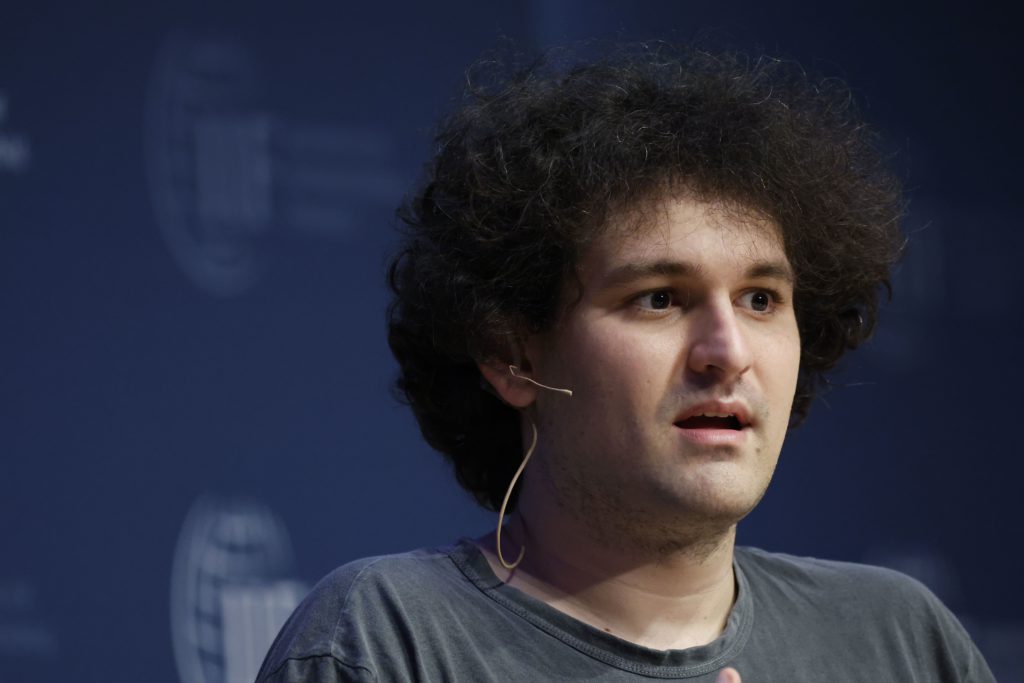
Sam Bankman-Fried used to say he was a man on a mission. That mission: giving away more than a billion dollars in the service of a movement known as “effective altruism”. Through personal giving, and through a philanthropic unit called the FTX Foundation, Bankman-Fried appeared to support causes ranging from pandemic prevention to research into climate change.Fast forward a bit, and that message of “using wealth to empower people and projects that are doing the most to make positive, long-lasting change” — a marketing line from the FTX Foundation — now rings hollow. 

Bloomberg reporters Sophie Alexander and Laura Davison join this episode with the backstory on SBF and effective altruism.

Subscribe to the Bloomberg Crypto Newsletter at https://bloom.bg/cryptonewsletter 

This podcast is produced by the Bloomberg Crypto Podcast team: Supervising producer: Vicki Vergolina, Senior Producer: Janet Babin, Producers: Sharon Beriro and Muhammad Farouk, Associate Producers: Mo Andam and Ty Butler. Sound Design/Engineer:  Desta Wondirad.

More stories like this are available on bloomberg.com

©2022 Bloomberg L.P.
Top Xiaomi India Executive Resigns Just as Challenges Mount

(Bloomberg) — One of Xiaomi Corp.’s top executives in India is leaving the smartphone maker just as it faces intensifying regulatory scrutiny and competitive pressure in the country.

Chief Business Officer Raghu Reddy, who helped the Chinese company to the top of India’s smartphone and smart-television markets, resigned to “pursue different growth opportunities externally,” Xiaomi India said in an email on Wednesday. “It has been a privilege to have Raghu as an integral part of the Xiaomi India leadership team,” it said.

Reddy, who is currently serving notice, didn’t respond to a WhatsApp message seeking comment.

Xiaomi is among Chinese companies targeted by India’s government amid continued hostility between the two nuclear-armed neighbors since 2020 when the deadliest fighting in decades erupted along a disputed Himalayan border site. Indian authorities have accused Xiaomi of illegally remitting money overseas, allegations it has denied saying the transfers are royalty payments.

Meanwhile, Prime Minister Narendra Modi’s administration has asked smartphone makers, including the Chinese companies, to export more from India and build local supply chains. But an Indian state agency’s recent holdup of some 27,000 phones set to be exported by Xiaomi’s rival Vivo is likely to unnerve Chinese brands.

Before his most recent role, Reddy headed online sales at Xiaomi and helped the brand become a hit on India’s e-commerce websites. Previously, he worked for SoftBank Group Corp.-backed Indian online retailer Snapdeal Ltd.

More stories like this are available on bloomberg.com

©2022 Bloomberg L.P.

China Eases Curbs in Major Shift From Covid Zero Policy

(Bloomberg) — China moved definitively away from its long-held Covid Zero approach Wednesday, easing a range of restrictions that it has persisted with way after the rest of the world moved on to living with the virus. 

By jettisoning key tenets of the virus elimination strategy, including forcing infected people into centralized quarantine camps, China is suddenly shifting gear faster than expected. The accelerated pace reflects pressure on President Xi Jinping to chart a path out of the crisis and quell public discontent. 

These Are the 10 New Covid Rules China Will Follow on Path to Reopening

Less than a month after starting the reopening process by issuing 20 guidelines to local officials to minimize disruption from looser rules, the National Health Commission set out 10 new measures to assist the move away from Covid Zero. Markets appeared to be taken aback by how far-reaching the steps were, despite a buildup in expectations in recent weeks. An initial rally fizzled as some investors worried about a spike in infections and chaos that might ensue.

Top health officials sought to project confidence at a briefing in Beijing after the announcement, insisting that China’s Covid Zero adherence had limited loss of life, and that conditions were now appropriate to move on. 

Liang Wannian, an epidemiologist turned health official who led China’s initial pandemic response, said the adjustment was “proactive, rather than reactive” and that it would “ensure resources are utilized more efficiently and better coordinate outbreak control and economic development.” 

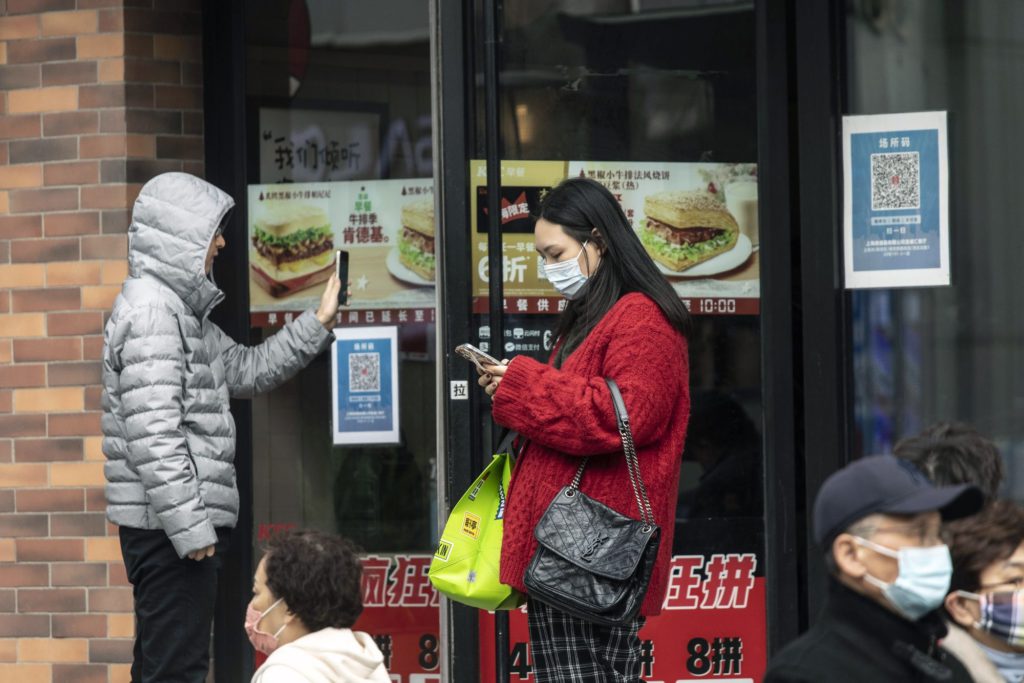
The latest steps include accelerating vaccination among the elderly and stopping local officials from designating large areas as high risk, which had led to lockdown-like curbs in entire housing compounds and other places. A green health code on contact-tracing smartphone apps is no longer needed for domestic travel or to enter most venues. Bloomberg News reported earlier that changes were imminent.

A nationwide expansion of the home isolation rule, already allowed in Beijing after quarantine facilities ran out of space, could shift public perception of the virus from a serious health threat to a more commonplace illness. The government championed its Covid Zero approach throughout the pandemic, involving widespread testing and lockdowns to wipe out infections. But it left China isolated and caused misery and economic hardship. 

The three-year adherence to Covid Zero has hit economic activity, pushing down consumer and business confidence and leaving people stuck in a cycle of outbreaks and lockdowns. Tragic incidents blamed on Covid controls, including a deadly fire in Xinjiang, intensified public anger. 

With an eye on recovery, senior officials are debating an economic growth target of around 5% in 2023.

The Politburo said it will use “targeted and forceful” monetary policy as it aims for “overall improvement” in the economy next year, according to a Wednesday readout of its most recent meeting. The phrase “Dynamic Zero Covid,” which it has used previously, didn’t appear.

Asymptomatic and mild cases will now be able to isolate at home, provided their residences meet certain conditions, which authorities didn’t specify. People can still go to centralized quarantine facilities if they prefer. Close contacts can either isolate at home or at government facilities, and they can finish quarantine five days after a negative PCR test. 

There was also a pledge to bolster vaccination rates among the elderly. Fewer than 50% of people aged 80 or above have received boosters and only about 60% have had full doses, raising concern that fatalities could surge and health-care services come under even greater pressure as the virus inevitably spreads.

Health officials shortened the list of medical exemptions for vaccinations to increase the take up. They also said Chinese vaccines have been widely used globally and at home, with over 1 billion doses administered, including to senior Communist Party officials. 

Yet China, where Covid-19 emerged about three years ago, is still is far behind the rest of the world in reopening. For example, anyone flying in from overseas must quarantine for five days in a hotel followed by three days at home, while mask-wearing is mandatory in most places. 

China to Gradually Optimize Policy on Inbound Covid Quarantine

Stocks initially reacted positively to the news Wednesday, including the country’s three main airlines, Air China Ltd., China Eastern Airlines Corp. and China Southern Airlines Co., which for a time all surged more than 10% in Hong Kong. The CSI 300 Index later erased its gains and a key gauge of Hong Kong-listed Chinese stocks also reversed course to slide 1.6%.

Expectations that China would loosen its Covid regime spurred the strongest monthly rally in Hong Kong-listed Chinese stocks in nearly two decades in November. 

State media had painted Covid as fearsome and Western countries’ acceptance of it as a moral failing. But as other places moved past the pandemic, a growing number of people started questioning why they were stuck with China’s approach, raising pressure on the authorities. Protests eventually spilled into streets in cities around the country, with some demonstrators calling for Xi to step down — incredibly rare scenes of public unrest in the world’s most populous nation.  

Covid cases nationwide surged to highs of nearly 40,000 a day at the end of November before declining — more as a result of dialed-back testing. While loosened rules will drive the numbers higher again, especially as cold weather intensifies, the government appears to consider the trade-off a necessary one. It remains to be seen how evenly the changes will be applied nationwide.

Authorities have urged grassroots medical institutions to help meet health-care demands so hospitals aren’t overwhelmed. Large hospitals have been asked to set aside special wards to treat vulnerable Covid patients, while the number of so-called fever clinics will be increased to identify cases. 

The 20 measures issued last month, including cutting quarantine times and discouraging arbitrary mass testing, were met with a muddled and chaotic rollout. A reversion to strict curbs in some cities fueled public discontent, with residents brandishing the new guidelines to stop neighborhood authorities from imposing lockdowns again. 

–With assistance from Lianting Tu, Fran Wang and Yujing Liu.

(Updates with more detail and comments from government briefing in Beijing.)

More stories like this are available on bloomberg.com

©2022 Bloomberg L.P.
UK Tones Down ‘Big Bang’ Finance Plan to Avoid Backlash

(Bloomberg) — The UK government will move away from talking about a “Big Bang 2” for the City of London, in part a recognition of the fact that changes will be gradual due to their complexity and opposition from critics.

Ministers are expected to stop using the phrase, a reference to dramatic reforms in the 1980s that made London a global financial center, according to a person familiar with the matter. The shift reflects a wish to build support among a broad range of stakeholders and to position growth in financial services as an opportunity for the wider country. 

There has also been a realization that the scope for speedy change is limited, several people involved in the discussions said. 

Andrew Griffith, the City Minister, will unveil a relatively muted package of post-Brexit reforms on Friday to boost the UK’s financial services industry. The changes include relaxing ring-fencing capital rules to lighten the burden on smaller banks. 

Jeremy Hunt, the chancellor, is also due to meet finance executives in Edinburgh to discuss opportunities for the sector. 

The government’s plans may include reversing the EU MiFID II ban on banks bundling the costs of company research with other fees, deregulation of trading rules to boost flexibility for investors and a watering down responsibilities for senior managers and firms over consumer protections, according to people who have been involved in the discussions.

They also said there may be a reference to corporate governance reforms to enhance London’s attractiveness for listings and investment by trying to improve relations between companies and their shareholders, reducing the influence of proxy voting agencies, and liberalizing guidance on non-executive pay. 

It’s a far-cry from the far-reaching changes mooted when Liz Truss was prime minister. Most of the reforms from that helter-skelter period have been shelved.

Risk Premium 

Griffith told an event at the Conservative Party conference this Autumn that he believes the principle of caveat emptor — buyer beware — should be restored in financial services to reduce the burden on firms and to encourage innovation. 

He also argued in a speech last week that there should be more “appropriate risk-taking” to generate opportunities and has written to UK regulators calling for greater transparency on their “operational effectiveness.”

However, the minister has run into opposition over his reforms, which he has been consulting on for weeks. He climbed down on a new intervention power over regulators after a high-profile campaign against it by the Bank of England. 

“There must be no race to the bottom on financial stability regulation and consumer protection,” Labour’s shadow city minister Tulip Siddiq said in a statement. “The global competitiveness of the UK’s financial services sector depends on our strong regulatory standards.”

Crypto reforms could be another flash point as there are concerns among MPs and consumer groups about the risk of more people losing money if they believe the sector is fully regulated, according to two of the people.

The Treasury Select Committee is holding an inquiry into crypto assets. “As crypto becomes more widespread there will be increasing concern about financial stability and consumer protection that will be difficult to ignore,” said Anthony Browne, a Conservative lawmaker on the committee. 

MiFID Rules

As the UK played a leading role in designing much of the EU’s financial services regulations, there are only limited areas to be changed, many in the City have argued. 

There is skepticism among some at the Financial Conduct Authority and Treasury that deregulating rules on analyst research fees will have the desired outcome of boosting reports written on smaller companies and so stir interest among investors, according to the people close to the discussions. 

There is also a view inside big banks that the consumer duty, now in place, should not be dismantled, they said. Some of the ambivalence among finance executives toward Griffith’s ideas is because they think they might be abandoned if the Labour Party wins the next general election. 

Griffith is also constrained by a wish to avoid further conflict with regulators, some officials inside the Treasury and critics within the Conservative Party, according to two of the people.

“We are committed to delivering ambitious reform of the UK financial services sector,” a Treasury spokesperson said.

–With assistance from Alex Wickham.

(Adds Labour Party response in 12th paragraph.)

More stories like this are available on bloomberg.com

©2022 Bloomberg L.P.
Close Bitnami banner
Bitnami