

Bloomberg

Faraday Future Delays Launch of Debut EV, Warns Cash Is Short

(Bloomberg) — Faraday Future Intelligent Electric Inc. is pushing back the start of production and deliveries of its long-awaited debut vehicle to the “third or fourth quarter of 2022,” and says it needs additional capital to pull off the launch.

The Los Angeles-based electric vehicle startup, which went public in a July 2021 merger with a blank-check company, had previously said it planned to launch the battery-powered SUV as soon as this month. 

Founded in 2014, Faraday Future once promised to start making and selling the so-called FF91 SUV as early as 2018, but it has been forced to postpone delivery of its first mass market vehicles several times.

“The company needs additional cash to commercially launch the FF 91, and is currently seeking to raise additional capital to fund its operations through December 31, 2022,” it said Monday in a filing. Faraday Future had previously said it wouldn’t need additional funds until after the launch of the vehicle.

The company said in an investor slide deck that it was looking to raise about $325 million.

Shares of the company traded up 3.5% to $2.38 as of 5:14 p.m. in New York after closing down 12%. The stock has fallen about 57% this year through Monday’s close.

The delay comes amid a standoff between the electric vehicle startup and its founder, Jia Yueting. In late June, a shareholder group affiliated with him demanded the removal of a director from the startup’s board.

Faraday pushed back, saying the group had offered the director a contract worth up to $700,000 in order for him to resign.

On July 15, those shareholders said in a filing that they had offered Faraday a lifeline of “at least $100 million” on the condition that the director resign. Several days later, the group accused the startup of not treating the offer “with the gravity, urgency and fairness it deserves in light of” its financial condition.

(Updates with additional details beginning in fourth paragraph)

More stories like this are available on bloomberg.com

©2022 Bloomberg L.P.

‘Nope’ Leads Box Office in Win for Director Jordan Peele

(Bloomberg) — Jordan Peele’s “Nope” led the North American box office this weekend, another feather in the cap for a writer-director known for weaving social commentary into his horror films.

  • The movie from Comcast Corp.’s Universal Pictures generated $44.4 million in US and Canadian ticket sales, Comscore Inc. said on Monday. That was below the $56 million that BoxOffice Pro had forecast and the studio’s projected $45 million to $50 million.
  • Walt Disney Co.’s “Thor: Love and Thunder,” and “Minions: The Rise of Gru,” also from Universal, finished in second and third place, respectively.

Key Insights

  • Horror films have been among the more dependable box-office draws during the pandemic because they attract a younger, male audience that has been more willing to venture out to theaters.
  • “Nope” is the latest in a string of pictures from Peele, whose work includes 2017’s “Get Out” and 2019’s “Us.” It focuses on a family of horse trainers coping with supernatural occurrences. The film, which had an 82% critical approval rating on Rotten Tomatoes, reunites Peele with actor Daniel Kaluuya, who also starred in “Get Out.”
  • Cinema attendance has rebounded this summer thanks to new releases from familiar franchises. The calendar is beginning to get a little light, however, with “DC League Of Super-Pets,” and “Bullet Train,” a thriller starring Brad Pitt, among the most promising films ahead.

Get More

  • See the schedule for new releases.
  • See Boxoffice Pro’s long-range forecast.

(Updates with final weekend totals.)

More stories like this are available on bloomberg.com

©2022 Bloomberg L.P.

Stock Trading Hits 2022 Low Before Fed, Earnings: Markets Wrap

(Bloomberg) — Stocks wavered in a choppy session as traders braced for earnings from technology bellwethers amid the threats of a hawkish Federal Reserve, scorching inflation and a looming economic recession.

Traders turned more cautious after last week’s rally, with the S&P 500 closing slightly higher amid the lowest intraday volatility and volume of the year. The Nasdaq 100 underperformed ahead of results from the likes of Apple Inc. and Google’s parent Alphabet Inc. In late trading, Walmart Inc. tumbled after cutting its profit outlook. Ten-year US yields halted a two-day plunge.

This week will be a “make-or-break” period for investors’ confidence in the power of Corporate America, said DataTrek Research’s Nicholas Colas. The economy is already feeling the pinch from repeated rate increases — with the Fed expected to deliver another jumbo hike Wednesday — and traders will get more clues on how much of that slowdown is reflected in earnings.

For now, investors are expecting mostly bad news from megacaps. Amazon.com Inc.’s revenue is seen growing at its slowest rate in decades. Chipmakers are lurching from boom times to a potential glut. Gig-economy companies such as Uber Technologies Inc. and DoorDash Inc. could be victims of consumer budget cutting. And the pullback in online advertising is set to weigh on results from Facebook owner Meta Platforms Inc.

“For the recent rally to continue, markets need to feel that monetary policy and corporate earnings power are incrementally more predictable than six weeks ago,” Colas wrote in a note to clients. “Our bias is to lighten up here, but even long-term investors should understand that this week is critical to market psychology.”

Strategists at major Wall Street firms remained split on their views about earnings. 

Goldman Sachs Group Inc.’s David Kostin sees revenues under pressure of a stronger dollar, while Bank of America Corp. strategists note that corporate sentiment during earnings calls is deep in recession territory. Meantime, Citigroup Inc. and UBS Global Wealth Management strategists say the earnings season is turning out to be better than feared as consumer spending remains resilient.

Read: Morgan Stanley Sees More Fed Hikes While JPMorgan Expects Pivot

Investors are skeptical that the Fed can tame the worst inflation in four decades without driving the economy into a recession. Over 60% of 1,343 respondents in the latest MLIV Pulse survey said there’s a low or zero probability that the US central bank can rein in consumer-price pressures without causing an economic contraction.

A hallmark of recession is a drop in investment, often driven by a slowdown in inventory building or outright destocking. Inventories and durable goods orders — due Wednesday — will help clarify whether a recession is at hand, according to Anna Wong, chief U.S. economist for Bloomberg Economics. She estimates that both have weighed on second-quarter gross domestic product. The Fed’s preferred inflation gauge — PCE deflator — comes out Friday.

“Naturally, during times of market stress, every week seems pivotal,” wrote Strategas’ Jason De Sena Trennert and Ryan Grabinski. The strategists added that they are still cautious as “earnings estimates have not yet begun to discount what would seem to be some obvious pressures on profit margins.”

Meantime, Ed Yardeni has some words of comfort — the worst has passed for this bear market. 

“It’s never easy to pick a bottom in the stock market, but I’m going to give it a try,” the president of Yardeni Research said on Bloomberg Television. “The real question is going to be the earnings season, and so far the earnings season is going reasonably well. It has not really thrashed the stock market, and the stock market’s held up quite well.” 

In corporate news, Apple announced a rare retail promotion in China, offering four days of discounts on its top-tier iPhones and related accessories in advance of the launch of its next-generation devices. Intel Corp. has secured one of the biggest customers to date for its year-old contract chipmaking arm. Regulators are directing US operators of Boeing Co. 777 widebody jets to repair aircraft to address concerns about potential fuel-tank explosions, according to a filing Monday.

Here are some key events to watch this week:

  • Alphabet, Apple, Amazon, Microsoft, Meta earnings due this week
  • Bank of Japan releases minutes from its June meeting, Tuesday
  • US new home sales, Conf. Board consumer confidence, Tuesday
  • IMF’s world economic outlook update, Tuesday
  • EU energy ministers emergency meeting, Tuesday
  • Fed policy decision, briefing, Wednesday
  • Australia CPI, Wednesday
  • US GDP, Thursday
  • Euro-area CPI, Friday
  • US PCE deflator, personal income, University of Michigan consumer sentiment, Friday

Some of the main moves in markets:

Stocks

  • The S&P 500 rose 0.1% as of 4 p.m. New York time
  • The Nasdaq 100 fell 0.5%
  • The Dow Jones Industrial Average rose 0.3%
  • The MSCI World index was little changed

Currencies

  • The Bloomberg Dollar Spot Index fell 0.2%
  • The euro rose 0.1% to $1.0227
  • The British pound rose 0.5% to $1.2053
  • The Japanese yen fell 0.4% to 136.62 per dollar

Bonds

  • The yield on 10-year Treasuries advanced six basis points to 2.81%
  • Germany’s 10-year yield declined one basis point to 1.02%
  • Britain’s 10-year yield was little changed at 1.94%

Commodities

  • West Texas Intermediate crude rose 2.2% to $96.75 a barrel
  • Gold futures fell 0.5% to $1,736 an ounce

More stories like this are available on bloomberg.com

©2022 Bloomberg L.P.
China’s Slowdown Spills Over to Major Economies Through Imports

(Bloomberg) — China’s economic slowdown is spilling over to major exporting nations in Europe and East Asia through falling demand for manufactured goods, causing Germany and South Korea to post rare deficits with the world’s second-largest economy.

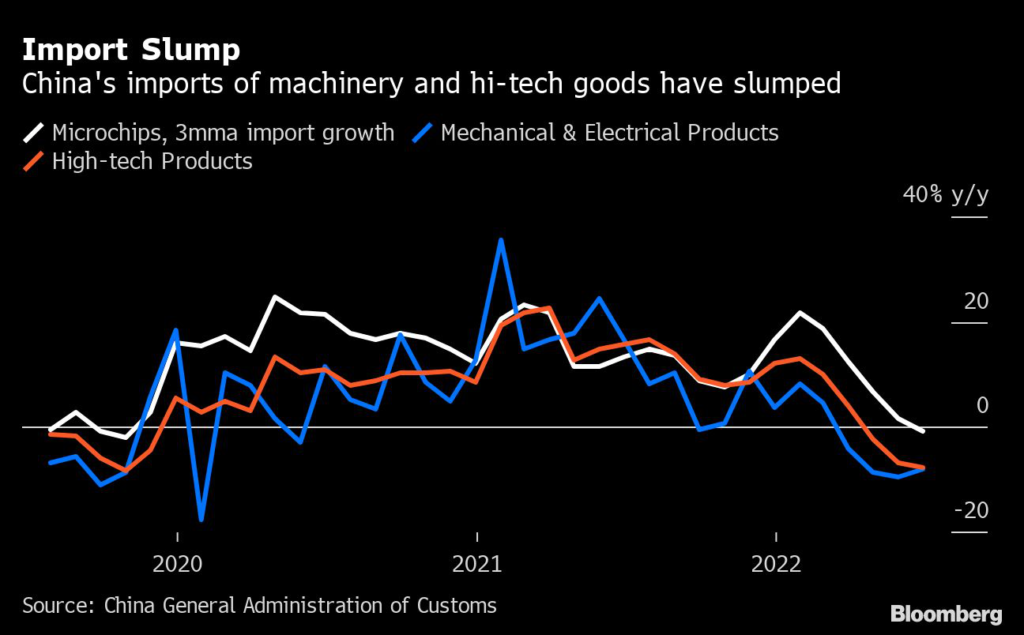
Elevated global commodity prices meant that China’s official import growth of 1% in June from a year earlier hid a worse result for manufactured goods. Imports of hi-tech products and mechanical and electrical goods fell about 8% last month, according to recently released Chinese customs data. There doesn’t seem to have been an improvement this month, with South Korea’s exports to China falling 2.5% in the first 20 days of July.

The decline was mainly due to the lingering impact of lockdowns to prevent Covid-19 infections, which hit the confidence of consumers and business, according to Trinh Nguyen, Asian emerging markets economist at Natixis SA. “Countries that are directly exposed to Chinese domestic demand, especially [for] manufactured goods, are more vulnerable,” she said.

China’s role as driver of global commodity demand tends to overshadow the fact that the majority of its imports are manufactured products, both for its domestic market and for assembly into products which are then exported. Germany and South Korea, which have run trade surpluses with China for most of the last decade, both saw unusual deficits last month, according to Chinese and Korean data. 

China’s slump “comes at a bad time for these economies as they also have a widening import bill while export demand has fallen sharply for their key customer,” Nguyen added.

Worse for those countries, some of China’s slowdown in imports is structural. China’s electric vehicle exports have surged this year, and the EV supply chain is more China-centered, reducing demand for auto parts from countries like South Korea, said John Gong, a professor at the University of International Business and Economics in Beijing.

“I expect the pandemic winners Korea and Taiwan to have a really rough time as China, semiconductors, and the global goods cycle all turn negative,” said Rory Green, head of Asia research at TS Lombard.

Japan’s exports to China recovered in June from year-on-year declines in April and May, but the growth may be short-lived, said Craig Botham, chief China economist at Pantheon Macroeconomics. “Ordinary exports aimed at final demand have no hope given the dire situation Chinese consumers find themselves in, and intermediate goods are only useful as long as global export demand is strong — as far as I can tell, it is fading,” he said.

Economists are lowering their expectations for the Chinese economy as the country’s coronavirus cases remain at elevated levels, suggesting more lockdowns are likely. A slump in the country’s real-estate sector has also deepened, compounding the issue. The median forecast for China’s GDP growth in 2022 fell to 3.9% in the latest Bloomberg survey. 

Economists expect export growth of 7.8% this quarter, compared with import growth of 5.4%.

With demand from Europe and the US still holding up and a rebound in port activity after Shanghai ended its lockdown, China posted its highest-ever monthly trade surplus of $98 billion in June. As a result of the weak outlook for Chinese demand, “odds are good that we get a record surplus for the full year,” Botham added.

In a more optimistic scenario where China can avoid more strict lockdowns in the second half of the year, imports could recover to see annual growth of 7%-8%, said Le Xia, chief Asia economist at Banco Bilbao Vizcaya Argentaria SA in Hong Kong.

But that would be a sharp drop from more than 30% growth last year. “Weak imports will be the most important channel for China’s slowdown to spillover to the rest of the world,” he added.

More stories like this are available on bloomberg.com

©2022 Bloomberg L.P.

Kylie Jenner Reposts Critique of Instagram: ‘Stop Trying to Be TikTok’

(Bloomberg) — Kylie Jenner, the reality-show celebrity who is the most-followed woman on Instagram, reposted a critique of the app’s redesign that asked it to “stop trying to be TikTok.” 

“PLEASEEEEEEE,” Jenner commented. Soon after, her famous sister and co-star Kim Kardashian weighed in, sharing the same post with a “PRETTY PLEASE” comment.

Instagram owner Meta Platforms Inc. has changed that app and Facebook to be more like Bytedance Ltd.’s TikTok, prioritizing short-form videos and an algorithm that suggests content to users that they aren’t already following. Some users have protested the change, saying they want to see the posts they have signed up for, not random entertainment.

“Make Instagram Instagram again,” the complaint, originally from the account @illumitati, says. “I just want to see cute photos of my friends.”

Read more about Facebook and Instagram’s latest changes

Jenner’s opinion is closely followed because of her influence on social media platforms. On Instagram, she has 360 million followers, while Kardashian has 326 million. In 2018, Jenner’s tweet criticizing Snapchat caused the parent company Snap Inc. to lose $1.3 billion in market value in a day. 

But members of the Kardashian-Jenner family also rely heavily on Instagram for sales of merchandise such as makeup and clothing. Instagram’s algorithm change could make it harder for those who are already famous to keep being seen by their followers, as the company prioritizes elevating new voices.

More stories like this are available on bloomberg.com

©2022 Bloomberg L.P.
Target Extends Local-Delivery Bet With Hubs in Chicago and Denver

(Bloomberg) — Target Corp. will open three new package-sorting centers during the next year — two in greater Chicago and one in the Denver area — to further its strategy of using stores to handle online orders. 

The expansion will give Target nine of the mini-warehouses in the US, and more are planned for the coming years, according to a company statement Monday. The hubs, which receive goods from stores and forward them to customers, are designed to speed local deliveries and cut the shipping costs that typically make online orders less profitable than in-store sales. 

For Target, fulfilling online orders from stores yields savings of about 40% per package compared with shipping them from big distribution centers. Using sorting hubs eases the burden even more, and surging digital sales since the start of the pandemic are pushing the retailer to add more of the facilities as it vies for online orders with the likes of Amazon.com Inc. and Walmart Inc. 

“The biggest part of fulfillment costs is shipping,” Target Chief Operating Officer John Mulligan said at a recent briefing for reporters. “Stores are the asset, they’re close to consumers. We continue to believe they are the fastest way to fulfill, and the cheapest.”

Target slipped less than 1% at 11:36 a.m. in New York. The shares dropped 32% this year though July 22, while an S&P retailer index fell 24%.

E-Commerce Pressure

Paring costs is increasingly important as e-commerce becomes more popular and accounts for a larger part of revenue. Target says it recorded an increase of almost $13 billion in digital sales from 2019 to 2021. While growth has slowed this year as more customers shop inside stores, the Minneapolis-based company is preparing for a continued long-term shift online. 

But shipping orders directly to customers from the stores themselves clutters back rooms and leads to an inefficient use of space, said Mark Schindele, Target’s chief stores officer. 

Thus the company’s focus on local hubs such as a 170,000-square-foot sorting center in Minneapolis. The warehouse receives merchandise from 43 stores and one dedicated fulfillment center, said Doire Perot, the site director. It opened in October 2020 and can now handle as many as 50,000 packages a day. 

Inside, employees disassemble pallets of packages and put the parcels on a conveyor belt. Some will go to the US Postal Service, FedEx Corp. or United Parcel Service Inc. Target’s last-mile delivery service will handle others, which typically arrive a day after a customer places an order. 

At 10:30 a.m. on a recent Wednesday, the sorting center’s outer doors opened and about two dozen automobiles entered a staging area. Their drivers were gig workers for Shipt, a delivery company Target bought less than five years ago. Warehouse employees arrived with packages that were loaded into the vehicles. The drivers then left to make their rounds. 

On average last year, Shipt shoppers and drivers made $25 to $35 an hour including tips and bonuses. Drivers have to pay for gasoline and provide vehicles. At the Minneapolis hub, Shipt-delivered packages are currently averaging about 12,500 a day. 

Target is also working with Shipt at the sorting center to pilot the use of larger delivery vans, which can hold up to eight times more packages per route. That will help make room for growing order sizes, the retailer said. 

Recent Acquisitions

In addition to Shipt, two other recent acquisitions play a key role. Target uses software from Grand Junction, a startup it purchased in 2017, to determine which goods can be efficiently handled by its own delivery service and which should go to outside transportation providers. 

Target also bought technology assets from Deliv, another startup, in 2020. That software helps the retailer optimize delivery routes so that each driver has as many stops as possible on a given course. 

“Density is what creates efficiency,” Mulligan said. “And efficiency is what takes out cost.” 

(Corrects Shipt wage information in 11th paragraph to show that it applies to both shoppers and drivers)

More stories like this are available on bloomberg.com

©2022 Bloomberg L.P.
Steve Jobs’s Apple-1 Computer Prototype Is on the Auction Block

(Bloomberg) — A rare piece of history from Apple Inc.’s storied early days in Silicon Valley will go to the highest bidder. 

Steve Jobs’s Apple-1 Computer prototype is being auctioned by Boston-based RR Auction, with current bids at $278,005. Bidding ends on Aug. 18. RR Auction sold the Apple-1 computer in September 2018 for $375,000.

The prototype, which was considered “lost” until recently, is what the Apple co-founder used to demonstrate the Apple-1 to personal computer store owner Paul Terrell in 1976. According to the item description on RR Auction’s website, Jobs and co-founder Steve Wozniak originally envisioned the Apple-1 computer as part of a $40 do-it-yourself kit. Terrell convinced the entrepreneurs to turn the product into a pre-assembled personal computer for $666.66 and gave them their first big order.


“There is no Apple-1 without this board— it’s the holy grail of Steve Jobs and Apple memorabilia,” said Bobby Livingston, executive vice president at RR Auction.  

The device passed through Wozniak’s hands, too: The prototype appears to have been hand-soldered by Wozniak on a unique “Apple Computer A” circuit board, according to auction house description. The prototype shows Wozniak’s unusual “three-handed technique” using a wire in one hand, soldering iron in the older and solder with his mouth.

In 1976, Terrell took Polaroid photos of the prototype, which were matched to the circuit board. The prototype was examined and authenticated in 2022 by Apple-1 expert Corey Cohen, who also wrote an accompanying 13-page report.

More stories like this are available on bloomberg.com

©2022 Bloomberg L.P.
Snap Loses Wall Street Fan Base as ‘Cash Bonfire’ Rages On

(Bloomberg) — Snap Inc. finds itself increasingly abandoned by Wall Street, with more than a dozen brokerages downgrading the social media company’s stock in the wake of disappointing sales figures that sent shares into a tailspin. 

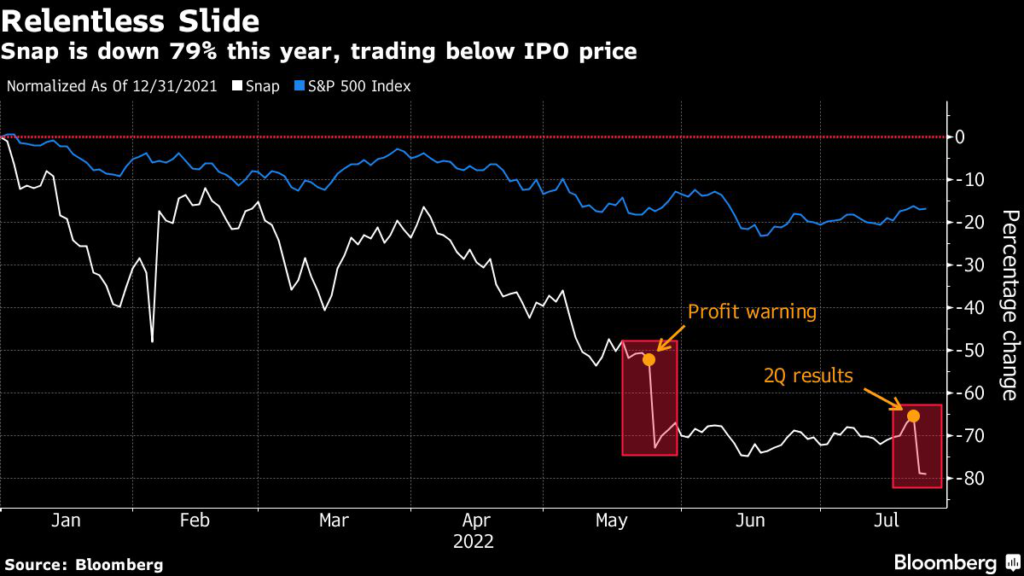
At least 14 brokerages and investment banks including Evercore ISI, KeyBanc and Oppenheimer, downgraded their recommendations and price targets since late Thursday, when Snap reported second-quarter revenue that missed estimates and held back guidance for the third quarter. Morgan Stanley on Monday went as far as slapping the stock with a double downgrade, adding fuel to a selloff that has seen shares fall nearly 80% so far this year. 

Snap and other social-media shares including Meta Platforms Inc. and Pinterest Inc. are under pressure as advertising spending by businesses, among their biggest revenue drivers, cools amid fears of a global recession and as competition from the likes of TikTok increases. The downturn may be even more severe for Snap as its ad business is less developed, analysts said. Brian Nowak at Morgan Stanley, cut the stock’s price target to $8 from $17 citing TikTok’s threat to the company’s ad revenue as higher than previously anticipated.

“The cash bonfire at Snap shows no signs of abating,” said David Trainer, chief executive officer of New Constructs, an investment research firm based in Tennessee. “Snap’s year-over-year user growth has consistently slowed in recent quarters, much as we’ve seen with other companies single-mindedly focused on user growth, such as Netflix and Pinterest.” 

Snap representatives declined to comment on the downgrades.

JPMorgan’s Doug Anmuth, who cut his rating to underweight from overweight, also cited TikTok as an overhang for Snap’s shares. “TikTok’s strong engagement and rapid monetization growth are having an outsized impact on Snap’s business,” he said. 

The downgrades and price cuts brought Snap’s consensus rating — a proxy for its ratio of buy, hold, and sell ratings — to about 3.6 out of five, the lowest for the Snapchat parent since late 2019 and below that of Meta Platforms. 

Snap shares closed at $9.95 in New York, below the 2017 IPO price of $17, bringing total losses in market value so far this year to almost $60 billion. 

“We had expected soft SNAP results, but the magnitude of the weakness still surprised us,” Evercore ISI analysts led by Mark Mahaney said in a downgrade report last week. “When fundamentals change this dramatically, it’s hard for us not to change our investment opinion.”

(Updates share price moves throughout.)

More stories like this are available on bloomberg.com

©2022 Bloomberg L.P.

Bitcoin Drops Back Within Recent Trading Range; Altcoins Decline

(Bloomberg) — Bitcoin edged lower for the fifth time in six trading sessions, though the cryptocurrency continued to linger near the closely watched $22,000 price level.  

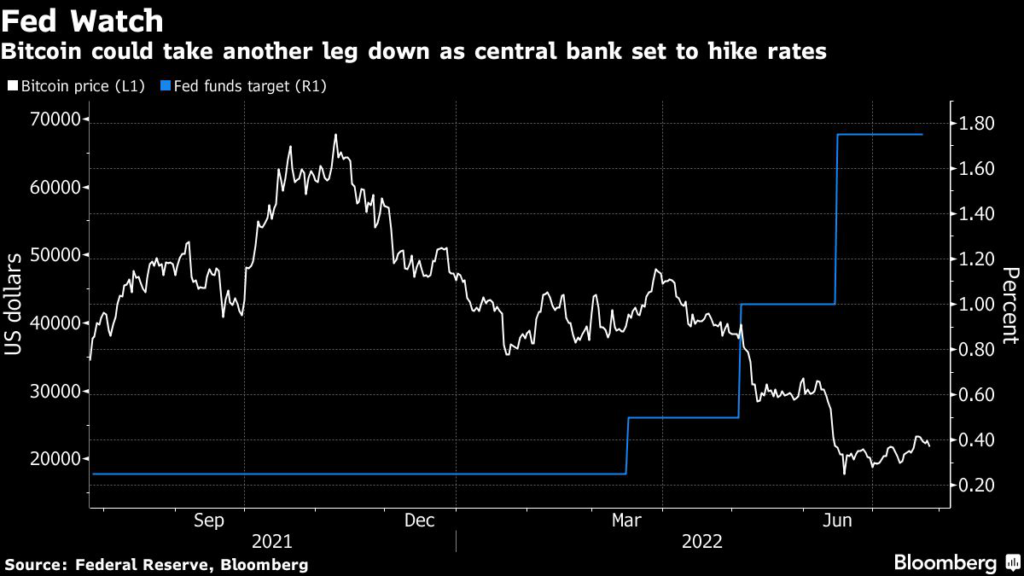
The largest digital token fell as much as 5.1% on Monday and was exchanging hands at $22,154 as of 4:18 p.m. in New York. Ether slumped as much as 9.5% after outperforming Bitcoin for much of July. Smaller virtual coins like Avalanche and Solana also nursed larger declines.

Cryptocurrencies are again at the vanguard of swings in riskier investments ahead of an expected Federal Reserve interest-rate hike on Wednesday and a slate of earnings from megacap technology firms in the US amid a slowing economy. US stocks began the week on a down note. 

The past two rate increases by the US central bank ended up sapping market sentiment. Poor earnings could also drag down tech shares and Bitcoin given the correlation between the two. That said, some prognosticators continue to believe the worst of Bitcoin’s selloff is over after a more than 50% plunge this year.

“If crypto investors can stomach this week’s likely Fed-induced volatility, it should transpire that Wednesday’s rise” past $24,000 “wasn’t a flash in the pan,” said Antoni Trenchev, co-founder at crypto lender Nexo. 

The digital-asset sector has begun to clean up the wreckage of a leveraged speculative binge that found its comeuppance in a Fed determined to tighten monetary settings to slay runaway inflation.

While any hints of crypto stabilization are still very tentative, they are enough for some market watchers to look up rather than down.

Nexo’s Trenchev and Rick Bensignor of Bensignor Investment Strategies flagged the $30,000 level, suggesting that’s where Bitcoin could head to before meeting some technical resistance.

More stories like this are available on bloomberg.com

©2022 Bloomberg L.P.

Biden Says He ‘Feels Great’ and Expects Full Covid Recovery

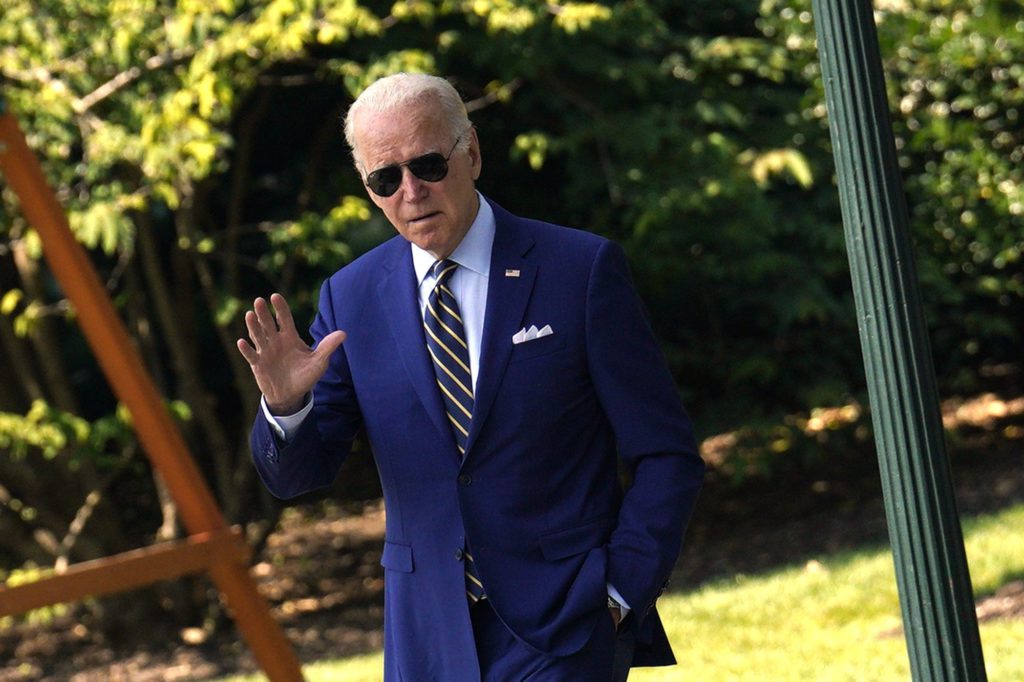
(Bloomberg) — President Joe Biden, still sounding mildly hoarse, said he was on his way to a “total recovery” from Cvoid-19 four days after testing positive for the virus. 

“I’m feeling great. You know, I’ve had two full nights of sleep — all the way through,” Biden told reporters Monday after a virtual meeting to discuss an ongoing semiconductor shortage with companies that rely on the devices. 

“My voice is still raspy,” he said. But the president, 79, added that he was “feeling better every day.”

“I think I’m on my way to full, total recovery,” he said. 

Biden’s physician said earlier in the day that his Covid-19 symptoms have “almost completely resolved.”

“At this point he only notes some residual nasal congestion and minimal hoarseness,” White House physician Kevin O’Connor said in a Monday memo. Previously, the president experienced a sore throat, fatigue, coughs and a runny nose.

Biden has been taking Pfizer Inc.’s Paxlovid since he tested positive for the virus Thursday, and O’Connor said he continues to respond as expected to the treatment. 

Some patients have reported rebounds after taking Paxlovid pills, in which symptoms return after initial improvement. However, White House Covid-⁠19 Response Coordinator Ashish Jha said rebound rates stand at about 5%. 

Biden and other administration officials used the event Monday with company executives and labor leaders to make the case for a China competition bill would provide billions in incentives for domestic semiconductor manufacturing. A final Senate vote on the measure is expected this week. 

Read more: Senate Moves Forward With $52 Billion in Semiconductor Funding

“Congress must pass this bill as soon as possible so we can get it to my desk,” Biden said.

More stories like this are available on bloomberg.com

©2022 Bloomberg L.P.

Close Bitnami banner
Bitnami