
Bloomberg

ADHD Startup’s Business Surged, Followed by Complaints and Concerns

(Bloomberg) — Mental-health startup Done grew quickly by offering online prescriptions for ADHD, touting “worry free” refills and “next day” appointments. But in recent months, an influx of patients and a focus on growth has overwhelmed the company’s clinicians and exacerbated their concerns about Done’s ability to properly look after patients.

It’s also led to a wave of customer complaints about missed refills and confusing communication. In some cases, patients have taken to airing their grievances as comments on the company’s feel-good Instagram posts – only to find their comments vanished days later.

The complaints and internal concerns, described to Bloomberg by about a dozen patients and staff, are the latest chapter in the tumultuous world of startups that arose during the pandemic to provide treatment for mental-health conditions. They promised to solve a real problem: Despite high US rates of mental illness, it remains bafflingly difficult to find health professionals to help. But as Bloomberg has previously reported, a handful have pushed boundaries in ways that have courted controversy and even legal scrutiny.

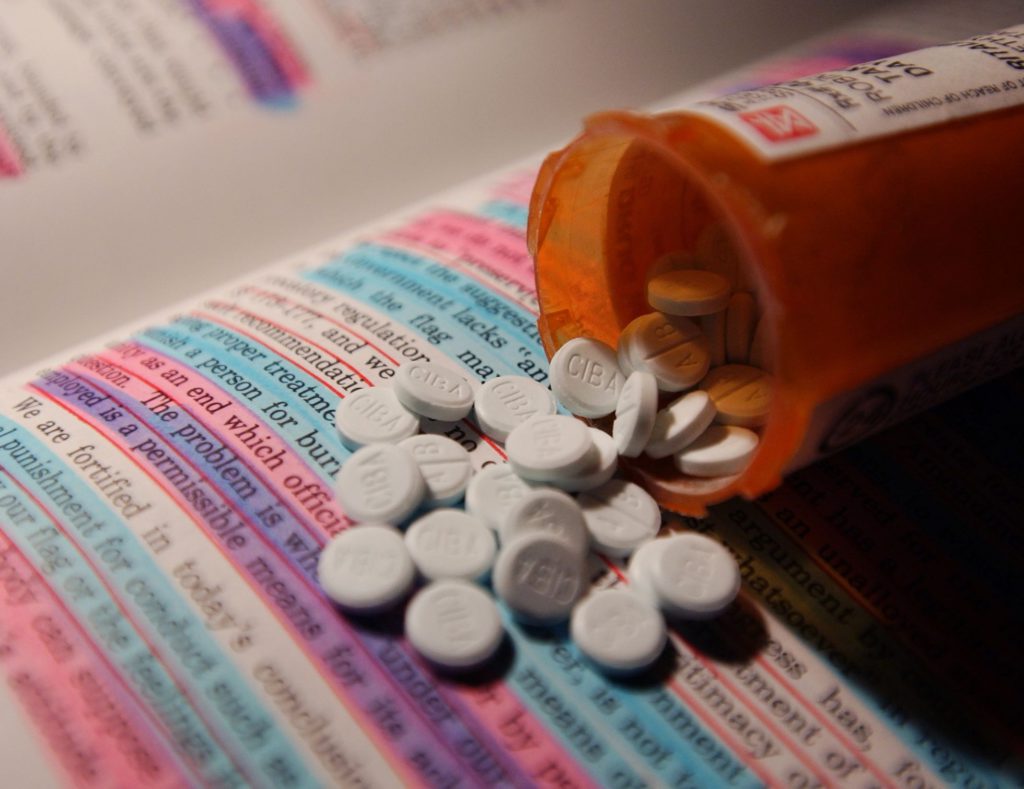
Done offered ADHD patients an appealing proposition: For a monthly fee, they could book online appointments with health professionals who could evaluate them and write prescriptions, including for tightly regulated medicines such as Adderall and Ritalin.  

Jennifer Bauer, a 36-year-old in Austin, Texas, signed up for Done’s services in March because she thought she might have attention-deficit/hyperactivity disorder, known as ADHD. At first, it went smoothly – she received a diagnosis and a prescription for Adderall – but recently she said she’s been frustrated. 

Bauer says she requested a refill of her Adderall prescription at the beginning of July. On July 12, one day before she was set to run out of medication, she emailed Done to check on her prescription. The company responded that her provider wanted to schedule a telehealth appointment “before prescribing more medication,” according to an email from Done that Bauer shared with Bloomberg. 

The earliest available appointment was in October. Bauer ran out of pills on July 13.

That was “absolutely horrible,” Bauer said. The medication enabled her to concentrate, and without it, she had difficulty completing basic tasks, like cooking or doing laundry.

Struggling Patients

Bloomberg spoke to six Done customers, including Bauer, who described similar frustrations – ranging from issues with refills to a non-responsive customer service department to difficulties canceling their accounts. Replies to the company’s social media posts are filled with angry comments. Others have posted scathing reviews at the Better Business Bureau.

Done acknowledged that some clinicians might have backlogs and said the issues were also caused by outside pharmacies and technical challenges. The company said it was committed to “high-quality psychiatric chronic care management.”

Done saw explosive growth during 2021. Its monthly revenues quickly eclipsed the $3 million it raised from investors, and profits peaked last summer, three people familiar with the private company said. Much of that growth was helped by a pandemic-era change in online health rules that let doctors and nurses working with companies like Done write prescriptions for controlled substances, including stimulants used to treat ADHD.

But Done struggled to handle the surge in demand. High turnover among its independent-contractor clinicians caused a backlog of hundreds of messages from patients, four current and former clinicians said. On top of that, Done saw a surge of new patients after it’s competitor,  Ahead, shut down in April.

Done also faced turnover among key staff, which may have to do with the company’s compensation structure that incentivizes prioritizing new patients, clinicians said. Nurse practitioners are paid about $100 per hour, on average, for new patient appointments, which typically last half an hour. However, their earnings are much lower for follow-up sessions which can pay as low as $7 per appointment, said clinicians who spoke to Bloomberg on condition of anonymity. 

Done’s focus on growth sometimes collided with quality-of-care concerns, former executives told Bloomberg in May. 

Terry Plumlee, 62, in Houston, Texas, faced her own challenges with the company. She signed up for Done in April and received a 30-day Adderall prescription after an initial video consultation. The prescription wasn’t refilled in May, and after weeks of trying to contact the company, she was asked to pay $47 to have the medication mailed to her. She paid the funds but didn’t receive the package. 

Since April, Plumlee has paid at least $509 to the company, with the most recent charge on July 12, according to bank statements and credit card records she provided. She hasn’t had any video visits since April or received any pills beyond the initial 30-day supply. 

“I’ve never been so incensed with any company in the history of my life,” Plumlee said.

Done declined to comment on Bauer or Plumlee’s experiences, or on any other patient. But just one day after Bloomberg asked the company about Plumlee’s complaints, she received an email from Done saying she would receive $205 in refunds, according to a copy of the message shared with Bloomberg.

Some Done patients said the company was able to help address their problems. A 36-year-old in Reno, Nevada, who didn’t want to be named for privacy reasons, said that when their pharmacy refused to fill the prescription, Done helped find an alternative. A woman in Oregon said that Done refunded her more than $500 after trouble filling her prescription.

Other companies have faced more than just complaints. Cerebral Inc., another mental telehealth company, is being investigated by federal law enforcement for possible violations of the Controlled Substances Act, but has not been charged. The increased scrutiny has resulted in CVS Health Corp. and Walmart Inc. refusing to fill prescriptions for controlled substances from Cerebral and Done. 

“We strive to provide all of our members with excellent service,” a Done spokesperson who declined to provide their name said in an email. “Due to some pharmacies making decisions to illegitimize patient’s needs for treatment via telehealth, many patients experienced delays receiving their prescriptions, particularly for controlled substance medications.”

The spokesperson also cited technical problems, saying the company’s electronic systems were down over the July 4 weekend, but back online July 5. Affected patients received some free membership, the spokesperson wrote. But three patients told Bloomberg News they experienced issues well before the July 4 outage, and three said they had trouble after Done said the issue was resolved. 

Bauer was one of the patients who took her complaints online, to Done’s Instagram posts. 

Bauer commented on one of Done’s posts on July 15: “It’s been 12 days since my refill request and no one has been able to tell me When or if I’ll receive it.”

Bloomberg News saw Bauer’s online reply on June 15. By June 20, it had vanished. 

In an Instagram conversation between Bauer and an unnamed Done representative, Bauer asked why the company was deleting negative comments.

“Public comments will be deleted as required since they are relatively irrelevant with social marketing comms,” the representative wrote, according to a screenshot provided by Bauer. Done declined to comment further.

More stories like this are available on bloomberg.com

©2022 Bloomberg L.P.

Billionaire Tom Steyer Bets on Weather Stations to Battle Climate

(Bloomberg) — Solar-powered weather stations that beam real-time information to farmers are the first investment for Galvanize Climate Solutions, the firm launched last year by billionaire Tom Steyer and Katie Hall to battle climate change.

Galvanize led a $40-million funding round for San Francisco-based Arable, whose weather equipment gives farmers information on how much sunlight and water crops are getting, and can help optimize when to irrigate or fertilize. Such visibility is becoming increasingly important amid tight on-farm labor and with drought shrinking water reserves. At the same time, Russia’s invasion of Ukraine has helped send prices for fertilizer and crops such as wheat to the highest ever. 

“There’s so many different things we need to do better in agriculture in terms of both using the land more productively, but also using water, fertilizer and pesticides much more carefully,” Steyer said in a phone interview. “If you can’t measure those impacts and manage it using the information, then you’re doing everything by the seat of your pants.”

Arable’s clients include Treasury Wine Estates, who is trying to maximize scant rainfall in California, and the World Food Progamme in Mozambique, one of the countries most impacted by climate change. There’s room to grow in the field of providing extremely localized weather with costs surging from seeds to fuel.

“Across the industry and globally, it’s still a very low adoption of farmers who actually use data to drive decisions,” said Jim Ethington, the chief executive officer of Arable, in a phone interview. “That has shifted, the mindset of the market.”

The risk is that agriculture’s carbon footprint will increase from roughly a quarter of the world’s greenhouse gas emissions as more land is cleared to feed a rising global population. 

More stories like this are available on bloomberg.com

©2022 Bloomberg L.P.
Anti-Instagram App BeReal Takes Top Spot on Apple Despite Crashes

(Bloomberg) — BeReal, a social media app dubbed the anti-Instagram, has soared in popularity in recent weeks despite numerous complaints that it crashes at a critical moment. 

The app, which requires all of the people on the platform to take a photo within a two-minute window each day, often glitches when everyone tries to upload their spontaneous pictures at once. Failure to upload your image within the designated timeframe leads to a “late” label of public shame. 

Far from deterring users, however, the app took the top spot in the US on Apple Inc.’s App Store for three days this week. It had 1.7 million installs during the week of July 11, the biggest weekly gain ever, according to digital analytics platform Sensor Tower.

It’s common, especially among social media companies, that when demand suddenly surges the infrastructure comes under strain, according to Arun Lakshmanan, an associate professor of marketing at the University at Buffalo School of Management. “The faster an application is able to ramp up, the more likely it is to become popular and stable,” he said.

BeReal’s boom echoes the early success of Instagram and Twitter, when platform glitches were frequent because of an overload of users. Those apps adapted and survived, but at a time when so many social media apps are competing for people’s attention, BeReal still has to prove it can be more than a passing fad.

The French app has been around since 2020, when it was launched by Alexis Barreyat, who had previously worked at at GoPro Inc. BeReal said it received $30 million in funding from Andreessen Horowitz, Accel Partners and New Wave, with participation from DST Global and others. Insider reported that BeReal is raising $85 million in fresh capital, led by DST Global, that would value the company at $600 million.

After gaining popularity in France, the app started taking off among college-aged users in the US earlier this year. Its appeal, according to many users, is its intentional opposition to the ultra-curated aesthetic of Instagram, which is owned by Facebook parent Meta Platforms Inc. 

On BeReal, people post only once daily, prompted by a push notification instructing them that it’s “Time to BeReal,” bracketed by two yellow warning sign emojis. With one click the app takes two photos, one from the front and back cameras simultaneously.

But for many people, this is where things go wrong. They might have to close and reboot the app multiple times, or if they are able to take a photo, it will take too long time to upload, resulting with the dreaded “late“ label. Users can’t see what their friends post until they have posted themselves, so the glitches keep them from using the app.

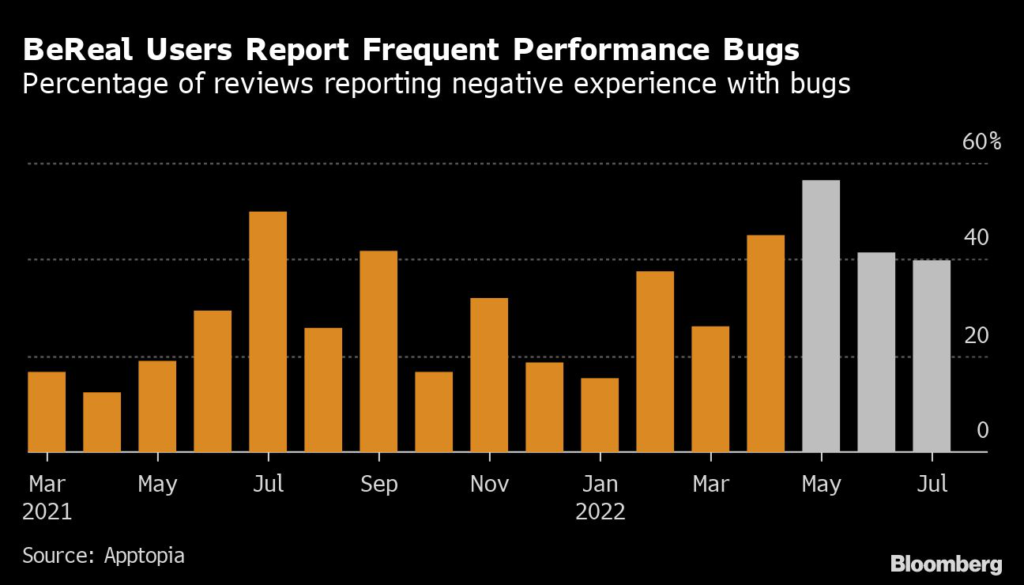
During the first two weeks of July, there was a 254% increase in the number of negative reviews for BeReal for performance and bugs, according to data intelligence platform Apptopia. In May, reviews that cited “negative“ or “mixed” performance and “bugs” made up 56.4% of total reviews. BeReal declined to comment. 


Despite the technical frustrations, people keep coming back for their daily post. BeReal users kept with the app at higher rates than the top 10 social apps, according to numbers from data.ai, a consumer and market data platform. For the month of May, users who are still with the app after 7 days is almost 50% at BeReal, compared with 37% for other apps. After 30 days, those numbers level out at 35% and 34%.

One user, 19-year-old University of Michigan student Brianna Fox who uses she/they pronouns, would try to take a picture but see instead their face toned purple and multiplied into a kaleidoscope-like grid, an effect their normal iPhone camera doesn’t have. When friends also got technical bugs, they joked that Fox passed it to them. Still, Fox continues to post daily.

“The only reason I would say I keep using it is it’s funny,” Fox said. “There are no filters like Instagram or Snapchat. It’s more candid, and I like that more.”

Omer Cayir, a 22-year-old law student in London, also posts to BeReal every day. He started using it in April, and after a couple of weeks saw glitches like the caption or whole post deleting. For about a month, he wouldn’t get the notification that it was time to post. Cayir said it was frustrating, but he was happy to deal with it because he was still in the honeymoon phase with the app.

“There was a week or so where it felt a bit like a chore,” he said, “but the app luckily in the nick of time started to fix itself and started to get more exciting again.”

Not every user is enamored. Ben Boehlert, a 22-year-old research assistant in Cambridge, Massachusetts, said half the time when he gets the “Time to BeReal” notification he doesn’t bother, and the other half he tries and fails to post. Many days he doesn’t see the notification, because it’s in the middle of the work day.

“It’s made it kind of impossible to use,” he said, “which is unfortunate because it’s cool.“

Fox, Cayir and Boehlert all got on the app after friends convinced them to join. Lakshmanan said when people talk to their friends about the app it creates a network effect that can help the app take off. But the platform needs to invest in making it usable so people’s behavior becomes ingrained, the professor said. 

With the infusion of capital and “a little more investment” in the product and infrastructure, the glitches should get ironed out in time, Lakshmanan said. “Now, whether this will go the way of Facebook or Twitter, that’s an open question.”

(Corrects to remove reference to co-founder.)

More stories like this are available on bloomberg.com

©2022 Bloomberg L.P.
Pre-Fed Jitters Send Bitcoin Back Into Sub-$22,000 Trading Range

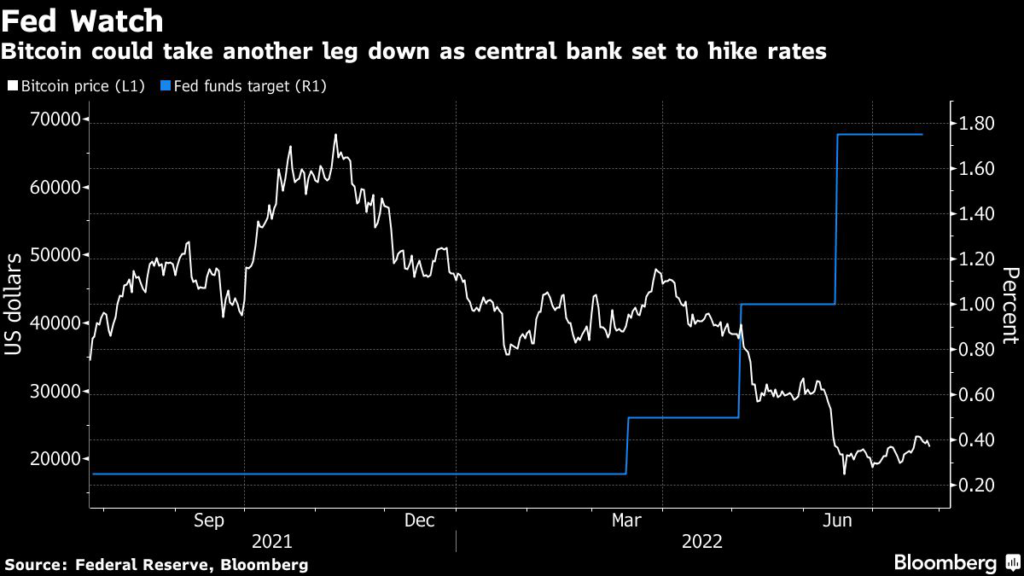
(Bloomberg) — Bitcoin sank back into the doldrums of a one-month-old trading range between $19,000 and $22,000, part of a wider cryptocurrency selloff.

The largest digital token fell as much as 4.3% on Monday and was exchanging hands at $21,840 as of 10:10 a.m. in New York. Second-ranked Ether and smaller virtual coins like Avalanche and Solana nursed larger declines.

Crypto may again be at the vanguard of swings in riskier investments ahead of an expected Federal Reserve interest-rate hike on Wednesday and a slate of earnings from megacap technology firms in the US amid a slowing economy.

The past two rate increases by the US central bank ended up sapping market sentiment. Poor earnings could also drag down tech shares and Bitcoin given the correlation between the two. That said, some prognosticators continue to believe the worst of Bitcoin’s selloff is over after a 53% plunge this year.

“If crypto investors can stomach this week’s likely Fed-induced volatility, it should transpire that Wednesday’s rise” past $24,000 “wasn’t a flash in the pan,” said Antoni Trenchev, co-founder at crypto lender Nexo. 

The digital-asset sector has begun to clean up the wreckage of a leveraged speculative binge that found its comeuppance in a Fed determined to tighten monetary settings to slay runaway inflation.

While any hints of crypto stabilization are still very tentative, they are enough for some market watchers to look up rather than down.

Nexo’s Trenchev and Rick Bensignor of Bensignor Investment Strategies flagged the $30,000 level, suggesting that’s where Bitcoin could head to before meeting some technical resistance.

More stories like this are available on bloomberg.com

©2022 Bloomberg L.P.
Zipmex Seeks $50 Million After Freezing Crypto Withdrawals

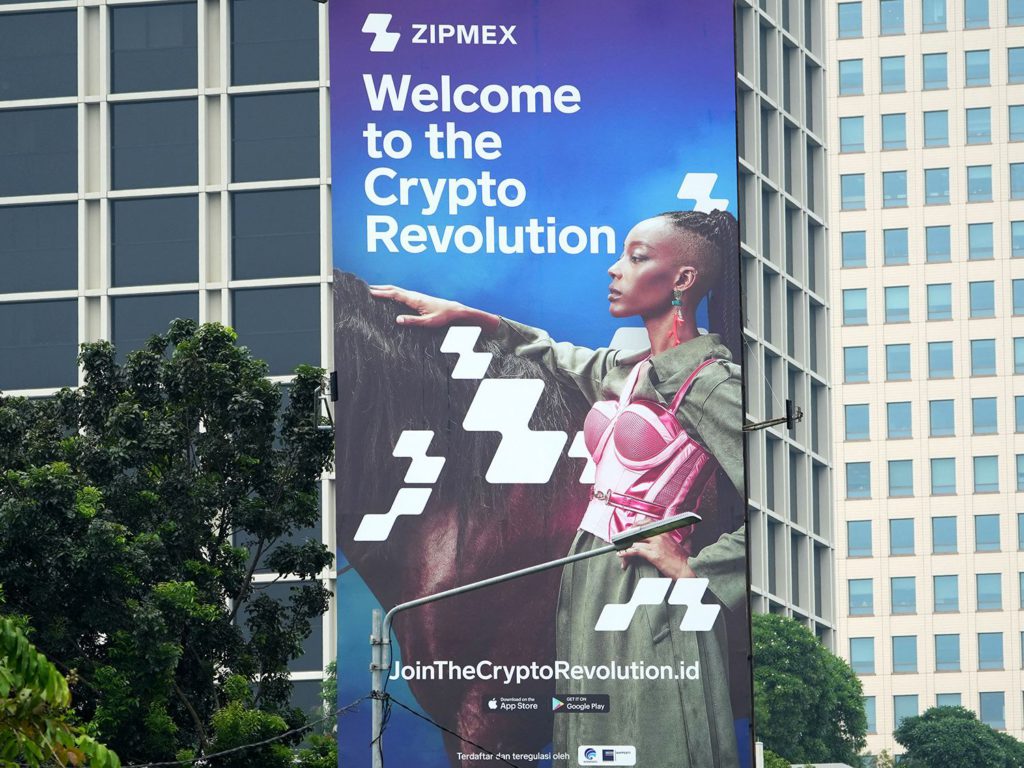
(Bloomberg) — Zipmex, the Asia-focused crypto exchange that froze some withdrawals last week, said it’s seeking to raise at least $50 million to repair its balance sheet. 

The company confirmed the targeted fundraising amount in an emailed response to questions from Bloomberg. Zipmex is in discussions to sell all or part of itself after lending money to troubled crypto firms Babel Finance and Celsius Network Ltd., a person with knowledge of the matter said, asking not to be named discussing private deliberations. 

Zipmex said in a tweet on Sunday that one of “various interested parties” it’s held talks with has “offered terms” in a memorandum of understanding, without identifying the entity.  

The fundraising target roughly represents Zipmex’s combined exposures to Babel and Celsius, which stand at $48 million and $5 million, respectively. Zipmex was derailed by the daisy chain of defaults that’s rippled through the highly interconnected market for crypto lending and borrowing following a $2 trillion rout in digital assets. Celsius filed for bankruptcy earlier in July and Babel has tapped restructuring advisers. 

Zipmex operates in Thailand, Singapore, Indonesia and Australia. It has a license for digital asset trading from the Securities and Exchange Commission of Thailand, according to its website. In Singapore, the exchange holds an exempted payment service provider permit, rather than a full license under the central bank’s new regime for cryptoasset firms.

Among its products is ZipUp+, an account that pays yields as high as 10% on deposits of tokens like Bitcoin, Ether and Litecoin. Withdrawals from that product are still frozen. 

Thailand’s SEC is investigating whether there were any legal violations by Zipmex’s Bangkok-based unit as the company’s actions affected a large number of people, according to a statement from the watchdog on Monday. 

“We have been engaged with the SEC and other government agencies to provide them with all required documents,” a Zipmex spokesperson said in an email, declining to comment further. 

More stories like this are available on bloomberg.com

©2022 Bloomberg L.P.
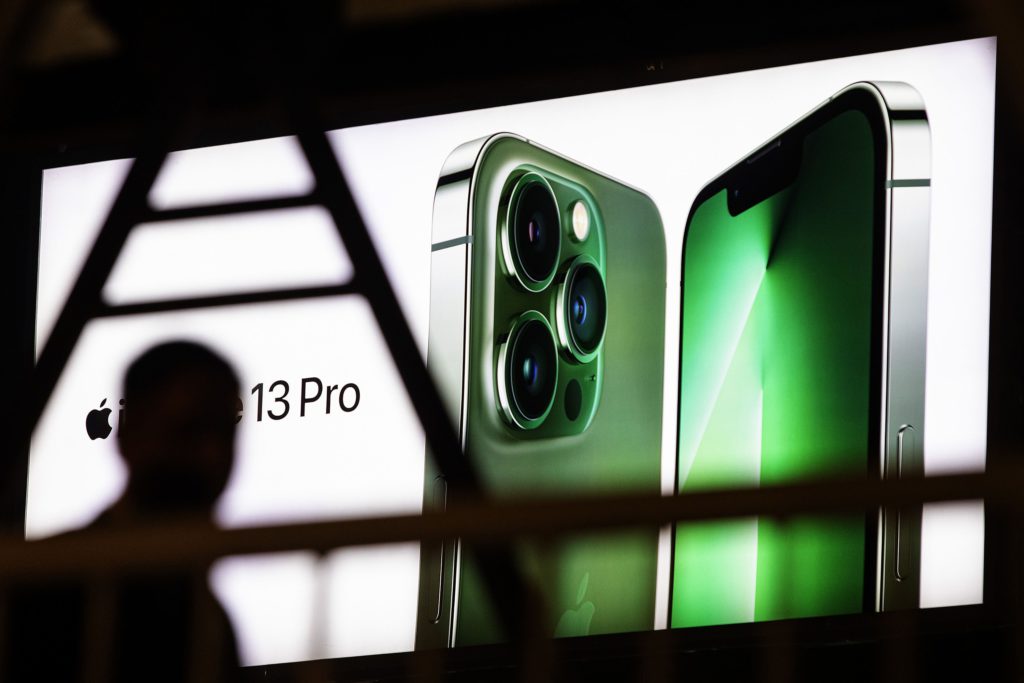
Apple Prepares Rare iPhone Discount for China Buyers

(Bloomberg) — Apple Inc. announced a rare retail promotion in China on Monday, offering four days of discounts on its top-tier iPhones and related accessories in advance of the launch of its next-generation devices.

The company, usually reluctant to alter pricing, will take up to 600 yuan ($89) off the price of its top-line iPhone 13 Pro series between July 29 and Aug. 1, according to a notice on its website. To be eligible, buyers have to use one of a select number of payment platforms, such as Ant Group Co.’s Alipay. Certain AirPods and Apple Watch models are also part of the promotion.

The discounts come as China’s economy tries to bounce back from major Covid-19 lockdowns in business hubs Shanghai and Beijing, which have hurt sales of leading domestic smartphone brands from Xiaomi Corp. to Vivo and Oppo. Apple bucked the trend by registering healthy growth in China shipments in June, according to national statistics, though the discounts suggest even it has surplus inventory heading into the latter half of the year.

Weakening consumer demand, inflation and supply chain issues triggered a 9% fall in global smartphone shipments in the second quarter, research firm Canalys said this month. Chinese companies took the brunt of that hit, registering double-digit declines.

The Cupertino, California-based company is due to report fiscal third-quarter results on Thursday and Apple is expected to post its slowest quarterly sales growth since the early days of the pandemic. Global economic events are catching up with the company, which plans to slow spending and hiring across some teams next year, Bloomberg has reported. Apple shares were little changed at $154.44 Monday morning in New York.

Apple has traditionally kept iPhone prices unchanged between generations, though this year’s economic upheaval has already pushed it to one unusual move: raising prices in Japan in response to the drastically weakened yen.

The company offers several payment options in China, including installment plans and lower pricing for students. But it has refrained from discounting its flagship products in the country for years.

(Updates with share trading; a previous version corrected the owner of Alipay in second paragraph)

More stories like this are available on bloomberg.com

©2022 Bloomberg L.P.

Tesla Boosts Capital Spending Plan, Reveals New SEC Subpoena

(Bloomberg) — Tesla Inc. increased its capital expenditure plan by billions of dollars after Chief Executive Officer Elon Musk referred to the carmaker’s new factories as “gigantic money furnaces.”

The revised plan was revealed Monday in a regulatory filing that also disclosed details of the electric-vehicle maker’s Bitcoin sales and another subpoena from securities regulators related to Musk’s 2018 tweet about taking Tesla private.

The company now expects $6 billion to $8 billion of capital expenditures this year and each of the next two years, according to its latest quarterly report. Tesla had previously estimated it would spend between $5 billion and $7 billion on ramping up manufacturing facilities and other items.

Musk told a Tesla owners club at the end of May that the company was struggling to boost production of Model Y sport utility vehicles at factories that recently opened near Berlin and in Austin, Texas. The carmaker still managed last week to beat estimates for second-quarter earnings, and the CEO’s optimism about emerging from supply-chain challenges sent shares soaring to the highest since early May.

Tesla’s shares slipped less than 1% at 9:35 a.m. Monday in New York.

The company also said it received a subpoena on June 13 from the US Securities and Exchange Commission about its compliance with an agreement to oversee Musk’s tweeting. It was the second subpoena the SEC has issued in months regarding how the company has governed its CEO’s social media postings after he claimed in 2018 to have had secured funding to take Tesla private.

See also: Musk’s Tweets Drew More SEC Scrutiny as He Soured on Twitter Bid

Tesla said it’s cooperating with regulatory and government requests.

Musk last month appealed a federal court ruling upholding the settlement.

Tesla disclosed it recorded a $170 million impairment loss in the first half of the year related to the carrying value of its Bitcoin holdings. It also reported a $64 million gain from selling the digital asset during the period.

Musk told analysts on a call last week after Tesla reported earnings that Tesla sold Bitcoin to bolster its cash position after the Shanghai shutdowns due to Covid-19 earlier this year.

Earlier: Tesla’s Bitcoin Dump Leaves Accounting Mystery in Its Wake

(Updates with share trading in fifth paragraph)

More stories like this are available on bloomberg.com

©2022 Bloomberg L.P.

Ex-Meta Staffers Raise $150 Million for New Crypto Venture

(Bloomberg) — Aptos Labs, a startup that rose from the wreckage of Meta Platforms Inc.’s failed crypto ambitions, has raised $150 million in new funding, the company announced Monday. 

The funding round more than doubled the startup’s previous valuation—which was over $1 billion in March—even as venture capitalists cool on crypto investing, and other digital currency startups look to raise at lower valuations during the market downturn. Founded less than a year ago, Aptos raised $200 million from investors in its last funding round. The company declined to specify its new valuation. 

Aptos’ co-founders Mo Shaikh and Avery Ching are former employees of Meta and worked on the doomed cryptocurrency project, Diem, which was backed by Meta but met with strong resistance from regulators, and eventually sold its assets. Based in Palo Alto, California, Aptos is building a blockchain that uses a programming language called Move, which also powered the Diem blockchain and is supposed to make transactions faster and cheaper. 

“We are developing upgradable, cutting-edge blockchain innovations that will dramatically improve the web3 experience for developers, brands and users,” Ching said in a statement to Bloomberg. 

Mysten Labs, another startup founded by ex-Meta workers, is also building a blockchain that uses the Move language and is raising new funding, according to reports. Both Aptos and Mysten share investors, including Andreessen Horowitz and Coinbase Ventures.

FTX Ventures and Jump Crypto led the Aptos funding round, which also included Andreessen Horowitz, Apollo, Franklin Templeton, Griffin Gaming Partners and Circle Ventures.

More stories like this are available on bloomberg.com

©2022 Bloomberg L.P.
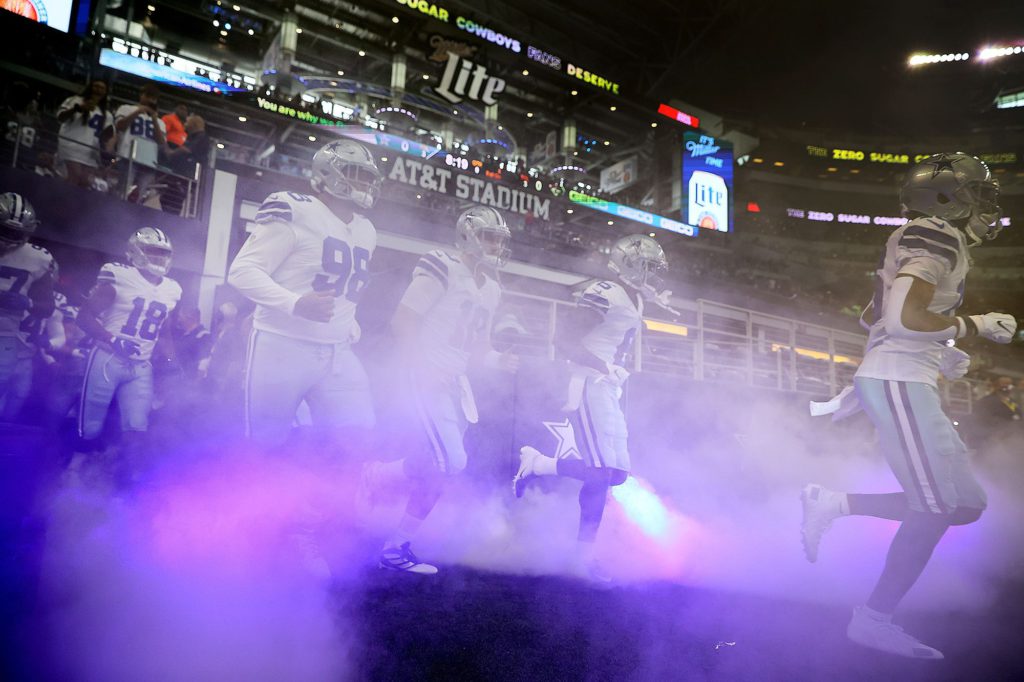
NFL Starts Its Own Mobile Streaming Service for $4.99 a Month

(Bloomberg) — The National Football League has launched its own streaming service, betting that the growing number of cable TV cord-cutters will pay to watch certain games on mobile devices.

NFL+, which debuts Monday, costs $4.99 a month or $39.99 a year. In addition to live games, it features shows from the NFL Network and archives of NFL Films. A premium version of the service, which includes commercial-free replays of games, costs $9.99 a month or $79.99 a year. 

The NFL remains by far the most popular programming in all of television. After viewership declined two years ago, its regular season audience rose 10% last year to an average 17.1 million per game, its highest mark since 2015.

But it’s a challenging time to launch a new streaming service. The highest US inflation in four decades is squeezing household budgets and forcing some to scale back entertainment spending. At the same time, NFL+ will compete with a wide array of sports-focused streaming services, including some that also show NFL games.

Verizon Communications Inc. had owned the rights to broadcast NFL games on phones and tablets until it revised its deal with the league last year. The NFL’s new streaming service combines those mobile rights with a subscription product called NFL Game Pass, which will no longer be available to US subscribers as a standalone product.

The NFL has carved up its media rights in a dizzying number of ways. That has helped the league generate more revenue and reach young fans who don’t have cable. But it’s also created a fragmented media landscape where fans must sort out which games appear on which app, on which device and in which market. 

For example, NFL+ will show regular season and postseason games. But subscribers can only watch games in prime time and Sunday matchups that normally air in their local TV market. And they need to be watching those games on a phone or tablet.

NFL+ could appeal to cord-cutters who can’t see Sunday games on CBS or Fox because they don’t subscribe to cable TV or don’t have another way to watch local channels.

Meanwhile, the league is looking for a new owner for NFL Sunday Ticket. Those rights, which are currently held by DirecTV, let subscribers watch NFL games outside their home market on Sundays.

More stories like this are available on bloomberg.com

©2022 Bloomberg L.P.
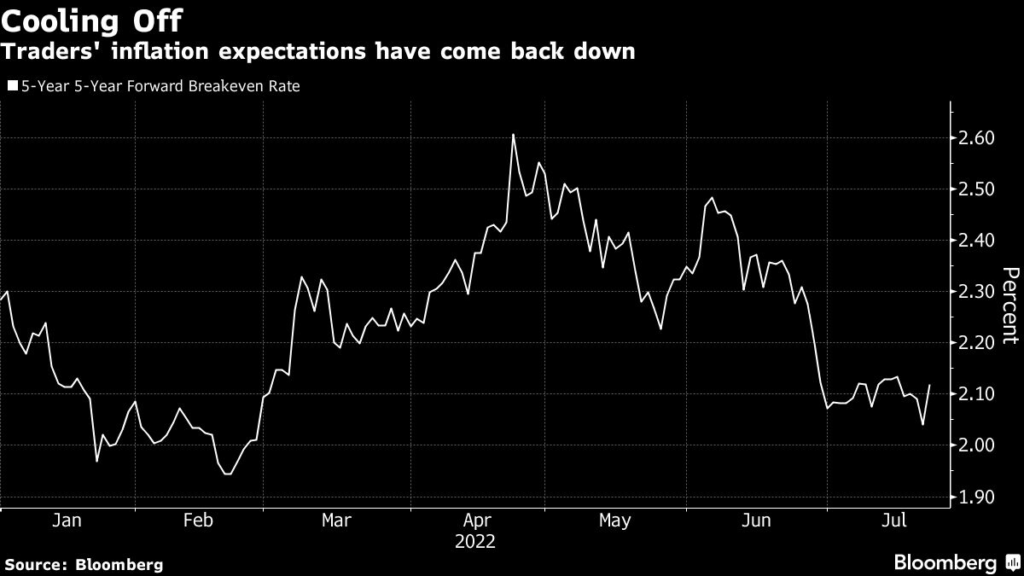
Futures Rise as Investors Look to Earnings, Fed: Markets Wrap

(Bloomberg) — Stocks and US equity futures rose on Monday as earnings expectations outweighed concerns about a possible recession.

Technology companies gained in premarket trading as US index futures and Europe’s Stoxx 600 reversed earlier declines. China’s property shares pushed higher amid a report that officials plan a fund to support struggling developers. 

Treasury yields advanced and a dollar gauge slipped. Oil advanced.

Investors are turning their focus to earnings of big-tech companies as they await another Federal Reserve interest-rate hike of at least 75 basis points this week. The Fed will probably inflict more pain on the economy to get inflation under control, while the European Central Bank may also continue big interest-rate increases. 

The Federal Reserve policy decision, along with earnings from the likes of Google’s Alphabet Inc. and technology titan Apple Inc., will help to clarify the outlook for a one-month-old rebound in stocks. Bank stocks also rose in premarket trading amid a broader rebound in risk assets. 

“We still see further downside for risky assets as recession fears accumulate and central banks remain committed to fighting inflation at the expense of growth,” wrote Eric Robertsen, chief strategist at Standard Chartered Bank Plc.

In Europe, German business confidence deteriorated to the worst level since the early months of the pandemic on growing concerns that record inflation and limited energy supplies from Russia will throw Europe’s biggest economy into a downturn.

Bear-Market Blues

“We don’t think that this bear market is going to end until there’s some evidence of nearing a bottoming of economic data or a pivot by the Fed toward a more dovish stance,” Nadia Lovell, UBS Global Wealth Management senior US equity strategist, said on Bloomberg Radio.

Elsewhere, wheat climbed as commodity markets evaluated a Russian missile strike on Odesa’s sea port that threatened to test a fledgling agreement to unblock Ukrainian grain exports from the Black Sea.

Here are some key events to watch this week:

  • Alphabet, Apple, Amazon, Microsoft, Meta earnings due this week
  • Bank of Japan minutes, Tuesday
  • IMF’s world economic outlook update, Tuesday
  • EU energy ministers emergency meeting, Tuesday
  • Fed policy decision, briefing, Wednesday
  • Australia CPI, Wednesday
  • US GDP, Thursday
  • Euro-area CPI, Friday
  • US consumer income, University of Michigan consumer sentiment, Friday

Some of the main moves in markets:

Stocks

  • Futures on the S&P 500 rose 0.4% as of 8:30 a.m. New York time
  • Futures on the Nasdaq 100 rose 0.4%
  • Futures on the Dow Jones Industrial Average rose 0.5%
  • The Stoxx Europe 600 rose 0.3%
  • The MSCI World index fell 0.4%

Currencies

  • The Bloomberg Dollar Spot Index fell 0.2%
  • The euro rose 0.2% to $1.0234
  • The British pound rose 0.6% to $1.2066
  • The Japanese yen fell 0.4% to 136.69 per dollar

Bonds

  • The yield on 10-year Treasuries advanced seven basis points to 2.83%
  • Germany’s 10-year yield advanced four basis points to 1.07%
  • Britain’s 10-year yield advanced two basis points to 1.96%

Commodities

  • West Texas Intermediate crude rose 1.7% to $96.29 a barrel
  • Gold futures fell 0.2% to $1,742 an ounce

More stories like this are available on bloomberg.com

©2022 Bloomberg L.P.

Close Bitnami banner
Bitnami
