Bloomberg

Tesla Boosts Capital Spending Plans, Reveals New SEC Subpoena

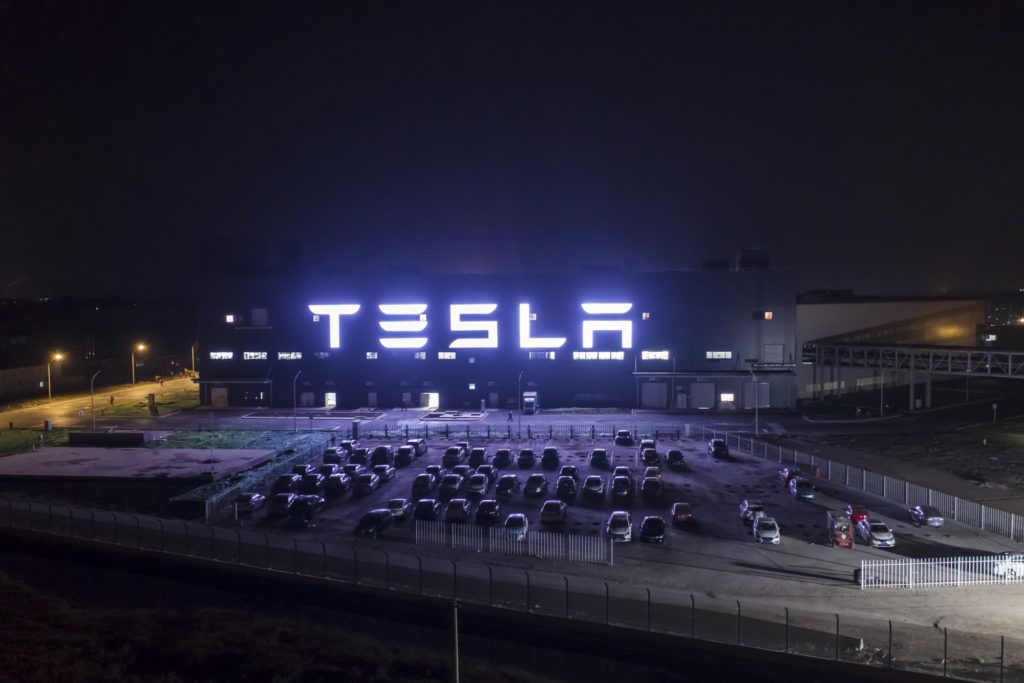
(Bloomberg) — Tesla Inc. increased its capital expenditure plan by billions of dollars after Chief Executive Officer Elon Musk referred to the carmaker’s new factories as “gigantic money furnaces.”

The revised plan was revealed Monday in a regulatory filing that also disclosed details of the electric-vehicle maker’s Bitcoin sales and another subpoena from securities regulators related to Musk’s 2018 tweet about taking Tesla private.

The company now expects $6 billion to $8 billion of capital expenditures this year and each of the next two years, according to its latest quarterly report. Tesla had previously estimated it would spend between $5 billion and $7 billion on ramping up manufacturing facilities and other items.

Musk told a Tesla owners club at the end of May that the company was struggling to boost production of Model Y sport utility vehicles at factories that recently opened near Berlin and in Austin, Texas. The carmaker still managed last week to beat estimates for second-quarter earnings, and the CEO’s optimism about emerging from supply-chain challenges sent shares soaring to the highest since early May.

Tesla’s shares rose 1.2% as of 8:15 a.m. Monday in New York.

The company also said it received a subpoena on June 13 from the US Securities and Exchange Commission about its compliance with an agreement to oversee Musk’s tweeting. It was the second subpoena the SEC has issued in months regarding how the company has governed its CEO’s social media postings after he claimed in 2018 to have had secured funding to take Tesla private.

See also: Musk’s Tweets Drew More SEC Scrutiny as He Soured on Twitter Bid

Tesla said it’s cooperating with regulatory and government requests.

Musk last month appealed a federal court ruling upholding the settlement.

Tesla disclosed it recorded a $170 million impairment loss in the first half of the year related to the carrying value of its Bitcoin holdings. It also reported a $64 million gain from selling the digital asset during the period.

Musk told analysts on a call last week after Tesla reported earnings that Tesla sold Bitcoin to bolster its cash position after the Shanghai shutdowns due to Covid-19 earlier this year.

Earlier: Tesla’s Bitcoin Dump Leaves Accounting Mystery in Its Wake

More stories like this are available on bloomberg.com

©2022 Bloomberg L.P.

Porsches Postponed by Buggy Software Cost VW’s CEO His Job

(Bloomberg) —

It says a lot about the state of the auto industry and where it’s going that software problems have cost the CEO of a carmaker his job.

Volkswagen ousted Herbert Diess as chief executive officer after severe software-development delays set back the scheduled launch of new Porsches, Audis and Bentleys. This was untenable considering buggy software postponed the debut of VW’s initial rollout of ID models, and customers are still having to drop off their cars at the dealer for updates the company has struggled to make over the air.

Sure, Diess also didn’t do enough to make allies and became increasingly isolated due to his hard-nosed leadership style. In his push to transform the company into an electric-vehicle leader, he repeatedly clashed with labor leaders by warning VW was losing out to Tesla and needed to cut thousands of jobs. But failures at the carmaker’s software unit Cariad ultimately eroded Diess’s support from the powerful Porsche and Piech family that calls the shots.

Back in December, VW overhauled its management board, stripping Diess of some responsibilities while tasking him to turn around Cariad. While there’s been a lot of re-arranging since then, Diess didn’t manage to make the issues go away.

Discord at Cariad has pushed back the rollout of important new models including the electric Porsche Macan, a high-volume sport utility vehicle for the division that’s planning an initial public offering in the fourth quarter. Audi’s new line of Artemis EVs has been delayed by around two years to 2027. And VW’s ultra-luxury brand Bentley may not be able to go all-electric by the end of this decade as planned because of the software issues, Automobilwoche reported earlier this month.

“Taking over the ship at Cariad seems to have been Diess’s downfall,” said Matthias Schmidt, an independent auto analyst based in Berlin.

VW’s solutions to challenges tend to reflect its status as an industrial behemoth: it’s able to throw lots of money and people at its problems. But modernizing the company for the digital age is going to take bringing in talent and building skillsets outside its traditional zones of expertise. Drivers increasingly demand intuitive user interfaces and services that could create new revenue streams, if done correctly.

“Software is the key to the future,” Tesla’s Elon Musk tweeted when one of his followers asked about VW switching CEOs.

Diess certainly didn’t lack ambition. His last spending plan called for investing 89 billion euros ($91 billion) in software and EVs over the next half decade. VW said last year it would eventually employ 10,000 people just within its software operation, which would make it one of Europe’s biggest companies in the space. Just three weeks ago, he teased major investments in China to employ several thousand software engineers in the biggest auto market.

The stakes also have been clear. Diess regularly referred to Nokia’s failure to respond to the emergence of Apple’s iPhone as a cautionary tale and his belief that self-driving functionality would bring about an even more fundamental transformation of the industry than the shift to battery power.

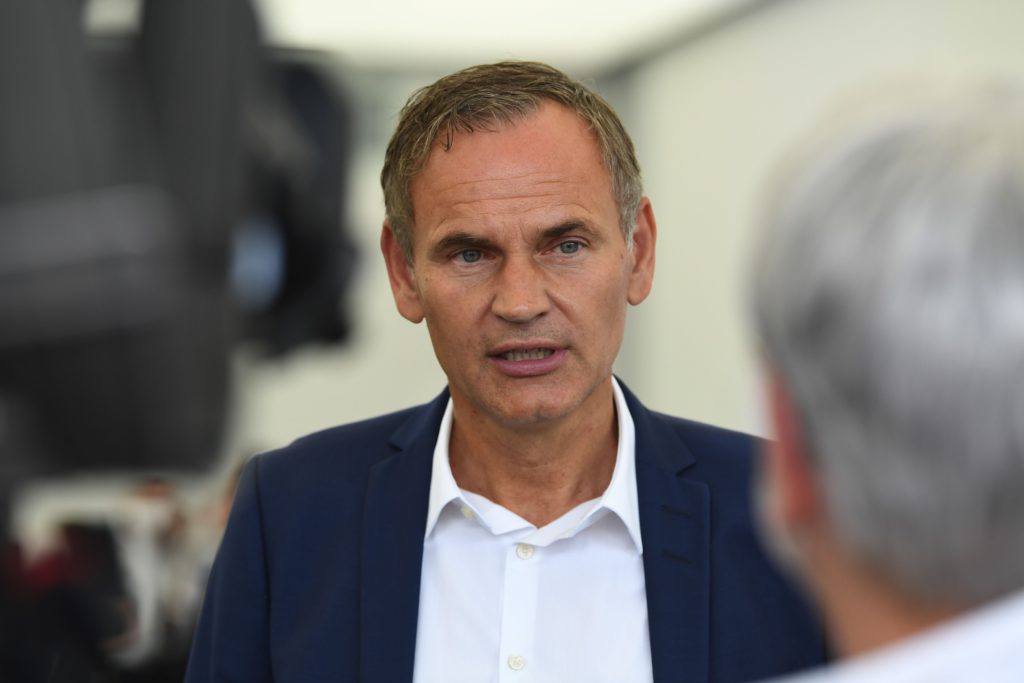
VW is now turning to Porsche boss Oliver Blume, banking on him being more of a team player and shrewd navigator of the group’s various factions. Unlike Diess, Blume isn’t a big presence on LinkedIn or Twitter, but he’s proven he can recognize automotive trends. The former Audi trainee who has headed Porsche since 2015 championed the Taycan, the sports-car brand’s first all-electric model, which now outsells the 911.

Leading VW out of its software morass won’t be an easy one. Schmidt said Blume needs to bring about a deeper cultural change at Cariad to make things work, and doubts that German automotive managers will be able to fix the business on their own.

“They should have head-hunted the best people from Silicon Valley,” Schmidt said. “You can’t lead on software with automotive people.”

More stories like this are available on bloomberg.com

©2022 Bloomberg L.P.

Elon Musk Denies Report of Affair With Sergey Brin’s Wife

(Bloomberg) — Elon Musk denied he had an affair with Sergey Brin’s wife, after the Wall Street Journal reported that the liaison led the Google co-founder to order his advisers to sell his investments in Musk’s companies.

Musk, the co-founder of Tesla Inc., had an alleged liaison in early December in Miami with Brin’s wife Nicole Shanahan, the Journal said, citing unidentified people familiar with the matter. That ended the long friendship between Musk, 51, and Brin, who helped support the electric carmaker during the 2008 financial crisis. Brin, 48, filed for divorce from Shanahan in January.

Musk said in a post on Twitter, where he has more than 100 million followers, that the Journal’s story was untrue, saying he’s seen Brin’s wife twice in three years, both times in the presence of other people, and there was “nothing romantic” between the pair. He also added that he’s still friends with Brin.

Read more: Sergey Brin Seeks Divorce From His Wife of Three Years

Brin had instructed his advisers to sell his personal investments in Musk’s companies in recent months after learning that he had a brief affair with his wife, according to the Journal. The size of Brin’s personal investments in Musk’s companies isn’t known, and it’s unclear whether there have been any sales, the newspaper said.

Musk is the world’s richest person with a $242 billion fortune, according to the Bloomberg Billionaires Index. Brin is the eighth-wealthiest, with a net worth of $94.6 billion.

The alleged affair is the latest in a string of revelations about Musk’s personal life. Reports earlier this year said he became the father to twins born to a senior executive at his artificial intelligence startup Neuralink.

Another of his companies, SpaceX, paid an employee $250,000 to settle a claim she was sexually harassed by Musk in 2016, according to Insider. Musk said the accusations were “utterly untrue” and designed to interfere with his acquisition of Twitter Inc., an agreement which he’s now trying to exit.

Musk’s affair with Shanahan took place in December at Art Basel in Miami, and Musk at another event asked Brin for forgiveness, according to the Journal. 

Brin and Shanahan are currently negotiating a settlement, with Shanahan seeking more than $1 billion, the Journal said, even though there’s a prenuptial agreement. 

(Updates with report of Musk asking for forgiveness in penultimate paragraph.)

More stories like this are available on bloomberg.com

©2022 Bloomberg L.P.

Even Tech Giants Like Amazon and Meta Can’t Escape the Slowdown

(Bloomberg) — Growth is sputtering across the technology world, and even usually invincible companies like Apple Inc. and Amazon.com Inc. can’t escape the slowdown.

With many of the biggest tech giants poised to report earnings in the next two weeks, investors are bracing for mostly bad news. Amazon is expected to grow at its slowest rate in decades. Chipmakers are lurching from boom times to a potential glut. And gig-economy companies such as Uber Technologies Inc. and DoorDash Inc. could be victims of consumer budget-cutting during a shaky economy.

Then there’s the pullback in online advertising — a shift that already ravaged sales of Snap Inc. and Twitter Inc. last week and is poised to weigh on results from Facebook parent Meta Platforms Inc. on Wednesday. 

The question for investors is how much of the slowdown is already reflected in stock prices. The tech-heavy Nasdaq 100 Index is down 24% this year, Amazon is down a bit more than that and Meta has lost half its value. 

Here is how tech industries are expected to fare as corporate results trickle in over the coming days:

Online Advertising

Research firm Magna estimates that the US digital ad market increased just 11% in the second quarter, a steep deceleration from 58% in the same period a year earlier. Growth will be especially anemic for social media ads, which have been hurt by Apple privacy changes that make it harder to target customers.

That’s left an increasingly crowded field of tech companies vying for a piece of the pie. Google and Facebook, which renamed itself Meta last year, were long the kings of online advertising. But Amazon and TikTok are now making inroads.

Meta is poised to report its first period of zero sales growth since the company’s initial public offering a decade ago, along with a 33% decrease in net income. Alphabet Inc., Google’s parent company, is expected to post its slowest sales increase since the start of the pandemic in 2020.

Facebook and Google “seem to be so much on the back foot right now,” said Eric Franchi, a general partner at AperiamVentures, a venture capital firm that invests in marketing and media startups. “Things have shifted really fast.”

There are still some bright spots in ad spending, said Sean Corcoran, US CEO of media agency Mediahub Worldwide. Some clients in sectors such as travel and entertainment are continuing to spend at a healthy clip, while others are in wait-and-see mode, he said.

“That’s kind of where people are at — they don’t know what to expect,” Corcoran said. “They don’t want to make the big cut. They want to keep the engines burning.”

Amazon Hits Brakes

Amazon isn’t just facing a historic slowdown in sales growth — it’s dealing with a hangover from its pandemic investments. When e-commerce spending surged after the Covid-19 outbreak, the company went into building mode, doubling its warehouse footprint to meet demand. Now that shoppers have gone back to physical stores, Amazon has too much capacity. So it’s subleasing space and reducing its hourly workforce through attrition. 

In the meantime, profit has taken a hit. Analysts are predicting earnings of 14 cents per share in the second quarter, with total net income expected to decline 82% from a year earlier. Profitability is expected to rebound in the second half of the year as Amazon slims down.

If there’s a full-blown recession, Amazon could still fare better than rivals — thanks to its reputation for low prices. During the global financial crisis in 2008, the company grew faster than the overall e-commerce industry.

For now, Amazon’s growth has slowed to a trickle. Revenue is projected to rise by 6%, the lowest in any quarter since 2001. And if you just look at Amazon’s online stores segment, the sales are expected to decline for a third straight quarter. The company’s cloud services division should continue to be a bright spot during the slump, helping bolster results. 

Gig Economy

The specter of an economic recession looms over ride-hailing and food-delivery apps like Uber, DoorDash and Lyft Inc., whose services may become more of a luxury as consumers’ budgets tighten. Already, shares of the companies have plunged this year, with the especially hard-hit Lyft losing more than two-thirds of its value.

DoorDash and Uber have benefited from a boom in takeout food orders during the pandemic, spurring an expansion into alcohol, convenience-store items and groceries. That area remains relatively strong. Delivery sales grew an estimated 23% at DoorDash last quarter from a year earlier and 31% at Uber. Still, order volumes are down from Covid-19 highs, and competition with peers like GrubHub and Instacart is intensifying.

Unlike Uber, Lyft still gets almost all its revenue from ride hailing, which suffered greatly during pandemic lockdowns. Demand has now rebounded, but a persistent shortage of drivers has proven costly. For Lyft, plans to ramp up spending on driver bonuses and incentives is fueling concern among investors that profit will get squeezed.

Travel Jitters

Travel executives proclaimed for months that the summer season would be their best yet. After all, Covid restrictions have been lifted in much of the world, and travelers have two years of pent-up demand. 

But summer got off to a rocky start, with labor strikes and staffing shortages plaguing airports in Europe and several US airlines cutting flight capacity. Add inflation and economic uncertainty to that, and the industry’s recovery could weaken. 

A ferociously strong dollar also is weighing on earnings, especially for companies like Booking Holdings Inc. and Airbnb Inc. Close to 87% of Booking’s revenue comes from foreign markets, with many sales denominated in pounds and euros, both of which have weakened this year. About half of Airbnb’s revenue last year came from overseas.

Such companies are still growing much faster than most tech giants right now. But some analysts are pulling back on their projections. Truist Securities’s Naved Khan sees third-quarter revenue of $2.71 billion for Airbnb, down from his previous estimate of $2.83 billion. That period is typically the company’s biggest sales season of the year. 

Apple’s Slowdown

Apple is expected to post its slowest quarterly sales growth since the early days of the pandemic. It already warned that supply-chain snags would reduce sales by much as $8 billion in the period, and now investors are worried about ebbing consumer demand as well.

In any case, Apple’s fiscal third quarter is a tough comparison with the year-earlier period, when sales jumped 36% — helped by customers stocking up on equipment to outfit their home offices during the pandemic. 

If there’s any growth in Apple’s business, it will be in online services. Analysts expect a record for the June quarter in that category, with sales reaching nearly $20 billion.

Chip Retreat

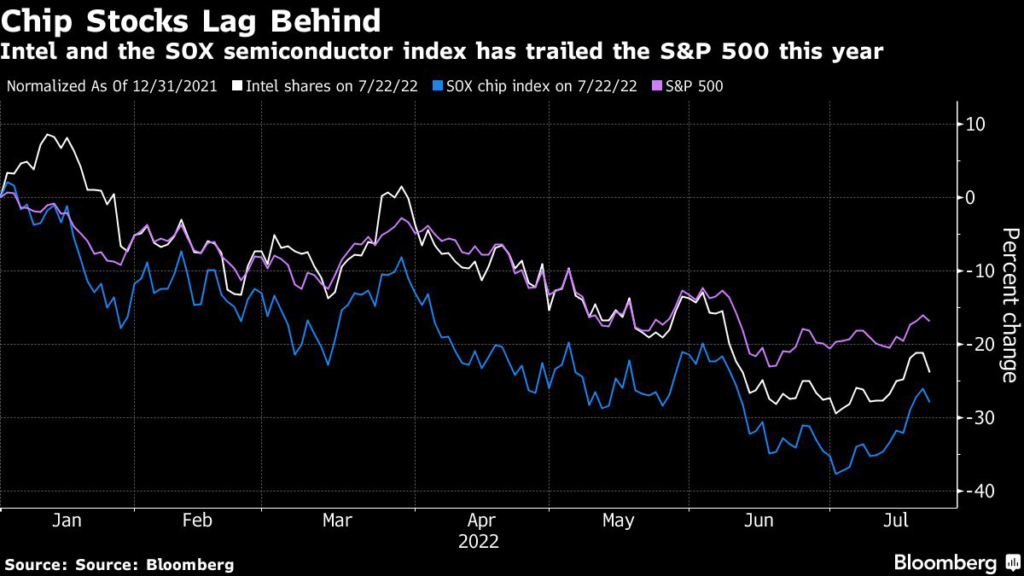
Surging sales of chips during the pandemic brought shortages and sent the industry scrambling to add capacity. But investors have become increasingly concerned that demand may have peaked. That’s reflected in the benchmark Philadelphia Stock Exchange Semiconductor Index, which is down 28% this year.

Texas Instruments Inc. will give its earnings report on Tuesday, providing vital clues about the state of the industry. It has the broadest product range among chipmakers and the biggest customer list. That makes it a bellwether for sales of everything from industrial machinery to space hardware to consumer electronics. Analysts expect Texas Instruments to report a 1% decrease in sales, compared with a 41% gain in the year-earlier quarter.

Intel Corp., the biggest US chipmaker, delivers its results on Thursday, alongside Apple and Amazon. Estimates indicate that revenue fell 3% in the second quarter, pushed down by lower demand for laptop chips. In June, Chief Financial Officer Dave Zinsner said the economy had gotten weaker and that it was going to affect Intel’s financial performance.


Tech Chart of the Day 

Tesla Inc. shares have risen for eight straight sessions, their longest streak since March, and they’re higher again in premarket trading Monday. A ninth gain would be the longest run since January 2021. The rally has added has added more than $121 billion to the electric-vehicle maker’s market capitalization. The shares have risen 21% in July, outperforming both the S&P 500 Index’s 4.7% rise and the tech-heavy Nasdaq 100’s 7.8% gain this month.

Top Tech Stories

  • Apple announced a rare retail promotion in China on Monday, offering four days of discounts on its top-tier iPhones and related accessories in advance of the launch of its next-generation devices.
  • Elon Musk denied he had an affair with Sergey Brin’s wife, after the Wall Street Journal reported that the liaison led the Google co-founder to sell his investments in Musk’s companies.
  • Eutelsat Communications SA is in talks about a combination with UK satellite rival OneWeb Ltd., a step toward creating a European champion to rival the likes of Elon Musk’s SpaceX. Eutelsat slumped as much as 19% in Paris trading.
  • Crypto platform Voyager Digital LLC said a joint offer proposed by FTX and Alameda is a “low-ball bid” that disrupts the bankruptcy process, according to a court filing.
  • Infosys Ltd. raised its annual revenue outlook, saying the company’s order book was as strong as it had been for much of 2022. The stock initially fell on investor concern about worsening margins and tepid global IT spending before rebounding.
  • Shares of Indian online food-delivery and restaurant platform Zomato Ltd. plunged in Mumbai after the end of a lock-up period for investors that had stakes in the company prior to its initial public offering.
  • Rogers Communications Inc. expects to spend C$10 billion ($7.7 billion) over the next three years to improve network reliability after a massive outage this month, Chief Executive Officer Tony Staffieri said in a letter to customers seen by the Globe and Mail.
  • Peter Thiel-backed Valar Ventures is leading a $40 million financing round into European investing app Shares.
  • Google has fired a software engineer, Blake Lemoine, who worked on the company’s artificial intelligence development team over his public contention that he had conversations with a bot that had become “sentient.”

More stories like this are available on bloomberg.com

©2022 Bloomberg L.P.

A $40 Billion Wireless Sector Meltdown Puts Focus on T-Mobile

(Bloomberg) — AT&T Inc. and Verizon Communications Inc. shocked investors with their second-quarter results last week — the former warning about the high cost of phone giveaways and the latter failing to meet growth targets. 

The news sparked a sell-off that erased some $40 billion in market value from the three industry leaders. Now T-Mobile US Inc. is cast as the potential Goldilocks in this drama — if its second-quarter results are just right.

T-Mobile reports financial results Wednesday morning before markets open. Investors will be eager to see if the wireless industry is starting to see a slowdown in consumer spending due to decade-high inflation, or if some of the troubles might be more self-inflicted.

“Sometimes the macro environment, or the change of century or even El Nino provides a convenient excuse for what might in reality be an execution issue,” said LightShed Partners analyst Walt Piecyk.

Take AT&T. Its surprisingly big customer gain of 1.06 million was fueled in part by phone giveaways. The promotions, worth $800 or more per buyer, make for big upfront costs for the carriers. They are designed to pay off over time, as the customer sticks around. 

But those promotions and other costs add up, cutting into free cash flow. Which is why AT&T lowered its full-year forecast again last week. The stock dropped 7.6%. And in an alarming note to to those watching the overall economy, AT&T said some customers were feeling the pinch of higher costs and delaying their bill payments by two days on average. 

Verizon, the largest US carrier, tried to stay away from the free phone battle at least until the middle of the quarter, when the company then shifted into gear in an effort to spend its way back to growth.

The company ended up with a different problem: It added only 12,000 monthly wireless phone subscribers in the second quarter, well below analysts’ predictions for 167,200 new phone customers. 

In a saturated mobile market, where everyone already has a phone, new monthly customers are usually found by moving people with poor credit history off cheaper prepaid services and on to regular monthly plans. It’s possible AT&T may have attracted too many customers who now have overdue bills.

Verizon is more selective about that movement, according to Chief Financial Officer Matt Ellis. 

“We’re very comfortable with the quality of our customers,” Ellis said in an interview Friday.

While Verizon said it wasn’t seeing any increase in delinquent customers, Chief Executive Officer Hans Vestberg said on an earnings call that the company was being affected by an “inflationary environment.” He didn’t offer specifics.

Higher prices might be cooling off some consumer spending, but mobile is a different expense all together, said Maribel Lopez, an analyst with Lopez Research.

“Wireless spending remains strong, as most consumers consider this an essential,” she said.

Looking ahead to Wednesday, Wall Street expects T-Mobile, the second-largest US wireless carrier, to report nearly 1.2 million new monthly subscribers, which would top AT&T’s gain and put it well above Verizon. 

If T-Mobile can post industry-leading subscriber growth without a dramatic dent in free cash flow, which is expected to be $1.4 billion, then the industry might not be looking at a widespread economic challenge.

If T-Mobile stumbled somewhere it’s probably not because of the economy, said Piecyk.

“T-Mobile doesn’t need macro issues to blame for any hiccups in the quarter, they still have a big bucket of Sprint integration expenses to lean on,” he said.

More stories like this are available on bloomberg.com

©2022 Bloomberg L.P.
Moelis Brushes Off Crypto Winter to Start Blockchain Group

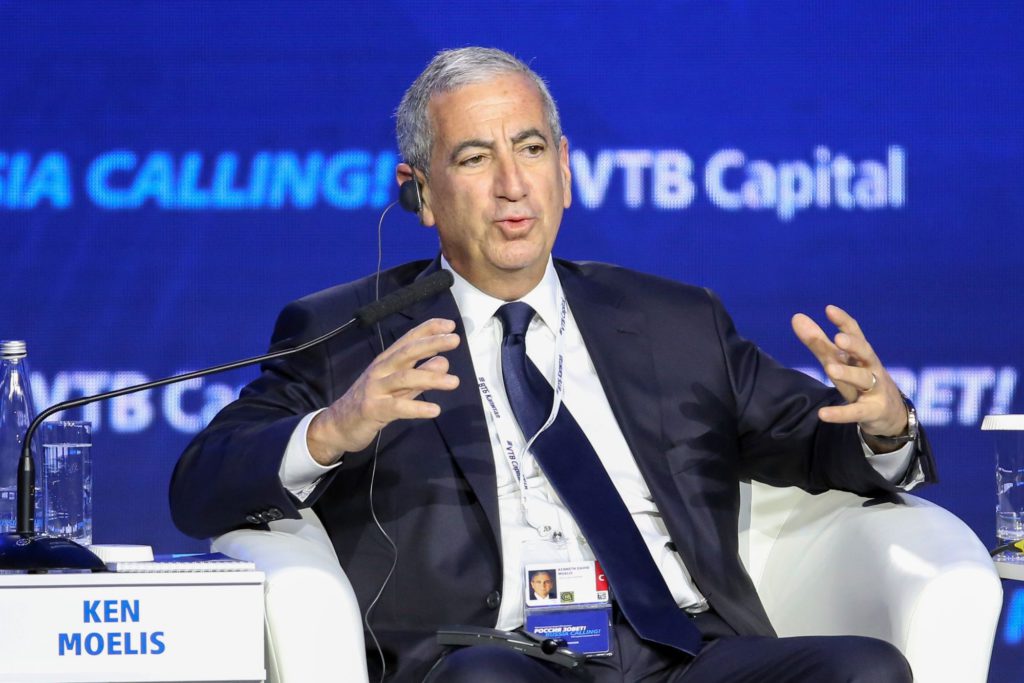
(Bloomberg) — Moelis & Co., the investment bank founded by billionaire Ken Moelis, is starting a group to focus on global blockchain deals after a spate of transactions among crypto firms. 

John Momtazee, who co-founded Moelis and is the global head of media investment banking, is overseeing the effort. Longtime venture investor Lou Kerner is joining the firm as a senior adviser to the group, reuniting the two executives who worked together more than 20 years ago.

Moelis is starting its effort as venture funding in the industry has tumbled and the price of Bitcoin has plummeted to less than one-third of its peak price of more than $68,000 in November. 

The so-called crypto winter hasn’t phased Moelis. Companies including Celsius Network have filed for bankruptcy, while several large investors are mulling acquisitions.

“We love the timing. We think that to pile in on good days and say, ‘Here we are, ready to help,’ feels less genuine than when there’s a challenge,” Momtazee said in an interview. “Any disruptive technology is going to have volatility.”

Moelis has already been advising on deals in the industry. It was hired by crypto broker Voyager Digital Ltd., which has filed for bankruptcy and has reached out to dozens of potential strategic partners, according to a regulatory filing.

The New York-based investment bank has also worked with clients including Ripple Labs Inc. and CipherTrace, which was acquired last year by Mastercard Inc.

Crypto Wallets

Momtazee said the blockchain group will work with other industry teams across the nearly two dozen Moelis offices around the world. The interest within the firm has also been substantial. At a conference of the firm’s managing directors, Momtazee said more than 30% said they had crypto wallets. 

“I suspect that the junior bankers and mid-level bankers actually are more active,” said Momtazee. “This is a young person’s world.” 

Ken Moelis also personally has exposure to the space, becoming an investor in blockchain firm Paxos in 2020. Last year, he likened the crypto industry to the California gold rush of 1848, while also expressing some caution. 

Kerner, who worked with Momtazee at the dot-com era startup The .TV Corp., is also the founder of consulting firm CryptoOracle Collective.

Dot-Com Parallel

While there haven’t been many big-ticket blockchain related transactions yet, Moelis is betting that the companies will keep growing and beget larger deals. Momtazee said it’s analogous to the period following the dot-com crash, when there were deals happening but they were smaller because of the size of the companies.

“As we see this explosion of value, M&A deal values will probably correlate very highly with the expansion of the market cap in the blockchain space,” he said.

Momtazee is invested in funds at a separate firm where Kerner is a partner, Blockchain Coinvestors, as well as in funds tied to Blockchain Capital and Dan Morehead’s Pantera Capital. He also has investments in individual companies, and said the bank is thinking about whether investing in companies directly could make sense. 

Blockchain technology solves a lot of problems, Momtazee said, adding “We’re in the early ages of that revolution.”

More stories like this are available on bloomberg.com

©2022 Bloomberg L.P.
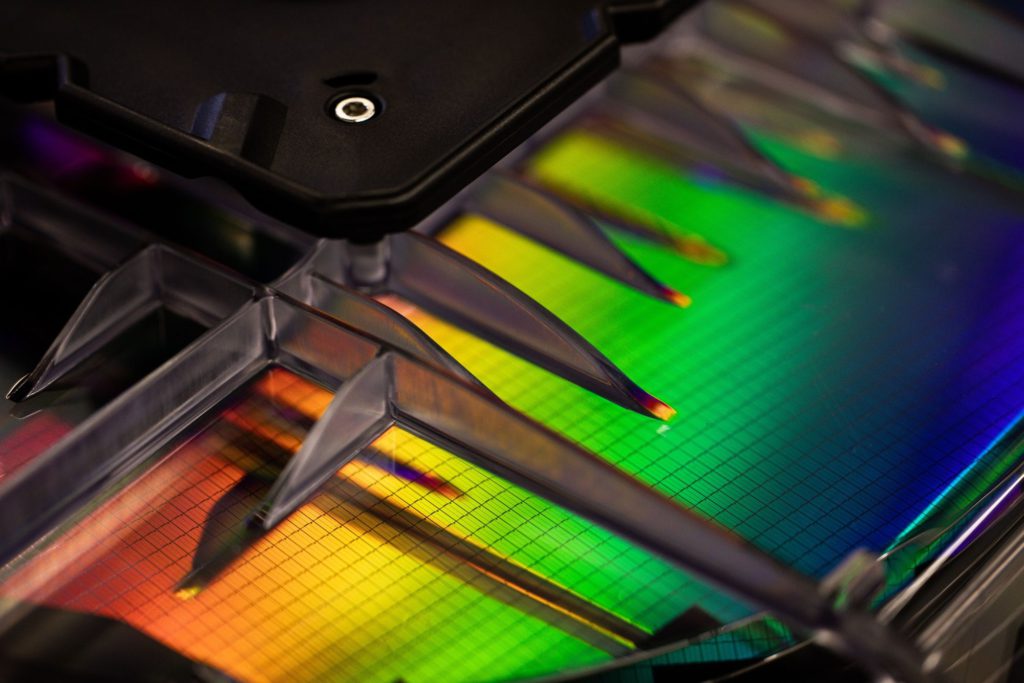
Manufacturing CEOs Want to Bring More Chip Production to US to Counter Global Shortage

(Bloomberg) — Sign up for the New Economy Daily newsletter, follow us @economics and subscribe to our podcast.

Bringing more semiconductor production to the US could help counter the global chip shortage, according to a majority of American heavy-equipment manufacturers in a survey.

Almost 90% of whole-good, component and portable-good manufacturers said ramping up the domestic output of components and chips could relieve supply-chain pressures, a survey by the Association of Equipment Manufacturers released Monday showed. 

Also, 91% of surveyed chief executive officers said the federal government should invest more in training, as four in five companies have delayed production because of skilled-labor shortages since companies began dealing with chip shortages last year, it found.

About 79% of the executives surveyed said they had to raise prices on finished products and 60% saw delays in production because of the shortages.

As companies worldwide report second-quarter results, complaints about chip shortages related to the pandemic continue to emerge in analyst calls. Carmakers worldwide — from Sweden’s Volvo Car AB to South Korea’s Kia Motors — are still seeing disruptions caused by the lack of enough chips.

Meanwhile, chipmakers are doubling down to expand their production capacity in the US. Samsung Electronics Co. is considering spending almost $200 billion on 11 semiconductor manufacturing facilities in Texas, and GlobalWafers Co. plans to build a $5 billion silicon-wafer facility in the state that will be the biggest of its kind on American soil.

Last week, the US Senate voted by a wide margin to begin a debate on legislation to provide more than $52 billion in grants and incentives for the American semiconductor industry. A draft bill in consideration includes a 25% investment-tax credit for the manufacturing of chips and the tools to create them, $200 million for worker training and $1.5 billion for public wireless supply-chain innovation.

The survey was conducted between June 27 and July 6, and included responses from 100 US-based CEOs.

More stories like this are available on bloomberg.com

©2022 Bloomberg L.P.

Marcos Bats for Digital Tax, Solar Power in 8% Growth Push

(Bloomberg) — Sign up for the New Economy Daily newsletter, follow us @economics and subscribe to our podcast.

Philippine President Ferdinand Marcos Jr. pushed to tax digital services, pledged to sustain robust spending on infrastructure and vowed never to enforce another lockdown to hit an 8% growth during his term.

“Our tax system will be adjusted in order to catch up with the rapid development of the digital economy,” Marcos said in his first speech before Congress on Monday, laying down his legislative agenda that includes a continuing tax reform, changes to energy and infrastructure-enabling laws, and streamlining government operations.

Imposing value-added tax on digital services, which is Marcos’s first revenue-generating proposal, will yield an initial 11.7 billion pesos ($208.6 million) in revenue in 2023 if passed by Congress, he said. Boosting collections, also by simplifying and automating tax processes, would help cut debt below 60% of gross domestic product by 2025 and narrow the budget deficit to 3% of GDP by 2028, he said.

The Southeast Asian nation aims to expand GDP by 6.5%-7.5% this year and grow by as much as 8% through the end of his term in 2028, Marcos said, reiterating projections made by his economic team earlier this month. The last time the Philippines recorded growth above 8% was in 1976 under the late dictator Marcos Sr., the president’s father and namesake.

While the Philippines remains one of Asia’s fastest growing economies, the quickest inflation since 2018, rising interest rates and a weaker currency are threatening its pandemic recovery. To this, Marcos vowed to keep the economy open, resume in-person education and provide relief to the agriculture sector.

No More Lockdown

“We can’t afford another lockdown. We need to balance the health and well-being of our countrymen on one hand and the economy on the other,” Marcos said, prompting applause and standing ovation from lawmakers. “Spending efficiency will be improved to immediately address the economic scarring arising from the effects of Covid-19, and prepare for future shocks.”

He vowed to build the country’s health care capacity especially outside the capital Manila and support the welfare of nurses and doctors. In a bid for more investment, Marcos said the country’s economic zones would be equipped to welcome companies in health care. The trade department, he said, is in talks with manufacturers of generic medicines to bring down the cost of drugs.

Marcos, who is also the agriculture secretary, proposed a one-year moratorium on farmers’ loan payments and write off some obligations to give the sector some breathing space. 

Nuclear Power

The Philippines must build new power plants and reexamine its strategy on nuclear power, Marcos said, citing rising demand. It must take advantage of renewable energy, such as solar and wind, and also study providing incentives for gas exploration.

The government will also look into the nation’s “precarious” water supply situation and explore ventures with private companies, he said. Marcos said he will build on his predecessor’s infrastructure program to help drive growth and employment, vowing to sustain spending at 5% of GDP. “We must keep the momentum, and aspire to build better more.”

On foreign policy, Marcos said he will “not preside over any process that will abandon even a square inch of territory” to any foreign power. “We will not waver. We will stand firm in our independent foreign policy, with the national interest as our primordial guide.”

More stories like this are available on bloomberg.com

©2022 Bloomberg L.P.
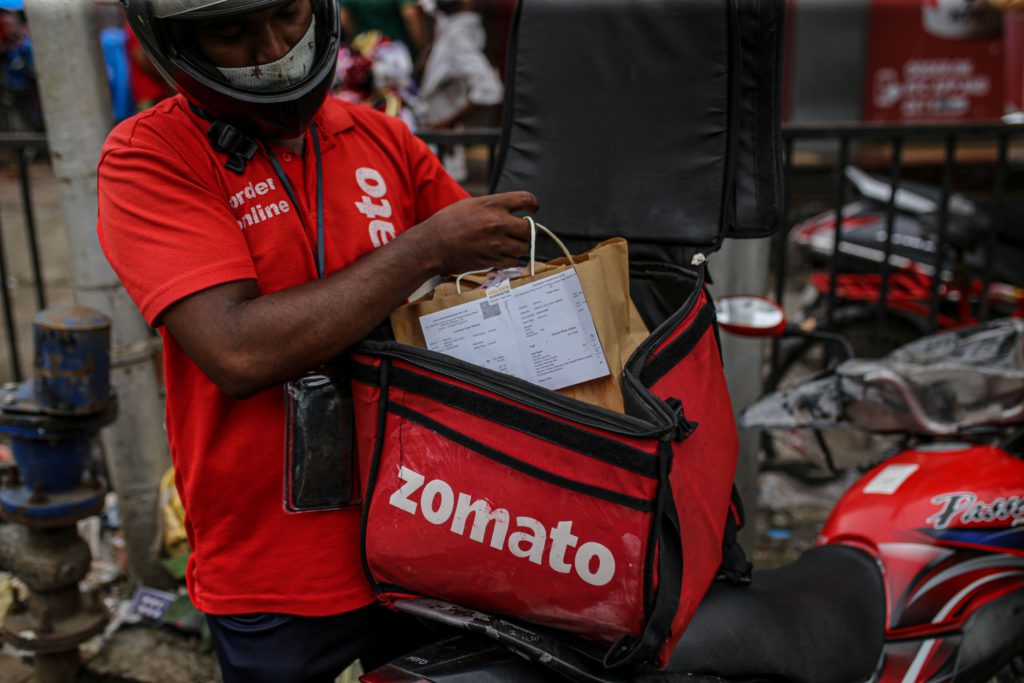
Zomato Plunges 11% to Record Low as IPO Lock-Up Period Ends

(Bloomberg) — Shares of Indian online food-delivery and restaurant platform Zomato Ltd. plunged in Mumbai after the end of a lock-up period for investors that had stakes in the company prior to its initial public offering.

The stock dropped 11% to a record low of 47.60 rupees. 

Zomato’s offering last July raised close to $1.3 billion and lured investors including Morgan Stanley and Fidelity Investments. China’s Ant Group Co. was an early holder, having initially invested in it in 2018, owning a stake of about 16% before the share sale.

After a surge following the debut about one year ago, Zomato shares pared those gains to now trade about 40% below the IPO price. That compares to a 4.9% increase for the Nifty 50 Index over the same period.  

Zomato’s successful IPO last year set the tone for the coming-out parties of a generation of Indian unicorns, including digital-payments firm One 97 Communications Ltd. But their shares have also plummeted as doubts persist about the valuations of loss-making technology firms, particularly as global macroeconomic uncertainty mounts.

The company is competing against deeper-pocketed rivals including Amazon.com Inc. and Naspers Ltd.-backed Swiggy, presenting hurdles in how quickly it can become profitable. Its recent acquisition of fellow startup Blinkit in quick-commerce, another high-competition, high-cash-burn segment, has left investors unimpressed.

“The shine of new age IT stocks is fading away at a very fast pace,” said Mohit Nigam, a fund manager with Hem Securities Ltd. Zomato’s $570 million acquisition of quick-commerce firm Blinkit, which loses 84 rupees ($1.10) per order, has acted as a catalyst in the stock’s downward movement, he said.

The delivery giant reported a smaller-than-expected loss for the March quarter. Some analysts anticipate Zomato will narrow its red ink over time, and point out that the meal-delivery market remains in its infancy.

Zomato is the latest Asian technology company to see shares under pressure following the end of IPO lock-up periods. Chinese artificial-intelligence-software maker SenseTime Group Inc.’s collapsed in Hong Kong last month once restrictions on sales by cornerstones ended.

(Updates price in headline, second paragraph, adds analyst comment.)

More stories like this are available on bloomberg.com

©2022 Bloomberg L.P.

Who Is Nicole Shanahan, Woman at Center of Musk-Brin Drama?

(Bloomberg) — Silicon Valley entrepreneur and philanthropist Nicole Shanahan emerged this weekend at the center of a rift between two of the world’s richest men, Sergey Brin and Elon Musk. 

Shanahan and Brin have been married for over three years but announced in June they plan to divorce, citing “irreconcilable differences.” The Wall Street Journal reported this weekend that Musk and Shanahan had an extramarital affair, an allegation that Musk has since denied. A spokeswoman for Shanahan didn’t respond to requests for comment, according to the WSJ.

Shanahan and Brin signed a prenuptial agreement and are currently negotiating the terms of their divorce, in which she seeks more than $1 billion, according to the report. That could put the settlement of her divorce in the same league as those of billionaire philanthropists MacKenzie Scott and Melinda Gates.

Lawyer, Founder

Now an attorney and a research fellow at CodeX, the Stanford Center for Legal Informatics, Shanahan founded ClearAccessIP, a Palo Alto-based firm that helps patent owners manage and monetize their intellectual property rights. It was acquired by rival IPwe in 2020.

A daughter of Chinese immigrants, Shanahan has talked about her mother, who worked as a maid, and growing up on public assistance. According to her LinkedIn profile, she graduated from the University of Puget Sound in Washington State, where she studied economics, Asian studies and Mandarin Chinese. She earned her law degree at Santa Clara University, doing a stint as an exchange student at the National University of Singapore.

Foundation Work

In 2019, Shanahan started her own foundation, Bia-Echo, and pledged $100 million to reproductive longevity — access to medical technologies that help women bear children later in life — and criminal justice reform, along with other issues. She is also a supporter of left-leaning organizations and Democratic political candidates.

“I want to get the word out that and assure everyone that I am committed as ever to dedicating my life’s work to social justice, climate solutions and a thoughtful, caring democracy,” Shanahan said in an interview with Puck this month. “And I actually think that as I move forward out of this separation, I feel very optimistic in how I might grow in this role.”

More stories like this are available on bloomberg.com

©2022 Bloomberg L.P.
Close Bitnami banner
Bitnami