

Bloomberg

Marcos Bats for Digital Tax in Congress Speech to Cut Debt

(Bloomberg) — Philippine President Ferdinand Marcos Jr. pushed for a tax on digital service providers to help narrow budget deficit and debt levels in his first speech before Congress as he pledged to prioritize fiscal management.

“Our tax system will be adjusted in order to catch up with the rapid development of the digital economy,” Marcos said in his annual State of the Nation Address on Monday. Imposing value-added tax on digital services, if approved by Congress, will yield an initial 11.7 billion pesos ($208.6 million) in revenue in 2023, he said.

This is Marcos’s first revenue-generating proposal as he targets to bring down the country’s outstanding debt below 60% of gross domestic product by 2025 while sustaining pandemic recovery in an environment of rising prices and declining local currency.

The Southeast Asian nation is aiming to expand GDP by 6.5%-7.5% this year and grow by as much as 8% through the end of his term in 2028, Marcos said, reiterating projections made by his economic team earlier this month. The budget deficit should narrow to 3% by 2028 while poverty rate should decline below 10% by then, he said.

No More Lockdown

The Philippines won’t be implementing another lockdown, Marcos said, as he vowed to build the country’s health care capacity while supporting the welfare of nurses and doctors. The country will also resume full in-person education, the president said, without providing a definite time line.

The trade department is in talks with companies that will produce generic medicines to bring down the cost of drugs, while the government intends to build more clinics and hospitals outside of capital Manila to bring health care closer to the people, he said.

Philippines must build new power plants and reexamine its strategy on nuclear power, Marcos said, citing rising demand. It must take advantage of renewable energy, such as solar and wind, and also study providing incentives for gas exploration.

The government will also look into the nation’s “precarious” water supply situation and explore ventures with private companies, he said.

Other measures proposed by Marcos include:

  • “Fully” supporting economic zones, especially for companies involved in manufacturing and healthcare, aiming to make the Philippines an investment destination
  • Pursuing measures to determine undervaluation, mis-invoicing of imported goods
  • Streamlining the customs agency and simplifying tax payments through digitalization

More stories like this are available on bloomberg.com

©2022 Bloomberg L.P.
Julius Baer Says Worst Is Over After Wild Markets Erode Profit

(Bloomberg) — Julius Baer Group Ltd. said the worst of the market selloff may be over for the Swiss wealth manager after a first half that was one of the most difficult in decades.

Clients have started to come back and will probably look for ways to make money again in the second half, Chief Executive Officer Philipp Rickenbacher said in an interview Monday. First-half profit slumped 26% as wild market swings spooked wealthy investors and eroded assets the firm oversees for the rich.

“I think the worst is through, at least for what we have seen,” Rickenbacher said on Bloomberg TV. “While it’s a bit too early to see a full swing re-leverage yet, I think clients will look very closely at opportunities in the second half.”

The results are the first indication how Switzerland’s large wealth managers navigated volatile markets and surging inflation that are weighing on clients’ risk appetite and threatening to drive up bad loans. Julius Baer said in May that it’s stepping up efforts to rein in costs as clients remain on the sidelines, including by streamlining the markets where it operates and using technology. 

Julius Baer shares reversed losses to rise 2.1% at 10:44 a.m. in Zurich. They had declined as much as 5% earlier, as operating profit missed analysts’ estimates, costs rose and a hiring freeze suggested the firm remains cautious for now.

Operating costs rose 5.8% in the first half, driven by provisions and losses from a legacy litigation case. But personnel expenses decreased by about 1% as the firm reduced the bonus pool to reflect a weaker business performance.

Assets under management slumped 11% from the end of last year, mainly driven by market swings. While clients pulled 1.1 billion francs over the six months, Julius Baer said inflows have started to come back recently.

Rate Boost

Net income fell because of lower transaction- and trading-driven income. However, net interest income rose as banks across Europe stand to benefit from the end of negative interest rates that have saddled them and their clients with costs to hold excess deposits. Julius Baer said last week it will no longer charge negative interest rates on client deposits in euro, Swiss franc, and Danish krone as of Aug. 1.

Russia’s invasion of Ukraine and the ensuing sanction on some of the country’s wealthiest people is also upending wealth management and private banking plans from Zurich to New York. For Julius Baer, the regulatory risks are particularly acute after the bank came under regulatory fire over a money laundering scandal in Latin America.  

The firm said it has initiated the wind-down of its advisory subsidiary in Moscow, in compliance with local regulations and contractual agreements. The net asset value of this entity on 30 June 2022 was CHF 1.2 million.

More stories like this are available on bloomberg.com

©2022 Bloomberg L.P.

Philippines Tycoon, Duterte’s Ally’s Stocks Tumble on Default Notice From Banks

(Bloomberg) — Stock shares controlled by Philippine businessman Dennis Uy slumped after one of his company’s units received a default notice from a consortium of banks, threatening further losses to an already struggling market.

Prices for oil firm Phoenix Petroleum Philippines Inc. slid 11% Monday, and shipping company Chelsea Logistics & Infrastructure Holdings Corp. plunged as much as 16% before closing 12% lower. A gauge of financial stocks dropped 2.8%, the steepest loss in a month.

Uy’s Udenna Corp. received a default notice on July 22 against its affiliate, Clark Global City Corp. Banks led by BDO Unibank Inc., the Philippines’ biggest lender, said Udenna had failed to pay $4 million in debt related to an airport lease agreement.

In a statement on Monday, Udenna said the company had settled the debt issue “to the satisfaction of the majority lender.” BDO Unibank said Uy’s obligations were secured and that a potential default wouldn’t have a material adverse effect on the bank.

Still, that did little to ease market jitters on Monday. Shares of BDO sank 4.6%, outpacing losses among Philippine lenders. The Philippines’ benchmark stock index, Asia’s second-worst performer this year, dropped 0.9% at the close, improving on an earlier loss of as much as 1.6%. 

Other Udenna units that struggled included Dito CME Holdings Corp., a telecommunications company, which plunged as much as 9.1%. PH Resorts Group Holdings Inc., Udenna’s casino venture, slumped 7.5% before paring losses to 2.5%. 

“Investors are seeing a lower value for the stocks because of the risk this could spread to other companies within the group and affect its ability to raise financing,” said Astro del Castillo, managing director at First Grade Finance Inc. He added that Uy-linked stocks will be considered “high risk” until the issue is revolved. 

Udenna, a conglomerate with investments in everything from oil to casinos, has seen its debt grow following a series of deals made during former President Rodrigo Duterte’s six-year term. 

Following volatility in global markets and project delays, the firm said in May that it was exploring asset sales and alliances for some of its businesses. Amid a government probe, Uy also put on hold a project to develop the nation’s only operating gas field.

Udenna had total liabilities of 254.5 billion pesos ($4.5 billion) by the end of 2020, according to its annual report filed with the Securities and Exchange Commission.

(Updates share prices and company details)

More stories like this are available on bloomberg.com

©2022 Bloomberg L.P.

From BlackRock to Uniswap: Mary-Catherine Lader In Her Own Words

  • Listen to Bloomberg Crypto on the iHeartRadio App
  • Listen to Bloomberg Crypto on Apple Podcasts
  • Listen to Bloomberg Crypto on Spotify  

(Bloomberg) — Mary-Catherine Lader has a story to tell. She was a rising star at fund giant BlackRock when she left Wall Street and TradFi for crypto and DeFi. She’s now  chief operating officer at Uniswap Labs, creator of the world’s biggest decentralized exchange protocol. She joined Bloomberg Reporter Olga Kharif to talk about her belief in blockchain, what comes next after the Terra collapse, and how she sees decentralized finance shaping the future. 

Follow us on Twitter @crypto, and subscribe to the Bloomberg Crypto Newsletter at https://bloom.bg/cryptonewsletter

More stories like this are available on bloomberg.com

©2022 Bloomberg L.P.

Vodafone Sales Rose After UK Growth Offset German Weakness

(Bloomberg) — Vodafone Group Plc delivered sales growth narrowly ahead of estimates in the first quarter after UK growth helped offset weakness in its biggest market, Germany. 

  • Organic service revenue rose 2.5% in the quarter that ended in June, the Newbury, England-based phone company said in a statement on Monday, versus the 2.4% gain forecast by analysts surveyed by Bloomberg.
  • A 6.5% jump in UK sales came partly from price rises and a rebound in holiday roaming revenue post Covid restrictions, while the group tries to move past issues with new customer re-contracting regulations at Vodafone Deutschland, where service revenue fell 0.5%.

Key Insights

  • The group reiterated its outlook for 2023 adjusted earnings between 15 billion euros ($15.3 billion) and 15.5 billion euros before interest, tax, depreciation and amortization after leases, and adjusted free cash flow of about 5.3 billion euros.
  • Vodafone has a “near-term focus” on deal opportunities for its European operating companies as well as with infrastructure arm Vantage Towers, Chief Executive Officer Nick Read said in the statement on Monday. Earlier in July, rival Deutsche Telekom AG agreed to sell a majority stake in its towers unit, valuing the business at 17.5 billion euros, one of the largest such deals this year.
  • On a call with reporters, Read said market turbulence added “complexity” to potential deal talks. “We have on towers very good engagement with a number of partners and we are advancing those discussions,” and “on our fiber JV in Germany we’re seeing very strong demand.” He declined to elaborate on consolidation talks.
  • The company warned in May that inflation could hurt growth in the next year, adding pressure to Read’s attempts to consolidate Vodafone’s business and improve returns.
  • High inflation at Vodafone’s smaller Turkish business also boosted revenue.
  • Chief Financial Officer Margherita Della Valle estimated energy costs are currently on track to be about 300 million euros higher than last year’s. That was an increase from the company’s previous estimate of an additional 200 million euros in energy costs.

Market Context 

  • Vodafone shares were little changed at 9:15 a.m. in London.
  • Vodafone shares have gained 15% this year through Monday, versus a 1.5% loss in the FTSE 100 and a 0.8% loss in the Stoxx 600 Telecommunications Index over the period.
  • Of 26 analysts surveyed by Bloomberg, 15 rate the stock Buy, 9 Hold and 2 Sell.

Get More

  • Statement
  • NOTE, June: Vodafone’s Mobile Phones Were the Future Once. Now What Happens?

(Updates with management comments starting in fifth bullet point)

More stories like this are available on bloomberg.com

©2022 Bloomberg L.P.
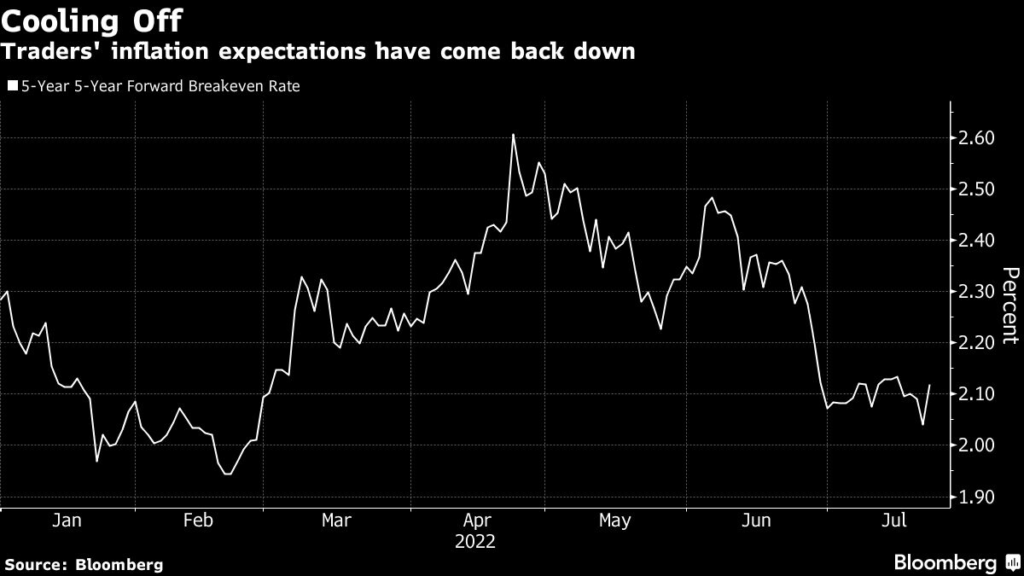
Stocks, Futures Fluctuate Amid Recession Concerns: Markets Wrap

(Bloomberg) — Stocks and US equity futures wavered Monday amid concerns about a dimming economic outlook and possible recession.

European stocks pared losses after their best week since May, as energy shares fell with oil and bank stocks rose. S&P 500 and Nasdaq 100 futures fluctuated, while China’s property shares pushed higher amid a report that officials plan a fund to support struggling developers. 

Treasury yields advanced, paring a sliver of last week’s drop, and a dollar gauge was little changed.

Investors are monitoring weaker economic data amid expectations the Federal Reserve will inflict more pain on the economy to get inflation under control and as European Central Bank Governing Council member Martins Kazaks said there may be more big increases in interest rates. 

German business confidence deteriorated to the worst level since the early months of the pandemic on growing concerns that record inflation and limited energy supplies from Russia will throw Europe’s biggest economy into a downturn.

The Federal Reserve policy decision this week, along with earnings from the likes of Google’s Alphabet Inc. and technology titan Apple Inc., will help to clarify the outlook for a one-month-old rebound in stocks.

“We still see further downside for risky assets as recession fears accumulate and central banks remain committed to fighting inflation at the expense of growth,” wrote Eric Robertsen, chief strategist at Standard Chartered Bank Plc.

Swaps tied to Fed meeting outcome dates indicate another 75 basis-point interest-rate hike Wednesday. Expectations for the peak in the policy rate have moderated to about 3.4% roughly by year-end. Cuts are then expected in 2023.

Bear-Market Blues

“We don’t think that this bear market is going to end until there’s some evidence of nearing a bottoming of economic data or a pivot by the Fed toward a more dovish stance,” Nadia Lovell, UBS Global Wealth Management senior US equity strategist, said on Bloomberg Radio.

Retreating business activity and mixed earnings performance from major firms left US shares in the red on Friday. Treasury Secretary Janet Yellen said she doesn’t see any sign that the US is in a broad recession. Former Treasury Secretary Lawrence Summers said a soft landing is highly unlikely.

Elsewhere, wheat climbed as commodity markets evaluated a Russian missile strike on Odesa’s sea port that threatened to test a fledgling agreement to unblock Ukrainian grain exports from the Black Sea.


Here are some key events to watch this week:

  • Alphabet, Apple, Amazon, Microsoft, Meta earnings due this week
  • Bank of Japan minutes, Tuesday
  • IMF’s world economic outlook update, Tuesday
  • EU energy ministers emergency meeting, Tuesday
  • Fed policy decision, briefing, Wednesday
  • Australia CPI, Wednesday
  • US GDP, Thursday
  • Euro-area CPI, Friday
  • US consumer income, University of Michigan consumer sentiment, Friday

Some of the main moves in markets:

Stocks

  • The Stoxx Europe 600 was little changed as of 9:43 a.m. London time
  • Futures on the S&P 500 rose 0.2%
  • Futures on the Nasdaq 100 rose 0.3%
  • Futures on the Dow Jones Industrial Average rose 0.2%
  • The MSCI Asia Pacific Index rose 0.5%
  • The MSCI Emerging Markets Index was little changed

Currencies

  • The Bloomberg Dollar Spot Index was little changed
  • The euro was little changed at $1.0216
  • The Japanese yen fell 0.2% to 136.33 per dollar
  • The offshore yuan rose 0.2% to 6.7544 per dollar
  • The British pound rose 0.2% to $1.2020

Bonds

  • The yield on 10-year Treasuries advanced four basis points to 2.79%
  • Germany’s 10-year yield advanced two basis points to 1.05%
  • Britain’s 10-year yield was little changed at 1.94%

Commodities

  • Brent crude fell 0.7% to $102.50 a barrel
  • Spot gold rose 0.1% to $1,729.72 an ounce

More stories like this are available on bloomberg.com

©2022 Bloomberg L.P.
China Seals Off IPhone Maker, CNOOC in Shenzhen to Battle Covid

(Bloomberg) — China has forced some of its biggest companies, including iPhone maker Foxconn and oil producer CNOOC Ltd., to operate within a “closed loop” restricted system for seven days as the southern manufacturing hub of Shenzhen battles its latest Covid outbreak.

The city government has asked its 100 biggest companies, including automaker BYD Co., networking giants Huawei Technologies Co. and ZTE Corp. and drone-maker DJI to restrict operations only to employees living within a closed loop or bubble, with little to no contact with people beyond their plants or offices. Authorities also asked companies to reduce unnecessary interaction between non-manufacturing staff and factory floors to reduce infection, according to a Shenzhen government notice seen by Bloomberg News.

The lockdown comes as China narrowly escaped an economic contraction in the June quarter, when a series of rolling lockdowns shut businesses nationwide, eroded employment and hurt consumer spending. The Shenzhen action is taking place months before Foxconn Technology Group, which makes the majority of the world’s iPhones, is due to deliver the next generation of Apple Inc.’s marquee device. 

A Foxconn spokesperson said operations at its Shenzhen sites “remained normal.” Its plant in the central Chinese city of Zhengzhou is a far bigger iPhone-making hub. ZTE and DJI representatives declined to comment. A spokesperson for the Shenzhen government’s news office didn’t respond to a message seeking comment, while a representative for the city’s industry and infotech bureau said it wasn’t aware of the action when contacted by phone. Huawei, CNOOC and BYD spokespeople didn’t immediately respond to inquiries from Bloomberg News.

Read more: Apple Suppliers, Top Chipmaker Succumb to China Lockdowns

China’s Covid Zero strategy, which relies on a playbook of closed borders, quarantines, lockdowns and mass testing, is up-ending its giant manufacturing sector even as the rest of the world lives with the pandemic and opens up.

The measure in Shenzhen rekindles the possibility of Shanghai-style lockdowns that forced tens of thousands of workers into isolation. Apple supplier Quanta Computer Inc., chipmaker Semiconductor Manufacturing International Corp. and Tesla Inc. were among the companies that ran their Shanghai plants in closed loops for weeks or months, when China’s financial hub battled the worst outbreak since Wuhan.

Read more: Apple Supplier Faces Worker Revolt in Locked Down China Factory

China’s top chipmaker SMIC was among the companies that cut their outlook for the second quarter, while Apple itself predicted that supply constraints would cost $4 billion to $8 billion in revenue. 

Economists and academics have urged Beijing to relax its curbs on Covid, among the harshest in the world, which have been blamed for disrupting the economy and triggering widespread protests. In its notice, Shenzhen officials asked local regulators to “resolutely” act on President Xi Jinping’s orders regarding Covid, sticking with Covid Zero policies.

Shenzhen reported 21 cases for Saturday, up from 19 a day ago, according to health authorities. That’s a fraction compared with nationwide numbers: China reported 680 cases for Sunday, according to data from the National Health Commission.

More stories like this are available on bloomberg.com

©2022 Bloomberg L.P.

Eutelsat in Talks to Combine With UK Satellite Rival OneWeb

(Bloomberg) — Eutelsat Communications SA is in talks about a combination with UK satellite rival OneWeb Ltd., a step toward creating a European champion to rival the likes of Elon Musk’s SpaceX.

Eutelsat and OneWeb shareholders will each hold 50% of the combined group, with OneWeb shareholders receiving newly issued Eutelsat shares, the French company said in a statement Monday. The deal, first reported by Bloomberg on Friday, could be valued at more than $3 billion, people familiar with the matter had said. 

Speaking in front of European ministers in February, French President Emmanuel Macron said it was a “matter of sovereignty” to create a satellite offering that could rival Musk. Five months later, Macron could be getting his wish. 

However, the deal faces a raft of potential hurdles. Eutelsat is heavily backed by the French state, while its fourth-largest shareholder is the China Investment Corp. sovereign wealth fund. The UK, also a major stakeholder in OneWeb, has been heavily scrutinizing deals involving foreign investors. 

Within its statement on Monday, Eutelsat said that any deal would need all the relevant antitrust approvals, including foreign investment, and that there was no certainty a deal would be reached. Eutelsat’s shares fell 8% following the announcement on Monday, the biggest drop in about eight months. 

Read More: Why Billionaires Are Flinging Satellites Into ‘LEO’: QuickTake

If the deal is successful, it could be the latest merger in what has become a race by corporations and governments to offer rapid connectivity via low-orbit satellites. 

Europe has been attempting to build its own satellite system that would make it less dependent on Chinese and US technology. Macron has been urging Europe to enhance its space strategy since at least 2019, citing tensions with the US, and new threats from Russia and China.

At present, Europe is far behind. Starlink has a fleet of about 2,500 spacecraft launched in the last few years by Musk’s Space Exploration Technologies Corp. Amazon.com Inc.’s Project Kuiper is also planning a similar venture. 

“If Eutelsat were to combine with OneWeb, we believe it should demand a bigger proportion of the merged entity than 50%. Eutelsat already has a hedge against technology change via its commercial arrangement with OneWeb and its 23% stake. The company generates significant cash flow, whereas OneWeb has little to no revenue and its main assets are probably its orbital slots and spectrum access.”

— John Davies, BI media and telecoms analyst

Eutelsat, which originally agreed to pay $550 million in cash for a 24% stake in OneWeb in April 2020, operates satellites for clients like government and TV broadcasters from higher geostationary orbit. This doesn’t offer the same quick connection speeds as those that focus on low-orbit satellites.

However, the UK has emerged as home to a surprise rival to SpaceX. Founded in 2012, OneWeb collapsed in 2020 when lead investors pulled their money at the height of the coronavirus pandemic. The UK government put forward about $500 million as part of a $1 billion partnership with Bharti Global, in a deal pushed by Dominic Cummings, a former adviser to Prime Minster Boris Johnson, under the guise of protecting a potentially vital tech asset following Brexit. 

The UK has since ceded ground. In November, US firm Viasat Inc. agreed to purchase London-based Inmarsat Group Holdings Ltd for $4 billion, creating the world’s biggest geostationary satellite company. Inmarsat had said last year that it planned to launch a constellation of low-earth orbit spacecraft and set up 5G wireless networks.

The new tie-up between OneWeb and Eutelsat is being branded as a merger of equals. As part of the proposed transaction, existing investors in OneWeb would continue to hold minority stakes, according to people familiar with the matter.

It’s also a major distributor of Russian TV channels. Eutelsat’s and OneWeb’s have contrasting relationships with Russia. OneWeb said in March that it will use SpaceX to launch satellites after Russia blocked deployments planned with French rocket company Arianespace SA.

Eutelsat has continued to provide select satellite services to Russia, even after pressure from European regulators. It reaches 50% of homes across the Russian and surrounding region, according to its website.

OneWeb’s future strategic decisions will also be under additional scrutiny. A major customer of Arianespace, in December it said it would spend $3 billion shifting manufacturing from the US to the UK, according to local press reports. OneWeb currently has a joint venture with Airbus SE — part owned by France and Germany — to manufacture satellites in Florida. 

(Updates with details Eutelsat statement.)

More stories like this are available on bloomberg.com

©2022 Bloomberg L.P.

Philips Cuts Forecast After China, Inflation Hit Earnings

(Bloomberg) — Royal Philips NV lowered its sales guidance for 2022 as inflationary pressures, supply-chain troubles and Covid lockdowns in China cut earnings by more than half in the second quarter.

The Dutch maker of medical gear now sees sales growth of as much as 3% this year, down from an earlier estimate of 5%, according to a statement Monday. Orders in China dropped about 30% in the three months through June from a year ago due to stringent coronavirus restrictions. 

Philips shares plunged as much as 10.2% and were down 8.8% at 19.84 euros per share as of 9:16 a.m. in Amsterdam.

The company was hit “by a lot of headwinds” in the second quarter, Chief Executive Officer Frans van Houten said in an interview on Bloomberg TV. 

“Orders continue to come in; we just need to get the supplies and the chips in place to deliver on that strong order book,” Van Houten said.

Companies across Europe are struggling persistent disruptions in their supply chains and record inflation. A global shortage of semiconductors has hit products ranging from cars to medical equipment, while the costs of energy, labor and other basic materials are surging.

As those challenges persist, Philips dialed back its medium-term guidance, now estimating its earnings margin will hover between 14% and 15% from 2023 to 2025 instead of improving by as much as 90 basis points year on year. The company also trimmed its free cash flow estimate to about 2 billion euros ($2 billion).

Philips said second-quarter adjusted earnings before interest, taxes and amortization amounted to 216 million euros, falling short of an average estimate of 347.7 million euros in a Bloomberg survey of analysts. The result shows earnings more than halved from 532 million euros during the same period in 2021.

The magnitude of the miss will disappoint, analysts at Jefferies said in a note, with even the revised guidance leaving “limited room for execution error.”

Meanwhile, Philips continues to face about 300 court cases over noise-dampening foam inside ventilators that treat sleep apnea. Users have alleged that inhaling the foam after it disintegrates poses a cancer risk. The company started its first recall of the devices last June and has made financial provisions of around 885 million euros. 

Philips’s unit knew as far back as 2015 that the foam the company used in the recalled devices could lead to health issues but Van Houten said he only personally became aware of issues in the first quarter of 2021.

“We should acknowledge that could have been done better,” he said in the interview. “You want to get early signals investigated and acknowledged because you then act faster.”

The CEO added that the company will need to continue price increases into the second half of the year. 

“We will take further price action as we anticipate that inflation is here to stay and we want to anticipate that rather than being reactive to it,” Van Houten said.

(Updates with shares in third paragraph, interview with CEO)

More stories like this are available on bloomberg.com

©2022 Bloomberg L.P.
Telefonica Picks Vauban, Credit Agricole for Spanish Fiber JV

(Bloomberg) — Telefonica SA has chosen a consortium of Vauban Infrastructure Partners and Credit Agricole Assurances SA as partners for a fiber broadband roll-out in rural Spain, the carrier said in a regulatory filing Monday. 

Vauban and Credit Agricole Assurances will pay 1.02 billion euros ($1 billion) in cash for a 45% stake in the joint venture, known as Bluevia, valuing it at 2.5 billion euros, the Spanish carrier said.

The new partnership will be separate from Telefonica’s existing fiber network in Spain, which mainly serves urban areas. Bluevia will acquire 3.5 million premises already passed from Telefonica’s Spanish unit and will deploy an additional 1.5 million over the next two years. 

Last year, Telefonica considered selling a stake in its main fiber unit before shelving the idea. Instead, it decided to create a new unit focused on rural and low-density areas, which will comprise existing fiber and new roll-outs.

Telecom infrastructure assets, such as cellular towers, broadband networks and data centers, are favored by pension and infrastructure funds in recent years as a way to access a stable, long-term revenue streams. For carriers, selling the assets entirely or partially can help raise funds to invest elsewhere, reduce the cost of capital or unlock share price value. 

Telefonica has struck several deals with broadband networks in recent years, in markets including Chile, Brazil and Germany. The joint venture it owns in the UK with Liberty Global Plc is seeking a financial partner for its broadband network.

More stories like this are available on bloomberg.com

©2022 Bloomberg L.P.

Close Bitnami banner
Bitnami
