Bloomberg

Ryanair Dodges Travel Chaos to Quarterly Profit: The London Rush

(Bloomberg) — Here’s the key business news from London-listed companies this morning.

Ryanair Holdings Plc: The low-cost carrier reported a first-quarter profit after dodging the worst of Europe’s travel disruption, though the airline is cautious about its outlook beyond the typically busy summer.

  • The Dublin-based company said while there are clear signs of pent-up demand, bookings continue to be made closer to the date of travel than pre-pandemic and there is almost “zero visibility” into the second half of the financial year

Vodafone Group Plc: The telecommunications provider’s operations in Germany — which makes up a large portion of its revenue —were impacted by the country’s new customer re-contracting regulations.

  • Very strong organic service revenue growth in the UK driven by annual price increases offset the poor performance in Germany leading to a first-quarter result of 2.5% for the group

Card Factory Plc: The greeting card maker’s CFO Kris Lee after navigating the company through what Lee called an “exceptionally challenging backdrop”.

  • Also losing its CFO is online wine retailer  Naked Wines Plc who is leaving the company by “mutual agreement”.

Outside The City

Liz Truss, who is leading the race to be prime minister, said she would introduce low-tax, light-regulation investment zones across the UK to spur economic growth if she came to power.

Here’s the first story in a six-part series on the political and economic landscape facing Britain’s new prime minister.

In Case You Missed It 

Last week, unbeknown to many outside the power industry, parts of London came remarkably close to a blackout — even as it was recovering from the hottest day in British history, writes Bloomberg Opinion’s Javier Blas. 

And British satellite firm OneWeb is nearing a deal to combine with France’s Eutelsat Communications SA in a transaction that would create a pan-European operator that could better compete with Elon Musk’s Starlink project, people familiar with the matter told Bloomberg. 

Looking Ahead

Consumer giant Unilever Plc will report tomorrow, as the company battles to raise prices in line with rising input costs, without hurting sales volume. And, amid Europe-wide travel chaos, EasyJet Plc will also provide an update with questions lingering over how cancellations might impact the company’s earnings. 

For a news fix when the day is done, sign up to The Readout with Allegra Stratton, to make sense of the day’s events.

More stories like this are available on bloomberg.com

©2022 Bloomberg L.P.

Zomato Plunges 14% to Record Low as IPO Lock-Up Period Ends

(Bloomberg) — Shares of Indian online food-delivery and restaurant platform Zomato Ltd. plunged in Mumbai after the end of a lock-up period for investors that had stakes in the company prior to its initial public offering.

The stock dropped as much as 14.3% to a record low of 46 rupees. 

Zomato’s offering last July raised close to $1.3 billion and lured investors including Morgan Stanley and Fidelity Investments. China’s Ant Group Co. was an early holder, having initially invested in it in 2018, owning a stake of about 16% before the share sale.

After a surge following the debut about one year ago, Zomato shares pared those gains to now trade about 40% below the IPO price. That compares to a 4.9% increase for the Nifty 50 Index over the same period.  

Zomato’s successful IPO last year set the tone for the coming-out parties of a generation of Indian unicorns, including digital-payments firm One 97 Communications Ltd. But their shares have also plummeted as doubts persist about the valuations of loss-making technology firms, particularly as global macroeconomic uncertainty mounts.

The company is competing against deeper-pocketed rivals including Amazon.com Inc. and Naspers Ltd.-backed Swiggy, presenting hurdles in how quickly it can become profitable. Its recent acquisition of fellow startup Blinkit in quick-commerce, another high-competition, high-cash-burn segment, has left investors unimpressed.

The delivery giant reported a smaller-than-expected loss for the March quarter. Some analysts anticipate Zomato will narrow its red ink over time, and point out that the meal-delivery market remains in its infancy.

Zomato is the latest Asian technology company to see shares under pressure following the end of IPO lock-up periods. Chinese artificial-intelligence-software maker SenseTime Group Inc.’s collapsed in Hong Kong last month once restrictions on sales by cornerstones ended.

(Updates price in second paragraph, adds chart and context starting in third paragraph.)

More stories like this are available on bloomberg.com

©2022 Bloomberg L.P.

Infosys Surprise Outlook Hike Fails to Allay Tech Demand Fears

(Bloomberg) — Infosys Ltd. slid as much as 1.9% after a surprise hike in its annual revenue outlook failed to assuage investors concerned about worsening margins and tepid global IT spending.

Revenue will grow 14% to 16% in the fiscal year through March 2023, India’s No. 2 software services exporter said in a statement Sunday. That’s up from 13% to 15% it projected in April, but still lags the average analysts’ estimate for 17%.

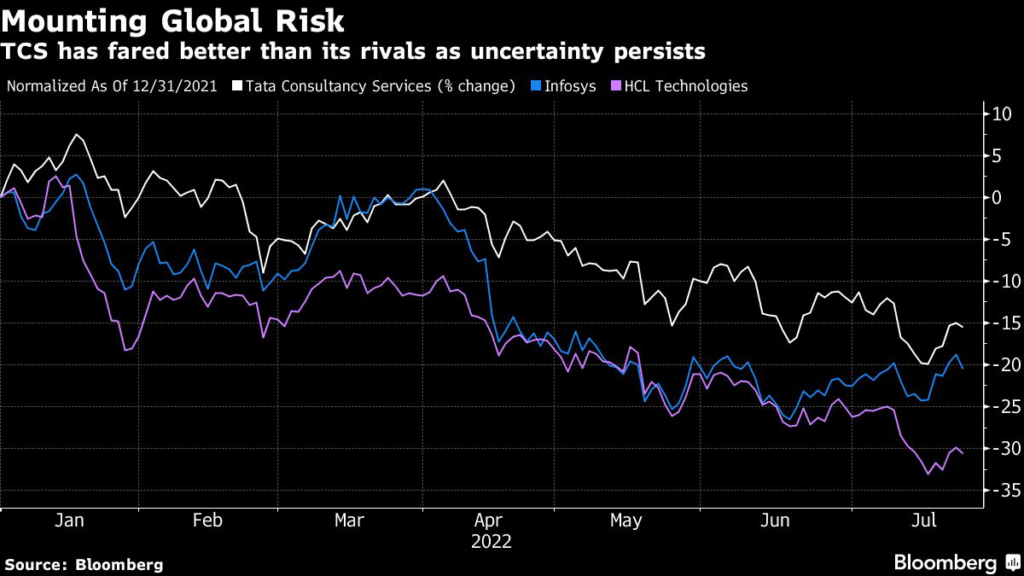
India’s $227 billion IT industry, led by Tata Consultancy Services Ltd. and Infosys, is bracing for an economic slowdown with some analysts predicting a global recession. On Sunday, Infosys executives sought to temper concerns about the prospects for IT budgets, saying their order book was as strong as it had been for much of 2022.

“The pipeline that we have today for our large deals is larger than what we had three or six months ago,” Chief Executive Officer Salil Parekh told a news conference Sunday. “Having said that, we of course, recognize what is going on in the global environment.”

For the April to June quarter, Infosys said revenue rose 24% from a year ago to 344.7 billion rupees ($4.3 billion), beating estimates of 340.09 billion rupees. Revenue from the financial services segment rose 15% from a year earlier to 105.6 billion rupees, although it trailed estimates of 106.87 billion rupees.

The company’s net profit rose 3.1% to 53.6 billion rupees for the first quarter to June, despite expenses such as wage costs. Analysts estimated 56.7 billion rupees. Bigger rival TCS also reported net income that missed analysts’ projections.

Finance Chief Nilanjan Roy warned that the company making “competitive compensation revisions” to reduce attrition levels will impact margins in the immediate term.

Rising competition from global IT giants such as Accenture Plc and International Business Machines Corp., and an acute tech talent crunch have also pressured margins of India’s software services companies.

Technology spending may also be hurt by customers bringing employees back to workplaces, dampening the demand for remote services that surged during the early part of the Covid-19 pandemic. Russia’s attack on Ukraine is set to slow new orders especially from Europe, which accounts for a quarter of Infosys’s revenue.

Other Key Highlights:

  • Infosys retained FY23 operating margin outlook at 21% to 23%, estimate 22.2%
  • Total costs were at 276.1 billion rupees, up 29% y/y
  • Operating margin 20% vs. 23.7% y/y, estimate 21.4%
  • First quarter large deal total contract valued at $1.7 billion


More stories like this are available on bloomberg.com

©2022 Bloomberg L.P.

Julius Baer-Backed Crypto Bank Ramps Up Asia Hiring After Selloff

(Bloomberg) — SEBA Bank AG, an online bank backed by Julius Baer Group Ltd. that’s focused on digital assets, plans to more than double its headcount in Asia, despite the recent rout in crypto assets. 

The bank is seeking to increase its staffing to more than 20 in Hong Kong and Singapore, from about seven people now, adding legal, compliance and relationship manager staff, Eugene Sun, the bank’s head corporate development for Asia. The lender is seeking licenses in both cities, he said. 

The ramp-up comes even as cryptocurrencies have slumped, with the collapse of the Terra ecosystem rattling investors. Regulators around the world are looking to rein in the market’s expansion amid increasing adoption from Main Street to Wall Street. 

“We are finding the selloff to provide an opportunity commercially and in the war for talent, as clients and talent alike seek a more secure and more regulated platform for the promising future of digital assets,” said Sun. 

Singapore intends to broaden the scope of cryptocurrency regulations, and revised rules may include further tightening retail-investor access to crypto and widening the ambit of regulations to cover more activities. Hong Kong is seeking to introduce a licensing system for virtual asset service providers. Wealthy investors across the globe have buying crypto – from Bitcoin to non-fungible tokens – but private banks have struggled to offer this to their rich clients for compliance reasons. 

A UBS Group AG study showed that family offices are turning their attention to digital assets, with a quarter of those surveyed investing in crypto or considering it. 

“Private banks generally are going to start to embrace crypto,” said Sun. 

Liechtenstein-based private bank LGT Bank said in May it was partnering with SEBA to provide crypto to clients domiciled in Liechtenstein or Switzerland. SEBA Bank is also preparing to launch with LGT in Asia, said Sun, declining to be more specific. 

SEBA Bank earlier this year raised 110 million Swiss francs ($119 million) in a funding round, which included Julius Baer and DeFi Technologies. It was started in Switzerland in 2018 and now supports more than 25 markets across the globe.

More stories like this are available on bloomberg.com

©2022 Bloomberg L.P.

London’s Square Mile Struggles to Find Its Way in Brexit Britain

(Bloomberg) — London is in danger of becoming a mere “regional stock market” down the line unless it significantly raises its game — that is the warning from Mark Austin, the latest person charged with sprucing up the UK’s listing rules and helping the city maintain its position as one of the world’s leading financial centers.

“We need to be fleet of foot, ambitious and bold,” said Austin, a partner at law firm Freshfields Bruckhaus Deringer, who was commissioned to lead a government review into London’s capital markets. For companies wanting to list in Europe rather than the US, “London was often the go-to option; that is not necessarily the case any more. They are increasingly also eyeing Amsterdam or other venues, be it for valuation, or easier regulation,” he said in an interview.

It’s a sentiment that’s repeated across the City of London: hope for the capital’s future as a financial hub outside the European Union, mixed with anxiety that the Brexit vote six years ago has so far only led to stiflingly slow change and political rows.

Outgoing Prime Minister Boris Johnson, who was elected on a promise to slash bureaucracy inherited from the bloc, saw one element of his plan come to fruition on Wednesday, with a financial services bill that will undo hundreds of EU regulations. Presenting the bill was the chancellor he’d appointed two weeks earlier, Nadhim Zahawi, who may not be in post once Johnson’s successor is picked in September. 

Rishi Sunak, the former chancellor who oversaw the drafting of the bill, is one of the leadership candidates, though polls of Conservative Party members show him trailing considerably behind Liz Truss.

Listing Slump

Meanwhile, London’s stock market is faced with the quietest period for listings since the financial crisis. While the immediate cause of the slump was the global pause in share sales after Russia’s invasion of Ukraine, the reasons behind the UK’s slide date back years — with Austin’s review the latest in a long line of attempted cures. 

The most recent blow came from SoftBank Group Corp., which is now rethinking whether to bring back UK chip designer Arm Ltd. to the London market with a partial listing, in light of the political upheaval. Even floats that proceed are having a tough time: GSK Plc spun off Haleon, its £30 billion consumer division, only to see it drop 6% on its debut on July 18.

Home-grown tech companies, whom Johnson was championing last month even as he struggled for political survival, have also suffered a string of disappointments on the London market. Food delivery platform Deliveroo Plc, e-commerce group THG Plc and furniture retailer Made.com Group Plc are all down more than 75% since their initial public offerings. Even those more removed from consumer spending and the cost of living crisis, such as money-transfer company Wise Plc and semiconductor firm Alphawave IP Group Plc, have lost 50% of their initial value.

With volumes down dramatically, over half of this year’s IPO proceeds in London stem from the listing of a Chinese wind turbine maker called Ming Yang Smart Energy Group Ltd. on a little-used stock connect program designed to encourage more international listings. No British companies so far have used the venture, launched in 2019, to issue shares in China.

London stock prices overall have lagged international rivals, despite economic conditions over the last year favoring miners and oil majors that represent a large chunk of the market. Since the Brexit referendum in 2016, the UK’s FTSE 100 index has grown by about 45% with dividends reinvested, while the S&P 500 has delivered returns of 112%.

Still, not everybody is downbeat. London Stock Exchange Group Plc executive Julia Hoggett told Bloomberg Television on Thursday that she is still determined to attract Arm to list in its home country.

Hoggett will chair a new capital markets taskforce aimed at “ensuring the UK is the place where great companies can start, grow, scale and stay.” Other members include Austin, Schroders Plc CEO Peter Harrison, and GSK Chair Jonathan Symonds.

“I want to win every single offering that I can do and I also feel very strongly there is a very compelling case for Arm to have a dual premium listing in the UK,” Hoggett said. She added that Arm’s previous listing here gave it a higher valuation than its peers around the world, before SoftBank agreed to take it private in 2016. 

SoftBank founder Masayoshi Son plans to resume talks about a secondary listing in the UK once a new cabinet is in place and the company has confidence the government’s assurances around favorable tax policies and R&D credits will be delivered, people familiar with the situation told Bloomberg.

“I’m very confident about the future of the Square Mile; London’s not going to stop being a global financial power,” said Steven Fine, chief executive of broker Peel Hunt, citing the UK’s education system, time zone, and financial infrastructure.

“The listing rule changes are clearly a step in the right direction. This is the place from which big fund houses can access international markets, and it’s unlikely to go away overnight.”

Rule Changes

The UK has spent years discussing ideas to revitalize its stock market. Much like peers in Europe, who’ve worked for six years and counting on a capital markets union, policy makers are finding that tweaking the financial system takes time. 

Austin’s proposals, revealed on July 19, build on a 2020 report into the industry by Jonathan Hill, a former financial services commissioner for the EU. That review was set up to attract more fast-growing companies to London, especially tech founders with a preference for the much deeper American market. 

Hill’s recommendations included cuts to free float requirements — the amount of a company’s shares that are in public hands — from 25% to 15%, allowing dual class share structures in the London Stock Exchange’s premium listing segment, and reforms to attract US-style special purpose acquisition companies. That last idea, proposed during New York’s Spac craze that’s since run out of steam, has led to just a handful of listings.

Austin also suggests making permanent a Covid-era exemption that allowed for companies to raise as much as 20% of their existing capital on the spot market, involving retail investors in all fundraising, digitizing shareholder registers and slashing requirements for prospectuses. 

Many of these proposals, and the shake-up contained within the financial services bill, are in political limbo for at least the next few months until a new prime minister is chosen. 

Another change that could come to the City — depending on who is in charge — is a government power to challenge regulators’ decisions. The bill presented last Wednesday stopped short of a right to “call in” decisions and force change, but would give ministers the right to order a review. 

Zahawi admitted during a speech that he might be little more than a caretaker chancellor. Sunak, if he wins the race to become prime minister, could decide the reforms should be taken further to give elected politicians more say. Truss has hinted she may change the Bank of England’s mandate more broadly.

“The chancellor clearly understands the government is in a caretaker phase and has ducked the idea of call in powers — for now,” said Iain Anderson, founder of Cicero/AMO, a communications firm spanning Westminster and the City. “This will be in the in-tray of the new government from September.”

The regulators will also be watching closely. Andrew Bailey, the BOE governor, has stressed the importance of the Bank’s independence on several occasions, telling politicians on the Treasury select committee that “independence of regulators is important because much of our international standing depends on it.”

Meanwhile, Sam Woods, chief executive of the Prudential Regulation Authority, faces calls from the insurance industry to support the relaxation of the Solvency II capital rules, which were written while part of the EU. Last month while he was still chancellor, Sunak met with industry leaders to discuss ways to “deliver these ambitious reforms at pace.”

These are just some of the choices available to regulators — and politicians — now they no longer need to stick to the letter of EU law. Tensions about how far to take this new freedom encapsulate the broader relationship between Westminster and the City: united on the need to reform the UK’s most lucrative industry post-Brexit, yet still uncertain about how it will be done.

More stories like this are available on bloomberg.com

©2022 Bloomberg L.P.

Porsche IPO, Tesla Chase, Software Fix: What Awaits VW’s New CEO

(Bloomberg) — As much of Volkswagen AG takes a summer break the next few weeks, Oliver Blume, the carmaker’s designated chief executive officer, will be staring down an extensive to-do list.

A diverse set of pressing issues await the 53-year-old ascending to the job Herbert Diess has been ousted from. Lead among them will be listing Porsche AG — VW’s most prized asset — amid the worst climate for initial public offerings in years, and fixing protracted problems at the software division postponing new electric Porsches and Audis.

Diess’s aggressive strategies for EVs, software and new-mobility offerings set VW on a path the company’s billionaire owners praised even as they pushed him out of the CEO role. It’s now up to Blume to follow through in transforming the world’s second-biggest carmaker to better contend with up-and-coming Tesla Inc. and incumbents Toyota Motor Corp. and Stellantis NV.

Here are some of the challenges awaiting Blume:

Taking Porsche Public

The industrial logic behind listing a minority stake in VW group’s most profitable major brand is sound. The IPO, which could be Europe’s largest ever, must succeed to finally boost VW’s languishing valuation.

But in addition to governance concerns, there’s growing fear that recession risks, surging energy costs and geopolitical tension ultimately will drag on Porsche’s valuation. In 2019, VW’s listing of its truck unit Traton SE was a disappointment.

Harnessing Software

VW’s efforts to build its own software operation has been a bruising experience of strategy shifts, executive purges and product delays.

Tesla is way ahead in regularly deploying over-the-air updates that add capabilities and improve the performance of its EVs after they leave the showroom, and attempts by traditional rivals like Toyota to replicate this have been less messy. Seizing the opportunities software brings, including new forms of revenue, will be the industry’s next frontier.

Keeping US Growth Going

VW has finally stopped losing money in America, but the company remains a long way from closing the gap to Toyota, General Motors Co. or Ford Motor Co. To better compete with those market leaders and upstarts like Rivian Automotive Inc., the automaker is reviving the off-road brand Scout that will offer an electric pickup and rugged SUV.

As for the luxury segment, Audi has long sought to take on Mercedes-Benz AG and BMW AG on a global scale, but has no production footprint in the US.

Turning China Around

VW has been losing share in its biggest market due to poor handling of the chip shortage and a dearth of digital features that China’s tech-savvy drivers have increasingly come to expect.

Tesla’s new Shanghai factory isn’t the only thorn in VW’s side, as local manufacturers’ products also are catching on. VW can’t afford dwindling profits from the Chinese ventures it’s counting on to finance its EV ambitions.

Challenging Tesla

Whereas VW has flailed during the chip crisis and struggled to keep production lines running, the US electric-car maker has maintained steady growth through the supply-chain turmoil. 

After quickly turning the Shanghai plant into its most productive globally, CEO Elon Musk has added factories in Austin, Texas, and near Berlin this year. Tesla’s aggressive expansion is making VW’s electric-car project Trinity, which includes a 2 billion-euro ($2 billion) German factory, look all the more critical.

Containing Controversy

Within days of being named the new CEO, Blume apologized for comments he made during an internal event last month about Christian Lindner, Germany’s finance minister.

Blume boasted that he had been constantly exchanging messages with Lindner months ago when the government was negotiating a coalition agreement allowing for new vehicles in the coming years to be powered by synthetic fuels, which aren’t as clean as EVs. Blume apologized over the weekend, saying he oversimplified the exchange and hadn’t sought to influence Lindner.

More stories like this are available on bloomberg.com

©2022 Bloomberg L.P.

Elon Musk Denies Report He Had Affair With Sergey Brin’s Wife

(Bloomberg) — Elon Musk denied he had an affair with Sergey Brin’s wife, after the Wall Street Journal reported that the liaison led the Google co-founder to sell his investments in Musk’s companies.

Musk, the co-founder of Tesla Inc., had an alleged liaison in early December in Miami with Brin’s wife Nicole Shanahan, the Journal said, citing unidentified people familiar with the matter. That ended the long friendship between Musk, 51, and Brin, who helped support the electric carmaker during the 2008 financial crisis. Brin, 48, filed for divorce from Shanahan in January.

Musk said in a post on Twitter, where he has more than 100 million followers, that the Journal’s story was untrue. Musk said he has seen Brin’s wife twice in three years, both times in the presence of other people, and there was “nothing romantic” between the pair. Musk also said he’s still friends with Brin.

Read more: Sergey Brin Seeks Divorce From His Wife of Three Years

Brin had instructed his advisers to sell his personal investments in Musk’s companies in recent months after learning that he had a brief affair with his wife, according to the Journal.

The size of Brin’s personal investments in Musk’s companies isn’t known, and it’s unclear whether there have been any sales, the newspaper said.

Musk is the world’s richest person with a $242 billion fortune, according to the Bloomberg Billionaires Index. Brin is the eighth-wealthiest, with a net worth of $94.6 billion.

The alleged affair is the latest in a string of revelations about Musk’s personal life. Reports earlier this year said he became the father to twins born to a senior executive at his artificial intelligence startup Neuralink.

Another of his companies, SpaceX, paid an employee $250,000 to settle a claim she was sexually harassed by Musk in 2016, according to Insider. Musk said the accusations were “utterly untrue” and designed to interfere with his acquisition of Twitter Inc., an agreement which he’s now trying to exit.

Brin and Shanahan are currently negotiating a settlement, with Shanahan seeking more than $1 billion, the Journal said, even though there’s a prenuptial agreement. 

More stories like this are available on bloomberg.com

©2022 Bloomberg L.P.

Billionaire Kotak’s Brokerage Eyes Small-Town Peers For Growth

(Bloomberg) — The stock-broking firm controlled by Asia’s richest financier is bringing beleaguered peers from India’s small towns into its fold as the company seeks a larger share in the sector that drew record revenues of $3.5 billion last year.

Kotak Securities Ltd., a unit of billionaire Uday Kotak-controlled Kotak Mahindra Group, has onboarded four small brokerages into its platform and is in talks to add another 20, Jaideep Hansraj, chief executive officer of the company said in an interview.

The arrival of low-cost, fintech brokerages has disrupted the sector along with a rapidly changing regulatory framework. Many smaller firms are being forced to shut shops or merge into bigger ones amid a retail trading frenzy that is driving revenues to a record high in India. 

“A lot of brokers from smaller cities don’t have the financial wherewithal, technology, compliance processes, and legal talent required to meet tightening norms prescribed by the regulator and exchanges,” said Hansraj.

Like its peers, Kotak Securities offers these brokers an opportunity to tie up with larger and more established names, which provides an alternative to closing shop.

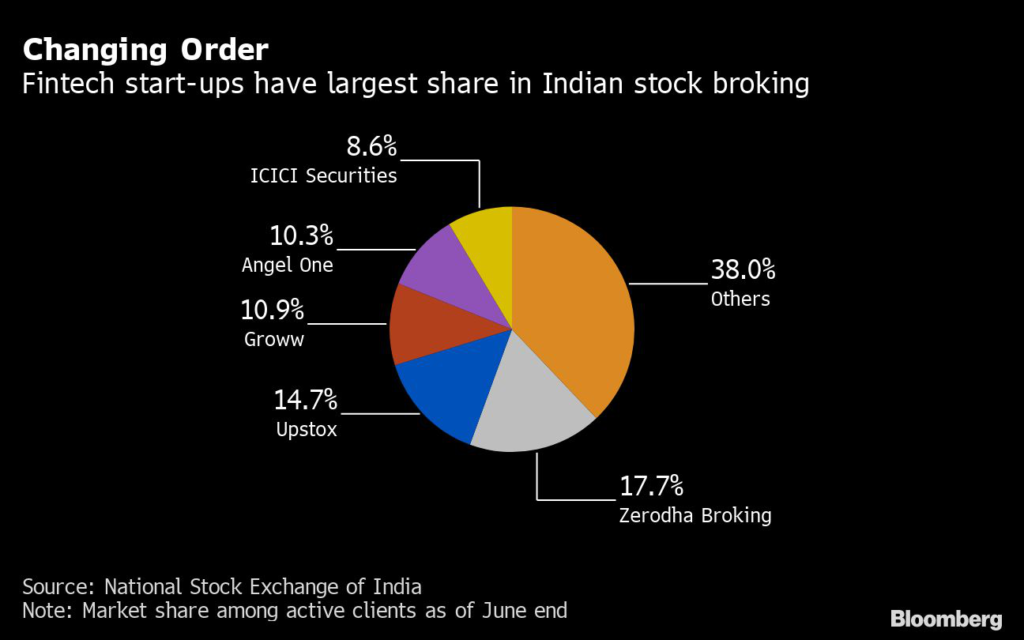
Zerodha Broking Ltd. and similar Robinhood-like online brokers have shot past traditional brokers like ICICI Securities Ltd. and Kotak Securities in the highly competitive sector. While deep-pocketed brokerages are trying to adapt and compete with the slick, mobile-friendly platforms and rock-bottom commissions, smaller peers have been feeling the pinch.

ICRA Ltd., the local arm of Moody’s Investors Service Inc., said it expects revenues for the broking industry to grow at 5%-7% in the financial year to March 2023. That is down from 28%-33% annual growth seen in the previous year, the rater said in March, as financial conditions tighten and markets witness increased volatility.

Besides, the Securities and Exchange Board of India, the nation’s market regulator, has tightened margin norms for brokers in the past three years to weed out risk for retail investors. Past practices like using the margin of one client for another, or putting in brokers own money, are no longer allowed. On top of this, the latest guidelines from regulators require brokers to collect 50% of margins from clients in cash.

As a result, more than 130 brokers with the BSE Ltd. and 122 on the National Stock Exchange of India Ltd. returned their permits in the last three financial years, the latest data from the bourses show.

Thirty-year-old PCS Securities Ltd. is among the brokers who are returning their permits and moving clients to Kotak.

“I think it will become difficult for mid-size and small brokers to survive,” Paresh Shah, whole-time director at Hyderabad-based PCS Securities said. “Sooner or later, other smaller and regional brokerage will chose this path.”

When they choose that path, smaller brokers, while retaining their brand names, will become sub-brokers and earn a percentage of the overall business. The clients belonging to the smaller brokers, though, will be transferred to the platform of the larger brokerage.

With increased retail participation and dwindling pricing power, “slowly this business is becoming economies of scale. Whenever any business reaches economies of scale, 90% of the business is concentrated with the top five or ten,” Suresh Shukla, joint president at Kotak Securities, said.

More stories like this are available on bloomberg.com

©2022 Bloomberg L.P.

Voyager Responds to FTX’s Offer, Calling It a ‘Low-Ball’ Bid

(Bloomberg) — Crypto platform Voyager Digital LLC said a joint offer proposed by FTX and Alameda is a “low-ball bid” that disrupts the bankruptcy process, according to a court filing. 

On Friday, crypto billionaire Sam Bankman-Fried proposed a restructuring deal to Voyager publicly. Under the plan, Alameda, Bankman-Fried’s trading firm, would buy all of Voyager’s digital assets and digital asset loans, other than loans to Three Arrows Capital, in cash at market value. Meanwhile, FTX, his crypto exchange, would offer customers of Voyager an option to receive their share of claims by opening a new account at FTX.  

“The AlamedaFTX proposal is nothing more than a liquidation of cryptocurrency on a basis that advantages AlamedaFTX,” lawyers for Voyager said in response to the bid in a court filing submitted Sunday. “It’s a low-ball bid dressed up as a white knight rescue.”

Voyager will entertain any “serious proposal” made under the bidding procedures, but the bid from FTX and Alameda was “designed to generate publicity for itself rather than value for Voyager’s customers,” they wrote. It undermined a competitive process, declared no value in Voyager platform and intellectual property, and ignored tax consequences, among other things, they said.

“We submitted what we think is a generous proposal,” Bankman-Fried said in an emailed comment. “It appears that Voyager’s consultants are attempting to stall out the process, increasing their fees. We feel for the customers who have lost significant funds and are waiting to receive those that remain.”

Voyager reserves all rights and remedies against Alameda and FTX for the “clear and intentional subversion of the bankruptcy process and the damages that may be suffered by customers and other creditors as a result,” the lawyers said in the filing. 

Earlier this month, Voyager filed for Chapter 11 bankruptcy protection, weeks after getting a credit line from Alameda. Alameda is a lender, borrower and major shareholder of Voyager. 

Read More: Bankman-Fried’s Crypto Firm Alameda Is All Things to Voyager

Under FTX’s proposal, any Voyager customer that doesn’t wish to sign up with FTX would continue to retain all of their rights and claims in the bankruptcy proceedings, but would not receive early access to a distribution on their claim via FTX. 

(Updates with comment from Sam Bankman-Fried in fifth paragraph and link to Twitter thread.)

More stories like this are available on bloomberg.com

©2022 Bloomberg L.P.

China’s Gen Z Is Dejected, Underemployed and Slowing the Economy

(Bloomberg) — The most educated generation in China’s history was supposed to blaze a trail towards a more innovative and technologically advanced economy. Instead, about 15 million young people are estimated to be jobless, and many are lowering their ambitions. 

A perfect storm of factors has propelled unemployment among 16- to 24-year-old urbanites to a record 19.3%, more than twice the comparable rate in the US. The government’s hardline coronavirus strategy has led to layoffs, while its regulatory crackdown on real estate and education companies has hit the private sector. At the same time, a record number of college and vocational school graduates—some 12 million—are entering the job market this summer. This highly educated cohort has intensified a mismatch between available roles and jobseekers’ expectations.  

The result is an increasingly disillusioned young population losing faith in private companies and willing to accept lower pay in the state sector. If the trend continues, growth in the world’s second-largest economy stands to suffer. The sheer number of jobless under-25s amounts to a 2% to 3% reduction in China’s workforce, and fewer workers means lower gross domestic product. Unemployment and underemployment also continue to impact salaries for years—a 2020 review of studies reported a 3.5% reduction in wages among those who had experienced unemployment five years earlier.

More young people taking roles in government may leave fewer jumping into new sectors and fueling innovation.

“The structural adjustment faced by China’s economy right now actually needs more people to become entrepreneurs and strive,” said Zeng Xiangquan, head of the China Institute for Employment Research in Beijing. Lowered expectations have “damaged the utilization of the young labor force,” he added. “It’s not a good thing for the economy.”

Pre-pandemic, 22-year-old Xu Chaoqun was prepared for a career in China’s creative industries. But a fruitless four-month job hunt has left him setting his sights on the state sector. “Under the Covid outbreak, many private companies are very unstable,” said Xu, who majored in visual art at a mid-ranked university. “That’s why I want to be with a state-owned enterprise”.

Xu is not alone. Some 39% of graduates listed state-owned companies as their top choice of employer last year, according to recruitment company 51job Inc. That’s up from 25% in 2017. A further 28% chose government jobs as their first choice. 

It’s a rational response in a pandemic-hit labor market. All workplaces have been hit hard by China’s snap lockdowns and strict quarantine measures, but private companies were more likely to lay off workers. Beijing’s main employment-boosting policy has been to order the state sector to increase hiring.

President Xi Jinping may be relieved that the country’s unemployed youth are trying to join the government rather than overthrow it. During a June visit to a university in the southwestern China’s Sichuan province, he advised graduates to “prevent the situation in which one is unfit for a higher position but unwilling to take a lower one.” He added that “to get rich and get fame overnight is not realistic.”

The message is getting through: Graduate expectations for starting salaries fell more than 6% from last year to 6,295 yuan ($932) per month, according to an April survey from recruitment firm Zhilian. State-owned enterprises grew in appeal over the same period, the recruiter said. 

But lower income expectations and talent shunning the private sector are likely to lower growth in the long term, challenging the president’s plan to double the size of China’s economy from 2020 levels by 2035—by which point it would likely overtake the U.S. in size.

The phrase “tang ping”—“lying flat”—spread through China’s internet last year. The slogan invokes dropping out of the rat race and doing the bare minimum to get by, and reflected the desire for a better work-life balance in the face of China’s slowing growth. As the unemployment situation has continued to worsen, many young people have adopted an even more fatalistic catchphrase: “bailan,” or “let it rot.”

Read More: From the Great Resignation to Lying Flat, Workers Are Opting Out

That concept is “a kind of mental relaxation,” said Hu Xiaoyue, a 24-year old with a psychology masters degree. “This way, even if you fail, you will feel better.”  When Hu started looking for work last August, she found it easy to land interviews. “But when it came to spring, only one in 10 companies would offer an interview,” she said. “It fell off a cliff.”

China’s state-owned enterprises (SOEs) aren’t all unproductive behemoths. But the weight of economic evidence suggests they are, on the whole, less efficient and less innovative than privately-owned companies. China’s economic boom has coincided with a falling share of SOE jobs in urban employment—from 40% in 1996 to less than 10% pre-pandemic. That trend could now go into reverse.

Last year, China launched a regulatory crackdown on formerly high-flying sectors dominated by private companies that previously attracted ambitious young people. Internet companies were hit with fines for monopolistic behavior, real estate businesses were starved of financing and the private tutoring sector was almost entirely shuttered.

Read More: Xi Jinping’s Capitalist Smackdown Sparks a $1 Trillion Reckoning

Regulatory filings show that China’s top five listed education companies reduced their staffing by 135,000 in the last year after the crackdown. The largest tech companies have kept their headcounts stable, and Zhilian says that there were more tech jobs advertised in the first half of this year than the same period in 2021. Even so, the sector’s allure has faded.

A graduate of the highly ranked Central University of Finance and Economics in Beijing, Hu was set for the tech sector—she interned at three internet companies including video-sharing giant Beijing Kuaishou Technology Co. But she has changed her mind. “People who are going to work for Internet companies are all worrying about themselves because they feel like they could be fired any time,” she said.

Instead, Hu landed a position at a research institute within state-owned China Telecom Corp. “The working hours of my future job will be 8:30 a.m. to 5:30 p.m., and the workload will be quite light. Internet companies are too consuming,” she said.

As well as the movement of talent towards state-owned companies, there’s another mechanism at work that can damage long-term growth. Studies from the US, Europe and Japan have shown that the longer young people are unemployed at the start of their careers, the worse their long-term incomes, an effect known as “scarring.”

That’s the risk facing Beiya, who was laid off from an e-commerce company this year. The 26-year-old, who gave only one name because she feared that talking about losing her job could hit her employment prospects, missed out on a role with TikTok parent company Bytedance Inc. because of her limited experience.

“I’m a good candidate with potential but they want to see me in two years,” she said. “But how can I get the experience if no one gives me a job now?”

The state sector already employs around 80 million people and the figure could grow by as much as 2 million on a net basis this year, according to Lu Feng, a labor economist at Peking University. “But compared with total demand for jobs, it’s still relatively small,” he said. “We still need private firms to hire.”

That will only happen if the economy grows. To meet its employment goals, economists say China needs GDP to increase between 3% and 5% this year. Economists are predicting growth closer to 4%—with the outlook highly uncertain due to the prospect of more lockdowns to contain the spread of the coronavirus. “Lack of clarity on an exit strategy from the Covid-Zero policy makes companies wary of hiring,” said Chang Shu, Bloomberg Economics’ chief Asia economist.  

Beijing has launched a version of the job-support programs seen in Europe during the pandemic, offering tax rebates and direct subsidies to companies who promise to retain workers. But the amounts involved are small: The incentive for hiring a new worker is just 1,500 yuan. Provincial subsidies for graduates who start businesses are also small—just 10,000 yuan in the prosperous Guangdong region.


Even if China can return to strong growth in the second half of this year, the youth unemployment problem will persist—the rate has been rising since 2017, reaching 12% pre-pandemic. Economists attribute that to two factors: urbanization and a mismatch between the education system and employers’ needs.

The hundreds of millions of workers who moved from the countryside to cities used to return to their villages during labor market slumps, acting as an economic shock absorber. Now, younger migrants increasingly stay put when they lose their jobs, pushing up urban unemployment.

“A lot of them are not even raised in rural areas. So they regard themselves as urban people,” says Peking University’s Lu. “The constraints for the government have changed substantially, it’s tougher than in the past.”

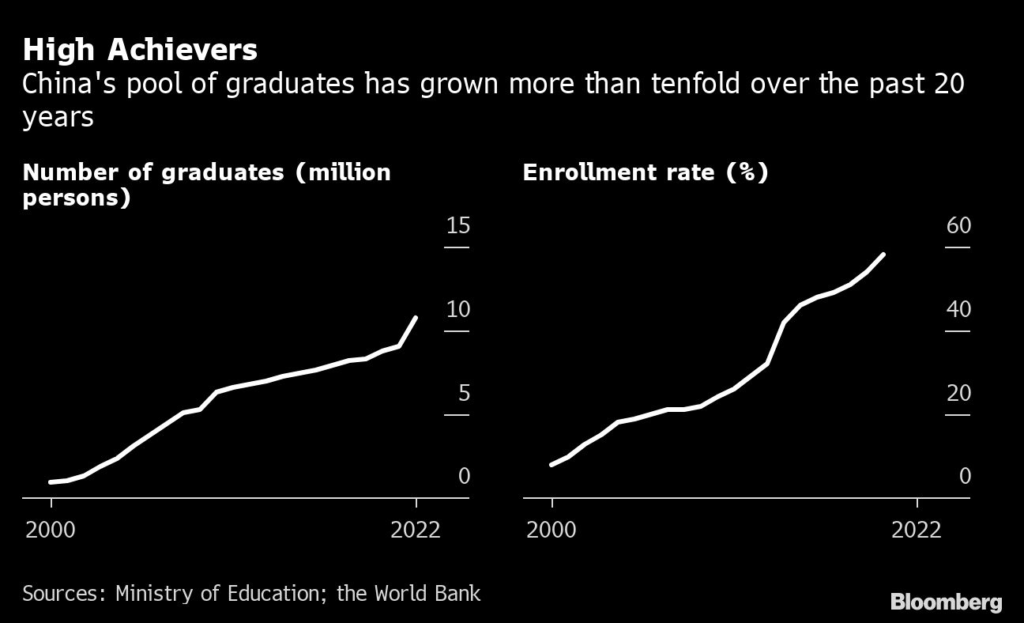
Second, the annual number of graduates in China has increased tenfold over the last two decades—the fastest higher-education expansion anywhere in the world, at any time. The share of young Chinese people attending college is now almost 60%, similar to developed countries.

The number of vocational graduates lags far behind those receiving academic degrees. Such is the stigma around vocational education that students rioted last year when told their university was being rebranded as a vocational school. Highly educated young people are rejecting factory jobs. “That’s the basic matching problem. It is huge in this country,” said Lu.

That’s left manufacturers complaining about shortages of skilled technicians. “There are not a lot of people applying for those jobs, such as electrician or welder,” said Jiang Cheng, 28, an agent for electronics factories in central China.

Other sectors are oversubscribed. According to a 2021 study of 20,000 randomly selected jobseekers on Zhilian’s website, some 43% of the job applicants wanted to work in the IT industry, while the sector accounted for just 16% of recruitment posts.

Half of jobseekers had a bachelor degree, but only 20% of jobs required one. “There is now compelling evidence of over-education,” the study’s authors wrote, warning that the misalignment “could have profound influences on both individuals and the nation.”

In the longer term, it’s possible that government intervention may get the private sector hiring again, while education reforms and market forces can smooth the misalignment in the labor market. 

China is easing its regulatory campaigns, and a vocational education law passed this year aims to improve standards. A study by Wang Zhe, an economist at Caixin Insight, found college majors that attracted a wage premium in 2020 became more popular in 2021. As applicants’ academic choices adapt to demand in the jobs market, mismatches stand to ease. 

But the share of graduates from China’s nine top-ranked universities joining the private sector has fallen since the pandemic, according to research from Hong Kong’s Lingnan University. That suggests ideological shifts, and not just market forces, are at play. Some graduates at top universities are adopting “ cadre style,” according to online forums where they seek tips on where to buy the black zippered windbreakers favored by Xi.

Even in the current environment, Kay Lou, 25, would be a leading candidate for any number of private-sector jobs. She has a masters in law from top-ranked Tsinghua University and has interned for a legal firm, an Internet giant, a securities brokerage and a court.

In the end, she won a government position in Zhejiang province—where some roles attract as many as 200 applicants.

“I felt my work wasn’t meaningful,” she said. “I became increasingly opposed to the capitalists’ pursuit of wealth after I read Marx, so in the end I chose to become a civil servant.”

(china job)

More stories like this are available on bloomberg.com

©2022 Bloomberg L.P.

Close Bitnami banner
Bitnami