Bloomberg

What Investors Are Looking for in Marcos’s First Congress Speech

(Bloomberg) — Philippine President Ferdinand Marcos Jr. will lay down his agenda before Congress for the first time, with economic challenges looming large in the early days of his administration.

Business and industry groups want to hear Marcos talk about how he would tackle soaring prices, record debt and food supply woes in the speech scheduled for 4 p.m. local time Monday. Also awaited during the annual State of the Nation Address are his pandemic recovery plan and infrastructure roadmap.

Marcos is starting his six-year term “with headwinds already there,” said Philippine Chamber of Commerce and Industry President George Barcelon. “These are not of the new administration’s doing but these are issues they have to deal with.”

While the Philippines remains one of Asia’s fastest growing economies, the quickest inflation since 2018 and rising interest rates are threatening pandemic recovery. Elevated oil prices and supply logjams that are the fallout from the war in Ukraine have also dimmed the global outlook.

Agriculture

Marcos, who’s also the agriculture secretary, has to give “total support” to the farm sector to avert a food crisis and tame price increases, said Joji Co, president of the Philippine Confederation of Grains Association. 

Marcos should set clear plans on how to boost food production, and allot a bigger budget to modernize farms, Co said. Agriculture posted the smallest growth among major industries in the first quarter, with a 0.2% expansion.

Debt & Taxes

Marcos will present in detail his government’s medium-term fiscal framework aimed at reducing the budget deficit and driving growth, Finance Secretary Benjamin Diokno said earlier this month.

The new government may need to pursue tax reform measures to boost collections and bring down the debt-to-GDP ratio to “more sustainable levels” below 60%, said Michael Ricafort, an economist at Rizal Commercial Banking Corp. That will prevent any credit rating downgrade, he said.

Marcos’s plans on how to boost revenues and whether he’ll borrow more or raise taxes are keenly awaited in the market, said Astro del Castillo, managing director at First Grade Finance Inc.

Covid response

Marcos will draw attention to pandemic response, particularly how to strengthen the health system and boost the economic recovery, Executive Secretary Vic Rodriguez said July 22. The president will also present plans on school reopening, and providing better Internet connection for those who will still need online classes.

Jobs

Creation of more jobs is among the priorities of investors after the pandemic increased the number of unemployed over the last two years. The jobless rate was at 6% in May, latest data from the statistics agency showed.

“How to improve government service in health and education and how jobs will be created – that’s what our countrymen want to hear in the upcoming SONA,” said Senator Sonny Angara.

Infrastructure

The market will be on the lookout for government’s infrastructure investment policy, said Cristina Ulang, head of research at First Metro Investment Corp. “It’s closely watched because it’s a growth stimulus and a test of how well regulatory framework will be executed,” she said. 

“We hope the president sends more signals that business is welcome again as a partner; that laws, franchises, and contracts will be upheld and targeting businesses politically be stopped,” Makati Business Club Executive Director Coco Alcuaz said. 

Former President Rodrigo Duterte cracked down on some of the biggest businesses during his term as he pushed a populist agenda that endeared him to his supporters.

A healthier relationship between government and businesses will help boost private investment in infrastructure projects which the country needs for growth, Alcuaz said.

More stories like this are available on bloomberg.com

©2022 Bloomberg L.P.

Peter Thiel’s Fund Leads $40 Million Round in Shares App

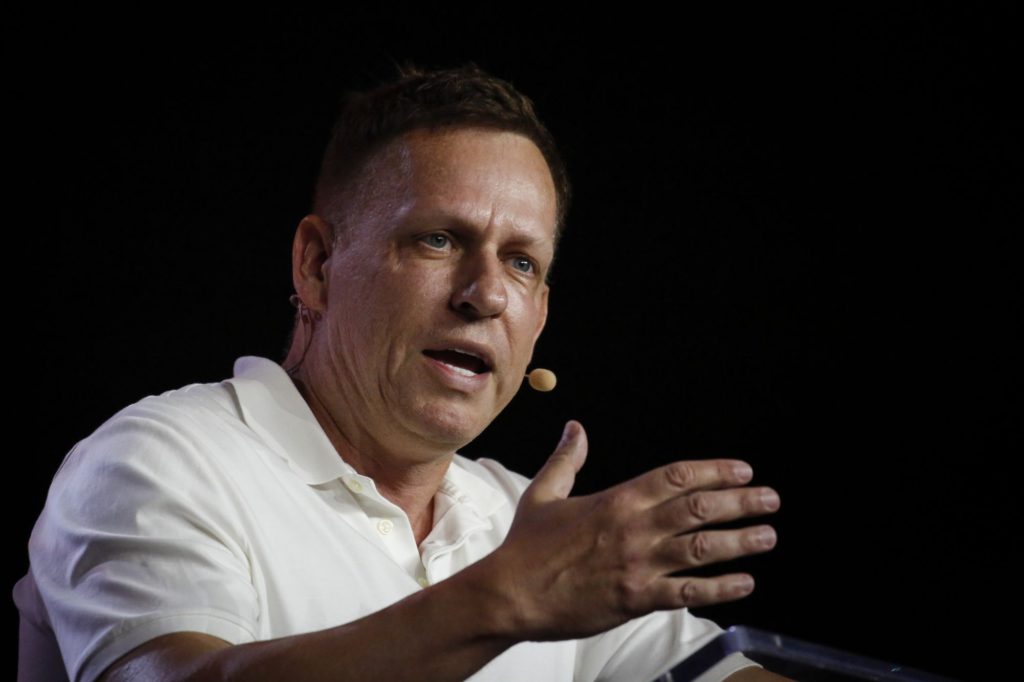
(Bloomberg) — Peter Thiel-backed Valar Ventures is leading a $40 million financing round into European investing app Shares. 

The new round of financing brings the year-old company’s total funds raised to $90 million, and will give Shares further cash to expand across Europe, the company said in a statement. 

Chief Executive Officer Benjamin Chemla plans to take the service to the rest of Europe by the end of the year, if he can get regulatory approval, and has hired regional leaders in Barcelona, Berlin, Stockholm, Krakow and Amsterdam. The company is also exploring offering services around cryptocurrency markets, according to the release. 

Shares has also raised funding from firms including Global Founders Capital and Singular. The investment comes amid a broader pullback among financial technology companies, with investors souring on fast-growing cash-burning companies because of rising interest rates and a darkening economic outlook.

The company — which was founded in 2021 and launched in the UK two months ago — said it has more than 150,000 users who access the app to trade stocks, read market data and chat about investing, according to its website. 

More stories like this are available on bloomberg.com

©2022 Bloomberg L.P.

A 75-Year-Old Harvard Grad Is Propelling China’s AI Ambitions

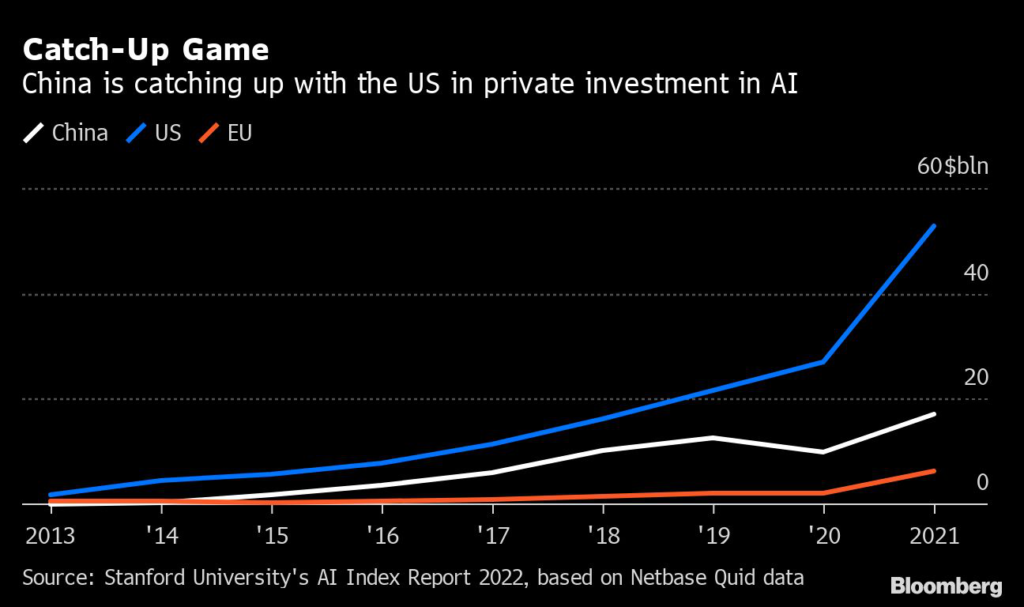
(Bloomberg) — At a time when the US and China are divided on everything from economics to human rights, artificial intelligence is still a point of particular friction. With the potential to revolutionize everything from food production and health care to financial markets and surveillance, it’s a technology that sparks both optimism and paranoia. 

One of the field’s most influential figures is Andrew Chi-Chih Yao, whose education and professional life have straddled the world’s two biggest economies. China-born and Harvard-trained, Yao is his country’s only recipient of the Turing Award, computer science’s equivalent of a Nobel Prize. After almost 40 years in the US, he returned to China in 2004. Now he teaches a prestigious yet little-known university class that has shaped some of the country’s biggest AI startups, informed government policy and molded a generation of academics. 

“We have a very good opportunity in the next 10 or 20 years, when artificial intelligence will change the world,” Yao said in May 2019. He urged China to “take a step ahead of others, to cultivate our talents and work on our research.” The scientist, who rarely speaks to foreign media, didn’t respond to Bloomberg’s requests for an interview.

The “Yao Class”—an undergraduate computer science course at Beijing’s Tsinghua University, alma mater to President Xi Jinping and many of China’s ruling elite—has exerted a profound impact on the country’s technology pioneers and growing scientific prowess. Its graduates form a powerful network across the country, advising on each others’ projects and pooling resources and capital where needed. 

Yao’s acolytes have created startups worth more than $12 billion at their peak, including Alibaba-backed facial-recognition giant Megvii Technology Ltd. and Guangzhou-based Pony.ai Inc. Others teach at top-flight American universities including Stanford and Princeton.

“Just his willingness to come back to China means a lot,” said Hu Yuanming, a Yao class student from 2013 to 2017 and the chief executive officer of computer graphics startup Taichi Graphics Technology Inc. His company is backed by Sequoia China, Source Code Capital, GGV Capital and BAI Capital, having finished its series A round of financing of $50 million in February.

Hu is a beneficiary of the Yao Class talent pool. Pony.ai’s Lou Tiancheng and Megvii’s Tang Wenbin advised Hu on founding his company, and he says hiring is easier for Taichi than for many small businesses. Current Yao students have undertaken internships too.

Driving Force

One thing the US and China agree on is the vast potential of AI—a sweeping field that will define much future technology and which is now a key battleground in Washington and Beijing’s struggle for tech ascendancy. Given its potential for making weapons smarter, AI may also have major national security implications. 

The US National Security Commission on Artificial Intelligence, chaired by former Google CEO Eric Schmidt, warned last year of the risks inherent in China’s growing grasp of the sphere. “If the United States does not act, it will likely lose its leadership position in AI to China in the next decade and become more vulnerable to a spectrum of AI-enabled threats,” the NSCAI report said.

Meanwhile China has framed AI as a “core driving force” in its industrial transformation and a “new focus of international competition” as it pushes for technological self-reliance. In 2017, the country set a target for AI-related industries to reach 1 trillion yuan ($148.2 billion) by 2030. 

With the world’s largest pool of Internet users and an unprecedented amount of data, China has had marked—and controversial—success in AI, especially in fields like facial recognition. Companies like SenseTime Group Inc. and CloudWalk Technology Co. are among the sector’s most advanced globally. China’s share of global AI patent filing reached 52% in 2021, up from 12% in 2010, according to research from Stanford. 

Some experts say China’s AI expertise is limited in scope and more focused on domestic surveillance than world domination. But regardless of whether China comes to dominate AI, or merely maintains its position as one of the top players, Yao is a key part of the nation’s toolkit. 

Born in 1946, Yao emigrated to Taiwan as a child. He has described the upbringing he shared with his two siblings as happy and middle-class with an emphasis on traditional Chinese values, including education. He was an excellent student, and has said he considered scientists Galileo and Newton to be heroes and found physics more creative than Sherlock Holmes mysteries. 

He moved to the US in 1967 to study Physics at Harvard University and credits his wife, Frances Yao, with introducing him to algorithms. A former PhD student at MIT, she is now also a professor of computer science at Tsinghua.

Yao taught for nearly three decades in the US, mostly at Stanford and Princeton, before returning to China in 2004. A number of other celebrated Chinese scholars returned from abroad around the same time, including Nobel prize-winning physicist Yang Chen-Ning and biophysicist Shi Yigong. 

Yao told the state-run Xinhua News Agency that the opportunity to educate young Chinese students meant it was “not a difficult decision” to make. 

New Understanding

Former students say Yao’s accessible and participatory teaching style helps to unlock the complex, highly abstract ideas at the heart of his discipline. He’s been known to invoke the Wizard of Oz or Alice in Wonderland when discussing his journey through computer science. Students are encouraged to answer questions on the spot and to challenge their teacher, and may be treated to KFC or Pizza Hut if a class member solves a particularly tough problem. 

And the tough ones really are tough. Yao’s Millionaires’ Problem asks how two individuals can decide which of them is richer, if neither is prepared to say how much money they have. Answering such questions through cryptography—the study of secure communications techniques—has real-world applications for e-commerce, data mining, and many of the corners of the internet that call for passwords.

Within his field, Yao is perhaps best known for his work on the Min-Max Principle, a decision rule that is critical to game theory and computing. 

“Professor Yao’s work gave us new ways of understanding algorithms,” said Aleks Kissinger, associate professor of quantum computing at the University of Oxford, in his introduction to a speech Yao gave in May. “The way that he explains fundamental problems is very relevant to scientists but also to anyone interested in more fundamental questions about the limits of what we can accomplish and what kinds of problems we can solve.”

In addition to his computer science class at Tsinghua, Yao has established more specialized classes in AI and quantum information. He also serves as the chief editor of China’s high-school AI textbook—a publication that was introduced in 2020. 

“China missed the microelectronics revolution 70 or 80 years ago, so today it is difficult to catch up with the advanced level of the international semiconductor industry,” Yao said in an interview with China Global Television Network last year. “But in emerging fields such as quantum technology and artificial intelligence, China is expected to become an important player.”

Zou Hao, a former Yao student whose startup Tsimage Medical Technology offers AI-driven diagnosis services, believes Tsinghua graduates will play an important role in the technology’s future. “As time goes by, there will be more and more talents from Yao Class that make a difference and get great achievements,” he said.

Other entrepreneurs from the Yao Class include Li Chengtao, founder and CEO of AI drug discovery firmGalixir; Qi Zichao, co-founder and chief architect of metaverse startup DeepMirror and Long Fan, founder-president of blockchain startup Conflux. In academia, Yao alumni have been found on staff at Duke, Princeton and Stanford Universities, as well as at Tsinghua and Renmin University of China.

“Whether it’s applying for studying abroad or getting a job at universities, the label of Yao Class graduate did benefit me,” said Huang Zhiyi, an associate professor of computer science at the University of Hong Kong who was a Yao Class compatriot of Pony.ai’s Lou.

“Almost every aspect of my life and work is impacted by my experience there.”

More stories like this are available on bloomberg.com

©2022 Bloomberg L.P.

Sergey Brin Ordered Sale of Musk Investments After Affair: WSJ

(Bloomberg) — Google co-founder Sergey Brin instructed his advisers to sell his personal investments in Elon Musk’s companies in recent months after learning that he had a brief affair with his wife, according to the Wall Street Journal.

Musk, the co-founder of Tesla Inc., had an alleged liaison in early December in Miami with Nicole Shanahan, the Journal said, citing unidentified people familiar with the matter. That ended the long friendship between Musk, 51, and Brin, who helped support the electric carmaker during the 2008 financial crisis. Brin, 48, filed for divorce from Shanahan in January.

Sergey Brin Seeks Divorce From His Wife of Three Years

The size of Brin’s personal investments in Musk’s companies isn’t known, and it’s unclear whether there have been any sales, the newspaper said.

Musk is the world’s richest person with a $242 billion fortune, according to the Bloomberg Billionaires Index. Brin is the eighth-wealthiest, with a net worth of $94.6 billion.

The affair is the latest in a string of revelations about Musk’s personal life. Reports earlier this year said he became the father to twins born to a senior executive at his artificial intelligence startup Neuralink.

Another of his companies, SpaceX, paid an employee $250,000 to settle a claim she was sexually harassed by Musk in 2016, according to Insider. Musk said the accusations were “utterly untrue” and designed to interfere with his acquisition of Twitter Inc., an agreement which he’s now trying to exit.

Musk’s affair with Shanahan took place in December at Art Basel in Miami, and Musk at another event asked Brin for forgiveness, according to the Journal. 

Brin and Shanahan are currently negotiating a settlement, with Shanahan seeking more than $1 billion, the Journal said, even though there’s a prenuptial agreement. 

More stories like this are available on bloomberg.com

©2022 Bloomberg L.P.

Barclays to Buy a Stake in Cryptocurrency Firm Copper: Sky

(Bloomberg) —

Barclays Plc is buying a stake in Copper, a cryptocurrency company that counts former Chancellor Philip Hammond among its advisers, according to Sky News. 

The UK lender is among a group of new investors joining a funding round for Copper and will invest a few million dollars, with the fundraising expected to be finalized within days, Sky News reported on Sunday, citing sources. 

 “As the funding round is ongoing, we’re unable to comment on this report,” Sophie Arnold, head of communications for Copper said via WhatsApp.

Copper provides custody, prime broking and settlement services to institutional investors in crypto assets. Barclays and Copper declined to comment on the report, according to Sky.

Companies linked to cryptocurrencies have had a challenging year and some have faced bankruptcies as major digital tokens, like Bitcoin, have slumped along with other risk assets globally.

More stories like this are available on bloomberg.com

©2022 Bloomberg L.P.
Battered Bitcoin Devotees Begin to Contemplate a Market Bottom

(Bloomberg) — A buzz is building in crypto-investor circles and on Twitter about Bitcoin’s stealth July rally, which has beleaguered investors starting to ponder whether the largest digital asset has found a bottom. 

Yet, given how intense the boom-and-bust cycles can be in the sector, many are also remaining cautious, unwilling to provide an all-clear sign given the mercurial nature of digital tokens — even as they see signs emerging of Bitcoin having found a floor.

That’s because it’s happened plenty of times before — the coin posts a monster surge that in hindsight turns out to have been nothing but a bear-market bounce. And making such a call might be even more arduous right now considering that digital assets have all year traded in tandem with US stocks, where there are lots of disagreements among strategists over whether the worst of the selling is over. 

It’s difficult to call a bottom, even more so “with this one, because its rally was fueled so much by young people who had never invested in anything before,” said Matt Maley, chief market strategist at Miller Tabak + Co. “Crypto is a liquidity asset right now, so as long as the Fed is tightening, it’s going to be hard for it to see a sustained rally. Second, the asset class has lost a lot of confidence with investors, so it’s going to take time for it to regain that confidence.”

Bitcoin has added roughly 15% over the past month through Friday, while other tokens, including Ether, have posted even better returns. Shawn Cruz, head trading strategist at TD Ameritrade, says there will need to be a shift in risk appetite before the coin can start to move significantly higher. 

Bitcoin “could probably tread water here for a little bit,” Cruz said. “It’s a matter of waiting for risk appetites to turn around.”  

Many are doing just that — watching equities for a guide-map of how things might play out for digital assets. Noelle Acheson, head of market insights at crypto-lender Genesis, points to an investor survey by Bank of America that showed bleak sentiment and potential investor capitulation. Many stock observers see the poll as a contrarian signal. 

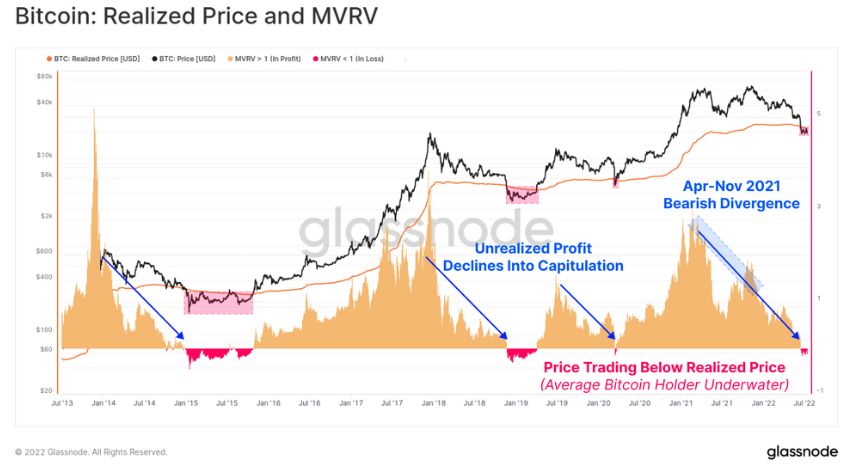
She’s also looking at something called the “spent output profit ratio” of long-term Bitcoin holders, meaning those who have held at least five months, on average. The reading is currently below 1, meaning that even long-term holders are selling at a loss. A drop below that level has historically signaled a bottom is near, she said.


There are plenty of other such analyses to be found for Bitcoin. The token and its brethren have gone through “one of the heaviest, and fastest downwards repricing events in their history,” wrote analysts at Glassnode, meaning that a ton of excess leverage has already been purged from the system. And for a floor to be established, investors need to experience “a wide-ranging capitulation event,” that causes seller exhaustion. 

They’re watching a measure called realized value, which shows the difference between the value of a coin at time of disposal and the time of acquisition. It’s frequently considered to be the on-chain acquisition price of Bitcoin’s supply, they said. Right now, it’s showing an unrealized loss of minus-5%, and previous bear-markets have also all tended to bottom below the realized price. 

“Numerous signals indicate that genuine bottom formation could be underway,” Glassnode analysts wrote.

Eternal optimism, though, is a requisite of being a crypto investor. Billionaire money-manager Mike Novogratz said recently that the “worst is over” in the crypto industry and that while some of the recent issues may have increased distrust among retail investors, the argument for Bitcoin is still strong. Meanwhile, the sector’s best-known booster, Elon Musk, said his company Tesla Inc. sold a significant chunk of its Bitcoin holding, though he said the move shouldn’t be considered a verdict on the coin.

To Alex Tapscott, managing director of Ninepoint Partners’ Digital Asset Group, the bottom is in, though he doesn’t rule out a potential re-test of $19,000. Still, “the risk-reward for Bitcoin is skewed heavily to the upside,” he said. “For the long-term investor, this is a rare and tantalizing entry point.”

Whether or not it has hit bottom has huge implications for the sector — retail investors tend to shy away from buying when the market is in a downturn. That cohort could start inching their way back in should the idea that a bottom has been formed prevail. 

Still, it’s a fraught task calling it definitive, and not everything is signaling an all-clear. Glassnode’s analysts also point to the MVRV, which divides market value by the average purchase price. It’s currently trading at 0.95, a reading that’s not as deep as the average of 0.85 seen during previous bear markets. 

“This may mean further downside and/or consolidation time is required to establish a bottom,” Glassnode said. “However, it may also signal that a greater degree of investor support exists in this bear cycle.”

More stories like this are available on bloomberg.com

©2022 Bloomberg L.P.
Troubled Crypto Exchange Zipmex Says Mulling Possible Offer

(Bloomberg) — Zipmex, a cryptocurrency exchange that operates in markets like Singapore and Thailand, said on Sunday it was considering a possible offer after talks with interested parties, and that due diligence should commence.

The Asian platform was among several in the digital-assets industry encountering financial difficulties in recent weeks. On Thursday, it had halted withdrawals as the fallout from a series of defaults spread further throughout the industry.

Zipmex’s chief marketing officer Proud Limpongpan declined to elaborate on the negotiations, citing a confidentiality clause. 

On Friday, Zipmex tweeted it would resume allowing withdrawals but only from Trade wallet “until further notice.”

Read: Crypto Woes Spread as Celsius, Babel Links Hit Another Firm 

The platform is the latest to encounter financial difficulties stemming from dealings with troubled crypto leaders Babel Finance and Celsius Network Ltd. Zipmex has $48 million of exposure to Babel and $5 million with Celsius, it said on its Facebook page on Thursday. 

(Updates with response from Zipmex in third paragraph)

More stories like this are available on bloomberg.com

©2022 Bloomberg L.P.

PBOC Official Vows to Protect User Privacy in Digital Yuan Push

(Bloomberg) —

China will protect data related to the use of digital yuan, its central bank’s head of digital currency unit says, as the country moves forward with tests of the currency also known as e-CNY.

Only a limited amount of personal information is collected when people use digital yuan, and access to it will be restricted, Mu Changchun, head of the Digital Currency Institute at the People’s Bank of China, said at a forum in Fujian, China, on Sunday.

For normal transactions and purchases, neither the PBOC nor the platforms that operate and convert digital currency will be able to get all the information about the trading, Mu said. Authorities should only ask to use the data when it’s necessary to investigate transactions that are suspected of violating laws, he said. 

Mu reiterated that the digital yuan has the highest level of privacy protection among existing digital payment tools. Still, he said it’s not proper for digital currency to be as anonymous as cash, since that would facilitate money laundering and other illegal behaviors.

The highlights of Mu’s speech include:

  • “Isolation” mechanism and use restrictions should be created to regulate use of client data
  • Operators of digital currency platforms should set up an internal system to protect client data and monitor relevant work
  • Only some authorities should be allowed to look into or freeze people’s e-Wallets or transfer money out of them based on legal reasons; operators otherwise should have the right to refuse requests
  • Regulators need to penalize non-compliant use of data
  • China should study and roll out legal regulations in due time to fight money laundering and terrorism financing using digital yuan 

More stories like this are available on bloomberg.com

©2022 Bloomberg L.P.

Boom-to-Bust Past Inspires Iceland’s Push to Diversify Its Economy

(Bloomberg) — Sign up for the New Economy Daily newsletter, follow us @economics and subscribe to our podcast.

A part of Iceland’s economic future is growing inside a warehouse on the windswept Reykjanes peninsula in the southwestern corner of the volcanic island.

Not far from the capital Reykjavik, the unassuming white sheet-metal building is filled with rows and rows of transparent pipes, full of moss-green and brown liquid. The tubes, suspended on racks, are lit up in a multitude of colors with led lights to promote the growth of microalgae for extracting a valuable antioxidant called astaxanthin.

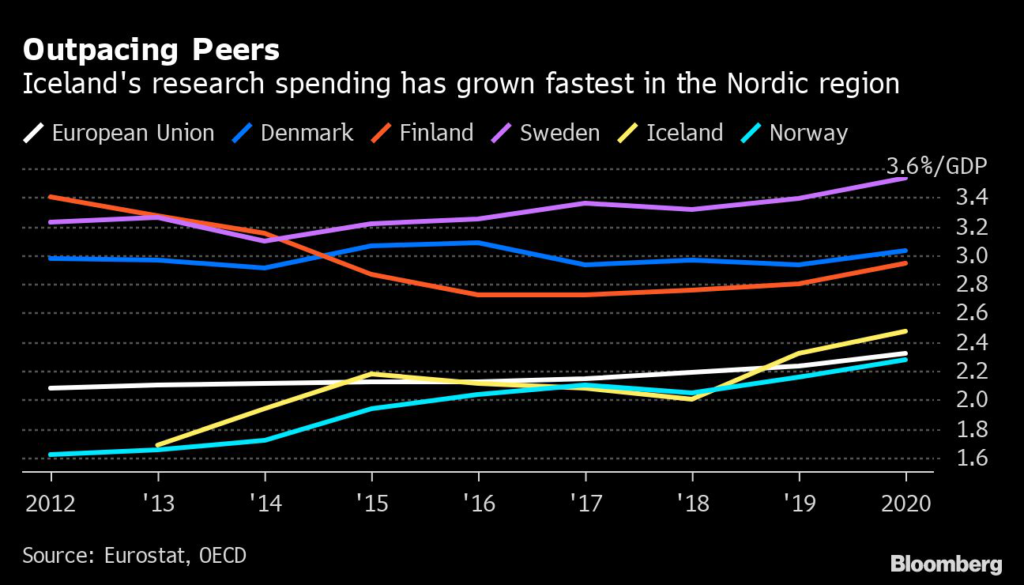
Tired of repeated booms and busts in its economy caused by individual sectors growing too big too fast, Iceland is making a concerted effort to diversify into new industries. Growing algae for nutritional supplements is just one of the businesses that have sprung up in recent years amid a drive by the government to promote innovation.

“The key to improved living standards and more opportunities is that innovation will become the biggest export sector in Iceland,” said Aslaug Arna Sigurbjornsdottir, minister of higher education, science and innovation. 

The 31-year-old minister is keen to see the country move past repeated economic crashes, such as the 1969 collapse precipitated by a sudden disappearance of herring due to overfishing that sent the nation reeling. Or the 2008 financial crisis that toppled its banks, which had become nearly 12 times bigger than its economy. The most recent painful memory is the abrupt halt to travel in the wake of the pandemic.

“External shocks — like when the herring vanished or when Covid put a stop to tourism — will have a much greater long-term impact if we have all our eggs in the same basket,” Sigurbjornsdottir said in an interview.

It’s something the International Monetary Fund has also been calling attention to, saying in May that the multiple external shocks hitting Iceland underscore the need for further efforts to diversify the economy. The focus should be on improving competition, promoting innovation and easing rules on startups, the IMF said. The administrative burden on Icelandic startups is clearly above the level of Nordic peers and also exceeds the average among members of the Organization for Economic Cooperation and Development, the IMF said last month.

Iceland relies on aluminum smelters and fisheries for the bulk of its export revenue. The share of innovation and technology has recently grown as the pandemic hurt tourism in the land of glaciers and volcanoes.

At Algalif Iceland ehf., the microalgae grower, Head of Sales and Marketing Svavar Halldorsson said that early assistance from the government to get operations off the ground “absolutely helped” turn the company into what it is today: a profitable and growing R&D-focused business which foresees expanding sales to other industries beyond nutritional supplements. 

Algalif has developed a way to cultivate the algae on an industrial scale on the cold North Atlantic island — a far cry from the traditional method using shallow open ponds in sunlit countries close to the Equator. It’s in the process of building a new factory to scale up production.

“We are tripling our production and are going to be producing 100 tons of biomass, which gives us about 5,000 kilograms (11,000 pounds) of pure astaxanthin,” he said. That’s worth about $40 million.

In the government’s vision, innovation isn’t just a sector of its own, but something underpinning all industries, Sigurbjornsdottir said. It’s reimbursing companies for a share of their research and development costs, and allows individual investors a tax deduction of 75% of their investment in innovation companies, up to 15 million kronur.

It’s also vowed to make it easier and more flexible to hire “foreign specialists” and cut red tape in their immigration process. That’s to respond to the 80% of the country’s high tech and innovation companies saying they need more staff, according to a survey by the Federation of Icelandic Industries.

“We see a lot of opportunities ahead in gaming, IT development, biotech and health technology, and various other growth sectors, but a shortage of experienced professionals is impacting those industries,” said Sigridur Mogensen, director of creative industries at the federation. “It’s becoming a more pressing matter as each day passes,” she said, signaling the government isn’t acting fast enough.

Ivar Kristjansson, founder and chief executive of an indie games studio, 1939 Games ehf., agrees.

“Today the talent pool is still a little bit too small,” with about 500 people working in the country’s games industry, “and some solve that by hiring experts from abroad,” he said in an interview. His company hasn’t done that, but instead opted to open a second studio in Helsinki, where talent was more widely available.

“It’s great to start a company in Iceland but it can be challenging to scale up,” said the CEO, overseeing the development of a World War II themed digital collectible-card game.

The IMF also notes that digital-intensive sectors contribute less to value-added growth in Iceland than in other OECD countries, “suggesting that there is scope to widen digital penetration in the production process and increase the innovation potential in the economy.”

Alvotech SA, a biotech company that last month made history by becoming the first Icelandic company to have its shares traded both in the US and in its homeland, is set to be “one of the main generators of foreign currency to Iceland,” according to Chairman Robert Wessman, who founded the maker of so-called biosimilar drugs.

Read More: Alvotech Set to Become Biggest Icelandic Firm to List in US

“There’s been a lot of transfer of knowledge into the country” giving Iceland a “deep knowledge of biosimilars,” Wessman said. “We aren’t just building up a company, but also a new industry.”

More stories like this are available on bloomberg.com

©2022 Bloomberg L.P.
What Corporate Britain Can Reveal About the State of the Economy

(Bloomberg) — Almost two thirds of UK blue-chip companies will update the market over the next three weeks, as earnings season reaches fever pitch. While Square Mile professionals pore over second-quarter details, the reports are also likely to shed light on broader subjects affecting the whole country, from the energy crunch to the cost-of-living crisis, rising interest rates and the threat of an economic slump.

Here are five things to watch.

Airlines and Travel Chaos

For some airlines, the summer’s travel chaos may also be a boon as travel rebounds after two years of lackluster results. Low supply amid a shortage of staff — together with a surge in demand as Covid restrictions end — has driven ticket prices sky high.

Ryanair Holdings Plc, which reports earnings on Monday, is among those to have avoided mass cancellations. The Irish budget carrier has beaten estimates in six of its last 10 fiscal periods. EasyJet Plc is scheduled to report a day later, with British Airways-owner International Consolidated Airlines Group and Air France-KLM disclosing their performance at the end of the week.

But there could be some turbulence. Travel-industry data platform OAG recently estimated that caps on passenger numbers at London Heathrow could result in as much as $550 million in lost revenues.

Energy Companies and the Crisis

Soaring oil and gas prices following Russia’s invasion of Ukraine have given energy majors an historic boost. Shell Plc is expected to post its largest profits since 2008 on July 28, with BP Plc also predicted to reveal bumper earnings on Aug. 2.

Centrica Plc, the owner of British Gas, reports on the same day as BP. Profits there may spark political grumbling, but with a windfall tax already imposed by the UK government, ministers’ options are limited.

London-listed miner Glencore Plc is expected to report a boost from coal sales on July 29, with the global energy crunch increasing demand for the highly-polluting fuel.

Retail and Inflation

The most intense cost of living crisis in decades has forced people in the UK to tighten their purse strings. The clearest sign of the effect on retailers will come from Next Plc, when it reports earnings Aug. 4. According to Deutsche Bank analyst Adam Cochrane, the sector faces precarious times: “Like in a cartoon, we believe that 2023 earnings forecasts are hanging over a cliff edge.” 

Meanwhile, Mars Inc. and Kraft Heinz Co. have clashed with supermarkets over price hikes, as grocers also look to undercut suppliers with their cheaper own-brand products. Consumer-goods rivals Unilever Plc and Reckitt Benckiser Group Plc update in the last week of July. 

Tineke Frikkee, head of UK equity research at Waverton Investment, is looking for any indication that shoppers have started “trading down” to lower-priced food. Kantar data shows that sales of branded goods fell 2.4% in the 12 weeks to July 10, while own-brand sales rose 4.1%.

The FTSE’s new £30 billion consumer goods giant, Haleon Plc, will issue its first update on July 27 after being hived off from pharmaceutical behemoth GSK Plc. BT Group Plc and Vodafone Group Plc will report on July 28 and July 25 respectively, shedding light on whether hard-stretched families are trying to cut their telecom bills.  

Banks, Insurers and Interest Rates

Rising interest rates could spell good news for banks. Lloyds Banking Group Plc kicks off bank reporting on July 27, with NatWest Group Plc unveiling its half-year results two days later (July 29). 

But with the Bank of England pondering a 50 basis-point hike in August, consumer-facing lenders are vulnerable to the economic slowdown. Mortgage spreads for UK banks have narrowed and consumer credit markets may also slow with the economy, Shore Capital analyst Gary Greenwood said in a note. 

Banks with relatively large trading operations, such as Barclays Plc, will hope to have enjoyed a similar boom in revenues to Wall Street’s financial giants, which have benefited from volatility on the markets. Barclays reports on July 28.

Insurers are facing inflationary pressures of their own through claims. Direct Line Insurance Group Plc and Admiral Group Plc have both signaled profits will come in lower when they report on Aug. 2 and Aug. 10, respectively. 

“Supply chain issues, and wider economic inflation will likely make it difficult to reduce claims inflation levels in the near term,” JP Morgan analyst Kamran Hossain wrote in a note. The costs are already being passed on, according to the Federation of Small Businesses, which said 60% of small firms have seen insurance premiums rising.

Cars and Supply Chains

The global supply chain crunch, triggered by Covid lockdowns and exacerbated by the war in Ukraine, has taken a severe toll on the automobile sector. Amid a persistent shortage of semiconductors, carmakers will be closely-watched for signs that supply chains are opening up. Mercedes-Benz Group AG and Ford Motor Co report on July 27, while Stellantis NV and Volkswagen AG update markets a day later. Even though they aren’t listed in the UK, their reports could give crucial updates on both supply issues and demand in the face of the cost-of-living crisis.

More stories like this are available on bloomberg.com

©2022 Bloomberg L.P.

Close Bitnami banner
Bitnami