

Bloomberg

Stocks End Three-Day Rally on Tech, Growth Woes: Markets Wrap

(Bloomberg) — US stocks fell as disappointing results from social-media firms and weak economic data added to recession fears. Treasuries rallied as traders dialed back bets on Federal Reserve hikes, while the dollar retreated.

The S&P 500 dropped for the first time in four days, while the tech-heavy Nasdaq 100 underperformed major benchmarks, closing down 1.8%. Snap Inc.’s poor results and Twitter Inc.’s sales miss raised concern about online ad spending and weighed on shares of Facebook parent Meta Platforms Inc. and Google owner Alphabet Inc. Hardware and storage companies including Micron Technology Inc. and Western Digital Corp. fell after Seagate Technology Plc’s earnings miss and weak outlook.

Despite Friday’s churn, the equity market posted its best week in a month, paring this year’s market rout to about 17%. Speculation that the worst of the selloff has passed is partly behind the move. But angst about the damage from inflation, rapidly rising interest rates and recession fears is proving hard to shake despite a tempering in expectations for Fed aggressiveness next week.

“The Fed meeting is crucial,” Quincy Krosby, chief global strategist at LPL Financial, said by phone. “Does the Fed rhetoric become less hawkish? Because what the market may be expecting that the Fed goes into the summer months and comes out perhaps a little bit less hawkish. But it’s a question mark because it depends on the trajectory of inflation.” 

In other earnings news:

  • American Express Co. rallied after reporting record revenue and raising full-year forecasts.
  • Verizon Communications Inc. slumped after it missed profit estimates and cut guidance.
  • HCA Healthcare Inc. soared after an earnings beat.

Snap’s results have become a barometer for ad spending amid mounting economic concerns. There are growing signs that tech companies are preparing for a recession with some pulling back on hiring, while Meta has lost about half of its value this year after disappointing revenue forecasts. Meta and Alphabet are scheduled to report earnings next week.

Read more: Snap Craters as Sales Disappoint, Erases $130 Billion From Peers

Underscoring recession fears, Treasuries extended an advance, pushing the 10-year yield to around 2.7%. US business activity contracted in July for the first time in more than two years, according to the S&P Global flash composite purchasing managers output index. 

That prompted swaps traders to pare bets on Fed hikes, shifting toward pricing a 50-basis-point hike in September as more likely than a three-quarter-point move. Swaps targeting next week’s meeting briefly indicated a 75 basis-point increase was slightly less than certain.

Meanwhile, German short-term bonds soared as investors trimmed bets on European Central Bank rate hikes after weaker-than-expected PMI data in the region fanned fears of a recession.

Read more: Business Activity Deteriorates Globally as Recession Fears Rise

Oil posted a weekly loss with softer European economic data and signals of US fuel demand stalling souring the market’s outlook. West Texas Intermediate slipped below $95 a barrel. 

More market commentary

  • “The market has experienced a selloff due to multiple compressions, not due to lower earnings,” Alicia Levine, head of equities, BNY Mellon Wealth Management, said in an email. “The recent earnings in social media are a reminder that there is earnings risk in these pummeled sectors … which still may not be priced into the market. Further, there is macro risk to earnings in general after weak US and European PMI’s this morning.”
  • “Expectations heading into the reporting cycle are ultra-low and well priced in most sectors,” Art Hogan, chief market strategist at B. Riley Wealth, wrote. “Another potential positive is that market participants may have reached a peak in pessimism at the same time that inflation has likely peaked. With pessimism at a peak, and inflation receding, the market may be at the ever elusive capitulation point and see more constructive action in the second half.”
  • “The message of the week is clear: bulls clearly took control of markets,” said Florian Ielpo, head of macro research at Lombard Odier Asset Management. “For now, sentiment is in the driver seat and the previously excess pessimism is now resulting in a relief rally: investors cannot complain about that.”
  • “It’s still very early days but we’ve seen numerous cases now of earnings surprises driven by the ‘it’s not as bad as we feared’ argument,” said Craig Erlam, a senior market analyst at Oanda. “That’s a relief of course, but surely not a case for a sustainable rebound.”

Some of the main moves in markets:

Stocks

  • The S&P 500 fell 0.9% as of 4 p.m. New York time
  • The Nasdaq 100 fell 1.8%
  • The Dow Jones Industrial Average fell 0.4%
  • The MSCI World index fell 0.5%

Currencies

  • The Bloomberg Dollar Spot Index fell 0.2%
  • The euro fell 0.2% to $1.0208
  • The British pound was unchanged at $1.1995
  • The Japanese yen rose 1% to 136.02 per dollar

Bonds

  • The yield on 10-year Treasuries declined 12 basis points to 2.76%
  • Germany’s 10-year yield declined 19 basis points to 1.03%
  • Britain’s 10-year yield declined 11 basis points to 1.94%

Commodities

  • West Texas Intermediate crude fell 1.8% to $94.58 a barrel
  • Gold futures rose 0.5% to $1,739.30 an ounce

More stories like this are available on bloomberg.com

©2022 Bloomberg L.P.
Progressive Caucus Asks Schumer to Set Vote on Antitrust Bills

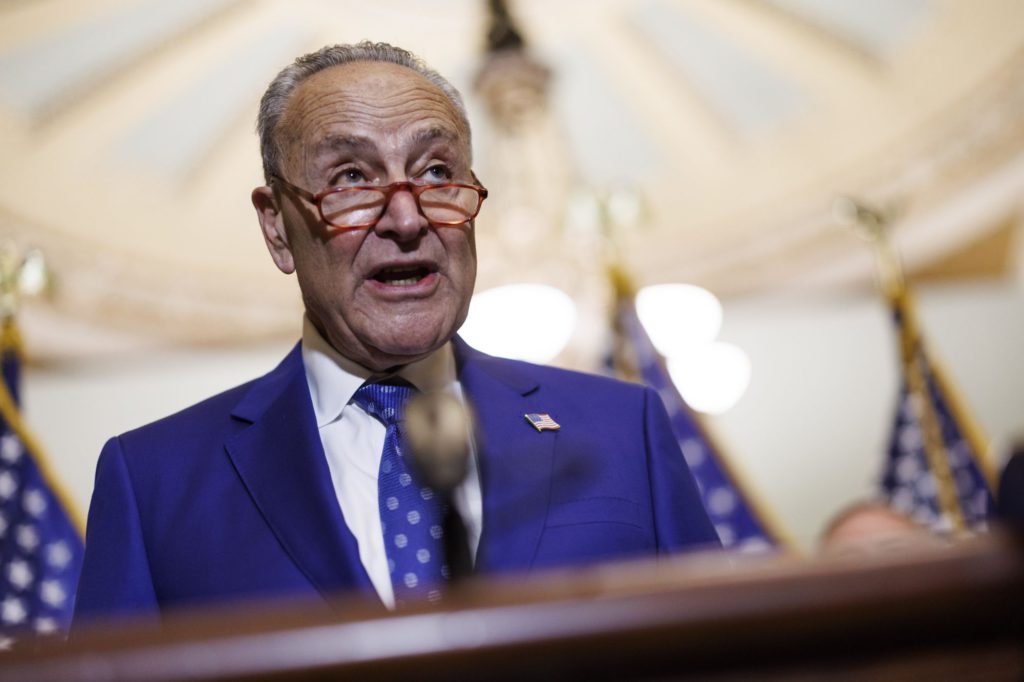
(Bloomberg) — The Congressional Progressive Caucus called for Senator Majority Leader Chuck Schumer to bring legislation to rein in technology giants to a floor vote before the August recess.

The lawmakers said in a letter to Schumer that a 16-month investigation led by the House Judiciary Antitrust Subcommittee discovered that “these platforms routinely abuse their gatekeeper power to hurt rivals and destroy competition — thereby harming consumers, the free press, innovation, and the American economy.” 

The legislation “has the full support of the Biden Administration,” the lawmakers said in the Wednesday letter. 

The American Innovation and Choice Online Act would ban major tech companies from giving advantages to their own products over those of competitors, including Amazon.com, Apple Inc., Alphabet Inc., Meta Platforms Inc. and Microsoft Corp. Another piece of legislation, the Open App Markets Act, would break open Google and Apple’s duopoly over the app-store market. 

Critics and supporters of the measures are watching whether Congress has the votes to turn the bills into law. Several Democrats are on the fence, while others aren’t revealing their stance. 

Schumer said earlier this week he supports the legislation but signaled he wants to ensure there’s enough support to overcome a filibuster.  

“I want to bring them to the floor, we have to see that we have 60 votes,” he told reporters. 

Chances of legislation getting passed after August recess are slim, when lawmakers are expected to shift their focus to the November midterms. 

One of Schumer’s daughters is a registered Amazon lobbyist and another works for Meta, which sparked criticism from antitrust advocates. Sixteen progressive groups called for Schumer’s recusal from the legislation in a separate letter Friday, arguing that he has a conflict of interest due to his daughter’s occupations. 

The current push to crack down on tech has spawned a flurry of lobbying around the measures and prompted chief executive officers including Apple’s Tim Cook, Google’s Sundar Pichai and Amazon’s Andy Jassy to come to Washington to meet with lawmakers about the proposals. 

Lawmakers who signed the letter include Representatives Pramila Jayapal, Ilhan Omar, Jan Schakowsky, chair of the consumer protection and commerce committee, and Katie Porter.

More stories like this are available on bloomberg.com

©2022 Bloomberg L.P.

Verizon Shares See Biggest Loss Since 2008 After Outlook Cut

(Bloomberg) — Verizon Communications Inc. shares plunged to their biggest drop in 14 years after the mobile-phone company cut its forecast for the second straight quarter, adding to concerns that consumers are pulling back on spending.

The largest US wireless carrier is having difficulty keeping up with rivals on subscriber growth amid heavy phone discounts and decades-high inflation. Verizon said Friday that it added only 12,000 monthly wireless phone subscribers in the second quarter, well below analysts’ predictions for 167,200 new phone customers. 

The shares fell 6.7% in New York, their biggest one-day drop since 2008, when the US was in the throes of the Great Recession. The stock has fallen 14% this year.

The news is another setback for wireless carriers after AT&T Inc. alarmed industry watchers Thursday with a warning that some customers are starting to delay paying their bills. Both AT&T and Verizon have been raising prices by $6 a line on older mobile plans.

“It’s hard to find any silver lining in these results,” said LightShed Partners analyst Walt Piecyk. “Verizon management appears to have no answers for how to grow. It’s unclear what is next.”

Verizon is under pressure to retain its market lead. The company returned to free phone promotions in an effort to counter discounts and giveaways by AT&T and T-Mobile US Inc. The New York-based mobile giant is also racing to catch up with T-Mobile on 5G service and expects to find new revenue by pursuing network contracts with businesses and facilities including shipping ports.

Earnings per share, excluding some items, are now expected to be between $5.10 to $5.25 for the year, down from a range of $5.40 to $5.55, Verizon said Friday in a statement. The company also reduced its forecast for service and other revenue, calling for as much as a 1% decline. The outlook had previously been for flat revenue growth compared with a year ago.

Verizon lost a net 215,000 consumer wireless customers in the second quarter and gained 227,000 business customers. Higher device activations and increased inventory levels tied to supply-chain initiatives hurt cash flow in the first half of 2022, the company said.

Verizon hasn’t seen late bill payments from customers, Chief Financial Officer Matt Ellis told analysts on a conference call. He said challenges facing the company this year are a “short term” setback. 

In so-called fixed wireless, a relatively new segment of broadband service where signals are beamed directly to a home WiFi router, Verizon added 256,000 wireless internet subscribers. T-Mobile had taken a lead in the race to serve wireless broadband to homes with more than 1 million internet subscribers as of April. The wireless carriers’ introduction of a $50-a-month, high-speed alternative to landline broadband has been cutting into the cable companies’ most prized business.

“The competitive environment will only get more difficult over the course of the next few quarters,” New Street Research analyst Jonathan Chaplin wrote in a note to clients. “They managed to keep their market share stable when AT&T or Sprint were shedding subs, but with Sprint gone and AT&T refocused on its communications businesses, maintaining that position may be impossible.”

(Updates with closing stock price in third paragraph.)

More stories like this are available on bloomberg.com

©2022 Bloomberg L.P.

Snap Craters as Sales Disappoint, Erases $130 Billion From Peers

(Bloomberg) — US social-media companies saw more than $130 billion wiped off their stock-market values Friday, after disappointing revenue from Snap Inc. and a lackluster report from Twitter Inc. raised new concerns about the outlook for online advertising.

The Snapchat parent plummeted 39%, sinking to its lowest level since March 2020. Meanwhile, Facebook parent Meta Platforms Inc. fell 7.6%, Pinterest Inc dropped more than 13%, and Google owner Alphabet Inc. declined 5.6% in its biggest one-day drop since March 2020.

Twitter also reported quarterly results on Friday, though Wall Street remains focused on the company’s legal battle with Tesla CEO Elon Musk, who is attempting to withdraw from a deal to buy the company. The stock rose 0.8% on the day.

Social media shares are facing a relentless slowdown in advertising revenue at a time when competition from other platforms, such as TikTok, increase. Friday’s losses in the group’s shares mark the second selloff sparked by Snap in two months. 

Wall Street analysts were quick to react, with more than a dozen brokerages cutting recommendations on Snap’s stock, while many more trimmed their price targets. The shares have slumped nearly 80% this year, while Meta and Pinterest are down about 50%. 

“TikTok’s strong engagement and rapid monetization growth are having an outsized impact on Snap’s business,” JPMorgan analyst Doug Anmuth wrote in a note. He cut his rating on the stock to underweight and slashed the price target to a Wall Street low of $9. 

Snap didn’t issue financial guidance for the third quarter, except to say that revenue so far in the period is about flat compared with last year. Management also reiterated it plans a “substantially reduced rate of hiring,” echoing plans by Apple Inc. and others.

“The earnings optimism may come to a pause for now,” said Tina Teng, a markets analyst at CMC Markets in Auckland. “Snap’s miss on earnings expectations indicates the severe challenges facing its tech peers, typically on social platforms such as Meta Platforms.” 


Vital Knowledge called the results from Snap and hard-disk-drive maker Seagate Technology Holdings Plc “awful” and “ugly.” Tech stocks may face more pressure as earnings season ramps up next week.

READ: Snap Growth Muted Through 2023 on Uncertainty: Bloomberg Intelligance 

“With more and more mega-cap tech companies planning to slow hiring and downgrade their growth expectations, the economic outlook is certainly not in good shape,” CMC’s Teng said.

(Updates with closing prices)

More stories like this are available on bloomberg.com

©2022 Bloomberg L.P.
Crypto Stocks Get Boost From Retail Traders Who Drove Meme Craze

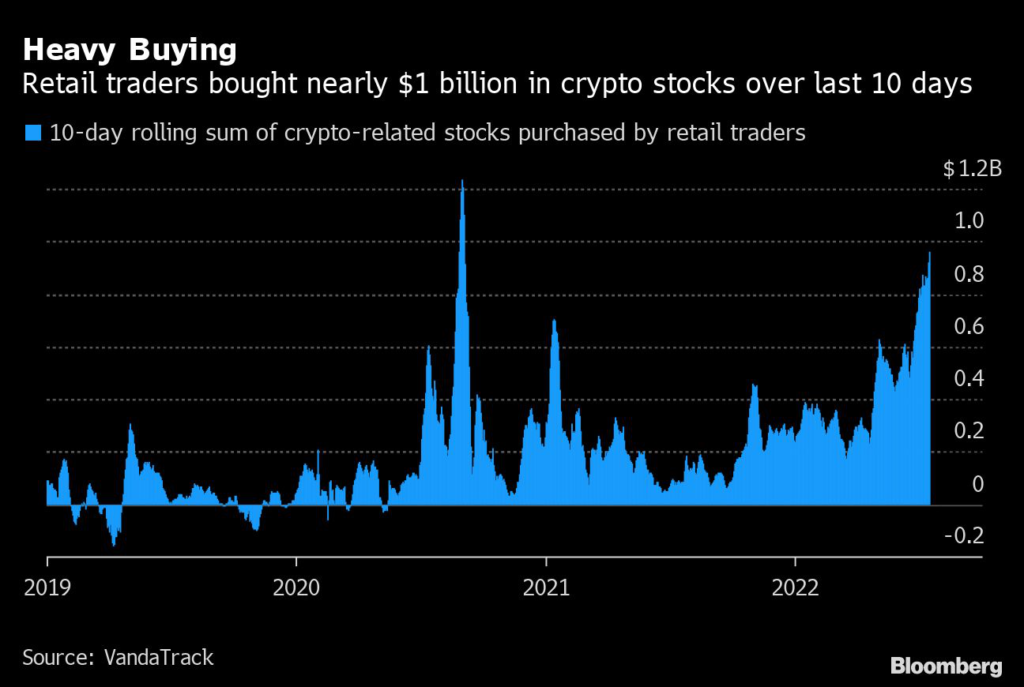
(Bloomberg) — Retail traders, responsible for the wild price swings in everything from GameStop Corp. to Revlon Inc., have returned to another old favorite: beaten-down cryptocurrency stocks.

Over the last 10 days, they have scooped up nearly $1 billion worth of shares of crypto-exposed companies, according a report published Wednesday by VandaTrack. That rapid burst of buying has led to stocks including Marathon Digital Holdings Inc., Coinbase Global Inc. and Riot Blockchain Inc. showing up among the most bought assets on Fidelity’s platform this week.

“Retail traders are definitely surfacing here,” said Ed Moya, senior market analyst at Oanda Corp. “Everyone expected one last major plunge for Bitcoin and now prices are recovering and risk appetite on Wall Street is somewhat improving.”

With the resurgence, the NYSE FactSet Global Blockchain Technologies Index is now on track for its largest monthly gain since February 2021. Among its biggest gainers this month, Marathon Digital has jumped 133%, while Riot Blockchain, Silvergate Capital Corp. and Coinbase have all climbed by at least 50%. These stocks are still down more than 40% this year. 

The Bloomberg Galaxy Crypto Index, which tracks the performance of the largest digital assets including Bitcoin, has climbed roughly 35% over that stretch. And half of the 20 best-performing US ETFs since the end of June are crypto-related. However, Bitcoin is still down about 51% this year. 

Despite July’s rebound, crypto-related companies have been among the worst performing stocks this year as investors fled risky assets fearing that the Federal Reserve’s aggressive policy-tightening regime could tip the economy into a recession. The collapse of the TerraUSD stablecoin and subsequent folding of firms including Celsius Network and Three Arrows Capital only exacerbated these losses in recent months.

Mining stocks have taken a particularly hard beating as Bitcoin prices tumbled from a record high of almost $69,000 in November to a two-and-a-half year low of less than $18,000 last month. Bitcoin’s plunge has spurred several analysts to declare a so-called “crypto winter” as roughly $2 trillion in market value was erased from the digital-token space. 

Even one of the biggest influencers in the crypto space has seemingly started to get cold feet. On Wednesday, Elon Musk’s Tesla Inc. revealed that it had sold off a majority of its Bitcoin holdings during the second quarter, saying the move was made to provide the electric-vehicle maker additional liquidity.

But that hasn’t deterred some traders. With Bitcoin on track for its first monthly gain since March, the retail crowd has shown up en mass, flocking particularly to mining stocks. 

The $7.4 million Viridi Bitcoin Miners ETF (ticker RIGZ) has jumped roughly 33% this month, making it one of the top-performing US-listed exchange-traded funds in July. Stronghold Digital Mining Inc., which is held by the ETF, surged more than 79% over the same period and is on track for its best month on record. 

Trading volume for the miner soared to upwards of 100 million shares on Wednesday, more than 70% of its total trading volume since it went public last year, a sign of retail-investor interest. 

“Whenever any stock or group breaks out of a multimonth range to the upside, the rally usually lasts several weeks,” said Matt Maley, chief market strategist at Miller Tabak + Co. “It won’t happen in a straight line, so they could take a breather at any time, but the line of least resistance is now up.”

(Updates pricing throughout.)

More stories like this are available on bloomberg.com

©2022 Bloomberg L.P.

Alphabet Stock Split Lands With a Thud in Worry-Filled Market

(Bloomberg) — Even for Alphabet Inc., financial gimmickry is no match for the power of the bear market.

The Google parent’s shares sank 2.5% on Monday, the first day of trading after a 20-for-1 split that brought its stock price down to the $100 range from more than $2,000. Alphabet shares dropped more than 3% this week while the Nasdaq 100 Stock Index advanced and has fallen more than 20% since the split was announced Feb. 1.

It’s not alone. Of the four companies in the S&P North American Technology Index that split their stocks this year, none of them have gained appreciably since announcing the plans. Amazon.com Inc. has fallen 12% since declaring its split in March. Canadian e-commerce company Shopify has fallen 38% and cybersecurity company Fortinet Inc. is up about 2%.

The lackluster performances are a far cry from the heady days of 2020 when Apple Inc. and Tesla Inc. helped revive the practice after their stocks surged to records in the months after annoucning the plans. In the following year, there were five splits in the S&P 500, compared with just two in 2019, according to data compiled by Bloomberg.

The aim of a stock split is simple: bring down the cost to purchase a share so that more retail investors can afford it and spreading the company’s equity over a larger number of shares. Some investors, however, tended to view the decision by a company to split it stock as a positive cue.  

“A split of a very popular tech company is seen as a way to bring in the retail investor at a time when institutions aren’t buying with slowing economic growth, inflation and higher costs,” said Phil Blancato, chief executive officer of Ladenburg Thalmann Asset Management. “Institutions are not buyers here, they’re sellers and I think they’re seeing the split as a sign of weakness.”

It’s not just splits in the technology sector that have fallen flat. Medical-device maker Dexcom Inc. has dropped 28% since announcing its split in March. Of the five companies in the S&P 500 Index that have split their stocks this year, only insurance company WR Berkley Corp. has seen its shares advance more than 3%.

The jump in retail trading volume during the Covid-19 pandemic offered a compelling reason for companies to reduce their stock prices. So far, the splits appear to have been effective at attracting more mom-and-pop investors but it hasn’t been enough to overcome selling pressure. Retail trader order volume as a percentage of total market volume has jumped to 14.5% for Amazon this month, compared with 3.8% a year ago, estimates compiled by JPMorgan Chase & Co. show. For Alphabet, retail traders’ share of volume is at 8.2%, compared with 2.8% a year ago.

Despite poor post-split performance, companies don’t appear to be deterred. Tesla last month said it’s seeking shareholder approval for a 3-for-1 split in the form of a stock dividend after initially raising the prospect in March, less than two years after completing its 5-for-1 split. 

(Updates shares throughout.)

More stories like this are available on bloomberg.com

©2022 Bloomberg L.P.

Surface-to-Air Missiles Need Chips Too, Pentagon Tells Congress

(Bloomberg) — The Pentagon is pushing for the passage of legislation aimed at boosting the US’s domestic semiconductor industry, telling lawmakers the components, which go into everything from vacuum cleaners to fighter jets, are needed for the war in Ukraine.

“The national security stakes for passing the Chips Act are high,” Deputy Secretary of Defense Kathleen Hicks said in a statement to Bloomberg News. “Microelectronics are fundamental to virtually every current and legacy military system.”

Hicks said the production of Javelin and Stinger missiles — “systems desperately needed by those in Ukraine” — are hampered by persistent semiconductor manufacturing delays and that having access to on-shore manufactured chips would help the US deter its adversaries and better assist its partners and allies. A Javelin missile system has about 200 chips.

The US’s share of semiconductor manufacturing has fallen to 12% from 37% since 1990 and the country currently produces none of the most advanced chips, which are made largely in Taiwan.

The Senate is considering a package of legislation that would funnel $52 billion in grants and subsidies to US semiconductor manufacturers as well as funding to 5G wireless networks. It would provide $3 billion for research. The bill contains a 25% tax credit for semiconductor manufacturing — the source of a projected $79 billion revenue loss.

Read more: Senate’s Bipartisan Chips Bill Would Add $79 Billion to Deficit

“This is a national security issue for us,” said Democratic Senator Mark Kelly of Arizona, a former fighter pilot and astronaut, following a recent briefing on Capitol Hill with Hicks, Director of National Intelligence Avril Haines and Commerce Secretary Gina Raimondo. “We need to get this bill done.”

“The next generation of technologies is bound up in our ability to make sure that we have a secure and resilient supply chain, and it means getting the kind of structures in place to get the most sophisticated kinds of chips to the United States,” Hicks said.

More stories like this are available on bloomberg.com

©2022 Bloomberg L.P.
Stocks Jostled by Tech Losses, Bonds Extend Gains: Markets Wrap

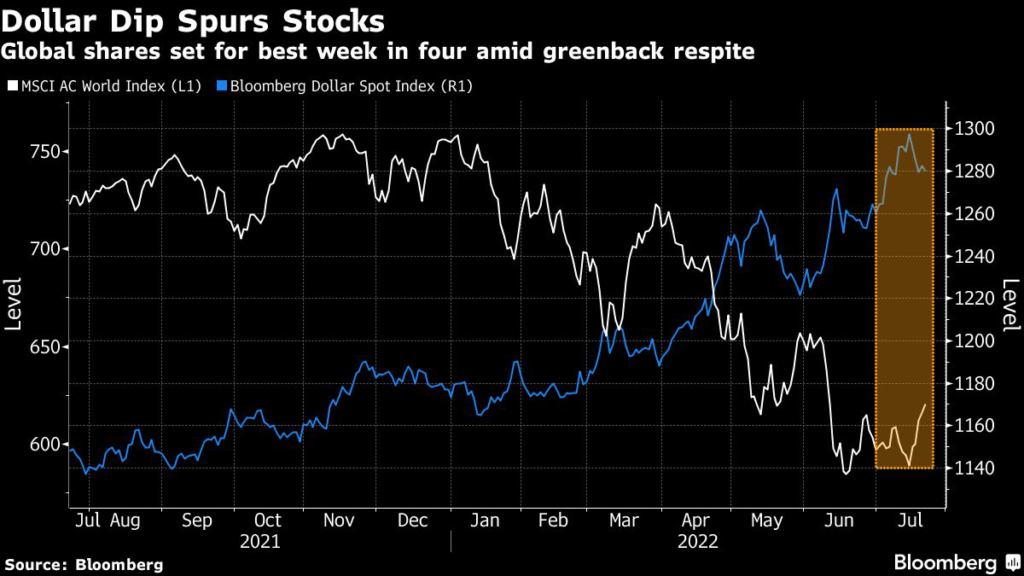
(Bloomberg) — US stocks swung between gains and losses in early trading as investors parsed a flood of big-name second-quarter earnings. Treasuries extended gains after weak US economic data.

The S&P 500 pared losses in choppy trade. American Express Co. led financial stocks higher after reporting record revenue and raising full-year forecasts. Snap Inc.’s poor results weighed on social-media stocks, and Twitter Inc. slipped after posting disappointing second-quarter sales. The tech-heavy Nasdaq 100 underperformed, falling 0.4%.

Snap’s disappointing revenue hit stocks, including Facebook parent Meta Platforms Inc. and Google owner Alphabet Inc. Hardware and storage companies including Micron Technology Inc. and Western Digital Corp. fell after Seagate Technology Plc’s earnings miss and weak outlook.

Still, stocks remain on course for their best week in a month, paring this year’s market rout to about 16%. Speculation that the worst of the selloff has passed is partly behind the move. Angst about the damage from inflation and rapidly rising interest rates is proving hard to shake — despite a tempering in expectations of just how aggressive the Federal Reserve will be. 

“It’s still very early days but we’ve seen numerous cases now of earnings surprises driven by the ‘it’s not as bad as we feared’ argument,” said Craig Erlam, a senior market analyst at Oanda. “That’s a relief of course, but surely not a case for a sustainable rebound.”

In other earnings news:

  • Verizon Communications Inc. slumped after it missed profit estimates and cut guidance.
  • HCA Healthcare Inc. soared after an earnings beat.

Underscoring recession fears, Treasuries extended an advance, pushing the 10-year yield to around 2.7%. US business activity contracted in July for the first time in more than two years, according to the S&P Global flash composite purchasing managers output index.

Meanwhile, German short-term bonds soared as investors trimmed bets on European Central Bank rate hikes after weaker-than-expected PMI data in the region fanned fears of a recession. US PMIs are due at 9:45 a.m.

Friday’s losses for Snap mark the second major sector selloff sparked by Snap in two months, as its results become a barometer for ad spending amid mounting economic fears. There are growing signs that tech companies are preparing for a recession with some pulling back on hiring, while Meta has lost about half of its value this year after disappointing revenue forecasts.

Read more: Company Forecasts Are Showing Inflation Cracks: Earnings Watch

Focus will now turn to the Fed’s meeting next week, where the central bank is again expected to increase interest rates to tame scorching inflation. 

Some of the main moves in markets:

Stocks

  • The S&P 500 was little changed as of 10:20 a.m. New York time
  • The Nasdaq 100 fell 0.4%
  • The Dow Jones Industrial Average rose 0.2%
  • The Stoxx Europe 600 rose 0.4%
  • The MSCI World index rose 0.3%

Currencies

  • The Bloomberg Dollar Spot Index fell 0.6%
  • The euro rose 0.2% to $1.0251
  • The British pound rose 0.5% to $1.2056
  • The Japanese yen rose 1.2% to 135.66 per dollar

Bonds

  • The yield on 10-year Treasuries declined nine basis points to 2.78%
  • Germany’s 10-year yield declined 19 basis points to 1.04%
  • Britain’s 10-year yield declined 10 basis points to 1.95%

Commodities

  • West Texas Intermediate crude rose 0.3% to $96.65 a barrel
  • Gold futures rose 1.2% to $1,752.30 an ounce

More stories like this are available on bloomberg.com

©2022 Bloomberg L.P.
Verizon Cuts Forecast After Wireless Miss, Stinging Shares

(Bloomberg) — Verizon Communications Inc. fell after cutting its forecast for the second straight quarter, adding to concerns that consumers are pulling back on spending.

The largest US wireless carrier is having difficulty keeping up with rivals on subscriber growth amid heavy phone discounts and decades-high inflation. Verizon said Friday that it added only 12,000 monthly wireless phone subscribers in the second quarter, well below analysts’ predictions for 167,200 new phone customers. 

The news is another setback for wireless carriers after AT&T Inc. alarmed industry watchers Thursday with a warning that some customers are starting to delay paying their bills. Both AT&T and Verizon have been raising prices by $6 a line on older mobile plans.

“It’s hard to find any silver lining in these results,” said LightShed Partners analyst Walt Piecyk. “Verizon management appears to have no answers for how to grow. It’s unclear what is next.”

Shares of Verizon fell 5.4% at 10:03 a.m. in New York. The stock dropped 2.9% Thursday after AT&T’s earnings and is down more than 13% on the year.

Verizon is under pressure to retain its market lead. The company returned to free phone promotions in an effort to counter discounts and giveaways by AT&T and T-Mobile US Inc. The New York-based mobile giant is also racing to catch up with T-Mobile on 5G service and expects to find new revenue by pursuing network contracts with businesses and facilities including shipping ports.

Earnings per share, excluding some items, are now expected to be between $5.10 to $5.25 for the year, down from a range of $5.40 to $5.55, Verizon said Friday in a statement. The company also reduced its forecast for service and other revenue, calling for as much as a 1% decline. The outlook had previously been for flat revenue growth compared with a year ago.

Verizon lost a net 215,000 consumer wireless customers in the second quarter and gained 227,000 business customers. Higher device activations and increased inventory levels tied to supply-chain initiatives hurt cash flow in the first half of 2022, the company said.

Verizon hasn’t seen late bill payments from customers, Chief Financial Officer Matt Ellis told analysts on a conference call. He said challenges facing the company this year are a “short term” setback. 

In so-called fixed wireless, a relatively new segment of broadband service where signals are beamed directly to a home WiFi router, Verizon added 256,000 wireless internet subscribers. T-Mobile had taken a lead in the race to serve wireless broadband to homes with more than 1 million internet subscribers as of April. The wireless carriers’ introduction of a $50-a-month, high-speed alternative to landline broadband has been cutting into the cable companies’ most prized business.

“The competitive environment will only get more difficult over the course of the next few quarters,” New Street Research analyst Jonathan Chaplin wrote in a note to clients. “They managed to keep their market share stable when AT&T or Sprint were shedding subs, but with Sprint gone and AT&T refocused on its communications businesses, maintaining that position may be impossible.”

(Updates shares in fifth paragraph.)

More stories like this are available on bloomberg.com

©2022 Bloomberg L.P.

Twitter Sales Miss Estimates Amid Takeover Battle With Musk

(Bloomberg) — Twitter Inc. reported disappointing second-quarter sales on Friday, another blow to a company that is already fighting a high-profile legal battle with Elon Musk over the fate of the social network. 

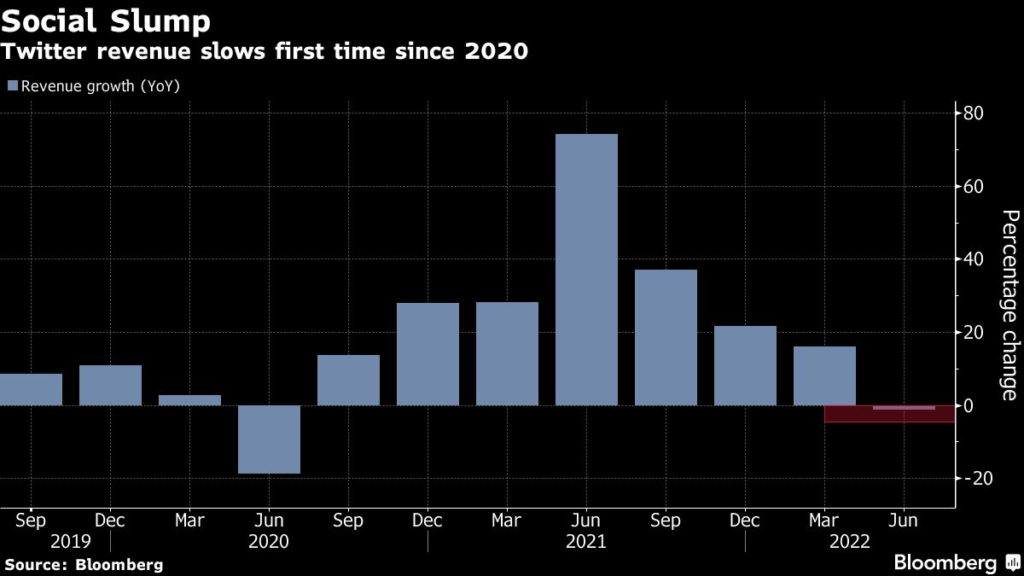
Revenue fell 1% in the quarter from a year earlier, its first annual decline since the middle of the pandemic in 2020. Sales totaled $1.18 billion in the quarter, which fell short of the $1.32 billion analysts estimated. The company said “advertising industry headwinds associated with the macroenvironment as well as uncertainty related to the pending acquisition of Twitter” were factors in the disappointing results.

Twitter added 8.8 million new users during the quarter, in line with analysts’ estimates. 

It’s unclear how much Friday’s earnings report truly means to investors while the company’s fate remains in limbo. Until two weeks ago, Twitter was set to sell the company to Musk for $54.20 per share, making its financial reports little more than a formality as it awaited the deal to close. 

But Musk tried to back out of the deal on July 8, claiming Twitter hasn’t been forthcoming with information on the number of fake accounts running rampant on the site. Twitter reiterated in its earnings release on Friday that it believes false or spam accounts make up less than 5% of its total user base, a claim that Musk has repeatedly questioned.

Both sides are preparing for a trial, expected in October, during which Twitter will ask a judge to force the Tesla Inc. chief executive officer to honor his purchase agreement to buy the company for roughly $44 billion. 

“This makes the investment case for Twitter hard to make at this point,” wrote Truist Securities analyst Youssef Squali after Musk’s announcement. Truist estimated that the shares could trade “in the high $20s” if the deal falls through. 

If the deal does fall through, Twitter’s business could be in trouble. The company previously set a goal to reach 315 million daily users by the end of 2023 and boost revenue to $7.5 billion annually by the same period. Currently, Twitter isn’t on track to meet the user goal. It reported 237.8 million average monetizable daily active users in the second quarter.

Like many of its social media peers, Twitter is also facing a major slowdown in advertiser spending and increasing competition from TikTok for viewers. Snap Inc. foreshadowed the difficulties in the industry on Thursday when it reported disappointing sales, citing advertisers slashing budgets more than expected due to the global economic uncertainty, but also increased competition for dwindling marketing dollars. 

Twitter shares, which fell initially after Snap’s results, were little changed at $39.68 Friday morning in New York. They are down almost 9% this year. 

Twitter’s net loss was $270 million in the quarter, or a loss of 35 cents a share. That compares with net income of $66 million and earnings per share of 8 cents in the same period a year earlier.

Twitter isn’t holding an analyst call to discuss earnings, and only published a short press release with minimal detail compared with its usual shareholder letter. In the previous quarterly results in April, Twitter withdrew its earlier outlook and said it wouldn’t provide forward-looking guidance.

(Updates shares)

More stories like this are available on bloomberg.com

©2022 Bloomberg L.P.

Close Bitnami banner
Bitnami