Bloomberg

Snap Plunges After Advertiser Slump Crushes Quarterly Sales

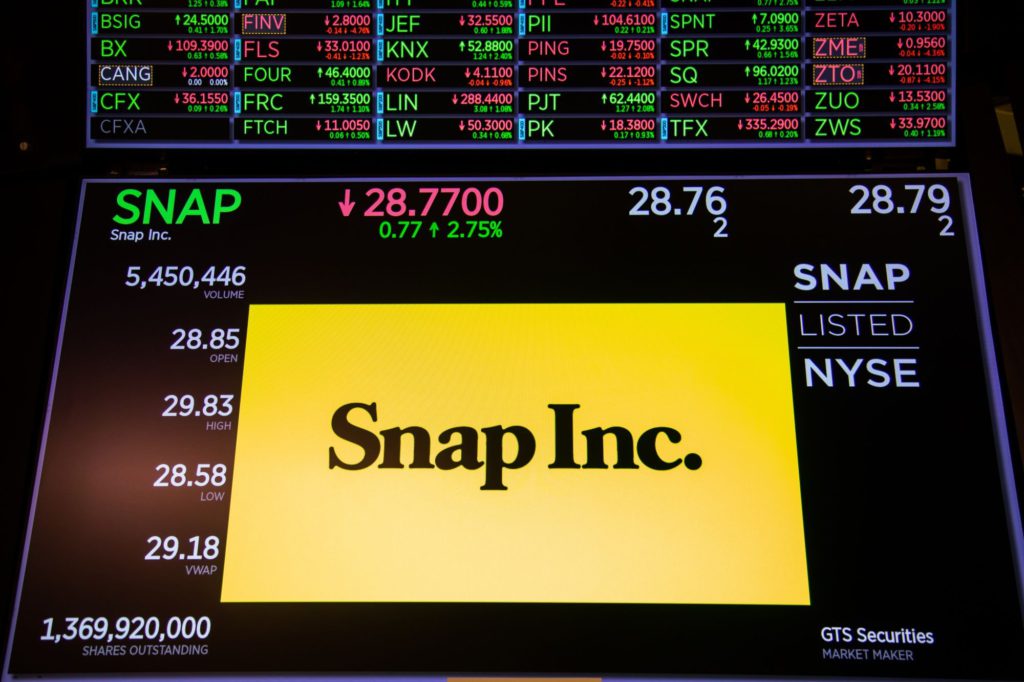
(Bloomberg) — Snap Inc. fell to its lowest level in more than two years after the company reported disappointing sales, roiled by a major slowdown in ad spending and rising competition for dwindling marketing dollars. Shares of Meta Platforms Inc. and Alphabet Inc. fell in tandem.

Second-quarter revenue grew 13% to $1.11 billion, the company said Thursday, falling short of analysts’ expectations for $1.14 billion. Snap told investors in May to disregard its initial growth guidance, which the company ultimately missed.

Advertisers are slashing budgets more than expected — a trend the company attributed to broad economic uncertainty. Snap makes the popular Snapchat app, which reached 347 million daily active users in the quarter. Its user growth outpaced rivals Facebook and Twitter and topped analysts’ estimates. But it wasn’t enough. 

“The combination of macroeconomic headwinds, platform policy changes and increased competition have limited the growth of campaign budgets,” the company said in an investor letter Thursday. The results “do not reflect the scale of our ambition,” Snap added. “We are not satisfied with the results we are delivering, regardless of the current headwinds.”

Due to the economic uncertainty, the company didn’t issue financial guidance for the third quarter, except to say that — this far into the period — revenue is about flat compared with last year. In the second quarter, Snap posted a net loss of $422 million, more than the $332.7 million average estimate. 

Snap shares plunged as much as 36% to $10.51 in New York on Friday morning, dragging shares of other social media companies with them. The stock had already fallen about 65% this year prior to the announcement. Snap management has told employees of plans to limit hires, and reiterated the strategy Thursday, saying it plans “a substantially reduced rate of hiring.”

What Bloomberg Intelligence Says:

“Snap appears likely to face worse-than-expected ad-pricing pressure, driven by a pullback in spending as well as Apple’s privacy changes. The company’s view of 3Q revenue being about flat year-over-year suggests its headwinds aren’t likely to abate in the near term.”

— Mandeep Singh, BI senior technology industry analyst

Click here to read the research.

Investors will be watching Snap for clues on the performance of other advertising-dependent social media businesses. Twitter reported its second-quarter results on Friday and showed revenue declined 1% in the period, the first drop since the middle of the pandemic in 2020. The company cited “advertising industry headwinds associated with the macroenvironment as well as uncertainty related to the pending acquisition of Twitter,” as factors in the disappointing results. Meta and Alphabet also report earnings this month.

Snap, Meta-owned Facebook and Alphabet-owned Google are competing for advertising dollars at a challenging time. Spiraling inflation is putting pressure on companies and consumers’ spending. Meanwhile, new rules from Apple Inc. that require all apps to get a smartphone user’s permission to be tracked online have made it more difficult for advertisers to measure and manage their ad campaigns. 

“We’re seeing the overall advertising pie grow at a smaller rate, and that essentially intensifies the competition,” Snap Chief Financial Officer Derek Andersen said on a call to analysts and investors Thursday.

Fast-growing competitor TikTok, with its endless feed of short-form videos, has been swiftly luring users and advertisers to its platform. It now has about 1 billion users in the US, who spend more time on the app monthly than they do on Instagram and Facebook combined, according to mobile researcher Data.ai. In response, Instagram, Facebook, YouTube and Snap have all added similar vertical-video feeds in response.

“The economy and these changes to Apple in particular have really accelerated a lot of the problems that were existing for a lot of these social media companies,” said Jasmine Enberg, principal analyst at Insider Intelligence. “The reality here is public behavior is shifting to more public sharing — the TikTok-like short video entertainment. TikTok has really shaken up the social media world.”

To weather this environment, Chief Executive Officer Evan Spiegel is investing in three main priorities: initiatives that continue to grow its user base, improving its direct-response advertising business and how it measures ad spending, and finding new sources of revenue to diversify the company.

In the last quarter, the company rolled out a number of user-focused tools. Snapchat+ is a subscription service that allows power users to access “exclusive” and “experimental” features for $3.99 a month. Snapchat for Web was made available to users in certain markets, extending voice and video calling, and chat tools to desktops. The company also launched a $230 square-shaped flying camera drone that can automatically film the user and then land in the palm of their hand.

As part of its earnings announcement, the Santa Monica, California-based company’s board authorized a stock buyback program of as much as $500 million in the next 12 months to help offset the issuance of shares for employee compensation. 

The board also authorized a stock split if the shares reach $40 in the next 10 years, which would let the co-founders to sell or donate shares. The move would award one additional share to holders of Class A shares, which is the nonvoting stock also traded by investors. This would permit the founders to hold their Class B and C shares, which allow the pair to control more than 99.5% of the company’s voting rights.

On Thursday, Snap said co-founders Spiegel and Bobby Murphy have entered into new agreements to serve in their roles — CEO and chief technology officer, respectively — until at least Jan. 1, 2027. The executives will be paid $1 a year and receive no equity compensation.

(Updates with stock trading.)

More stories like this are available on bloomberg.com

©2022 Bloomberg L.P.

FedEx Reduces US Sunday Deliveries as E-Commerce Cools

(Bloomberg) — FedEx Corp. plans to scale back Sunday delivery service in far-flung areas of the US, the latest evidence that the e-commerce surge spurred by Covid-19 is ending. 

The courier’s Ground unit will pare service in rural and lightly populated areas, reducing its coverage to about 80% of the population from 95% now, according to a statement.

“As economic conditions have shifted, we are making operational adjustments to suspend Sunday delivery operations in certain low-density, rural markets,” FedEx said late Thursday.

Its shares rose less than 1% at 9:42 a.m. in New York. FedEx had slid 12% this year through Thursday’s close.

The 6,000 small companies that deliver packages for the Ground unit have been complaining that they’re losing money because of rising costs. On Wednesday, one large contractor called for Sunday service to be scrapped and for an extra payment to cover rising expenses for fuel, wages and vehicles. 

FedEx accelerated the rollout of Sunday service in 2020 to handle an historic increase of residential deliveries after Covid-19 spurred lockdowns to stem the spread of the virus. 

Volume at the Ground unit jumped 33% for the quarter ending in August 2020, during the height of the pandemic. In the latest quarter, the company reported the unit’s package volume fell 6.2%. 

Contractors’ Complaints

It’s unclear what role the contractors’ complaints played in the decision to scale back Sunday service, which Chief Executive Officer Raj Subramaniam touted as a competitive advantage during an investor meeting in Memphis last month.  

Spencer Patton, who has about 225 FedEx Ground delivery routes in 10 states, said his estimates show that the company was losing as much as $500 million a year on Sunday deliveries because the volume wasn’t high enough to run sorting hubs efficiently.

The low volume on Sundays also makes the contractors less efficient and creates problems for scheduling drivers, Patton said as part of his drive to get FedEx to increase its compensation for contractors.

In 2019, FedEx announced that it would begin Sunday service year-round in January 2020 after doing seven-day deliveries only during the peak holiday season. United Parcel Service Inc. relies mostly on the U.S. Postal Service for its Sunday deliveries. 

More stories like this are available on bloomberg.com

©2022 Bloomberg L.P.

‘Awful’ Snap Sales Wipe $80 Billion From Social-Media Stocks

(Bloomberg) — US social-media companies saw nearly $80 billion wiped off their stock-market values Friday, after disappointing revenue from Snap Inc. and a lackluster report from Twitter Inc. raised concerns about the outlook for online advertising.

The Snapchat parent plummeted as much as 36% Friday to its lowest level since March 2020. Meanwhile, Facebook parent Meta Platforms Inc. fell 5.9%, Google owner Alphabet Inc. declined 2.8%, and Pinterest Inc sank 9.7%.

Twitter also reported quarterly results on Friday premarket with its shares fluctuating at the trading open. The company said second-quarter revenue missed expectations, although average monetizable daily active users were in line with the average analyst estimate.

Social media shares are facing a relentless slowdown in advertising revenue at a time when competition from other platforms, such as TikTok, increase. Friday’s losses in the group’s shares mark the second selloff sparked by Snap in two months. 

Wall Street analysts were quick to react, with more than a dozen brokerages cutting recommendations on Snap’s stock, while many more trimmed their price targets. The shares have slumped nearly 80% this year, while Meta and Pinterest are down almost 50%. 

“TikTok’s strong engagement and rapid monetization growth are having an outsized impact on Snap’s business,” JPMorgan analyst Doug Anmuth wrote in a note. He cut his rating on the stock to underweight and slashed the price target to a Wall Street low of $9. 

Snap didn’t issue financial guidance for the third quarter, except to say that revenue so far in the period is about flat compared with last year. Management also reiterated it plans a “substantially reduced rate of hiring,” echoing plans by Apple Inc. and others.

“The earnings optimism may come to a pause for now,” said Tina Teng, a markets analyst at CMC Markets in Auckland. “Snap’s miss on earnings expectations indicates the severe challenges facing its tech peers, typically on social platforms such as Meta Platforms.” 


Vital Knowledge called the results from Snap and hard-disk-drive maker Seagate Technology Holdings Plc “awful” and “ugly.” Tech stocks may face more pressure as earnings season ramps up next week.

READ: Snap Growth Muted Through 2023 on Uncertainty: Bloomberg Intelligance 

“With more and more mega-cap tech companies planning to slow hiring and downgrade their growth expectations, the economic outlook is certainly not in good shape,” CMC’s Teng said.

(Updates share price moves throughout.)

More stories like this are available on bloomberg.com

©2022 Bloomberg L.P.

China Giants Struggle to Lure Buyers After Epic Rout

(Bloomberg) — A 40% slump in shares over the past year, the winding down of a hallmark investigation and vows of support for the sector should offer a solid buy signal for China’s tech giants. But investors aren’t so sure yet.

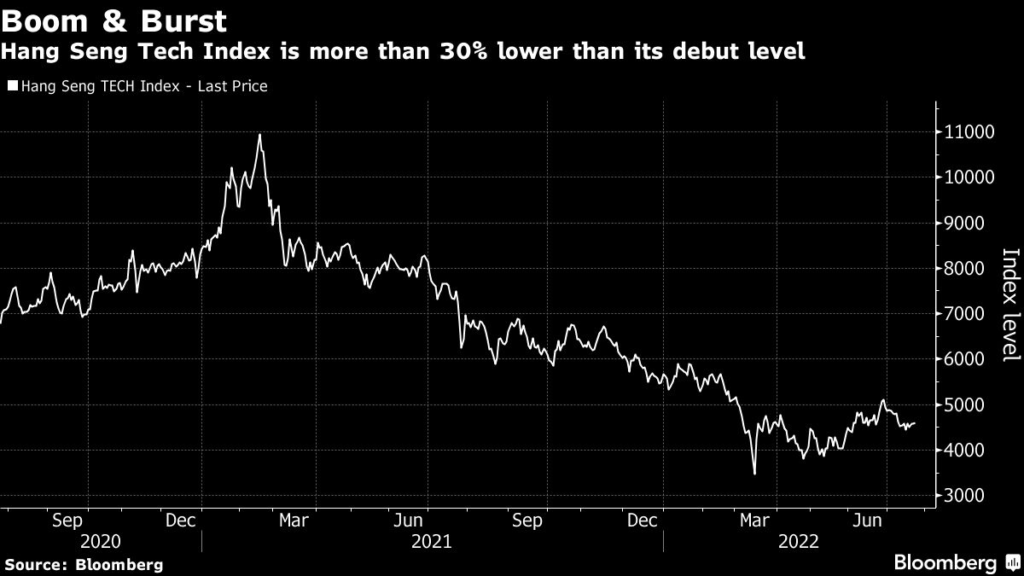
As the Hang Seng Tech Index approaches the second anniversary of its inception next week, traders say they remain wary about plowing money into companies in the benchmark. Their angst centers on the yearyear-long government crackdown, which they see persisting even if the worst of the punitive measures may be over.

The uncertainty is highlighting just how hard it remains for investors to navigate the volatility in shares of Alibaba Group Holding Ltd., Tencent Holdings Ltd. and others. Prediction of a market bottom in recent months have been met with knee-jerk drops triggered by sudden headlines. All that is weighing on a sector that’s already seen $2 trillion wiped out in one of the world’s worst tech stock corrections. 

“We are seeing signs that the worst of the regulatory pressures could be over,” said Pruksa Iamthongthong, senior investment director of Asian equities at Abrdn, who remains underweight on Chinese internet stocks. “However, we do expect regulatory noise to persist in the background and therefore we should expect some volatility given the fragile market.” 

While the Hang Seng Tech has bounced by 32% from its low in March, it remains more than 30% below its July 2020 launch. Over the same period, the Nasdaq Composite Index has gained 14%.

Reprieve

Chinese tech shares got a boost this week from news that authorities were putting an end to the probe of Didi Global Inc. by levying a fine. Much of that excitement fizzled later, as analysts pointed out that it may do little for sentiment in the broader sector.  

There are other reasons to remain wary, including China’s increased oversight of livestreamers and Tencent Holdings Ltd. remaining unable to win approval to launch new games on the mainland.

To make matters worse, China’s adherence to the Covid Zero policy is hurting consumption and weighing on online advertising, a key pillar for e-commerce giants and internet platform operators.

“I think the worst is likely over, but a lower expected growth rate and continued smaller regulatory moves could constrain the attractiveness of the sector,” said Louis Lau, partner and portfolio manager at Brandes Investment Partners.

Still, there is a silver lining for tech shares. At 25 times forward earnings, the Hang Seng Tech Index is cheaper than its historical average and its mainland China peer ChiNext Index. 

Not everyone is so pessimistic about Chinese tech shares. Tightening regulation in China has shifted from the announcement phase into implementation, according to Victoria Mio, Fidelity International’s director for Asia equities. That means risk has already been priced into stocks, she said at a briefing this week.

The earnings reporting season that kicks off next month also offers a look into tech firms’ profit outlook and the outcome of their cost control measures.

“Investors are struggling to rewrite the growth story for China’s tech sector, and it is impossible without clear regulatory red lines on the type of business allowed, the issues on antitrust and data sovereignty,” said Gary Ng, a senior economist at Natixis. “The unanswered question is still how far it would go, which is still the key source of uncertainties.”

Tech Chart of the Day 

Amazon.com Inc. shares rose Thursday for the seventh straight session, its longest streak since June 2020. The shares have gained about 14% over the period as the e-commerce giant gears up to report its second-quarter results on Thursday next week. However, the stock is set to snap the winning streak, with shares trading lower on Friday. 

Top Tech Stories

  • US social-media giants were on course to shed nearly $69 billion in market value on Thursday, as disappointing revenue from Snap Inc. raised concerns about the outlook for online advertising.
    • Snap’s stock cratered after the company reported disappointing sales, roiled by a major slowdown in ad spending and rising competition for dwindling marketing dollars. Shares of Meta Platforms Inc. and Alphabet Inc. fell in tandem.
  • Omead Afshar, one of Elon Musk’s top lieutenants and the executive running Tesla Inc.’s Texas factory, is under scrutiny in an internal investigation for his role in a plan to purchase hard-to-get construction materials, according to people familiar with the matter.
  • Seagate Technology Holdings Plc, the biggest maker of computer hard drives, gave a weak forecast for the current period, citing “weakening global economic conditions.” The stock fell 11% in premarket trading.
  • Delivery Hero SE cut its outlook for orders for the year, becoming the latest delivery company to be hit by slowing growth industrywide.
  • Ashok Soota has spent four decades in India’s technology industry, headed three prominent IT companies and taken two of them public. Now, the 79-year-old is getting his newest venture off the ground with a goal to take it to IPO in five years.
  • Battered semiconductor shares in East Asia are bouncing back as prospects grow for massive US subsidies for the chip-making industry, which are seen boosting suppliers in Taiwan, South Korea and Japan.
  • Financial technology startup Zepz has named Bill.com Holdings Inc.’s Chief Operating Officer Mark Lenhard as its next chief executive officer, people familiar with the matter said.
  • Samsung Electronics Co. is floating the idea of a broad expansion of semiconductor manufacturing facilities in Texas, a possibly significant step in bolstering domestic capabilities at a time of rising concern over US vulnerabilities.
  • NetEase Inc. is planning to debut the Diablo Immortal mobile game in China on July 25 — a month after the highly anticipated title was originally scheduled to launch in the world’s biggest gaming market.


(Updates stock move in last paragraph.)

More stories like this are available on bloomberg.com

©2022 Bloomberg L.P.

Germany Moves to Prevent Energy Collapse With $17 Billion Rescue

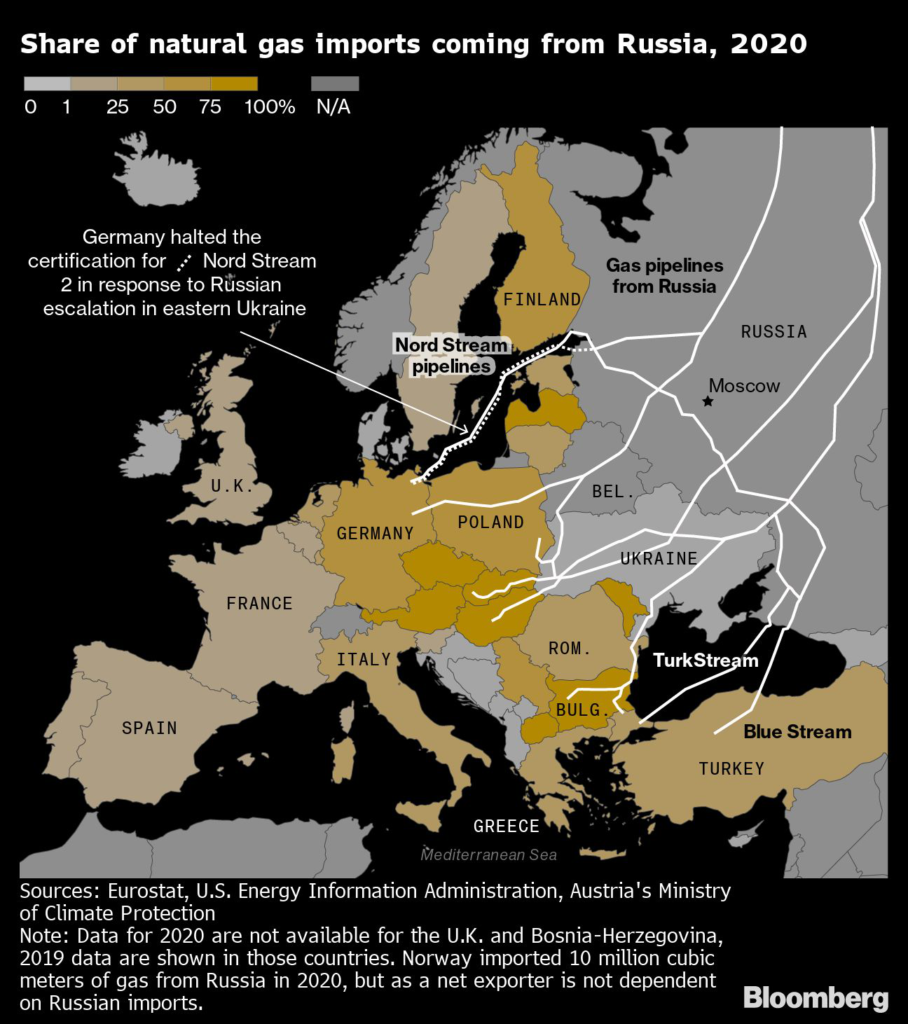
(Bloomberg) — Germany agreed to provide a 17 billion-euro ($17.3 billion) rescue package for struggling utility Uniper SE in its biggest move to date to prevent the collapse of its energy network in the wake of Russia’s moves to slash gas deliveries.

While consumers will soon start to bear the cost of the fallout of lost supply, Chancellor Olaf Scholz vowed to contain the impact of the energy crunch on the wider economy as the country prepares for potential gas rationing in the coming months. 

“We will do all that is necessary to ensure that together we will succeed and we will continue to do so for as long as it takes,” Scholz said Friday in Berlin, interrupting his vacation to announce the bailout. “We will overcome the difficult times together.”

Uniper became the first major corporate casualty of Europe’s unfolding gas crisis when it asked for a government bailout earlier this month. Germany’s biggest buyer of Russian gas was pushed to the brink as President Vladimir Putin squeezed supplies in retaliation over European sanctions against Russia’s invasion of Ukraine.

Decades of increasing reliance on cheap energy from Russia made Germany vulnerable to pressure from Moscow. German authorities have warned consumers to brace for energy bills to double or triple in the coming months, deepening the pain from surging cost-of-living increases. 

“I’m pleased and relieved that today’s agreement stabilizes Uniper financially as a system-critical energy partner,” Chief Executive Officer Klaus-Dieter Maubach said. “We now have a clear perspective on how the costs, which arise due to the interrupted gas supplies from Russia can be shared by many shoulders.”

Scholz said a new package of aid measures would be put in place by early next year to ease the burden on households, as the government effectively shores up the entire energy sector. 

Uniper — set up in 2016 from E.ON SE’s former fossil-fuel assets — emerged as the weakest link in the energy system that powers Europe’s largest economy. Its extensive contracts with Russia’s Gazprom PJSC made the utility particularly exposed to supply cuts and forced it to cover shortfalls at high prices on the spot market.

As part of the bailout, Uniper can pass on 90% of the additional costs for replacing missing Gazprom supplies and it said the government would cover the losses on gas sold in Germany.

After initial gains, Uniper’s shares tumbled as much as 25% to value the company at about 3 billion euros. Fortum Oyj, Uniper’s main shareholder, also rose and then fell as much as 6.3%. 

After the transaction closes, the government will control about 30% of Uniper, a holding big enough to give it veto rights on important strategic decisions. The total bailout package is worth more than four times the company’s current market value, and it could just be the beginning. 

“Whilst we have now achieved immediate stabilization of Uniper, further efforts will be required to create a long-term sustainable basis for the gas business,” said Fortum CEO Markus Rauramo. The Finnish utility agreed to see its stake diluted to 56% from 78%.

As it burned through cash, Uniper had already drawn a 2 billion-euro credit line from KfW and started talks about additional funds after getting 8 billion euros in financing earlier this year from Fortum. 

Despite the financial risk, Germany couldn’t afford to let Uniper fail as the fallout would ripple through the economy, hitting industrial companies and local utilities. While flows on a key gas link with Russia have resumed after 10-day maintenance, deliveries remain significantly reduced and storage levels are low.

On Thursday, Germany raised its targets for gas reserves, reflecting growing concern about having enough energy to heat homes and keep factories running through the winter. The move increases the likelihood that the government will intervene in managing supplies.

Germany’s gas storage stands at about 65%. To reach the 95% level targeted for Nov. 1, the country would need nearly three months at the average fill rates in the week before the Nord Stream pipeline was halted. Scholz indicated that he isn’t relying on Russia to hold to its delivery commitments.

The energy squeeze has been gradually becoming more tangible in Germany. Heating pools is banned, Cologne is dimming street lights and Hamburg plans to make warm water only available at certain times of the day. Some cities are setting up heating halls to help people escape the cold.

“In this crisis, the state must do everything possible to prevent the system from collapsing,” said Michael Vassiliadis, head of the IGBCE union, acknowledging that higher energy bills needed to be part of the package. “Waste needs to be combated through price.”

(Updates Olaf Scholz quote in the fifth paragraph)

More stories like this are available on bloomberg.com

©2022 Bloomberg L.P.

Hulu Rejects Campaign Ads as Politics Collide With Streaming TV

(Bloomberg) — Suraj Patel launched an ad campaign recently with two goals in mind: to address hot-button topics and reach young voters who binge-watch streaming services.

“From abortion rights and gun laws to climate change, 1990s Democrats are losing every major battle to Mitch McConnell,” Patel, a Democrat running for Congress in New York, says at the start of the commercial. Moments later, he adds that “Trumpism is on the rise” as images of the Jan. 6 insurrection are displayed on screen.

But while the 30-second ad appeared that way on cable-TV and social media, Walt Disney Co.’s Hulu asked for changes. The streaming service suggested replacing those terms with less “sensitive” topics like taxes, infrastructure or democracy, Patel said in an interview. The attorney and lecturer on business ethics at New York University insisted on keeping the references to abortion and gun laws. After he swapped the word “democracy” for “climate change” and cut the images of the Jan. 6 insurrection, Hulu approved the ad, he said.

Patel’s experience, which was first reported by the website Jezebel, could be a preview of future clashes as the midterm elections near and candidates seek to reach more online viewers. While broadcast channels like CBS or NBC are required to air candidates’ ads, even if they are controversial or false, streaming services are not. 

That contradiction goes back to federal regulations that were created long before the streaming era.

“The rules for broadcast channels were adopted over 50 years ago when we had a different political climate and media climate,” said David Oxenford, a media law attorney with Wilkinson Barker Knauer LLP in Washington.

The fact that streaming services — as well as cable channels and social media platforms — are free to reject campaign ads, especially false ones, could cut down on the spread of misinformation. But it also means candidates may not be able to touch on certain hot button topics. And it raises thorny questions about how much power media companies should have over political discourse, Oxenford said. 

“You give them the right to decide what political opinions get expressed and which ones don’t,” he said. “And that’s a very difficult decision for any media company.”

Disney declined to comment about Hulu’s advertising standards. 

The entertainment company has said a new ad-supported version of its Disney+ streaming service coming later this year won’t take political commercials. The company got into hot water earlier this year after opposing a Florida schools bill restricting discussion of sexual orientation and gender identity in younger grades. Governor Ron DeSantis, a Republican running for a second term, signed legislation eliminating a special municipal district Disney has operated in since the 1960s.

Patel is not the first candidate to have a campaign ad initially rejected. And there’s a history of politicians and companies using those rejections to attract media attention. In May, US Representative Carolyn Bourdeaux, a Georgia Democrat, said that Hulu turned down her pro-choice ad, which said that she is “leading the fight to protect a women’s right to choose.” Two years ago, CNN’s owner rejected ads from President Donald Trump’s campaign that attacked the election results.

Candidates are pouring more money into streaming services like Hulu. During the current political cycle, $1.5 billion in political ads is expected to be spent on streaming TV, according to AdImpact. That’s about 17% of the $9 billion total.

There are several reasons for this. Streaming services with commercials, such as Peacock, Tubi, Pluto TV and Hulu, help candidates not only reach a younger audience, but also target them more precisely than traditional TV. Also, more people are ditching their cable-TV subscriptions for streaming and more streaming services are selling commercials.

“My base is going to be relatively younger voters,” Patel said. “It’s very essential that we get the mobilization message out to people in the medium they consume.”

On its ad sales website, Disney says that Hulu’s team reviews ads on a “case-by-case basis” and “content that takes a position on a controversial issue of public importance,” like social issues, is prohibited.

Another media giant, Comcast Corp.’s NBC, which owns the streaming service Peacock, said any “controversial political or issue ad” must be approved by its standards and policies before airing on its properties.

Earlier this month, Patel said he wrote a letter to Disney Chief Executive Officer Bob Chapek and Hulu President Joe Earley “to express shock” that his initial ad was rejected. In the letter, he cited recent Supreme Court decisions on gun ownership, abortion and carbon dioxide emissions. 

“How are voters supposed to make informed choices if their candidates cannot talk about the most important issues of the day?” Patel wrote.

More stories like this are available on bloomberg.com

©2022 Bloomberg L.P.

GM’s Ultium Battery Inches Ahead in the Electric Range Race

(Bloomberg Businessweek) —

With the debut of the electric Chevrolet Blazer this week, we’re starting to get a clearer sense of the Ultium battery system General Motors has been developing along with LG the past several years and how it stacks up against the powertrains in vehicles on the market.

This has been a tortoise-and-hare race where GM got off to an underwhelming start relative to Tesla, which stormed out ahead of the pack a decade ago with longer-range EVs. While GM has been talking a lot about its plans to sell 30 EVs globally by 2025, Ford, Hyundai, Kia and Volkswagen have had more traction lately establishing themselves as challengers to Tesla.

GM has argued its Ultium-based vehicles may be a year or two behind, but they’ll be worth the wait. The automaker didn’t want to just retrofit the chassis of existing models and stick batteries into the floor. Its vehicles would deliver the longer driving range vital to win over consumers who haven’t yet been persuaded to go electric.

For the most part, GM looks like it will be vindicated, although not necessarily because of radically better range.

Two of GM’s Ultium-powered vehicles — the GMC Hummer pickup and Cadillac Lyriq SUV — just went into production, and a trio of Chevy EVs will go on sale next year. The Lyriq offers about 86 miles more driving distance on its 100 kilowatt-hour battery than the similarly priced Audi e-Tron.

GM estimates the Hummer pickup will go up to 350 miles, but with a massive battery in a 9,200-pound beast carrying all kinds of off-roading hardware, it’s difficult to gauge just how efficient it really is.

The Blazer offers the best indication yet of Ultium’s merits. The RS version will go an estimated 320 miles, compared to 318 miles for Tesla’s long-range Model Y, 314 miles for Ford’s Mustang Mach-E, 310 miles for Kia’s EV6 and 303 miles for Hyundai’s Ioniq 5. While Chevy may be able to brag about segment-leading range, it’s not a head-turning advantage.

That said, the Blazer is almost six inches longer and four inches wider than the Model Y and Mustang Mach-E, meaning it may offer a combination of slightly longer range and roomier interior. We’ll have to see once the model is available for a test drive.

As for upcoming pickups, GM’s electric Chevy Silverado will go about 400 miles on a charge with its 200 kWh battery pack when it goes on sale in less than a year. Ford’s recently launched  F-150 Lightning goes 320 miles on a 131 kWh battery. So while GM will have an edge with respect to maximum range, Ford is holding its own in terms of efficiency.

The real advantage of Ultium may well be at the industrial level: GM can develop more vehicles and offer better variety. The Blazer will be available in rear-wheel drive for customers who want sportier handling, front-wheel drive for those who prioritize traction, and all-wheel drive for the snow belt. I don’t recall seeing a vehicle offering an option of front-, rear- or all-wheel drive.

That’s the bottom line: Even if Ultium ultimately doesn’t offer a huge advantage in terms of battery chemistry or power density, it enables GM to manufacture and market a much broader lineup of models.

More stories like this are available on bloomberg.com

©2022 Bloomberg L.P.

Twitter Spy Trial Exposes Betrayal of Saudi Arabia Dissidents

(Bloomberg) —

Twitter Inc. cultivated Saudi Arabian leaders to boost the use of its platform in the Middle East. At the same time, it prided itself on providing a forum where the country’s dissidents and activists could anonymously post their criticism of the royal family and organize.

But as it tried to achieve contradictory goals, the dissidents were allegedly betrayed by a former Twitter staffer.

That’s the story unfolding at a criminal trial in San Francisco federal court, just blocks from Twitter’s headquarters. Current and former employees of the social media company are testifying against Ahmad Abouammo, their former colleague who was a rising star at Twitter. He is charged with spying for the Kingdom and outing the dissidents — exposing them to imprisonment and torture.

Assistant US Attorney Colin Sampson elicited testimony from the witnesses in an attempt to substantiate the government’s charge that Abouammo, a US citizen fluent in Arabic, was recruited as “an operative, a mole” by Bader Al-Asaker, Crown Prince Mohammed bin Salman’s “right-hand man.”

Sampson described for jurors a conspiracy that spanned the globe but started with a bribe to Abouammo of a Hublot watch. In addition, the Twitter employee also collected $300,000 from the Saudis. In exchange, Binkasakar gave Abouammo “a shopping list of Twitter users that he wanted an insider to keep track of,” Sampson said. 

The former Twitter employees explained the company’s privacy and data access policies, which Abouammo would’ve violated if, as alleged, he turned over to Saudi Arabia users’ email addresses, phone numbers, IP addresses, and dates of birth.

Abouammo faces numerous charges including acting as an illegal foreign agent in the US and obstruction of justice, which carries a maximum sentence of 20 years in prison. The trial is scheduled to take about two weeks.

Read more: Twitter Security Breach Blamed for Saudi Dissident Arrests

For Twitter, the trial reanimates the company’s most damaging security lapse. Other breaches have gained more attention, including when personal information of celebrities was hacked.

But US and human rights organizations say the information stolen by Abouammo and his alleged co-conspirators in 2015 resulted in the gravest consequences: critics of Saudi Arabia being held in secret prisons, suffering electric shocks, sleep deprivation, beatings and other forms of torture.

Abouammo’s prosecution contrasts with President Joe Biden’s more recent attempt to warm relations with Saudi Arabia, a paradox epitomized by his controversial fist bump with the crown prince, known as MBS, whose photograph prosecutors featured for jurors atop a pyramid of figures they say are responsible for the breach at Twitter. 

Biden’s visit to Saudi Arabia last week compelled him to backtrack on an earlier vow to isolate Riyadh and relegate it to a “pariah” for the 2018 killing of Washington Post columnist Jamal Khashoggi. MBS has denied responsibility for Khashoggi’s murder.

Yoel Roth, Twitter’s head of safety and integrity, told jurors that Arabic is one of the most used languages on the platform — by hundreds of millions of users. Its availability to human rights advocates and activists is critical in Saudi Arabia because it offers a “robust space” for dissent, he said.

Katie Jacobs Stanton, a former vice president of global media at Twitter and Abouammo’s supervisor, recounted how the two visited the home of Saudi billionaire and royal Al Waleed bin Talal Al Saud. She rode a camel and they had a two-hour dinner with the prince, she said. Prosecutors showed jurors a 2015 email Abouammo sent to Stanton and the global media team announcing he brought “onboard of a new government leader.”

“I have built a strong relationship with the team of HRH Crown Prince Salman bin Abdulaziz Al Saud,” Abouammo wrote, referring to the King of Saudi Arabia and MBS’s father. “I am working with His Majesty’s team for an official announcement for Twitter now.”

Abouammo’s promotion of Twitter among royals in Saudi Arabia was part of his job of finding “the world’s best content creators” and “making them successful” on the social platform, Stanton explained.

Abouammo left Twitter in 2015 for a job with Amazon Inc. in Seattle. Despite the government’s argument that he’s a flight risk, judges handling his case have granted him bail because he’s lived in the US for more than 20 years and has a family. In opening arguments Thursday, Abouammo’s lawyer, Jerome Matthews, a federal public defender, said his client has cooperated with federal agents.

“Things aren’t always as they seem,” Matthews told the jury. “Context matters, looking at the whole picture matters.” The case against Abouammo is “hand-picked and curated by the government” from a large amount of data, he said, adding that his client’s alleged co-conspirator fled the US and now lives in Saudi Arabia.

“Given every opportunity to evade an investigation, every opportunity to flee the country, every opportunity to shut up, Mr. Abouammo remained here and went about his life,” Matthews said.

The case is U.S. v. Abouammo, 19-cr-00621, U.S. District Court, Northern District of California (San Francisco).

More stories like this are available on bloomberg.com

©2022 Bloomberg L.P.

Fortum Faces Dilution of Uniper Stake to 56% Following Bailout

(Bloomberg) — Fortum Oyj, the main owner of Uniper SE, agreed on the dilution of its stake to 56% from about 80% as part of the bailout for the German utility.

The Finnish energy company will remain Uniper’s majority shareholder and will continue to consolidate it as a subsidiary, Espoo-based Fortum said in a statement Friday. It made no new capital injection into the German firm.

“For us it is also important that the solution now reached doesn’t require additional capital from Fortum beyond the already provided 8 billion euros of financial support,” Chief Executive Officer Markus Rauramo said.

Germany Bails Out Uniper in Fallout From Russian Gas Squeeze

Fortum will now have the option to convert its existing 4 billion-euro ($4.1 billion) loan made to Uniper against a portion of the maximum 70% of mandatory convertible instruments subscribed by the German state, ensuring its ability to retain its position as the majority shareholder, it said. 

Fortum’s parent company guarantee of 4 billion euros will remain in place. In the sequence of repayment, the loans made by German state-owned lender KfW to Uniper rank senior to Fortum’s loan.

Fortum shares rose as much as 13% after trading in Helsinki resumed, the most since 2008. The stock had been trading 8% higher before the halt.

Uniper, which is heavily dependent on Russian natural gas, has run into difficulties as the government in Berlin hasn’t fully allowed energy companies to pass on the soaring cost of the fuel to consumers. It became the first major corporate casualty of Moscow’s squeeze on European energy flows when it asked the German government for a bailout on July 8, prompting talks between the two governments on who should shoulder the burden.

Finland’s government has rebuffed any suggestions it would provide further funds to Uniper as pressure has been mounting to limit Finnish taxpayers’ role in the bailout, signaling its only strategic interest lies in keeping Fortum afloat. The Finnish government holds a majority stake in Fortum.


More stories like this are available on bloomberg.com

©2022 Bloomberg L.P.

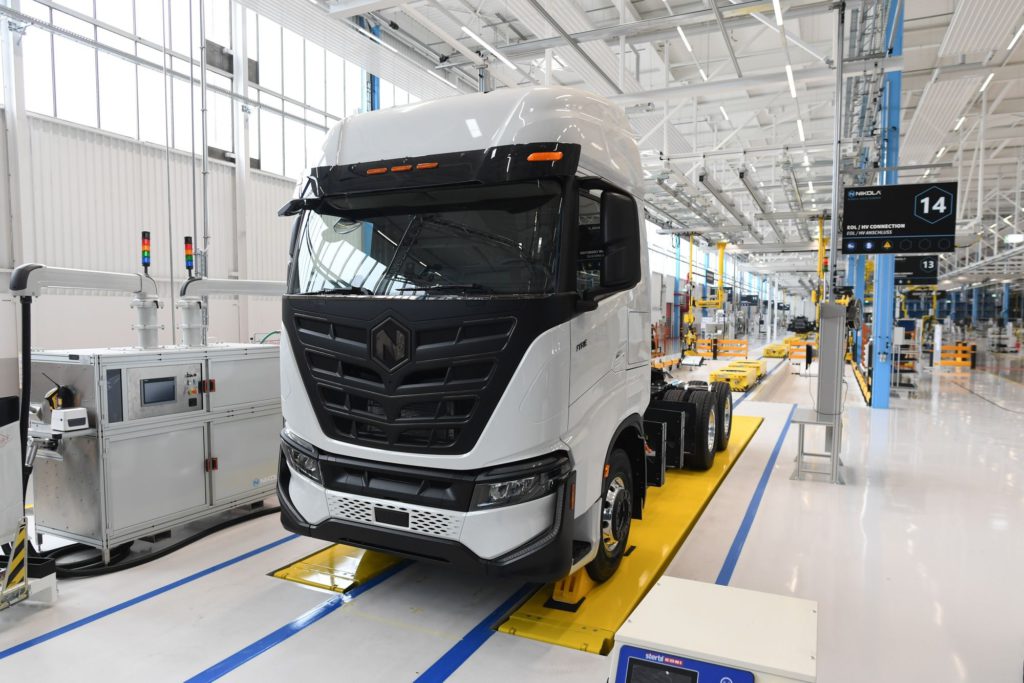
Nikola Founder’s First Fuel Cell Semi Truck Lacked a Fuel Cell

(Bloomberg) — Trevor Milton was riding high a little over two years ago. His battery-electric and fuel cell-powered truck startup, Nikola Corp., had just gone public by merging with a special purpose acquisition company, and its shares were among the first post-SPAC meme stocks to go berserk. Without having sold a single truck, Nikola briefly exceeded Ford Motor Co. in market value.

People familiar with the company’s first prototype, the Nikola One, told Bloomberg News that at the unveiling of the truck in December 2016, the founder of the company exaggerated its capabilities. And on June 17, 2020, Milton gave a pivotal interview.

Milton acknowledged during the interview that the truck he showed the crowd at the unveiling years earlier — which he described as “not a pusher,” meaning an inoperable vehicle meant just for show — lacked key components to run under its own power, including a fuel cell or functioning electric motor. While the words H2 Zero Emission Hydrogen Electric were emblazoned on the vehicle and Milton referred to the truck as fully functioning, he said 3½ years later that he hadn’t deceived anyone.

Bloomberg’s story published that afternoon got the attention of Hindenburg Research, a short selling firm that produced a damning report three months later accusing Milton and Nikola of hoodwinking investors by portraying inoperable products as fully functional and lying about its technology and partnerships. Eleven days after Hindenburg released that report in September 2020, Milton resigned as executive chairman. 

Milton, 40, is scheduled to go to trial in September facing charges he lied to investors to pump up Nikola’s stock price. Bloomberg is releasing the audio from the June 2020 interview for the first time. What follows is an excerpt of the interview, edited for length and clarity.

Bloomberg News: So Trevor, the crux of it is, through the reporting we’ve been doing, we’ve learned the Nikola One prototype you unveiled on Dec. 1, 2016, was inoperable at the time you unveiled it, and the time leading up to it — that it was missing a number of components that would have been necessary for it to have been operable and able to drive. And crucially, that it did not have a fuel cell installed in it. What are your thoughts on that?

Trevor Milton: Yeah, no problem. So, there was no fuel cell in the truck. We never claimed there was. When we first announced that truck to everyone, it was a turbine-electric truck at that time. We had all the batteries, we had all the components in it to make that truck run, including e-axles. Everything was there. The batteries were there, everything was there to make it run, and with the turbine. We pulled the turbine out right before the show. We told everyone we were going fuel cell.

So no, it never had the fuel cell at the show. We never told anyone it did. Could it have driven? Yes, but it was not safe. So we never did, other than on a closed road, without it being underneath power. You’ll never see anywhere where I told people that the truck was ever driven. It just wasn’t safe to drive. We did do a demonstration with it for the video where we just let it coast down a road, because it just wasn’t safe to drive. If those electric motors or controllers took off, you would not be able to stop a truck that size, and you’d potentially kill people. So no, we never drove the thing. It was capable. Everything was there. The fuel cell wasn’t on it during that unveiling. I never told anyone it was. As a matter of fact, we told people at the unveiling there was no fuel cell in it.

BN: You said on stage that night, and in an on-camera interview the following day, that the truck was not a pusher. But for all intents and purposes, what you’re saying is that it was a pusher?

Milton: No, a pusher is a vehicle that can’t be driven. That one actually was designed to be driven and had all the components to be driven. We were planning on going out and actually taking that vehicle and doing testing with it, powering it. But at that point we just decided, you know what, let’s scrap this one and let’s quickly build one that has all the changes in it that we’ve learned from. So, you know, it’s not a pusher because that thing could actually drive. It had the full e-axles, it had the full batteries. It was huge. It had everything in there: controllers, inverters, batteries, power steering. It had everything in it to be able to drive, so it was not a pusher, but it just wasn’t safe enough to drive. By the time we got into it further, over the next few months, we decided it’s just not worth it.

BN: Again, on something you said at the time, both on stage and in the interview the following day, you said you had unveiled the world’s first zero-emission fuel cell semi truck. The thing is that, if it had been a natural gas turbine right up until the the switch to fuel cell, it wouldn’t have been zero emissions?

Milton: This is kind of a little bit of a gotcha question, because we did unveil that. We told everyone we switched over. Everyone knew we had a turbine. There was no deceiving. We were very clear and open about it. We told everyone, we moved away from a turbine to a zero-emission because at that point the technology was starting to get there.

We unveiled the truck at Nikola World. We took the turbine out of it. It was totally functional. You could drive it. We decided not to, but it was, every single component in that vehicle was made to drive. It had real e-axles, real electric motors, real batteries, real everything in there that even today could be driven if we had to. For safety, we never did it because we didn’t trust the components. We were like, well, if something happens, if this thing takes off, someone’s going to die. So we decided to start over and build a better one, but we never deceived anyone.

I said it was going to have the fuel cell. This is what this truck is going to be designed for, and so we did that. We built one completely redesigned that was safer, that we could put a fuel cell in. I never told anyone we had a fuel cell in that truck when I unveiled it.

It was all-electric. And that was what we were showing people is, look, this is going to be the entire change of the world. This is the first-ever fuel cell, zero-emission semi truck. I never said it had a fuel cell in it. And I was very clear to the audience. They got up there and took pictures. They were like, hey, where’s the fuel cell? And we told them, we said, well it’s not in this one, it is going to be, though.

That doesn’t mean you can’t tell people that this is going to be the first-ever zero-emission fuel cell truck. It’s just like a lot of vehicles when you don’t have all the features in them when you unveil them sometimes.

BN: When you say that it had all that it needed to run, but it didn’t have a fuel cell, how was it able to run, then?

Milton: Two different ways. One is it could have run as a turbine-electric, but that was not what we unveiled, but everyone knew about that turbine-electric all the way up to a few months before the unveiling. So we built it as a turbine-electric truck, every part on there functioned. We could have driven it as a turbine-electric truck, exactly as we promised.

A few months prior to the unveiling, we decided to head over to a fuel cell electric truck because we believed we did not want to have emissions on our truck. Fuel cell, obviously, there’s no way to have that ready within a couple months. That takes years. So it could have fully been driven on battery alone with no issue whatsoever. Everything in that truck functioned, and you can ask every engineer at Nikola, not a single person, not a single engineer at Nikola would tell you that those parts were not functionable. If we just spent a few weeks of safety, or a few months of safety testing to make sure that they were good, every part on there was functional. It was the real battery. We had them fully charged. Real e-axles. We just decided it wasn’t safe to drive.

BN: You mentioned a bit earlier on the call, and also when we spoke last week, that you guys did it, you got it up and running. You tested it in a closed environment. When did that driving test take place, and under what system? Was it just under battery? And do you have any video of that test that you can share with us?

Milton: Yeah, that’s online. So it was never driven under power. We took the rotors and stators out of it, because if it took off, we would kill someone. So underneath that test, we wanted to check some things. What we did is we just started it on an incline and we let it coast to make sure that we wouldn’t have any issues with safety. And we only did that for video purposes only. We never invited anyone out there. We never did anything.

Phillips wanted to do a commercial on it. Phillips is a company that does truck parts. So we told Phillips, we said look, we’re not going to power this truck. We’re not going to take it out, it’s just too dangerous. Like if the thing takes off, people are going to die, and believe me, electric vehicles, when you first start developing them, they take off. Like, Tesla has had tons of people where the cars just randomly took off. We didn’t want to be in a spot where a huge semi truck was going to go barreling down a freeway and kill a bunch of people.

So we told Phillips, not going to happen. And they said, well, will you take the main component out? Can you take something out to make it safe? And we said yes, we can take the rotors and stators out of here and it can still coast. And they said OK, we want to be able to video this thing coasting, and we said OK, no problem. So we took it out. We closed the road off. We allowed it to coast. It still had operable brakes and everything. It had operable steering, it had operable everything. We just didn’t feel safe to turn it on. As you know, theoretically, we never ran that thing underneath power. And we never claim. If you look back at every interview I ever did in my life, I never claimed that truck was under power.

BN: But you did say it was not a pusher.

Milton: That’s true, it’s not a pusher.

BN: But those things do not seem reconcilable if it cannot drive under its own power.

Milton: No, it can drive. That’s the thing you’re missing. I get this, you guys have got a report, you want to create headlines, but let me be real clear with you: it was not a pusher. It could have easily been driven. I chose not to drive it for the safety of our company. If that truck would have taken off, I would not be here today. So it was not a pusher. I just chose not to drive it. There’s a big difference between those two things.

BN: Through our reporting, we learned about some of the specific components that were missing from the Nikola One prototype, fuel cell aside. The motors were hollow, the motor core was not even installed in what was onstage, and a number of the gear components were also missing. And while the battery was in place, it wasn’t connected to anything. Essentially the cables were just attached into hollow space. Are you able to comment on that?

Milton: Yeah, you do that for safety. All the parts were there, though. We had every single one of the parts there that were built for assembly. I can show you the entire CAD models, the parts that were actually built fully. It was completely done. Those parts were taken out for safety because, like I said, that’s the only thing preventing that vehicle from taking off. So we just, we took the rotors and stators in the gears, they’re not in there. There’s no reason to be in there, because I’m not going to drive it, but we have them all, we even still, I think we had them all, you know, we have photos of all of them. We have all the CAD models. I can show you every one of them. We had one of the best gear designers in the world that did it all. They can tell you that they actually assembled the entire thing. We took this stuff out. There’s just no way, no reason to keep it in.

If you have some kind of failure inside of your gear system, the rear end of that truck would launch in the air. So no, we don’t have those pieces in there for safety. We actually had them out on tables to display them to everyone. So we showed everyone all the gears and the rotors and the stators, but we just, we didn’t have them inside the gear housing. Even today, we don’t have them in the gear housing. In our showroom, they’re still out.

BN: At what point did you have a functioning prototype that used a fuel cell, and who provided that fuel cell?

Milton: The Nikola Two was the first vehicle we ever drove under power, that was safe enough to drive. It was done in conjunction with Robert Bosch. So we had a joint venture set up with Bosch for the fuel cell, or a joint development agreement. And we worked for quite some time on that. And the Nikola Two was driven months before Nikola World 2019. So it probably would have been around either the fourth quarter of 2018, or the first quarter of 2019, would have been the first time we actually ever drove a semi truck under power of a fuel cell, where it was safe enough to drive, and the parts had gone through some validation and testing to ensure it wouldn’t, you know, wouldn’t kill anyone.

It’s very important to know, I’ve been through this with two or three people already, so it’s nothing that is new to me, getting asked about this. I never once ever told anyone that the Nikola One was powered by fuel cell. It was not a pusher. We could have driven it. We didn’t do it for safety, and you can ask any engineer at Nikola. There are 35 people that worked on that truck that could tell you that every component in that truck could have been driven.

We had all intents and purposes to actually drive that truck after Nikola World, but we just decided it was just not safe enough. I never deceived anyone. I understand people like to dig and pry, I have no problem with that. And you can ask anyone at Nikola that was there. They’ll tell you the parts were totally drivable. It was designed to be a real, drivable truck. We just never did it, for safety.

More stories like this are available on bloomberg.com

©2022 Bloomberg L.P.

Close Bitnami banner
Bitnami