
Bloomberg

A Green Hydrogen Economy Depends on This Little-Known Machine

(Bloomberg) —

Solar power depends on the solar cell. Wind power, the wind turbine.

The key to the green hydrogen economy is a little-known machine with a name out of 1950s sci-fi — the electrolyzer. And after a century of obscurity, the electrolyzer’s moment has come. 

The device uses electricity to split water into hydrogen and oxygen. If that electricity comes from wind turbines, solar panels or a nuclear reactor, the whole process gives off no greenhouse gases. Factories, power plants, even jet aircraft can then burn that hydrogen without warming the earth. 

There are other ways to make hydrogen fuel, from natural gas or even coal. But the ways to do it carbon-free, with no emissions that need to be trapped and stored, rely on the electrolyzer.

“I don’t think people grasp what an electrolyzer is,” said Andy Marsh, chief executive officer of  Plug Power Inc., which makes the devices. “It is the building block of green hydrogen.”

Unlike wind turbines and solar cells, electrolyzers aren’t immediately easy to understand. Larger ones can look like a jumble of tubes and pipes, while smaller, more modular versions are collections of electronics and machinery crammed into boxes the size of a shipping container or even a fridge. 

Scientists discovered the process the electrolyzer employs — electrolysis — more than two centuries ago, and commercial electrolyzers hit the market in the 1920s. They were the main way to produce hydrogen until the 1960s, when a process using steam to strip hydrogen from natural gas supplanted them. Almost all of the hydrogen used around the globe today — in oil refineries, fertilizer plants and chemical facilities — comes from natural gas. Demand for electrolyzers dried up.

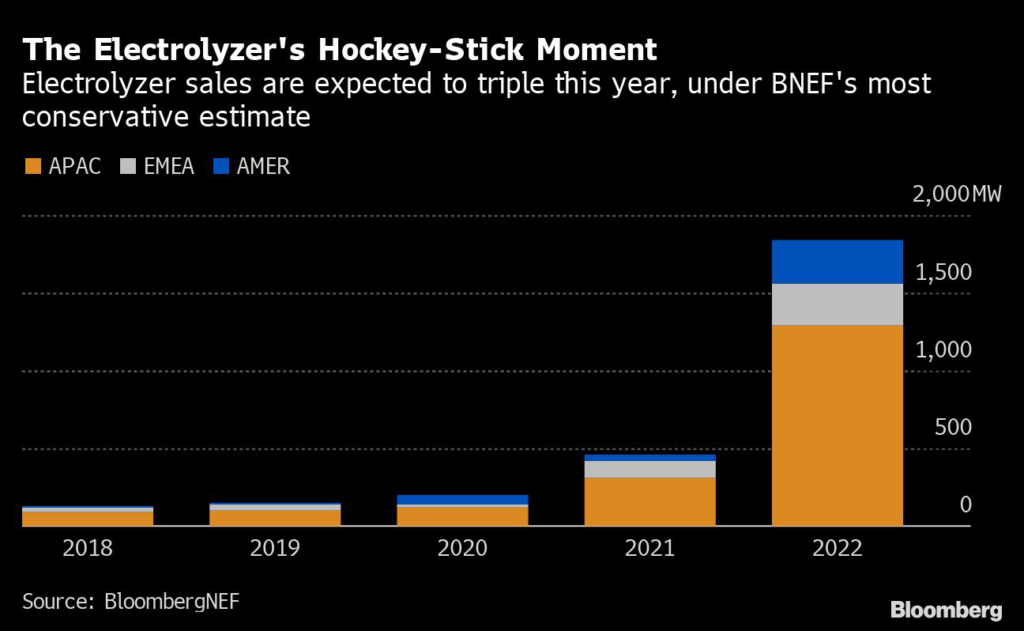
That has now changed — in just the last few years. Measured by the amount of power the machines consume, worldwide electrolyzer sales doubled from 200 megawatts in 2020 to 458 in 2021, according to BloombergNEF, a clean energy research group. They’re expected to triple this year, reaching anywhere from 1,839 megawatts to 2,464 megawatts, BNEF predicts. It may be the kind of hockey-stick moment solar power experienced a decade ago.

“It’s going to be difficult to supply all the demand,” said Amy Adams, vice president of fuel cell and hydrogen technologies at Cummins Inc., a veteran engine maker that has jumped into the business. “Can everybody scale up the supply base as fast as people would like?”

Even more explosive growth likely lies ahead. Electrolyzer “gigafactories,” each able to make enough electrolyzers in one year to use at least 1,000 megawatts of power, have been announced in Australia, China, India and Spain.

“When somebody says they’re going to build a gigafactory, they’re talking about in a year having more capacity than is installed in the world today,” said Patrick Molloy, a manager in the climate aligned industries program at the US-based RMI energy and climate think tank.  

The amount of hydrogen each megawatt of electricity can produce varies, making comparisons between products and projects difficult. The most popular electrolyzer technology needs between 51 and 54-kilowatt hours of electricity, on average, to produce one kilogram of hydrogen, according to BNEF. 

The underlying idea may be old, but there’s plenty of innovation. Electrolyzers come in three basic flavors — alkaline, proton-exchange membrane (PEM), and solid oxide — with different pros and cons. All involve water reacting with oppositely charged electrodes and an electrolyte, sometimes liquid, sometimes solid. Competitors are vying to perfect each technology. They’re paring down the use of such expensive catalysts as iridium and figuring out better ways to build a product that, until now, was largely assembled by hand.

Driving all of this is the need for a clean, carbon-free fuel. Solar and wind power now cost less than new fossil fuel generation in much of the world, but storing that electricity in bulk remains difficult and expensive. And some things, like steel mills and jet planes, can’t easily run on electricity. A molecule that can be produced, stored, shipped and used without pumping heat-trapping carbon into the atmosphere would work far better. Governments and companies worldwide are betting hydrogen will be that molecule.


“You need long-term energy storage, and you need it transported place to place,” said KR Sridhar, chief executive officer of Bloom Energy Corp. a veteran cleantech company now diving into the electrolyzer market. Large-scale batteries, he said, only provide energy for a few hours and aren’t portable. “You will not charge a big battery in Australia, ship it to Japan, discharge it and ship it back to Australia,” Sridhar said.

Hydrogen is the most common element in the universe. But here on Earth, it’s typically bound together with oxygen, nitrogen, carbon or other elements. To use hydrogen as a fuel, it must be cleaved off of those compounds. That can be done in a dizzying array of ways, each represented by a specific shade on a constantly expanding color wheel. The dominant form of hydrogen today, pulled from natural gas, is “gray hydrogen.” Capture the CO₂ from that process, and it’s called “blue.” Strip the hydrogen from water using renewable power and an electrolyzer, and you get “green hydrogen.” Plug the electrolyzer into a nuclear plant, and it’s “pink.” Green hydrogen now costs far more than gray or blue: as much as $9.62 for a kilogram of green hydrogen, compared to $2.72 for blue, according to BNEF. But that likely won’t last. BNEF predicts that by 2030, green hydrogen will be cheaper than blue in every country the analysis service tracks. 

For many hydrogen advocates, the electrolyzer is the missing piece to fulfill renewable power’s promise. It can take the excess electricity streaming from solar plants at noon and turn it into a fuel for use any time.

“That’s one of the things about electricity — we as consumers want it when we want it, and renewables don’t always work that way,” said Ian Russell, Bloom Energy’s director of development engineering. 

Two of Bloom’s electrolyzers perch behind a low industrial building in Fremont, California, just up the freeway from Tesla Inc.’s original auto plant. Seven feet tall, their smooth, rounded covers pop out and up to reveal a mass of circuit boards, red and orange wiring, and a metal core that holds the “hot box” where water vapor separates into hydrogen and oxygen. The core runs between 750 and 800 degrees Celsius — a scorching 1,472 degrees Fahrenheit — but touch its exterior, and it feels warm. The only sound is the whir from a row of fans at top.

Bloom built its business on fuel cells, devices that generate electricity through an electrochemical reaction rather than combustion. Now the San Jose company is selling solid-oxide electrolyzers using most of the same technology, but in reverse. Hydrogen fuel cells combine hydrogen and oxygen into water as they produce power — electrolyzers do the opposite. They’re almost mirror images of each other.

“We’re building on our track record of fuel cells,” Russell said. “The manufacturing technologies, the field service program we have in place, the global supply chain — we already know how to do this.” 

Plug Power also started with fuel cells before adding electrolyzers, and several competitors sell both. Cummins in 2019 spent $290 million to buy Hydrogenics Corp. for its fuel cells, thinking they could help decarbonize Cummins’s customers in mining and heavy transportation. But Hydrogenics had also developed electrolyzers, and now those look like the better business, said Managing Director Alex Savelli.

“We came to realize the electrolyzer opportunity is probably as big if not bigger, and probably will happen sooner, than the fuel cell,” he said. “Sometimes, it’s OK to get lucky.”

Each type of electrolyzer has its selling points. Alkaline electrolyzers, for example, tend to be the least expensive and have become the technology of choice for Chinese manufacturers. They’re trying to undercut their global competitors on price —  just as happened with solar cells a decade ago — and BNEF reports that Chinese alkaline electrolyzers currently cost 73% less than comparable units made in the West. PEM technology uses more rare metals and costs more, but it can start faster than alkaline, something worth considering if the power source is as variable as the sun and the wind. 

Hydrogen has become a priority for the Chinese government, and electrolyzers are a big part of the push. Electrolyzer deliveries there may top 1,600 megawatts this year, mostly on orders from state-owned businesses such as oil and gas giants Sinopec and CNPC, as well as high-emitting companies like coal-based chemical company Ningxia Baofeng Energy Group. If anything, demand is rising faster than production. And the companies making the machines — including  one of the world’s largest solar manufacturers, Longi Green Energy — don’t want to limit themselves to the Chinese market. 

“It’s quite difficult to order electrolyzers now,” said Mao Zongqiang, a professor at the Institute of Nuclear and New Energy Technology at Tsinghua University in Beijing. “The supply can’t meet the demand.”

The customers could, in the end, span many industries. Oil companies need hydrogen for their refineries, where it helps lower the sulfur content of fuel, although many have their own way of producing it from their own natural gas. But semiconductor and LED factories use hydrogen, too, and could benefit from on-site production. Electrolyzers would provide that. Owners of solar plants and wind farms may want to add electrolyzers, just as they’re adding batteries to their projects today.

“We’re just at the beginning of where this industry’s going,” said Ole Hoefelmann, general manager of Plug Power’s electrolyzer business.


More stories like this are available on bloomberg.com

©2022 Bloomberg L.P.

Decentralized Finance Versus Traditional Finance:  Key Differences

  • Listen to Bloomberg Crypto on the iHeartRadio App
  • Listen to Bloomberg Crypto on Apple Podcasts
  • Listen to Bloomberg Crypto on Spotify  

(Bloomberg) — Something we say a lot here on the Bloomberg Crypto team is, “everything old is new in crypto.” And what we mean by that is that while there’s a perception that ideas like the blockchain are novel and groundbreaking, the reality is there’s lots of precedents for concepts like DAOs (decentralized autonomous organizations) or ICOs (initial coin offerings). This is particularly clear right now, as crypto experiences its own version of a “Bear Stearns moment.” Which all begs the question: Is decentralized finance just reinventing traditional finance with more complexity and a sprinkling of blockchain? Or is there genuine novelty here?  Bloomberg Opinion columnist Matt Levine and Bloomberg reporter Muyao Shen join host Stacy-Marie Ishmael on this episode.

Follow us on Twitter @crypto, and subscribe to the Bloomberg Crypto Newsletter at https://bloom.bg/cryptonewsletter

More stories like this are available on bloomberg.com

©2022 Bloomberg L.P.
Groups Push Schumer to Recuse Himself From Big Tech Legislation

(Bloomberg) — A coalition of progressive groups is calling on Senate Majority Leader Chuck Schumer to recuse himself from legislation intended to crack down on technology giants, saying he has a conflict of interest because his daughters work at Amazon.com Inc. and Meta Platforms Inc. 

Sixteen groups, which have been advocating for the antitrust bills, wrote in a letter to Schumer Friday that he shouldn’t oversee the floor vote on the measures because of his daughters’ ties to the companies. 

“While you have claimed to support antitrust legislation seeking to rein in Big Tech companies, your continued failure to put the bills to a full Senate vote raises the question of whether you are covertly seeking to run out the clock before the legislation can pass,” the groups wrote in the letter, which was seen by Bloomberg News.

The letter is just one example of how activists are stepping up their pressure campaign against Schumer, who hasn’t scheduled the legislation for a floor vote despite a pledge that the bills would get one by early summer. Protesters have also placed billboards outside his homes in Washington and New York.

Jessica Schumer is a registered lobbyist for Amazon, while Alison Schumer works for Meta.

There is precedent for Schumer to recuse himself. He did so during congressional deliberations around Comcast Corp.’s attempted purchase of Time Warner Cable in 2014 because his brother Robert Schumer was a lawyer involved in the deal.

“It would be appropriate for you to follow the same ethical standard in this matter,” wrote the coalition, which includes anti-monopoly groups American Economic Liberties Project and Demand Progress.

The groups suggested that Schumer should tap Majority Whip Dick Durbin, the Democratic Senator from Illinois, to schedule the bills for a floor vote.

The bills, the American Choice and Innovation Act and the Open App Markets Act, would prevent the largest tech companies from using their gatekeeper power to discriminate against rivals. They have been the subject of vigorous lobbying campaigns by Alphabet Inc.’s Google, Amazon, Apple Inc. and Meta. The companies have spent millions of dollars to defeat the legislation, which would change some of their fundamental business practices.

Schumer’s office and representatives for Amazon and Meta didn’t immediately respond to requests for comment. 

While the judicial branch is subject to a web of conflict-of-interest laws, lawmakers have very few restrictions and it’s rare for members of Congress to recuse themselves from specific votes. But there is some precedent. 

The late Senator John McCain, an Arizona Republican, recused himself from voting on alcohol-related legislation because his wife, Cindy Hensley McCain, was an heiress to a major beer distribution company. John McCain didn’t vote on bills requiring alcoholic beverage producers to provide government labels on containers.

More stories like this are available on bloomberg.com

©2022 Bloomberg L.P.
South Korea Restores Military Drills Once Reduced to Help Trump

(Bloomberg) — South Korea will bring back joint military exercises with the US that had been scaled down or halted since about four years ago under former President Donald Trump to facilitate his nuclear negotiations with North Korea.

The government of President Yoon Suk Yeol, a conservative who took office in May on pledges of bolstering military ties with the US and taking a tough line with Pyongyang, will resume combined field training drills with American troops, the Defense Ministry in Seoul said in a policy report Friday.

The two will also restore exercises that include training with aircraft carrier groups and amphibious vehicles. The sides will return to practicing war scenarios in person, replacing training over the past three years that used computerized command-and-control simulations, it said.

The allied forces will conduct 11 joint field exercises in August and September, including a large-scale drill at the Korea Combat Training Center, and change the name of the annual drill from Ulchi Freedom Guardian to Ulchi Freedom Shield, the military said. 

Yoon warned Friday that North Korea could soon ratchet up tensions with its seventh nuclear test, after firing off ballistic missiles at a record pace this year. Any display of the weapons in leader Kim Jong Un’s nuclear arsenal would serve as a reminder of the pressing security problems posed by Pyongyang that have simmered as Biden’s administration focused on Russia’s invasion of Ukraine.

“We believe North Korea is prepared to conduct a nuclear test any moment they decide to do so,” Yoon said, adding he has discussed the matter with the US.

Satellite imagery indicated that refurbishment work and preparations at Tunnel No. 3 at Punggye-ri Nuclear Test Facility, where North Korea has conducted all six of its nuclear tests, are complete and ready for another detonation of a nuclear device, the Beyond Parallel website said in mid-June.

The moves from Seoul comes less than a week before the 69th anniversary of the July 27 signing of the armistice agreement that ended fighting in the 1950-1953 Korean War. The US still has about 28,500 troops in South Korea and military leaders from the two countries have said drills are essential to prepare for any provocations by North Korea. The north positions large portions of its million-man military near the border drawn up when the cease fire took hold.

Trump’s three meetings with Kim from 2018 led to no concrete steps to wind down Pyongyang’s nuclear program, which only grew in strength and size as the in-person diplomacy eventually fizzled. The former US president had repeatedly expressed frustration with the open-ended troop deployment, saying after a meeting with Kim in June 2018 that he would “like to bring them back home” but that’s not part of the equation right now. 

North Korea has sought for decades to leverage the prospect of talks to scale back US-South Korean military drills, something which Trump controversially agreed to during his summits with Kim. Drills were canceled in the first half of 2020 because of the coronavirus pandemic and computer simulation exercises were carried out in August 2020 and March 2021, raising concerns about the alliance’s readiness to respond in a crisis.

Since most US troops are stationed in South Korea for about a year, drills are typically the only time for most of them to do real-world, widespread training with their allies. Soldiers and equipment from bases in the US and Japan at times were integrated into the operations, while a US aircraft group has sailed offshore for many incarnations.

The Biden administration appears ready to step up military cooperation. About a month before Yoon took office, the US Navy dispatched an aircraft carrier group to waters between the Korean Peninsula and Japan for the first time since 2017. 

North Korea has publicly ignored Biden’s calls to return to the bargaining table. For decades, it derided the drills as a preparation for invasion and nuclear war.

More stories like this are available on bloomberg.com

©2022 Bloomberg L.P.

Nokia Explores Sale of Managed Services Business

(Bloomberg) — Nokia Oyj is weighing a sale of its managed services business, people familiar with the matter said.

The Finnish telecommunications company is working with advisers to gauge interest from potential suitors, the people said, asking not to be identified discussing confidential information. The unit generates annual revenue of about 500 million euros ($510 million) and is expected to draw interest from private equity firms, according to the people.

Nokia’s managed services business sits within its Cloud and Network Services division. It offers communication services providers everything from network maintenance to data management. 

Shares in Nokia rose as much as 2.3% on Friday. The stock was up about 1% at 10:25 a.m. in Helsinki, giving the company a market value of 28.8 billion euros.

Deliberations are ongoing and there’s no certainty that Nokia will decide to proceed with a disposal, they said. A representative for Nokia declined to comment.

Pekka Lundmark, Nokia’s chief executive officer, has been working to turn around the company since mid-2020 with a focus on restructuring and adding resources to product development. Earlier this year, he said Nokia had moved into the “accelerate phase” of this strategy, with the aim of boost growth and margin expansion.

On Thursday, the company reported better than-expected earnings and indicated it’s on track to meet full-year guidance amid strong demand for 5G gear.

(Updates with shares in fourth paragraph.)

More stories like this are available on bloomberg.com

©2022 Bloomberg L.P.
Terra Co-Founder’s Home Raided as Korea Widens Crypto Probe

(Bloomberg) — South Korean prosecutors raided the home of Terraform Labs co-founder Daniel Shin, deepening a probe into allegations of illegal activity behind the collapsed stablecoin TerraUSD.

A series of raids on crypto-exchanges and offices on Wednesday also included Shin’s home and his payment app Chai Corp., the Seoul Southern District Prosecutors Office said via a text message, confirming an earlier report from MBC News. Police also visited two affiliated firms, a spokesperson for the prosecutors said, declining to provide further detail in an ongoing investigation.

Policymakers around the world have zeroed in on stablecoins given the turmoil in the crypto markets, most notably the collapse of the popular TerraUSD token in May. That spurred a debate about whether blowups of crypto experiments could pose a risk to the wider financial system, along with calls for stronger regulation. 

In South Korea, prosecutors conducted raids this week in 15 areas, including seven local exchanges such as Upbit, Bithumb and Gopax. The action took place about a month after authorities banned current and former employees of Terraform Labs from leaving the country. Prosecutors summoned a former official at a unit of Terraform Labs for questioning, KBS TV report has reported.

Prosecutors are also looking into whether the company’s other co-founder, Do Kwon, evaded taxes by moving profits from cryptocurrency transactions to an offshore account, local news agency Yonhap has reported.

Shin and Kwon, who is believed to be in Singapore, didn’t immediately respond to requests for comment. 

Payment Services

The two crypto entrepreneurs started Terraform Labs together in 2018 and initially split ownership 50-50, Chai said in a statement to Bloomberg in May. Their idea was to use blockchain technology for payment services. But since South Korea lacked a regulatory regime for such offerings, Shin and Kwon decided to part ways, according to Chai. 

In March 2020, Shin stepped down from his position as chief executive officer of Terraform Labs and reduced his stake in the company to focus on building Chai. Kwon took control of Terraform Labs, which launched the Terra blockchain to support decentralized-finance applications, Chai said. 

Read more: Bitcoin’s Most-Watched Whale Is the King of the ‘Lunatics’

TerraUSD, or UST, and its sister Luna token became a key part of Kwon’s wider project, backing applications like the Anchor lending protocol. A key premise underpinning the wider Terra ecosystem was UST’s peg to the US dollar, supposedly safeguarded by a complex mix of algorithms and trader incentives involving Luna. It was a different model to other stablecoins like USDC, which are backed by cash and other liquid assets. 

UST crumbled from its peg in early May when the mechanism failed to protect it from a sharp selloff, rendering Luna nearly worthless and wiping out some $40 billion in combined market value. The UST crash, in turn, exacerbated the rout in digital assets.  

Since UST imploded, Shin has put up a notice on the Chai app distancing himself from Kwon and TerraLabs.

Some Luna investors filed a complaint with South Korean prosecutors in May, alleging Kwon and his company had committed fraud and engaged in illicit fundraising.

(Updates with background on Terra in starting in seventh paragraph.)

More stories like this are available on bloomberg.com

©2022 Bloomberg L.P.

Bitcoin Shows Signs of Larger Advance Toward $25,000

(Bloomberg) — Bitcoin has risen about 30% since its lows in June, but hints of a larger advance toward key resistance at $25,000 are beginning to appear. Prices have tagged the so-called upper Bollinger Band after a period where volatility was compressed, which is often a precursor to a sustained, directional move. A similar stretch of low volatility was seen in June, which subsequently saw Bitcoin sliding after it tagged the lower band.

More stories like this are available on bloomberg.com

©2022 Bloomberg L.P.
Three Arrows Founders Break Silence Over Collapse of Crypto Hedge Fund

(Bloomberg) — After five weeks in hiding, the disgraced founders of Three Arrows Capital spoke extensively about the spectacular implosion of their once high-flying hedge fund, saying their bungled crypto speculation unleashed cascading margin calls on loans that should never have been made.

Su Zhu and Kyle Davies, both 35, first became friends in high school. They built 3AC into a crypto-trading behemoth before its collapse bankrupted creditors and exacerbated a selloff that foisted steep losses on mom-and-pop owners of Bitcoin and other tokens. At times contrite and at times defensive, Davies and Zhu, speaking from an undisclosed location, described a systemic failure of risk management in which easy-flowing credit worsened the impact of wrong-way bets. 

They acknowledged the collapse triggered widespread pain, but mostly talked around questions about the effect on others in the industry. Instead, they stressed they suffered deep losses while denying allegations they pulled money out of 3AC before it all blew up. “People may call us stupid. They may call us stupid or delusional. And, I’ll accept that. Maybe,” Zhu said. “But they’re gonna, you know, say that I absconded funds during the last period, where I actually put more of my personal money back in. That’s not true.”

Advisers in charge of liquidating the fund said in July 8 filings that Zhu and Davies hadn’t cooperated with them and that the founders’ whereabouts were unknown. Zhu said death threats had forced them into hiding. “That does not mean that we haven’t been communicating with all relevant authorities,” said Zhu in the telephone interview with Davies and two lawyers from Solitaire LLP. “We have been communicating with them from day one.”

The two declined to say where they were but one of the lawyers on the call said their ultimate destination is the United Arab Emirates, which has emerged as a hot spot for crypto.

Read more: Three Arrows Capital Moving Headquarters to Dubai From Singapore

In a wide-ranging interview, the former Credit Suisse traders detailed the events leading to their fund’s implosion, which itself set off a chain reaction that has cost institutions and small-time speculators billions of dollars. 

“The whole situation is regrettable,” Davies said. “Many people lost a lot of money.”

Leveraged Bets Meet Crypto Winter

Creditors of the fund, recently registered in the British Virgin Islands, filed paperwork saying they’re owed more than $2.8 billion in unsecured claims. That figure is expected to rise significantly, court papers show. To date, liquidators overseeing the insolvency have gained control of assets worth at least $40 million.

Read more: Three Arrows Creditors Include Crypto Giants, Co-Founder’s Wife

Zhu and Davies, long among the most vociferous crypto bulls in an industry known for extremes, put on trades – turbocharged by leverage – that put 3AC at the center of a series of implosions that convulsed the crypto market as prices retreated this year from their highs last fall. “We positioned ourselves for a kind of market that didn’t end up happening,” Zhu said. 

“We believed in everything to the fullest,” added Davies. “We had all of our, almost all of our assets in there. And then in the good times we did the best. And then in the bad times we lost the most.”

At the same time, they claim, they weren’t outliers. They describe a confluence of interrelated one-way bets and accommodative borrowing arrangements that all blew up at once, leading not just to their fund’s demise but to bankruptcy, distress and bailouts at firms like Celsius Network, Voyager Digital and BlockFi.

Read more: The Collapse of Three Arrows Capital Became a Crypto Contagion

“It’s not a surprise that Celsius, ourselves, these kind of firms, all have problems at the same time,” Zhu said. “We have our own capital, we have our own balance sheet, but then we also take in deposits from these lenders and then we generate yield on them. So if we’re in the business of taking in deposits and then generating yield, then that, you know, means we end up doing similar trades.”

Efforts by Zhu and Davies to deflect blame are a sharp contrast to the pair’s previously relentless campaign of cheer-leading cryptoassets and belittling critics. Nerves were raked anew this week by creditor claims that the founders put a down payment on a $50 million yacht before the fund went under, a claim Zhu said is part of a smear campaign.

The boat “was bought over a year ago and commissioned to be built and to be used in Europe,” Zhu said, adding the yacht “has a full money trail.” He rejected the perception that he enjoyed an extravagant lifestyle, noting that he biked to work and back every day and that his family “only has two homes in Singapore.” 

“We were never seen in any clubs spending lots of money. We were never seen, you know, kind of driving Ferraris and Lamborghinis around,” Zhu said. “This kind of smearing of us, I feel, is just from a classic playbook of, you know, when this stuff happens, when funds blow up, then you know, these are kind of the headlines that people like to play.”

The Long Arm of Luna

Davies and Zhu acknowledged heavy losses related to trades in Luna and the now-defunct algorithmic stablecoin TerraUSD, saying they were caught by surprise at the speed of the collapse of these tokens. 

“What we failed to realize was that Luna was capable of falling to effective zero in a matter of days and that this would catalyze a credit squeeze across the industry that would put significant pressure on all of our illiquid positions,” Zhu said.

In retrospect, Zhu said, the firm may have been too close to Terra’s founder, Do Kwon.

“We began to know Do Kwon on a personal basis as he moved to Singapore. And we just felt like the project was going to do very big things, and had already done very big things,” he said in describing the firm’s miscalculations. “If we could have seen that, you know, that this was now like, potentially like attackable in some ways, and that it had grown too, you know, too big, too fast.”

“It was very much like a LTCM moment for us, like a Long Term Capital moment,” Zhu said.  “We had different types of trades that we all thought were good, and other people also had these trades,” Zhu said. “And then they kind of all got super marked down, super fast.”

Read more: ‘Everything Broke’: Terra Goes From DeFi Darling to Death Spiral

One of those trades involved an Ethereum-linked token called staked ETH, or stETH — designed to be a tradable proxy for Ether and widely used in decentralized finance. While every stETH is meant to be redeemable for one Ether once long-awaited upgrades of the Ethereum blockchain take effect, the turmoil sparked by Terra’s collapse caused its market value to fall below that level. This, in turn — in Zhu’s telling — caused other investors to put on trades that could benefit from the widening gap.

“Because Luna just happened, it, it was very much a contagion where people were like, OK, are there people who are also leveraged long staked Ether versus Ether who will get liquidated as the market goes down?” Zhu said. “So the whole industry kind of effectively hunted these positions, thinking that, you know, that because it could be hunted essentially.”

Read more: Flows of Ether Offshoot Reveal Terra’s Ripple Effect on Crypto

Still, the fund was able to continue borrowing from large digital-asset lenders and wealthy investors — until, that is, they blew themselves up.

After Luna’s implosion, Zhu said lenders were “comfortable” with 3AC’s financial situation, and that they allowed them to keep trading as “as if nothing was wrong.” As courts filings have now revealed, many of these loans had required only a very small amount of collateral.

“So I just think that, you know, throughout that period, we continued to do business as usual. But then yeah, after that day, when, you know, Bitcoin went from $30,000 to $20,000, you know, that, that was extremely painful for us. And that was in, that ended up being kind of the nail in the coffin.”

Zhu said that “if we were more on our game, we would’ve seen that the credit market itself can be a cycle and that, you know, we may not be able to access additional credit at the time that we need it. If, if it kind of, you know, it hits the fan.”

Locked in to GBTC

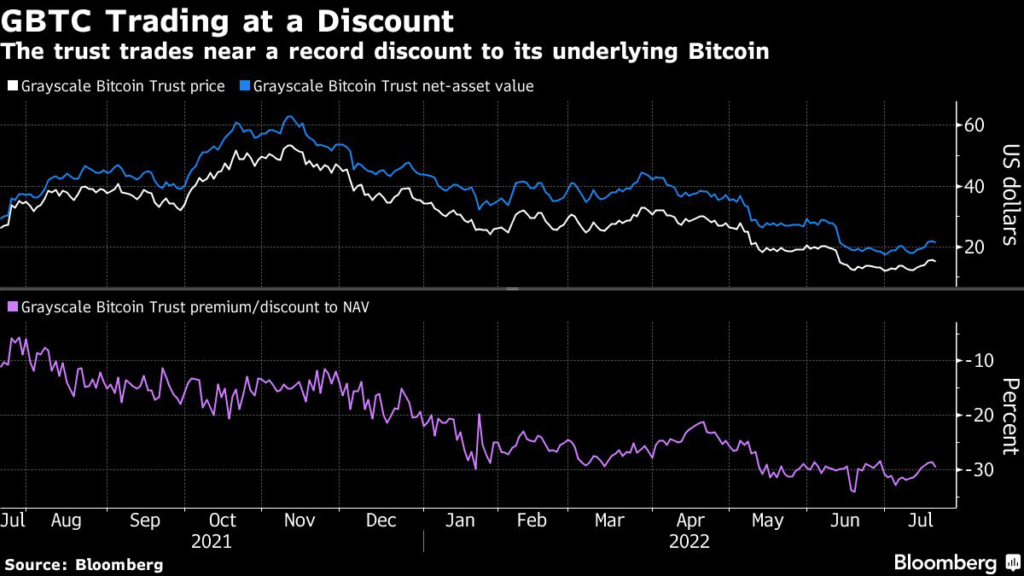
Another bullish trade that came back to bite 3AC was through the Grayscale Bitcoin Trust, or GBTC. The closed-end fund allows people who can’t or don’t want to hold Bitcoin directly to instead buy shares in a fund that invests in them. For a while, GBTC was one of the few US-regulated crypto products, so it had the market to itself. It was so popular that its shares traded at a persistent premium to the value of the Bitcoin it held on the secondary market.

Grayscale allowed big investors like 3AC to purchase shares directly by giving Bitcoin to the trust. These GBTC holders could then sell the shares to the secondary market. That premium meant any sales could net an attractive profit for the big investors. At the time of its last filing at the end of 2020, 3AC’s was the largest holder of GBTC, with a position then worth $1 billion.

The strategy had a snag, though: The shares bought directly from Grayscale were locked up for six months at a time. And starting in early 2021, that restriction became a problem. GBTC’s price slipped from a premium into a discount—a share was worth less than the Bitcoin backing it—as it faced stiffer competition from similar products. As the months went on, the discount got wider and wider and the so-called GBTC arbitrage trade no longer worked – especially hurting investors that used leverage to try to enhance returns.

In Zhu and Davies’ telling, it was partly their own success that helped propel both GBTC and the herd mentality around the trade.

“We managed to do it at the right window when it was a very big profit,” Zhu said. “And then like others copied us into that trade later on and then lost not just the money, but also went into negative. Because everyone did it, then the trust went to discount and then it went to a far bigger discount than anyone thought possible.”

No Risk-Free Returns

In response to questions about what went wrong at the firm, Zhu cited overconfidence born of a multiyear bull market that infused not just him and Davies but nearly all of the industry’s credit infrastructure, where lenders saw their values swell by virtue of financing firms like his.

“There was always an understanding of what they were getting themselves into — this was a risky firm,” Zhu said. “For us, if you go to our website, we’ve always had massive disclaimers about crypto risk. We’ve never once pitched ourselves as risk-free, like a simple yield.”

When crypto markets first started buckling in May, “we met all margin calls,” he said. “And, and so people understood that there was a risk involved.”

Moreover, lenders to the firm “benefited immensely when we were doing well, because as we were doing well, they could say, look, I make $200 million a year from Three Arrows’ financing business, give me a 10x multiple on that,” he said. “And now my own company’s worth $2 billion more. All these kinds of things. And so, like the risk departments were very relaxed about like the kind of risks that we were taking.”

So where from here? For now, the two co-founders are now transiting into Dubai. Zhu’s main hope is to get a calm, and orderly liquidation for their complex book of private assets.

“For Kyle and I, there’s so many crazy people in crypto that kind of made death threats or all this kind of noise,” Zhu said. “We feel that it’s just the interest for everyone if we can be physically secured and keep a low profile.” 

“Given that we had planned to move the business to Dubai, we have to go there soon to assess whether we move there as originally planned or if the future holds something different for us,” Zhu added. “For now, things are very fluid and the main emphasis is on aiding the recovery process for creditors.”

As for Davies, “I have a feeling my next year is planned for me,” he said.

More stories like this are available on bloomberg.com

©2022 Bloomberg L.P.

Northvolt to Develop Wood-Based Batteries With Stora Enso

(Bloomberg) — Swedish battery maker Northvolt AB is looking to make batteries that use carbon contained in wood sourced from Nordic forests to help lower environmental footprint and cost.

Northvolt and Finnish forestry company Stora Enso Oyj plan to make sustainable batteries using lignin-based hard carbon on an industrial scale, the companies said Friday. The aim is to develop a battery with anode sourced entirely from European raw materials, they said.

“We are exploring a new source of sustainable raw material and expanding the European battery value chain, while also developing a less expensive battery chemistry,” said Emma Nehrenheim, chief environmental officer at Northvolt.

Lignin, one of the biggest renewable sources of carbon on the planet, is a plant-derived polymer found in the cell walls of dry-land plants. Trees are composed of 20% to 30% of lignin. 

In the partnership, Stora Enso will provide its lignin-based anode material Lignode, while Northvolt will drive cell design, production process development and scale-up of the technology. 

Stora Enso is the world’s largest kraft lignin producer, making 50,000 tons a year at its Sunila site in Finland. It’s also conducting a feasibility study into the first industrial production of Lignode at the Sunila site.

More stories like this are available on bloomberg.com

©2022 Bloomberg L.P.
Crypto-Asset Platforms to Face Stricter Rules in Thailand

(Bloomberg) — Thailand plans to tighten supervision of digital-asset firms after a cryptocurrency selloff saddled retail investors with large losses and toppled several companies, the country’s top regulator said.

The Securities & Exchange Commission is looking to amend existing digital-asset regulations, most of which were approved in 2018, said Secretary-General Ruenvadee Suwanmongkol. Proposals include stricter qualifications for management and licensing of crypto custodians, she said, without providing specific details.

“The extreme volatility of digital-asset prices has spurred the urgent need for improved supervision,” Ruenvadee said in an interview. “Our main focus will be to provide more protection for small investors, some of whom are putting most of their savings into these assets.”

Plans to boost oversight comes as Zipmex (Thailand) Ltd., one of the country’s licensed cryptocurrency exchanges, and its regional parent this week halted withdrawals. They joined other crypto firms facing a liquidity crunch with the bankruptcy of Celsius Network Ltd. and Three Arrows Capital. 

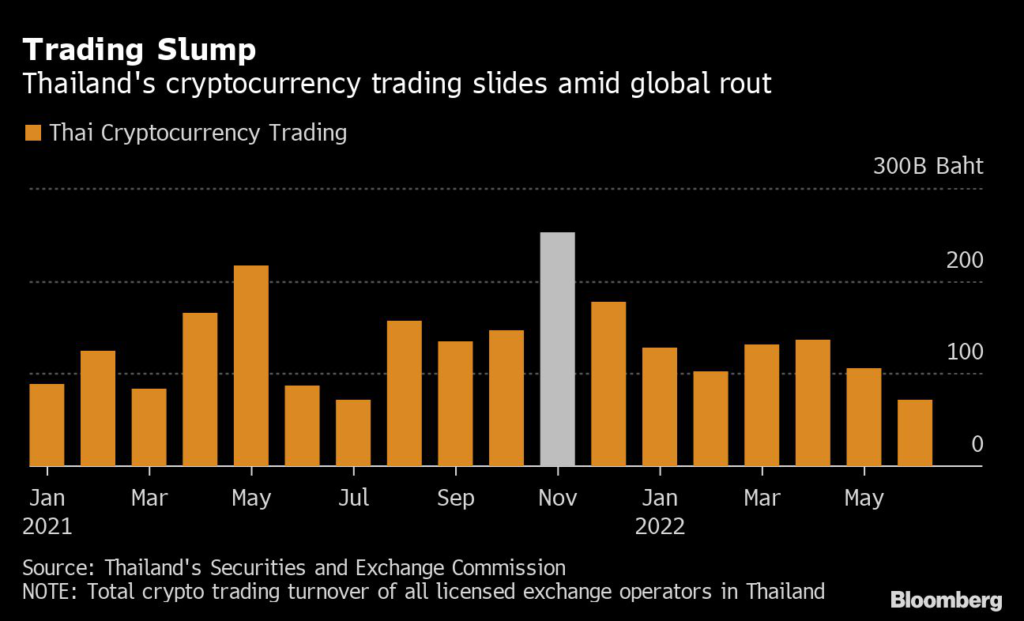
Trading of cryptocurrencies on Thailand’s licensed exchanges slumped to 58 billion baht ($1.6 billion) in June, the lowest since January 2021, according to SEC data. The total number of active trading accounts fell to 305,000 in June, from 556,000 in May, the data showed. A large proportion of traders of digital assets are “young investors,” Ruenvadee said.  

Zipmex Thailand’s woes are an individual case stemming from problems at a related business, Ruenvadee said. 

Zipmex’s troubles underscore the perils of leveraged bets permeating in a closely interconnected industry between crypto exchanges, lenders, investors and hedge funds that’s seen Celsius, Voyager and Three Arrows Capital file for bankruptcy.

Zipmex (Thailand) Chief Executive Officer Akalarp Yimwilai said Wednesday that the firm is in talks with potential investors to raise funds for a “bailout.”  The company has $48 million of exposure to Babel and $5 million with Celsius, it said on its Facebook page on Thursday.

Thailand’s largest crypto exchange, Bitkub Online Co., and its CEO Sakolkorn Sakavee were fined by the SEC last month for creating “artificial trading volume” on the platform. The company and five officials were also fined in May for breaching guidelines in listing the company’s own digital coins. 

Bitkub still has normal operations and allows withdrawals and deposits of all assets under its policies, the company said in a statement on its website. 

(Adds Bitkub’s comment in final paragraph.)

More stories like this are available on bloomberg.com

©2022 Bloomberg L.P.

Close Bitnami banner
Bitnami
