Bloomberg

Tesla Teasing a Robotaxi Must Leave Customers Scratching Their Heads

(Bloomberg) —

A Tesla event touting one product wouldn’t be complete without Elon Musk teasing a next one.

While marking the initial delivery of Tesla Semi trucks last week, Musk offered a first, vague glimpse of a product he divulged was in the pipeline back in April: a dedicated robotaxi.

There wasn’t much to glean from a computer-generated white sheet over a rendering of a vehicle. But looks are the least of what’s mysterious about this product for Tesla owners.

What ever happened to the cars customers bought years ago being an eventual software update away from becoming robotaxis that would earn them $30,000 in gross profits a year? That was among the claims Musk made during Tesla’s Autonomy Day in April 2019.

“We expect to have the first operating robotaxis next year,” Musk said then. “With no one in them, next year.” On the same timeline, he predicted there would be more than 1 million Teslas using a “feature complete” system that would operate so reliably, customers wouldn’t need to pay attention.

Three and a half years later, zero Teslas are operating as robotaxis. Customers who have paid as much as $15,000 for a product the company markets as Full Self-Driving, or FSD, still need to keep their hands on the wheel and be ready to take over at a moment’s notice.

There were signs Tesla’s inability to deliver on Musk’s self-driving statements were catching up with him before last week’s tease. In August, California’s Department of Motor Vehicles accused the company of misleading consumers about its FSD and Autopilot systems. A customer in the state sued in September, accusing Tesla of deceptive marketing and seeking class-action status for other car owners to join his legal fight. In October, Bloomberg was among news outlets that reported the US Justice Department and Securities and Exchange Commission have been investigating Tesla’s self-driving claims.

“Mere failure to realize a long-term, aspirational goal is not fraud,” Tesla said in a Nov. 28 motion to dismiss the California customer’s complaint.

Maybe so, but Tesla owners have to be asking themselves just how long-term this effort will be. The same fan Musk engaged with on Twitter about an impressive FSD trip this week posted a sobering warning 12 days earlier: “If you’re trying Tesla Full Self-Driving Beta for the first time, it’s important to remember that it will at some point randomly try to kill you. This is a when, not an if.”

Actually delivering a robotaxi would be an impressive but not unprecedented feat. Alphabet’s Waymo and General Motors-backed Cruise have been operating driverless ride services in select cities. 

While Waymo and Cruise have a lot to prove with respect to scaling their businesses, Musk’s bet that he could reach critical mass faster by iterating his way from advanced driver-assistance systems to full autonomy isn’t working. Tesla developing a dedicated robotaxi amounts to a tacit admission this is the case.

More stories like this are available on bloomberg.com

©2022 Bloomberg L.P.

These Home Appliances Are Using Power Even When Turned Off

(Bloomberg) — Coffee makers. Television sets. Washing machines. Practically every appliance and electronic device you have plugged in at home is using some electricity — and adding to your utility bill — even when it isn’t in use or even turned on. 

The problem is known as standby power, and it’s getting worse as people acquire more appliances, more equipment goes electric, and a growing number of devices get “smart,” or connected to the internet. It’s no longer uncommon for a household to have dozens of appliances plugged in at any given time — from a microwave with a digital clock to a smart light bulb synced to an app on their phone — and the collective electricity consumption of all these items in low-energy mode is not trivial.


Quantifying standby power, however, can be tricky. “There is not a generally agreed-upon estimate for the fraction of residential electricity consumed by standby,” says Alan Meier, a senior scientist in the Building Technology and Urban Systems Division of Lawrence Berkeley National Laboratory. “This is because there is no agreed-upon definition and no comprehensive set of field measurements.” 

Meier’s “best guess” is that standby makes up “5 to 10% of electricity use in an average American home,” though he warns that “it’s only going to grow over time.”

Others estimate the percentage can already be even higher. Ram Narayanamurthy, Emerging Technologies Program manager at the US Department of Energy, pegs baseline energy usage in his own home at around 20% of annual electricity. His definition of baseline energy overlaps with what others in the field attribute to standby power, such as Wi-Fi routers, cable modems and voice assistants that “remain connected just so you have no latency when you want to use them.”

“That baseline energy usage is something that many people are not aware of,” Narayanamurthy says, “and it’s something we’re trying to understand better and focus better on how we can address that.”

One reason is to help consumers save money at a time when many are tuned in to even small changes in their energy bills. Another is to help tackle climate change. In 2021, the building sector represented around 37% of global carbon dioxide emissions, according to the Global Status Report for Buildings and Construction released last month at COP27 climate talks in Egypt. Part of the push to decarbonize buildings includes finding ways to reduce their energy use, says Narayanamurthy.

Individually, most appliances aren’t using much power in standby mode: In a US home today, the average standby level of any given gadget is likely to be 3 watts or less, with many items coming in around 1 watt or less. That’s according to a review of published literature and measurements directly conducted by scientists this year at the Lawrence Berkeley National Laboratory. Low-consuming appliances and home equipment includes everything from air purifiers to cell phone chargers, fans and televisions.

Meanwhile, many of the appliances or tools with the highest average standby power levels today are critical infrastructure that you wouldn’t want to turn off for functional or safety reasons, from security systems to water heaters.

For certain items built with a hard mechanical on/off switch, such as some fans or kettles or laptops, standby power can be reduced all the way to zero. For many older devices, however, the maximum standby power can sometimes be five or 10 times higher than the average. 

There can also be a big range in standby depending on product type. Take video games. Various Xbox devices, excluding the original and 360 models, have standby levels starting at 8.6 watts. In contrast, many Nintendo and Playstation systems have lower standby levels ranging from less than 1 watt to 5.7 watts.

Further complicating things, there’s no easy way to tell what the standby power of a device is by looking at it. “That’s one of the frustrating parts — you may be thinking it’s zero but it may still be consuming power,” says Meier. On newer appliances, digital displays or lights can be clues that standby power is not zero, he adds, “but in general, there’s no way to tell that without measuring.” 


Manufacturers have had to solve for this once before. Back in the 1980s and 1990s, a cable box, or a set top box, used an average of 11 watts constantly, with some models using up to roughly 25 watts. VCRs used an average of 6 watts, with some models using up to about 13 watts, and some DVD players had an average of 4.2 watts, with a maximum of 12 watts. These high standby levels largely stemmed from the product chargers being inefficient and wasting energy.

“People would always tell me their cat used to love to sleep on their set top boxes because they were so warm,” says Jennifer Amann, a senior fellow at the American Council for an Energy-Efficient Economy. “Anything that’s hot is a sign that it’s losing power.”

These devices usually had two prongs, or teeth, and were so good at sucking up energy while their owners slept that they were sometimes referred to as energy vampires, or vampire appliances. “It’s a nice metaphor — the vampire constantly drawing electricity,” says Meier. 


Since then, Meier notes, “there has been extraordinary progress” that started with governments implementing both mandatory and voluntary programs designed to incentivize manufacturers to reduce standby levels. In the US, for example, the government’s voluntary Energy Star program started factoring standby power into its rating and testing of some consumer goods, a move Amann says helped drive down the standby loads of electronics and office equipment. South Korea and countries in the European Union, meanwhile, began requiring lower standby levels for certain products.All these initiatives “did really change the nature of these loads to be individually not too bad,” says Wyatt Merrill, a technology manager working on emerging technologies at the US Department of Energy. 

Then the nature of the problem changed. It’s now “driven mostly by the fact that we have so many more plug loads than we did twenty years ago,” says Merrill. “The new challenge is how do you coordinate across all these different loads and think about them collectively.”

If you’re curious about the standby footprint of your own home, “the first thing I would do is not so much look at your appliances but try to look at the electricity consumption and your smart meter and find out what’s happening at 3 a.m.,” says Meier. This will likely give you a sense of the lowest level of continuous energy consumption in a day, some of which will be standby.

If you don’t have a smart meter, handheld watt-meters — available online, at hardware stores and sometimes in the local library — can measure standby levels. First, you plug your meter into an outlet and then plug the device into the meter; a screen on the meter shows power use.  


A simple way to eliminate an appliance’s standby power is to unplug it entirely. But experts don’t recommend this for devices that are used regularly or where unplugging could pose a safety risk. Meier suggests starting with seasonal appliances, such as lawn mowers, window unit air conditioners and snow blowers.

Other possible candidates for unplugging: small kitchen appliances, especially when you’re on vacation; spare television sets or cable boxes in barely used guest rooms; and any lingering VCRs or other gadgets that are at this point more novelty than utility.

Those types of small changes can help. But going on an unplugging spree in your home isn’t a long-term solution to standby power. “These things need to be fully autonomous and do things without any intervention in order for the user to have the long term [energy] savings,” Merill says. “I don’t think the solution is going to come in terms of behavior.”

More stories like this are available on bloomberg.com

©2022 Bloomberg L.P.

Most Valuable Indian Startup Byju’s Is Said to Seek Easier Terms on $1.2 Billion Loan

(Bloomberg) — Indian online-education provider Byju’s is seeking to restructure its $1.2 billion loan as it struggles with steep losses and cost reduction targets, according to people familiar with the information.

The nation’s most valuable startup, valued at $22 billion, has appointed an adviser to discuss tweaks in covenants of the term loan B with creditors, the people said, asking not to be named as the information is not public. Discussions on more lenient terms, including lower coupon and more time to repay, are continuing and no final decision has been reached, one of the people said, without providing further details.

Byju’s is among the crop of startups that thrived on India’s growing mobile connections and overseas investments until its blistering growth trajectory was cut short by excessive cash burn. Creditors are getting concerned about the company’s ability to repay and many have sold down the loans, they said.

The three-month Libor has surged more than 21 times this year, making the loan costlier for the Bengaluru-headquartered firm. The margin on the loan was raised by an additional 50 basis points this year after its parent company, Think & Learn Pvt., failed to get rated, the people said. 

The loan, priced at 550 points over Libor in November last year, is one of the largest unrated term loan B offerings ever from a new-age economy company worldwide and received strong demand from investors including sovereign wealth funds, Madhur Agarwal, managing director at JPMorgan Chase & Co., one of the deal’s bookrunners, said then. 

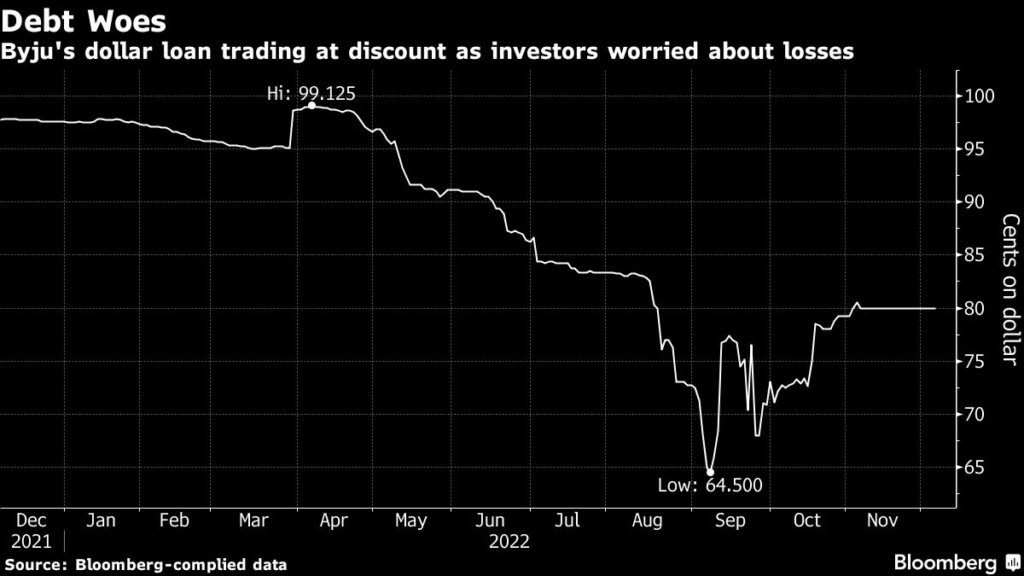
The loan is trading at 80 cents on the dollar on Wednesday after touching a record low of 64.5 cents in September, according to data compiled by Bloomberg.

A representative for Byju’s declined to comment on whether it’s in talks with lenders over the loan terms.

The closely-held startup with 150 million users has been battling multiple headwinds, including a truncated fund raising, regulatory pressure and a much-delayed filing of audited financial statements that disclosed a 13-fold jump in losses for the year ended March 2021 — the latest period for which its financial accounts are available.

In October, Byju’s said it would shed 2,500 workers — about 5% of its total workforce — and lower its marketing and sales costs, as it races to become profitable by March. The company, founded by Byju Raveendran, is also in talks with advisers for a $1 billion initial public offering of its tutoring business Aakash Educational Services, to bolster its balance sheet, Bloomberg News reported last month citing people familiar with the process.

–With assistance from Divya Patil.

More stories like this are available on bloomberg.com

©2022 Bloomberg L.P.

China Could Yet See ‘Rebound in Unrest,’ Protest Watcher Says

(Bloomberg) — Dissatisfaction runs deep in China and could still spill over into further protests, according to a Chinese Twitter user who has emerged as a key conduit for activists to get their messages past strict internet controls. 

The Twitter user — an Italy-based art student who goes by “Teacher Li” — has helped shed light on protests against President Xi Jinping’s Covid Zero strategy by verifying and sharing information sent to him from contributors back home. The videos, photos and first-hand accounts of frustration with government policies continue to flow in, Li said, despite Beijing’s efforts to ease virus curbs in the wake of widespread demonstrations last month.

He said he has received tens of thousands of such reports, giving him unique insight into the country’s fears and anxieties. 

“The public lacks a sense of security, with frequent and unpredictable policy changes,” Li told Bloomberg News. The on-the-ground reality has yet to catch up with easing measures, and new moves or policy reversals could bring a “rebound in the unrest,” said Li, who asked to be identified only by his surname to protect his privacy. 

See: China Protesters Exploit Gaps in Great Firewall to Pressure Xi

Li’s Twitter account, @whyyoutouzhele, which has more than 820,000 followers, has been a critical source both inside and outside China for news about protests that spread in response to a fatal fire on Nov. 24 in the Xinjiang regional capital of Urumqi. While people were initially outraged that Covid controls may have slowed emergency responders, demonstrations soon began to convey broader dissent, with chants for Xi to “step down” during at least one rally in Shanghai. 

Overseas aggregators like Li are necessary because China’s censors can quickly flag and remove politically sensitive content from mainstream social media platforms like WeChat or Sina Weibo. To get around that, Chinese internet users have begun sending content to middlemen to share with an international audience, where it can be viewed within China using virtual private network software. 

“If it wasn’t me, it would be someone else doing this job,” he said. 

Also: Young Women at Front Line of China’s Sweeping Covid Protests

It’s risky work for Li, who has seen his Weibo accounts deleted for posting banned content. His parents, who live in China, have been visited repeatedly by local police to pressure him to stop posting, he said.

Li said the country’s vast population of migrant workers should be among the government’s biggest concerns, since they have the least to lose and the most “fighting power.” He cited crowds at a Foxconn Technology Group factory pushing through barricades or people throwing bottles at police in Guangzhou as examples of how protests among migrant workers have become more violent.  

“Once people see they can get results with protests, they will bring up more thing they want in the future,” Li said. 

–With assistance from Zibang Xiao.

More stories like this are available on bloomberg.com

©2022 Bloomberg L.P.

Red-Hot Lithium Rally Cools as China’s BYD Flags Surplus

(Bloomberg) — Red-hot lithium prices are getting a little less expensive, just as China’s electric-car giant BYD Co. flags that the market could swing back into surplus next year.

The battery material in China has continued to retreat from the all-time high hit last month as signs of demand weakness weigh on the market. Lithium carbonate fell 0.2% to 571,500 yuan ($82,000) a ton on Wednesday, although prices are still around double where they were at the start of the year.

BYD’s Executive Vice President Stella Li told Bloomberg in an interview on Tuesday that she sees new mines coming on stream next year, calling lithium prices “unreasonable.”

Lithium has enjoyed an extraordinary 1,200% gain over two years as supply has struggled to match rampant demand for electric vehicle batteries. That’s pinched manufacturers, which have been forced to raise prices. BloombergNEF’s annual lithium-ion battery survey showed a 7% jump in average pack prices in real terms this year — the first increase since the survey began.

Global passenger EV sales will grow less quickly in the fourth quarter than previously expected, especially as China faces a rising tide of Covid infections, according to BNEF. Meanwhile, Beijing’s subsidies for EVs that encouraged the rapid expansion of the past decade are due to be phased out at the end of the year.

The moderation in demand is overshadowing supply disruptions in China’s Jiangxi province, a key production hub.

Jiangxi Yongxing Special Steels New Energy Technology Co. has suspended lithium carbonate refining since the end of last month due to environmental scrutiny. Jiangxi Lingneng Lithium Industry Co. has also temporarily halted production because of disruptions to local infrastructure.

Yongxing said it would carry out maintenance in the meantime to ensure full production once operations resume, according to a filing from its parent company. Lingneng estimated that its stoppage would reduce output by about 20 tons a day, according to its parent.

The production cuts from the two firms aren’t enough to offset slower demand, said Susan Zou, an analyst at Rystad Energy. She expects the downturn in prices to continue in 2023, although losses won’t be large, at least in the first quarter, because the supply of lithium compounds remains tight.

More stories like this are available on bloomberg.com

©2022 Bloomberg L.P.
Microsoft Agrees to 10-Year Call of Duty Deal With Nintendo

(Bloomberg) — Microsoft Corp. and Nintendo Co. agreed to a 10-year deal to bring Call of Duty to Nintendo gaming platforms, signaling a willingness to share one of the game industry’s most important titles at a time of growing consolidation in the industry.

The agreement depends on Microsoft closing its $69 billion acquisition of Activision Blizzard Inc., the Redmond, Washington-based company said. The duration of the deal can be further extended after the initial period and Microsoft is committed to expanding the number of platforms on which people can play games, Xbox chief Phil Spencer told Bloomberg News. Microsoft also said it’s committed to offering Call of Duty on Valve Corp.’s Steam platform at the same time as it’s released on Xbox.

The company has extended a similar offer to Sony Group Corp., to bring the famous Activision franchise to PlayStation consoles for a decade, but that has so far been rebuffed by the Japanese company, Spencer said. Sony has fiercely objected to the Activision acquisition, primarily because of concerns the US tech giant could make content like Call of Duty exclusive to its own gaming services.

“This deal and especially its timing clearly looks like Microsoft trying to appease regulators,” said Tokyo-based analyst Serkan Toto. “I have a hard time imagining recent mainline Call of Duty titles running on current Nintendo hardware, but the next Switch will certainly be able to handle such a game.”

Microsoft executives are set to meet with US Federal Trade Commission Chair Lina Khan and other commissioners Wednesday to make its final case in support of the deal.

“Our intent is to become more relevant on more screens,” Spencer said. “We have a pretty good idea of how to build a win-win relationship with Nintendo and frankly Sony.”

Nintendo shares in Tokyo erased losses on the day and were up as much as 1.5% after the announcement. Sony widened losses to 1.3%.

Representatives of Nintendo and Sony Interactive Entertainment declined to comment.

Read more: Microsoft Is Ready to Fight for $69 Billion Activision Deal

Spencer remains confident that Microsoft’s Activision takeover will be approved by regulators, with the company setting a timeline of getting that deal done by the end of its fiscal year, which is in June. He sees the steps taken by Microsoft with Nintendo and Valve — assuring them of the prized asset for their competing gaming platforms — as a signal of Microsoft’s push to be inclusive and distribute its portfolio of gaming content widely.

“There’s been one game industry participant that’s really been raising all the objections, and that’s Sony, and they’ve been fairly public about the things that don’t meet their expectations,” Spencer said. “From where we sit, it’s clear they’re spending more time with the regulators than they are with us to try and get this deal done.”

Outside of Sony’s objection to the Activision acquisition, Microsoft has seen “a lot of support from the industry,” he added.

Read more: Microsoft to Meet with FTC Chair Lina Khan on Activision Deal

–With assistance from Dina Bass, Takashi Mochizuki and Yuki Furukawa.

(Updates with Nintendo response and analyst comment)

More stories like this are available on bloomberg.com

©2022 Bloomberg L.P.

Tesla Offers China Buyers Further Subsidies to Boost Sales

(Bloomberg) — Tesla Inc. is offering further incentives to Chinese customers who buy and take delivery of new cars this month, in the latest move to boost sales in the world’s biggest electric vehicle market. 

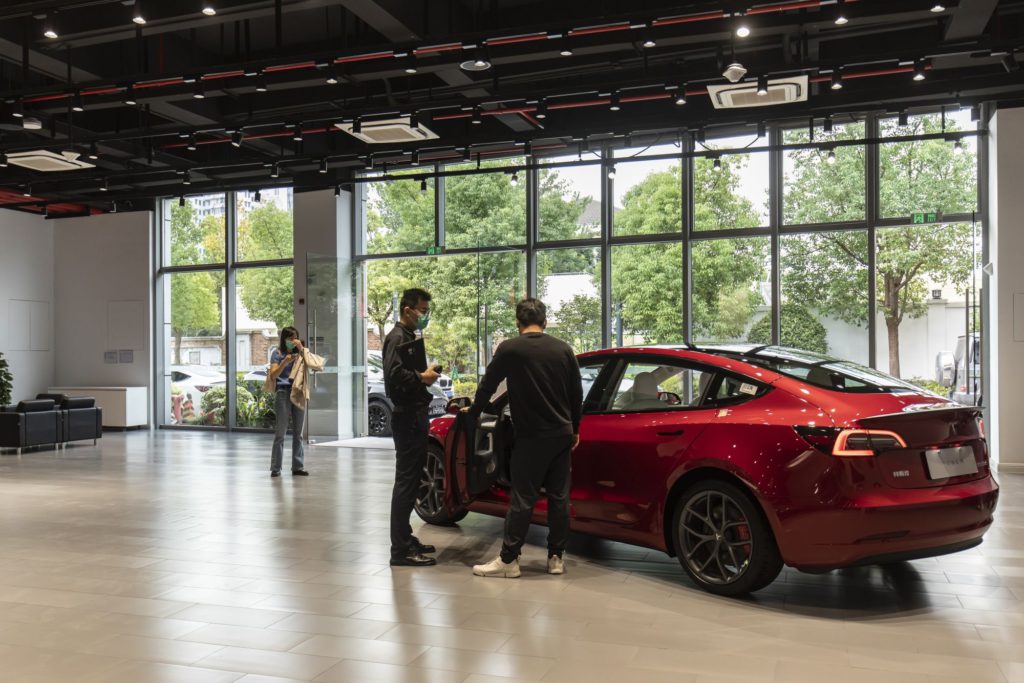
Elon Musk’s EV pioneer will subsidize purchases by 6,000 yuan ($860) for Model 3 sedans and Model Y sports utility vehicles, which currently start at 265,900 yuan and 288,900 yuan respectively after government subsidies, a company representative said Wednesday. 

The offer is in addition to a slew of incentives Tesla has launched recently amid intensifying competition from local automakers and concerns about production overcapacity after an upgrade of its Shanghai factory. While cutting prices across its lineup in late October, Tesla has also offered insurance subsidies and reinstated a user-referral program.

Read more: Tesla Revamps China Marketing Strategy as Rivals Lure Customers

Earlier this week, Bloomberg News reported Tesla plans to lower production this month at the Shanghai factory by about 20% from last month, although there’s flexibility to increase output if demand increases, citing people familiar with the situation. That fueled concern demand in China, a key market for Tesla, isn’t meeting expectations — and sent the share price tumbling. 

A Tesla representative in China said Tuesday that it was “untrue” it planned to cut output, declining to elaborate further.

The company delivered a record 100,291 cars from the Shanghai factory in November, Cui Dongshu, secretary general of China’s Passenger Car Association, said Monday, though didn’t provide a breakdown of how many vehicles were for the domestic market, and how many were exported.  

Any Model 3 or Model Y ordered in China today should be delivered within the month, Tesla’s website shows. The wait time is down from as much as four weeks in October and up to 22 weeks earlier this year.

More stories like this are available on bloomberg.com

©2022 Bloomberg L.P.

China’s Xi Jinping Signals He’ll Press On With Fight Against Corruption

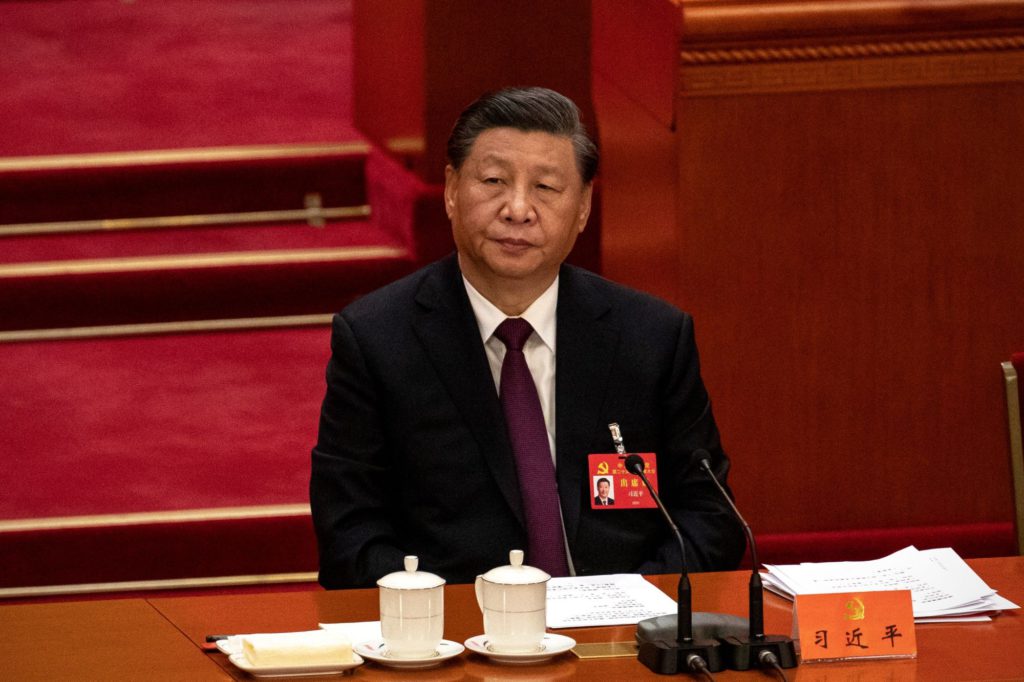
(Bloomberg) — Chinese President Xi Jinping indicated that an anti-graft campaign that has already ensnared 4.7 million officials will continue well into his third term, focusing over the coming year on areas where power, money and resources are concentrated.

A meeting of the 24-member Politburo chaired by Xi on Tuesday determined that the country has achieved an “overwhelming victory” in its battle against corruption but the work is still “far from over,” according to the official Xinhua News Agency.

The government will keep its stringent measures against graft in place “in the long run” to prevent any rebound of the problem, Xinhua reported on Wednesday. 

The comments by the Politburo reinforce the high priority Xi has placed on addressing corruption during his decade in power. The effort wins public support for cleaning up government after years of rampant graft while also eliminating potential rivals to Xi and his allies.

The latest pledge comes after a twice-a-decade Communist Party congress in October allowed Xi to pack top decision-making bodies like the Politburo with his supporters, while sidelining figures such as Hu Chunhua, once seen as a potential successor. China did away with presidential term limits in 2018, paving the way for Xi to lead the world’s No. 2 economy indefinitely.

See: The Fate of This One-Time Xi Heir May Signal China’s Direction

Earlier this year, the country’s top anti-graft agency busted what it called a “political clique” led by former police official Sun Lijun, who was sentenced to what amounts to life in prison for taking 646 million yuan ($91 million) worth of bribes and other crimes.

Sun was accused of “cultivating personal power and forming an interest group,” phrasing that could be read as a sign they posed a threat to Xi’s power. Two other people associated with the group — former justice minister Fu Zhenghua and Wang Like, who was a senior official in Jiangsu — were similarly given suspended death sentences. 

Also: China Probes PBOC Deputy Governor Fan Amid Anti-Graft Campaign

Xi’s campaign has also targeted the $58 trillion financial system and the semiconductor industry, as the leadership became frustrated with failures in efforts to boost self-reliance in high-end chip production. Last month, central bank governor Fan Yifei, 58, was placed under investigation, the Central Commission for Discipline Inspection, the Communist Party’s top graft buster said.

The drive has also breached the private sector, with the Communist Party expelling an official over corruption charges relating to the “disorderly expansion of capital.” Zhou Jiangyong, former party secretary of Hangzhou — the base of Alibaba Group Holding Ltd. — was ousted in January for serious violations of official duties, taking bribes and abuse of power, according to the CCDI.

More stories like this are available on bloomberg.com

©2022 Bloomberg L.P.

The 10 Best Shows to Go See in London This Winter

(Bloomberg) — There’s something for everyone on the London stage this winter. You can catch smart new plays that explore gender and the left-right political divide, or world-class Shakespeare adaptations, or feel-good musicals where you’ll leave the theater with a grin on your face. There’s even anime brought to life on stage.

And that’s not to mention the celebrity-filled new productions building up buzz: Later this month, actor Paul Mescal, who was the breakout star of the Hulu hit Normal People, will play the role of Stanley Kowalski in A Streetcar Named Desire at the Almeida Theatre. It’s directed by Rebecca Frecknall, fresh off her Olivier Award-winning (and Bloomberg Pursuits-recommended) revival of Cabaret. Streetcar has sold out before even the first preview performance, but lucky theatergoers should be able to snag return tickets at the door or online.

And superstar director Josie Rourke is back with two shows this winter: First, her version of As You Like It at the West End’s newest theater @Sohoplace, and in January, she directs Jenna Coleman (Victoria) and Aidan Turner (Poldark) in Lemons Lemons Lemons Lemons Lemons, a rom-com about a world where words are rationed.

Below, the 10 best shows to see in London this winter.

Best of Enemies

Where: Noël Coward TheatreWhen: Through Feb. 18This thrilling show is centered on the explosive televised debates in 1968 between liberal Gore Vidal (Star Trek’s Zachary Quinto) and conservative Willam F. Buckley Jr. (Homeland’s David Harewood). James Graham’s smart script has so much to say about how toxic American political discourse and TV punditry developed over time—the debates devolve from policy to vicious attacks with Buckley being called a crypto-Nazi and Vidal’s sexuality insulted in front of a live TV audience. The staging is stylish and sexy, and the writing makes you think without being preachy or condescending. 

Orlando 

Where: The Garrick Theatre When: Through Feb. 25Emma Corrin is magnetic as Orlando in director Michael Grandage’s version of the Virginia Woolf novel about a dashing English nobleman who skips through centuries and transforms into a woman at the age of 30. They command the stage in this joyful production about gender (the script breaks the fourth wall, saying hello to ladies, gentleman and everyone) and the way women have been treated over the centuries. It’s a riotous 90 minutes that cements Corrin’s place as a star after their much-praised turn as young Princess Diana in The Crown.

To Kill a Mockingbird

Where: Gielgud TheaterWhen: Through April 1The smash-hit Broadway show is lighting up the West End, with Matthew Modine (Stranger Things) now playing the iconic Atticus Finch. Aaron Sorkin wrote the script, with the award-winning writer giving his take on the beloved American novel about racism, good and evil, and the lack of justice in the American South. The show keeps the heart of the book, but the zippy dialogue from Sorkin updates it for modern audiences. 

Othello 

Where: National TheatreWhen: Through Jan. 21Giles Terera proves again why he’s one of the best British stage actors working today with his athletic, fiercely intelligent Othello in Shakespeare’s drama about jealousy, race and masculinity. Even as the audience knows the mistakes Othello is going to make after Iago manipulates him, the production still feels new and thrilling. Director Clint Dyer told the New York Times that the play broke his heart when he saw a photo of Laurence Olivier doing the titular role at the National Theatre in blackface. Now, as the first black man to direct the play at the National, Dyer says, “The beauty of that circle is almost overwhelming.” The first black man to play Othello at the National was David Harewood (can be seen now in Best of Enemies) in 1997, not so long ago.

Good

Where: Harold Pinter TheatreWhen: Through Jan. 7This play has been postponed twice because of the pandemic, but London audiences finally have their chance to see David Tennant (Doctor Who, Broadchurch) in this chilling production set in Nazi Germany. Tennant is a “good” citizen with a Jewish best friend who falls down the rabbit hole of evil, not because he necessarily believes in the Nazi rhetoric but because of his own self-interest. It’s by no means an easy watch, but it’s a memorable show that lingered with me for days afterward.

My Neighbour Totoro

Where: The BarbicanWhen: Through Jan. 21Studio Ghibli’s beloved anime film comes to the stage via the Royal Shakespeare Company in this blockbuster production. It leans heavily into theatrical magic and make-believe as it tells the story of two young girls, Satsuki and Mei, who move to the countryside, encounter creatures and have adventures. The movie’s original composer, Joe Hisaishi, did the music as well, ensuring that the enchanting tunes are back. It’s a faithful adaptation, so fans of the film are sure to be delighted. But those who go in blind are likely to fall for the show’s charms as well.

Vardy v Rooney: The Wagatha Christie Trial 

Where: Wyndham’s TheatreWhen: Through Jan. 10 and moving to the Ambassadors Theatre April 6-May 20Writer Liv Hennessy boils down seven days of court transcripts from a case that gripped a nation (or at least tabloids and online comment sections) into a hilarious production about what the spotlight and celebrity culture do to people. The show is based on the real-life own goal that was the libel case Rebekah Vardy (Lucy May Barker) brought against Coleen Rooney (Laura Dos Santos, really ratcheting up the Scouse accent) after her now famous social media posts alleging Vardy leaked her private Instagrams to the press. It’s perfectly timed for the World Cup, and it’s a fantastic night out.

Henry V 

Where: The GlobeWhen: Through Feb. 4This is a stripped-down version of Shakespeare that aims to reexamine the nationalism in the history play. (“Cry ‘God for Harry, England and Saint George!’”) Oliver Johnstone is a fantastic, tormented lead and, as Henry, delivers the famous “once more unto the breach” speech more as inspiration for himself than a cry for troops to go to battle and shed blood for him. The final scene is set in a modern-day immigration center, which is sure to ruffle feathers for some, but the direction goes for bold swings that almost always connect as the show zeroes in on masculinity and what it means to be British.

Oklahoma!

Where: Wyndham’s TheatreWhen: Feb. 16-Sept. 2After a sold-out run at the Young Vic this summer, most of the cast is back for a West End run of Daniel Fish’s bold take on the Rogers and Hammerstein classic. I’ll fully admit to not wanting to see this at first, having been in a (bad) production of it as a child myself. But I was won over. The show surprised me in the best way. Arthur Darvill as cowboy Curly and Anoushka Lucas as Laurey are sensational in a show about small-town danger, boredom and sex. You’ll never hear “Oh, what a beautiful mornin’” in the same way again.

Come From Away

Where: Phoenix TheatreWhen: Through Jan. 7This musical is chock-full of heart, based on the true story about a small town in Canada that offered shelter and friendship to 7,000 stranded people after Sept. 11, when American airspace was closed. Go see it before it ends, and soak in the show’s beautiful message of generosity and hope. We could all use a little cheer. 

More stories like this are available on bloomberg.com

©2022 Bloomberg L.P.
EU to Challenge China at WTO on Patents, Lithuania Pressure

(Bloomberg) — The European Union will proceed with two cases against China at the World Trade Organization on Wednesday after talks to resolve the issues with its largest trading partner failed to yield results. 

The cases relate to China’s restrictions on Lithuanian exports and Beijing’s coercive practices to limit patent holders from exercising their rights to protect their innovations before a court, said Valdis Dombroskis, the European Commission vice-president responsible for trade. Both cases were of “systemic importance,” he said. 

“Our first preference was to find negotiated solutions through consultations and we invested a lot of time in those exchanges to avoid further steps,” the EU trade chief told Bloomberg News in an interview Tuesday. “But these exchanges did not bring us the satisfactory results.”

The escalation in the trade dispute with China comes as the EU bloc is reassessing its relationship with the country, increasingly seen as a competitor and a rival on issues ranging from market openness to human rights. But the EU has been also trying to re-engage politically with Beijing and wanted the Chinese government to play a more active role as a mediator with Russia following Moscow’s invasion of Ukraine.

The bilateral relationship has worsened since last December after China imposed coercive measures against exports from Lithuania and other EU products that include Lithuanian components after Taiwan opened a trade office in the Baltic country. Companies from Sweden and Germany were also affected, people familiar with the matter said. 

As a result, Lithuanian exports to China fell by 80% from January to October compared with the same period of the previous year. The WTO is expected to establish a panel to settle the dispute in early 2023, and verdict could take up to 1 1/2 years.

China banned Lithuanian exports by either blocking customs clearance or imposing phytosanitary requirements on certain products including beef and some alcoholic drinks. Countries including Australia and Canada have been also hit by China’s coercive practices. 

The case “is not only about Lithuania, because it affects supply chains within the EU, and we see this kind of pattern of China restricting its trade flows with one or another country in response to different developments,” Dombrovskis said. “We see this is a recurring pattern.”

“We know that China is a difficult partner and also our companies are having different challenges while doing business there,” he added. Dombrovskis considered the EU decision as a test case for the WTO, given that China was “not transparent” about these type of measures as many of the restrictions are not formalized in written form, although the impact of the measures are “very visible.”

Patent Killer

In addition, the EU will become the first jurisdiction to request a WTO verdict over China’s actions to impede companies from protecting their high-tech patent rights.                        

Chinese courts have been issuing so-called “anti-suit injunctions” since August 2020 to discourage companies from filing a case beyond its borders to settle a dispute under the threat of fines of up to €130,000 ($136,000) per day.

“We see this practice as damaging to innovation growth in Europe and is depriving European high-tech companies of exercising and enforcing their patent rights, which gives them a technological edge,” he said.

The bloc considers these anti-suit injunctions as part of China’s effort to position itself higher up in the technological chain to be capable of selling products at cheaper prices. In addition, it limits European companies’ powers to protect key standard-setting patterns.

The economic impact is significant. Only in the wireless communication field, European companies hold 3G, 4G and 5G licenses worth billions of euros, and these are now at risk because of these Chinese court decisions, Dombrovskis said.

The EU’s trade move against China comes as the bloc is in the final stages of setting up an anti-coercion instrument to increase its arsenal to retaliate in cases like these.

“Within the existing legal framework, we see the WTO panel as the most efficient way forward,” Dombrovskis said. The possibility of activating the anti-coercion instrument in parallel once it is in place is “something to be reflected,” he said.

(Updates with Dombroskis quote in second paragraph. A previous version of this story corrected the dates in first and third paragraphs.)

More stories like this are available on bloomberg.com

©2022 Bloomberg L.P.
Close Bitnami banner
Bitnami