Bloomberg

Ubisoft Delays ‘Avatar’ Video Game’s Release Until at Least 2023

(Bloomberg) — Ubisoft Entertainment SA reported first-quarter bookings in line with analysts expectations but also announced it would postpone its “Avatar” game, as the French video game studio works to overcome a post-pandemic production crunch. 

The publisher behind the “Assassin’s Creed” franchise is “adapting” its organization “to current economic uncertainties through cost optimization,” Chief Executive Officer Yves Guillemot said in a statement Thursday. “We continue to work on the richest pipeline in the company’s history.” 

The game “Avatar: Frontiers of Pandora,” based on the movie franchise in partnership with Disney, was expected to be released this year but is now delayed until at least 2023.

Still, Ubisoft said it will release “Mario + Rabbids: Sparks of Hope,” developed in partnership with Nintendo, on Oct. 20. “Skull and Bones,” which has been hit by a number of development delays since its announcement in 2017, is also set for release Nov. 8.

Key Insights

  • Ubisoft confirmed its operating income forecast for fiscal 2023 at 400 million euros ($408 million).
  • The group published first-quarter net bookings of 293.3 million euros, in line with the 292.7 million-euro average estimate from analysts surveyed by Bloomberg.
  • The French company’s stock has been battered as it coped with concerns over delayed launches caused by the pandemic.
  • The delay of the “Avatar” game is due to “more difficult working conditions” in the industry as “people can’t come to the office as often,” Guillemot said during a call with analysts after the results were released. In the statement, the CEO said Ubisoft is working to “design the most efficient working conditions.”
  • Ubisoft is set to stabilize its headcount by the end of the fiscal year, its Chief Financial Officer Frederick Duguet said during the call. A spokesperson for the company said the company would have 21,000 employees by the end of the year.
  • The company secured a “new high-value licensing partnership on mobile” for one of its AAA brands, according to the statement.

Market Context

  • Ubisoft’s shares have fallen about 3.3% for the year to date in Paris.
  • Investors are watching Ubisoft’s performance as game studios are seen as potential takeover targets for big tech companies and private equity firms.
  • The company has attracted preliminary takeover interest from buyout funds including Blackstone Inc. and KKR & Co., Bloomberg reported in April. Ubisoft said at the time that it would consider any offer, but the company has the means to remain independent.

Get More

  • Ubisoft Drops as Exane Cuts to Neutral on 2023 Caution
  • Assassin’s Creed Publisher Ubisoft Said to Draw Buyout Interest
  • Ubisoft Plans New Assassin’s Creed Game to Help Fill Schedule

(Updates with context, CEO, CFO quotes from first paragraph.)

More stories like this are available on bloomberg.com

©2022 Bloomberg L.P.

Samsung Eyes $200 Billion Expansion of Chip Plants in Texas

(Bloomberg) — Samsung Electronics Co. is floating the idea of a broad expansion of semiconductor manufacturing facilities in Texas, a possibly significant step in bolstering domestic capabilities at a time of rising concern over US vulnerabilities.

The South Korean company, the leading maker of memory chips, laid out potential plans to spend almost $200 billion on 11 plants in a series of filings in the state. Two of the units would be in Austin and nine would be in Taylor, Texas, where Samsung has already unveiled plans to spend $17 billion on an advanced facility. 

The company isn’t committed to building the new facilities, and the “hypothetical” proposals could change under various circumstances. The first new production facility would not start operating until around 2034 even if Samsung does proceed. Samsung revealed the plans in part to vie for Texas financial incentives ahead of a program expiration this year.

“We currently do not have specific plans to build at this time, however, the Chapter 313 applications to the State of Texas are part of a long-term planning process of Samsung to evaluate the viability of potentially building additional fabrication plants in the United States,” Samsung said in a statement.

The concentration of chip manufacturing in North Asia has drawn increasing attention from US politicians concerned about supply chain disruptions and China’s growing power. Taiwan Semiconductor Manufacturing Co. and Samsung together dominate the business of making the most advanced chips for customers like Apple Inc.

“These new facilities solidify the Lone Star State as the nation’s leader in the semiconductor industry, and I thank Samsung for increasing their investment in the hardworking people of Central Texas,” Governor Greg Abbott said in a statement.

The US is moving toward a $52 billion federal program to provide grants and incentives to boost the American semiconductor industry. The initiative has gained support after chronic shortages over the past two years left companies like Ford Motor Co. and Apple short of the chips they needed for production.

“This potential investment by Samsung reinforces that America’s industrial strategy is working, and underscores the urgency of Congress passing the CHIPs for America Act now, and getting it to President’s desk,” National Economic Council Director Brian Deese said in a statement. “Passing the CHIPS Act will unlock hundreds of billions of dollars in additional investment in America, creating tens of thousands of jobs here at home, while strengthening our economic and national security.”

(Updates with NEC statement in final paragraph)

More stories like this are available on bloomberg.com

©2022 Bloomberg L.P.

Amazon to Buy One Medical for $3.49 Billion in All-Cash Deal

(Bloomberg) — Amazon.com Inc. announced it would buy primary-care company One Medical for $18 a share, the latest move by the e-commerce giant to muscle into the healthcare market.

The all-cash transaction has an equity value of $3.49 billion. 

One Medical, whose parent is called 1Life Healthcare Inc., operates 182 medical offices in 25 markets in the US. Customers pay a subscription fee for access to its physicians and round-the-clock digital health services. 

“We think healthcare is high on the list of experiences that need reinvention,” said Neil Lindsay, the senior vice president leading Amazon’s healthcare push. 

Amazon in recent years has launched an online drug store, following its acquisition of mail-order pharmacy PillPack Inc., and started a primary-care clinic for its employees and some other companies, among other health-focused initiatives. The One Medical deal would be Amazon’s third-biggest acquisition, trailing only its purchases of organic grocer Whole Foods Market and film studio Metro-Goldwyn-Mayer.

One of the least-profitable areas in medicine, primary care has been attracting investment from retailers, health insurers and drugstore chains. CVS Health Corp. and Walgreens Boots Alliance Inc., which are both adding primary-care services to their stores, fell on the news. Walgreens, which last year agreed to pay $5.2 billion for a controlling stake in clinic chain VillageMD, fell 3.1% as the market opened in New York, CVS lost about 2.7%, and Teladoc Health Inc. dipped 7.9%.

Amazon shares rose less than 1%, and 1Life Healthcare increased about 66%. 

One Medical began as an early attempt to revamp primary-care services with sleek clinics in urban centers that patients or their employers paid a premium to join. For an annual fee, the company promised easier access to appointments and virtual consultations as well as a higher level of customer service than typical medical practices. It struck deals with large health networks such as Mount Sinai Health System in New York to refer patients for specialty care. 

But unlike other investor-backed clinic chains such as Oak Street Health Inc., One Medical has historically focused on fee-for-service medical care, rather than new payment models that much of the industry is moving to. That changed last year with the company’s $1.4 billion acquisition of Medicare-focused chain Iora Health Inc., known for trying to reinvent senior care by improving quality while managing costs.

Despite billions of dollars invested in companies trying to reinvent primary care, clinic operators have struggled on the public markets, and valuations have sunk in recent months. Before the deal was announced, One Medical was trading below the price of its 2020 initial public offering.

Bloomberg reported earlier this month that One Medical was weighing its options after attracting takeover interest, including from CVS. Carlyle Group Inc., the private equity firm that invested $350 million in One Medical in 2018, is exiting its remaining 7% stake in the company as part of the deal, according to two people with knowledge of the matter who asked not to be identified because the information hasn’t been made public.

Completion of the transaction is subject to customary closing conditions, including approval by One Medical’s shareholders and regulatory approval. On completion, Chief Executive Officer Amir Dan Rubin will continue to run One Medical.

(Updated with Carlyle Group exit in penultimate paragraph.)

More stories like this are available on bloomberg.com

©2022 Bloomberg L.P.

Microsoft, Google Are Latest Tech Giants to Hit Brakes on Hiring

(Bloomberg) — With recession fears mounting—and inflation, the war in Ukraine and the lingering pandemic taking a toll—many tech companies are rethinking their staffing needs, with some of them instituting hiring freezes, rescinding offers and even starting layoffs.

Microsoft Corp., Google and Lyft Inc. are some of the latest companies to pull back. Microsoft said Wednesday it was eliminating many job openings. Google is pausing hiring for the next two weeks, while Lyft is shutting down a division and trimming jobs. 

Here’s a look at the dozens of companies that are tapping the brakes.

Alphabet Inc., Google’s parent company, has been decelerating its recruiting efforts. Chief Executive Officer Sundar Pichai told employees this month that—although the business added 10,000 Googlers in the second quarter—it will be slowing the pace of hiring for the rest of the year and prioritizing engineering and technical talent. “Like all companies, we’re not immune to economic headwinds,” he said. The hiring pause announced Wednesday is part of that slowdown, Google said, “to enable teams to prioritize their roles and hiring plans for the rest of the year.” It had nearly 164,000 employees at the end of March.

Amazon.com Inc. said in April that it was overstaffed after ramping up during the pandemic and needed to cut back. “As the variant subsided in the second half of the quarter and employees returned from leave, we quickly transitioned from being understaffed to being overstaffed, resulting in lower productivity,” Chief Financial Officer Brian Olsavsky said. Amazon is subleasing some warehouse space and has paused development of facilities meant for office workers, saying it needs more time to figure out how much space employees will require for hybrid work. The company had 1.6 million workers as of March, making it the biggest employer in the tech world.

Apple Inc. is planning to slow hiring and spending at some divisions next year to cope with a potential economic slump, according to people familiar with the matter. But it’s not a companywide policy, and the iPhone maker is still moving forward with an aggressive product-release schedule. Apple had 154,000 employees in September, when its last fiscal year ended.

Carvana Co., an online used car retailer, laid off 2,500 people in May, about 12% of its workforce. In an unusual move, the executive team will forego salaries for the rest of the year to pay severance to those who were let go, according to a filing with the Securities and Exchange Commission. The company had more than 21,000 full-time and part-time employees at the end of last year.

Coinbase Global Inc., a cryptocurrency exchange, told employees it was cutting 18% of staff in June to prepare for an economic downturn. It also rescinded job offers. “We appear to be entering a recession after a 10+ year economic boom,” CEO Brian Armstrong said in a blog post. “While it’s hard to predict the economy or the markets, we always plan for the worst so we can operate the business through any environment,” he said. The company ended the quarter with about 5,000 employees. 

Compass Inc., a real estate brokerage platform, is eliminating 450 positions, about 10% of its staff, according to a filing last month. The company had nearly 5,000 employees at the end of 2021.

Gemini Trust Co., a cryptocurrency exchange founded by Bitcoin billionaires Cameron and Tyler Winklevoss, announced a 10% staff reduction in June. 

GoPuff, a grocery delivery app, is laying off 10% of its workforce and closing dozens of warehouses. The cuts will affect about 1,500 staff members—a mix of corporate and warehouse employees.

Lyft told employees it was reining in hiring in May after its stock dropped precipitously. The company went further this week, announcing plans to shutter its car-rental business and cut about 60 jobs. Lyft had about 4,500 employees in 2021. Archrival Uber Technologies Inc., meanwhile, has been more upbeat. CEO Dara Khosrowshahi told Bloomberg in June that his company was “recession resistant” and had no plans for layoffs.

Meta Platforms Inc., the parent of Facebook, slashed plans to hire engineers by at least 30%. CEO Mark Zuckerberg told employees that he’s anticipating one of the worst downturns in recent history. The company had more than 77,800 employees at the end of March.

Microsoft told workers in May that it was slowing down hiring in the Windows, Office and Teams groups as it braces for economic volatility. The company had 181,000 employees in 2021. More recently, the software maker  cut some jobs—less than 1% of its total—as part of a reorganization. This week, the company said it began eliminating many job openings—a freeze that will last indefinitely.

Netflix Inc., the streaming giant, has had several rounds of highly publicized layoffs since it reported the loss of 200,000 subscribers in the first quarter. In April, it began scaling back some marketing initiatives, then cut 150 employees in May and 300 in June. Last quarter, it reported $70 million in expenses from severance and shed an additional 970,000 subscribers. Netflix had 11,300 employees in 2021.

Niantic Inc., maker of the Pokemon Go video game, fired 8% of its team in June. It was an effort to streamline operations and position the company to weather economic storms, CEO John Hanke told staff in an email. Niantic had around 800 employees at the end of last year.

Peloton Interactive Inc. announced plans to cut about 2,800 jobs globally, roughly 20% of its corporate roles, as part of a surprise shake-up in February that saw its CEO John Foley and several executive team members step down. In 2021, the company reported having nearly 9,000 employees.

Redfin Corp., another real estate brokerage, cut 8% of its staff in June. “We don’t have enough work for our agents and support staff,” CEO Glenn Kelman wrote in a blog post, saying that May demand was 17% below projections and that he expected the company to grow more slowly during a housing downturn. Redfin had about 6,500 employees at the end of last year.

Robinhood Markets Inc., the online brokerage, terminated 9% of its workforce in April. It had about 3,800 employees at the end of last year and racked up more than $2 billion of losses since going public last July.

Rivian Automotive Inc. is planning to cut hundreds of non-manufacturing jobs and teams with duplicate functions. The Southern California electric-vehicle maker, which has more than 14,000 employees, could make an overall reduction of around 5%. In a memo to employees, CEO RJ Scaringe said, “We will always be focused on growth; however, Rivian is not immune to the current economic circumstances and we need to make sure we can grow sustainably.” 

Salesforce Inc., the cloud computing platform, has been slowing hiring and reducing travel expenses, according to a leaked memo reported in May by Insider.

Shutterfly Inc., a maker of personalized photo items, laid off 100 staffers in June, CEO Hilary Schneider told Bloomberg. The company, which has 7,000 employees, is making hiring adjustments to weather the economic uncertainty. “Clearly we’re going through a period of economic choppiness on a global level,”  she said. “When you look at the supply chain, it certainly is driving inflation and impacting consumer confidence.”

Spotify Technology SA, the audio service, is cutting employee growth by about 25% to adjust for macroeconomic factors, CEO Daniel Ek said in a note to staff in June. The company has more than 6,500 employees, according to its website.

Stitch Fix, an online personalized styling service, said in June that it was pursuing a 15% reduction in salaried positions—about 4% of its workforce—with the majority coming from non-technology corporate jobs and styling leadership roles. It’s coping with higher expenses and weaker demand. According to its website, the company has 8,900 employees.

Tesla Inc., the electric-vehicle maker, cut 200 autopilot workers as it closed a facility in San Mateo, California, in June. CEO Elon Musk said earlier that layoffs would be necessary in an increasingly shaky economic environment. In an interview with Bloomberg, he said that about 10% of salaried employees would lose their jobs over the next three months, though the overall headcount could be higher in a year. The company had 100,000 employees globally at the end of last year.

Twitter Inc. initiated a hiring freeze and began rescinding job offers in May, amid uncertainty surrounding Elon Musk’s acquisition of the company, according to an internal memo obtained by Bloomberg. The company had 7,500 employees in 2021.

Unity Software Inc., which makes a video-game engine, surprised employees in June when it sent pink slips to 200 of its 5,900 workers, amounting to 4% of its workforce. Its CEO had assured staff there would be no layoffs, according to Kotaku.

Wayfair Inc., the online furniture retailer, initiated a 90-day hiring freeze in May. The company had 18,000 employees as of March.

(Updates with entry on Shutterfly.)

More stories like this are available on bloomberg.com

©2022 Bloomberg L.P.

‘I’m Calling About Your Auto Warranty’: FCC Says No More, Orders Spam Block

(Bloomberg) — The Federal Communications Commission has ordered phone companies to stop carrying traffic related to robocalls about scam auto warranties.

US voice service providers must now “take all necessary steps to avoid carrying this robocall traffic,” or provide a report outlining how they’re mitigating the traffic, the FCC’s Robocall Response Team said in a statement on Thursday. The calls are coming from Roy Cox, Jr., Aaron Michael Jones and related companies and associates.

“Consumers are out of patience and I’m right there with them,” FCC Chairwoman Jessica Rosenworcel said in the statement.

The group appears to be responsible for making more than 8 billion unlawful prerecorded calls to Americans since at least 2018, per the FCC statement. The operation is also the target of an ongoing investigation by the FCC’s Enforcement Bureau and a lawsuit by the Ohio Attorney General.

From the Archive: The FCC Just Voted to Stop the ‘Scourge’ of Robocalls. Will It Work?


Auto warranty renewal calls were the top robocall complaint filed with the FCC by consumers in 2021. The number of complaints filed with the FCC about auto warranty scams rose from close to 7,600 in 2020 to more than 12,000 in 2021, the agency said.

The calls often include specific information about your particular car and warranty that can make the call seem more legitimate, according to the FCC.

Other top categories for robocalls were Social Security number phishing scams, credit and credit card scams, fake insurance and healthcare, and phony lawsuit or criminal charges, the FCC said.

Americans received over 4.3 billion robocalls in June, marking an 8.5% increase from May, according to a tally by YouMail Inc., a developer of software that blocks the calls. Because May has one more day than June, robocalls were actually up 13.4% on a daily basis.

The FCC in recent years has told carriers to adopt a system to digitally validate phone calls passing through the complex web of networks that carry phone calls. The agency also has made it clear that providers may block calls. And in May, the agency adopted new rules to stop illegal robocalls that originate outside the US from entering American phone networks.

New FCC rules haven’t slowed the robocall scourge, YouMail said in a news release.

“The robocall volume in June 2022 was almost identical to that of June 2021” when a call authentication rule went into effect, YouMail said in the July 7 release. “US consumers have received 48.3 billion robocalls since the rule was initially rolled out one year ago.”

The calls are a perennial top consumer complaint, the FCC says.

Will spam text messages be next? 

(Adds information about robocalls, FCC beginning in fifth paragraph.)

More stories like this are available on bloomberg.com

©2022 Bloomberg L.P.

Altice USA Considers Selling Suddenlink for Up to $20 Billion

(Bloomberg) — Altice USA Inc. is exploring the sale of Suddenlink, which provides cable and internet service in the south-central US, according to people familiar with the matter, as the telecommunications company seeks to pay down its massive debt load. 

Altice USA is working with Goldman Sachs Group Inc. on the potential sale, which could fetch as much as $20 billion, said some of the people, who asked to not be identified because the matter isn’t public. The unit has about $1.3 billion in earnings before interest, taxes, depreciation and amortization, some of the people said. Altice USA has begun soliciting interest from potential suitors, they said. The company could still decide to keep the division.

After Bloomberg reported Altice USA’s plans, shares surged 32% to $12.14 at 12:53 p.m. in New York, and rose as high as 43%, a record intraday increase. The company’s market value climbed to about $5.5 billion. It has more than $20 billion in debt. 

A representative for Altice USA, based in Long Island City, New York, declined to comment. A Goldman Sachs spokeswoman also declined to comment.

Altice USA Chief Executive Officer Dexter Goei said at an investor conference in May that his company is open to trading, swapping or selling certain assets.

“Suddenlink in itself is a great asset — great growth matrices, under-penetrated markets, less-competitive areas because they’re very rural, but strategically is not a footprint that makes you just sit there and say, ‘Wow, I’ve got the most strategic footprint out there,’” Goei said.

Suddenlink is one of Altice USA’s main cable and internet service brands, along with Optimum, which primarily operates in the New York metropolitan region. Altice USA has announced that it’s merging Suddenlink into the Optimum brand.

Altice USA, spun out of Europe’s Altice NV in 2018, is one of the largest broadband and video services providers in the US, serving more than 5 million residential and business customers across 21 states, according to its website.

The company’s chairman is Patrick Drahi, who’s worth $7.4 billion, according to the Bloomberg Billionaires Index.

(Updates with shares in third paragraph, previous company comment starting in sixth.)

More stories like this are available on bloomberg.com

©2022 Bloomberg L.P.

Amazon Breaks Lobbying Record Amid Antitrust Fight

(Bloomberg) — Amazon.com Inc. spent a record $4.98 million on lobbying during the second quarter of this year as momentum intensified in Congress to pass legislation intended to crack down on technology giants. 

Amazon’s lobbying expenditures increased 2.5% over the second quarter of 2021, according to disclosure reports filed on Wednesday. Spending by the e-commerce behemoth was up only slightly from the first three months, when it shelled out a previous record of $4.97 million on lobbying. 

The major tech companies and their trade groups spent $17.3 million on lobbying in Washington during the second quarter of this year, seeking to fend off legislation that could force them to fundamentally change their business practices. 

The industry in the last quarter outspent one of Washington’s biggest donors: top pharmaceutical companies and their major trade group, which spent nearly $16 million, according to a Bloomberg tally of the top five US firms and their leading trade group.

Overall, the four biggest technology companies and their third-party groups spent $35.3 million during the first half of 2022, a 15% increase over $30.5 million in the first half of last year. 

The legislation, championed by Senator Amy Klobuchar of Minnesota and Representative David Cicilline of Rhode Island, would prohibit the largest tech companies from using their dominant platforms to disadvantage competitors. Another bill would ease Apple Inc. and Google’s grip over the app ecosystem, forcing iPhone and Android makers to open up their platforms to third-party app stores and apps. The giants — Amazon.com Inc., Apple Inc., Meta Inc. and Alphabet Inc.’s Google — have spent tens of millions of dollars on lobbying to crush the legislative effort. 

The spotlight is now on Senate Majority Leader Chuck Schumer, who hasn’t scheduled a floor vote for the bills despite pledging to do so earlier his summer. Antitrust advocates have escalated a pressure campaign against Schumer, participating in stunts like playing ads in front of Schumer’s homes in New York and Washington. 

It’s unclear whether Congress will pass the legislation before the August recess. Still, the threat has caused a flurry of opposition as the companies spend tens of millions on advertising campaigns, funnel money into front groups and deploy their top executives to appeal to lawmakers directly. 

Two top tech trade groups, Netchoice and Technet, both spent more more on lobbying in the second quarter than a year ago. Netchoice, a right-leaning trade association that counts Amazon, Google and Meta among its members, spent $120,000, up about 200% from $40,000 in last year’s second quarter. Technet spent $300,000 in the three months ending in June, up 42.9% from the same period last year. 

Apple spent $1.9 million, a decrease from its record $2.5 million outlay during the first three months of the year. 

Google spent $2.77 million, marking a 32% increase from a year earlier and a 6.4% decrease from $2.96 million in the first three months of the year.  

Microsoft Corp., which has differentiated itself from its peers by not opposing the antitrust legislation, spent $2.41 million on lobbying in the second quarter, a 2.4% decrease since last year. 

At the same time, Huawei Technologies Co., the embattled Chinese tech giant, decreased its Washington spending in the same period, doling out $750,000, a roughly 29% drop from the second quarter of last year. 

More stories like this are available on bloomberg.com

©2022 Bloomberg L.P.

Billionaire ‘French Murdoch’ Is Building His Own Right-Wing Media Empire

(Bloomberg) — The seven-part 2019 American television series “The Loudest Voice” on Roger Ailes, the mastermind behind the rise of Rupert Murdoch’s Fox News into a powerhouse of right-wing politics in the US, found an avid viewer in France: billionaire Vincent Bollore. 

The series resonated with the French media baron, a person close to him said. Bollore has taken his own CNews TV channel sharply to the right by tapping into the formula that’s paid off handsomely for Murdoch — catering to conservative audiences deemed to be under-served by the mostly left-leaning mainstream media. As Bollore takes that winning blueprint to his ever-expanding media empire, he’s being dubbed the “French Murdoch.’’ 

Armed with more than 12 billion euros ($12.2 billion), Bollore, 70, is beefing up his media presence across Europe and beyond. His holding company, Bollore SE — a sprawling 20 billion-euro conglomerate that effectively controls media giant Vivendi, with its film and TV company Canal+, news channel CNews and Hachette, the world’s third-largest publishing house — is adding operations in news, magazines, pay-TV, cinema and broadcast. Best known in France as an uncompromising corporate raider, Bollore says his media strategy is driven purely by business metrics. But many see a deeply conservative ideological agenda.    

“While Rupert Murdoch always acknowledged he was pursuing ideological goals on top of business, Bollore is well known as a Catholic, a conservative, but was not engaged in an ideological fight,” says Alain Minc, Bollore’s one-time business adviser who has now parted ways with him. “He has recently switched.”

Bollore turned down requests for an interview on his media operations, while Vivendi declined to comment on the billionaire’s plans for the group’s expansion. 

Like Murdoch, who began by rattling the power structure in his native Australia, Bollore waded into the French political arena during the presidential election in April, with his media machine backing Eric Zemmour, an anti-immigrant, ultra-right candidate. Zemmour campaigned to keep France firmly rooted in its Catholic heritage and touted the Great Replacement conspiracy theory, a radicalized view that white Christians are being supplanted by Muslim immigrants from Africa and elsewhere. Although he was knocked out of the first round of the elections, coming in a distant fourth, Zemmour’s views have found their way into the political conversation in France — thanks in no small part to Bollore’s influential media outlets, where they got ample airing. 

Zemmour, who was a panelist on Bollore’s CNews before running for president, said in a TV interview that the billionaire “is very aware of the danger of civilization that’s threatening us, of the replacement of civilization. He wants to bequeath to his children and grandchildren the France that was bequeathed to him.”  

Although Bollore has yet to make inroads in the political arena outside his home market of France — like Murdoch did in the UK and the US — the French billionaire is finding other ways to influence the social discourse in Europe, Africa and elsewhere. 

Not unlike Murdoch’s News Corp, which over the decades brought its cultural products to over 100 countries, Bollore is weaving together assets that can carry immense influence in the markets he serves. Since taking over control of Vivendi’s struggling film and TV arm Canal+ about six years ago, he has made it a Netflix-like platform and bought rivals in Europe, Africa and Asia, giving it almost 24 million subscribers in over 40 countries — as many as Sky, the British peer founded by Murdoch and bought by Comcast for $39 billion in 2018.

Bollore has entered the same segments that at one point gave News Corp its media breadth, everything from film production and distribution, TV and broadcasting, advertising, newspapers and magazines to books and music. Like the Murdoch empire’s tendency to support right-wing ideologies and promote conservative ideas, there’s an active tilt toward “God and country’’ at the media taken over by Bollore.

As he expands into markets like Austria, Belgium, Poland and other countries in Europe, the traditionalist turn at his media outlets in France may show what lies ahead for his international platforms. Conservative programing has crept into the channels of the once-iconoclastic Canal+. In addition to far-right leaning debates, CNews now live-streams a Catholic mass on religious holidays. On C8, a general channel under Canal+, a controversial anti-abortion film “Unplanned” was broadcast at prime time last year despite opposition from President Emmanuel Macron’s minister for women’s rights.

This month, Paris Match, the influential French magazine Vivendi took over when it bought control of rival media group Lagardere, put a relatively obscure, ultra-conservative cardinal, Robert Sarah, from Guinea on its cover. Sarah has in the past come down strongly against “western ideologies over homosexuality and abortion and Islamic fanaticism.”  

The shift in the narrative that Bollore is trying to bring about has raised hackles in France. Journalists have protested. At book-publishing unit Hachette, which includes Little, Brown and Co. in the US and Hodder & Stoughton in the UK, some high-profile French authors are leaving.

“Hachette falling under Vincent Bollore’s control is a worrying signal knowing what happened to the other media he manages, with their editorial freedom in danger,” said Fabrice Lhomme, a reporter at the French newspaper Le Monde and co-author of best-selling books on the country’s politics. He and other French authors like Virginie Grimaldi and Jacques Attali have fled Hachette’s publishing house Fayard.

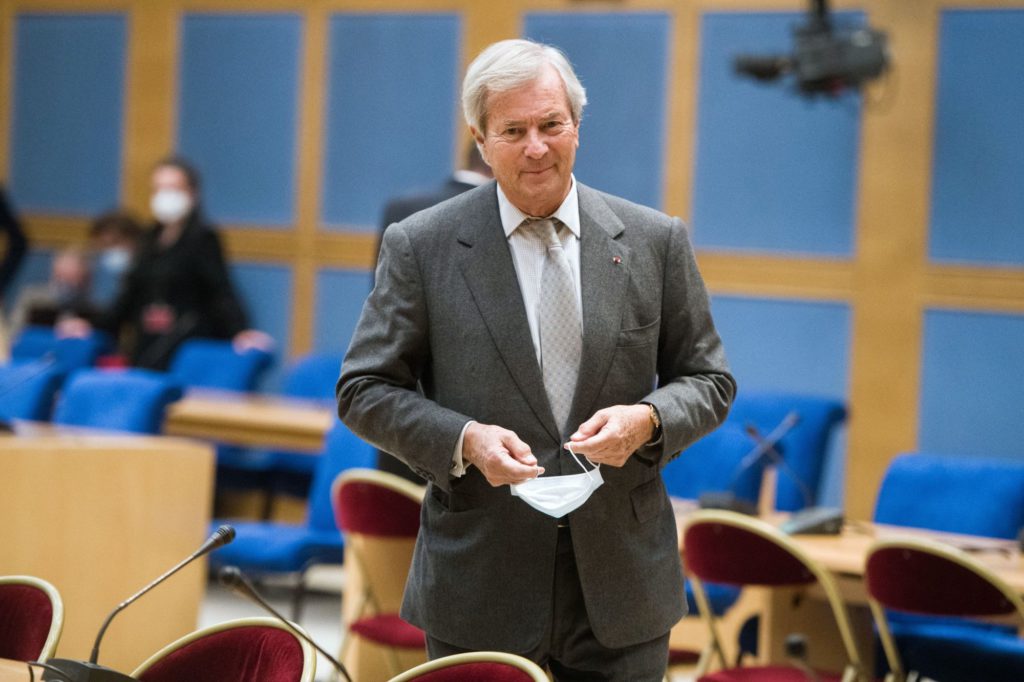
Bollore brushes aside critics, saying his media outlets are politically diverse and even carry works by far-left French politician Jean-Luc Melenchon. At a French Senate hearing in January on his growing influence, the billionaire insisted his political clout is marginal.

“It’s a uniquely economic project,” he said. “Our interest is neither political nor ideological.” 

Bollore is relatively new to the media business. Born in a wealthy Paris suburb, he comes from a family that created a paper manufacturer 200 years ago in the town of Ergue-Gaberic in Brittany, on the western tip of France. He began his career as a banker and joined Edmond de Rothschild before overhauling the struggling family paper factory and listing it. Bollore quickly earned the moniker “Le Smiling Killer” in the French media as he stealthily bought stakes in companies including Lazard, Havas, Ubisoft and Bouygues. Over the years, his group has grown, giving him a net worth of about $6.2 billion, according to the Bloomberg Billionaires Index. 

Bollore’s media forays have been driven by his deep Catholic faith and his desire to preserve a certain idea of France and Europe, people close to him say.  

His penchant for tradition was on full display on the sunny but chilly morning of Feb. 17 as the Bollore holding company celebrated its bicentenary at the Kerdevot Chapel, a Gothic church in the Brittany countryside. About 200 Parisian executives in suits were squeezed into the shrine as Bollore entered in an elaborately embroidered local costume — complete with a flat, black hat. 

As bodyguards in leather jackets lined the porch and a band played old Celtic tunes, three of Bollore’s four children, Yannick, Marie and Cyrille, walked ahead of him, with the men wearing outfits similar to their father’s. Cyrille carried a large, gilded cross. The family sat in the first pew facing an altar with 200 candles as a hymn praising the Virgin Mary brought tears to Bollore’s eyes. 

In a brief interview as he herded his guests toward buses that took them to his ancestral manor on the banks of the River Odet for some local shrimps, Bollore said, “We are here for this mass because this is how it started — same place, same family, 200 years of history.”  

Bollore says he wants to create a Latin-culture Netflix to ensure European voices are not drowned out.

“Versailles and Clovis are more interesting than Superman 2, 3 and 4,” he told French senators. “Alongside American soft power, and its content, alongside Asian content, which is increasingly present, European content brings a certain freshness, no doubt very interesting to conserve for the sake of our past, but above all to export. We want to create a champion of European and French culture.” 

Canal+ is developing a series on Marie-Antoinette, France’s best-known royal, as well as one based on Italian comic-book character Corto Maltese. Paddington Bear — the fictional bear from Peru created by British writer Michael Bond whose rights were acquired by Vivendi in 2016 — has been one of the group’s superstars. Like many Disney creatures, the fluffy bear has turned into a money spinner for Vivendi, with feature films, music scores, books, games and communication campaigns — it even became an attraction at a German theme park. 

Over the last few years, Bollore has accelerated media purchases, seeking to create a European empire that will rival Netflix  and Walt Disney by controlling large chunks of the continent’s content and their delivery. His group wants to be among the world’s top five paid-content providers by the end of this decade.

Bollore has a potential war-chest to pursue that ambition. He has shares valued at about 7 billion euros in Universal Music Group and will have another 5.7 billion euros from the sale of his group’s African ports business to MSC, the world’s second-biggest container line. In addition, Bollore SE and Vivendi had a combined 5.4 billion euros in credit lines at the end of 2021 for potential acquisitions, according to their annual reports.

In a March interview with Le Figaro newspaper, Canal+ Chief Executive Officer Maxime Saada said he’s looking at between five and 10 targets worldwide. A key priority is tapping the world’s more than half a billion Spanish speakers. An effort to buy Telefonica SA’s unit Movistar, the largest subscription-TV provider in Spain, was recently rebuffed, although Bollore is still keen, according to a person familiar with the matter. 

Canal+ also recently studied a potential deal with US pay TV channel Starz and its associated streaming service Starzplay, a person familiar with the matter said. Owned by Lions Gate Entertainment, home to series such as Outlander and Power and blockbuster films like the Twilight and Hunger Games franchises, the services have more than 35 million global subscribers. 

Bollore, who announced his retirement earlier this year, remains hands on. He chairs the weekly meeting of Vivendi’s top executives at its headquarters off the Arc de Triomphe in Paris, commenting on films and series. He maintains the power to greenlight projects with his title at Vivendi of “Censeur” — which can mean both an adviser and a censor in French. He has not been coy about wielding that power in the past.  A person with knowledge of the matter says he canceled financing for the movie “Grace a Dieu,” something the company said was an editorial committee decision.  The film, which depicted pedophilia in the French Catholic church, found other funding and won a Cesar — the top French movie award — for best picture in 2019. 

While he can’t control every aspect of his media business, he, like Murdoch, has put people who share his beliefs in key roles — like Christine Kelly, the star of one CNews’s most successful panels. Also, with his views well known, there’s a great deal of self-censorship, said Patrick Eveno, a media historian at the Sorbonne University in Paris.

“Bollore is operating in the globalized entertainment business, where you have to produce the content people want,” but his ideology leads to people not putting forward projects they believe won’t fit, he said.

Bollore’s active role in strategic decisions makes it awkward for his children who have been assigned new roles in the group as part of a succession plan that began in 2018. His sixth-floor office, with a stunning view of the Arc de Triomphe, is now occupied by his son Yannick, the chairman of Vivendi’s board. The younger Bollore has been careful to avoid taking a political stance or support Zemmour. When he took over his father’s office, he kept the big burgundy leather sofas, but replaced a statue of Virgin Mary of Lourdes with modern artwork.

Still, with their father’s business strategy paying off — like Murdoch’s money-spinner Fox News, CNews is likely to break even in 2022 after years of losses — the children may not stray too far from their father’s path. 

“I hope I have pushed my successors to try and defend French culture,” Bollore said during the senate hearing. “They assure me that’s what they wish.”


More stories like this are available on bloomberg.com

©2022 Bloomberg L.P.

SoftBank Deal Flow Halved After Portfolio Takes Heavy Losses

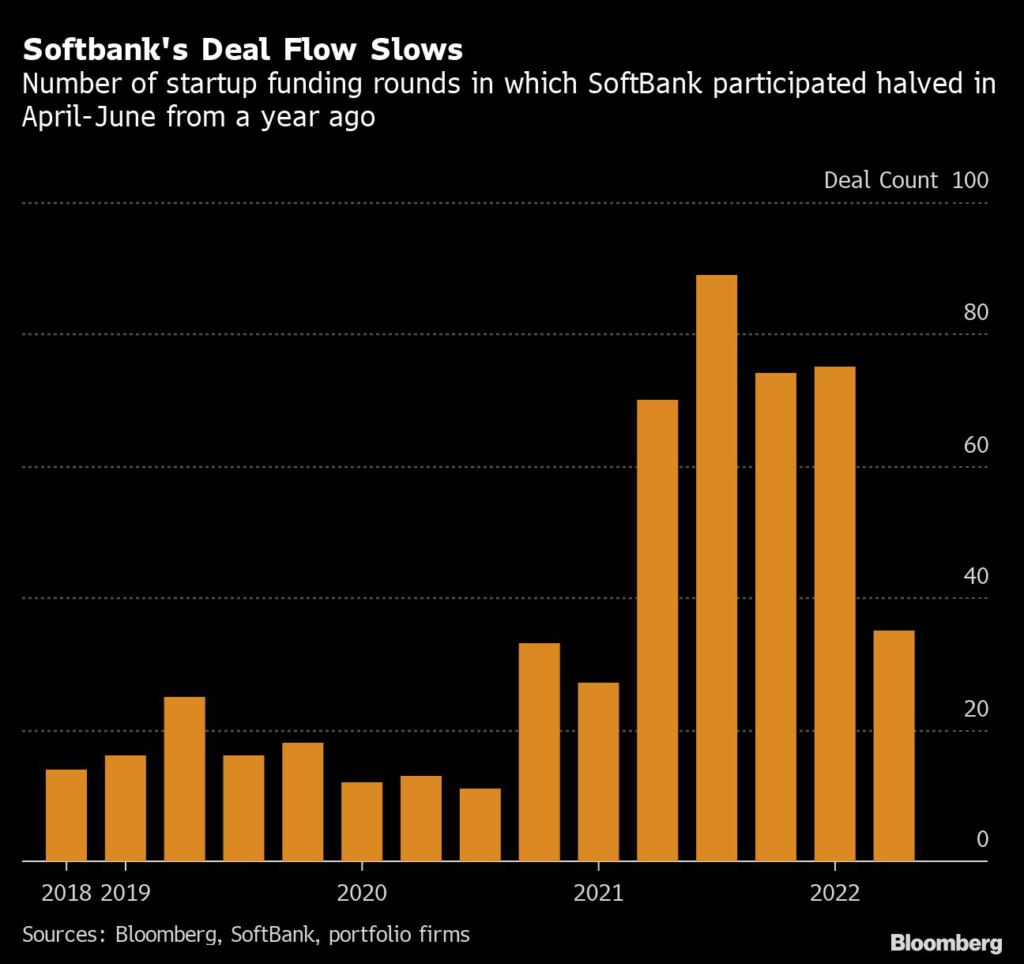
(Bloomberg) — The number of SoftBank Group Corp.’s Vision Fund investments halved in April-June after weak tech valuations sapped the risk appetite of the world’s biggest startup investor.

The Japanese backer of Uber Technologies Inc. and Didi Global Inc. put money into 35 startups and participated in financing rounds valued at $5.1 billion over the past three months, according to data compiled by Bloomberg. This compares with 70 deals worth a total $17.4 billion from a year ago. SoftBank led or co-led most of the rounds.

That’s a sharper slowdown than in venture capital activity worldwide. Global VC deal count fell by 6% in the last quarter compared with a year ago, to 7,651 deals worth $108.5 billion, according to research firm CB Insights. 

SoftBank, whose mammoth funds deployed $142 billion in the five years to March, is now a smaller presence among deal makers. Alibaba Group Holding Ltd.’s biggest shareholder invested in only two Chinese startups during the June quarter, down from six a year ago, for a total deal value of $220 million, Bloomberg’s data show.

A SoftBank spokeswoman declined to comment on Thursday.

Low tech valuations are draining SoftBank’s ability to turn public listings of its portfolio companies into liquidity to fuel its outsized bets. The prospect for a big return on SoftBank’s $32 billion purchase of chip designer unit Arm Ltd. through an initial public offering has dimmed amid a slump in chip-related stocks. SoftBank-backed ByteDance Ltd., whose planned IPO remains on hold, recently traded at valuations as low as $275 billion, down from its blended valuation of $460 billion a year ago, Bloomberg reported.

Read more: ByteDance Valuation Drops Below $300 Billion in Private Deals

“The rest of the year will probably not look much different as less cash is coming in to fund new opportunities,” said Kirk Boodry of Redex Research who publishes on Smartkarma. “A sale of Fortress would help with that but the steady flow of IPOs that Vision Fund used to raise cash last year has largely dried up.”

Mubadala Investment Co. — a backer of the first Vision Fund — is in talks to acquire asset manager Fortress Investment Group from SoftBank, Bloomberg News reported earlier this month. The Abu Dhabi sovereign wealth fund is said to be discussing a deal that would value Fortress at more than $1 billion.

The value of new investments at SoftBank could shrink to as little as a quarter of what it was a year ago, its founder Masayoshi Son has said. The company reported an annual record loss of 2.64 trillion yen ($19 billion) at its Vision Fund unit in May on tumbling valuations. 

Venture capital worldwide has slowed to a trickle as investors become pickier and stingier, forcing companies to restructure or reassess valuations.

“We started talks for our latest funding round last summer, but by December, some of the investors who had initially shown interest had backed out,” said Akira Oki, an executive at Japanese startup LegalForce Inc., in which SoftBank led a 13.7 billion yen funding round last month. “There was a need to redo valuations based on what investors were thinking.”

More stories like this are available on bloomberg.com

©2022 Bloomberg L.P.

Intel Spends Record Sum on Lobbying Amid Global Chip Shortage

(Bloomberg) — Intel Corp., one of the major semiconductor companies in the US, spent a record $1.75 million on federal lobbying over the past three months as the chip industry fought to secure billions of dollars in grants and subsidies from Congress.

Intel’s spending on lobbying, which came amid a chip shortage that has choked supply chains around the world, increased 65% from the roughly $1 million the company spent in the second quarter of 2021. The previous high was $1.43 million in the first quarter of this year.

The semiconductor industry’s latest lobbying disclosures, which were released on Wednesday, show that the industry blitzed Washington with an enormous lobbying campaign, with the top chip companies spending a total of $19.6 million during the first half of this year alone. 

The companies spent $15.8 million in the first half of 2021. 

The industry has spent record sums over the last year as it advocated for legislation that would dedicate more than $50 billion to increase the manufacturing of semiconductors in the US

The Senate this week voted 64 to 34 to start debate on the semiconductor legislation, setting up passage as early as next week. House Speaker Nancy Pelosi indicated on Wednesday that the House will schedule a vote soon. 

Lobbying on the legislation, known as the CHIPS Act, has picked up steam since the beginning of 2021 as Senate Majority Leader Chuck Schumer hailed the $52 billion infusion as the centerpiece of his ambitious legislative plan to counter China’s growing technological presence. Because of partisan disputes, it’s likely that Congress will pass the CHIPS Act next week without the broader China competition package.

The international chip companies have increased their Washington game, lobbying to ensure that assistance goes to companies outside of the US as well. The Taiwan Semiconductor Manufacturing Company, which accounts for more than 90% of the global output of the most advanced chips, spent more money on lobbying this quarter than it has previously, shelling out $650,000. That’s a 25% increase over the $501,630 that TSMC spent during the second quarter of 2021, and a 1.6% increase over the company’s previous high of $640,000.

The major players in the industry, including Qualcomm Inc. and Texas Instruments Inc., spent a total of $8 million in the second quarter. 

While the billions in chip assistance enjoys bipartisan support, some critics on the left have described the CHIPS Act as a giveaway to a wealthy industry. Vermont Independent Senator Bernie Sanders this week described the legislation as “extortion.”

“Should American taxpayers provide the micro-chip industry with a blank check of over $50 billion at a time when semiconductor companies are making tens of billions of dollars in profits and paying their executives exorbitant compensation packages?” Sanders asked during a speech on the Senate floor. “I think the answer to that question should be a resounding no.”

More stories like this are available on bloomberg.com

©2022 Bloomberg L.P.

Close Bitnami banner
Bitnami