
Bloomberg

Stock Rally Sputters in Asia Amid Growth Concerns: Markets Wrap

(Bloomberg) — Asian stocks slid with US futures Thursday as investors weighed signals from the latest corporate earnings and geopolitical risks in Europe.

An Asian stock gauge is on track to end a three-day winning streak, dragged down by Hong Kong. Futures retreated in the US and Europe, where Italy’s government looked set to collapse. The S&P 500 posted its first back-to-back gain in almost two weeks, while the Nasdaq 100 outperformed. 

The euro gained ahead of a European Central Bank meeting where it is expected to hike for the first time in more than a decade, almost certainly raising rates by 25 basis points. It will also unveil its new crisis management tool. The dollar edged lower.

The yen was under pressure after the Bank of Japan maintained its policy rate and lowered its economic growth forecast for this year. Treasury yields slipped. Gold was near an 11-month low.

Bitcoin dropped below $23,000. Tesla Inc. disclosed that it sold about 75% of holdings of the cryptocurrency during the second quarter.

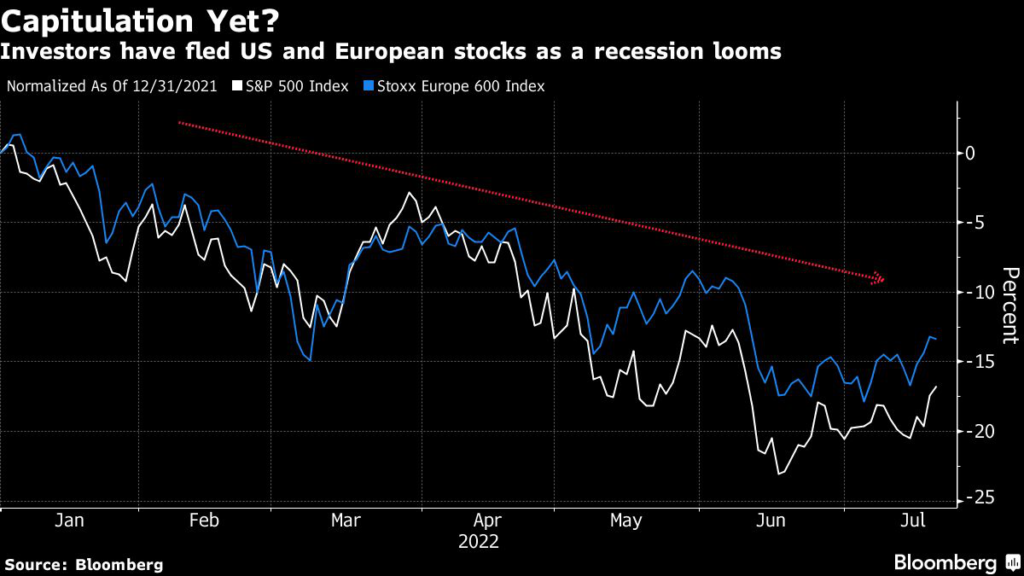
Risk sentiment remains fragile as investors debate whether equities have reached a trough after this year’s selloff amid the war in Ukraine, a slowdown in China and the prospect of a US recession. Investors are also assessing earnings to gauge how companies are managing amid the highest inflation in generations and escalating borrowing costs.

Many stocks “are still in very distinct downtrends so you can see a rally off maybe an oversold level but really if you are not starting to recover and break into a better uptrend it really remains to be seen if this can continue,” said Cameron Dawson, NewEdge Wealth chief investment officer. “So it’s more a relief at this point and not necessarily a trend change.”

Geopolitics are adding to investors’ skittishness as well. The European Union is preparing for a scenario where Russia halts gas exports to retaliate against sanctions over its invasion of Ukraine. Russian President Vladimir Putin signaled that Europe will start getting gas again through a key pipeline, but warned that unless a spat over sanctioned parts is resolved, flows will be tightly curbed.

While the market may have incorporated a lot of global economic growth downgrades, “it certainly isn’t helpful for some forms of risk sentiment and perhaps business confidence as well,” John Vail, the chief global strategist at Nikko Asset Management Co., said on Bloomberg Television.

Meanwhile, US President Joe Biden said he expects to speak to Chinese leader Xi Jinping “within the next 10 days” as Washington considers lifting some tariffs on Chinese imports.

Oil was back below $100 a barrel as growing stockpiles of crude and gasoline tempered fears of a tight market. 

How far will the Fed go in this hiking cycle? It takes one minute to participate in the confidential MLIV Pulse survey, so please click here to get involved. 

Key events to watch this week:

  • European Central Bank rate decisions. Thursday
  • Nord Stream 1 pipeline scheduled to reopen following maintenance. Thursday

Some of the main moves in markets:

Stocks

  • S&P 500 futures fell 0.2% as of 12:30 p.m. in Tokyo. The S&P 500 rose 0.6%
  • Nasdaq 100 futures fell 0.3%. The Nasdaq 100 rose 1.6%
  • Topix index fell 0.3%
  • Kospi index added 0.5%
  • Hang Seng Index slid 1.1%
  • Shanghai Composite Index shed 0.5%
  • Australia’s S&P/ASX 200 Index added 0.1%
  • Euro Stoxx 50 futures lost 0.5%

Currencies

  • The Bloomberg Dollar Spot Index fell 0.1%
  • The euro was at $1.0210, up 0.3%
  • The Japanese yen was at 138.35 per dollar, down 0.1%
  • The offshore yuan was at 6.7714 per dollar, added 0.1%

Bonds

  • The yield on 10-year Treasuries fell about one basis point to 3.01%
  • Australia’s 10-year bond yield lost one basis point to 3.53%

Commodities

  • West Texas Intermediate crude fell 0.7% to $99.16 a barrel
  • Gold was at $1,692.20 an ounce, down 0.3%

More stories like this are available on bloomberg.com

©2022 Bloomberg L.P.

GM Wants to Test Self-Driving Car With No Steering Wheel, Pedals

(Bloomberg) — General Motors Co. and Ford Motor Co. are seeking exemptions from US authorities to relax some rules related to testing of autonomous vehicles, according to Steven Cliff, the head of the National Highway Traffic Safety Administration. 

The exemptions sought by the carmakers, posted on the agency’s website, will be open for public comments for 30 days, the notices show. The vehicle proposed by GM won’t have steering wheels, pedals, manual turn signals and mirrors, while the one offered by Ford is envisaged for the automated system to give commands for braking, throttle and steering.

“Once the comment period closes, NHTSA will review these comments, evaluate the petitions’ merits, and determine whether granting them is in the public interest,” Cliff said. “Safety will be paramount as we decide whether to grant or deny these petitions.” 

GM-backed self-driving startup Cruise LLC is already facing scrutiny from US regulators and its own board of directors after a pair of on-road incidents raised questions about how ready the company is to expand its services. Argo AI, the driverless startup backed by Ford and Volkswagen AG, began testing self-driving vehicles in Miami and Austin, Texas, in May without a human behind the wheel. 

More stories like this are available on bloomberg.com

©2022 Bloomberg L.P.

Samsung SDI to Build $1.3 Billion Battery Plant in Malaysia

(Bloomberg) — South Korea’s Samsung SDI Co. will build a second battery plant in Malaysia to boost production of cylinder-type cells used for electric vehicles and electronics devices. 

The company will spend 1.7 trillion won ($1.3 billion) on the plant, which will produce so-called 21700 batteries, referring to a 21-millimeter-wide and 70-millimeter-long cell, to “respond to increasing demand for cylinder-type batteries,” it said in a statement Thursday. Mass production will start in 2024. 

The new plant will be a “starting point” for Samsung SDI to become a leader in the global battery market by 2030, Chief Executive Officer Yoonho Choi said at a groundbreaking ceremony in Seremban, according to the statement. Samsung’s investment will create more jobs and opportunities for local companies, Negeri Sembilan Chief Minister Aminuddin Harun said. 

Samsung SDI, which supplies batteries to BMW AG and Volkswagen AG, had a 5% share of the global battery market this year through June. That ranks it sixth behind market leader Contemporary Amperex Technology Co. Ltd. with 34% and LG Energy Solution Ltd. at 14%, according to Seoul-based SNE Research. 

In May, Samsung SDI announced plans to build its first US battery plant, a $2.5 billion factory in Indiana, in partnership with Stellantis NV.  

More stories like this are available on bloomberg.com

©2022 Bloomberg L.P.

TikTok Owner Spends Record $2.14 Million on US Lobbying

(Bloomberg) — ByteDance Inc., the Chinese parent company of social media video streaming sensation TikTok, spent a record $2.14 million on lobbying during the second quarter as it sought to fend off escalating congressional attacks over its privacy and security practices. 

The company’s lobbying spending increased nearly 130% from the first quarter, a sign that TikTok’s government affairs operation is escalating its attention to Congress after a lull. This year’s second quarter spending increased 16.3% over a year earlier, when the company spent $1.84 million.

TikTok has been the object of increasing scrutiny from lawmakers and officials who have expressed concerns in recent months over the data privacy granted to US users and whether their personal information can be accessed by the Chinese government.

Relations between China and the US deteriorated after former President Donald Trump hit China with import duties starting in July 2018 after an investigation concluded China stole intellectual property from American companies and forced them to transfer technology. 

On Wednesday, President Joe Biden says he expects to speak to Chinese leader Xi Jinping “within the next 10 days,” as the US considers whether lifting some tariffs on Chinese imports would help stem rampant inflation. 

In the past month, ByteDance has exchanged letters with US senators following a report by Buzzfeed News that said TikTok’s US consumer data was accessed by company engineers in China. The lawmakers said TikTok and ByteDance “are using their access to a treasure trove of US consumer data to surveil Americans.” TikTok responded, acknowledging that certain China-based employees can access information from American users, but denied that data goes to the Chinese Communist Party.

Brendan Carr, a Republican member of the Federal Communications Commission, has been a strong opponent of the app, pushing Apple Inc. and Alphabet Inc.’s Google to remove it from their stores. Carr testified to a House panel earlier this month about his concern that military personnel using TikTok could be risking national security.

Last week, the company named a new head of global security as part of its evolving approach “to minimize concerns about the security of user data in the US, including the creation of a new department to manage US user data for TikTok,” Chief Executive Officer Shou Zi Chew and ByteDance Vice President of Technology Dingkun Hong said in a statement. 

At the same time, the company has been working with the US government on strengthening data security around that information — particularly anything defined as “protected” by the Committee on Foreign Investment in the US, or Cfius. TikTok is also shifting its platform to Oracle Corp.’s cloud infrastructure, which means the app and the algorithm will be accessed and deployed for US users from domestic data centers.

TikTok hired its first lobbyist in 2019 and has rapidly built out its Washington operations since.

More stories like this are available on bloomberg.com

©2022 Bloomberg L.P.

Baidu Unveils New Robotaxi It Says Could Halve Commuting Costs

(Bloomberg) — Baidu Inc. unveiled a new version of its self-driving robotaxi that it says costs nearly half as much to make as the previous model, opening the opportunity for cheaper travel.   

Apollo RT6 robotaxis are set to be mass-produced at a cost of 250,000 yuan ($37,000) per unit, the Chinese search-engine giant said in a statement Thursday. The car, which has a detachable steering wheel, will become available on Baidu’s riding-hailing service in 2023. The company said it plans to eventually deploy “tens of thousands” of the robotaxis.

“We are moving toward a future where taking a robotaxi will be half the cost of taking a taxi today,” Baidu co-founder and Chief Executive Officer Robin Li said in the statement. 

Beijing-based Baidu is expanding beyond internet advertising with its push into artificial intelligence technology and autonomous driving, making it less of a target in China’s crackdown on technology firms such as Alibaba Group Holding Ltd. and Tencent Holdings Ltd. Still, the country’s weakening economy and Covid restrictions add to uncertainty over its near-term outlook. 

Baidu’s ride-hailing platform Apollo Go deploys 300 driverless cars in major cities including Shanghai and Beijing, and may become profitable in some regions in three years, company Vice President Wei Dong told Bloomberg News in April. Baidu has said it plans to expand Apollo Go into 65 Chinese cities by 2025, rising to 100 by 2030.

The Apollo RT6 has a projected operating cycle of more than five years, a Baidu spokeswoman said in an email, adding that the company’s self-developed technology and low-cost sensors helped reduce production costs.

More stories like this are available on bloomberg.com

©2022 Bloomberg L.P.
Korea Early Exports Hold Up on Chip Sales Despite China Lockdown

(Bloomberg) — Sign up for the New Economy Daily newsletter, follow us @economics and subscribe to our podcast.

South Korea’s early trade data showed exports remained resilient in the face of risks to global economic growth and China’s Covid lockdowns that are disrupting supply chains.

Exports advanced 14.5% in the first 20 days of July from a year earlier, the customs office reported Thursday. Overall imports rose 25.4%, resulting in a trade deficit of $8.1 billion.

Exports to China, the biggest buyer of Korean goods, fell 2.5% over July 1-20, reflecting the impact of virus restrictions. In contrast, shipments to the US jumped 19.7% in another sign of strong demand from American consumers.

Overall semiconductor shipments increased 13.2%, underscoring the tech demand that is helping to shore up the Korean economy.

South Korea’s exports range from cars to ships to smartphones, serving as an early barometer on the state of the world economy. Concerns about a global recession are putting pressure on trade, while Russia’s war on Ukraine and China’s virus struggle are adding to supply chain risks. 

Central banks are also sticking to a path of higher interest rates in order to rein in inflationary pressures. With the Federal Reserve accelerating its policy tightening, trade-dependent nations like South Korea are seeing their deficits swell. Meantime, their currencies’ falls against the dollar are driving up the cost of raw materials, making it tougher for manufacturers.

Labor disputes are another risk for South Korea’s exports. A strike at a shipyard is disrupting the delivery of vessels, prompting the government to call for an end to the dispute or it will consider tough measures. A strike in June by a nationwide truckers’ union had weighed on exports before it came to a temporary settlement.

Today’s report showed exports to the European Union climbed 18.1% and those to Japan decreased 2.6%. Exports of cars rose 15%, while the sales of wireless communications devices fell 12.2%.

Oil-product exports jumped 109.7%, while imports of crude also rose 107.5% in the first 20 days, as energy prices remain elevated around the world. Coal imports also soared 148.9%.

(Updates with trade deficit.)

More stories like this are available on bloomberg.com

©2022 Bloomberg L.P.
Microsoft Cuts Many Open Job Listings in Weakening Economy

(Bloomberg) — Microsoft Corp. is eliminating many open jobs, including in its Azure cloud business and its security software unit, as the economy continues to weaken.

These hiring cuts will continue for the foreseeable future, Microsoft said, while declining to comment on which departments and businesses are affected. The company said it is honoring job offers that have already been made for open roles and will make some exceptions for critical jobs.It’s an expansion of a hiring slowdown disclosed in May, which mostly affected its Windows, Office and Teams groups. In June, Insider also  reported cuts to new headcount in the security business. 

The latest slowdown, which was communicated by executives in the groups to their teams, impacts the company’s cloud crown jewels — a key source of growth and investor scrutiny — as well as a newer priority area in security. In the past year, Microsoft brought on longtime Amazon.com Inc. cloud executive Charlie Bell to bulk up its products and strategies for combating hackers and the company considered acquiring cybersecurity firm Mandiant Inc. Now Bell’s ability to bring in new talent has been pared back considerably. 

“As Microsoft gets ready for the new fiscal year, it is making sure the right resources are aligned to the right opportunity,” the company said in an emailed statement. “Microsoft will continue to grow headcount in the year ahead, and we will add additional focus to where those resources go.”

Earlier this month, Microsoft cut less than 1% of its 180,000-person workforce, affecting groups such as consulting and customer solutions, but had said it planned to finish the current fiscal year with increased headcount. The moves follow others in technology. Google Chief Executive Officer Sundar Pichai told staff to expect a hiring slowdown for the remainder of the year. Apple Inc. is also planning to slow hiring and spending at some divisions next year, people familiar with the matter said Monday.

Read more: Google, Lyft Are Latest Tech Companies to Hit Brakes on Hiring

Azure, the No. 2 infrastructure cloud provider, has been trying for years to narrow the gap with larger rival Amazon Web Services. The percentage growth rate of the Microsoft unit remains one of the most closely watched metrics in Microsoft’s quarterly earnings, scheduled for release next on Tuesday. 

Microsoft’s new fiscal year began on July 1. The month is often a period of job cuts and adjustments to hiring, as the company reassesses where it wants to invest. Still, such a broad pullback on hiring plans is unusual and comes as fears of a recession mount, with inflation, the war in Ukraine and the lingering pandemic taking a toll.

(Adds company statement in fifth paragraph.)

More stories like this are available on bloomberg.com

©2022 Bloomberg L.P.
Zuckerberg to Testify in Cambridge Analytica Privacy Lawsuit

(Bloomberg) — Meta Platforms Inc. Chief Executive Officer Mark Zuckerberg and Chief Operating Officer Sheryl Sandberg will testify in a lawsuit claiming Facebook illegally shared user data with research firm Cambridge Analytica.

Users sued after it was revealed that a UK research firm connected to Donald Trump’s 2016 campaign for president gained access to the data of as many as 87 million of the social media network’s subscribers.

In hard-fought battles over pretrial information sharing since the suit was filed in 2018, lawyers for the consumers have gained leverage to pry into the company’s internal records to back up their claims that it failed to safeguard their personal data. Facebook’s parent company could be on the hook for hundreds of millions of dollars if it loses the case.

Zuckerberg has agreed to sit for a deposition for as long as six hours, while Sandberg is set to be questioned for up to five hours, according to a filing Tuesday in San Francisco federal court. Javier Olivan, who has led the company’s growth efforts for years, faces up to three hours of deposition questioning. He will take Sandberg’s place as COO when she formally leaves the company in the fall.

Facebook faced a storm of controversy following the revelation in 2018 that Trump’s campaign benefited from the work of an app developer who started out by collecting personal information from 300,000 users, and later, from those users’ friends. Unbeknownst to users, the developer shared the data trove with Cambridge Analytica, which used it to target voters in 2016 with hyper-specific appeals through “psychographic” modeling.

The ensuing lawsuits were filed on behalf of everyone in the US who uses the social network.

Facebook has argued it disclosed its practices in user agreements. It has also said that anyone sharing their information on a social network shouldn’t count on holding onto their privacy.

Meta didn’t immediate respond to an email seeking comment on the filing.

The case is In Re Facebook Consumer Privacy User Profile Litigation, 18-MD-02843, U.S. District Court, Northern District of California (San Francisco).

(Updates with background on case)

More stories like this are available on bloomberg.com

©2022 Bloomberg L.P.

FedEx Contractor Revolt Intensifies With Calls for Pay Increase

(Bloomberg) — FedEx Corp. is facing more pressure to raise pay for the small businesses that deliver a big portion of its packages, adding another hurdle to the logistic giant’s plans to boost profitability.

Spencer Patton, who runs more than 200 routes in 10 states for FedEx Ground, launched the latest challenge on Wednesday by distributing a letter to fellow logistics firms and posting a video online that asks for payments to increase by 50 cents per stop and 20 cents per mile when shuttling packages between hubs. 

“The FedEx Ground network is in far more peril than what anyone realizes,” Patton said in a video viewed by Bloomberg. “There is not a day that goes by that I do not hear from my fellow contractors that are seeking a financial path out of certain bankruptcy.”

An increasing number of contractors are failing, especially after federal pandemic relief dried up. The extra payments would help contractors survive a spike in driver wages and prices for gasoline and trucks, according to Patton, who also runs a consultancy for delivery companies and has helped recruit firms into the FedEx network. In his letter, he asks FedEx to negotiate an increase in compensation by Nov. 25, which falls on Black Friday, the start of the US holiday-shopping season. 

A separate group of contractors organized two petitions earlier this year, decrying dwindling profits, faulty software for predicting package volume and inefficiencies at FedEx’s package sorting hubs that delay drivers.

The contractors earned average revenue of $2.3 million last year and more than half have provided service for five years or more, helping the Ground unit navigate the rapid growth of e-commerce, FedEx said in an emailed statement. FedEx said it’s more effective dealing directly with each contractor, whose businesses have unique characteristics depending on their service area. 

“We recognize the shifting market dynamics and current economic conditions may pose new challenges for service provider businesses, and we remain committed to working with these businesses to create opportunities for continued success,” FedEx said in the statement. “FedEx Ground teams across the network are continuing these productive discussions at a business-to-business level.”

Profit Drive

Meanwhile, Raj Subramaniam, who took over on June 1 from founder Fred Smith as chief executive officer, is trying to win over skeptical investors whose shares have fallen by 23% over the past year. He has announced a big increase in the dividend and a reduction in capital spending. And the company accepted two board members recommended by an activist investor.

The new CEO also wants to squeeze more money from the Ground unit, FedEx’s most-lucrative business. Profit margins at the division have narrowed with the pandemic-fueled boom in e-commerce deliveries, which are less profitable than its shipments to businesses. 

FedEx has made a flurry of changes to address the surge of residential packages, including expanding delivery from five days a week to seven days. Subramaniam recently touted the expansion as one of FedEx’s strengths.

Read more: FedEx ground delivery becomes a road to riches for contractors   

However, Sunday service is a burden for contractors and should be ended, according to Patton. There’s not enough volume to run routes efficiently and the extra weekend day creates driver scheduling headaches. The option is also unprofitable for FedEx, totaling about $500 million in losses a year, he said in the letter, citing “our estimates.”

Contractors have also complained that FedEx charges its customers a fuel surcharge and only passes along a portion of the extra fee to the firms making the deliveries. On the company’s earnings call last month, FedEx said fuel surcharges were the largest driver of higher revenue per package.

Coordinated Response

Patton hosts an annual conference for contractors, and this year’s event, which is in Las Vegas, will be used to coordinate a response to FedEx. At the meeting, a 10-person committee will be formed to negotiate with FedEx management on behalf of delivery firms. More than half of the 6,000 contractors that work for the Ground unit are expected to attend, Patton said. 

This kind of activism is rare within the FedEx universe. Fear of retaliation is prevalent among more than a dozen contractors interviewed by Bloomberg. One reason is that the Ground unit offers contracts that are as short as one year and have triggers that allows FedEx to cancel them. 

Patton said in the video he’s “taking an enormous risk” by confronting FedEx. However, he doesn’t want a “war” and said there’s no plan to attempt to unionize contractors. He made a direct appeal to Subramaniam to reduce contractor failures. 

“I have brought thousands of people into this space as an investment,” Patton said. “They’re depending upon the cash flow of these businesses and ensuring that this is a viable investment going forward.”

(Updates with FedEx comments in the sixth and seventh paragraphs.)

More stories like this are available on bloomberg.com

©2022 Bloomberg L.P.

Tesla Beats Profit Estimates, Keeps 50% Target for Output Growth

(Bloomberg) — Tesla Inc. Chief Executive Officer Elon Musk said the electric-vehicle manufacturer has been through “supply chain hell,” but sees commodities prices trending lower and signaled optimism the company can achieve record volume over the rest of the year.

The remarks came after the EV market leader reported second-quarter earnings that beat Wall Street estimates, reflecting Tesla’s progress in getting production back on track while tackling supply-chain hurdles and Covid lockdowns at its factory in China.  

“We have potential for a record-breaking second half of the year,” Musk said Wednesday on a call with analysts, noting strong June production at the company’s factories in California and Shanghai. But he cautioned that the industry has faced severe challenges securing adequate supplies of parts and materials.

“It’s kind of been supply chain hell for several years,” Musk said.

Tesla’s CEO sees signs that commodities prices are on a downward trajectory and predicted inflation will slow by the end of the year. 

Shares of the company rose 0.8% to $748.55 as of 6:26 p.m. in New York. The stock had fallen 30% this year as of the close Wednesday in New York. 

Production Forecast Intact

The first major US automaker to report second-quarter financial results, Tesla said in a letter to shareholders that increasing production at its two newest plants — one in Germany and the other in Texas — will depend on the smooth launch of new vehicles and improved supply chains. 

The Austin, Texas-based manufacturer left unchanged its production forecast for 50% average annual growth “over a multiyear horizon,” but said issues ranging from shortages of supplies and labor to logistical problems kept its factories from running at full capacity in the most recent quarter. 

“They are maintaining their 50% growth rate, which is a bit of a surprise. I thought they might back off from that,” said Gene Munster of Loup Ventures. “They are doing a good job navigating a difficult environment.”

Tesla posted adjusted earnings of $2.27 a share, besting the $1.83 a share average of analysts’ estimates compiled by Bloomberg. But that was below the $3.22 Tesla made in the first quarter, marking the first sequential profit decline since the end of 2020.

Cybertruck’s 2023 Debut

Analysts are paying close attention to how quickly Tesla can ramp up output of its mass-market Model Y SUV from those two factories, and also introduce the long-awaited Cybertruck pickup in Austin. Musk told analysts on the call that Tesla is on track to debut the truck in mid-2023 and said it could be “our best product ever.”

Tesla said previously it delivered 254,695 vehicles worldwide in the quarter, up 27% year over year but down from its first-quarter record of 310,048. It was the first time in two years that the company failed to increase vehicle deliveries from the prior quarter. In April, Musk predicted the company would produce more than 1.5 million vehicles this year. Tesla had made about 564,000 through the first half.

The EV maker’s revenue came to $16.9 billion, meeting the average of estimates. Revenue from the sale of regulatory credits totaled $344 million, down from $679 million in the first quarter.

Read more: Tesla sells majority of Bitcoin

Calling Tesla’s dalliance in digital currencies “a sideshow to a sideshow,” Musk said Telsa is open to increasing its holdings of cryptocurrencies even after it reported a Bitcoin impairment that reduced second-quarter earnings.

Tesla converted about 75% of its Bitcoin purchases into fiat currency, but the CEO explained the move as a way to increase liquidity amid uncertainty about the duration of Covid-related shutdowns in China. It should not be seen as “some verdict on Bitcoin,” he said. 

(Updates with CEO’s comments from third paragraph.)

More stories like this are available on bloomberg.com

©2022 Bloomberg L.P.

Close Bitnami banner
Bitnami