

Bloomberg

FaZe Clan’s Market Debut Will Test Gen-Z Hype Machine

(Bloomberg) — The frat house of the video game industry is flinging open its doors and letting the public in. 

FaZe Clan, a bombastic organization of gaming celebrities and esports pros that helped pioneered the influencer marketing industry, begins trading on the Nasdaq Wednesday after merging with a special purpose acquisition company. It becomes the first publicly traded Gen-Z influencer company and one of only a handful of esports companies on the market.

The Los Angeles-based organization was formed in 2010 by a group of teens who met playing Xbox online. They began posting clips of themselves performing trick shots in Call of Duty on YouTube, which attracted large audiences of young, primarily male gamers. 

FaZe Clan soon became associated with the cool, older teen who could earn thousands of dollars a day playing games such as Fortnite on streaming site Twitch in lieu of attending college or who might flash a diamond studded watch in a video about pranking his friends. The group is defined by “stunt” culture—from its founders pulling off eyebrow-raising sniper shots in Call of Duty, to the YouTube video by member Brian “FaZe Rug” Awadis called “I Filled my Swimming Pool with GIANT SNAKES!! **scary**” which has been viewed more than 19 million times. 

FaZe Clan has parlayed its popularity into lucrative brand tie-ins with companies like General Mills Inc. and McDonald’s Corp., and lines up content deals and collaborations like one with Japanese artist Takashi Murakami that clocked more than $1 million in sales on the first day. FaZe Clan became the first esports organization to land on the cover of Sports Illustrated and has its own Batman comic book. It also earns revenue through branded streetwear, ads on YouTube and Twitch videos, and wins some money through esports competitions. 

FaZe’s name is its most valuable asset. Members attach “Faze” to their gamer nicknames and are “immensely more famous the day after,” Chief Executive Officer Lee Trink said in an interview with Wired in 2020.  However, FaZe’s reliance on public perception and sponsorships, which make up half its revenue, clashes with its ethos as an edgy, often controversial organization.

“It’s very experimental,” says Joost van Dreunen, a New York University Stern School of Business lecturer who wrote “One Up: Creativity, Competition, and the Global Business of Video Games.” “They’re a pioneer of digital lifestyle branding and post-pandemic entertainment. Basically, a bunch of cool people trying to sell merch by acting cool, and making people want to be cool like them.” 

FaZe Clan now counts more than 500 million global followers on social media. Its 93 “influential personalities” include a mix of talent who go beyond the world of gaming, such as National Basketball Association star Anthony Davis, Lebron “FaZe Bronny” James Jr. and Snoop Dogg aka “FaZe Snoop,” who wore a gold chain that read “FaZe Clan” at the 2022 Super Bowl half-time show. 

But will the good life that FaZe’s selling, epitomized by the $30 million Los Angeles mansion where seven FaZe Clan members lived and filmed videos until last year, withstand the scrutiny of Wall Street?

FaZe is going public through a merger with blank check company B. Riley Principal 150 Merger Corp., whose Chief Investment Officer, Daniel Shribman, saw in FaZe “a brand that speaks to today’s youth culture like Nike spoke to yesterday’s.” But FaZe Clan is coming to market amid an economic downturn that could put pressure on budgets of sponsors, whose ranks include McDonald’s, Nissan Motor Co. and Doordash Inc. The stock market has been in a downward spiral for much of the year, and FaZe’s blank-check merger closes just weeks after a wave of similar SPAC deals were called off.  

When the plan was announced last October, FaZe was given a nearly $1 billion valuation. At the time, the group was projecting $50 million in revenue in 2021 and a loss before interest, tax, depreciation and amortization of $19 million. But in April, FaZe reported an Ebitda loss in 2021 that was greater than its forecast by $9.7 million, widening to a loss of $28.7 million. The company also said it expects results for 2022 and 2023 to “differ materially” from its last forecast. Shares, which trade under the ticker FAZE, tumbled 28% from Tuesday’s closing price of the SPAC FaZe  merged with to $9.40 at 11 a.m. in New York. 

FaZe is steeped in highly volatile industries: esports, branded sponsorships and, recently web3, a new idea for the next iteration of the web that incorporates concepts such as blockchain and cryptocurrencies. The organization relys on the hype factor to draw in revenue.

“Gen Z is the tip of the spear driving culture,” said Trink. “We have an understanding of the changes Gen Z wants to see in commerce and we have the position to capitalize.” Trink, a former music industry executive credited with managing Kid Rock’s career, has compared FaZe to MTV. 

FaZe is considered a world-class influencer organization, with all of the associated controversy. FaZe and its stable of rowdy teen boys — there’s only one woman among the current roster of influencers —  have been embroiled in controversies surrounding a racist slur, a sexist joke about women esports pros, and a “pump and dump” cryptocurrency scam called “SaveTheKids.” And that was all in the last year. In 2020, FaZe co-owner Ricky Banks advertised a site for gambling with video game cosmetics without disclosing that he owned it, and in 2021, was generously compensated to fly to Mexico to promote an offshore crypto gambling website. 

Two former FaZe superstars — Turner “Tfue” Tenney and Dennis “Cloak” Lepore, who have a combined 13 million YouTube subscribers — have had public blow-ups around their contracts.

The company shuns firm job titles and old-school professionalism, which, combined with FaZe’s big personalities, has contributed to internal volatility, according to people familiar with the organization. FaZe now has an interim chief financial officer, after his predecessor left after just one year. Several of FaZe’s Gen Z influencers, including Banks, have played a large part in the company’s business dealings. One former employee says kids with no experience in business or branding are calling the shots, and described the organization as a “shit-show.” “We’ve been preparing for over a year to become a public company,” Lee said. “In the time that we’ve announced our merger, we’ve put together a stellar management team and a world class board of directors to oversee the company. FaZe Clan has a professional management team and a public company board to run the business, but as a brand at the forefront of youth culture, it’s critical to include the perspectives of Gen Z and our people who have an innate knowledge of the internet community and the brand.”

Shribman believes FaZe’s brand will weather the scandals. “It’s edgy, deep-in-youth-culture, deep-in-gaming-culture. That’s what makes it what it is. If there were no controversies, that would be pretty boring.” 

FaZe may have pioneered a way to monetize gaming’s swagger, but holding its lead could be a challenge. It already faces competition from other esports teams that have pivoted into lifestyle brands such as 100 Thieves. And esports itself has proven difficult to make money in, with fickle sponsorships and tournament winnings barely buoying even the most well-respected organizations.

FaZe’s next steps are in web3. The company plans to spend some of its listing funds on acquisitions, Trink said. It’s also pursuing partnerships with several companies involved in the metaverse, an immersive version of the internet where users will interact through digital avatars. He is  “unquestionably” pushing forward into web3 despite crypto’s $2 trillion free fall.

“Gen Z is such an entrepreneurial generation,” Trink said. “And there have never been more tools to be entrepreneurial.”

(Updates with share trading. A previous version of this story removed an incorrect reference to the company’s market cap.)

More stories like this are available on bloomberg.com

©2022 Bloomberg L.P.

Turkish Mobility App Marti’s New York IPO Announcement Imminent

(Bloomberg) —

Turkey’s mobility app Marti will announce its planned merger with a blank-check company within weeks, a deal that marks the first initial public offering by a Turkish company via a SPAC in New York.

The deal between Marti Technologies Inc. and Galata Acquisition Corp., a special purpose acquisition company listed in New York, is finalized following months-long negotiations, people with knowledge of the matter said.

Marti, which currently offers electric bike, scooter and moped rentals in 20 cities in Turkey, will use IPO proceeds to expand its area of activity and boost the size of its fleet, the people said asking not to be identified as the listing has yet to be announced.

Galata and Marti both declined to comment on the merger. 

Turkish Bike-Riding App Marti to List in New York Via SPAC

The deal highlights Marti’s ambitions to take advantage of a growing wave of interest in ride sharing apps, which attracted $2.83 billion in investments in 2021, up from $1.31 billion the previous year, according to research by BloombergNEF, CB Insights and Pitchbook. Marti’s app was downloaded 8 million times and has been used for more than 40 million rides in Turkey, the company said by email. Its fleet — the country’s largest with around 55,000 vehicles — is assembled and maintained locally, where Marti says labor costs remain low and transportation fees are high.  

“We believe that almost everything on two- and four-wheels will be electric in just a few years, and everything electric will be sharable,” Marti CEO and founder Oguz Alper Oktem said in an interview, declining to comment on merger talks.

2021 Valuation 

The company was valued at about $100 million last year, when it attracted $30 million worth of investment from the likes of the European Bank for Reconstruction and Development and Turkish private equity firm Actera, according to Webrazzi, an Istanbul-based startup monitor. Other investors in the firm include AutoTech Ventures LLC and Beco Capital.

Galata has $147 million in cash and a market value of $180 million, according to data compiled by Bloomberg. It’s backed by Callaway Capital Management LLC, a Washington D.C.-based asset manager founded by Daniel Freifeld, who’s also the SPAC’s chief investment officer.

Cash shells like Galata raise money through to buy a business that would be identified later on. A SPACs boom at the onset of the coronavirus pandemic has since waned amid heightened market volatility and a growing number of prominent deals fizzling out. They accounted for deals worth around $10 billion so far this year, compared to $149 billion during the entire 2021, according to Bloomberg Intelligence research. The De-SPAC Index, a basket of companies that completed their tie-ups, has crashed 65% this year, compared with a 19% decline in the S&P 500 Index.

More stories like this are available on bloomberg.com

©2022 Bloomberg L.P.
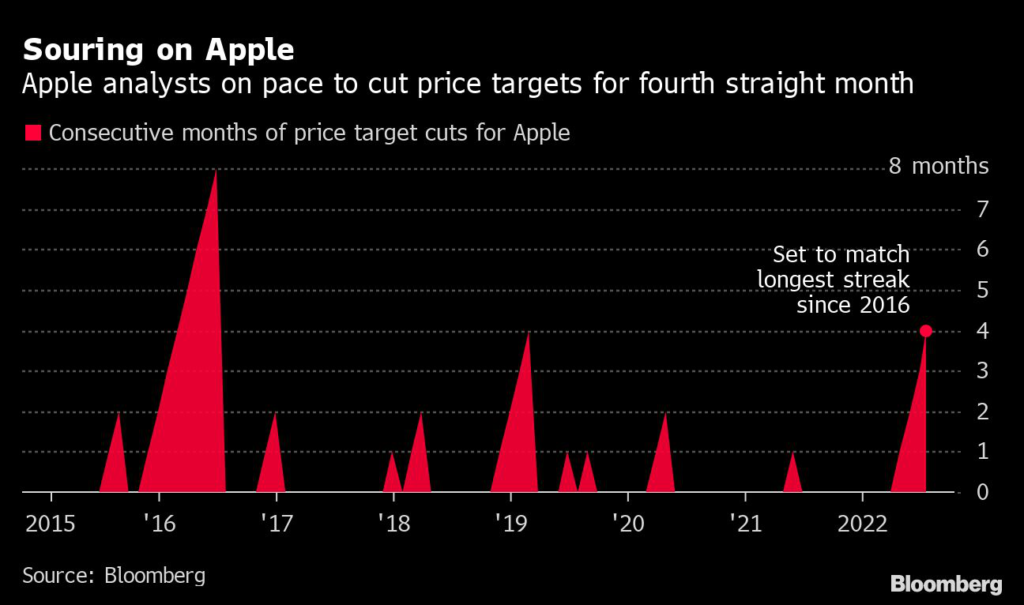
Apple’s Stock Gloom Spreads as More Analysts Trim Price Targets

(Bloomberg) — More analysts covering Apple Inc. are cutting their share-price forecasts, signaling growing concerns about an economic slowdown that could hurt the sales of its products.

Wells Fargo Securities and Morgan Stanley were the latest to lower their price targets, joining a drumbeat of brokerage firms that have recently reduced their stock forecasts ahead of the company’s quarterly results slated to be released next week.

Wells Fargo late on Tuesday cut its price forecast by about 10% to $185 citing a challenging macroeconomic environment and the surging US dollar and Morgan Stanley reduced its 12-month projection on the possibility of weak sales in Apple’s Mac and services businesses. Apple’s average analyst price target now currently stands at roughly $180. While that is about 19% above the tech giant’s stock price, the average has dropped from a March peak above $190.

Setting aside the headwinds that have broadly pressured the sector — rising interest rates, slowing economic growth and soaring inflation — Apple is also facing supply constraints related to Covid restrictions in China. In April, the company warned that it could take a $4 billion to $8 billion hit to revenues for the second quarter. Apple also plans to slow hiring and spending growth next year to cope with a potential recession, people with knowledge of the matter told Bloomberg News. 

Its shares are down about 15% so far this year, outperforming the 25% drop in the Nasdaq 100 Index. While analysts have been cutting their share-price targets, a majority of them are still bullish, with about 75% recommending investors buy the stock.

(Updates with added details throughout.)

More stories like this are available on bloomberg.com

©2022 Bloomberg L.P.
Bankman-Fried’s Crypto Exchange FTX Is In Talks to Raise Funds After Buying Spree

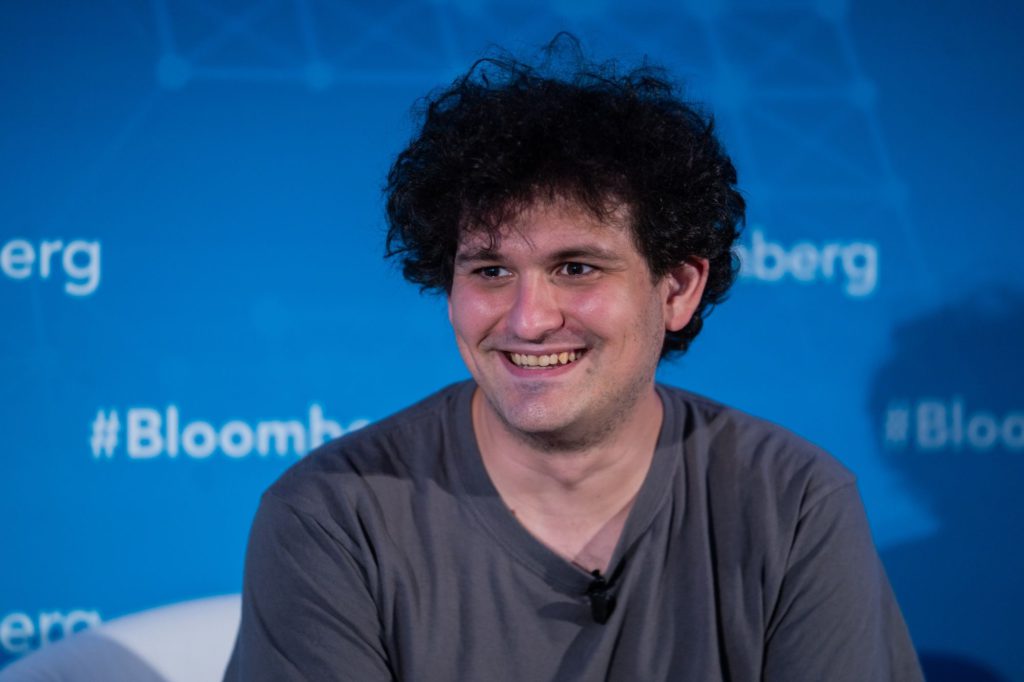
(Bloomberg) — Crypto exchange FTX, co-founded by billionaire Sam Bankman-Fried, is in talks to raise fresh funding after carrying out a shopping spree during the recent digital-assets market rout.  

FTX and its American entity FTX US are both fundraising, according to people familiar with the matter who aren’t authorized to discuss ongoing discussions. FTX is targeting a round at essentially the same valuation as its January fundraising, the people said. In January, FTX announced it raised $400 million at $32 billion valuation, while FTX US raised a separate $400 million at an $8 billion valuation. 

A spokesperson for FTX declined to comment when asked about the talks. 

Bankman-Fried has positioned himself as a lender of last resort in a crypto industry roiled by a collapse in prices that prompted a number of firms to seek rescue. In all, he committed about $1 billion during the digital-asset rout that’s wiped out $2 trillion in market value in only eight months. 

Read More: Sam Bankman-Fried Expands Crypto Empire During $2 Trillion Rout

He propped up crypto lending platform BlockFi, and tried to save Voyager Digital with a large loan. He has said he backstopped a couple of companies where his involvement hasn’t been made public. 

More stories like this are available on bloomberg.com

©2022 Bloomberg L.P.
US Stocks Waver as Haven Bid Lifts Treasuries: Markets Wrap

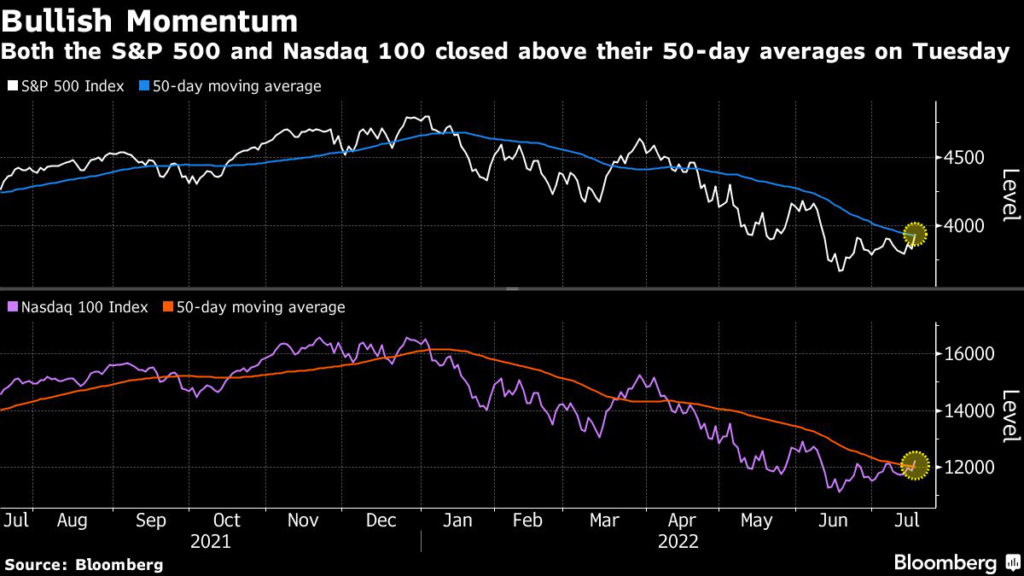
(Bloomberg) — US stocks fluctuated in early trading as investors parsed through the latest corporate results while growing concern that Europe may lose access to Russian gas added to recession fears. 

The S&P 500 was little changed, while the tech-heavy Nasdaq 100 posted modest gains. Netflix Inc. rose after it reported better-than-feared earnings late on Tuesday and said it expects to return to subscriber growth before the end of the year.  

Risk sentiment took a hit on news the European Union is preparing for a scenario where Russia halts gas exports to retaliate against sanctions over its invasion of Ukraine. That sparked a reversal in haven assets, as Treasuries rose, with the yield on the 10-year benchmark fell back below 3%. 

The risk of a global downturn and Europe’s energy crisis doused optimism about the US earnings season and confidence the Federal Reserve will take a more measured approach to tightening. 

“Markets are starting to come to a realization that the tail risk of a sustained meaningful drop in European gas imports is rapidly becoming the core risk,” said Seema Shah, chief global strategist at Principal Global Investors. “Global markets have largely assumed they will be immune to European pain. However, Europe is a key trade partner for several major economies and spillover effects are almost unavoidable.”

The EU proposed that the bloc cut its natural gas consumption by 15% over the next eight months to ensure that any full Russian cutoff of natural gas supplies won’t disrupt industries over the winter.

Read more: EU Proposes 15% Cut in Gas Consumption on Russian Supply Concern

West Texas Intermediate crude oil slipped below $103 a barrel. Bitcoin hovered above $23,000 after climbing out of a one-month-old trading range.

How far will the Fed go in this hiking cycle? It takes one minute to participate in the confidential MLIV Pulse survey, so please click here to get involved. 

Key events to watch this week:

  • Earnings this week include Tesla
  • Bank of Japan, European Central Bank rate decisions. Thursday
  • Nord Stream 1 pipeline scheduled to reopen following maintenance. Thursday

Some of the main moves in markets:

Stocks

  • The S&P 500 was little changed as of 9:37 a.m. New York time
  • The Nasdaq 100 rose 0.4%
  • The Dow Jones Industrial Average fell 0.1%
  • The Stoxx Europe 600 fell 0.3%
  • The MSCI World index rose 0.3%

Currencies

  • The Bloomberg Dollar Spot Index was little changed
  • The euro rose 0.1% to $1.0238
  • The British pound was little changed at $1.2004
  • The Japanese yen rose 0.1% to 138.05 per dollar

Bonds

  • The yield on 10-year Treasuries declined five basis points to 2.97%
  • Germany’s 10-year yield declined four basis points to 1.23%
  • Britain’s 10-year yield declined eight basis points to 2.10%

Commodities

  • West Texas Intermediate crude fell 1.5% to $102.65 a barrel
  • Gold futures were little changed

More stories like this are available on bloomberg.com

©2022 Bloomberg L.P.
Netflix’s Million-Customer Loss Avoids Worst-Case Scenario

(Bloomberg) — After losing more than a million customers in the first half of 2022, Netflix Inc. has a message for investors: It could have been worse.

The leader in paid streaming TV lost 970,000 subscribers in the second quarter, according to a statement Tuesday. That was less than half what Wall Street feared, thanks in large part to a new season of “Stranger Things,” the service’s most popular English-language series.

“We’re talking about losing 1 million instead of 2 million — our excitement is tempered by the less-bad results,” Chairman Reed Hastings said on an earnings call. “But looking forward, streaming is working everywhere. Everyone is pouring in.”

Shares of Netflix climbed 0.8% at 9:36 a.m. in New York, paring a larger gain earlier in the premarket session. The stock has lost two-thirds of its value so far this year.

This quarter, Netflix expects to sign up 1 million subscribers. While that’s well short of the 1.83 million analysts forecast this period, it reverses the losses of the first half.

Despite concerns about increased competition and a potential recession, Netflix remains confident in its position. The company said its share of total TV viewing in the US hit an all-time high in June at 7.7%.

“We believe the prospect of a prolonged period of subscriber losses is becoming increasingly unlikely,” Stifel analyst Scott Devitt wrote in a research report on Wednesday. He upgraded his rating on Netflix to buy from hold following the earnings release.

Management has responded to the subscriber slide by cutting costs and adjusting its strategy on several fronts. The company plans to introduce a lower-priced version of the service with advertising around early 2023, and is testing ways to charge customers for password sharing.

For the second quarter, revenue grew 8.6% to $7.97 billion, Netflix said. That missed Wall Street estimates of $8.04 billion, in part because of the strong dollar.

Read more: Streaming-video stocks rise on Netflix news

During the quarter, Netflix lost 1.3 million customers in the US and Canada, its largest region, and another 770,000 in Europe, the Middle East and Africa, its second-largest. Those are the steepest quarterly declines the company has reported in either place since it started supplying individual results from those markets.

Growth in the Asia-Pacific region offset those declines. Netflix added 1.1 million customers in APAC, after cutting prices in India.

Hastings had positioned Netflix as an advertising-free alternative to cable TV, but now says commercials are necessary to appeal to people who find the service too expensive. Netflix has raised prices several times and is now one of the most expensive streaming services.

“At a high level, Netflix’s ambitions are to accelerate revenue growth while moderating its content investment growth,” Morgan Stanley analysts led by Benjamin Swinburne wrote in a note to clients. “If successful, shares should outperform. However, it remains early in its monetization initiatives and while success is not priced in, neither in our view is failure.”

The company will introduce the advertising-supported option first in a handful of countries, and just tapped Microsoft Corp. to handle ad sales and technology. Advertising will start small and look a lot like other video businesses ads. But Netflix believes it can be substantial, Chief Operating Officer Greg Peters said.

Read more: Netflix chooses Microsoft as ad partner

Netflix has also started to release new episodes of shows in batches, breaking with its tradition of dropping every episode of a season at the same time. It released the drama “Stranger Things” and the final season of “Ozark” in two batches.

The batching strategy allows Netflix to extend the life of its biggest shows. When every episode is released at once, the majority of the viewing happens in the first couple of weeks. The number of people who cancel Netflix has jumped 87% since a year ago, according to Antenna.

The popularity of the fourth season of “Stranger Things” exceeded the expectations of Netflix executives. The supernatural drama has been one of the service’s most successful titles since its debut in 2015, and turned star Millie Bobby Brown into one of the most in-demand female actors in Hollywood.

The release of “Stranger Things” meant that fans who had Netflix in the second quarter would want to keep the service until the start of the third quarter to finish the season. The company is looking to turn hits like “Stranger Things” into franchises that can outlast any individual show. The creators of the show are developing a spinoff series, and Netflix has also announced plans for a Broadway play.

On Tuesday, Netflix said it will acquire Animal Logic, an Australian animation studio that worked on “The Lego Movie.”

“We have some headwinds right now; we’re navigating through them,” co-Chief Executive Officer Ted Sarandos said on the call. “This company and this team has navigated through a lot of change.”

Total subscribers in the second quarter came to 220.7 million, compared with estimates of 220.2 million. Earnings of $3.20 a share beat analysts’ projections.

This quarter, Netflix forecasts revenue of $7.84 billion, shy of Wall Street estimates of $8.1 billion. The company sees earnings of $2.14 a share, compared with estimates of $2.72, and says total membership will reach 221.7 million, also shy of estimates.

(Updates shares in fourth paragraphs.)

More stories like this are available on bloomberg.com

©2022 Bloomberg L.P.
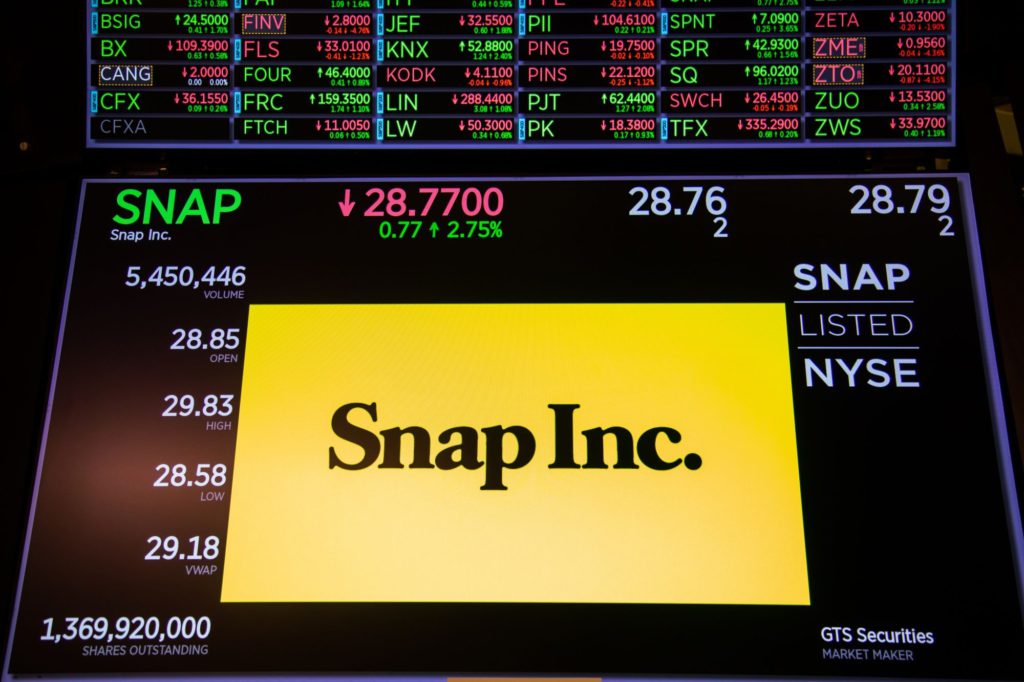
Snap’s Warning Looms Over Battered Online Ad Stocks

(Bloomberg) — Investors are learning that online advertising stocks may be just as vulnerable as old-school media companies amid a looming potential economic downturn.

Concerns over the sector have grown since Snap Inc. slashed its forecast in May, warning that a weaker economic outlook was weighing on its ad business. That sparked a selloff of more than 40%, its biggest one-day drop ever, and the stock is now down almost 70% in 2022. The parent of Snapchat releases second-quarter results Thursday after the market closes.

Facebook parent Meta Platforms Inc. is down 47% this year, and ad-tech provider Trade Desk Inc. is off almost 50%. The losses have come as the Federal Reserve aggressively raises interest rates to combat inflation, weighing on the growth outlook. The Nasdaq 100 Index is down about 25% in 2022.

Snap advanced 5% on Wednesday while Meta climbed 1.4% and Trade Desk rose 1.6%.

While the industry has benefited from the long-term tailwind of ad spending shifting to digital from print and broadcast, the growth in publicity budgets is likely to take a hit as business gets tougher. In addition, higher rates have hurt the valuations of companies that are priced based on expected growth far out in the future, while social-media stocks also have been struggling against a changed privacy policy at Apple Inc. that has diminished their ability to target ads.

“There are still too many headwinds to get excited in the near term,” said Jordan Kahn, chief investment officer of ACM Funds. “Overall, you’re going to need to see a new upcycle for earnings before these names start moving higher.”

Industry watchers already are cutting their forecasts for this year. GroupM, a media investment company, expects ad revenue growth of 8.4%, excluding US political ads. That’s slower than the 24.3% pace set in 2021, and down from the 9.7% that GroupM expected for 2022 at the end of last year. 

While the onset of the pandemic triggered a recession in 2020, that was a brief, one-time shock, caused by an outbreak that kept people at home and in front of their computers — a favorable environment for online businesses. A 2022 recession, should one hit, will be a classic cycle: Rapid growth and inflation prompts higher interest rates, cooling the economy and causing advertisers to cut their spending. 

First Taste

Most of the companies that dominate online advertising went public after the Great Recession of 2008-2009, so investors are getting their first taste of how well their businesses and share prices will hold up in a tough economy. One exception: behemoth Alphabet Inc., which went public as Google Inc. in 2004. The stock lost two thirds of its value from the peak in late 2007 to the bottom a year later. 

Kahn singled out Trade Desk as a stock that still looks risky despite strong long-term prospects; it trades at almost 45 times estimated earnings. “Even though it has beaten expectations for several straight quarters, that’s still a premium valuation for a bear market,” he said. 

There is one ad stock that Wall Street remains almost unanimously favorable on: Alphabet. The Google parent has nearly 100% buy ratings among analysts, who note steady demand for its search and YouTube businesses, along with a stock trading at less than 18 times estimated earnings, a multiple that’s below its long-term average and the market overall.

“The valuation is not at all demanding for such a great company,” said Aaron Dunn, who oversees more than $4 billion at Eaton Vance Management. He said other stocks in the sector continued to look more speculative, even as he expects advertising to continue shifting online over the long term.

“Online ads are here to stay and likely to grow,” he said. “That said, the trend over the past year or two was unsustainable, and we’re getting payback for that today.”

Tech Chart of the Day 

Shares of Netflix Inc. rose 0.9% Wednesday after the video-streaming giant reported that it lost fewer than half the number of customers that analysts had estimated it would shed. However, the Los Gatos, California-based company remains the worst-performing stock of the year in both the S&P 500 and the tech-heavy Nasdaq 100 by a wide margin. Netflix is down 66% this year.

Top Tech Stories

  • After losing more than a million customers in the first half of 2022, Netflix Inc. has a message for investors: It could have been worse.
  • ASML Holding NV cut its revenue growth guidance in half for this year because fast-track shipping of its chip-making machines led to delayed sales recognition.
  • London data centers used by Google and Oracle Corp. buckled on Tuesday after a record-setting heat wave hit Britain, knocking some websites offline.
  • Twitter Inc. scored an early win against Elon Musk in its fight to make him complete his $44 billion buyout of the company, as a Delaware judge agreed to fast-track the case with an October trial date.
  • The US Senate voted by a wide margin to begin debate on legislation to provide more than $52 billion in grants and incentives for the American semiconductor industry, a major milestone for the long-stalled package that proponents say is vital to national security.
  • Online grocery delivery firm Missfresh Ltd. is weighing selling stakes in a unit that offers services to fresh produce sellers such as business consultation and setting up online stores, according to people familiar with the matter, as the struggling firm looks for a lifeline.

(Updates to market open.)

More stories like this are available on bloomberg.com

©2022 Bloomberg L.P.
Pelosi Backs Senate Semiconductor Bill Designed to Bolster US-China Competition 

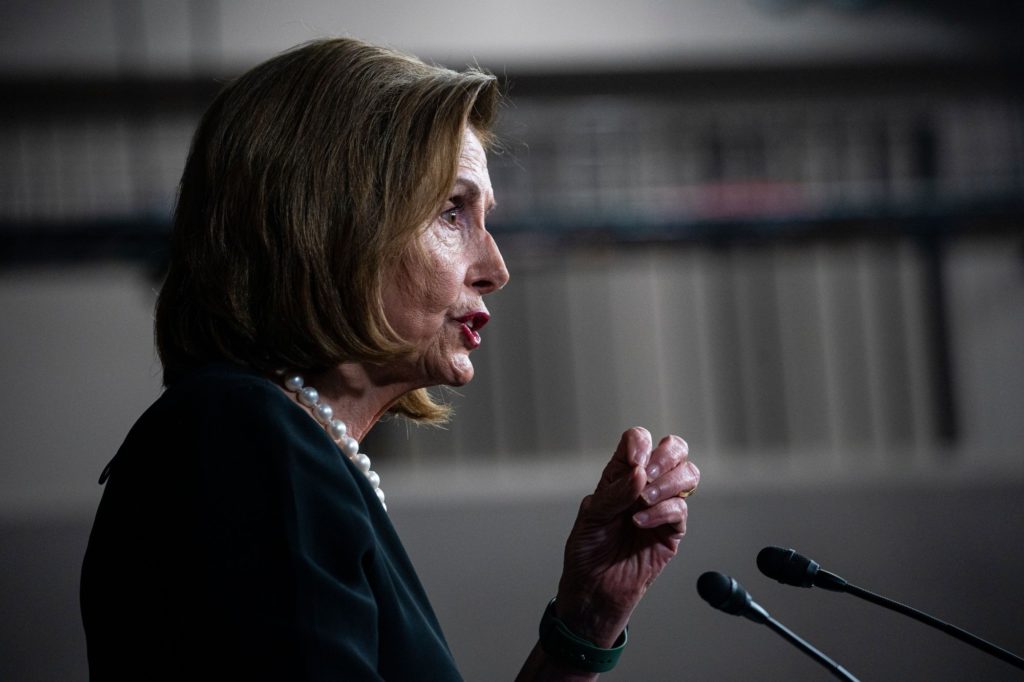
(Bloomberg) — House Speaker Nancy Pelosi backed a compromise Senate bill that provides subsidies for the semiconductor industry, and said she plans for a House vote on it as soon as next week.

With her Wednesday statement of support for the Senate bill, which funnels $52 billion to chipmakers, Pelosi signals a close to a yearlong deadlock between the House and Senate on a legislative package designed to bolster US competition against China. Her backing greatly boosts chances of passage before the August congressional recess. 

Pelosi and House Democrats had long pushed to add environmental provisions and compensation for workers displaced by trade agreements to the bill, but are now leaving those fights for another day. 

“The Chips Act for America is a major victory for American families and the American economy. As the Senate undergoes its legislative process, we are optimistic that the House will be able to take this bill up as early as next week,” Pelosi said in a letter to her House colleagues.

The Senate on Tuesday took a procedural vote to begin debate on the semiconductor legislation, by a vote of 64 to 34. That chamber is likely to vote to end debate on Thursday, setting up passage early next week in the Senate. At that point the House would be poised to act.

Items Included

In addition to money to assist semiconductor companies in building fabrication plants or “fabs” in the US, a draft bill circulated by the Senate leadership includes:

  • A 25% investment tax credit for the manufacture of semiconductors and tools to create semiconductors
  • $500 million for an international secure communications program
  • $200 million for worker training
  • $1.5 billion for public wireless supply-chain innovation

The 1,054 page compromise bill unveiled Tuesday night in the Senate also contains scientific research provisions that reflect months of negotiation between House and Senate lawmakers. Those provisions reorganize programs at the National Science Foundation and National Space and Aeronautics Administration, boost scientific education and create regional technology hubs.

The science provisions were added after a push by Indiana Senator Todd Young and Arizona Senator Kyrsten Sinema. 

There is also a provision to provide $20 million to boost Supreme Court security.

Pelosi praised the inclusion of a $1 billion House provision to provide funding for distressed communities, as well as strong guardrails that prevent chipmakers from using subsidies for stock buybacks or investments in China.

It remains to be seen how much support the bill will get from House Republicans. Frank Lucas, the top GOP member of the House Science Committee, said in a statement that the final science provisions had been negotiated in secret and did not yet have his full support.

A last-minute push by some lawmakers to include $2 billion in retroactive research and development tax breaks fell short, making a year end push for the credit likely.

In addition to House and Senate disagreements over the substance of the China competition package, Senate Minority Leader Mitch McConnell said last month that no bill would go forward so long as Democats were pursuing a $1 trillion tax measure to fund climate change spending and other measures.

West Virginia Senator Joe Manchin scuttled talks on that bigger bill — at least for now — last week. That then cleared the way for a bipartisan semiconductor bill in the Senate.

More stories like this are available on bloomberg.com

©2022 Bloomberg L.P.
Saudi Arabia Plans Air-Cargo Roadshows to Lure Amazon, DHL

(Bloomberg) —

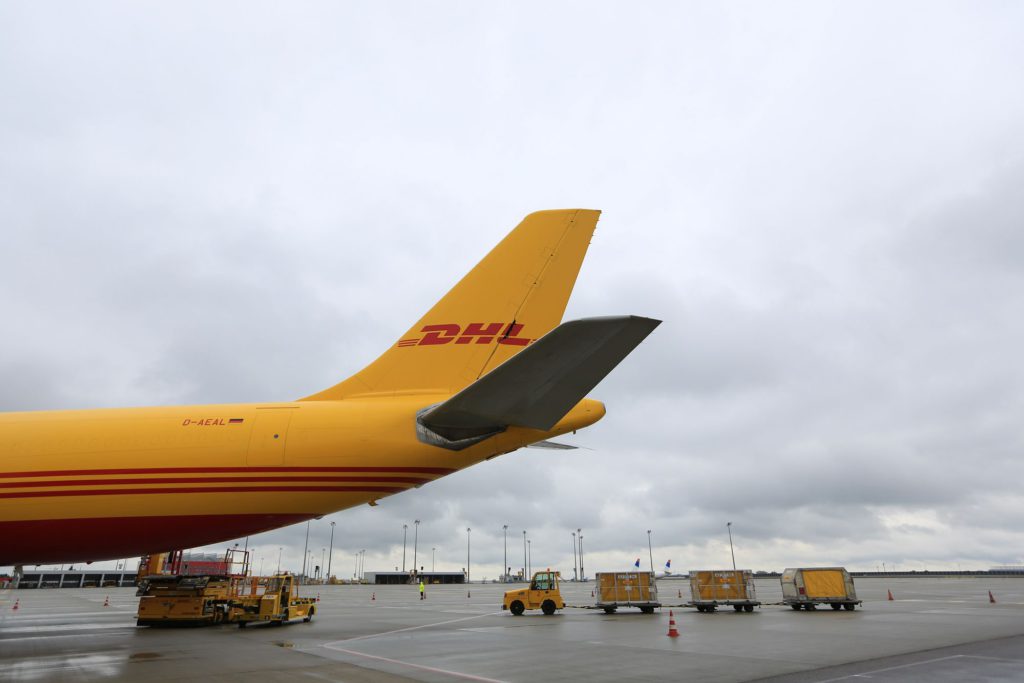
Saudi Arabia plans to stage a number of roadshows in the next 12 to 18 months as it seeks to persuade the likes of Amazon.com Inc., Alibaba Group Holding Ltd. and Deutsche Post AG’s DHL to help scale up air-cargo and distribution operations.

The Mideast country will invite private companies to establish partnerships and set up freight-forwarding and warehousing activities, Mohammed Fahad Alkhuraisi, vice president for strategy at the Saudi General Authority of Civil Aviation, said in an interview Wednesday.

The push into air cargo and logistics aims to lift the amount of freight handled to 4.5 million tons annually by the end of the decade as part of a $100 billion plan to expand aviation in line with the Vision 2030 strategy of overhauling the Saudi economy and reducing its reliance on oil.

The country is expanding its airport infrastructure and setting up a new passenger airline in the Saudi capital Riyadh, preparations for which are “progressing very well,” Alkhuraisi said at the Farnborough International Airshow southwest of London.

As part of the plan, the GACA is looking to coordinate with carriers to make sure “the overall picture makes sense,” he said, with discounters Flynas and Flyadeal operating short-haul services and flag-carrier Saudia serving long-haul, pilgrimage and Red Sea tourism markets from its hub in Jeddah.

More stories like this are available on bloomberg.com

©2022 Bloomberg L.P.

Volkswagen Partners With STMicroelectronics to Co-Design Semiconductors

(Bloomberg) — Volkswagen AG’s software unit will start designing chips for the first time, partnering with STMicroelectronics NV to co-develop semiconductors for its cross-brand single software platform. 

With the agreement, VW’s Cariad and STMicroelectronics plan to source the key components from global top chipmaker Taiwan Semiconductor Manufacturing Co. Ltd., they said Wednesday. 

“With the planned direct cooperation with ST and TSMC, we are actively shaping our entire semiconductor supply chain,” Murat Aksel, Volkswagen’s procurement head, said in a statement. “We’re ensuring the production of the exact chips we need for our cars and securing the supply of critical microchips for years to come.”

The agreement is the second chip-focused partnership for Volkswagen’s electrification push. Cariad said in May it had signed a deal with Qualcomm Inc to assist with automated driving applications.

Volkswagen’s Cariad unit, set up in 2020 to pool previous software efforts, has struggled with several setbacks as it aims to create a unified software platform for the production launch of VW brand’s Trinity project in 2026.

The division has so far released a toolkit for VW’s ID series of electric cars, the first model of which debuted with missing features. Development of a premium software architecture for the Audi and Porsche brands has been plagued by infighting, delaying models including a battery-powered version of Porsche’s Macan compact SUV.

More stories like this are available on bloomberg.com

©2022 Bloomberg L.P.

Close Bitnami banner
Bitnami
