

Bloomberg

Apple Argues It’s Now a Major Force in the Health-Care World

(Bloomberg) — Apple Inc. published a nearly 60-page report Wednesday outlining all its health features and partnerships with medical institutions, arguing that such offerings are key to the tech giant’s future.

The company pointed to its breadth of existing services — from sleep monitoring and fitness classes to atrial-fibrillation detection and cycle tracking — and promised to build on that foundation. Chief Operating Officer Jeff Williams, who oversees Apple’s health endeavors, said in a statement attached to the report that the company will continue to innovate in “science-based technology.” 

“The health innovations we’ve pioneered have aimed to help break down barriers between users and their own everyday health data, between health-care providers and patients, and between researchers and study participants,” he said.

The report serves as a response to Apple critics, who have knocked the company for not doing as much as rivals in health care. Though the Apple Watch dominates the market, the device hasn’t always gotten novel health features as quickly as competitors’ products. And fellow tech titans such as Amazon.com Inc. and Google have made ambitious forays into the medical field — with mixed results.

Apple is arguing that it’s a pioneer in health technology and positioned to use it as a growth driver in the years ahead. Already, fitness features are a major selling point for the Apple Watch, and the company plans to add capabilities related to women’s health and body-temperature monitoring as part of a new lineup coming this year, Bloomberg has reported. Apple also is working on technologies such as glucose and blood pressure monitoring that could come later.

Health technology is one of several categories that Apple hopes will help maintain sales growth. The company is also working on a mixed-reality headset for next year, along with augmented reality glasses, foldable devices and a self-driving electric car. 

While the company doesn’t charge for its health features directly, the enhancements could help fuel sales of future devices. The company also offers a Fitness+ subscription service that could eventually add more health tie-ins. 

Cracking health services has been a challenging task for Silicon Valley companies. Google shuttered its dedicated health unit last year, though it does own companies in the space, such as Verily and Fitbit. Amazon has made strides, including with an online pharmacy service and partnerships with in-person health-care providers. Samsung Electronics Co., meanwhile, has its own health app and offers some similar features to Apple.

In its report, Apple said it has an edge creating new offerings because of its research studies. A feature to analyze an iPhone user’s walking steadiness, for instance, was created based on data collected by over 100,000 users. The company also has partnered with several medical institutions and researchers, including UCLA.

The iPhone and Apple Watch now support features across 17 areas of fitness and health, according to the report. And the Health app can store more than 150 types of health-related data.

Moreover, there are tens of thousands of third-party apps on the App Store that can tap into the Health app, the report said. The company is adding medication tracking and reminders and new workout features to its devices this fall.

More stories like this are available on bloomberg.com

©2022 Bloomberg L.P.
Apple’s China Shipments Surged in June After Lockdowns Lifted

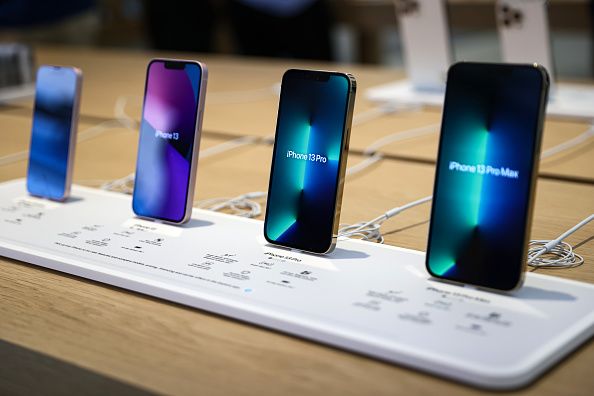
(Bloomberg) — Apple Inc.’s iPhone shipments likely surged in June in China, leading a rebound in the smartphone market after Covid lockdowns lifted.

China’s mobile phone shipments jumped 9.2% last month, led by overseas vendors such as Apple and Samsung Electronics Co. while domestic brands like Xiaomi Corp., Oppo and Vivo were down 0.5%, official data showed. Samsung no longer commands a significant share of the country’s smartphone market whereas Apple is the fourth-largest player, suggesting the bulk of the rebound in demand was for iPhones. The US company will provide details on its Chinese business when it reports earnings later this month.

Chinese smartphone makers have struggled to stir excitement for their handsets this year, hurt by rising costs and souring consumer sentiment. Sony Group Corp. warned at the start of the year that its sales of premium phone camera sensors to Chinese customers came in lower than expected and device shipments have matched that downward trend. Research firm Canalys said this week that all the Chinese smartphone powerhouses saw declines in their global second-quarter shipments.

China to Drag Global Smartphone Market Down This Year, IDC Say

This past June saw 24.5 million mobile phones shipped by domestic firms, down from 24.6 million the prior year. International companies, on the other hand, went from 1.1 million units to 3.5 million, figures from the China Academy of Information and Communications Technology showed. The data includes feature phones.

The rekindled consumer interest comes after the lifting of Covid lockdowns in major hubs Shanghai and Beijing, and may have gotten a boost from the annual “618” sales and discounts event hosted by online retailers like Alibaba Group Holding Ltd. and JD.com Inc.

More stories like this are available on bloomberg.com

©2022 Bloomberg L.P.
Futures Erase Gains With Stocks; Treasuries Rise: Markets Wrap

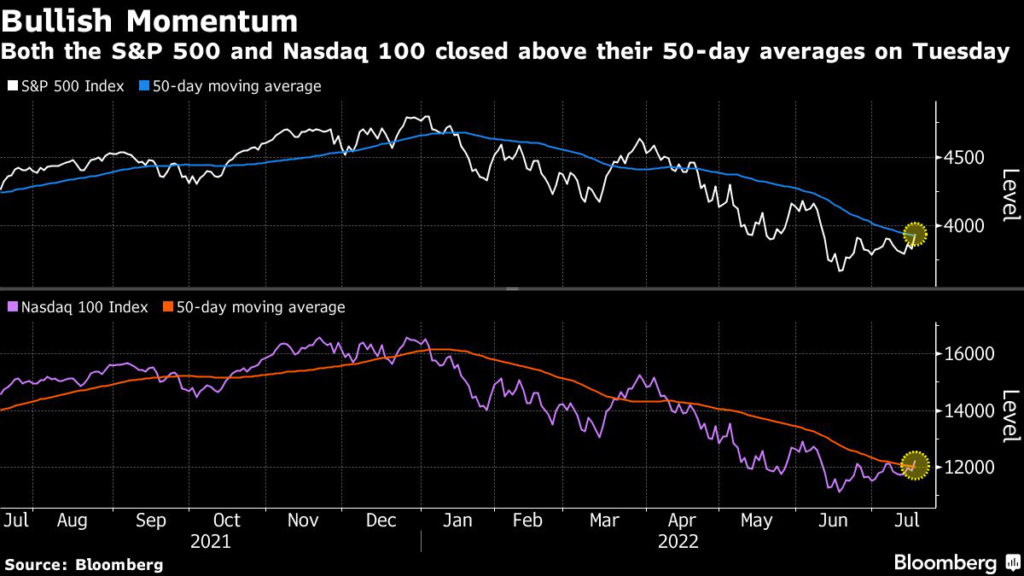
(Bloomberg) — US equity futures turned lower with stocks Wednesday as concern over the potential for a global downturn sparked by hawkish central bank lingers. 

Contracts on the Nasdaq 100 and the S&P 500 erased an advance to trade little changed. The Stoxx 600 Index flipped to a loss from a gain. In the premarket, Netflix rose 7.5% after it reported better-than-feared earnings late on Tuesday and said it expects to return to subscriber growth before the end of the year. 

Treasuries rose with the dollar, pushing the 10-year yield below 3%. The euro held its ground near a two-week high against the dollar on the possibility of a bigger-than-expected European Central Bank interest-rate hike Thursday. 

Speculation that company earnings will hold up and that the Federal Reserve will avoid very aggressive monetary tightening is giving investors some hope. Yet the risk of a global downturn and Europe’s energy crisis is keeping investors on edge.

“The fact that companies are showing a certain resilience to the current environment is reassuring market operators who have now started betting on a less aggressive monetary tightening than initially expected,” said Pierre Veyret, a technical analyst at ActivTrades. “Even if we’re not out of the woods yet, more and more traders now tend to believe the worst is behind for equity markets this year.”

Pessimism is hard for investors to shake after they endured the worst combined first-half losses on stocks and bonds around the world on record, with $8 trillion wiped off the S&P 500 alone.

West Texas Intermediate crude oil slipped below $103 a barrel. Bitcoin hovered above $23,000 after climbing out of a one-month-old trading range.

How far will the Fed go in this hiking cycle? It takes one minute to participate in the confidential MLIV Pulse survey, so please click here to get involved. 

Key events to watch this week:

  • Earnings this week include Tesla
  • Bank of Japan, European Central Bank rate decisions. Thursday
  • Nord Stream 1 pipeline scheduled to reopen following maintenance. Thursday


More stories like this are available on bloomberg.com

©2022 Bloomberg L.P.
Electric Cars Start Covering More Ground Than Combustion Counterparts

(Bloomberg) —

While gasoline prices have come down from their highs earlier this summer, drivers are still feeling plenty of pain at the pump. Unless, of course, you’re an electric vehicle owner, and thus feeling very smug while gliding past fueling stations to charge at home.

Using an EV more in times of high gasoline prices is to be expected, but one of the open questions in the industry has been whether EV drivers will consistently cover more miles on average than gas or diesel car owners.

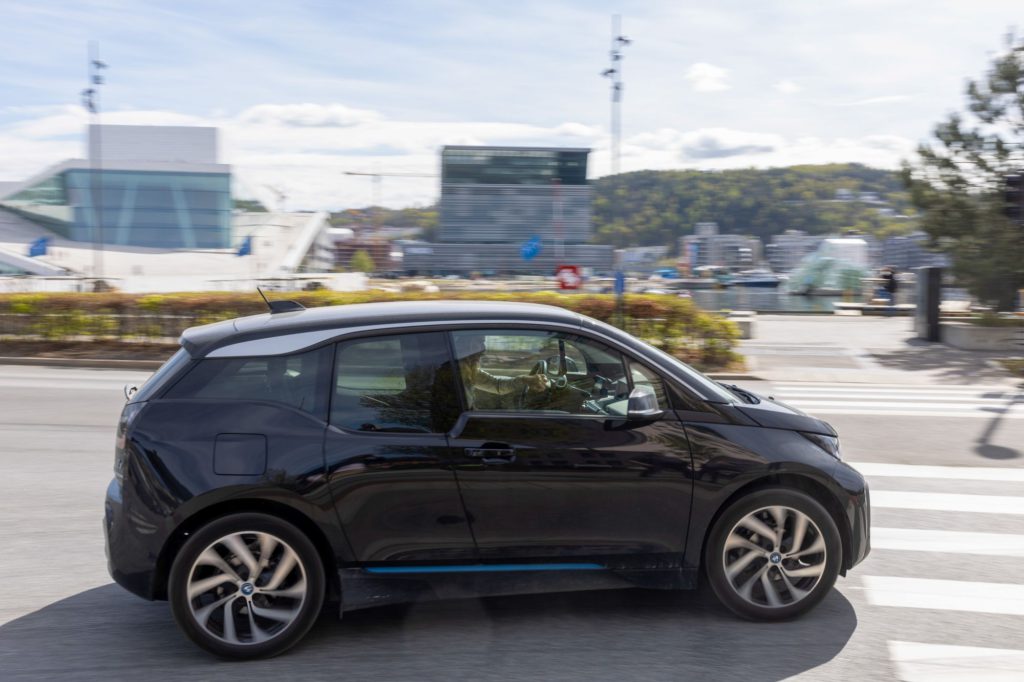
In many countries it’s difficult to get a clear read, mostly because EVs are still a very small share of the total number of cars on the road. But to get a hint of where things may head, we can turn to Norway. The latest data released from the nation’s statistical agency shows battery-electric vehicles now drive more miles annually on average than cars running purely on gasoline or diesel. Average distance traveled by the latter two car segments has fallen steadily the last 15 years.

This is remarkable. It highlights the growing capability of the latest EV models, and also has implications for what happens to oil demand from road transport. The amount of oil displaced by EVs depends on how fast we switch over the number of kilometers or miles traveled to electric, not the number of cars.

To understand this better, consider a two-car family, where one of the vehicles is electric and the other is internal combustion. EVs have much lower operating costs, so the family will likely start to shift more miles to the EV once they get comfortable with the vehicle. The commute to work, for example, involves a highly predictable route and often accounts for the largest share of driving a person does. So while the family still has an internal combustion car and uses it for occasional longer trips, the electric share of total kilometers traveled by the household rises faster than one might expect, especially if one was only considering the number of cars.

This effect shouldn’t be surprising; people like to use more of things that are cheaper. But it wasn’t always received wisdom in the market.  A few years ago, some oil energy outlooks assumed not only that EV adoption would be muted, but that each EV would on average travel less than a comparable internal combustion vehicle. This now looks like a very shaky assumption. Not only will higher ranges make people use their EVs more, but even lower-range EVs can soak up some of the miles used for commuting along predictable routes.

A few other things stand out in the data. One is that you can actually see the point when the Tesla Model S, the first real long-range EV, hits the market. Average distance traveled per EV jumped sharply in 2013 and 2014 — right after the Model S launched — then climbed several more years and is now at an all-time high.

This again points to the improved capability of EVs, and also potentially the effect of them moving beyond being an urban phenomenon and spreading out more broadly across the country. With more long-range EVs hitting the market, it seems reasonable to expect 2022 data will show a continuation of the trend.

Another interesting point is that hybrid vehicles also put up relatively high numbers. Data for hybrids is only available for from 2016 onwards, but they’re currently neck-and-neck with pure EVs and diesel vehicles, and it will be interesting to see how this plays out in the next few years.

Fully making the changeover to electric mobility will take time. Electric vehicles still accounted for just 17% of all kilometers traveled by the passenger car fleet in Norway last year, and only about 1.5% of all kilometers traveled by the global passenger vehicle fleet. Until more of the fleet is fully electric, total distance covered by EVs will still have some catching up to do.

Still, at BNEF, we’re expecting this same effect to start showing up in the data of more countries in the years ahead. Annual average EV mileage in China, for example, rose quickly from 2017 to 2020 before slowing slightly due to the pandemic, when ride-hailing usage plunged.

Counting car sales and fleet sizes is still important, but for energy market impact, it’s best to keep an eye on distances traveled, too.

More stories like this are available on bloomberg.com

©2022 Bloomberg L.P.

Amazon Fails to Halt India’s Future Retail Going into Bankruptcy

(Bloomberg) — An Indian court agreed to send Future Retail Ltd. into bankruptcy, allowing the creditors to find a new owner for the beleaguered retailer that once operated the largest chain of department stores across the country and was the prized trophy for two retail sector giants.

The National Company Law Tribunal on Wednesday gave its verdict on a petition by Bank of India to start bankruptcy resolution process for the cash-strapped retailer. It dismissed allegations from the local unit of Amazon.com Inc. that Future Retail’s lenders were colluding with its founders to push the firm into insolvency.

The court also appointed an administrator to take over the management at Future Retail.

The court ruling gives Mukesh Ambani-led Reliance Industries Ltd. an edge over Jeff Bezos’s Amazon in the fight for Indian retailer’s assets, as the two billionaire-led firms tussle to dominate the market with almost 1.4 billion consumers. Reliance can have another go at Future Retail under the court-overseen insolvency process, after its 2020 deal to buy these assets for $3.4 billion was thwarted by the American e-commerce giant through legal challenges across courtrooms in India and Singapore in the past two years.

While Reliance group is the country’s biggest retailer, there is no certainty of who will win an insolvent firm through the court-led resolution process. Indian laws, however, curb foreign direct investment in retail companies, which rules out the possibility of Amazon becoming the future owner of Future Retail. 

According to India’s bankruptcy law, a moratorium on all money recovery cases against Future Retail will now kick in. The ruling effectively stops Amazon from pursuing arbitration case in Singapore against Future Retail, though cases against Future Retail’s founder Kishore Biyani and his other companies can continue.

Facing a severe cash crunch during a hard lockdown in India 2020 amid the Covid-19 pandemic, Future Retail agreed to sell most of its assets to Reliance. Amazon later said the deal flouted its earlier investment contract with another Future Group firm and sought legal intervention. Courts halted the takeover deal that was eventually scrapped in April this year.

(Updates with details throughout.)

More stories like this are available on bloomberg.com

©2022 Bloomberg L.P.
Activist Bluebell Wants Ex-Bulgari CEO on Richemont Board

(Bloomberg) — Activist investor Bluebell Capital Partners Ltd. is asking Swiss luxury conglomerate Richemont to appoint the former head of rival Bulgari as a company director in an attempted boardroom shakeup. 

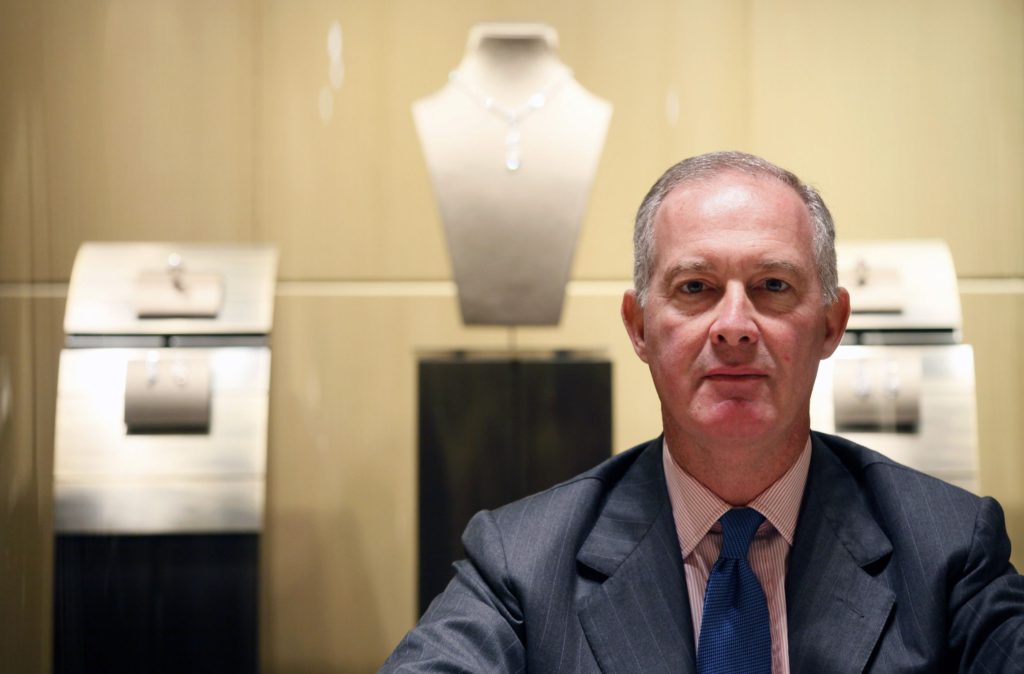
Bluebell proposed that Francesco Trapani, who led the Bulgari jewelry brand for nearly three decades until 2011 and was a founding partner of Bluebell in 2019, join Richemont’s board to represent its A-class shares, according to a letter dated July 14 sent to the company and seen by Bloomberg News.  

Richemont, which owns the Cartier, Vacheron Constantin and Montblanc brands, is controlled by Chairman Johann Rupert through its B-class shares. The South African billionaire holds 10% of the company’s share capital and 51% of its voting rights, according to the company’s most recent annual report.

Bluebell owns just over 1 million Richemont A shares — a stake worth about 109 million Swiss francs ($112.4 million) — and the minimum required to request items for the agenda at Richemont’s annual meeting in September. 

“We are concerned that none of the current board members represents the holders of A shares, as all directors are designated by the board and elected at the general meeting of shareholders which are fully controlled by the holders of B shares,” Bluebell partners Giuseppe Bivona and Marco Taricco wrote in the letter. 

Richemont disclosed on Tuesday that Bluebell had requested governance changes. A company representative declined to comment on the details of the demands in the letter.

Richemont shares edged up slightly in early trading on the Swiss stock exchange. 

Activist agitation

Led by Bivona and Taricco, Bluebell has taken on some of the world’s biggest companies, agitating for governance changes while building relatively small investment stakes. 

It has pressured UK drugmaker GSK Plc, which on Monday spun off its consumer-health unit Haleon, and questioned the leadership of Chief Executive Officer Emma Walmsley. Bluebell also participated in a campaign with other investors that prompted an overhaul of yogurt maker Danone’s management. Having taken on at least 10 companies, in both an advisory and activist capacity, not all of its campaigns have been successful. 

Tiny Activist Bluebell Quickly Becomes CEOs’ Worst Nightmare

Now with Richemont, Bluebell is asking the company to amend its bylaws, increasing the minimum number of directors representing the A shares from one to three and the minimum size of the board from three to six. It also wants an equal number of directors representing the A shares and B shares.

Bluebell contends in the letter that under Richemont’s current structure, the B class shares controlled by Rupert “possess 50% of the company’s voting rights, with an economic interest of just 9.1%.” 

Richemont’s A shares, which are publicly traded, “only possess 50% of the company’s voting rights, with an economic interest of 90.9%,” the Bluebell partners said in the letter. 

The activist investor is also asking that Trapani’s proposed appointment to the board be voted on only by A-class shareholders. 

Besides raising the issue in public, it is unclear how Bluebell, with its relatively small stake, might be able to force Rupert to relinquish control over the company that boasts a market capitalization of about $63 billion. 

Richemont last week reported a better-than-expected 12% increase in quarterly sales on strong demand in Europe and the US. Investors, however, drove down the share price on concerns about Covid restrictions in China where sales declined more than expected. 

Richemont has been trying to sell a stake in its online sales unit YNAP to investors including FarFetch Ltd. Richemont shareholder Artisan Partners, which called for changes at Danone alongside Bluebell, said in November that it saw “significant unrecognized value,” in Richemont.  

(Updates with share move in paragraph 7 and earnings results in third-last paragraph)

More stories like this are available on bloomberg.com

©2022 Bloomberg L.P.

Financial Inclusion in Crypto: Jay-Z and Jack Dorsey’s Bitcoin Academy

  • Listen to Bloomberg Crypto on the iHeartRadio App
  • Listen to Bloomberg Crypto on Apple Podcasts
  • Listen to Bloomberg Crypto on Spotify 

(Bloomberg) — What do Rapper Jay-Z and Jack Dorsey, founder and former CEO of Twitter, have in common? No, it’s not music. It’s Bitcoin. If you spend enough time around people who believe that crypto can transform society, you’ll eventually hear them make an argument about financial inclusion. Jay-Z has teamed up with Dorsey on what they’re calling Bitcoin Academy, an educational program designed to empower people through financial literacy —  with a focus on Bitcoin. Bloomberg reporters Paulina Cachero and Akayla Gardner join this episode to discuss Bitcoin Academy and whether Bitcoin is truly the key to a more financially inclusive society.

Follow us on Twitter @crypto, and subscribe to the Bloomberg Crypto Newsletter at https://bloom.bg/cryptonewsletter 

More stories like this are available on bloomberg.com

©2022 Bloomberg L.P.
Netflix Rises After Million-Customer Loss Avoids Worst Scenario

(Bloomberg) — After losing more than a million customers in the first half of 2022, Netflix Inc. has a message for investors: It could have been worse.

The leader in paid streaming TV lost 970,000 subscribers in the second quarter, according to a statement Tuesday. That was less than half what Wall Street feared, thanks in large part to a new season of “Stranger Things,” the service’s most popular English-language series.

“We’re talking about losing 1 million instead of 2 million — our excitement is tempered by the less-bad results,” Chairman Reed Hastings said on an earnings call. “But looking forward, streaming is working everywhere. Everyone is pouring in.”

That cheered investors, with shares trading about 7% in pre-market trading in New York. This quarter, Netflix expects to sign up 1 million subscribers. While that’s well short of the 1.83 million analysts forecast this period, it reverses the losses of the first half.

Shares of Netflix jumped as high as $225 in extended trading. They closed at $201.63 in New York Tuesday, down 67% this year.

Despite concerns about increased competition and a potential recession, Netflix remains confident in its position. The company said its share of total TV viewing in the US hit an all-time high in June at 7.7%. 

Management has responded to the subscriber slide by cutting costs and adjusting its strategy on several fronts. The company plans to introduce a lower-priced version of the service with advertising around early 2023, and is testing ways to charge customers for password sharing.

For the second quarter, revenue grew 8.6% to $7.97 billion, Netflix said. That missed Wall Street estimates of $8.04 billion, in part because of the strong dollar.

Read more: Streaming-video stocks rise on Netflix news

During the quarter, Netflix lost 1.3 million customers in the US and Canada, its largest region, and another 770,000 in Europe, the Middle East and Africa, its second-largest. Those are the steepest quarterly declines the company has reported in either place since it started supplying individual results from those markets.

Growth in the Asia-Pacific region offset those declines. Netflix added 1.1 million customers in APAC, after cutting prices in India.

Hastings had positioned Netflix as an advertising-free alternative to cable TV, but now says commercials are necessary to appeal to people who find the service too expensive. Netflix has raised prices several times and is now one of the most expensive streaming services. 

The company will introduce the advertising-supported option first in a handful of countries, and just tapped Microsoft Corp. to handle ad sales and technology. Advertising will start small and look a lot like other video businesses ads. But Netflix believes it can be substantial, Chief Operating Officer Greg Peters said.

Read more: Netflix chooses Microsoft as ad partner

Netflix has also started to release new episodes of shows in batches, breaking with its tradition of dropping every episode of a season at the same time. It released the drama “Stranger Things” and the final season of “Ozark” in two batches.

The batching strategy allows Netflix to extend the life of its biggest shows. When every episode is released at once, the majority of the viewing happens in the first couple of weeks. The number of people who cancel Netflix has jumped 87% since a year ago, according to Antenna.

The popularity of the fourth season of “Stranger Things” exceeded the expectations of Netflix executives. The supernatural drama has been one of the service’s most successful titles since its debut in 2015, and turned star Millie Bobby Brown into one of the most in-demand female actors in Hollywood.

The release of “Stranger Things” meant that fans who had Netflix in the second quarter would want to keep the service until the start of the third quarter to finish the season. The company is looking to turn hits like “Stranger Things” into franchises that can outlast any individual show. The creators of the show are developing a spinoff series, and Netflix has also announced plans for a Broadway play.

On Tuesday, Netflix said it will acquire Animal Logic, an Australian animation studio that worked on “The Lego Movie.”

“We have some headwinds right now; we’re navigating through them,” co-Chief Executive Officer Ted Sarandos said on the call. “This company and this team has navigated through a lot of change.”

Total subscribers in the second quarter came to 220.7 million, compared with estimates of 220.2 million. Earnings of $3.20 a share beat analysts’ projections.

This quarter, Netflix forecasts revenue of $7.84 billion, shy of Wall Street estimates of $8.1 billion. The company sees earnings of $2.14 a share, compared with estimates of $2.72, and says total membership will reach 221.7 million, also shy of estimates.

(Updates with quote from chairman, shares)

More stories like this are available on bloomberg.com

©2022 Bloomberg L.P.
China Tech Stocks Gain on Renewed Bets of Crackdown Ending

(Bloomberg) — Chinese tech stocks advanced following a report that regulators are wrapping up an investigation into Didi Global Inc. with a hefty fine, with traders again hoping this will herald an end to a crackdown on the sector.

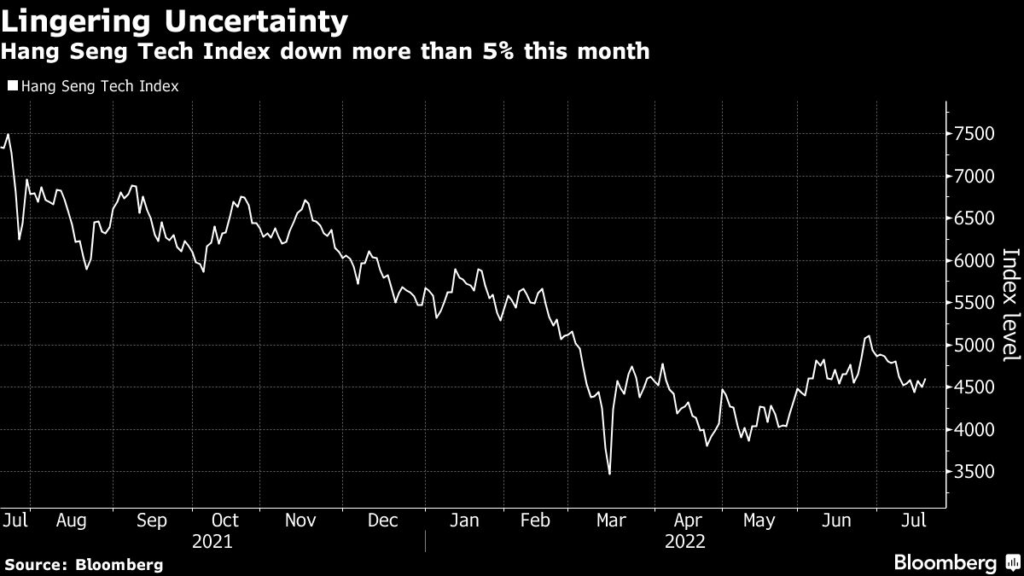
The Hang Seng Tech Index gained 1.6% on Wednesday, with Meituan and NetEase Inc. contributing the most to the rise. The move also tracks the advance in US tech stocks overnight after Netflix Inc. reported better-than-feared earnings. 

Chinese tech shares have been on a roller-coaster ride in recent months, with optimism that authorities are taking a softer regulatory stance being challenged by news on fresh scrutiny over Alibaba and Tencent Holdings Ltd. While investors are initially cheering over the report that Didi probe is winding down with a more than $1 billion fine, caution remains high as regulatory uncertainties linger.   

READ: Traders to Cheer Report Saying Didi Probe Over: Street Wrap

“This $1 billion amount is not too high for Didi, and signals an end of this investigation,” said Steven Leung, executive director at Uob Kay Hian (Hong Kong) Ltd. If the fine is followed up with an addition of new users to Didi’s platform and an initial public offering in Hong Kong, it will be one more step toward the end of the regulatory risks on the tech sector, he added. 

The Hang Seng Tech Index remains down 6% this month, threatening to erase a rally in June that was spurred by broader optimism over China’s supportive macro policy stance. 

The sector was hurt following a bevy of negative news including the antitrust watchdog’s fines on companies including Alibaba and Tencent, as well as a report that Alibaba’s executives are being questioned in connection with a data theft.  

The benchmark Hang Seng Index also gained 1.1% on Wednesday. On the mainland, the CSI 300 Index closed 0.3% higher. 

More stories like this are available on bloomberg.com

©2022 Bloomberg L.P.

South Korea Investigates Abnormal Crypto-Linked FX Transactions

(Bloomberg) — South Korean financial regulators are probing abnormal foreign-exchange transactions at some of the country’s largest commercial banks for any links to money laundering or currency speculation using crypto assets, an official said.

Some of the transactions involved crypto exchanges, according to a senior Financial Supervisory Service official who asked not to be named due to the sensitivity of the investigation. The person didn’t identify the exchanges. Shinhan Bank is one of the lenders being probed, people with knowledge of the matter said.  

Yonhap News Agency reported earlier that Woori Bank was involved in a transaction of about 800 billion won ($611 million) on June 23, and Shinhan Bank in a trade of 1 trillion won on June 30. The regulator is examining whether laws on money laundering and foreign-exchange trading were broken, according to Yonhap. Regulators have strengthened collaboration with the country’s prosecutors on the probe, the report also said.

An FSS spokesperson confirmed the details of the Yonhap report. A Shinhan Bank spokesperson confirmed that a regulatory probe is under way, while adding that the exact size of the transaction and its relation to crypto exchanges can only be revealed once the investigation concludes. 

Representatives for Woori Bank didn’t immediately respond to requests for comment. A spokesperson for the prosecutors office declined to comment. 

More stories like this are available on bloomberg.com

©2022 Bloomberg L.P.

Close Bitnami banner
Bitnami
