
Bloomberg

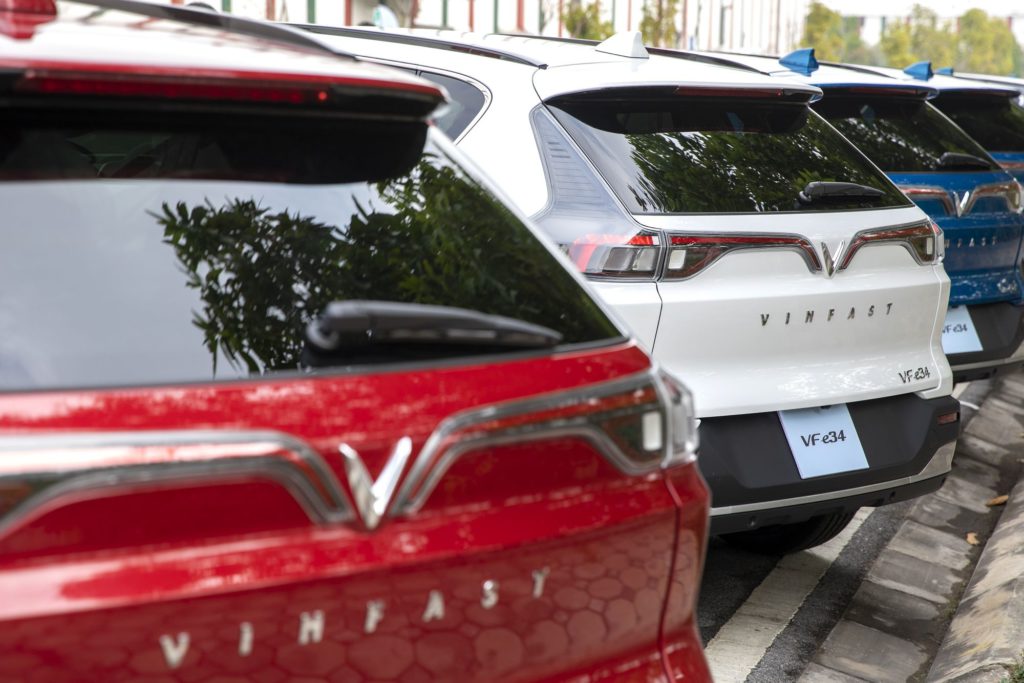
Vietnamese EV Maker VinFast Files for US IPO

(Bloomberg) — VinFast, an electric carmaker backed by Vietnam’s richest man trying to take on Elon Musk’s Tesla Inc, has filed for an initial public offering in the US just as it prepares to deliver its first SUVs to California customers later this month.

The unit of conglomerate Vingroup JSC, founded by Pham Nhat Vuong, is being advised by banks including JPMorgan Chase & Co., Citigroup Inc., Credit Suisse Group AG and Morgan Stanley, according to an F-1 filing with the US Securities and Exchange Commission. The shares will trade under the symbol VFS on the Nasdaq Global Select Market. There were no details provided on the size of the fundraising or a possible listing date.

Shares of Vingroup rose as much as 5.7% to a 5-month high Wednesday morning. The benchmark VN Index is up as much as 1.1%

VinFast’s IPO plans have been percolating for almost two years. Bloomberg News first reported in early 2021 that Vingroup was considering a $2 billion US IPO for the EV maker. The company in April filed confidentially for the share sale. VinFast could raise at least $1 billion from an offering as soon as January, Bloomberg reported.

The numbers presented by the company suggest its tough road ahead. VinFast lost $1.3 billion in 2021 and endured losses close to $1.5 billion in the nine months to September this year. As of September, its owners and lenders had invested about $7.5 billion to fund operating expenses and capital expenditures. 

While VinFast aims to make and sell around 1 million electric cars within five to six years, it has sold a small fraction of this so far. The company plans to expand its global production capacity to as much as 1.1 million vehicles per year by 2026, according to the prospectus.

VinFast’s additional capital requirements could be funded by additional debt and equity financing, which may include financing from related parties, it said. VinFast expects to continue to incur losses in the near term as it scales production, establishes manufacturing operations and expands marketing, sales and service networks outside of Vietnam, according to the filing. 

VinFast will sell and list shares on Nasdaq “when market conditions permit,” VinFast Chief Executive Officer Le Thi Thu Thuy said in a statement.

“We understand that our company valuation or the size of our IPO will be subject, in part, to market conditions,” she said. “Once VinFast successfully lists in the US, this will facilitate future access to the capital markets for the company, and further support VinFast’s global expansion.”

Shares of Rivian Automotive Inc. – the electric pickup-truck maker – are now trading for around $28, down about 64% from its initial public offering price, and has a market value of about $26 billion. Tesla is now trading at $179.82, valuing the company at about $567.8 billion.

The IPO could be the biggest by a Vietnamese company since Vinhomes JSC’s $1.4 billion domestic debut share sale in 2018, according to data compiled by Bloomberg. Even after a strong 24% rally since mid-November, the benchmark VN Index is still 30% lower this year, making it one of the worst-performing equity gauges in the world.

VinFast reported 8,779.7 billion dong ($365.3 million) from sales of vehicles for the nine months of the year ended September 30, according to the filing. The company had 1,854.6 billion dong in cash and cash equivalents for the same period. 

The filing comes after the company loaded 999 electric vehicles onto a VinFast branded cargo ship destined for Los Angeles on Nov. 25. The five-year-old company said it will deliver vehicles to its first US customers later this month, beginning the immense challenge of taking on the world’s top auto brands.

The company, little known outside of Vietnam, acknowledged its success will depend on achieving commercial acceptance in competitive markets like the US and Europe.

The automaker’s efforts to become a global brand include the recent ground breaking of a North Carolina factory, where it expects to start production in July 2024. It signed agreements with banks in July to raise at least $4 billion for its US expansion. However, the company said in late November that it needs to delay EV rollouts in Europe and Canada to early 2023 due to the global shortage of semiconductors.

–With assistance from Anurag Kotoky.

(Updates throughout with details from filing)

More stories like this are available on bloomberg.com

©2022 Bloomberg L.P.
Xi Jinping Gets Saudi Red Carpet as Middle East Looks Past US

(Bloomberg) — Two months after snubbing US President Joe Biden’s pleas for oil, Saudi Arabia is rolling out the red carpet for his Chinese counterpart, Xi Jinping.

Xi will visit Saudi Arabia for several days starting Wednesday, during which he will take part in a regional summit with Saudi Crown Prince Mohammed bin Salman and other Arab leaders, the kingdom’s SPA state news agency said, promising agreements worth some $30 billion.  Energy and infrastructure deals will top the agenda, according to two people briefed on the plans.

China confirmed the trip on Wednesday morning, a day after Xi led the nation in mourning the death of former leader Jiang Zemin on the heels of recent protests against his Covid Zero policy. The summit will give both Xi and Prince Mohammed a chance to showcase the Gulf’s deepening ties with Beijing, underlining just how far US-Saudi relations have sunk.

“This visit is the culmination or crowning of a deep strengthening in relations over the last few years,” said Ali Shihabi, a Saudi commentator and advisory board member for the kingdom’s Neom megaproject. “The US is concerned about this but cannot slow this already strong relationship down.” 

A low point in US-Saudi ties came in October when Biden accused Riyadh of allying with Russia on oil production cuts, and vowed “consequences.” However, relations have been fraying for some time as the US shifts its global focus to the competition with China.

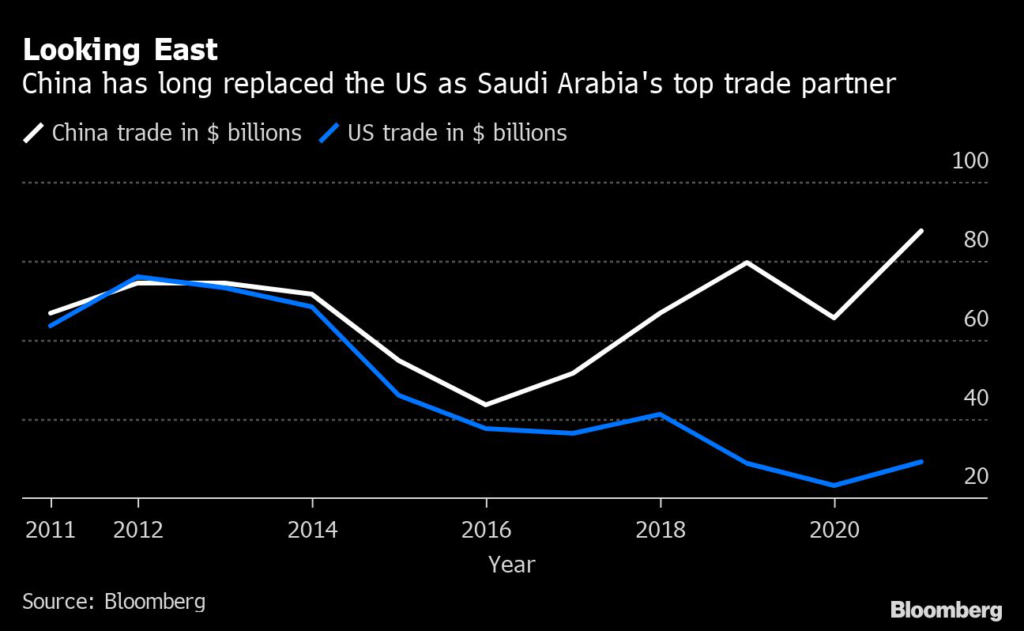
It’s a decade since the US was Riyadh’s biggest trading partner, and in that time not only has China leapfrogged America, but so too have India and Japan. Total US-Saudi trade shrank from some $76 billion in 2012 to $29 billion last year.

That’s in part because the US shale industry means it no longer imports much Middle East oil; China is Saudi Arabia’s top crude customer now —  and regional oil exporters will be keen for information on China’s plans for lifting Covid restrictions.

Read how China’s factories are struggling with the slow dismantling of Covid curbs

Yet Washington has also riled Saudis with its attempts — now all but dead — to return to the nuclear deal with Iran, a regional Saudi rival, while Riyadh’s powerful alliance with Russia and other oil exporters in OPEC+ is another point of friction.  

“For the Arab states, it’s about alternatives, in all possible ways”

“It’s high time we stopped seeing this as being purely about economic and commercial relations,” said Cinzia Bianco, a visiting fellow at the European Council on Foreign Relations, who focuses on the Gulf. “For the Arab states, it’s about alternatives, in all possible ways.”

Beijing has been picking up some of that economic and political slack.

In the past six months, Janes IntelTrak Belt & Road Monitor reported a surge of activity across the Middle East by US-blacklisted telecoms firm Huawei Technologies Co.; that State Grid Corporation of China was looking at investment opportunities in regional electricity transmission and distribution; and Saudi Arabia and China agreed to coordinate their investments in Belt and Road Initiative participating nations. The countries will sign pacts for the further “harmonization” of the Belt and Road Initiative with Saudi Arabia’s own Vision 2030 development plan, the SPA agency said. 

Talks on a free trade agreement between China and the six-nation Gulf Cooperation Council are entering a “final stage,” China’s ambassador to the United Arab Emirates Zhang Yiming said last month. He even mentioned a memorandum on moon exploration signed with the UAE.

Gulf states view the US as an increasingly unreliable partner and “want to capitalize on a new global multipolar landscape that presents fresh opportunities,” said Elham Fakhro, a research fellow at Exeter University’s Centre for Gulf Studies. In doing so, they might “strengthen their own bargaining power with the United States,” she said.

Still, the US maintains a significant troop presence in Saudi Arabia and across the region, and there are limits to how far Gulf states will look elsewhere.

It’s seen as unlikely, for example, that Saudi Arabia will move forward with the idea of accepting yuan payments instead of the dollar for oil, the two people briefed on the preparations said, referring to reports earlier this year. Diplomats and analysts said at the time the reports should be seen as a political message to the US, rather than the kingdom’s plans.

Whereas Donald Trump chose Riyadh for his first overseas trip as president, Biden came to office pledging that he’d treat the crown price as a pariah for his part in the murder of columnist Jamal Khashoggi.

But faced with high inflation going into the midterm elections, he swallowed his pride and visited the kingdom in July seeking help to lower global oil prices. 

He appeared to make some headway, expressing optimism Riyadh would take steps to comply — only for Saudi Arabia and OPEC+ to then announce production cuts. A furious Biden said it was time for the US to rethink the relationship.

Buoyed by higher oil revenues spurred by Russia’s war, the Saudi crown prince has cast the kingdom as a growing power capable of standing up to US pressure.

China has cheered on from the sidelines: Foreign Minister Wang Yi praised the kingdom’s “independent energy policy” and efforts to stabilize the international energy market after meeting with his Saudi counterpart in October. Wang also thanked Riyadh for “long-term and firm support” on matters including Taiwan, Xinjiang, Hong Kong and human rights — all touchstone issues for the US.

China Praises Saudi Arabia’s ‘Independent’ Energy Policy

“There’s a real synergy to the relationship,” said Jonathan Fulton, a nonresident senior fellow at the Atlantic Council focused on China’s relations with the Gulf. 

Whereas “the US keeps talking about a great power game” and focusing on counterterrorism, China has been helping address domestic concerns. The upshot is it’s less about China trying to replace the US than the two countries playing completely different games when it comes to the Middle East, he said.  

Since China held its last biennial dialog with Arab states in July 2020, Saudi Aramco revived discussions to build a multi-billion dollar refining and petrochemicals complex in China.

Saudi Arabia started working with Huawei to develop artificial intelligence systems and the kingdom’s using Chinese expertise to make its own drones. It’s even been reported to be manufacturing ballistic missiles with China’s help, according to a U.S. intelligence assessment.

It’s not all one way, though. High oil prices hurt China as well as the US, and Beijing nurtures close relations with Iran, a key Saudi rival. China cannot just replicate US military support for the region. 

The US isn’t asking countries to choose between Washington and Beijing but asking them to be “mindful” of the relationships they’re developing, Derek Chollet, a counselor at the US State Department, told a briefing in Kuwait ahead of Xi’s visit. 

“Our assessment is that China, in its efforts to build relations in this region, does not have an interest in building mutually beneficial partnerships,” he said. 

–With assistance from Jing Li, Alfred Cang, Matthew Martin and Fiona MacDonald.

(Adds details on Belt and Road integration, paragraph 12)

More stories like this are available on bloomberg.com

©2022 Bloomberg L.P.
Crypto Firm Amber Cuts Staff, Pauses Fundraising in FTX Fallout

(Bloomberg) — Amber Group, one of Asia’s leading crypto platforms, has continued to lay off staff and put a funding round on hold amid turmoil in the digital-asset sector following the bankruptcy of the FTX exchange.

The job cuts at the Singapore-based company, whose backers include Temasek Holdings Pte and Sequoia China, affected worldwide locations, according to a person familiar with the matter, who asked not to be identified discussing private information.

Amber had secured some of a planned $100 million fund raising that was broken up into multiple parts, but that round — which would have kept the startup’s valuation at $3 billion — has been paused in the fallout from FTX, the person said, adding the firm is now seeking a different funding round.

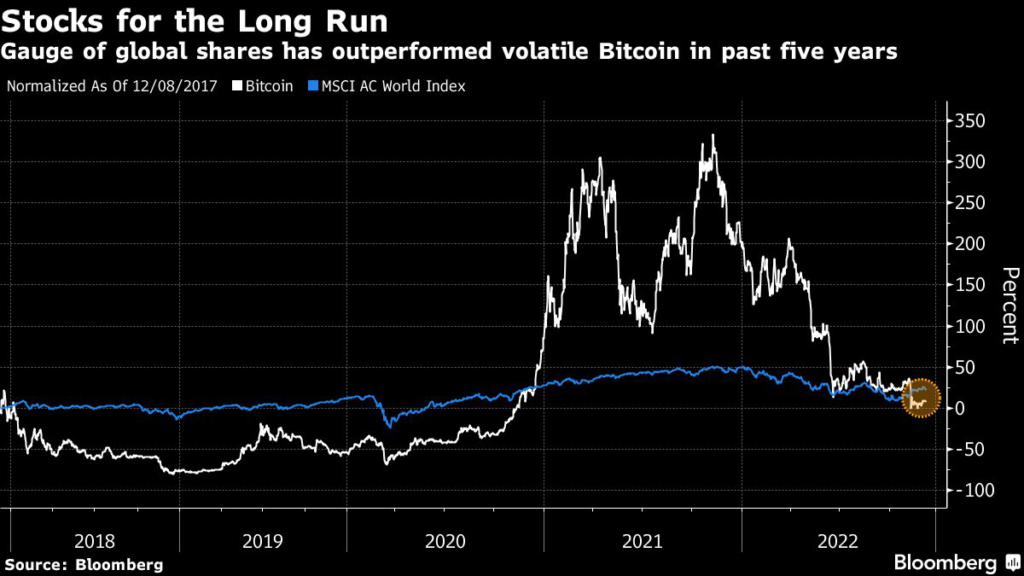
The crypto sector is in a febrile mood, agitated by a $2 trillion drop in the value of tokens and major blowups of which FTX is the most breathtaking. 

Amber itself has rebutted online speculation that it may be the next domino to fall. A top executive tweeted Wednesday the company is conducting “business as usual” after a blockchain data provider claimed it faced bankruptcy based on an analysis of crypto holdings and transfers. 

The person familiar said Amber is still doing deposits, withdrawals and trading as it normally would. The person added that Amber doesn’t have any entities in China, in response to reports that it closed offices there.

Amber sought to complete layoffs in November but the market slump necessitated further cuts, leaving employee numbers in Europe in single digits, the person said. 

Amber has previously said less than 10% of its trading capital was stuck on FTX and that the stranded funds do not “pose a threat” to its operations. 

The person familiar said Amber’s overall trading capital has shrunk since the collapse of FTX but business operations aren’t under threat.

Amber was founded in 2018 by a group of people that included former Morgan Stanley traders and raised $200 million at a $3 billion valuation in February. 

Traded volume on the platform exceeds $1 trillion and institutional clients number over 1,000, according to the company website. In September, the firm said it had cut as much as 10% of its staff.

One of Amber’s co-founders, Tiantian Kullander, passed away unexpectedly in his sleep in November at the age of 30. 

For crypto market prices: CRYP; for top crypto news: TOP CRYPTO.

More stories like this are available on bloomberg.com

©2022 Bloomberg L.P.
Warren Buffett ‘Loves’ China’s BYD Despite Selldown, EV Executive Says

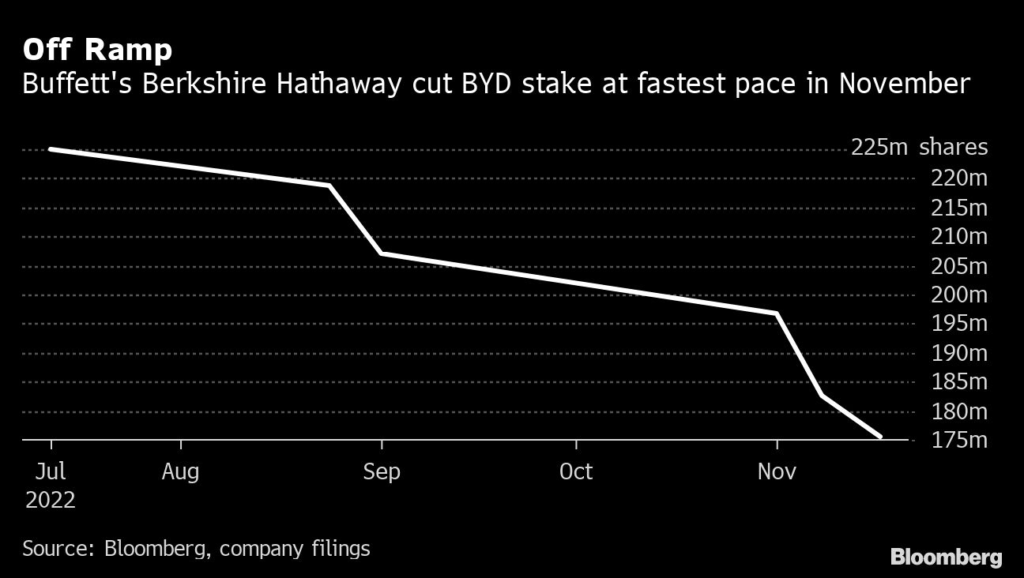
(Bloomberg) — Warren Buffett “loves” China’s biggest electric-vehicle maker BYD Co. and isn’t abandoning it, a senior executive from the company said, despite the legendary investor’s Berkshire Hathaway Inc. offloading more than a fifth of its stake this year. 

“It’s very natural for him to get some returns — cash out,” BYD Executive Vice President Stella Li said in an interview Tuesday, in the first high-level public comments addressing the selldown of Buffett’s long-held stake in the company. 

BYD Eyes Chile Lithium Deals in Global Hunt for EV Material

BYD shares jumped 6.9% in Hong Kong on Wednesday morning, hitting their highest since September and among the top gainers on the Hang Seng Index. 

Berkshire, which first invested in BYD in September 2008, disclosed in August the first known sale of some of its stake, held in the automaker’s Hong Kong-listed shares. The selloff accelerated in November, paring its holding to 15.99% from an initial 20.04% and raising questions about Buffett’s long-term commitment to the Shenzhen-based company.  

“I don’t feel this is any indication he’s abandoned BYD,” Li said. “He loves BYD, he loves management” and will “always be” the biggest supporter of the company, she said.

A spokesperson for Berkshire didn’t immediately respond to requests for comment.

BYD’s shares have fallen about 30% in Hong Kong since a Berkshire-sized stake appeared in the Hong Kong exchange’s clearing system on July 11, fueling the initial speculation that Buffett may sell his holding. The slump has wiped about HK$230 billion ($30 billion) from BYD’s market value.

The investment has still been a big winner for Berkshire and Buffett. An initial $230 million outlay has ballooned more than 1,570%, and even after the selldown Berkshire’s remaining stake is worth around $4.5 billion.

In other highlights from the interview, Li said: 

  • BYD is looking to build a passenger car plant in Europe. “Yes, and maybe not only one, it can be two.” That comes after the company announced plans to sell vehicles across the continent, including Germany, Sweden Norway, the Netherlands, France and the UK.
  • The company is evaluating the best location “to support BYD’s fast ramp-up.”
  • She also confirmed BYD was buying its own ships to export cars. “The size of BYD, when we go to any shipping companies, their service cannot really 100% satisfy us.”
  • She doesn’t view Tesla Inc. as a competitor, because its success means more people are learning about EVs. “Our competition, maybe our enemy, is the combustion-engine car.”
  • BYD will introduce two new luxury brands next year. One will have an SUV and a sports car. The second will revolve around fashion, styling and a car being treated as a hobby, she said.

–With assistance from Max Reyes and James Attwood.

(Adds share price in third paragraph.)

More stories like this are available on bloomberg.com

©2022 Bloomberg L.P.
Nomura’s Crypto Arm Seeks Profit in Two Years in Shakeout After FTX Crisis

(Bloomberg) — Nomura Holdings Inc. plans to break a profit at its crypto unit within two years as the spectacular failure of Sam Bankman-Fried’s FTX exchange spurs demand for safer counterparties in the digital-asset sector.

The unit, Laser Digital, will leverage the backing of the Tokyo-based investment bank to win over institutional investors and plans to add 50 employees by March, its Chief Executive Officer Jez Mohideen said. It’s now easier to hire talent and acquire assets at a lower valuation, he said, adding that the firm has tightened risk management. 

“The latest events in the crypto market will provide an opportunity for us as it will drive institutional investors to digital-asset firms backed by traditional finance houses,” Mohideen said in an interview. “We’ve run all the stress tests and assuming worse-case scenarios in terms of market volume, price volatility, we believe we can turn profitable within two years.”

Nomura’s launch of its digital-assets arm in September, one of the boldest embraces of the sector yet by a global financial firm, came amid a deep rout in crypto markets that was exacerbated by the bankruptcy of FTX last month. 

Other lenders are also seeking to make a mark on the industry. Singapore’s DBS Group Holdings Ltd. is already offering digital currency trading for wealthier clients, while Goldman Sachs Group Inc. plans to invest tens of millions of dollars in crypto firms, according to a report. JPMorgan Chase & Co. is exploring the use of blockchains for transactions like collateral settlements. 

“We can’t look at this asset class based on the market price,” 49-year-old Mohideen said. “You need to believe in it, invest in it and take a five-to-10 year view.” 

Nomura has made a “significant” multi-year capital commitment into Laser Digital, Mohideen said. Japan’s biggest brokerage named former head of trading and investment banking Steve Ashley as chairman of the digital-assets venture. Mohideen was previously chief digital officer of Nomura’s wholesale division, as well as co-head of global markets in Europe, the Middle East and Africa.

“Nomura is taking the digital-assets business very seriously,” said Mohideen, who previously worked at hedge fund Brevan Howard Asset Management and has a PhD in Process Systems Engineering from Imperial College, London, according to his LinkedIn profile. 

“The intention and the vision of this entity is to be a significant revenue driver for Nomura group,” he said. 

Laser will house three business verticals: trading, asset management and a venture capital fund. Trading will be the unit’s “core engine” to create revenues, while Laser Digital Ventures will invest in early stage startups and entrepreneurs that are developing institutional products and services in crypto. The fund aims to invest in 15 to 20 seed to Series A deals per year globally.

The foray adds to Nomura’s interest in Komainu, a digital-asset custody venture which it started in 2018 along with CoinShares and crypto security company Ledger.

Risk Management

Following the risks of interconnectedness and over-leveraging that pulled down several crypto firms in the last year or so, Laser has added “extra filters” on its risk management to assess counterparty exposure, he said.

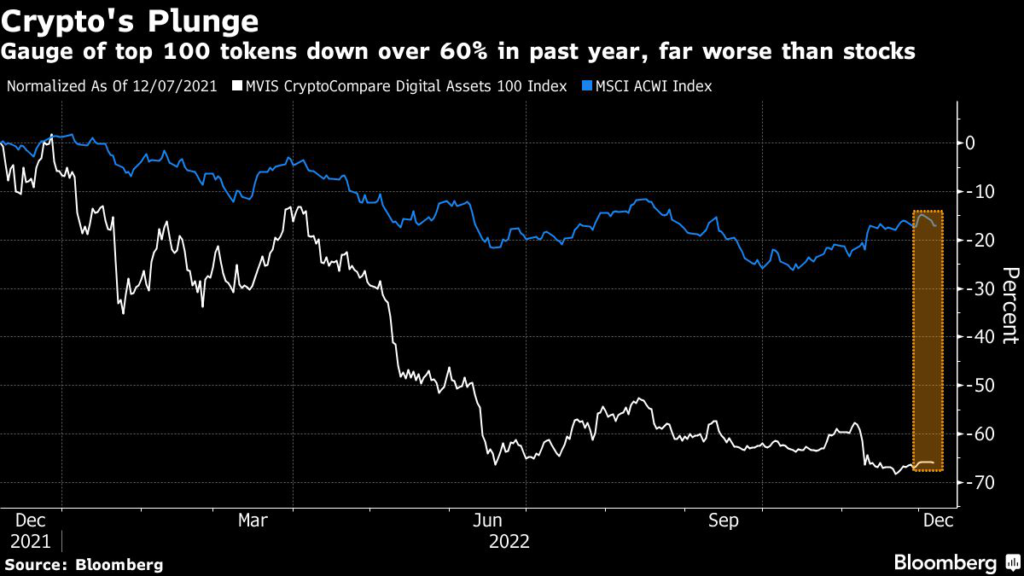
Crypto outfits including Three Arrows Capital, Celsius, BlockFi Inc. and Voyager ended up bankrupt and several others are facing a credit squeeze. A 65% plunge in the crypto market in the past year exposed leveraged bets and triggered margin calls.

Laser is seeking a license for its trading and asset management business in Switzerland, where the firm is based, as well as in Dubai due to its clear and stable regulations, Mohideen said. At a later stage, the firm plans to operate in the US and Japan, he added.

–With assistance from Sanjit Das.

More stories like this are available on bloomberg.com

©2022 Bloomberg L.P.

Musk Slams San Francisco for Probe of Bedrooms at Twitter HQ

(Bloomberg) — Elon Musk on Tuesday criticized San Francisco Mayor London Breed following a report the city is investigating Twitter Inc. for setting up bedrooms at its headquarters, saying the company was being unfairly attacked for “providing beds for tired employees.” 

Twitter in recent weeks has turned several conference rooms at the office into makeshift bedrooms, complete with furniture like bedside tables and armchairs, according to people familiar with the matter. It no longer needs as many conference rooms now that thousands of employees have either been laid off or fired after the billionaire’s $44 billion purchase of the company in late October.

A spokesperson for the city’s Department of Building Inspections told the San Francisco Chronicle that it would conduct a site inspection on Twitter headquarters following a complaint about the bedrooms, a possible violation of the building code.

In a tweet, Musk attached a link to a recent Chronicle report about a baby’s near death after allegedly accidentally ingesting fentanyl at a San Francisco playground. After the incident, Breed tweeted “it’s important to keep public spaces safe” and said those who sell the drug must be held accountable. 

Before his Twitter purchase closed, Musk floated the idea of turning the social media company’s office building into a homeless shelter, saying that employees weren’t turning up due to its now discontinued work-from-home policies. Since acquiring the company and firing around 3,700 employees, nearly half of its workforce, he issued an ultimatum to remaining staff to commit to “hardcore” Twitter.

Twitter Janitors on Strike at San Francisco Headquarters

Not only does Musk expect employees to work long hours and even sleep at the office when necessary, but he has also asked many of his employees at Tesla Inc. and the Boring Co. to assist him at Twitter during the transition period. The rooms are also believed to be for those workers, some of whom travel to Twitter for work meetings, the people with knowledge of the matter said.

(Updates with details on the bedrooms starting in the second paragraph.)

More stories like this are available on bloomberg.com

©2022 Bloomberg L.P.
South Korea’s Arms Sales Double in Wake of Russia’s War in Ukraine

(Bloomberg) — Russia’s war in Ukraine has opened a door for South Korea’s defense exports, which are on track to more than double this year as buyers seek to replace Soviet-era weaponry with higher tech arms from the Asian country.

South Korea’s defense exports totaled about $17 billion as of November this year, up from $7.25 billion a year before. Major buyers include countries that have for decades relied on stockpiles of aging Russian weaponry, like Poland, but have seen that many of those systems are no match for the weapons that arm the US and its allies.

South Korea has found itself uniquely positioned in the global arms market with weapons that are relatively affordable and meant to defeat Soviet-based conventional systems used by its neighbor North Korea. Meanwhile, Washington seems to be giving the green light to ally Seoul to sell to states in places like eastern Europe as US defense contractors race to fill orders for weapons that will go to Kyiv and Taipei, which is staring down threats from China.

Poland, which borders Ukraine, has been the biggest customer for South Korean arms since the war started. On Tuesday, the first shipment arrived in the Baltic port of Gdynia of 10 K2 tanks and 24 self-propelled K9 howitzers that were part of a $5.76 billion agreement reached in August with Hyundai Rotem Co. and Hanwha Defense Systems Corp. 

“We want peace and therefore we do prepare for war,” Defense Minister Mariusz Blaszczak told reporters, adding that the country is providing “our army with modern equipment in order to guarantee safety for Poland.”

“Many people were saying that these are merely plans that might be executed one day, but today we have proved that we are realizing them and are strengthening our army,” he said.

Lee Boo-hwan, head of Hanwha Aerospace’s European business, called the handover a key milestone in the relationship between the company and Poland.

South Korea is now ranked as the world’s eighth largest weapons exporter, according to a report from the Stockholm International Peace Research Institute, or SIPRI. President Yoon Suk Yeol said he is aiming to take the country to number four by 2027, seeing the defense industry as a growth engine amid trailing exports elsewhere and a chip slump. 

“In the midst of intensifying competition for technological supremacy, it is crucial to secure technological competitiveness to develop game-changing weapons system for future warfare,” Yoon said in a defense exports strategy meeting last month, wearing a pair of aviator sunglasses given to him by US President Joe Biden when he visited Seoul in May. 

While some South Korean systems may not be as technically advanced as some weapons from the US, they are designed to allow its military of about 600,000 defeat a North Korean force that has more than twice the number of personnel and relies on more rudimentary conventional arms.

Items such as jet fighters, tanks, multiple rocket launchers and precision-guided artillery have been sold to the likes of Poland, the UAE, Egypt and Indonesia.

“South Korean weapons are generally well-received by the global market for their cost-effectiveness and quick delivery, as well as a comprehensive operations and after-service management,” said Moon Seong-mook, a former general in South Korea’s military who is now the head of the Seoul-based Korea Research Institute for National Strategy.

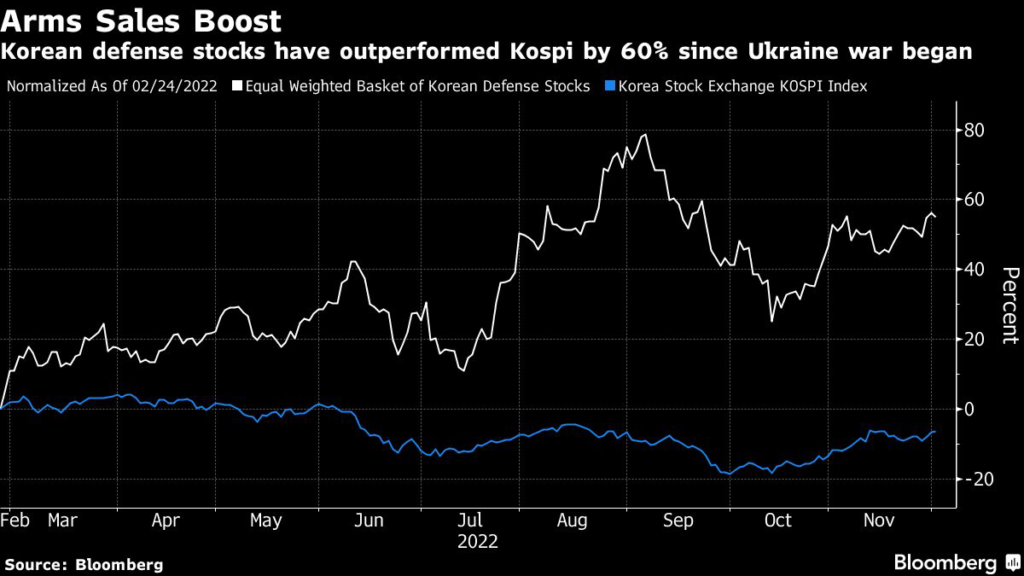
Defense stocks of companies such as Hanwha Aerospace Co., Korea Aerospace Industries Ltd. and LIG Nex1 Co. have skyrocketed since the war began in Ukraine in February, outpacing gains in the South Korea’s benchmark Kospi index by 60%.

One of the most recent acquisitions from Poland has come from a $3.55 billion deal signed in November to supply it with Hanwha Defense Systems Corp.’s multiple-launch rocket systems Chunmoo, according to the Defense Acquisition Program Administration statement. 

The agreements are on top of a $3 billion deal signed in September for 48 FA-50 aircraft that will help wean Poland off of Russian MiG fighters. Specialist defense publication Janes said the South Korean fighters offer “a highly capable ‘light’ combat capability at a time when it is needed urgently,” and will augment advanced Western aircraft already in the pipeline. 

In 2020, before Russia’s invasion, Poland struck a more costly deal to buy 32 F-35A fighter jets from the US, with the contract worth $4.6 billion, its defense minister said. 

Despite bitter partisan politics in Seoul, boosting defense exports has been a policy pursued by former President Moon Jae-in’s progressive government and Yoon’s conservative party that took power in May. Just before he left office, Moon landed a $3.5 billion deal with the United Arab Emirates to sell it Cheongung II surface-to-air missiles. 

Yoon is also pushing ahead with the fighter jet KF-21, also known as the Boramae, which is being marketed as a cheaper alternative to Lockheed Martin Corp.’s F-35 Lightning II. The design for the plane was unveiled under Moon and the $6.7 billion project to jointly develop the plane with Indonesia in 2014 was launched under his predecessor, President Park Geun-hye, a conservative.

Russia, meanwhile, may be turning to North Korea for help with its weapons. The Biden administration has accused North Korea of covertly supplying Russia with artillery shells for use in the invasion of Ukraine. The shells would be for older artillery systems that the two countries have operated since the Soviet era. 

North Korea has denied the allegations and the US hasn’t released any evidence that such sales have taken place.

–With assistance from Youkyung Lee, Akshay Chinchalkar, Andrea Dudik, Sam Kim and Natalia Ojewska.

(Updates with statement from company.)

More stories like this are available on bloomberg.com

©2022 Bloomberg L.P.
Xi Jinping Gets Saudi Red Carpet as Middle East Looks Beyond US

(Bloomberg) — Two months after snubbing US President Joe Biden’s pleas for oil, Saudi Arabia is rolling out the red carpet for his Chinese counterpart, Xi Jinping.

Xi will visit Saudi Arabia for several days starting Wednesday, during which he will take part in a regional summit with Saudi Crown Prince Mohammed bin Salman and other Arab leaders, the kingdom’s SPA state news agency said Tuesday, promising agreements worth some $30 billion.  Energy and infrastructure deals will top the agenda, according to two people briefed on the plans.

China confirmed the trip on Wednesday morning, a day after Xi led the nation in mourning the death of former leader Jiang Zemin on the heels of recent protests against his Covid Zero policy. The summit will give both Xi and Prince Mohammed a chance to showcase the Gulf’s deepening ties with Beijing, underlining just how far US-Saudi relations have sunk.

“This visit is the culmination or crowning of a deep strengthening in relations over the last few years,” said Ali Shihabi, a Saudi commentator and advisory board member for the kingdom’s Neom megaproject. “The US is concerned about this but cannot slow this already strong relationship down.” 

A low point in US-Saudi ties came in October when Biden accused Riyadh of allying with Russia on oil production cuts, and vowed “consequences.” However, relations have been fraying for some time as the US shifts its global focus to the competition with China.

It’s a decade since the US was Riyadh’s biggest trading partner, and in that time not only has China leapfrogged America, but so too have India and Japan. Total US-Saudi trade shrank from some $76 billion in 2012 to $29 billion last year.

That’s in part because the US shale industry means it no longer imports much Middle East oil; China is Saudi Arabia’s top crude customer now —  and regional oil exporters will be keen for information on China’s plans for lifting Covid restrictions.

Read how China’s factories are struggling with the slow dismantling of Covid curbs

Yet Washington has also riled Saudis with its attempts — now all but dead — to return to the nuclear deal with Iran, a regional Saudi rival, while Riyadh’s powerful alliance with Russia and other oil exporters in OPEC+ is another point of friction.  

“For the Arab states, it’s about alternatives, in all possible ways”

“It’s high time we stopped seeing this as being purely about economic and commercial relations,” said Cinzia Bianco, a visiting fellow at the European Council on Foreign Relations, who focuses on the Gulf. “For the Arab states, it’s about alternatives, in all possible ways.”

Beijing has been picking up some of that economic and political slack.

In the past six months, Janes IntelTrak Belt & Road Monitor reported a surge of activity across the Middle East by US-blacklisted telecoms firm Huawei Technologies Co.; that State Grid Corporation of China was looking at investment opportunities in regional electricity transmission and distribution; and Saudi Arabia and China agreed to coordinate their investments in Belt and Road Initiative participating nations. 

Talks on a free trade agreement between China and the six-nation Gulf Cooperation Council are entering a “final stage,” China’s ambassador to the United Arab Emirates Zhang Mingyi said last month. Zhang even mentioned a memorandum on moon exploration signed with the UAE.

Gulf states view the US as an increasingly unreliable partner and “want to capitalize on a new global multipolar landscape that presents fresh opportunities,” said Elham Fakhro, a research fellow at Exeter University’s Centre for Gulf Studies. In doing so, they might “strengthen their own bargaining power with the United States,” she said.

Still, the US maintains a significant troop presence in Saudi Arabia and across the region, and there are limits to how far Gulf states will look elsewhere.

It’s seen as unlikely, for example, that Saudi Arabia will move forward with the idea of accepting yuan payments instead of the dollar for oil, the two people briefed on the preparations said, referring to reports earlier this year. Diplomats and analysts said at the time the reports should be seen as a political message to the US, rather than the kingdom’s plans.

Whereas Donald Trump chose Riyadh for his first overseas trip as president, Biden came to office pledging that he’d treat the crown price as a pariah for his part in the murder of columnist Jamal Khashoggi.

But faced with high inflation going into the midterm elections, he swallowed his pride and visited the kingdom in July seeking help to lower global oil prices. 

He appeared to make some headway, expressing optimism Riyadh would take steps to comply — only for Saudi Arabia and OPEC+ to then announce production cuts. A furious Biden said it was time for the US to rethink the relationship.

Buoyed by higher oil revenues spurred by Russia’s war, the Saudi crown prince has cast the kingdom as a growing power capable of standing up to US pressure.

China has cheered on from the sidelines: Foreign Minister Wang Yi praised the kingdom’s “independent energy policy” and efforts to stabilize the international energy market after meeting with his Saudi counterpart in October. Wang also thanked Riyadh for “long-term and firm support” on matters including Taiwan, Xinjiang, Hong Kong and human rights — all touchstone issues for the US.

China Praises Saudi Arabia’s ‘Independent’ Energy Policy

“There’s a real synergy to the relationship,” said Jonathan Fulton, a nonresident senior fellow at the Atlantic Council focused on China’s relations with the Gulf. 

Whereas “the US keeps talking about a great power game” and focusing on counterterrorism, China has been helping address domestic concerns. The upshot is it’s less about China trying to replace the US than the two countries playing completely different games when it comes to the Middle East, he said.  

Since China held its last biennial dialog with Arab states in July 2020, Saudi Aramco revived discussions to build a multi-billion dollar refining and petrochemicals complex in China.

Saudi Arabia started working with Huawei to develop artificial intelligence systems and the kingdom’s using Chinese expertise to make its own drones. It’s even been reported to be manufacturing ballistic missiles with China’s help, according to a U.S. intelligence assessment.

It’s not all one way, though. High oil prices hurt China as well as the US, and Beijing nurtures close relations with Iran, a key Saudi rival. China cannot just replicate US military support for the region. 

The US isn’t asking countries to choose between Washington and Beijing but asking them to be “mindful” of the relationships they’re developing, Derek Chollet, a counselor at the US State Department, told a briefing in Kuwait ahead of Xi’s visit. 

“Our assessment is that China, in its efforts to build relations in this region, does not have an interest in building mutually beneficial partnerships,” he said. 

–With assistance from Jing Li, Alfred Cang, Matthew Martin and Fiona MacDonald.

(Updates with China confirmation in paragraph 3)

More stories like this are available on bloomberg.com

©2022 Bloomberg L.P.
FTX’s Sam Bankman-Fried Hires Ghislaine Maxwell Defense Lawyer

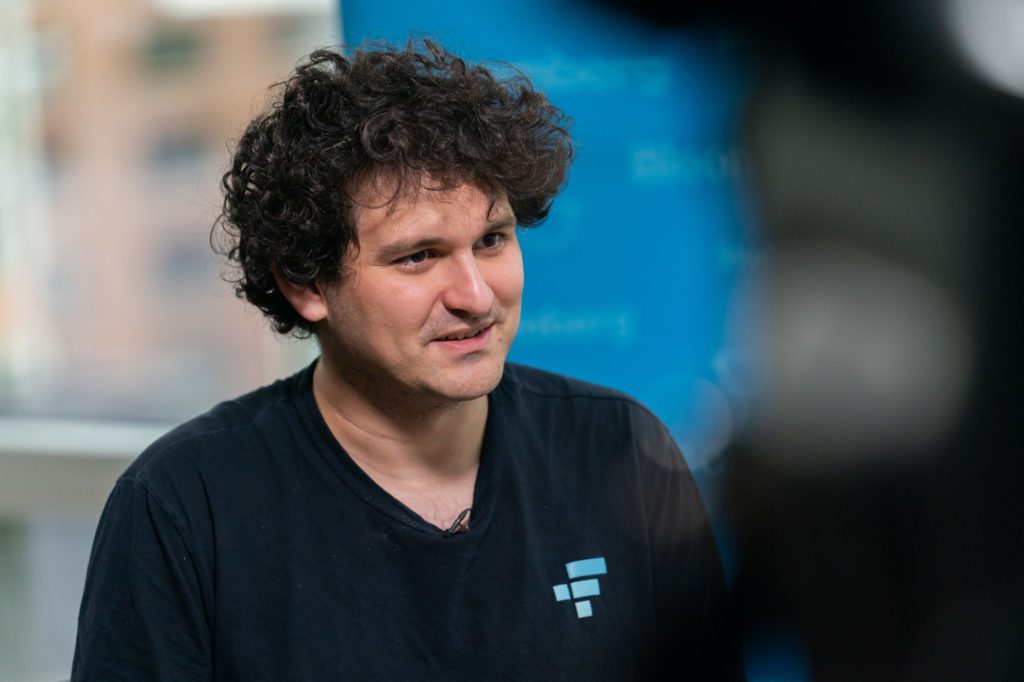
(Bloomberg) — Sam Bankman-Fried, the embattled co-founder of bankrupt crypto exchange FTX, has retained New York defense attorney Mark Cohen to represent him, according to Bankman-Fried’s spokesperson Mark Botnick.

Cohen was previously part of the team that represented convicted sex trafficker Ghislaine Maxwell. He also successfully defended analyst Peter Black against a Securities and Exchange Commission suit in a 2014 trial. Cohen’s hiring by Bankman-Fried was first reported by Reuters.

Read more: Sam Bankman-Fried Should Shut Up, Bernie Madoff’s Lawyer Says

Bankman-Fried hasn’t been charged with any crime, but federal prosecutors in Manhattan have begun investigating FTX’s collapse due in part to an unexplained $8 billion shortfall in funds. He is also facing class-action lawsuits and regulatory probes by the SEC and Commodities Future Trading Commission. Maxine Waters, chairwoman of the House Financial Services Committee, also wants Bankman-Fried to appear at a hearing on Dec. 13.

In choosing Cohen, Bankman-Fried said he was “going on advice of counsel and people who are able to understand the situation and the context,” according to a Twitter Spaces during which he appeared on Tuesday. Bankman-Fried’s parents are law professors at Stanford University.

It’s unclear how Bankman-Fried plans to pay for the representation. Just weeks ago he was worth more than $15 billion, but last week said he only has about $100,000 and a credit card to his name.

“I don’t necessarily have a long-term plan there yet” in how to pay legal fees, Bankman-Fried said Tuesday. “I am not sure I will be able to pay all of the legal fees I need to pay.”

Bankman-Fried is also represented by one of his parents’ colleagues at Stanford, David Mills. 

Cohen was a former federal prosecutor in Brooklyn, New York before moving into defense and co-founding his firm Cohen & Gresser. He mainly appeared for Maxwell in pre-trial proceedings, including her bail hearing, though other lawyers at his firm were active in her trial.

Before FTX filed for bankruptcy last month, Bankman-Fried, 30, was advised by the law firm Paul Weiss Rifkind Wharton & Garrison. But Bankman-Fried, who has ignored legal advice and taken part in several media interviews recently, and the Manhattan attorneys parted ways citing a conflict of interest.

More stories like this are available on bloomberg.com

©2022 Bloomberg L.P.

Incoming Kraken CEO David Ripley Blasts Jamie Dimon, Alleges Fraud at FTX

(Bloomberg) — The incoming chief executive officer of crypto exchange Kraken denounced Sam Bankman-Fried as a “fraudster” and laid into JPMorgan Chase & Co.’s Jamie Dimon for comments condemning crypto.

“We have information to know that fraud was committed there,” Kraken’s Dave Ripley said in an interview with Bloomberg Television on Tuesday, referring to Bankman-Fried’s now-bankrupt digital exchange. “It’s going to take time for regulatory bodies and government to come into the fold.”

Bankman-Fried, who has not been accused of any wrongdoing by authorities, has repeatedly denied trying to perpetrate a fraud while admitting to grievous managerial errors. 

Ripley is set to replace Kraken co-founder Jesse Powell as the company’s top executive in the coming months.

  • Read more: Crypto Agitator Jesse Powell Steps Down as CEO of Kraken

Ripley said Dimon’s comments that virtual tokens are “pet rocks” indicated he lacked understanding of the technology underlying digital assets and of innovation more broadly. The investment banking CEO was “clearly wrong on all fronts” when it comes to blockchain technology, he added.

Ripley also indicated he expected the aftermath of FTX’s collapse to continue to weigh on the sector more broadly, even as he touted Kraken’s strengths. 

“It’s clear there’s going to be more contagion from FTX,” Ripley said. “We’re not impacted by this contagion.” Kraken last month said it was laying off 30% of its workforce, or about 1,100 people.

  • Read more: Kraken Exchange to Lay Off 1,100 as Crypto Pain Deepens

More stories like this are available on bloomberg.com

©2022 Bloomberg L.P.

Close Bitnami banner
Bitnami