Bloomberg

Stocks Rise With Earnings in Focus; Dollar Falls: Markets Wrap

(Bloomberg) — US stocks rose in a broad-based advance as investors assessed the outlook for corporate earnings and global growth amid Europe’s deepening energy crisis.

The S&P 500 climbed, with industrials, energy and financials leading all 11 industry groups higher. The broad rally was mirrored in the tech-heavy Nasdaq 100, as megacaps Apple Inc. and Alphabet Inc. bounced back from Monday’s losses ahead of Netflix Inc.’s earnings due later today. The dollar fell against its Group-of-10 peers.

With the potential for earnings disappointments baked into markets, any upside surprises may lead to outsized gains. Investors remain on high alert for signs that high inflation and monetary tightening are squeezing consumers and employment, and allocation to stocks plunged to levels last seen in October 2008, according to the latest Bank of America Corp.’s monthly fund manager survey.

“Earnings-vulnerability was strongly flagged in the run-up to the Q2 season, but this also seems to have lowered the bar, with some of the early reporting having been characterized as ‘better than feared,”’ said Ulrich Urbahn, head of multi-asset strategy and research at Berenberg.

Meanwhile, the euro rose to its highest level in about two weeks after Bloomberg News reported the European Central Bank may consider raising interest rates on Thursday by double the quarter-point outlined previously to counter worsening inflation. 

Markets are pricing in about 38 basis points of tightening on Thursday, when the ECB is expected to raise rates for the first time in more than a decade. That reflects about a 50/50 chance of a 50-basis point increase. An outsized hike would put the ECB more in line with global peers moving up their policy rates at warp speed.

The ECB is under pressure to subdue inflation, but the potential for a Russian gas shutdown could plunge Europe into recession. The European Union is preparing to tell members to cut gas consumption “immediately” to preserve supplies for winter, according to a report. 

European stocks could slump another 10% if Russia cuts off gas to the region, triggering a recession, according to Citigroup Inc. strategists. A halt of Russian gas supplies could potentially reduce the euro area’s gross domestic product by about 1%, which would imply a 10% contraction in European earnings-per-share over the next 12 months, according to Citi. 

Oil slid, with West Texas Intermediate crude falling to about $100 a barrel, after posting the biggest one-day advance since May.

How far will the Fed go in this hiking cycle? It takes one minute to participate in the confidential MLIV Pulse survey, so please click here to get involved. 

Key events to watch this week:

  • Earnings this week include Netflix, Tesla
  • US Treasury Secretary Janet Yellen visits South Korea. Tuesday
  • Reserve Bank of Australia releases July minutes. Tuesday
  • UK Chancellor Nadhim Zahawi and Bank of England Governor Andrew Bailey speak at event. Tuesday
  • Bloomberg Crypto Summit in New York. Tuesday
  • Bank of Japan, European Central Bank rate decisions. Thursday
  • Nord Stream 1 pipeline scheduled to reopen following maintenance. Thursday

Some of the main moves in markets:

Stocks

  • The S&P 500 rose 1% as of 9:49 a.m. New York time
  • The Nasdaq 100 rose 0.9%
  • The Dow Jones Industrial Average rose 0.8%
  • The Stoxx Europe 600 rose 0.5%
  • The MSCI World index rose 0.8%

Currencies

  • The Bloomberg Dollar Spot Index fell 0.7%
  • The euro rose 1% to $1.0249
  • The British pound rose 0.6% to $1.2030
  • The Japanese yen rose 0.4% to 137.59 per dollar

Bonds

  • The yield on 10-year Treasuries declined one basis point to 2.98%
  • Germany’s 10-year yield advanced four basis points to 1.25%
  • Britain’s 10-year yield was little changed at 2.15%

Commodities

  • West Texas Intermediate crude fell 1.1% to $101.48 a barrel
  • Gold futures were little changed

More stories like this are available on bloomberg.com

©2022 Bloomberg L.P.

IBM Posts Highest Sales Growth in a Decade, Cuts Cash-Flow Estimate

(Bloomberg) — International Business Machines Corp. shares fell the most in almost nine months on Tuesday after the tech company lowered its forecasts for free cash flow this year due to the impact of a strong dollar and the loss of business in Russia.

The revision overshadowed results that topped analysts’ estimates, signaling that demand for mainframe computers, consulting and cloud services remains strong amid concerns of a pullback in tech spending.

IBM, which gets about half of its sales outside the Americas, said it estimates free cash flow of $10 billion this year, at the low end of a previous range of $10 billion to $10.5 billion. The company was also forced to pull out of profitable operations in Russia after the country invaded Ukraine and the US imposed strict sanctions. The reduced free cash flow range isn’t a result of a broader business slowdown Chief Financial Officer Jim Kavanaugh said in an interview. “Our demand remains solid,” he said.

The shares fell as much as 7.4%, the most since October, to $127.86 in New York. IBM has been a rare pocket of stability in the tech market meltdown, gaining 3.3% this year through Monday compared with a 31% loss for the iShares Expanded Tech Sector ETF.  

Sales rose 9% to $15.5 billion in the three months ending June 30, the company said Monday in a statement. Analysts were expecting an average of $15.2 billion according to data compiled by Bloomberg. 

Chief Executive Officer Arvind Krishna’s goal has been to pivot Big Blue from its traditional business of infrastructure and information-technology services to the fast-growing cloud-computing market. Acquisitions have been a major part of the strategy, with IBM buying more than 25 companies under Krishna’s tenure, largely focused on bolstering the company’s hybrid-cloud offerings. 

Hybrid-cloud revenue jumped 18% to $5.9 billion in the quarter. Krishna wants IBM to distinguish itself by targeting a so-called hybrid model, which helps clients store and analyze data across on-premises infrastructure, private cloud services and servers run by major public providers such as Amazon.com Inc. and Microsoft Corp. Software unit revenue increased 6.4% to $6.2 billion, missing estimates. Consulting sales gained 10% to $4.8 billion, beating estimates. 

“We continue to expect full-year revenue growth at the high end of our mid-single digit model,” Krishna said Monday in the statement.

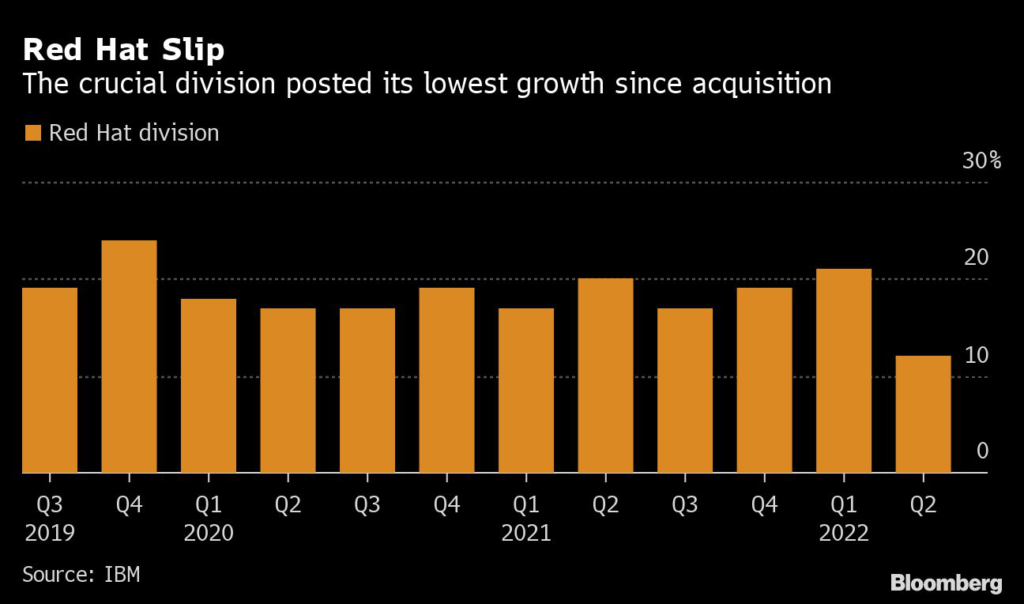
Red Hat sales increased 12% — the slowest rate since it was acquired in 2019. The division has been a key part of Krishna’s turn-around strategy, and typically posts growth closer to 20%. Last week, IBM named Matt Hicks as the new head of as the segment, promising little change in strategy. 

The growth dip is due to currency and there’s no material slowdown in the unit, which grew 17% at constant currency, Kavanaugh said.

Owing to the release of a new mainframe, the fastest-growing segment in the second quarter was infrastructure, which jumped 19% to $4.2 billion. Despite pivoting from on-premise offerings, the company remains one of the biggest makers of mainframe computers, which have long served as a foundation of a business’s most important applications. This segment drove much of the quarter’s overall upside, and “probably isn’t sustainable,” wrote analysts at Vital Knowledge after the release.

In November, IBM spun off a large portion of its legacy infrastructure services unit into a new company called Kyndryl Holdings Inc. Sales to Kyndryl continue to make up a significant portion of IBM’s revenue. 

Tech peers that have significant overseas exposure including Oracle Corp., Salesforce Inc., and Microsoft, have seen growth curtailed by a surging US dollar. IBM said current exchange rates will weigh on the full-year forecast by six percentage points, up from a three-to-four point estimate in April. Currency weighed on second quarter growth by seven percentage points, the company said.

Gross margin was 53.4%, beating the 52.9% analysts expected but down from 55.2% a year earlier. The margin decline was due to climbing labor and component costs and the company is addressing it through pricing, Kavanaugh said on an investor call.

Earnings excluding some costs were $2.31 a share, two cents higher than the average analyst estimate. Free cash flow was $3.3 billion in the quarter, beating estimates for $2.46 billion. 

(Updates shares.)

More stories like this are available on bloomberg.com

©2022 Bloomberg L.P.

IBM Disappoints With Cash Flow Outlook Despite Highest Sales Growth in a Decade

(Bloomberg) — International Business Machines Corp. shares fell the most in almost nine months on Tuesday after the tech company lowered its forecasts for free cash flow this year due to the impact of a strong dollar and the loss of business in Russia.

The revision overshadowed results that topped analysts’ estimates, signaling that demand for mainframe computers, consulting and cloud services remains strong amid concerns of a pullback in tech spending.

IBM, which gets about half of its sales outside the Americas, said it estimates free cash flow of $10 billion this year, at the low end of a previous range of $10 billion to $10.5 billion. The company was also forced to pull out of profitable operations in Russia after the country invaded Ukraine and the US imposed strict sanctions. The reduced free cash flow range isn’t a result of a broader business slowdown Chief Financial Officer Jim Kavanaugh said in an interview. “Our demand remains solid,” he said.

The shares fell as much as 7.4%, the most since October, to $127.86 in New York. IBM has been a rare pocket of stability in the tech market meltdown, gaining 3.3% this year through Monday compared with a 31% loss for the iShares Expanded Tech Sector ETF.  

Sales rose 9% to $15.5 billion in the three months ending June 30, the company said Monday in a statement. Analysts were expecting an average of $15.2 billion according to data compiled by Bloomberg. 

Chief Executive Officer Arvind Krishna’s goal has been to pivot Big Blue from its traditional business of infrastructure and information-technology services to the fast-growing cloud-computing market. Acquisitions have been a major part of the strategy, with IBM buying more than 25 companies under Krishna’s tenure, largely focused on bolstering the company’s hybrid-cloud offerings. 

Hybrid-cloud revenue jumped 18% to $5.9 billion in the quarter. Krishna wants IBM to distinguish itself by targeting a so-called hybrid model, which helps clients store and analyze data across on-premises infrastructure, private cloud services and servers run by major public providers such as Amazon.com Inc. and Microsoft Corp. Software unit revenue increased 6.4% to $6.2 billion, missing estimates. Consulting sales gained 10% to $4.8 billion, beating estimates. 

“We continue to expect full-year revenue growth at the high end of our mid-single digit model,” Krishna said Monday in the statement.

Red Hat sales increased 12% — the slowest rate since it was acquired in 2019. The division has been a key part of Krishna’s turn-around strategy, and typically posts growth closer to 20%. Last week, IBM named Matt Hicks as the new head of as the segment, promising little change in strategy. 

The growth dip is due to currency and there’s no material slowdown in the unit, which grew 17% at constant currency, Kavanaugh said.

Owing to the release of a new mainframe, the fastest-growing segment in the second quarter was infrastructure, which jumped 19% to $4.2 billion. Despite pivoting from on-premise offerings, the company remains one of the biggest makers of mainframe computers, which have long served as a foundation of a business’s most important applications. This segment drove much of the quarter’s overall upside, and “probably isn’t sustainable,” wrote analysts at Vital Knowledge after the release.

In November, IBM spun off a large portion of its legacy infrastructure services unit into a new company called Kyndryl Holdings Inc. Sales to Kyndryl continue to make up a significant portion of IBM’s revenue. 

Tech peers that have significant overseas exposure including Oracle Corp., Salesforce Inc., and Microsoft, have seen growth curtailed by a surging US dollar. IBM said current exchange rates will weigh on the full-year forecast by six percentage points, up from a three-to-four point estimate in April. Currency weighed on second quarter growth by seven percentage points, the company said.

Gross margin was 53.4%, beating the 52.9% analysts expected but down from 55.2% a year earlier. The margin decline was due to climbing labor and component costs and the company is addressing it through pricing, Kavanaugh said on an investor call.

Earnings excluding some costs were $2.31 a share, two cents higher than the average analyst estimate. Free cash flow was $3.3 billion in the quarter, beating estimates for $2.46 billion. 

(Updates shares.)

More stories like this are available on bloomberg.com

©2022 Bloomberg L.P.

Air India Mega Deal, Embraer and E-Commerce: Air Show Update

(Bloomberg) — Airbus SE is growing more confident it can secure a landmark purchase of about 50 A350 wide-body jets from Air India Ltd. this week, while Boeing Co. works on a deal for as many as 150 737 Max jetliners for the carrier, people familiar with the matter said. 

Boom Technology Inc., the US startup attempting to bring back a more environmentally friendly Concorde-style jet, is adding defense capabilities to the aircraft, one futuristic development Tuesday on day two of the Farnborough International Airshow.

Boeing was first out of the gate Tuesday with a firm order from 777 Partners LLC, which signed up for as many as 60 aircraft. The US planemaker also announced an order for 12 737-8 jets with lessor Aviation Capital Group LLC.

More purchase announcements are expected, including a possible deal between Airbus and Air Lease Corp. that could see the biggest aircraft financier in the US take dozens of A320neo craft.

2022’s show, held as summer temperatures in the UK soar to records, is the first significant commercial air show since Covid-19 decimated international air travel.

Key Stories and Developments:

  • Air Lease said to be in advanced talks for large Airbus order
  • A scorched air field south of London puts focus on green flying
  • Britain pledges to fly Tempest fighter design within five years

Embraer Sees E-Commerce Driving Smaller Plane Sales (2:32 p.m.)

Embraer SA published its 20-year market outlook for the sub-150 seat commercial aircraft segment, saying the explosive growth in e-commerce is opening new markets for smaller-capacity, all-cargo jet aircraft and driving demand for passenger-to-freighter conversions.

The Brazil-headquartered planemaker forecasts global demand for smaller aircraft up to 150 seats through 2041 will be around 10,950 units while the demand for new turboprops will be about 2,280 planes.

Embraer also Tuesday secured an order from Canada’s Porter Airlines Inc. for 20 E195-E2 passenger jets, adding to the carrier’s existing 30 firm orders, and inked a deal with Alaska Air Group Inc. for E175 aircraft, eight firm and 13 options.

Lilium Plots Scandinavia Launch in New Partnership (1:30 p.m.)

German flying taxi firm Lilium has partnered with professional services firm AAP Aviation to develop a network of landing sites in Scandinavia. As the nascent industry for electric vertical takeoff and landing, or eVTOL, aircraft continues to grow, firms are locked in a race to secure country partnerships and big orders. Lilium’s British rival Vertical Aerospace is exploring the potential for the technology in Brazil. AAP will also purchase 40 Lilium jets, the German startup announced Tuesday.

Boeing Secures Dreamliner Order from Aercap (1:17 p.m.)

Boeing kept up its steady drumbeat of orders at the show, announcing a commitment from Aercap Holdings NV for 5 787-9 Dreamliner models. Boeing said before the start of the show that it’s preparing to start speeding 787 Dreamliner production once the Federal Aviation Administration approves it to resume deliveries of the widebody aircraft.

Airbus, Boeing Court Air India (12:38 p.m.)

The Indian carrier is considering Boeing’s narrow-body planes alongside the Airbus A350 jets, as part of a fleet renewal under new owner Tata Group, according to people familiar with the negotiations. Airbus’s long wait time for A320neo delivery slots may constrain its effort to come up with a rival offer for narrow-bodies, said the people, asking not to be identified discussing private deliberations.

Airbus is trying to get the widebody deal firmed up at the show, but the carrier may wait with an official announcement until India’s Independence Day on Aug. 15, one person said.

UK Wants 2019 to Be Aviation Emissions Peak (12:25 p.m.)

Improvements to the existing aviation system, including a targeted 2% annual gain in fuel efficiency and steps to modernize airspace to shorten routes, should mean 2019 is remembered as the peak year for emissions, according to the Jet Zero blueprint unveiled Tuesday.

UK discount airline EasyJet Plc and engine maker Rolls-Royce Holdings Plc separately announced a partnership for the development of hydrogen-combustion technology capable of powering narrow-body planes.

Boom Unites With Stealth Bomber Maker on Military Jet (12:02 p.m.)

Boom is adding defense capabilities to its dreams of restoring supersonic passenger travel, announcing plans for a faster-than-sound jet fit for non-combat military missions. The jet could deliver medical supplies to surveillance personnel and handle medical evaluations. 

The US startup unveiled an agreement with defense giant Northrop Grumman Corp., the founder of the B-21 stealth bomber, at the Farnborough International Airshow on Tuesday to add military use for supersonic jets. Blake Scholl, Boom’s founder and chief executive officer, insisted its supersonic creation won’t be weaponized.

Vertical Aero Enlists Ex-McLaren CEO Flewitt (11:00 a.m.)

Flying-taxi pioneer Vertical Aerospace has recruited former McLaren supercars head Mike Flewitt to its board as the UK firm moves closer to starting production of the futuristic craft.

Flewitt, who made a surprise exit as chief executive officer of McLaren Automotive Ltd. in October after eight years in the post, will bring “deep industrial and manufacturing expertise” to Vertical at a key point in its development, the Bristol, England-based company said.


Boeing Inks 777 Partners Order (10:06 a.m.)

Boeing is first out of the gate again on day two with another commercial announcement, this time from private-equity firm 777 Partners, which placed orders and commitments for as many as 60 737-8 narrowbodies and the higher-capacity 737-8-200 model, which can seat as many as 200 passengers.

777 Partners Managing Partner Josh Wander said the order, of which 30 aircraft are firm and the remainder commitments, will be divided among the company’s low-cost assets, which include Flair, Australia’s Bonza, as well as a third carrier that will be revealed soon.

Read more: New Australian Airline Bonza Sees Launch Delayed by Pandemic

GE Completes Battery-Powered Test Flight (10:02 a.m.)

GE has completed the world’s first test of a battery-powered hybrid electric propulsion system at an altitude that simulates a commercial flight, it said in a statement Tuesday.

The test of the high power, high voltage system is significant considering getting battery-powered engines to work at cruising altitude has proven challenging. This is an “important, necessary step in GE’s technology programs with NASA to develop a hybrid electric propulsion system for flight tests later this decade and for entry into service in the mid-2030s,” GE said.

Delta Expands With Airbus A220 Fleet (9:46 a.m.)

Delta Air Lines Inc.’s purchase of 12 new A220-300 aircraft is the latest step in upgrading and streamlining its fleet and introducing more sustainable aircraft.

“The A220-300 is economical, efficient and delivers superior performance,” Mahendra Nair, the airline’s senior vice president of Fleet & Tech Ops Supply Chain, said. “These additional aircraft in the A220 family are an excellent investment for our customers and employees and will be fundamental as we work toward a more sustainable future for air travel.”

Featuring 12 first class, 30 comfort+ and 88 main cabin seats, the A220-300 aircraft will serve customers traveling domestically and to Delta’s coastal hubs. Powered by Pratt & Whitney Engine Services Inc.’s latest-generation geared turbofan GTF engines, the A220 offers 25% better fuel efficiency than the aircraft it replaces, Delta said.

GE Sees Bottlenecks in Engine Manufacturing (2:55 p.m.)

GE CEO Larry Culp discussed the strategy for GE Aerospace, the engine business he will lead, having spun off its energy and health-care divisions. In his first appearance in the role at the air show, Culp said the company chose GE Aerospace as the name for the aviation unit to reflect its “wider strategic aperture” beyond the traditional engine business. While it’s premature to discuss details the expansion, the unit will have the financial strength to grow organically and through acquisitions, he said.

Culp declined to discuss specifics of engine delays that have roiled Airbus and Boeing, but acknowledged that it’s “as challenging an operating environment” as he’s yet seen. GE is grappling with many bottlenecks and capacity issues within the company and its supply chain, he said. Part shortages, high inflation and a surge in airlines sending in their power plants for service is also putting pressure on the maintenance operation, traditionally a mainstay of profitability for GE. 

Qatar Says Heathrow Should Have Seen it Coming (1:40 p.m.)

Al Baker, who represents Qatar’s sovereign wealth fund on the Heathrow board, told Bloomberg Television he understood staffing issues facing the hub but was “disappointed” by its lack of foresight. They should have seen this coming and they should have taken mitigating actions,” the aviation executive said.

Heathrow took the decision last week to impose a two-month cap on daily passenger traffic to contain travel chaos caused by staffing shortages in key areas like ground handling. The move angered airlines forced to scrap flights at short notice in the peak summer season.

More stories like this are available on bloomberg.com

©2022 Bloomberg L.P.

Jeep’s China Failure Sends Foreboding Signal to Global Carmakers

(Bloomberg) —

It was one of the very first international auto brands to enter China, widely recognized by consumers and understood by its owners to have huge potential. And yet, Jeep is shutting down its only plant in the world’s largest market.

The announcement this week that Stellantis plans to terminate its local joint venture with state-owned Guangzhou Automobile Group was the culmination of a seemingly can’t-miss wager gone awry. And it begs some unsettling questions about what the future holds for foreign manufacturers in China.

The government set out 40 years ago or so to develop the nation’s auto industry by pairing local companies with experienced international players, among the earliest of which was former Jeep owner American Motors. These proverbial training wheels are not only no longer needed, but out of step with President Xi Jinping’s desire for China to become more self-reliant. The golden age of brisk growth and abundant profits for these various joint ventures appears to be over.

“We’re at the beginning of the end of the JV era in China,” said Michael Dunne, chief executive officer of ZoZo Go, a consultancy that advises companies how to navigate the nation’s auto industry. “It’s still the biggest market and nobody wants to get out, but you start to look around and say, ‘Why am I in this marriage?’”

Indeed, Stellantis’s union with Guangzhou Auto is just a few months removed from an openly testy moment. While Bloomberg News had reported in September that Stellantis had wanted to raise its ownership stake in the 50-50 venture, the carmaker known as GAC Group claimed to be caught off guard when its partner made this plan public in January. Less than six months later, Stellantis has opted for a divorce, citing a lack of progress toward increasing its shareholding to 75%.

CEO Carlos Tavares isn’t ready to completely abandon China. The 63-year-old Portuguese and paragon of cost discipline has alluded to an “asset-light” business model for the company formed last year from the merger between PSA Group and Fiat Chrysler. He may be able to profitably ship electrified Jeeps into the market, but no automaker is pursuing such a strategy at high volume. Import duties aren’t as inhibitive as they used to be, but at 15% still keep overseas brands from pricing their wares close to increasingly competitive domestic companies.

Tavares’s ambitions aren’t the issue. The 2030 strategic plan he shared on March 1 called for Stellantis to launch roughly 30 products and approach €20 billion annual revenue in China. That’s an awfully high hope considering the company sold some 122,000 vehicles there last year, enough for only 0.6% market share.

Just 22 days after Tavares delivered that address, he witnessed the disastrous consequences of being “asset-heavy” in a country that’s become a geopolitical pariah. PSA’s long-time French rival Renault caved to pressure from Ukraine and its allies to stop operating a Moscow plant and reconsider its position as majority owner of Lada-making venture AvtoVaz. Renault later agreed to transfer its €2.2 billion Russian business to state entities for the token sum of one ruble.

Jeep knows full well what a nightmare it can be when politics and auto production mix. A decade ago, then-boss of the brand Mike Manley, who went on to be Fiat Chrysler’s CEO, said Jeep would consider localizing every one of its models in China. Conservative media outlets and 2012 Republican presidential nominee Mitt Romney distorted those comments to suggest Jeep was going to uproot from the key battleground states of Ohio, Michigan and Illinois, and move its manufacturing to one of America’s nemeses. PolitiFact later named this their annual Lie of the Year.

If Tavares follows through with terminating the Jeep venture with GAC Group, he’ll be left only with a JV with Dongfeng Motor that similarly never took off as PSA had hoped. The future of that business also looks uncertain, with the two having just agreed to a framework for Dongfeng to sell off what’s left of its shareholding in Stellantis, which has shrunk to less than 3.2%.

International automakers that have fared much better than Stellantis in China, including Volkswagen and General Motors, also are having a tough time preserving their position. Dunne believes the two are “the powerhouses of yesterday.”

“You can feel the momentum has shifted in favor of Chinese brands,” Dunne said. “The government is talking about self-sufficiency, nationalism, depend on ourselves. Chinese consumers say, ‘I can get pretty good car now from Chinese brands.’”

More stories like this are available on bloomberg.com

©2022 Bloomberg L.P.

Stocktwits Expands into Equities, Undeterred by Market Qualms

(Bloomberg) — Stocktwits, a social media platform for retail investors, will allow users to buy and sell equities on its platform. It becomes the latest company to vie for the attention of US stock traders despite this year’s broad market selloff. 

New York-based Stocktwits, which has more than 6 million registered users, will launch equity trading on its platform through its subsidiary ST Invest LLC, a SEC registered broker-dealer, according to a press release on Tuesday. Stocktwits, which has been offering a forum for discussing markets and trading ideas since 2008, rolled out cryptocurrency trading, its first asset, in February.

“This isn’t a two-month play, or a three-month play,” said Stocktwits Chief Executive Officer Rishi Khanna. “This is a foundational piece to what we believe will be a great investing and trading platform.”

The company’s equities trading feature faces a long list of competitors, including app-based brokers such as Robinhood Markets Inc. and Webull Financial, and brokerage heavyweights like Charles Schwab Corp. and Fidelity Investments. The rollout comes at a time when investors have been particularly hard on high-flying technology stocks. 

More stories like this are available on bloomberg.com

©2022 Bloomberg L.P.
Blockchain Security Startup Raises $90 Million Despite Crypto Winter

(Bloomberg) — Blockchain security firm Halborn has raised $90 million, the company told Bloomberg News. The deal is an outlier in a climate where venture capital investing in crypto startups has slowed and digital currency prices have nosedived. 

Summit Partners led the Series A financing for Miami-based Halborn, which also included Castle Island Ventures, Digital Currency Group and Brevan Howard. The three-year-old startup declined to disclose its valuation. 

Many crypto-adjacent companies have recently looked to raise money at lower valuations and have laid off employees as the prices of currencies like Bitcoin and Ether plummet. But Halborn Chief Executive Officer Rob Behnke says the startup’s focus on cybersecurity gives it some immunity to the chill of the crypto winter. 

“The price of crypto has nothing to do with our business,” he said in an interview. “What really matters is that the entire industry is growing.”

And, critically, people keep trying to steal cryptocurrency. Halborn has seen demand for the company’s services increase over the past year as high-profile hacks have rocked the industry, Behnke said. The more than 100-person startup aims to prevent these exploits, such as a $620 million attack in March involving nonfungible token game Axie Infinity, by assessing the code underpinning blockchain platforms for vulnerabilities and developing security measures.

The startup even spotted a flaw in the popular MetaMask crypto wallet that was announced last month. “We’ve held onto that for like almost a year until they had it fixed,” Halborn co-founder and Chief Information Security Officer Steve Walbroehl said in an interview. 

The company works with Coinbase Global Inc., the Solana blockchain and Ava Labs, developer of the Avalanche blockchain. It even educates non-crypto companies like Amazon.com Inc., BNY Mellon and Nike Inc. on how to use and secure crypto. Halborn also advises VC firms, family offices and banks on the risk level of crypto projects.

“They really want to make sure they don’t get hacked and lose all their money,” Behnke said. 

When deciding whether to back Halborn, Matthew Hamilton, managing director at Summit Partners, said in an interview that the private equity firm believed that demand for the company’s security services would increase over time, since the crypto industry is still relatively young. 

Halborn represents Summit’s first blockchain investment, and Hamilton even sees advantages to the industry’s current crypto winter: “It’s a necessary separation of the good ideas from the bad,” he said. 

More stories like this are available on bloomberg.com

©2022 Bloomberg L.P.

Wireless Price Hikes Fatten Profits for Phone Carriers With Few Risks

(Bloomberg) — Josh Merkle was shocked when he saw the $6 increase on his AT&T Inc. wireless bill. The 36-year-old new father, already facing soaring prices for everything from gas to baby formula, said it’s “very upsetting” that the carrier would squeeze customers on a service that’s too essential to give up.

Merkle and millions of other wireless customers are opening phone bills this month to find AT&T and Verizon Communications Inc. raised rates on older service plans. Both Verizon, and to a lesser degree T-Mobile US Inc., have also increased monthly fees. While customers aren’t happy about it, they’re not racing for the exits. And that could pay off for the carriers.

“Telcos want to use this inflationary period to reset their pricing models upward,” said Tammy Parker, an analyst with GlobalData. “So far however, many subscribers are sticking with what they have, even if that means paying more than they used to.”

It took a pandemic, kinks in the global supply chain, skyrocketing inflation and the elimination of a fourth competitor, Sprint Corp., but the tables have finally turned for the wireless industry. After years of price battles to attract and keep customers, including phone giveaways and perks like free video streaming, carriers are, for the moment, in a position to take away those treats and raise rates without any immediate backlash.

AT&T and Verizon are scheduled to report earnings this week. And while the price increases didn’t go into effect until the last weeks of the quarter, the results may show slight benefits in the form of a boost to revenue and margins. 

Bottomline Padding

As fuel and labor costs rise, industry executives say they need to raise prices to keep up with the additional expenses. Given that 97% of US adults have at least one phone, the incremental increases in service plans, surcharges and fees start to reach big numbers when spread across hundreds of millions of customers. 

AT&T expects to book more than $1 billion in new revenue annually by raising rates on older service plans and is already looking at a second increase. For perspective, the $6-a-line increase AT&T is tacking on represents a 12% bump to its $49 average monthly revenue per customer, well outpacing the 9.1% rate of inflation in June.

Verizon expects to book an additional $600 million in the second half of this year, just from a new $1.35-per-line increase in administrative fees on consumers and a $2.20-per-line “economic adjustment charge” on business customers. That doesn’t include its own $6-a-line price hike this month, to match AT&T. Collectively, fee and service increases will boost revenue for the large carriers by $3 billion, according to LightShed Partners analyst Walt Piecyk.

As the bigger bills arrive, T-Mobile is ramping up marketing on its service plans and price promises, even staging an event in New York’s Times Square last week that featured Twisted Sister frontman Dee Snider singing his hit “We’re Not Going to Take It” in a shot at the other carriers. T-Mobile became the second-largest US wireless operator through a takeover of Sprint in 2020. As a condition of the deal, T-Mobile agreed not to raise prices for three years. That commitment ends in April.

‘Critical Services’

The industry’s defection rate, or churn of mobile phone subscribers switching service, has been hovering near a record low of 1% a month for the past year. And when it comes to pinching pennies, both mobile-phone and internet service are way down the list of areas where people would cut spending, according to a Recon Analytics Mobile Intender survey. 

When asked where they would cut if they were forced to spend less, 56% of respondents said dining out would be the first, followed by credit-card charges, car buying, streaming services, cable bills and gym memberships. Only 12% of those surveyed said they’d reduce mobile spending and internet bills.

“As we’ve learned from the pandemic, mobile and internet are critical services,” says Roger Entner of Recon Analytics. “It helps find a job and it’s the cheapest source of entertainment.”

When Merkle, the AT&T customer, saw the $6 increase he thought it was “ridiculous.” Sure, the price of gas and milk goes up, “those are physical tangible goods, whereas this is a service that’s already up and running,” he said. 

He was paying $101 a month for an unlimited plan that includes the HBO Max. His new bill is $107 a month. He called AT&T to complain and was put in touch with a supervisor who told him he could switch to a new cheaper plan that didn’t include the streaming service. So for now, he’s sticking with his current plan.

More stories like this are available on bloomberg.com

©2022 Bloomberg L.P.

Hosepipes on Roofs Are Keeping UK’s Data Centers Cool

(Bloomberg) — Some UK data centers have a low-tech way to avoid meltdowns during this week’s heat wave: spraying the roof-mounted air conditioning units with water.

“Many data centers in London will have people on the roof with hoses at the moment,” said Adrian Trevelyan, After Market Director at Airedale International, which provides and maintains cooling systems for data centers. 

Small data centers in dense urban areas running close to full capacity are most likely to need emergency hosing during a hot spell. The spray lowers the ambient temperature around the air conditioning unit’s coils to ensure they continue to dissipate heat effectively, Trevelyan said. He declined to name any specific companies adopting this technique, but said that it was happening “within the M25 and into the City.”

Read More: Startups Race Microsoft to Find Better Ways to Cool Data Centers

Hyperscale data centers run by technology giants often use vast amounts of water — Google struck a deal in the US that guarantees it 1 million gallons a day to cool one data center. Because of their large size, they have space to add extra cooling capacity to cope with temperature spikes. However, they are not immune to overheating: on July 10, there was a power outage at an Amazon Web Services data center in London due to what the company described as a “thermal event.” 

The hose approach is a “Heath Robinson solution,” said Sophia Flucker, director at data center consulting firm Operational Intelligence, which mimics the evaporative cooling systems installed at other facilities.

“It might get you out of a fix on a very hot day, but you are possibly shortening the equipment’s life,” she said, noting that if it’s done in places with hard water, such as London, it can lead to a build up of scale on the equipment. Properly designed evaporative cooling systems use treated water, she said.

Outages aren’t the only risk for data centers in a heat wave, Flucker said. Many “colocation” operators, who rent out capacity to third parties, face financial penalties for failing to keep the hall within a contractually agreed temperature range.

More stories like this are available on bloomberg.com

©2022 Bloomberg L.P.

Meta VR Rival Claims It Was Obliterated When Facebook Took Its Name

(Bloomberg) — A Meta Platforms Inc. rival claims in a federal trademark infringement lawsuit that its business has been obliterated after Facebook adopted its name.

Closely held MetaX LLC said since October 2021, when Facebook rebranded as Meta Platforms, its ability to do business in augmented reality and virtual reality has been hindered because it’s overshadowed by the much larger Meta Platforms, which is valued at more than $450 billion.

In a complaint filed Tuesday in federal court in Manhattan, MetaX is seeking a permanent injunction blocking Meta Platforms from using the “Meta” name as well as all Meta Platform’s profits from using the “Meta” name.

MetaX was founded in 2010 by Justin “JB” Bolognino, and is an immersive and experiential technology company, which includes consulting for, curating, and producing immersive events and exhibits. Meanwhile, when Meta Platforms rebranded it cited a new focus on the metaverse, or a virtual universe which spans many technologies but especially emphasizes AR and VR.

“Astoundingly, Facebook’s due diligence team ignored Meta’s federal registrations for the META mark that expressly identify services ‘using digital, virtual and augmented reality,”’ the smaller company said.

MetaX also claims Meta Platforms knew about it and its work before the name change. In August 2017, senior Meta Platforms employees praised MetaX and one of its immersive experiences in an email exchange with Bolognino, according to the lawsuit.

In response to a December 2021 demand letter from MetaX, Meta Platforms claimed the two companies offer “drastically different goods and services” and “[could] peacefully co-exist,” MetaX said in the complaint.

The case is MetaX LLC v. Meta Platforms Inc., US District Court, Southern District of New York (Manhattan).

More stories like this are available on bloomberg.com

©2022 Bloomberg L.P.
Close Bitnami banner
Bitnami