
Bloomberg

Stocks Subdued Amid Growth Worries Stoked by Apple: Markets Wrap

(Bloomberg) — Asian shares were subdued Tuesday after Apple Inc.’s plans to slow hiring highlighted concerns that aggressive monetary tightening to tackle inflation portends an economic downturn.

An Asian equity gauge dipped, hampered by a drop in technology stocks in Hong Kong and a retreat in China amid rising Covid infections and deepening turmoil in the nation’s property sector.

US futures inched up in the wake of another reversal for the S&P 500 on Monday. The index erased a 1% gain and ended lower on Apple’s intention to moderate some hiring and spending. 

A dollar gauge remained near a record high and Treasuries were steady, leaving the 10-year yield below 3%. The bond market reflects expectations for a short, sharp Federal Reserve interest-rate hiking cycle that gives way to cuts next year to shore up growth.

Crude dipped but held above $100 a barrel and will likely stay there for the rest of the year, according to Iraq’s energy minister. Ether was among the leaders of a cryptocurrency rally. 

Corporate updates such as Apple’s are helping markets to calibrate the risk of recession. Signs that high inflation and monetary tightening are squeezing consumers and employment could feed into worries that an equity revival since mid-June is merely brief respite in a bruising bear market.

“We’re in a period over the next couple of weeks where corporate headlines are really going to drive market activity,” Anthony Saglimbene, global market strategist at Ameriprise Financial Inc., said on Bloomberg Television. The focus is on how labor and input costs and demand are shaping the outlook, he said.

In China, officials may allow homeowners to temporarily halt mortgage payments on stalled property projects without incurring penalties. Authorities are racing to prevent a crisis of confidence in real estate from upending the world’s second-largest economy.

Meanwhile, India’s rupee tumbled to a fresh record low as foreign investors continued to pull money out from the nation’s stocks.

Overall global market volatility is a sign of the struggle “to gauge whether we are seeing, one, peak inflation and two, peak interest rates,” Lale Akoner, strategist at BNY Mellon Investment Management, said on Bloomberg Television. She expects the US dollar to remain higher for the next six months.

How high will the Fed go in this hiking cycle? Will it use the balance sheet and will it avoid tipping the US economy into a recession? It takes one minute to participate in the MLIV Pulse survey, so please click here to get involved anonymously.

Key events to watch this week:

  • Earnings this week include Netflix, Tesla
  • US Treasury Secretary Janet Yellen visits South Korea. Tuesday
  • Reserve Bank of Australia releases July minutes. Tuesday
  • UK Chancellor Nadhim Zahawi and Bank of England Governor Andrew Bailey speak at event. Tuesday
  • Bloomberg Crypto Summit in New York. Tuesday
  • Bank of Japan, European Central Bank rate decisions. Thursday
  • Nord Stream 1 pipeline scheduled to reopen following maintenance. Thursday

Some of the main moves in markets:

Stocks

  • S&P 500 futures rose 0.1% as of 12:52 p.m. in Tokyo. The S&P 500 fell 0.8%
  • Nasdaq 100 futures rose 0.1%. The Nasdaq 100 fell 0.9%
  • Japan’s Topix index rose 0.5%
  • South Korea’s Kospi index fell 0.4%
  • Australia’s S&P/ASX 200 index lost 0.5%
  • Hong Kong’s Hang Seng Index fell 1.2%
  • China’s Shanghai Composite Index dipped 0.3%
  • Euro Stoxx 50 futures dropped 0.8%

Currencies

  • The Bloomberg Dollar Spot Index was little changed
  • The euro was at $1.0136, down 0.1%
  • The Japanese yen was at 138.02 per dollar, up 0.1%
  • The offshore yuan was at 6.7533 per dollar, up 0.1%

Bonds

  • The yield on 10-year Treasuries fell one basis point to 2.97%
  • Australia’s 10-year bond yield rose seven basis points to 3.51%

Commodities

  • West Texas Intermediate crude was at $102.32 a barrel, down 0.3%
  • Gold was at $1,709.42 an ounce

More stories like this are available on bloomberg.com

©2022 Bloomberg L.P.
Tesla’s Denholm Says Australia Is Key to Avoid EV Battery Crunch

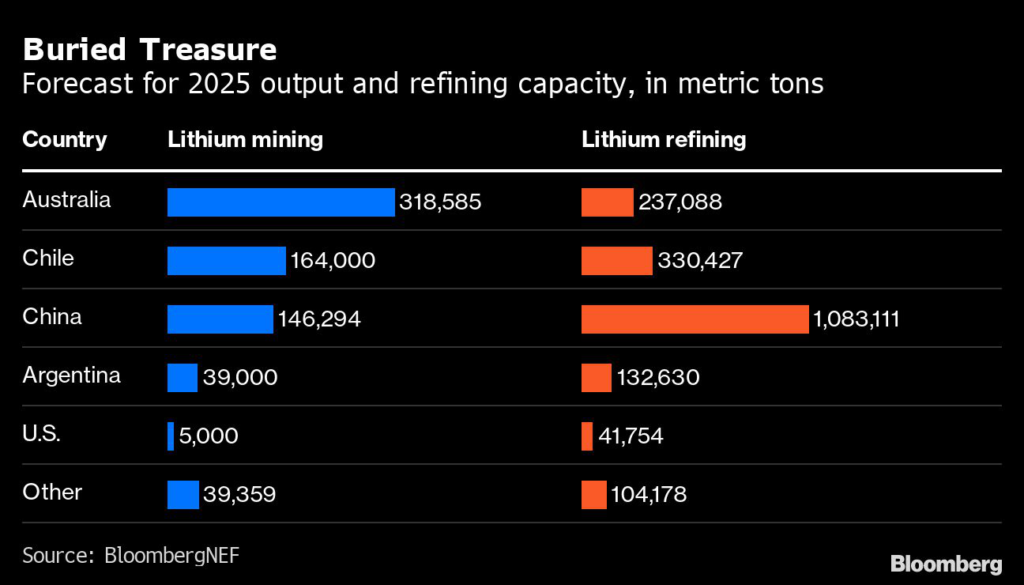
(Bloomberg) — Lithium powerhouse Australia, which produces about half of all unprocessed supplies of the raw material, needs to add capacity in refining and manufacturing to help the world meet surging demand for batteries, according to Tesla Inc. Chair Robyn Denholm.

Tesla alone will need more than 3 terabyte hours of lithium-ion batteries for electric vehicles and energy storage by 2030, compared to the industry’s current global capacity of about 1 terabyte, Denholm, who has helmed the automaker’s board since 2018, said Tuesday in Sydney.

“I can’t think of a technology that’s more important than lithium-ion batteries right now,” she said at the Australian Clean Energy Summit. “To meet the challenge of climate change this entire industry needs to scale at sprinting pace.”

Despite its vast mineral wealth, Australia accounts for only 7% of refined lithium supply and the nation can do more to use its advantages to develop production of specialist materials, battery cells and electric vehicles, according to Denholm. 

“Australia has the minerals — not just lithium — and also the knowhow and many of the skills to capture the opportunity of this new energy era,” she said. 

Read more: How a Battery Metals Squeeze Puts EV Future at Risk: QuickTake

Tesla and other carmakers have this year raised sticker prices, along with battery producers like Contemporary Amperex Technology Co. Ltd., in response to higher costs of raw materials, driven at least in part by demand that’s rising faster than production capacity. In lithium, almost $14 billion is needed to develop planned production capacity by 2025, according to BloombergNEF.  

Australia’s government should also seek to introduce fuel-efficiency standards to accelerate the adoption of electric vehicles, Denholm said. EVs accounted for 2.4% of new passenger vehicle sales in Australia last year, compared to 4.5% in the U.S. and 20% in Europe, BNEF said in a May report. “They must be strong standards,” Denholm said. “It’s no surprise that the cars on our roads are among the most polluting in the world. Australia currently accepts vehicles that the rest of the world doesn’t — they’re either too dirty or expensive to run.”

More stories like this are available on bloomberg.com

©2022 Bloomberg L.P.

Crypto ‘Altcoins’ Lead Push Higher as Bitcoin Jumps Above $22,000

(Bloomberg) — A rally in cryptocurrencies Tuesday took Bitcoin closer to breaking out of a one-month-old trading range and ignited big jumps in smaller tokens commonly referred to as altcoins.

The world’s largest virtual coin climbed as much as 6.8% to the cusp of $23,000, a level it was last at in mid-June. Ether at one point added almost 11%. Solana also achieved a double-digit percentage gain.

Bitcoin has struggled to escape a $19,000 to $22,000 range as investors lick their wounds from a rout sparked by tightening monetary policy and exacerbated by the toppling of crypto lenders and the TerraUSD stablecoin. 

A sustained break above could renew the speculative momentum that can grip crypto assets in the blink of an eye. Expectations for Federal Reserve interest-rate hikes are less aggressive now, which may help.

“We’ve just seen that momentum change, and I think that momentum change is going to last for the second half of this year,” said Julian Hosp, co-founder of Cake Defi, a crypto wallet solution provider.

Ether is extending a rally that began last week after developers of the Ethereum blockchain gave a target for the long-anticipated software update that is projected to lower the network’s energy usage.

Altcoins often outperform Bitcoin during rallies and underperform when prices are falling, in part because they’re a favorite of more speculative traders and tend to be less liquid.

“Bitcoin has recaptured the $22,000 level as some short-sellers need to call it quits,” Edward Moya, senior market analyst at Oanda Corp., wrote in a note. Cryptos are starting to look attractive now that expectations for Fed tightening have eased, he added.

The recent rebound in Bitcoin has pared its loss this year to about 52%. It was trading at $22,220 as of 10:27 a.m. in Tokyo. The overall market value of digital tokens has retaken the $1 trillion level.

More stories like this are available on bloomberg.com

©2022 Bloomberg L.P.
SoftBank Pauses Talks for Arm London Listing on UK Political Turmoil

(Bloomberg) — SoftBank Group Corp. has temporarily paused talks about listing shares of its chips division, Arm Ltd., in London because of turmoil in the UK government, while it continues to pursue an initial public offering for the business in New York, according to people familiar with the matter.

SoftBank founder Masayoshi Son has repeatedly said his primary focus is to take Arm public in the US because of its deep investor base and attractive valuations. In June, Son said he would also consider a London listing, in part because of political appeals.

The resignation of outgoing UK Prime Minister Boris Johnson, which was preceded by the walkout of many leading officials in his administration, has put those talks on hold for now, said the people, asking not to be named because the discussions are private. Investment minister Gerry Grimstone, who played a leading role in talks with SoftBank, is one of the officials who resigned. 

You can’t negotiate if there is no one on the other side to talk with, one of the people said, adding that the pause hasn’t changed SoftBank’s attitude toward a London Stock Exchange deal. A listing in Arm’s home market could still happen, but SoftBank remains focused on the US in 2023, according to the people.

SoftBank declined to comment. The company’s shares were little changed in morning trading in Tokyo on Tuesday.

The Financial Times reported earlier that SoftBank had halted work on a London IPO.

Arm, which the Japanese company acquired in 2016, is based in Cambridge, England. Arm was one of the UK’s most important technology companies before the purchase and still has the majority of its operations there. Johnson’s administration had lobbied hard to bring at least part of any initial public offering to the UK’s capital market. 

Arm sells and licenses technology that’s used by semiconductors in everything from smartphones to supercomputers. The pervasiveness of its products has made its planned IPO a closely watched event in the $550 billion chip industry. 

Son has said he plans to sell a portion of Arm before the end of the company’s financial year next March. 

The prospect for a return on his $32 billion purchase of Arm have dimmed as investors have shied away from chip-related stocks. The benchmark Philadelphia Stock Exchange Semiconductor Index has lost almost a third of its value in 2022.

(Updates with SoftBank’s response)

More stories like this are available on bloomberg.com

©2022 Bloomberg L.P.

Chips Bill Gains Steam in Senate Despite Last-Minute Lobbying

(Bloomberg) — A drive in the Senate to quickly pass $52 billion in grants and incentives for US semiconductor manufacturing picked up steam in Congress despite last-minute lobbying for changes.

Senate Majority Leader Chuck Schumer said Monday that Democrats and Republicans were “hashing out the final details on a bill so we can move forward this week.” 

He set a procedural vote for Tuesday.

The Biden administration, lawmakers from both parties and the semiconductor industry have called the chips incentives urgent amid a global shortage and supply chain disruptions that have affected industries including automobiles, electronics and appliances.

“This is a matter of national security,” said Senator Debbie Stabenow, a Michigan Democrat.

The legislation is a scaled-down version of a more expansive bill intended to make the US more competitive with China in technology and advanced manufacturing. That legislation has been hung up in negotiations between the House and Senate over how to merge their different versions. 

In addition to the chips money, a draft bill circulated by the Senate leadership includes a 25% investment tax credit for manufacture of semiconductors and tools to create semiconductors, $500 million for an international secure communications program, $200 million for worker training and $1.5 billion for public wireless supply-chain innovation, according to a copy of the text obtained by Bloomberg.

However, Senator Todd Young, an Indiana Republican who with Schumer was one of the co-sponsors of the original competitiveness bill, wants to include provisions that would establish a directorate for technology and innovation within the National Science Foundation to support basic and applied research and bolster education in science, technology, engineering and mathematics. Young conditioned his vote for the bill on those provisions being added into the draft.

Senator John Cornyn, a Texas Republican, said multiple senators “are very invested in” that portion of the legislation. “You may find some people who say that’s not enough,” to provide the incentives for chip manufacturing.

In the House, Ways and Means Chair Richard Neal said he was pushing for the House version of the investment tax credit to be used rather than Senate version. The House also would have to pass legislation before it could go to President Joe Biden’s desk.

The bill text also includes a provision that would bar companies that receive assistance from the US government from any “material expansion of semiconductor manufacturing capacity in the People’s Republic of China” or another foreign country of concern for 10 years after the award date. That restriction would also apply to new investments in Russia, according to a person familiar with the matter. It would not apply to “legacy” chips, as older technology is called.

Some companies have raised concerns about some of the language in that section, arguing it’s unnecessarily restrictive and could hurt their competitive advantage in the long run. The dispute is highly technical and centers on the types of chips and their relative performance attributes, certain types of which would be off limits for manufacturers despite already being produced in China. The industry is trying to balance politics, policy and a dynamic business environment, a person familiar with the matter said.

The White House has blessed the legislation, particularly the “guardrails” on investments in Chinese companies. 

The incentives are intended to “generate more semiconductor investment here in the US, not in China,” White House Press Secretary Karine Jean-Pierre said Monday. 

The legislation also is backed by tech giants such as International Business Machines Corp., which called the bill “essential.”  

“Every day that passes without this legislation is another day that leaves America dangerously dependent on limited foreign supplies of semiconductors,” IBM Vice Chairman Gary Cohn said in a statement. 

Proponents of the bill were trying to round up support, particularly among Republicans. 

Some key Republicans, including John Thune of South Dakota and Joni Ernst of Iowa, said Monday night they were undecided.  

“We’re looking at it, haven’t seen the final text so I haven’t made a decision yet,” Utah Republican Senator Mitt Romney said.

More stories like this are available on bloomberg.com

©2022 Bloomberg L.P.

‘Thor’ Maintains Lead at Box Office in Sequel’s Second Week

(Bloomberg) — “Thor: Love and Thunder,” Walt Disney Co.’s latest film featuring the hammer-throwing Norse god, topped the box office for a second straight weekend.

  • The superhero picture made $46.6 million in US and Canadian theaters, Comscore Inc. said Monday. It did so despite having some of the worst reviews of films from the Marvel comic book universe.
  • “Where the Crawdads Sing” and “Paws of Fury: The Legend of Hank,” two new movies that opened this weekend, finished in third and sixth place respectively.

Key Insights

  • The theater industry came roaring back this summer following two years of a pandemic that prompted cinema closures, film delays and overall skittishness by consumers. Movies with familiar characters, such as “Top Gun: Maverick” and “Jurassic World Dominion,” did particularly well.
  • “Minions: The Rise of Gru,” the latest animated movie from Universal Pictures and Illumination Entertainment, has continued to draw audiences, finishing in second place with $26.8 million in ticket sales in its third week. “The Gray Man,” one of the most-expensive films Netflix has produced, hit theaters in a limited run.

Read more: Netflix Changes Tack With Marketing for $200 Million Film

  • “Where the Crawdads Sing,” a mystery from Sony Pictures, generated $17.3 million in sales. An average of only 32% critics recommended the film, according to RottenTomatoes.com, with some citing a muddled story and lack of emotion. The picture, based on a popular novel, was co-produced by actress Reese Witherspoon.
  • “Paws of Fury,” with a 46% approval rating from critics, took in $6.3 million for Paramount Pictures. Next weekend’s releases include “Nope,” another horror film from director Jordan Peele.ee

Get More

  • See the schedule for upcoming releases.
  • See Boxoffice Pro’s long-range forecast.

More stories like this are available on bloomberg.com

©2022 Bloomberg L.P.

Ukraine Latest: Military Chief Says Situation Complex but Stable

(Bloomberg) — President Vladimir Putin said that Russia is facing “colossal challenges” in the high-tech sector, an unusually frank admission of the difficulties the Kremlin is experiencing as sanctions begin to bite.

US House Speaker Nancy Pelosi invited Olena Zelenska, Ukraine’s first lady, to address Congress on Wednesday. 

The European Union, which boosted military financing for Ukraine on Monday, is also set to approve some additional sanctions measures, including a ban on Russian gold. The EU’s foreign policy chief, Josep Borrell, said the EU must be prepared to deal with a cutoff of Russian gas. He also said he was hopeful Russia and Ukraine could clinch a deal this week to help export grain from the war-torn country. 

(See RSAN on the Bloomberg Terminal for the Russian Sanctions Dashboard.)

Key Developments

  • Russia Turns the Screws on Gas Market, Snubbing Transit Bookings
  • Russian Business Confidence Drops to Record Low, S&P Global Says
  • Coal-Rich Poland Rushes to Imports as Russian Sanctions Bite
  • EU Signs Deal to Double Azeri Gas Imports in Shift From Russia
  • Zelenskiy Bids to Oust Ukraine’s Security Chief, Top Prosecutor
  • Russia Orders Forces to Strike Ukraine’s Long-Range Weapons

On the Ground

Russia ordered its troops to step up combat in all areas and target Ukraine’s long-range weapons. Ukraine has used advanced US-supplied HIMARS systems to strike Russian logistics centers, supply routes and ammunition depots behind the front lines in recent weeks. A Russian missile ruined an elevator with more than 5,000 tons of grain in the Dnipropetrovsk region, local governor Valentyn Reznichenko said on Telegram. Russian missiles also hit a military facility and a bridge across the Dniester estuary west of Odesa, Natalia Humeniuk, a spokeswoman for the Ukrainian military’s southern command said.  

(All times CET)

Ukraine Military Commander Says Situation Has Stabilized (9:12 p.m.)

Ukraine’s military chief, Valeriy Zaluzhnyi, said Ukraine “has manage to stabilize the situation” in the country. 

“It is complex, intense, but completely controlled,” Zaluzhnyi said on Facebook after speaking with General Mark Milley, chairman of the US Joint Chiefs of Staff. “An important factor contributing to our retention of defensive lines and positions is the timely arrival of M142 HIMARS, which deliver surgical strikes on enemy control posts, ammunition and fuel storage depots.”

Zaluzhnyi and Milley also discussed an online meeting of the Ukraine Defense Contact Group, scheduled for July 20, where Ukraine’s military needs will be discussed.

First Lady to Address US Congress Wednesday (8:01 p.m.)

Olena Zelenska, the first lady of Ukraine and wife of President Volodymyr Zelenskiy, was invited to address the US Congress on Wednesday by Speaker Nancy Pelosi.

The day before her address, Zelenska, who met with US first lady Jill Biden during an unannounced visit to Ukraine in May, will accept a human rights award at the Victims of Communism Museum, according to a statement from the organization.

Borrell Urges EU to Prepare for Gas Cutoff (6:40 p.m.)

A gas cut-off from Russia would pose a major hurdle but the EU is ready to deal with the consequences, the bloc’s foreign policy chief Josep Borrell said following a meeting of EU foreign ministers in Brussels.

Borrell said the EU wasn’t considering new sanctions against Russia when it comes to gas but the bloc is discussing how to deal with a swift decrease in the supply of gas. “It’s not going to be an easy scenario, but we should be prepared for that,” he said.

Gazprom Declares Force Majeure on Some European Gas Buyers (4:30 p.m.)

Gazprom PJSC declared force majeure on at least three European gas buyers, a move that may signal it intends to keep supplies capped, according to people familiar with the matter.

The Russian gas giant — which had already been curbing exports to Europe and closed its main pipeline for maintenance earlier this month — said in a letter dated July 14 that the legal clause applied to supplies over the past month, said the people.

EU Estimates Russian Gas Halt to Cut GDP by 1.5% in Worst Case (4:05 p.m.) 

A halt of Russian gas supplies to the EU could potentially reduce its gross domestic product by as much as 1.5% if the next winter is cold and the region fails to take preventive measures to save energy, according to new estimates from the bloc.

The European Commission is set to warn that, in the event of an average winter, a cut-off of gas shipments from Moscow would reduce the GDP by between 0.6% and 1%, says a draft EU document seen by Bloomberg News. The EU’s executive arm is planning a set of recommendations to member states to mitigate the impact of a possible full disruption by Russia, its biggest source of imports. 

Putin Says Sanctions Causing Russia ‘Colossal’ Tech Woes (2:25 p.m.)

Russia faces “colossal challenges” in high technology from international sanctions, but won’t simply give up or allow its economy to fall back by decades, Putin told officials during a videoconference on strategic development goals.

Instead, Moscow will “intensively” seek solutions by relying on the country’s own technological resources and the work of domestic innovative companies, the Russian president said, even as he chided the state-run Rostec corporation for failing to meet previous targets for development of internet technology.

Russia Fines Google $382 Million, Tass Says (2:15 p.m.)

A Moscow court ordered the local unit of Alphabet Inc.’s Google to pay a 21.77 billion ruble ($382 million) fine for not removing content banned in Russia, Tass reported from the courtroom.

The fines, for repeated violations of orders to take down content deemed illegal, could be used as a pretext to block various Google services in Russia as the Kremlin cracks down on foreign tech companies.

Google’s local subsidiary filed for bankruptcy in June after authorities froze its local bank account amid escalating fines related to YouTube. However, it continues to offer free services, including search functions, YouTube, Gmail and Google Play.

More stories like this are available on bloomberg.com

©2022 Bloomberg L.P.

Bolsonaro Calls Ambassadors to Cast Doubt on Electoral System

(Bloomberg) — President Jair Bolsonaro told foreign ambassadors that Brazil’s electronic voting machines are subject to fraud, rehashing old and debunked conspiracy theories about the security of the system Brazil has been using for more than two decades.

Bolsonaro invited ambassadors to a meeting at his official residence on Monday to “exchange ideas about the electoral process,” according to a statement from the his office. The list of attendees wasn’t published by the government, but about 70 cars with representatives from foreign governments were seen leaving the presidential palace.

“I’m always accused of trying to stage a coup; I’m questioning [the security of the electronic ballots] in advance because we still have time to solve this problem,” Bolsonaro told his guests, according to remarks broadcast by Brazil’s state TV.

Bolsonaro, trailing former President Luiz Inacio Lula da Silva in all major opinion polls ahead of October’s elections, has repeatedly cast doubt about the reliability of Brazil’s electronic voting system, even claiming without proof that his 2018 election was rigged against him as he should have won it in the first round of voting. 

Read More: Bolsonaro’s Brawl With a Top Justice Tests Brazil’s Democracy

His invitation to foreign ambassadors came after electoral authorities invited them late in May to show evidence that Brazil’s voting system is safe and to invite them to work as foreign observers during the election. 

Top Justice Edson Fachin, the head of Brazil’s electoral court, said after Bolsonaro’s meeting that statements to discredit Brazil’s voting system are “fake news.” 

“The electoral justice is prepared and will carry out the 2022 election in a clean, transparent and auditable way,” he told an event organized by Brazil’s bar association. “The accusation of fraud and bad faith once again without presenting any evidence is very serious,” he added.

Read More: Brazil Electoral Court Fears Capitol-Style Riots in October Vote

Bolsonaro’s office didn’t immediately reply to a request for comment on Fachin’s remarks.

Senate President Rodrigo Pacheco added that the security of Brazil’s electoral process can no longer be questioned. 

“There’s no justification nor reason for that,” he wrote in a Twitter post. “Such questions are bad for Brazil in all aspects.” 

More stories like this are available on bloomberg.com

©2022 Bloomberg L.P.
Apple Joins Fellow Tech Giants in Putting a Lid on Hiring

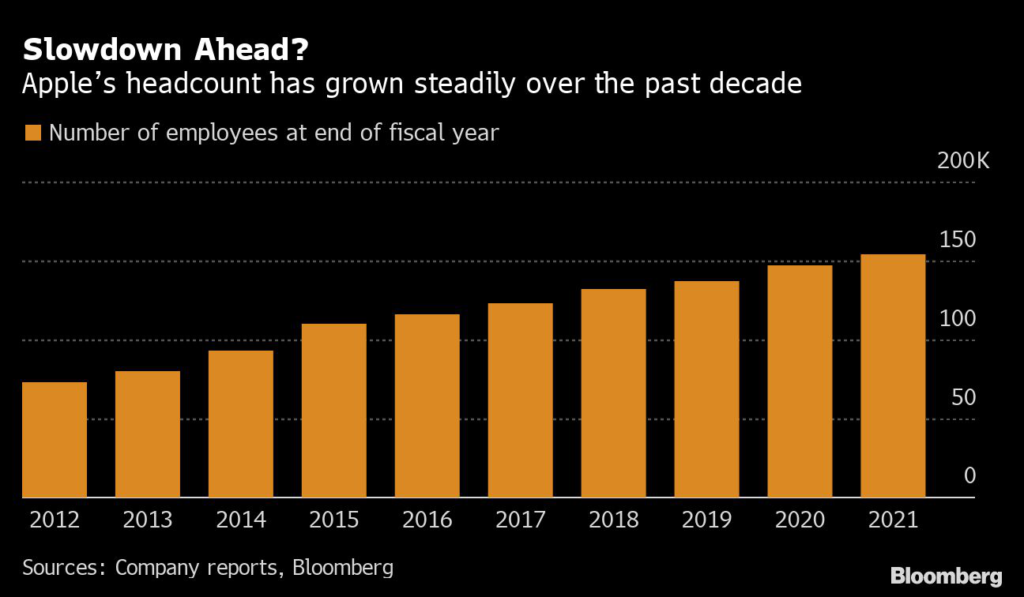
(Bloomberg) — Apple Inc. is the latest major technology company to rein in hiring and spending plans, adding to the evidence that even Silicon Valley stalwarts are worried about a recession in the coming months. 

The iPhone maker is looking to limit expenditures and job growth at some of its divisions, Bloomberg reported Monday, though Apple hasn’t adopted a companywide policy. The more cautious stance mimics the approach of its tech peers, including Amazon.com Inc., Alphabet Inc.’s Google and Microsoft Corp., which have all taken steps to decelerate spending. 

The news sent stocks sliding and increased trepidation surrounding tech earnings season, which goes into full swing this week. It may be difficult for companies to reassure jittery investors. International Business Machines Corp. posted better-than-expected sales growth Monday, only to see its shares slip in late trading.

For now, most of the biggest tech companies aren’t talking about eliminating jobs, just reducing the rate of hiring. And overall US job growth hasn’t stalled. Payrolls increased 372,000 in June, beating the 265,000 estimate, with manufacturing jobs helping bolster the numbers.

The US added 25,000 information jobs in June, putting that category 105,000 higher than just before the pandemic.

But some tech companies are going as far as cutting jobs. That includes Microsoft, which said last week that it was eliminating some positions as part of a reorganization.

The reduction affects less than 1% of its 180,000-person workforce, and Microsoft still expects to end the year with increased headcount. But it follows a move in May to slow hiring at the Windows, Office and Teams divisions “as Microsoft gets ready for the new fiscal year.”

Last month, Tesla Inc. laid off hundreds of workers and shuttered a California facility devoted to its Autopilot self-driving technology, according to people familiar with the matter.

Chief Executive Officer Elon Musk said earlier that layoffs would be necessary in an increasingly shaky economic environment. He clarified in a subsequent interview with Bloomberg that about 10% of salaried employees would lose their jobs over the next three months, though the overall headcount could be higher in a year.

Former pandemic highfliers like Netflix Inc. and Peloton Interactive Inc. also have been laying off workers in recent months. Netflix trimmed a few hundred jobs in June, and Peloton just announced plans to shutter its in-house manufacturing.

Facebook parent Meta Platforms Inc. has cut spending and slowed hiring for some senior-level positions. In April, the company announced plans to slash expenses by $3 billion this year. The idea is to refocus Meta’s product teams on core priorities, like the metaverse and its TikTok clone, Reels.

Meta also halted development on one of its early smartwatch prototypes and repositioned its in-home video device, Portal, to focus more on business customers instead of regular consumers.

Last week, Google CEO Sundar Pichai told staff that the company planned to slow hiring for the remainder of 2022 — a rare move for the internet giant, which typically adds tens of thousands of employees every year. Google will be focusing its hiring on technical and “other critical roles” through this year and the next.

“We need to be more entrepreneurial, working with greater urgency, sharper focus and more hunger than we’ve shown on sunnier days,” he said.

Other companies are looking to wind down ambitious growth plans without the need for major layoffs.

Amazon staffed up during the pandemic so it could handle a surge in e-commerce spending. That’s now left it overstaffed in its warehouses, but the company has said it’s working through that problem with attrition.

In some cases, Amazon is subleasing warehouse space and has paused development of facilities meant for office workers, saying it needs more time to determine how much space employees will require for hybrid work.

Amazon CEO Andy Jassy said the company made the decision early in the pandemic to err on the side of having too many workers and too much warehouse space — rather than too little.

“We knew it might mean that we might have more capacity for some short period of time,” he said.

A key question during the latest earnings season is whether demand from consumers has softened. Apple warned in April that the latest quarter would be bumpy, but mostly because of supply-chain challenges. 

Those problems are expected to erase as much as $8 billion from Apple’s sales in the quarter. Investors should get a clearer picture of the damage — and Apple’s outlook for the coming months — when it reports results on July 28.

More stories like this are available on bloomberg.com

©2022 Bloomberg L.P.
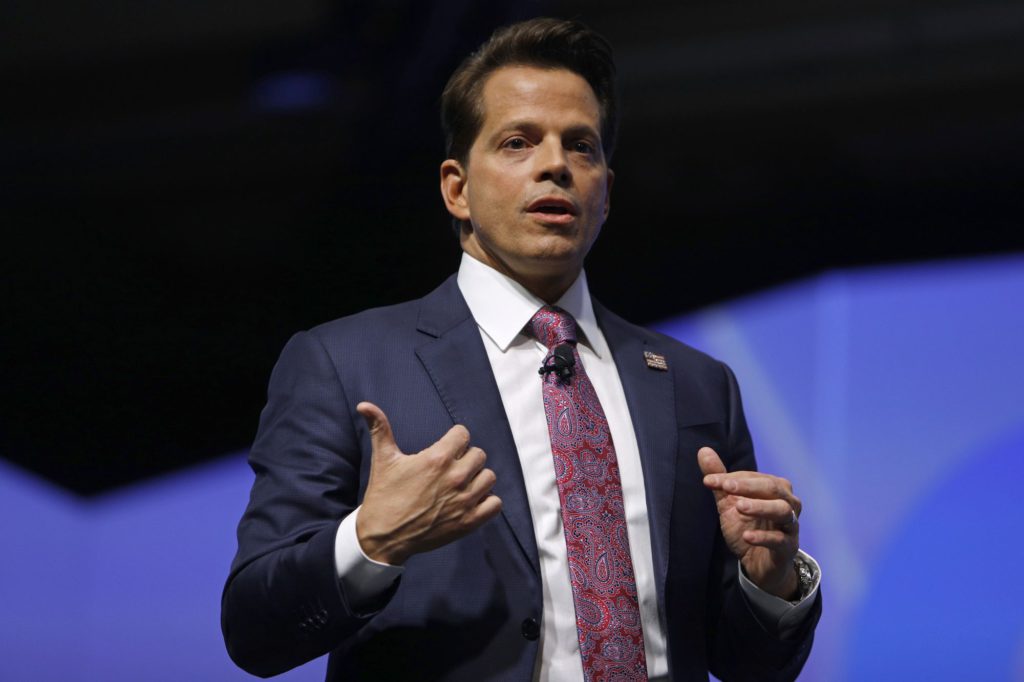
Scaramucci Halts Withdrawals in a Fund After Stock, Crypto Swoon

(Bloomberg) — Anthony Scaramucci’s Skybridge Capital suspended redemptions in one of its funds after sharp declines in stocks and cryptocurrencies, according to people familiar with the decision. 

The Legion Strategies fund suspended redemptions because private companies, which are harder to sell, now make up about 20% of the portfolio, one of the people said. The fund is one of Skybridge’s smaller offerings, farming out most of its roughly $230 million of assets to hedge fund managers.

FTX, the crypto exchange co-founded by billionaire Sam Bankman-Fried, is among the fund’s private investments.  

Scaramucci — who returned to money management after spending 11 days in the White House as the Trump administration’s communications director — made a big push into crypto, a move that has hurt Skybridge’s performance this year. An index of the 100 largest digital assets has tumbled 56% in 2022.   

Read more: Scaramucci’s Crypto Pivot Comes With an Eye on Tripling Assets

The Legion Strategies fund gained exposure to digital assets through other funds managed by Skybridge, including vehicles focused on Bitcoin, Ethereum and Algorand, according to a regulatory filing. As of Feb. 28, almost a quarter of Legion’s net assets were invested in such fund.

Skybridge runs a larger fund-of-funds, the Multi-Adviser Hedge Fund Portfolios, which managed about $2 billion as of March 31, according to a separate filing. That fund fell about 5.5% for the year through March 31. 

Redemptions for that fund are made through a tender offer by Skybridge. The firm told clients it will buy back 10% of the fund’s shares at the end of September, the next time investors are allowed to pull money, one of the people said. 

A representative for New York-based Skybridge didn’t reply to messages seeking comment.

More stories like this are available on bloomberg.com

©2022 Bloomberg L.P.

Close Bitnami banner
Bitnami
