Bloomberg

Three Arrows Creditors Include Crypto Giants, Co-Founder’s Wife

(Bloomberg) — A creditor list of bankrupt crypto hedge fund Three Arrows Capital puts the interconnected nature of the industry on display, with lenders ranging from some of the biggest digital-asset firms to the wife of co-founder Kyle Davies.

At the top is Digital Currency Group Inc., the parent company of crypto brokerage Genesis, which filed a $1.2 billion claim against Three Arrows, according to people familiar with the matter who reviewed a court filing. Chen Kaili Kelly, the wife of Davies, also filed a claim of about $66 million, the filing shows. And co-founder Zhu Su himself submitted a $5 million claim. It’s not immediately clear how Three Arrows was structured to allow Zhu to be a creditor.

The full extent of the impact of Three Arrows’s implosion on the industry is starting to emerge as it undergoes a liquidation process ordered by a British Virgin Islands court. Celsius Network and Voyager Digital, which both filed for bankruptcy in recent weeks, are among other creditors taking a hit from Three Arrows. Deribit, a crypto derivatives exchange, has a $80 million claim filed under the entity name DRB Panama Inc. 

Three Arrows has become emblematic of the industry’s excesses during last year’s bull run, when firms built up leverage that hobbled them as the market turned. Its downfall has rippled through the digital asset industry, leading to some, such as BlockFi Inc, seeking rescue finding, while others filed for bankruptcy protections. The whereabouts of co-founders Su and Davies are still unknown, liquidators have said. Davies told the Wall Street Journal earlier that the fund had roughly $3 billion in assets under management in April before crypto markets crashed.

Genesis had earlier disclosed that it was exposed to Three Arrows, and a July 9 filing in Singapore high court lists a $2.36 billion loan to the fund from Genesis Asia Pacific Pte Ltd. Genesis sold collateral and hedged its downside once Three Arrows failed to meet a margin call, Michael Moro, chief executive officer of Genesis, said in a series of tweets this month, without specifying the hedging strategy it employed. The loans to Three Arrows had a weighted-average margin requirement of over 80%, he said, without disclosing the total loan amount or the economic loss. Digital Currency Group has since assumed some of these liabilities.  

“Both the DCG and Genesis balance sheets remain strong. With no remaining exposure to Three Arrows Capital, Genesis continues to be well-capitalized and its operations are business as usual,” a spokesperson for DCG said in an emailed statement. 

More stories like this are available on bloomberg.com

©2022 Bloomberg L.P.

Bank of America Hires Barclays Banker Ahuja for Technology Deals

(Bloomberg) — Bank of America Corp. hired Akhil Ahuja from Barclays Plc for its technology investment banking team, according to people with knowledge of the matter.

Ahuja will join Bank of America in October as a managing director and will be based in Palo Alto, California, said one the people, who asked not to be identified discussing a private matter.

Representatives for Bank of America and Barclays declined to comment, while Ahuja couldn’t be reached for comment.

The hire is the latest in a string of additions to Bank of America’s technology group, which brought in Nick Hopkins from Goldman Sachs Group Inc. this month. Earlier this year, the company added Kaushik Banerjee and Neal Nisargand to its technology investment-banking team.

Ahuja was head of enterprise and communications technology banking at Barclays. Previously, Ahuja was head of systems and infrastructure software banking at Wells Fargo & Co. 

Even amid the tightest labor market in half a century and fears of a recession on the horizon, banks have continued adding to their ranks.

In the second quarter, investment banking fell by about half across the six biggest US banks, with markets upended by a war in Ukraine, inflation and other macroeconomic concerns. Still, mergers and acquisitions and other investments in the finance and technology industries have fared better with continued demand for bankers with expertise in those sectors.

More stories like this are available on bloomberg.com

©2022 Bloomberg L.P.

Bitcoin Rally Prompts Outsized Gains In Crypto Mining Stocks

(Bloomberg) — Shares of Bitcoin miners are outperforming the largest digital currency by a wide margin as demand for a way to gain exposure to the sector without actually buying the token rebounds. 

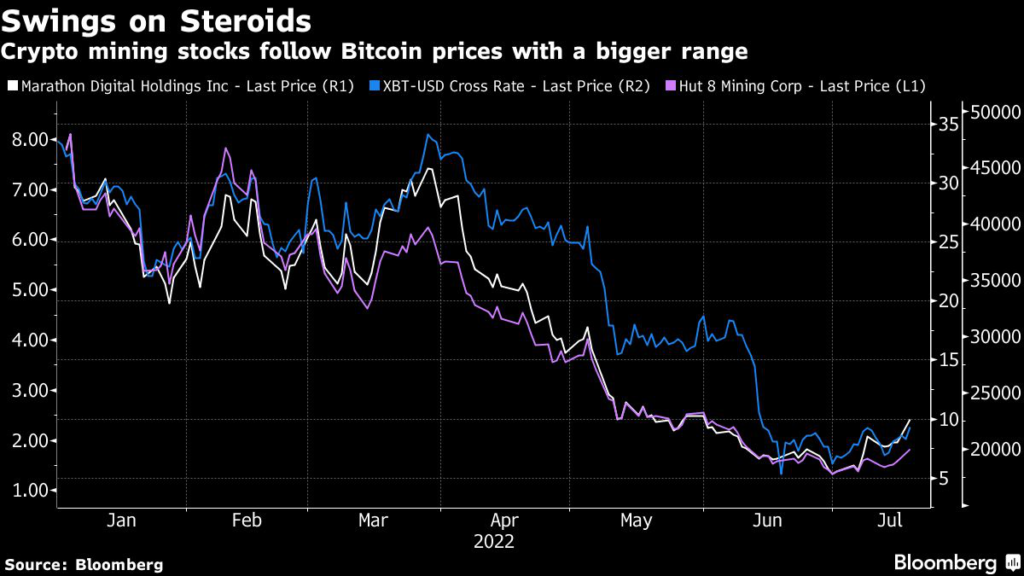
While Bitcoin rose as much as 7.5%, shares of top miners such as Marathon Digital Holdings Inc. and Riot Blockchain Inc. jumped by as much as 36% and 23%, respectively. Core Scientific Inc. and Hut 8 Mining Corp. also jumped by more than 20%. And even software maker MicroStrategy Inc., which invests in Bitcoin, jumped as much as 32%. 

Mining stocks have been highly correlated with Bitcoin prices but often move in a bigger range since they’ve become a favorite among retail investors. 

The miners that still have relatively large Bitcoin holdings on their balance sheets have been among the top-performing companies during this Bitcoin rebound. Marathon and Hut 8 were two of the few public miners that have not sold any mined coins. 

Low Bitcoin prices have forced most miners to sell their coins to cover operational costs and complete large purchase orders they made several months ago during the bull run. Core Scientific sold most of their holdings in June, while Bitfarms liquidated nearly half of their Bitcoin treasury to pay down a loan. Miners used to be some of the most adamant holders during the bull market, where large Bitcoin holdings could boost their balance sheets as the token appreciated. 

Mining stocks are still deep in the red this year with Marathon and Riot both down by around 70%. 

More stories like this are available on bloomberg.com

©2022 Bloomberg L.P.

Sick Honeybees Could Find Salvation in Covid Vaccine Technology

(Bloomberg) — Technology used to develop Covid-19 vaccines may also help combat a honeybee-killing pest.

GreenLight Biosciences is developing an RNA-based syrup to attack varroa mites, a parasite that attaches itself to honeybees and feeds off them while spreading diseases. The RNA acts as an “off switch” that interferes with the mites, disrupting their ability to lay offspring that attach to bees, said Mark Singleton, chief commercial officer and general manager of plant health at the Boston-based firm.

“We are really putting a dent in the ability of mites to reproduce,” he said.

Anecdotal feedback shows that hives using his company’s treatment are healthier and have a higher survival rate, according to Singleton, whose biotech firm worked with large-scale US beekeepers to test the technology.Varroa mites are thought to be one of the reasons behind the staggeringly high death rates that have become so common among honeybees. Catastrophic bee deaths in Canada this year left too few commercial hives to pollinate blueberry crops, a troubling sign of the bee crisis entering a new stage.  Australia, a major bee exporter and honey producer, imposed a bee lockdown after the mite was discovered in the country’s most populous state.

Read More: Beehive Wipeout Is Crimping Harvests as Crisis Enters New Stage

Moderna Inc. and Pfizer-BioNTech SE used experimental messenger RNA technology to develop Covid-19 vaccines that instruct the body to make the spike protein the coronavirus uses to enter cells, which in turn stimulates production of antibodies. GreenLight Biosciences acquired the RNA technology from Bayer in 2020 and it is the first RNA regulation that directly targets the mites, which reproduce in the same cells as bee larvae.

Unlike chemical options that exist to control the mites, RNA is naturally occurring and degrades without causing any harm to the bees, Singleton said.  The product is placed in an envelope with holes that beekeepers put in a hive. The bees do the rest—ultimately delivering it to where mites produce. GreenLight plans to submit its product for approval to the US Environmental Protection Agency by year end and, if approved, it could be commercially available by 2024.

“Without bees, 30% of the world’s food goes away and most of the quality foods we’re supposed to eat goes away,” Singleton said. “These varroa mites are not going to go away on their own.”

More stories like this are available on bloomberg.com

©2022 Bloomberg L.P.

Sick Honeybees Find Lifeline in Covid Vaccine Technology

(Bloomberg) — Technology used to develop Covid-19 vaccines may also help combat a honeybee-killing pest.

GreenLight Biosciences is developing an RNA-based syrup to attack varroa mites, a parasite that attaches itself to honeybees and feeds off them while spreading diseases. The RNA acts as an “off switch” that interferes with the mites, disrupting their ability to lay offspring that attach to bees, said Mark Singleton, chief commercial officer and general manager of plant health at the Boston-based firm.

“We are really putting a dent in the ability of mites to reproduce,” he said.

Anecdotal feedback shows that hives using his company’s treatment are healthier and have a higher survival rate, according to Singleton, whose biotech firm worked with large-scale US beekeepers to test the technology.Varroa mites are thought to be one of the reasons behind the staggeringly high death rates that have become so common among honeybees. Catastrophic bee deaths in Canada this year left too few commercial hives to pollinate blueberry crops, a troubling sign of the bee crisis entering a new stage.  Australia, a major bee exporter and honey producer, imposed a bee lockdown after the mite was discovered in the country’s most populous state.

Read More: Beehive Wipeout Is Crimping Harvests as Crisis Enters New Stage

Moderna Inc. and Pfizer-BioNTech SE used experimental messenger RNA technology to develop Covid-19 vaccines that instruct the body to make the spike protein the coronavirus uses to enter cells, which in turn stimulates production of antibodies. GreenLight Biosciences acquired the RNA technology from Bayer in 2020 and it is the first RNA regulation that directly targets the mites, which reproduce in the same cells as bee larvae.

Unlike chemical options that exist to control the mites, RNA is naturally occurring and degrades without causing any harm to the bees, Singleton said.  The product is placed in an envelope with holes that beekeepers put in a hive. The bees do the rest—ultimately delivering it to where mites produce. GreenLight plans to submit its product for approval to the US Environmental Protection Agency by year end and, if approved, it could be commercially available by 2024.

“Without bees, 30% of the world’s food goes away and most of the quality foods we’re supposed to eat goes away,” Singleton said. “These varroa mites are not going to go away on their own.”

More stories like this are available on bloomberg.com

©2022 Bloomberg L.P.

Airbus CEO Expects to Resolve ‘Glider’ Aircraft by End of Year

(Bloomberg) — Airbus SE Chief Executive Officer Guillaume Faury said he’s hopeful to have fixed supply issues by the end of the year that will allow the manufacturer to clear out all of its so-called gliders — fully built aircraft sitting on the ground without engines.

The planemaker now has 26 planes without engines, six more than at the end of May, Faury said in an interview at the Farnborough air show. Faury said engine manufacturers CFM International and Pratt & Whitney have assured him that they were ramping up production and that the issue should start getting better by the third quarter.

Airbus and arch rival Boeing Co. are struggling with a shortage of components from engines to computer chips as the world emerges from the pandemic. Airbus also has to contend with energy shortfalls as gas supplies are threatened by the fallout of the war in Ukraine. 

“The situation is slightly worse than what it was at the end of May,” Faury said. “We think we’re at the bottom of the problem and things will probably get better moving forward.”

Companies throughout the aerospace supply chain are battling with materials and labor shortages. Boeing said Monday it, too, was struggling with engine shortages but vowed not to build so-called gliders as it takes a more cautious approach to its own ramp-up. 

Airbus has charted an ambitious plan to push production of its flagship A320 family of aircraft to 75 planes a month by mid-2025. The manufacturer got a blockbuster China order a few weeks ago, but Faury said it’s too early to consider higher rates. Rather, the order will help serve the ramp up to rate 75, where Airbus hopes to stay for several years, he said.

The Airbus CEO reiterated his optimism on demand for larger twin-aisle jets, saying the recovery is happening faster than expected in this segment. He said he sees the company selling out on wide-body slots by the middle of the decade. 

Due to supply-chain constraints, Airbus is focused on serving existing customers, Faury said.

“We will be taking orders as well but we are really focusing as much as we can on getting things in order in the supply chain and being able to deliver,” he said.


More stories like this are available on bloomberg.com

©2022 Bloomberg L.P.

Ukraine Latest: EU Preparing to Deal With Cutoff of Russian Gas

(Bloomberg) — President Vladimir Putin said that Russia is facing “colossal challenges” in the high-tech sector, an unusually frank admission of the difficulties the Kremlin is experiencing as sanctions begin to bite.

The European Union, which boosted military financing for Ukraine on Monday, is also set to approve some additional sanctions measures, including a ban on Russian gold. 

The EU’s foreign policy chief, Josep Borrell, said the EU must be prepared to deal with a cutoff of Russian gas. He also said he was hopeful Russia and Ukraine could clinch a deal this week to help export grain from the war-torn country and avert a global food crisis. The comments come a day before Turkish President Recep Tayyip Erdogan meets Putin to discuss efforts to facilitate shipments of Ukrainian grain through the Black Sea. 

(See RSAN on the Bloomberg Terminal for the Russian Sanctions Dashboard.)

Key Developments

  • Russia Turns the Screws on Gas Market, Snubbing Transit Bookings
  • Russian Business Confidence Drops to Record Low, S&P Global Says
  • Coal-Rich Poland Rushes to Imports as Russian Sanctions Bite
  • EU Signs Deal to Double Azeri Gas Imports in Shift From Russia
  • Zelenskiy Bids to Oust Ukraine’s Security Chief, Top Prosecutor
  • Russia Orders Forces to Strike Ukraine’s Long-Range Weapons

On the Ground

Russia ordered its troops to step up combat in all areas and target Ukraine’s long-range weapons. Ukraine has used advanced US-supplied HIMARS systems to strike Russian logistics centers, supply routes and ammunition depots behind the front lines in recent weeks. A Russian missile ruined an elevator with more than 5,000 tons of grain in the Dnipropetrovsk region, local governor Valentyn Reznichenko said on Telegram. Russian missiles also hit a military facility and a bridge across the Dniester estuary west of Odesa, Natalia Humeniuk, a spokeswoman for the Ukrainian military’s southern command said.  

(All times CET)

Borrell Urges EU to Prepare for Gas Cutoff (6:40 p.m.)

A gas cut-off from Russia would pose a major hurdle but the EU is ready to deal with the consequences, the bloc’s foreign policy chief Josep Borrell said following a meeting of EU foreign ministers in Brussels.

Borrell said the EU wasn’t considering new sanctions against Russia when it comes to gas but the bloc is discussing how to deal with a swift decrease in the supply of gas. “It’s not going to be an easy scenario, but we should be prepared for that,” he said.

Gazprom Declares Force Majeure on Some European Gas Buyers (4:30 p.m.)

Gazprom PJSC declared force majeure on at least three European gas buyers, a move that may signal it intends to keep supplies capped, according to people familiar with the matter.

The Russian gas giant — which had already been curbing exports to Europe and closed its main pipeline for maintenance earlier this month — said in a letter dated July 14 that the legal clause applied to supplies over the past month, said the people.

EU Estimates Russian Gas Halt to Cut GDP by 1.5% in Worst Case (4:05 p.m.) 

A halt of Russian gas supplies to the EU could potentially reduce its gross domestic product by as much as 1.5% if the next winter is cold and the region fails to take preventive measures to save energy, according to new estimates from the bloc.

The European Commission is set to warn that, in the event of an average winter, a cut-off of gas shipments from Moscow would reduce the GDP by between 0.6% and 1%, says a draft EU document seen by Bloomberg News. The EU’s executive arm is planning a set of recommendations to member states to mitigate the impact of a possible full disruption by Russia, its biggest source of imports. 

Putin Says Sanctions Causing Russia ‘Colossal’ Tech Woes (2:25 p.m.)

Russia faces “colossal challenges” in high technology from international sanctions, but won’t simply give up or allow its economy to fall back by decades, Putin told officials during a videoconference on strategic development goals.

Instead, Moscow will “intensively” seek solutions by relying on the country’s own technological resources and the work of domestic innovative companies, the Russian president said, even as he chided the state-run Rostec corporation for failing to meet previous targets for development of internet technology.

Russia Fines Google $382 Million, Tass Says (2:15 p.m.)

A Moscow court ordered the local unit of Alphabet Inc.’s Google to pay a 21.77 billion ruble ($382 million) fine not removing content banned in Russia, Tass reported from the courtroom.

The fines, for repeated violations of orders to take down content deemed illegal, could be used as a pretext to block various Google services in Russia as the Kremlin cracks down on foreign tech companies.

Google’s local subsidiary filed for bankruptcy in June after authorities froze its local bank account amid escalating fines related to YouTube. However, it continues to offer free services, including search functions, YouTube, Gmail and Google Play.

Read more: Google to File to Bankrupt Russian Unit Amid Mounting Fines

EU Approves More Ukraine Arms Financing (1:15 p.m.)

EU foreign ministers approved another 500 million euros ($507 million) in military aid to Ukraine, boosting the total arms financing to 2.5 billion euros. It’s the fifth round of financing under the so-called European Peace Facility, which reimburses governments for military deliveries to Ukraine. 

Russia Keeps Gas Buyers Guessing (11:08 a.m.)

Moscow again rejected additional gas-pipeline space offered by Ukraine, keeping European buyers guessing as future flows on the key Nord Stream route also remain uncertain.

At a monthly auction on Monday, Russia’s Gazprom PJSC opted not to book extra capacity to ship gas to Europe via Ukrainian pipelines in August. That keeps deliveries to the continent tight, just as concern grows that the Nord Stream link may not fully return when maintenance ends later this week.

Russia’s squeeze on gas supplies has unsettled the market, with European benchmark futures more than doubling in value this year. Last week, Germany started to withdraw gas from stockpiles that it had been building up for winter, while Hungary declared an “energy state of emergency.”

Russia Turns the Screws on Gas Market, Snubbing Transit Bookings

Russia Eyes Cooperation Pact With Iran (10:37 a.m.)

Russia handed a draft comprehensive strategic cooperation treaty to Iran in mid-June and expects to sign it in the near future, Interfax quoted Russian presidential spokesman Dmitry Peskov as saying. 

It said some amendments were required taking into account Iranian opinion.

Russia Former State-TV Staffer Released (10:07 a.m.)

Russian police released a former state-television employee after several hours of detention, charging her under a strict new law against criticizing the Kremlin’s invasion of Ukraine.

Marina Ovsyannikova, who fled Russia earlier this year after being charged for holding up an anti-war sign on the main evening television news, has conducted several public protests since returning earlier this month for a child-custody hearing. On Friday, she stood across the Moscow River from the Kremlin, holding a homemade sign blaming President Vladimir Putin for the deaths of children killed in the war.

Police detained her Sunday for making anti-war statements outside the trial last week of another activist facing jail time for his protests. Ovsyannikova’s lawyer, Dmitry Zakhvatov, said she was charged with an administrative violation, punishable with a fine.

Zelenskiy Pledges Security Clean-Up (10:01 a.m.)

Kyiv pledged to clean up law-enforcement agencies after President Volodymyr Zelenskiy removed the country’s security chief and suspended its top prosecutor over allegations that dozens of staff were collaborating with Moscow. 

Ivan Bakanov, a childhood friend of Zelenskiy, was removed from his post as head of the State Security Service amid questions over how Russia managed to capture the southern region of Kherson. Iryna Venediktova, named prosecutor general in 2020, is also a Zelenskiy ally and lawmaker on his party list. 

Andriy Smyrnov, deputy chief of Zelenskiy’s staff, said in televised comments on Monday that Ukraine would find anyone working with or leaking information to Russia. The president said last Sunday that 651 people were already facing trial on charges of treason and collaborating with the enemy. 

Russia-Backed RT To Get EU Sanctions Ruling (9:45 a.m.)

RT, the Kremlin-backed TV network formerly called Russia Today, will get a July 27 ruling from the European Union General Court on whether its inclusion on the EU’s sanctions list over the Ukraine invasion was justified.

RT’s France unit told the court that the EU’s decision was a curb on press freedom that had no justification in law. The ruling date was announced on the court website.

Russia Orders Strikes on Long-Range Arms (8:43 a.m.)

Russian Defense Minister Sergei Shoigu ordered part of his forces to focus on destroying Ukraine’s long-range missile and artillery systems during a visit to the Vostok army group in the occupied east of the country.  

The order comes after Ukraine received advanced US-supplied HIMARS long-range artillery systems in recent weeks capable of striking Russian targets as far as 80 kilometers (50 miles) away. That has allowed it to hit logistics centers, supply lines and ammunition dumps deep behind the front lines and mostly from beyond the range of Russian artillery.

Ukraine sees Russian forces struggling to find safe places to store munitions in occupied areas as they also increasingly lack transport to move them, Natalia Humeniuk, a spokeswoman for the Ukrainian military’s southern command said on television.

Russia Orders Forces to Strike Ukraine’s Long-Range Weapons

EU’s Borrell Hopeful on Ukraine Grain Deal (8:07 a.m.)

The EU’s foreign policy chief said he was hopeful Russia and Ukraine could clinch a deal this week to help export grain from the war-torn country and alleviate a growing global food crisis.

“I have a hope that this week it will be possible to reach an agreement to deblock Odesa and other Ukrainian ports,” Josep Borrell told reporters ahead of a meeting of EU foreign ministers in Brussels. “The lives of tens of thousands of people depend on this agreement. It’s not a diplomatic game.”

Turkish President Recep Tayyip Erdogan has sought to broker a deal that would facilitate shipments of Ukrainian grain through the Black Sea and meets Vladimir Putin on Tuesday. 

H&M to Exit Russia at $190 Million Cost (7:57 a.m.)

H&M will begin winding down its operations in Russia, having halted all sales in the country in March.

The Swedish fashion retailer expects to book costs of $190 million from the process, it said in a statement Monday. It plans to reopen physical stores in Russia for a limited period of time to sell remaining inventory.

“After careful consideration, we see it as impossible given the current situation to continue our business in Russia,” Chief Executive Officer Helena Helmersson, said.

Russian Gas Flows to Europe Still Limited (6:42 a.m.)

Russian natural gas supplies to Europe remain curbed, with flows sent via Ukraine below capacity and the Nord Stream pipeline shut for annual maintenance until July 21. 

Russian Gas Flows to Europe Remain Curbed Amid Nord Stream Works

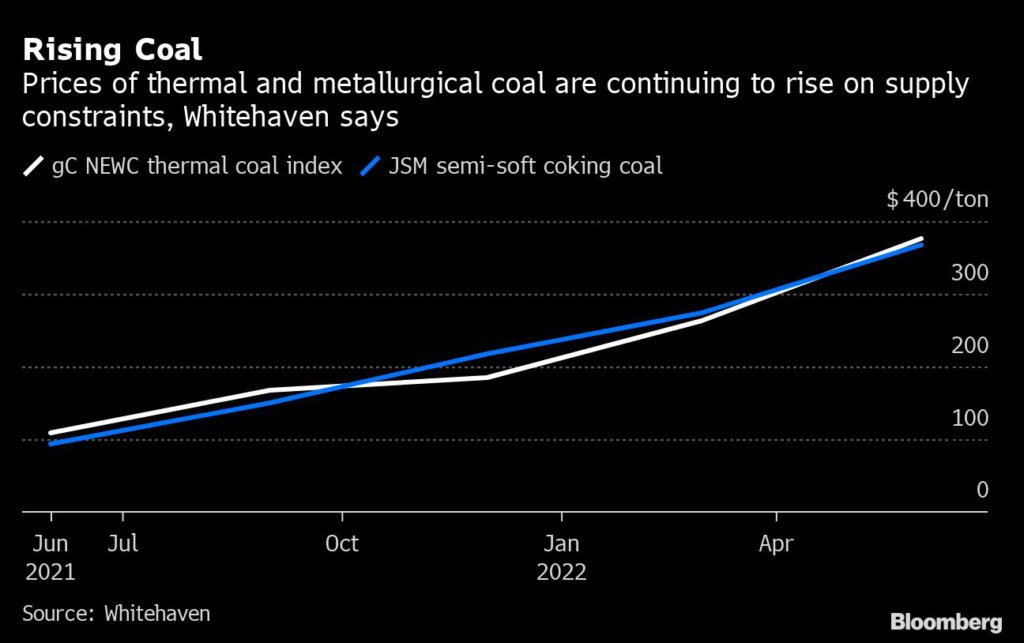
Russia Ban Seen Tightening Coal Market (5:15 a.m.)

A looming ban on Russian coal imports by the European Union will add to supply pressure that’s sent prices of the fossil fuel hurtling to a record, according to a key Australian producer.

The European ban that takes effect next month “is expected to tighten further the supply of high quality thermal coal,” Sydney-based Whitehaven said in its statement. “We continue to view thermal coal prices as well supported for 2022 and into 2023.”

More stories like this are available on bloomberg.com

©2022 Bloomberg L.P.

Scaled-Back Semiconductor Funding Bill Set Up for Senate Vote

(Bloomberg) — Legislation to provide $52 billion in grants and incentives for US semiconductor manufacturing and to secure the supply chain for wireless communication is likely to get a Senate vote on passage next week, according to people familiar with the discussions.

In addition to the chips money, a draft bill circulated by Senate leadership also includes a handful of measures with broad bipartisan support. Among them are as 25% investment tax credit for manufacture of semiconductors and tools to create semiconductors, $500 million for an international secure communications program, $200 million for worker training and $1.5 billion for public wireless supply-chain innovation, according to a copy of the text obtained by Bloomberg.

The bill is a drastically scaled back version of the US Innovation and Competition Act that passed the Senate last year based on legislation originally introduced by Senate Majority Leader Chuck Schumer and Indiana Republican Todd Young. It primarily consists of the semiconductor funding introduced by Democratic Senators Mark Kelly and Mark Warner and Republicans John Cornyn and Tom Cotton.

Schumer has told senators to expect a possible procedural vote on Tuesday to begin debate. The House also would have to pass legislation before it could go to President Joe Biden’s desk. A senior Democratic aide said the version put before the Senate would reflect an agreement with House leadership.

Cornyn, who last week backed Republican leader Mitch McConnell’s threat to withhold support for a more expansive version of the legislation while Democrats pursued a party-line tax and climate bill, tweeted Sunday that the problem was “solved” after Democrat Senator Joe Manchin effectively blocked action on the biggest parts of that legislation.

McConnell’s office didn’t immediately respond to a request for comment.

Missouri Senator Roy Blunt, a member of the GOP leadership, said Monday that he expects Republicans will support moving forward with debating the legislation as long as Democrats don’t try to restore additional pieces of the original legislation.

The bill text also includes a provision that would bar companies who receive assistance from the US government from any “material expansion of semiconductor manufacturing capacity in the People’s Republic of China” or another foreign country of concern for 10 years after the award date. That restriction would also apply to new investments in Russia, according to a person familiar with the matter. It would not apply to “legacy” chips, as older technology is called.

The semiconductor incentives have been a top priority for the Biden administration as well as chip manufacturers such as Intel Corp.and companies that are heavy users of chips. While the global semiconductor shortage has eased somewhat, there is still limited production for certain chips used in automobiles and home appliances. 

Jettisoning the rest of the larger bill would leave an uncertain path for provisions applying new sanctions on China, funding scientific research and education and providing trade benefits to workers displaced by international competition.

More stories like this are available on bloomberg.com

©2022 Bloomberg L.P.

Stocks Gain for Second Day on Back of Bank Results: Markets Wrap

(Bloomberg) — US stocks rose as Wall Street banks posted upbeat results while speculation the Federal Reserve will take a more measured approach to policy tightening eased fears of recession.

The S&P 500 gained for a second day, with all but three of the 11 major industry groups rising. Energy stocks rallied as oil climbed back above $100 a barrel. Goldman Sachs Group Inc. shares surged after the bank reported second-quarter results that were better than expected in nearly every area. Bank of America Corp. reported higher net interest income that it said is likely to increase more this quarter. 

Treasuries fell across the board as investors shunned haven assets, with the long-end of the curve underperforming and the 10-year yield climbing back to 3%. The dollar dropped against all of its Group-of-10 peers. On the flip side, Bitcoin rallied back above $22,000.

The S&P 500 index is more than 5% above June’s closing low following Friday’s strong rally on renewed hopes that inflation — and Fed rate hikes — may be close to peaking. Data last week showing a greater decline in US consumers’ long-term inflation expectations helped squashed talk of a 100 basis-point hike in July, while strong retail sales underscored a resilient economy.

Read more: Trader Behind Huge Fed Funds Wager Bags $14 Million in First Day

“You have to be very careful in how you’re allocating assets and allocating dollars in this market — but you had a couple of really good numbers this morning from Goldman and Bank of America, on the back of good retail sales,” said Chuck Cumello, president and chief executive officer of Essex Financial Services. “And the key thing in the US economy is the consumer, and if the consumer is out there spending — and yes, we can argue that yes, they were spending but inflation eroded that purchasing power, no doubt about it — but the bottom line is people are out spending.”

A pressure point for markets remains gas supply to Europe amid a standoff with Russia over its invasion of Ukraine, with the Nord Stream 1 pipeline scheduled to reopen Thursday following maintenance. Gazprom PJSC declared force majeure on several European natural-gas buyers, a move that may signal it intends to keep supplies capped.

Read more: Russian Gas Supply Halt Risks 1.5% Cut to EU’s GDP in Worst Case

Gains in stock markets may prove to be short-lived as inflation pressures remain high and a recession seems increasingly likely, according to strategists at Morgan Stanley and Goldman Sachs Group Inc.

Read more: Morgan Stanley, Goldman Say Stocks Have Yet to Find a Bottom

Elsewhere in markets, West Texas Intermediate crude climbed above $100 a barrel after the Saudis declined to make any promises regarding future output increases, and copper extended its recovery from last week’s slump. Bitcoin rallied, trading above $22,000 for the first time since early June.

Key events to watch this week:

  • Earnings this week include Tesla
  • US Treasury Secretary Janet Yellen visits South Korea. Tuesday
  • Reserve Bank of Australia releases July minutes. Tuesday
  • UK Chancellor Nadhim Zahawi and Bank of England Governor Andrew Bailey speak at event. Tuesday
  • Bloomberg Crypto Summit in New York. Tuesday
  • Bank of Japan, European Central Bank rate decisions. Thursday
  • Nord Stream 1 pipeline scheduled to reopen following maintenance. Thursday

Some of the main moves in markets:

Stocks

  • The S&P 500 rose 0.7% as of 12:38 p.m. New York time
  • The Nasdaq 100 rose 1.3%
  • The Dow Jones Industrial Average rose 0.5%
  • The MSCI World index rose 1.2%

Currencies

  • The Bloomberg Dollar Spot Index fell 0.6%
  • The euro rose 0.9% to $1.0169
  • The British pound rose 1.1% to $1.1984
  • The Japanese yen rose 0.3% to 138.14 per dollar

Bonds

  • The yield on 10-year Treasuries advanced eight basis points to 3.00%
  • Germany’s 10-year yield advanced eight basis points to 1.22%
  • Britain’s 10-year yield advanced seven basis points to 2.16%

Commodities

  • West Texas Intermediate crude rose 4.1% to $101.56 a barrel
  • Gold futures rose 0.4% to $1,709.60 an ounce

More stories like this are available on bloomberg.com

©2022 Bloomberg L.P.

Tycoon Masiyiwa to Raise $500 Million to Expand Digital Business

(Bloomberg) — Zimbabwe-born billionaire Strive Masiyiwa, who runs firms including Africa’s largest fiber-optic cable network, plans to raise as much as $500 million to expand his digital infrastructure and services businesses. 

The tycoon’s Cassava Technologies will tap investors including venture capital firm C5 Capital Management for the financing plan, Hardy Pemhiwa, chief executive officer at Cassava, said in an interview. The company on Friday signed a deal to raise $50 million from C5 Capital.

Masiyiwa, who sits on Netflix Inc.’s board, wants to tap the tech-savvy and young population in the world’s second-largest continent by expanding his businesses from providing cybersecurity to payment services in a region that lacks digital infrastructure. Demand for higher-speed internet and data storage is increasing in Africa as millions of people get connected, mostly using their mobile phones.

Cassava wants to “really ensure that Africa has got a technology company of continental scale that can stand up among, you know, the giants,” Pemhiwa said. That’s “something that Africa has never had,” he said.

Masiyiwa, who founded telecommunications group Econet Global, announced in November that certain assets including Econet’s fiber-broadband networks and data centers would be folded into a separate entity to form Cassava. The firm already generates almost $1 billion of revenue a year, said Pemhiwa. 

Cassava plans to use the funds to expand businesses such as the one that manage Econet’s 110,000 kilometers (68,350 miles) of fiber, cloud computing and nine data centers with another 10 coming over the next three years, said Pemhiwa. It also owns a renewable-energy unit. 

The company may consider an initial public offering in the future, but its current focus is on building a pan-African technology company of scale, said Pemhiwa. 

Bloomberg previously reported talks between Cassava and Fintech Acquisition Corp. VI, a blank-check company backed by serial dealmaker Betsy Cohen. 

Masiyiwa’s wealth is estimated at $2.7 billion by Forbes. 

More stories like this are available on bloomberg.com

©2022 Bloomberg L.P.
Close Bitnami banner
Bitnami