Bloomberg

Virgin Atlantic to Trial Flying Taxis at London Heathrow Hub

(Bloomberg) — Virgin Atlantic Airways Ltd. will carry out test flights using a flying taxi model from UK startup Vertical Aerospace Ltd. as the futuristic technology moves closer to becoming a reality.

Virgin will operate one flight from the main airport in Bristol, England, where Vertical is based, to an airfield elsewhere in the southwest, according to a joint statement Monday. A second will link the carrier’s own London Heathrow hub and a so-called vertiport to be built by infrastructure specialist Skyports.

Vertical said separately that it’s teaming up with Babcock International Group Plc to explore new applications for its VX4 model in providing emergency medical services and cargo transportation.

The announcements, which initially sent Vertical’s volatile stock soaring in premarket US trading, come at the start of the Farnborough Airshow southwest of London, where electric vertical takeoff and landing craft, or eVTOLs, are playing a higher profile role as competing designs reach maturity. Vertical shares traded down 6% at $4.70 as of 10:13 a.m. in New York.

The demonstration missions will take place in spring 2024 — subject to approval by the UK Civil Aviation Authority — in line with Vertical’s target of receiving type certification for the VX4 in time for service entry by 2025.

UK Funding

The program will be supported by £9.5 million ($11.4 million) in UK funding to a group led by engineering firm Atkins and including national air navigation service provider NATS, airports and a number of universities, as well as Vertical, Skyports and Virgin, which has a slew of outline orders for the VX4.

The test flights will evaluate vehicle operation, navigation, ground charging and security provision following development of physical and digital infrastructure, including a vertiport, where ground and aerial trials will begin in about a year.

Under the arrangement with Babcock, Vertical will seek to diversify a customer base currently dominated by airlines and aircraft lessors such as Avolon Holdings Ltd.

As the largest single operator of emergency helicopter services in the UK, Babcock will provide insight into medical evacuation applications and help develop modular maintenance capabilities for remote and challenging environments, the companies said. 

Vertical Aerospace is one of a number of companies competing to be first to bring eVTOLs to market. The UK startup has a backlog of 1,400 commitments for the VX4, with American Airlines Group Inc. saying Friday it was ready to make down payments to reserve delivery slots. Vertical rose 72% on that news.

(Updates with Babcock collaboration in third paragraph, shares in fourth)

More stories like this are available on bloomberg.com

©2022 Bloomberg L.P.

Bitcoin Rallies to Trade Above $22,000; Ether, Avalanche Advance

(Bloomberg) — Bitcoin rallied amid a broad risk-on mood in global markets, trading above $22,000 for the first time since June 8 and testing the upper bound of the tight range where it’s been stuck for the past month. 

The largest cryptocurrency jumped as much as 7.5% and was trading at $22,082 at 10:18 a.m. in New York. Ether surged 12% and coins like Avalanche and Polygon also posted double-digit gains. Crypto’s advance echoed the bullish tone in equity markets, with global stocks firmly in the green. 

June’s crypto wipeout has given way to a sharp rebound, with Ether up 47% this month and Polygon more than doubling. Clouds still hang over the sector, with persistently high inflation expected to trigger more monetary tightening across the world and last week’s bankruptcy of crypto lender Celsius Network Ltd. serving as a fresh reminder of potential contagion.

Cryptocurrencies’ resilience in the face of seemingly damaging news like last week’s worse-than-expected US inflation report adds to indications that the selloff that lopped some $2 trillion off digital assets may have run its course, some market observers say. 

“When the market starts reacting positively to negative news, this is a signal that a local bottom could be in for now, as fear may have caused the news to be priced in,” Marcus Sotiriou, an analyst at GlobalBlock, said in a note on Monday.

Traders are paying close attention to any indication that Bitcoin is firmly breaking out of its recent pattern of swinging between $19,000 and $22,000. The token hasn’t traded consistently above that range since mid-June, when news that crypto lender Celsius Network had frozen withdrawals sparked renewed panic selling.  

“I see the current Bitcoin price surge as an intermediate relief or swing rally that has a next resistance level around $25,000, or perhaps $28,000,” said Marcel Harmann, chief executive of THORWallet DEX. 

Even so, crypto hasn’t seen a “total capitulation” yet, and Bitcoin could bottom out at around $12,000 this year, “with a longer consolidation period afterward,” Harmann said.    

More stories like this are available on bloomberg.com

©2022 Bloomberg L.P.

Stocks Gain as Earnings, Rate Bets Boost Sentiment: Markets Wrap

(Bloomberg) — US stocks rose amid upbeat results from Wall Street banks while speculation the Federal Reserve will take a more measured approach to policy tightening eased recession fears.

The S&P 500 gained for a second day. Goldman Sachs Group Inc. shares surged after the bank reported second-quarter results that were better than expected in nearly every area. Bank of America Corp. reported an increase in net interest income. Treasuries fell with the dollar.

The S&P 500 index is more than 5% above June’s closing low following Friday’s strong rally on renewed hopes that inflation — and Fed rate hikes — may be close to peaking. Fresh data showed a greater decline in US consumers’ long-term inflation expectations, helping boost odds for a 75 basis points hike in July and squashing talk of a 100 basis-point move.

“We got a combination of better-than-expected inflation signals in some data points at the end of the week, reducing rate hike expectations, and better-than-expected retail sales that reassured markets about recession fears, which is lifting sentiment,” said Esty Dwek, chief investment officer at Flowbank SA. “Add to that some decent bank earnings this morning and markets are moving higher.”

Even so, a pressure point for markets remains gas supply to Europe amid a standoff with Russia over its invasion of Ukraine. Moscow has already curbed supplies to the continent amid tensions related to its invasion of Ukraine. European stocks and US futures briefly pared gains before the bell in New York after a report that Gazprom declared a “force majeure” on gas supplies to Europe to at least one major customer. 

“The possibility that Russia stops, or severely reduces, their gas exports to Europe should keep markets on edge in the near-term,” Mizuho International Plc strategists Peter McCallum and Evelyne Gomez-Liechti wrote in a note to clients. 

Gains in stock markets may prove to be short-lived as inflation pressures remain high and a recession seems increasingly likely, according to strategists at Morgan Stanley and Goldman Sachs Group Inc.

Read more: Morgan Stanley, Goldman Say Stocks Have Yet to Find a Bottom

Key events to watch this week:

  • Earnings this week include Tesla
  • US Treasury Secretary Janet Yellen visits South Korea. Tuesday
  • Reserve Bank of Australia releases July minutes. Tuesday
  • UK Chancellor Nadhim Zahawi and Bank of England Governor Andrew Bailey speak at event. Tuesday
  • Bloomberg Crypto Summit in New York. Tuesday
  • Bank of Japan, European Central Bank rate decisions. Thursday
  • Nord Stream 1 pipeline scheduled to reopen following maintenance. Thursday

Some of the main moves in markets:

Stocks

  • The S&P 500 rose 1% as of 9:50 a.m. New York time
  • The Nasdaq 100 rose 1.3%
  • The Dow Jones Industrial Average rose 0.9%
  • The Stoxx Europe 600 rose 1.2%
  • The MSCI World index rose 1.3%

Currencies

  • The Bloomberg Dollar Spot Index fell 0.6%
  • The euro rose 0.8% to $1.0164
  • The British pound rose 1.3% to $1.2006
  • The Japanese yen rose 0.3% to 138.09 per dollar

Bonds

  • The yield on 10-year Treasuries advanced six basis points to 2.97%
  • Germany’s 10-year yield advanced nine basis points to 1.22%
  • Britain’s 10-year yield advanced five basis points to 2.14%

Commodities

  • West Texas Intermediate crude rose 4.5% to $101.99 a barrel
  • Gold futures rose 0.8% to $1,716.70 an ounce

More stories like this are available on bloomberg.com

©2022 Bloomberg L.P.

Alphabet Split Ends Era of Jumbo Prices for Megacaps

(Bloomberg) — The days when investors had to shell out thousands of dollars to buy a single share of some of the world’s biggest technology companies are gone.

Alphabet Inc. closes the door on that era Monday when its shares begin trading in the $100 range after completing a 20-for-1 split, following the blueprint laid out by Amazon.com Inc. The stock rose as much as 1.1% to $113 at Monday’s open.

Alphabet was the most-purchased stock on Fidelity’s platform early Monday, with its ticker seeing notable interest on Reddit’s WallStreetBets platform. The stock saw more than eight-times the number of buy orders than those to sell shares.

The companies billed the moves as a way to make their stocks more accessible for retail investors and that has been achieved. But so far the lower price tags have done little to lift stocks amid broader concerns about Federal Reserve interest rate hikes and cooling economic growth.

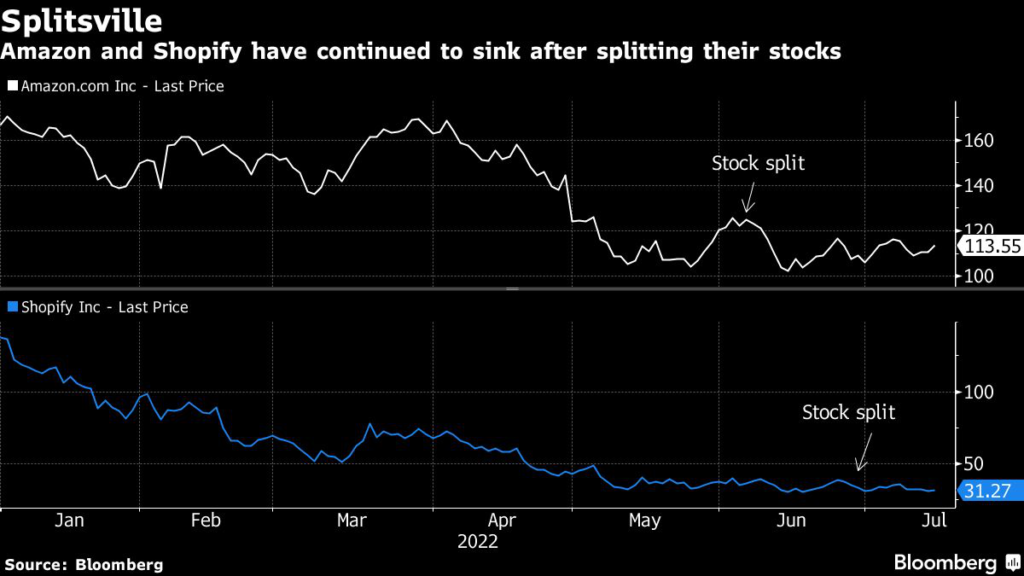
It’s still early, but Amazon has fallen 9% since completing its split last month. Even Shopify, the former high-flyer whose shares have dropped more than 70% this year, hasn’t been able to catch a bid. Its US shares are trading in the low $30s, down 5.4% since its 10-for-1 split took effect June 29. 

The poor stock performance is a far cry from 2020, when Apple Inc. and Tesla Inc. shares went on to set record highs in the months after their splits. Investors in Google’s parent shouldn’t expect a return to that type of price action while macroeconomic risks swirl, said Kim Forrest, founder and chief investment officer at Bokeh Capital Partners. 

“There are bigger concerns with what appears to be a recession starting,” Forrest said in an interview. “It certainly does look like there are layoffs coming and even the really rich companies aren’t going to be able to avoid it.”

Stock splits are purely cosmetic — they do nothing more than redistribute a company’s equity over a larger number of shares. Individual investors, though, take them as a bullish sign that a company is optimistic about the outlook for its business, and a split announcement often triggers at least a brief jump in a stock. 

Now, though, with the second-quarter earnings season under way, investors are focused on whether the technology giants can live up to Wall Street profit expectations that many see as overly optimistic. Estimates for Alphabet’s earnings this year have fallen just 0.8% over the past month despite a warning from Snap Inc. about macroeconomic headwinds hurting its ad business as well as a reduced forecast from Microsoft Corp. as a result of the strong US dollar.

Of course, there are other benefits that stock splits can bring, such as opening the door for giants like Alphabet and Amazon to gain entry to the Dow Jones Industrial Average, whose weighting is based on stock price rather than market value. Meanwhile, Alphabet and Amazon both still hold outsized sway over the S&P 500 Index due to their trillion-dollar market caps.

Tech Chart of the Day 

The Nasdaq Golden Dragon China Index has fallen 10% over the past three weeks, paring an almost 60% rally from its March low. China’s tech sector is once again dealing with the possibility of renewed regulatory crackdowns and a resurgence in Covid-19 lockdowns. The index slumped 8.5% last week, its biggest weekly drop since mid-April. 

Top Tech Stories

  • China’s Contemporary Amperex Technology Co. Ltd., the world’s biggest maker of batteries for electric vehicles, is considering at least two locations in Mexico for a manufacturing plant to potentially supply Tesla Inc. and Ford Motor Co.
  • Deliveroo Plc slashed projections for sales growth this year after the value of transactions on its platform grew more slowly in the latest quarter, reflecting mounting challenges facing the delivery service’s consumers.
  • Amazon.com Inc.’s UK grocery business will match prices on hundreds of everyday items to those offered by rival Tesco Plc in an aggressive move against Britain’s largest supermarket chain.
  • Vodafone New Zealand is selling its mobile-phone tower assets to investment firms for NZ$1.7 billion ($1.1 billion).
  • Strong demand for niche design services used in making electric vehicles has helped Tata Elxsi Ltd.’s stock surge by more than a third this year, even as inflation concerns have battered the sector globally.
  • “Stranger Things” is the most popular TV show of the year. Next week, we’ll find out if that’s enough to save Hollywood’s summer. Netflix Inc. will report results on Tuesday for its most recent quarter, and every one of its competitors is hoping for good news. Stocks across the industry have slumped ever since Netflix reported it lost customers in the first three months of the year.

(Updates stock move in second paragraph and adds retail trading details in third paragraph.)

More stories like this are available on bloomberg.com

©2022 Bloomberg L.P.

Meta’s Forced Sale of Giphy Halted as UK Court Orders Review

(Bloomberg) — Meta Platforms Inc.’s purchase of GIF search engine Giphy will be sent back to the UK antitrust regulator for a further review after a court found concerns in the agency’s investigation approach.

A judge quashed the Competition and Markets Authority’s order that Meta must sell Giphy, according to a ruling made public Monday. The case will now be referred back to the CMA for the watchdog to reconsider whether the deal would reduce competition in the market for display advertising and social media services.

“We have agreed to reconsider our decision in light of this finding,” the CMA said in a statement, saying that it aimed to complete the review within three months.

Meta has been stuck in a dispute with the regulator since it was ordered to unwind its $315 million 2020 acquisition of the GIF maker. It was the first time a global regulator has attempted to force a Big Tech firm to unwind a completed deal, signaling a tough regulatory approach to the market power of Silicon Valley giants.

But in their ruling, appeal judges at the Competition Appeal Tribunal ruled that the watchdog didn’t consult properly on certain aspects of its investigation and wrongly redacted material which undermined the decision. 

Meta will be given the chance to comment on the CMA’s full unredacted final report.

A Meta spokesperson declined to comment. 

(Updates with more detail in the sixth paragraph)

More stories like this are available on bloomberg.com

©2022 Bloomberg L.P.

Virgin Atlantic to Test Flying Taxis at Its London Heathrow Hub

(Bloomberg) — Virgin Atlantic Airways Ltd. will carry out test flights using a flying taxi model from UK startup Vertical Aerospace Ltd. as the futuristic technology moves closer to becoming a reality.

Virgin will operate one flight from the main airport in Bristol, England, where Vertical is based, to an airfield elsewhere in the southwest, according to a joint statement Monday. A second will link the carrier’s own London Heathrow hub and a so-called vertiport to be built by infrastructure specialist Skyports.

The announcement comes at the start of the Farnborough Airshow southwest of London, where electric vertical takeoff and landing craft, or eVTOLs, are playing a higher profile role as competing designs reach maturity.

The demonstration missions will take place in spring 2024 — subject to approval by the UK Civil Aviation Authority — in line with Vertical’s target of receiving type certification for its VX4 craft in time for service entry by 2025.

The program will be supported by £9.5 million ($11.4 million) in UK funding to a group led by engineering firm Atkins and including national air navigation service provider NATS, airports and a number of universities, as well as Vertical, Skyports and Virgin, which has a slew of outline orders for the VX4.

The test flights will evaluate vehicle operation, navigation, ground charging and security provision following development of physical and digital infrastructure, including a vertiport, where ground and aerial trials will begin in about a year.

Vertical Aerospace is one of a number of companies competing to be first to bring eVTOLs to market. The UK startup has a backlog of 1,400 commitments for the VX4, with American Airlines Group Inc. saying Friday it was ready to make down payments to reserve delivery slots.

More stories like this are available on bloomberg.com

©2022 Bloomberg L.P.

Ukraine Latest: Putin Says Russia Facing ‘Colossal’ Tech Hurdles

(Bloomberg) — President Vladimir Putin said that Russia is facing “colossal challenges” in the high-tech sector, an unusually frank admission of the difficulties the Kremlin is experiencing as sanctions begin to bite.

The European Union, which boosted military financing for Ukraine on Monday, is also set to approve some additional sanctions measures, including a ban on Russian gold. 

The EU’s foreign policy chief, Josep Borrell, said he was hopeful Russia and Ukraine could clinch a deal this week to help export grain from the war-torn country and avert a global food crisis. The comments come a day before Turkish President Recep Tayyip Erdogan meets Putin to discuss efforts to facilitate shipments of Ukrainian grain through the Black Sea. 

(See RSAN on the Bloomberg Terminal for the Russian Sanctions Dashboard.)

Key Developments

  • Russia Turns the Screws on Gas Market, Snubbing Transit Bookings
  • Coal-Rich Poland Rushes to Imports as Russian Sanctions Bite
  • Zelenskiy Bids to Oust Ukraine’s Security Chief, Top Prosecutor
  • G-20 Finance Chiefs Blame Russia as Path to Soft Landing Narrows
  • Russia Orders Forces to Strike Ukraine’s Long-Range Weapons
  • Russian Assets Barely Touched Across EU With $14 Billion Seized

On the Ground

Russia ordered its troops to step up combat in all areas and target Ukraine’s long-range weapons. Ukraine has used advanced US-supplied HIMARS systems to strike Russian logistics centers, supply routes and ammunition depots behind the front lines in recent weeks. A Russian missile ruined an elevator with more than 5,000 tons of grain in the Dnipropetrovsk region, local governor Valentyn Reznichenko said on Telegram. Russian missiles also hit a military facility and a bridge across the Dniester estuary west of Odesa, Natalia Humeniuk, a spokeswoman for the Ukrainian military’s southern command said.  

(All times CET)

Putin Says Sanctions Causing Russia ‘Colossal’ Tech Woes (2:25 p.m.)

Russia faces “colossal challenges” in high technology from international sanctions, but won’t simply give up or allow its economy to fall back by decades, Putin told officials during a videoconference on strategic development goals.

Instead, Moscow will “intensively” seek solutions by relying on the country’s own technological resources and the work of domestic innovative companies, the Russian president said, even as he chided the state-run Rostec corporation for failing to meet previous targets for development of internet technology.

Russia Fines Google $382 Million, Tass Says (2:15 p.m.)

A Moscow court ordered the local unit of Alphabet Inc.’s Google to pay a 21.77 billion ruble ($382 million) fine not removing content banned in Russia, Tass reported from the courtroom.

The fines, for repeated violations of orders to take down content deemed illegal, could be used as a pretext to block various Google services in Russia as the Kremlin cracks down on foreign tech companies.

Google’s local subsidiary filed for bankruptcy in June after authorities froze its local bank account amid escalating fines related to YouTube. However, it continues to offer free services, including search functions, YouTube, Gmail and Google Play.

Read more: Google to File to Bankrupt Russian Unit Amid Mounting Fines

EU Approves More Ukraine Arms Financing (1:15 p.m.)

EU foreign ministers approved another 500 million euros ($507 million) in military aid to Ukraine, boosting the total arms financing to 2.5 billion euros. It’s the fifth round of financing under the so-called European Peace Facility, which reimburses governments for military deliveries to Ukraine. 

Russia Keeps Gas Buyers Guessing (11:08 a.m.)

Moscow again rejected additional gas-pipeline space offered by Ukraine, keeping European buyers guessing as future flows on the key Nord Stream route also remain uncertain.

At a monthly auction on Monday, Russia’s Gazprom PJSC opted not to book extra capacity to ship gas to Europe via Ukrainian pipelines in August. That keeps deliveries to the continent tight, just as concern grows that the Nord Stream link may not fully return when maintenance ends later this week.

Russia’s squeeze on gas supplies has unsettled the market, with European benchmark futures more than doubling in value this year. Last week, Germany started to withdraw gas from stockpiles that it had been building up for winter, while Hungary declared an “energy state of emergency.”

Russia Turns the Screws on Gas Market, Snubbing Transit Bookings

Russia Eyes Cooperation Pact With Iran (10:37 a.m.)

Russia handed a draft comprehensive strategic cooperation treaty to Iran in mid-June and expects to sign it in the near future, Interfax quoted Russian presidential spokesman Dmitry Peskov as saying. 

It said some amendments were required taking into account Iranian opinion.

Russia Former State-TV Staffer Released (10:07 a.m.)

Russian police released a former state-television employee after several hours of detention, charging her under a strict new law against criticizing the Kremlin’s invasion of Ukraine.

Marina Ovsyannikova, who fled Russia earlier this year after being charged for holding up an anti-war sign on the main evening television news, has conducted several public protests since returning earlier this month for a child-custody hearing. On Friday, she stood across the Moscow River from the Kremlin, holding a homemade sign blaming President Vladimir Putin for the deaths of children killed in the war.

Police detained her Sunday for making anti-war statements outside the trial last week of another activist facing jail time for his protests. Ovsyannikova’s lawyer, Dmitry Zakhvatov, said she was charged with an administrative violation, punishable with a fine.

Zelenskiy Pledges Security Clean-Up (10:01 a.m.)

Kyiv pledged to clean up law-enforcement agencies after President Volodymyr Zelenskiy removed the country’s security chief and suspended its top prosecutor over allegations that dozens of staff were collaborating with Moscow. 

Ivan Bakanov, a childhood friend of Zelenskiy, was removed from his post as head of the State Security Service amid questions over how Russia managed to capture the southern region of Kherson. Iryna Venediktova, named prosecutor general in 2020, is also a Zelenskiy ally and lawmaker on his party list. 

Andriy Smyrnov, deputy chief of Zelenskiy’s staff, said in televised comments on Monday that Ukraine would find anyone working with or leaking information to Russia. The president said last Sunday that 651 people were already facing trial on charges of treason and collaborating with the enemy. 

Russia-Backed RT To Get EU Sanctions Ruling (9:45 a.m.)

RT, the Kremlin-backed TV network formerly called Russia Today, will get a July 27 ruling from the European Union General Court on whether its inclusion on the EU’s sanctions list over the Ukraine invasion was justified.

RT’s France unit told the court that the EU’s decision was a curb on press freedom that had no justification in law. The ruling date was announced on the court website.

Russia Orders Strikes on Long-Range Arms (8:43 a.m.)

Russian Defense Minister Sergei Shoigu ordered part of his forces to focus on destroying Ukraine’s long-range missile and artillery systems during a visit to the Vostok army group in the occupied east of the country.  

The order comes after Ukraine received advanced US-supplied HIMARS long-range artillery systems in recent weeks capable of striking Russian targets as far as 80 kilometers (50 miles) away. That has allowed it to hit logistics centers, supply lines and ammunition dumps deep behind the front lines and mostly from beyond the range of Russian artillery.

Ukraine sees Russian forces struggling to find safe places to store munitions in occupied areas as they also increasingly lack transport to move them, Natalia Humeniuk, a spokeswoman for the Ukrainian military’s southern command said on television.

Russia Orders Forces to Strike Ukraine’s Long-Range Weapons

EU’s Borrell Hopeful on Ukraine Grain Deal (8:07 a.m.)

The EU’s foreign policy chief said he was hopeful Russia and Ukraine could clinch a deal this week to help export grain from the war-torn country and alleviate a growing global food crisis.

“I have a hope that this week it will be possible to reach an agreement to deblock Odesa and other Ukrainian ports,” Josep Borrell told reporters ahead of a meeting of EU foreign ministers in Brussels. “The lives of tens of thousands of people depend on this agreement. It’s not a diplomatic game.”

Turkish President Recep Tayyip Erdogan has sought to broker a deal that would facilitate shipments of Ukrainian grain through the Black Sea and meets Vladimir Putin on Tuesday. 

H&M to Exit Russia at $190 Million Cost (7:57 a.m.)

H&M will begin winding down its operations in Russia, having halted all sales in the country in March.

The Swedish fashion retailer expects to book costs of $190 million from the process, it said in a statement Monday. It plans to reopen physical stores in Russia for a limited period of time to sell remaining inventory.

“After careful consideration, we see it as impossible given the current situation to continue our business in Russia,” Chief Executive Officer Helena Helmersson, said.

Russian Gas Flows to Europe Still Limited (6:42 a.m.)

Russian natural gas supplies to Europe remain curbed, with flows sent via Ukraine below capacity and the Nord Stream pipeline shut for annual maintenance until July 21. 

Russian Gas Flows to Europe Remain Curbed Amid Nord Stream Works

Russia Ban Seen Tightening Coal Market (5:15 a.m.)

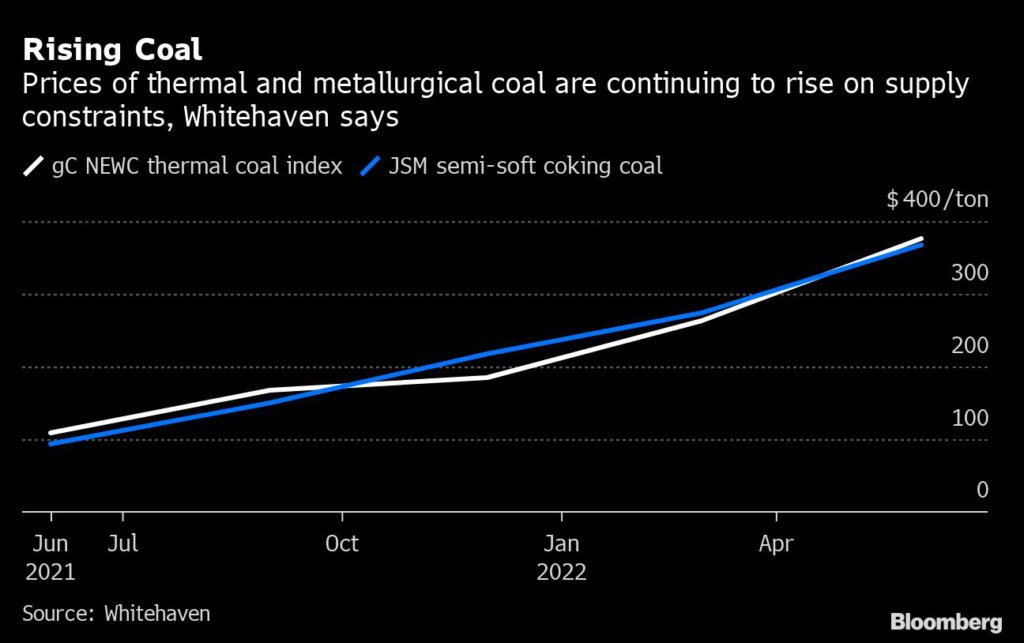
A looming ban on Russian coal imports by the European Union will add to supply pressure that’s sent prices of the fossil fuel hurtling to a record, according to a key Australian producer.

The European ban that takes effect next month “is expected to tighten further the supply of high quality thermal coal,” Sydney-based Whitehaven said in its statement. “We continue to view thermal coal prices as well supported for 2022 and into 2023.”

More stories like this are available on bloomberg.com

©2022 Bloomberg L.P.

Tesla’s Chinese Battery Maker Is Scoping Out Factory Sites in Mexico

(Bloomberg) — China’s Contemporary Amperex Technology Co. Ltd., the world’s biggest maker of batteries for electric vehicles, is considering at least two locations in Mexico for a manufacturing plant to potentially supply Tesla Inc. and Ford Motor Co.

The battery manufacturer is considering Ciudad Juarez, in the state of Chihuahua, and Saltillo, in Coahuila, according to people familiar with the deliberations. Both are near the Texas border. The company is contemplating an investment of as much $5 billion in the project, said the people, who asked not to be identified discussing private information.

Ciudad Juarez is attractive in part because it’s close to the San Jeronimo-Santa Teresa port of entry into the US state of New Mexico. That would provide a route around the border crossings of Texas, which is the home of Tesla’s new factory but in recent months has taken measures that complicated shipping and entry into the US. 

Texas Governor Greg Abbott in April increased inspections of commercial vehicles, stating a desire to crack down on illegal drug trafficking and immigration. But analysis by one economics research body found that it cost the state’s economy more than $4 billion in lost output due to shipping delays and bridge blockades.

Read more: Tesla Supplier CATL Weighs Sites for $5 Billion Battery Plant

CATL, as the Ningde, China-based company is known, is also considering splitting its investment across two locations — one in the US and one in Mexico, the people said. A final decision hasn’t been made and the total size of the investment is fluid. Bloomberg reported in March that the investment could build an 80 gigawatt-hour factory.

The battery maker and Dearborn, Michigan-based Ford declined to comment. Austin, Texas-based Tesla didn’t respond to a request for comment.

CATL’s shares jumped 3.5% Monday in Shenzhen.

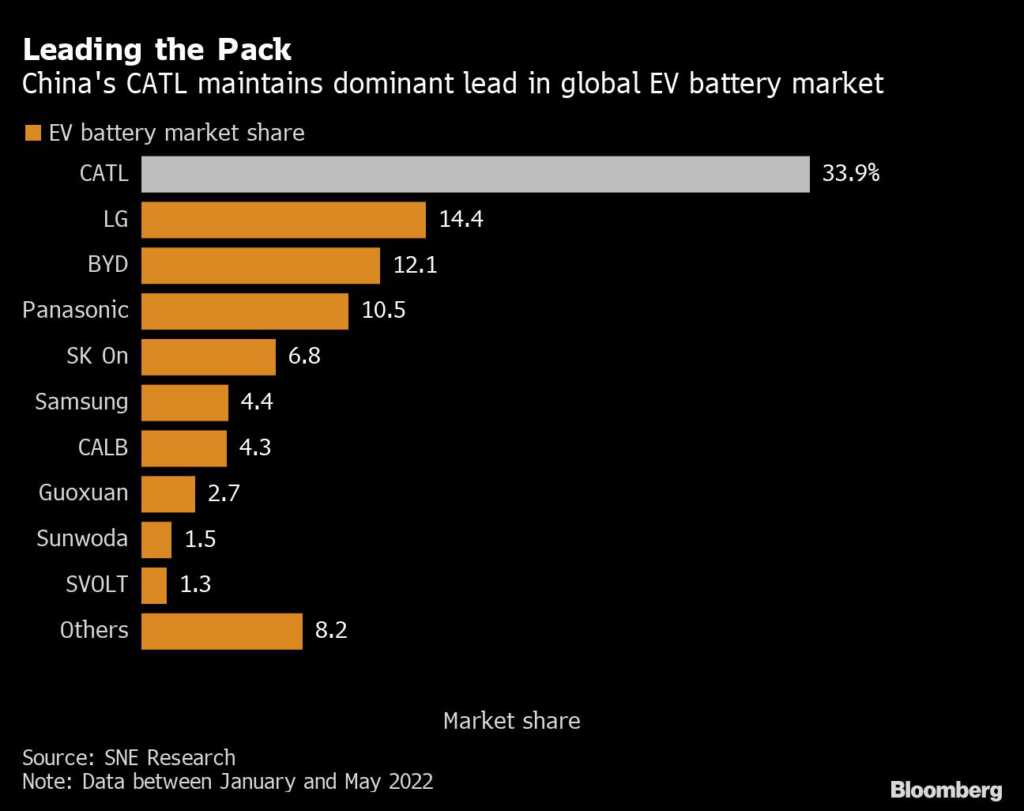
Backed by China’s strategic push into electric cars, CATL is riding a boom in demand for EVs as countries work to reduce carbon emissions and consumers embrace cleaner cars. The company, which completed an initial public offering in 2018, controls more than 30% of the global EV battery market.

CATL has been contemplating a battery plant in the US for years, but rising geopolitical tensions between the US and China have complicated the effort. It’s also under competitive pressure to speed a decision as rivals like LG Energy Solution Ltd., Samsung SDI Co. and Panasonic Holdings Corp. ink deals with automakers to build battery plants in the US.

The US-Mexico-Canada Agreement on trade, negotiated under then-President Donald Trump, further complicated CATL’s plans by introducing higher wage requirements for cars to trade duty-free, along with stricter content rules. A CATL site would help Mexico, which has long been a major part of the auto industry’s supply chain, cement its role in the region’s electric vehicle production.

Read more: Panasonic Is Scouting U.S. Sites for New Battery Factory by 2024

CATL could opt to manufacture battery cells in Mexico and then ship them to Kentucky to be assembled into battery packs. In 2020, the Chinese battery giant purchased a former RR Donnelley & Sons Co. printing plant in Glasgow, Kentucky, and formed a subsidiary in the state, documents show. In April 2021, it hired Charles Huang, a manufacturing executive, to be chief executive officer of the project, according to his LinkedIn page.

Huang’s LinkedIn page says his mandate is to “establish corporate structure and strategy for CATL manufacturing project in North America.”

A spokesman for Kentucky’s economic development agency declined to comment on CATL’s plans in the state. 

An expanded presence in North America could unsettle US officials who are keen on supporting domestic suppliers. President Joe Biden is allocating billions to cultivate the US battery supply chain and wean the auto industry off its reliance on China, but those efforts will take years to come to fruition through American startups and partnerships with Korean and Japanese companies.

More stories like this are available on bloomberg.com

©2022 Bloomberg L.P.

Rogers CEO Goes on Apology Tour With 13 Days to Close Shaw Deal

(Bloomberg) — There are less than two weeks until the biggest cable merger in Canadian history — the tie-up between Rogers Communications Inc. and Shaw Communications Inc. — is supposed to be nailed down. 

It should be a crowning moment for Edward Rogers, the chairman of Rogers’ board, and his hand-picked CEO, Tony Staffieri. Instead, the deal looks shaky, customers are livid, politicians annoyed, regulators suspicious, and Staffieri finds himself on a whirlwind apology tour, frantically trying to appease everyone.

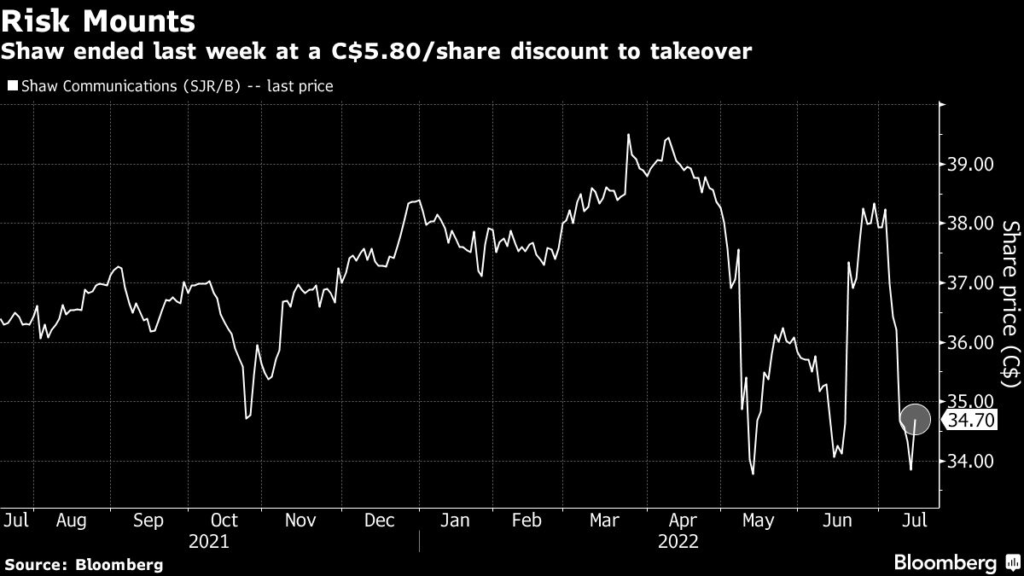
Traders are increasingly skeptical the C$20 billion ($15.4 billion) deal will close by the July 31 deadline, if at all. They’ve been ratcheting up bets in both the stock and bond markets that it will be delayed or fall apart. Shaw shares closed last week at C$34.70, implying nearly 17% upside if the deal does happen at Rogers’ C$40.50 offer price. That’s close to the steepest discount in a year. 

Investors, meanwhile, are bidding up Rogers debt in anticipation the debt-heavy deal might collapse. A 30-year bond issued by the company in March to help finance the acquisition ended last week at a yield of 1.98 percentage points above benchmark government bonds, down from 2.4 percentage points in late May. The price implies a 44% chance that the deal won’t be completed this year, according to Bloomberg Intelligence estimates. 

“We remain committed to that transaction, but today I really want to focus on what we’re doing about our network issue,” Staffieri said last week on BNN Bloomberg Television. 

That “network issue” is one of the worst public-relations disasters the Toronto-based company has suffered in years. More than 10 million Canadians lost their wireless and internet connections when the Rogers network failed on July 8. Some were unable to even call 911. 

Read more: Rogers CEO Apologizes, Blames Network Failure on Maintenance 

Payment systems went down, forcing businesses to do cash-only sales, and events were postponed, including the launch of The Weeknd’s world tour in Toronto, which was to be held at a stadium owned by Rogers.

The Shaw takeover was designed to improve Rogers’ wireless coverage across western Canada, extend its cable business and give it financial heft to compete against larger rival BCE Inc. But its network woes may have handed a stronger argument to those who say the deal should be denied because it will concentrate too much of the nation’s telecommunications infrastructure in one company. 

Staffieri, installed as chief executive officer after a vicious internal feud among the children of founder Ted Rogers, has been left to count the cost, estimated by one analyst at a minimum of C$160 million, and to give repeated public apologies. It’s an awkward role for a man who spent nearly a decade as Rogers’ chief financial officer, with little public profile outside the financial community.  

Meanwhile, the company has been battered in Ottawa. Industry Minister Francois-Philippe Champagne, whose department has the final decision on the Shaw deal, called the network problem “unacceptable” and ordered an investigation of the incident. He also called Staffieri and other telecom executives to a meeting at which he gave them 60 days to come up with a better system for helping each other during network failures. 

“My role and my mission is to protect the public interest, to protect consumers,” Champagne told BNN Bloomberg the next day. “Certainly, the events of the last few days will be in my mind and in the mind of others when looking at any possible transaction.” 

Before it gets to Champagne, though, Rogers and Shaw have to get through the Competition Bureau, Canada’s antitrust body, which has sued to block the deal on the grounds that it will reduce competition in the wireless market. Shaw is Canada’s No. 4 mobile provider and a player in major cities like Toronto, Calgary and Vancouver. 

Staffieri has already offered a partial surrender to antitrust czar Matthew Boswell by agreeing last month to sell most of Shaw’s wireless assets to Quebecor Inc., a Montreal-based cable and wireless firm. It’s not clear whether that will be enough to settle the matter or if Boswell will take the case all the way to Canada’s merger court, known as the Competition Tribunal. 

If the latter happens, it might take until the end of 2022 or early 2023 to resolve the deal’s status. “That prospect is increasing in terms of probability,” said Aravinda Galappatthige, a telecom analyst at Canaccord Genuity.

Boswell’s Challenge

Still, even with the deal likely to be extended past the July 31 deadline and drag into the fall, it’s possible it will still get approval. Competition lawyer Mark Warner says Boswell has an incentive to settle the antitrust complaint because his legal case is weak.  

“The challenge Matthew has is the bureau doesn’t have a great track record in the courts and the tribunal,” said Warner, who runs MAAW Law, which specializes in regulatory and trade law out of offices in Toronto and New York. 

In an odd way, the customer-service disaster might even strengthen the Rogers case, buttressing the company’s argument that it needs to be bigger to afford large-scale investments in better networks, Warner said. 

Galappatthige said he doesn’t think the network problem will sway the government’s decision on the acquisition. Since Rogers cut the side deal with Quebecor, stripping out the bulk of Shaw’s wireless assets, the transaction has essentially become a merger of firms that provide cable television and internet service in different regions of Canada. There’s little sign the government truly objects to that, he said.  

In fact, there may be a political incentive for the industry minister to eventually say yes to Rogers and Shaw because the divestiture has to the potential to make Quebecor much stronger, Warner said, and that company is based in Champagne’s political home.  

“Mr. Champagne wants to be Prime Minister Champagne,” he said, “and he comes from Quebec.”  

More stories like this are available on bloomberg.com

©2022 Bloomberg L.P.

Chinese Carmakers Roll Out Electric Models Catering to Camping Craze

(Bloomberg) —

China’s electric-vehicle makers have discovered a new fan base: camping enthusiasts who’ve embraced the great outdoors in their own backyard as the nation’s strict Covid Zero measures make international travel off-limits.

Geely, the automaker whose parent controls Volvo Cars and Polestar, last week unveiled a new-energy pickup truck brand, called Radar. Its first model, a fully electric beast that can run more than 600 kilometers (373 miles) on a charge, should be available in the fourth quarter.

“Chinese car owners have added outdoors settings into their routine scenarios, apart from home and work,” said Ling Shiquan, Radar’s newly appointed CEO, adding that the pandemic has pushed people in China to focus on a more healthy lifestyle.

Draconian measures to stop the virus from spreading have kept huge swaths of the population, including millions of people in Shanghai, sealed inside their homes or workplaces for weeks or even months on end. People subject to multiple rounds of mass testing and unpredictable restrictions on cross-provincial travel have become anxious about long trips on public transport.

As a result, camping and other outdoors activities have suddenly become trendy in China, the world’s biggest EV market. Bookings for camping trips and related travel products like campsite tickets tripled for this year’s Labor Day holiday versus a year ago, according to data from travel booking platform Qunar.com. Online sales of canopies, outdoor coffee machines and paddleboards have also soared.

The latest model from Beijing-based Li Auto — a plug-in hybrid sport utility vehicle that seats six and is designed for families — can discharge 3.5 kilowatts of power and comes with an optional built-in fridge. Rival Nio, which has long marketed itself as a premium carmaker catering to middle-class consumers, introduced an optional electric tow bar for its just-launched ES7, billing it as one of the first certified passenger vehicles in China able to tow a caravan or trailer.

“Electric vehicles have an advantage by nature to power up not only cars but other gadgets,” said Yale Zhang, managing director of Shanghai-based consultancy Autoforesight. “Without carrying a heavy power pack, you can easily charge a hotpot with your car battery.”

And unlike in the US, where there’s a mature camping market complete with well-established campsites, new-to-camping fans in China must rely more on the vehicle battery, Zhang said.

After missing the boat for karaoke aficionados in China, legacy global automakers might want to think about playing catch-up. Chinese manufacturers are already starting to sell branded camping merchandise like folding chairs and tents.

“Chinese customers right now are spoiled,” said Kevin Shen, co-founder and president of Li Auto. “If you don’t come here, understand the customer and design the product for the pickiest ones, I can’t imagine just replicating something and winning.”

More stories like this are available on bloomberg.com

©2022 Bloomberg L.P.
Close Bitnami banner
Bitnami