Bloomberg

Adobe Cuts 100 Jobs Concentrated in Sales as Tech Tightens Belt

(Bloomberg) — Adobe Inc. has eliminated about 100 jobs, concentrated in sales, joining many other tech companies in using staff cuts to reduce expenses.

Some of the employees who lost their jobs were given the opportunity to find other positions at the software company, according to a person familiar with the situation who wasn’t authorized to speak publicly about the cuts. Adobe’s workforce reductions are far smaller than the thousands announced by other technology companies, including Amazon.com Inc., HP Inc., Cisco Systems Inc. and Meta Platforms Inc. The company, based in San Jose, California, employed more than 28,700 people at the end of the fiscal third quarter on Sept. 2, according to filings.

The company “shifted some employees to positions that support critical initiatives” and wiped out “a small number” of other jobs, Adobe said in a statement.

“Adobe is not doing companywide layoffs and we are still hiring for critical roles,” the company said.

For more: Adobe’s Plan for Transformation Hinges on DOJ Nod on Figma Deal

Adobe announced in September an agreement to purchase smaller rival Figma Inc. for $20 billion, one of the largest prices ever paid for a private software maker. The US Department of Justice is investigating the deal for potential antitrust issues. Adobe, which has dominated the market for creative software for design professionals, is seeking to expand its user base to more casual consumers and small businesses.

The company is scheduled to report fiscal fourth-quarter results on Dec. 15. The stock has tumbled 42% this year amid a broad slump in the software industry.

More stories like this are available on bloomberg.com

©2022 Bloomberg L.P.

Pinterest Adds a Board Seat for Activist Investor Elliott

(Bloomberg) — Pinterest Inc. added a board seat for Elliott Investment Management as part of a cooperation agreement with the activist investor, the social-media company said Tuesday.

Elliott’s Marc Steinberg will join the board on Dec. 16, bringing the total number of seats to eight independent directors and 11 total members, Pinterest said in a statement. The shares rose more than 2.5% in extended trading, after falling 38% this year through Tuesday’s close.

The move comes in a year of major changes for the company, which lets users find, collect and share image-based lifestyle ideas. Pinterest founder and longtime Chief Executive Officer Ben Silbermann stepped down from the top role in June, and the digital-advertising business has faced an overall slowdown in revenue. Elliott in August said it became Pinterest’s biggest investor, meaning a stake of more than 9% including stock and options.  

“We appreciate the perspective the team brings, as well as their commitment to our company and mission,” Pinterest’s new CEO, Bill Ready, said in a statement. “We look forward to working together as we execute on our strategy to increase engagement with users, deepen monetization per user, and build personalized experiences on Pinterest that go from inspiration and intent to action – all while creating a more positive and inspiring place online.”

Ready, a former executive at at Alphabet Inc.’s Google and PayPal Inc, has focused on growing users and improving opportunities and tools for ads on the platform. 


More stories like this are available on bloomberg.com

©2022 Bloomberg L.P.

Musk Says Twitter Legal Executive Was ‘Exited’ From Company

(Bloomberg) — Jim Baker, Twitter Inc.’s deputy general counsel, was pushed out of the company over his handling of information, Elon Musk said in a tweet. 

“In light of concerns about Baker’s possible role in suppression of information important to the public dialogue, he was exited from Twitter today,” Musk said. 

Musk’s comment appeared to be in reference to Baker’s involvement with the so-called Twitter Files. The documents, which included communications surrounding the decision to block access to a New York Post story about Hunter Biden’s laptop, were publicized by journalist Matt Taibbi last week. 

In a tweet Tuesday, Taibbi suggested that Baker’s firing stemmed from “vetting the first batch of ‘Twitter Files’ — without knowledge of new management,” apparently a reference to Musk. 

Baker, who was formerly the general counsel of the Federal Bureau of Investigation, didn’t immediately respond to a request for comment. 

After acquiring Twitter for $44 billion in October, Musk has sought to show that the social network is taking a less restrictive approach to speech. That’s included criticizing the company’s policies under previous management.

The Hunter Biden incident unfolded in the lead-up to the 2020 presidential election. Twitter initially claimed it blocked access to the New York Post story under its “hacked materials” policy. In one of the internal communications published by Tiabbi, which is undated, Baker urged caution regarding the story. “I support the conclusion that we need more facts to assess whether the materials were hacked,” Baker wrote.  

Baker’s firing comes at a time when Twitter is coming under increased scrutiny from regulators around the world. Last month, Musk lawyer Alex Spiro attempted to calm staff by telling them they would not go to jail if the company is found in violation of a Federal Trade Commission consent decree. 

More stories like this are available on bloomberg.com

©2022 Bloomberg L.P.

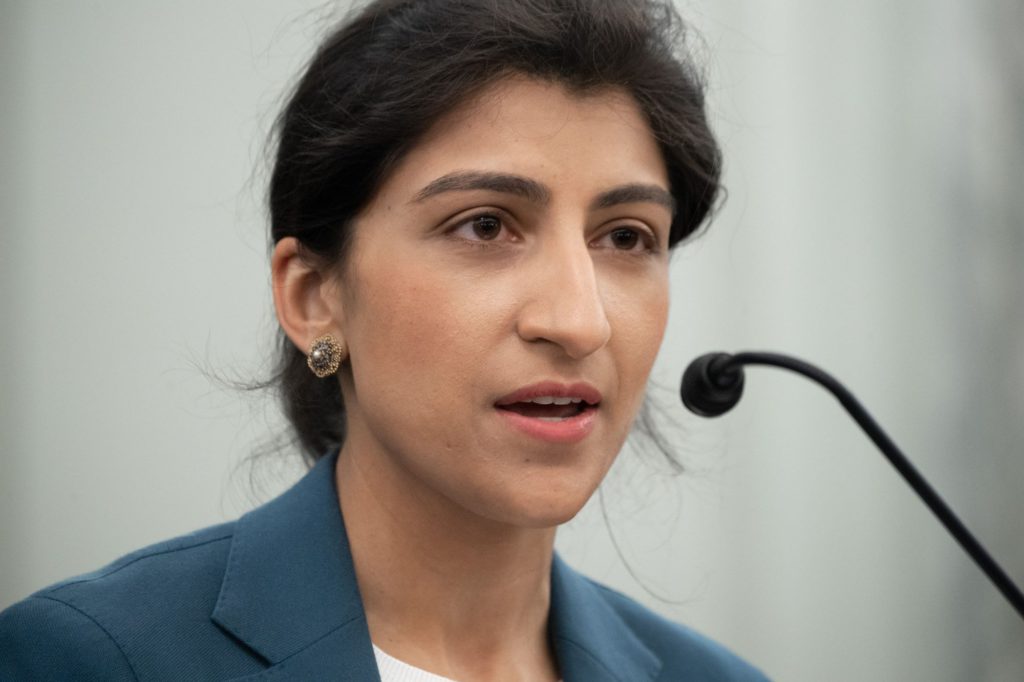
Microsoft to Meet with FTC Chair Lina Khan on Activision Deal

(Bloomberg) — Microsoft Corp. executives are set to meet with US Federal Trade Commission Chair Lina Khan and other commissioners Wednesday to make its final case in favor of its deal to buy gaming studio Activision Blizzard Inc., a person familiar with the meetings said.

The antitrust agency is nearing a decision on the $69 billion deal, which would make Xbox-maker Microsoft into the No. 3 gaming company globally. A so-called last rites meeting between the companies and the FTC’s commissioners –- who make the final call and vote on any agency actions -– is often one of the last steps before either a lawsuit or a settlement are filed.

Microsoft President Brad Smith and other company executives are expected to attend the meetings, the person said, asking not to be named discussing the confidential probe.

FTC spokesman Douglas Farrar and a Microsoft spokesperson declined to comment. 

Microsoft announced in January it planned to buy game publisher Activision Blizzard, which has developed popular franchises like Call of Duty and World of Warcraft. The acquisition would be the software maker’s largest ever and one of the 30 biggest deals of all time.

Khan, a progressive former Columbia University Law School professor who took the helm of the FTC last year, has taken a more aggressive approach to merger enforcement during her tenure. She declined to discuss the Microsoft-Activision Blizzard deal at a conference Tuesday, citing the ongoing probe. But Khan denied that the FTC is opposed to mergers and said preserving innovation in emerging markets is a top priority. 

“I think there can be this misperception that the FTC is somehow anti-deals,” she said at the Wall Street Journal’s CEO Summit. But “when you have increased consolidation, increased concentration and declining competition, that can have a real adverse effect on innovation,” she said. “Incumbents and monopolists are not going to be incentivized to innovate and to really push the boundaries in the way that they are when they’re facing robust competition.”

The deal also requires antitrust approval from officials in the UK and the European Union, who have raised concerns that Microsoft could withhold popular game titles from rival systems, particularly from Sony Group Corp.’s Playstation. 

European Commission Vice President Margrethe Vestager said Tuesday on the sidelines of a conference in Washington that the EU hasn’t started negotiating with the company over a possible remedy.

The New York Post earlier reported on the meetings.

–With assistance from Dina Bass.

More stories like this are available on bloomberg.com

©2022 Bloomberg L.P.

Biden Joins Tim Cook to Hail TSMC’s $40 Billion US Chip Venture

(Bloomberg) — President Joe Biden celebrated Taiwan Semiconductor Manufacturing Co.’s plans to increase its investments in Arizona to $40 billion and construct a second factory, with companies like Apple Inc. eager to source more chips from the US.

“These are the most advanced semiconductor chips on the planet. The chips will power iPhones and MacBooks,” Biden said during a visit to a $12 billion plant TSMC is already building in Phoenix. “Apple had to buy all the advanced chips from overseas. Now, they’re going to bring more of their supply chain here at home. It could be a game changer.”

TSMC’s plans are a showcase of the administration’s efforts to encourage companies to bring more chip manufacturing to the US and prevent a repeat of the supply disruptions over the last two years that cost companies hundreds of billions in sales. Biden received a tour of the site and delivered his remarks in front of a banner that read “A Future Made in America.” 

The Phoenix event, held to celebrate a construction milestone, drew a host of CEOs, including Apple’s Tim Cook, Lisa Su of Advanced Micro Devices Inc., ASML Holding NV’s Peter Wennink, and Jensen Huang from Nvidia Corp. 

Major customers have urged TSMC to build more advanced semiconductors in the US. Cook confirmed in remarks at the event that Apple would use chips sourced from Arizona.

“The progress we’ve made with Apple silicon has transformed our devices,” Cook said. “Now, thanks to the hard work of so many people, these chips can be proudly stamped ‘Made in America.’”

Read more: Apple’s Cook confirms made-in-US chips push at Arizona plant

AMD’s Su said her company would also source chips from the Arizona plants, calling the investments “critical for both the semiconductor industry and our extended ecosystem of partners and customers.” “AMD expects to be a significant user of the TSMC Arizona fabs and we look forward to building our highest performance chips in the United States,” Su said in a statement.

Commerce Secretary Gina Raimondo and TSMC executives, including founder Morris Chang, Chairman Mark Liu and Chief Executive Officer C.C. Wei, were at the event, as well as CEOs from Applied Materials Inc., Lam Research Corp., KLA Corp. and Tokyo Electron Ltd.

TSMC is likely to receive billions in subsidies from the Chips and Science Act, a measure Biden signed into law in August that offers about $50 billion in incentives for companies to produce semiconductors in the US. 

“TSMC is committed to building a strong semiconductor manufacturing ecosystem in the United States,” Liu said at the ceremony.

QuickTake: Why making computer chips has become a new arms race

The TSMC announcement provided a victory lap for Biden in a battleground state that helped him win the presidency in 2020 and where Democrats won narrow elections for governor and a US Senate seat in November’s midterms. Republican Governor Doug Ducey and Democratic Secretary of State Katie Hobbs, who is the governor-elect, attended the event.

But the president’s visit to Arizona also drew controversy. Republicans have pushed Biden to visit the US-Mexico border to see how the record number of migrant crossings are impacting states such as Arizona. Asked why he wasn’t doing so during his trip, Biden told reporters Tuesday morning, “Because there’s more important things going on,” citing the TSMC event.

“They’re gonna invest billions of dollars in a new enterprise,” Biden said.

Construction will begin at TSMC’s second Arizona site in the coming year with production slated to start in 2026. In addition to the over 10,000 construction workers who will help build the site, the two Arizona fabrication plants are expected to create an additional 10,000 high-paying high-tech jobs, including 4,500 direct TSMC jobs. 

The first plant will make advanced 4-nanometer chips when it comes online in 2024 and the second facility will make even more sophisticated 3-nanometer chips. However, when TSMC begins to make 3-nanometer chips in the US in 2026, its technology in Arizona will still lag at least one generation behind what’s available in Taiwan.

Read more: TSMC plans to make more chips in US at Apple’s urging

TSMC’s customers have pressed the company to roll out its latest technologies simultaneously in the US and Taiwan, which would help fulfill a Biden administration goal of having the most cutting-edge chips in the world produced on US soil. But Taiwanese and company officials have said they intend to keep the latest technology at home.

–With assistance from Akayla Gardner and Ian King.

More stories like this are available on bloomberg.com

©2022 Bloomberg L.P.

Trudeau Reminds World (and China) That Canada Values Free Speech

(Bloomberg) — A protest at a United Nations summit in Montreal gave Justin Trudeau an opportunity to laud Canada’s approach to freedom of expression, reinforcing a message he delivered to Chinese President Xi Jinping during a confrontation between the two leaders last month.

About three minutes into the Canadian prime minister’s prepared remarks at the opening ceremony of the COP15 biodiversity summit, a dozen indigenous protesters stood up in the hall, singing and brandishing a yellow sheet that read: “Indigenous genocide = ecocide. To save biodiversity, stop invading our lands.”

Trudeau stopped speaking and waited as the protest continued for more than two minutes until the group left, still singing. “As you can also see, Canada is a place of free expression where individuals and communities are free to express themselves openly, and strongly, and we thank them for sharing their perspective,” he then said.

COP15: What to Expect From the UN Biodiversity Conference

Trudeau used similar language during an encounter with Xi last month on the sidelines of the Group of 20 leaders’ meeting in Indonesia. Xi accused Trudeau of leaking details of a private meeting to the media. Trudeau responded: “In Canada, we believe in free and open and frank dialogue, and that is what we will continue to have.” The exchange was caught on camera. 

Canada’s relations with China have become strained in recent years. Last week, the country launched a new Indo-Pacific strategy aimed at countering China’s growing influence and building closer relationships with democratic allies in Asia. 

China Protesters Exploit Gaps in Great Firewall to Pressure Xi

China holds the presidency of COP15 but Covid-19 lockdowns required the event to move to Canada. 

Trudeau has also been criticized by some in Canada for using emergency legislation giving the government special powers to end protests in Ottawa and other sites in February. The protesters, who were angry about Covid-19 restrictions, had occupied the downtown core of the capital city for weeks and blocked roads near key border posts.  

More stories like this are available on bloomberg.com

©2022 Bloomberg L.P.

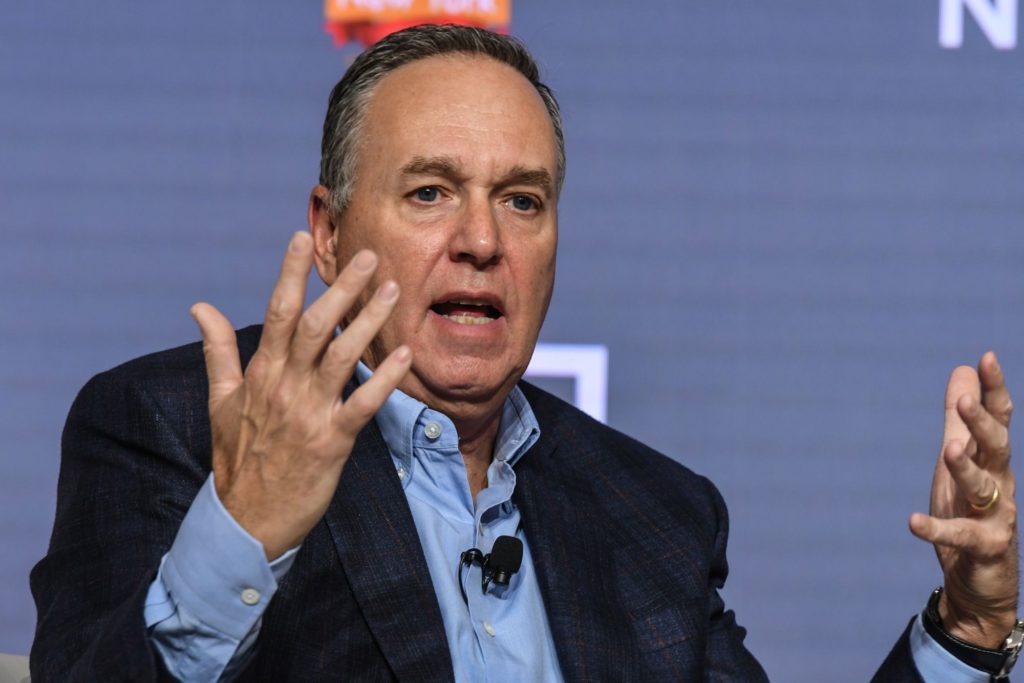
Capital One CEO Sees Learning Curve for Finance: Goldman Update

(Bloomberg) — Even a bank CEO who’s been at it for almost three decades hasn’t seen an economic environment quite like this one.

Richard Fairbank, the founder and longtime chief executive officer of Capital One Financial Corp., said with inflation running at 40-year highs and unemployment near historic lows, the current economy is unlike anything he and other banking titans have ever seen.

“The last time inflation was raging like it is now, we weren’t in the jobs that we’re in,” Fairbank said Tuesday at an investor conference in New York hosted by Goldman Sachs Group Inc. “For all of us, we’re going to sort of learn this as we go along.”

Fairbank, 72, has been CEO since Capital One was spun out of its former parent company Signet Bank in 1994. Under him, the McLean, Virginia-based company has grown to become the fourth largest US credit-card issuer, with a market capitalization of $35.8 billion.

Fairbank said his company has begun to tighten underwriting for lower-income consumers, who have already started to go delinquent on card loans more quickly than their wealthy counterparts. Still, he said the company, which has been investing in travel products and offers the $395-a-year Venture X card, is looking to increase its share among big-spending, prime consumers.

“The good news is the credit metrics are still better than they were in the past but the bad news is the trajectory,” Fairbank said. “But along the way, we continue to trim around the edges.”

Boutique Investment Banks See Hiring Opportunity (3:20 p.m. NY)

Executives at boutique investment banks Moelis & Co. and Perella Weinberg Partners said the weakness in Wall Street compensation will help them add high-quality employees.

“If we see the right talent, we will pull the trigger and we will invest,” Ken Moelis, founder and chief executive officer of Moelis, said at the conference.

Incoming Perella Weinberg CEO Andrew Bednar, meanwhile, said his bank has a “mandate” from its investors and partners to expand, and that a decline in correlation between performance and compensation at the largest investment banks would create opportunities for his firm to do so.

“We’ve built a terrific business,” Bednar said, “but it’s time to scale the business.”

ICE Focused on Mortgages Even With Rates Rising (2:03 p.m. NY)

Intercontinental Exchange Inc. is “leaning hard” into the mortgage business even as high interest rates slow originations.

“The best time to build a business is when some of these things are out of favor, when your clients are looking for solutions,” said Jeffrey Sprecher, CEO of ICE, which owns the New York Stock Exchange. “It’s going well.”

ICE and other exchange operators have been branching into data and other areas of financial technology in recent years as growth stalled in the traditional exchange business. Earlier this year, the company agreed to buy mortgage-software provider Black Knight Inc. in a deal valued at around $13.1 billion.

Sprecher said that his company is trying to build an infrastructure that can change the cost of wholesale mortgage using automation tools. “That can fundamentally change the capital markets,” he said.

On the fallout from the collapse of crypto exchange FTX, Sprecher expects the biggest impact will be on consumer behavior.

“A lot of people that thought they were wealthy will start to worry about their day jobs,” bringing them back to the office “to put in the hard work and earn an income,” he said. And while there will also be regulatory scrutiny of the crypto markets, Sprecher said he doesn’t expect “massive law changes,” adding that regulations “already exist — they will just be implemented.”

JPMorgan Sees Trading Revenue Rising About 10% (1:25 p.m. NY)

JPMorgan Chase & Co. expects trading revenue to rise about 10% this quarter from a year ago on continued strong performance in macro, said Marianne Lake, co-head of the firm’s consumer and community bank.

The guidance is based on quarter-to-date figures, Lake said Tuesday at the conference. In a wide-ranging conversation, Lake also reiterated JPMorgan’s fourth-quarter guidance for expenses and net interest income, but noted that each could be “a little better” than the firm earlier expected.

“Markets performance is good, particularly in fixed income,” Lake said. “In terms of NII and expense for the fourth quarter, I would say things have played out pretty much in line with the guidance.”

JPMorgan reported its highest-ever quarterly NII for the three months through September and raised its guidance for the year, a sign that the biggest US bank is reaping the benefits of the Federal Reserve’s rate hikes.

Lake, who earlier served as JPMorgan’s chief financial officer, said the US economy is “still strong,” but that the probability of a recession has gone up. Spending trends are moderating, but holiday spending is “so far, so good,” she said.

AmEx Platinum Clients Double Even With Fee Hike (11:47 a.m. NY)

American Express Co. said the number of Platinum cardholders in its portfolio doubled in recent years even as it pushed the annual fee to $695 from $450.

The company will continue to revamp the card’s perks and adjust the annual fee accordingly, Chief Executive Officer Steve Squeri said. 

AmEx has added a raft of benefits in recent years, including credits for Walmart Inc.’s subscription service and ride-sharing companies as well as flight and hotel perks.

“The reality is, it’ll go as high as the value allows us to go,” Squeri said of the Platinum card’s annual fee.

The changes have buoyed AmEx’s net card fee revenue, which has jumped 15% to $4.45 billion so far this year.

Discover Says Spending on Cards Is Slowing (11:11 a.m. NY)

Discover Financial Services has seen spending on its cards slow in recent months as consumers deal with inflation running at a 40-year high.

Spending rose 9% in November compared with 11% in October, CEO Roger Hochschild said in a Bloomberg Television interview Tuesday. Both months were lower than the 14% increase the firm booked in September, he said. 

Still, the company has continued to see strong growth in spending on everyday categories, he said.

“The consumer is hanging in there,” Hochschild said on the sidelines of the Goldman Sachs Group Inc. US financial-services conference in New York. “We are coming off unbelievably robust levels of consumer spending.” 

The pullback is especially striking when compared to last year, when consumers returned to traveling and dining out after months of pandemic-induced lockdowns.

Ally Says Car Prices to End 2002 Down as Much as 18% (10:30 a.m. NY)

When it comes to the car industry, prices are expected to end the year down by about 17% or 18%, according Jeffrey Brown, the CEO of Ally Financial, one of the biggest US car lenders. Brown forecasts the decreases will continue into next year, likely dropping approximately an additional 15%.

“Frankly, I’ve been surprised that the market has taken all of the price we’ve put in,” Brown said at the conference. The market is, however, “probably close to hitting a saturation point,” he said, where customers say enough is enough.

Used car prices have dropped since the beginning of the year and dealers like Carvana are struggling as a result. Brown said he regularly communicates with the Carvana executives, calling them a “responsible” partner.

BofA CEO Moynihan Sees Signs of Consumer Weakness (10:22 a.m. NY)

Bank of America Corp. is seeing signs of consumer weakness, with spending starting to slow, CEO Brian Moynihan said.

“Consumers are still spending more money right now, but the rate of growth is slowing,” Moynihan said at the Goldman Sachs conference. 

The bank saw consumer spending rise 5% in November, a lower rate compared with previous periods, Moynihan said. Consumer deposit balances are starting to come down as well, but borrowing and credit quality “are still in good shape” despite the slowdown in activity, he said.

Those are signs that the Federal Reserve’s attempts to get inflation under control might be having an impact. Moynihan has said previously that consumers are in “good shape” amid rising rates and expenses, with cash to spend. As long as consumers “stay employed, the rate of spending out excess savings is very small,” Moynihan said Tuesday.

In other parts of Bank of America’s business, the company’s traders should fare well this year even as their investment-banking colleagues are hurt by a slowdown in deals, Moynihan said. Sales and trading is expected to be up 10% to 15%, while traditional investment-banking fees will be down 50% to 60%, in line with peers, he said.

Discover Begins to Curtail Some Originations (10:14 a.m. NY)

Discover Financial Services said it’s begun to curtail certain origination activity as it’s seen a pullback in spending among prime households.

The company is limiting new accounts it offers to customers considered at the “lower end of prime” credit scores, Chief Executive Officer Roger Hochschild said at the conference. The credit-card firm has already begun to see the prime consumers it’s long catered to eating out less and shopping more at discount stores.

“The prime households have enough liquidity to manage inflation,” Hochschild said. “It doesn’t mean it’s not painful.”

Discover has seen spending growth on its cards slow in recent months as consumers battle the effects of inflation running at 40-year highs and a raft of job-cut announcements from the country’s largest technology firms. Still, the company was adamant that its focus on prime consumers will help it navigate any economic downturn better than rivals focused on less-credit-worthy customers.

“That’s why you’re seeing stress in the subprime and near-prime issuers, where those households are already tapped out,” Hochschild said. “They’re already shopping at Dollar General or the lower-end retailers.”

Synchrony CFO Sees Clues in Grocery, Gas Charges (9:53 a.m. NY)

Gas stations and grocery stores could offer the first signs that US consumers are starting to struggle, according to executives at the country’s largest store-card provider.

As financial burdens begin to mount, customers typically hit up those types of outlets more frequently, Brian Wenzel, chief financial officer at Synchrony Financial, said at the Goldman conference. 

Instead of filling up the tank, they’ll go more often and time their purchases around the days of the month they get paid, Wenzel said. Another red flag: Customers who turn off auto payments that took care of statement balances in full, in favor of just the minimums.

“It’s all about elongating liquidity for them,” Wenzel said, adding that, when his company listens in on collections calls, many customers have started lamenting rising rent costs. “What we hear today is, ‘I can’t make my rent payment, it’s up. Inflation is killing me on gas and groceries.’ You see that.”

Investors are closely watching credit-card companies for signs that US consumers are having trouble keeping up with their bills. So far, losses remain near historic lows, though delinquencies have begun to tick up in recent months.

Wells Fargo Looking at Paying Depositors More (9:05 a.m. NY)

Wells Fargo & Co. CEO Charlie Scharf said the bank is working to find the right balance of how much to raise the rates it’s paying depositors while protecting the firm’s profitability.

The lender sees increasing rates on deposits more as a tool to retain “franchise customers” than a way to attract new clients, he said at the conference. The bank is studying how customers at different levels of affluence and deposit concentrations react to rate changes as part of its evaluation, he said.

“There is a deep analysis that you need to do about how much can you get away with in terms of not passing on rate in the shorter term versus what do you lose in the longer term for just not treating customers properly,” Scharf said.

Citizens Financial Stays Disciplined (8:40 a.m. NY)

Citizens Financial Group Inc. CEO Bruce Van Saun said the bank was being “very disciplined” in its approach to commercial lending following a pull-back among banks.

“We’ll see some growth there because the economy is still doing OK, and there’s still folks borrowing money to expand or to do deals,” even as activity tapers off going into next year, Van Saun said during the Goldman conference.

Solomon Says Pay to Fall as ‘Bumpy Times Ahead’ (8:20 a.m. NY)

Goldman Sachs Group Inc. CEO David Solomon sees “bumpy times ahead” for the global economy, meaning compensation will decline from last year’s levels.

“You have to be a little bit more cautious,” Solomon said in a Bloomberg Television interview Tuesday.

Last year “was an exceptional year for the firm,” Solomon said, adding that 2022 is a “different year and so naturally compensation will be lower.” But he added that he’s surprised by how resilient the competition for talent is.

While the bank’s economists expect the US to avoid recession next year, he said he’s a little more cautious on the outlook.

Goldman Sachs Still Feeling Pressure on Expenses (8 a.m. NY)

Goldman Sachs is still experiencing pressure on expenses, Solomon said, highlighting the growth in non-compensation costs.

The firm is facing a tricky balancing act to keep a lid on total spending while rewarding its top performers in a very competitive market for top talent, Solomon said at the firm’s financial-services conference. Compensation costs are the biggest item in Goldman’s expense line.

Goldman has been cutting costs to protect profits from a costlier-than-expected foray into consumer banking as well as the global economic slowdown, which is taking a toll on dealmaking.

–With assistance from Sonali Basak, Jenny Surane, Sridhar Natarajan, Kevin Orland, Paige Smith and Dan Reichl.

More stories like this are available on bloomberg.com

©2022 Bloomberg L.P.

Finance CEOs Fret Over US Consumers Buckling on Inflation, Rates

(Bloomberg) — The potent cocktail of decades-high inflation and aggressively rising interest rates is showing signs of taking a toll on consumers, and financial-services providers are reacting with cuts to their business lines.

Consumers are still buying for now, according to a bevy of executives, who also said they are taking steps in anticipation that spending will curtail. 

Discover Financial Services is seeing weakening on its cards spending, and is pulling back on some origination activity, Chief Executive Officer Roger Hochschild said Tuesday at the Goldman Sachs Group Inc. financial-services conference in New York. Bank of America Corp. CEO Brian Moynihan also flagged the slowing rate of growth in consumer expenditures, and Capital One Financial Corp.’s Richard Fairbank said low-income customers have already faced cuts.

“Consumers are still spending more money right now, but the rate of growth is slowing,” said Moynihan.

Buyers with less-than-stellar credit scores are some of the first to feel the ripple effect. In addition to the Capital One cuts, Discover’s Hochschild said the firm is limiting new accounts for those at the “lower end of prime” scores.

“That’s why you’re seeing stress in the subprime and near-prime issuers, where those households are already tapped out,” Hochschild said. “They’re already shopping at Dollar General or the lower-end retailers.”

Households will have to make difficult spending decisions in the near future, a prospect some are already facing, according to Brian Wenzel, chief financial officer at Synchrony Financial. 

“It’s all about elongating liquidity for them,” he said. “What we hear today is, ‘I cant make my rent payment, it’s up. Inflation is killing me on gas and groceries.’ You see that.”

More stories like this are available on bloomberg.com

©2022 Bloomberg L.P.
Hedge Fund Sues Grayscale for Data on Battered Bitcoin Trust

(Bloomberg) — Fir Tree Capital Management is suing Grayscale Investments for information to investigate potential mismanagement and conflicts of interest at its $10.7 billion Bitcoin fund.

The Grayscale Bitcoin Trust closed Monday at a 43% discount to the value of the Bitcoin it holds, in part because the firm issued many shares in the past few years and didn’t redeem any of them, according to a complaint filed Tuesday in Delaware Chancery Court. 

The trust’s publicly traded shares have plunged about 75% this year, as the industry deals with the fallout from last month’s bankruptcy of Sam Bankman-Fried’s crypto exchange FTX and a tumble in Bitcoin and other cryptocurrencies.

Fir Tree, which manages $3 billion, wants to use the information to push Grayscale to erase the discount by lowering fees and resuming redemptions, said people familiar with the hedge fund’s plans. The trust has roughly 850,000 retail investors who have been “harmed by Grayscale’s shareholder-unfriendly actions,” the firm said in the complaint. 

Grayscale is owned by Barry Silbert’s Digital Currency Group, which also runs Genesis Global Trading, a crypto lender and broker that halted withdrawals in November — fueling questions about the health of its parent. 

“In 2013, we launched Grayscale Bitcoin Trust (GBTC) to provide investors with access to Bitcoin, and always with the intention of converting it to an ETF when permitted by US regulators,” a Grayscale spokesperson said in an emailed statement. “We remain 100% committed to converting GBTC to an ETF, as we strongly believe this is the best long-term product structure for GBTC and its shareholders.”

Fir Tree alleges that Grayscale’s redemption bar, which dates from 2014, is “self-imposed.” The hedge fund said there’s no legal reason that stops the trust from allowing investors to exit, as long as it complies with securities laws. Grayscale has said in regulatory filings it can’t offer an “ongoing redemption program.” 

The hedge fund claims Grayscale refuses to redeem shares because doing so would cut into profits. The firm sold “an immense number” of new shares between 2018 and 2021, according to the lawsuit. It charges 2%  — higher than competitors such as Osprey Bitcoin Trust — on the market value of its Bitcoin holdings rather than the lower market price of the shares. Last year, Grayscale collected $615.4 million in fees, Fir Tree said. 

Internal Files

Grayscale Bitcoin Trust boomed in popularity during crypto’s bull run in 2020 and 2021, quickly becoming the world’s biggest digital-assets fund as investors looked for access to Bitcoin without having to buy the coins directly. That seemingly insatiable demand boosted the trust’s price to a persistent premium above the value of its underlying Bitcoin, fueling one of the industry’s most popular arbitrage trades.

The complaint is a “books and records” action, demanding documents that could be used in court to get Grayscale to take action to close the discount. Delaware judges often grant such requests.

Fir Tree also is looking for internal files about the alleged interdependency of Digital Currency Group’s businesses, which it said is “especially troubling given recent events in the crypto ecosystem, including the rapid collapse of FTX and Three Arrows Capital.” 

The firm said it’s also concerned by the fund’s lack of independent oversight. 

Fir Tree said it wants Grayscale to stop its efforts to convert the trust into an exchange-traded fund, which Grayscale claims is the only way it can legally redeem shares. 

The US Securities and Exchange Commission refused to bless the conversion earlier this year, as it has for similar funds, and Grayscale is suing the regulator over the refusal. 

“That strategy will likely cost years of litigation, millions of dollars in legal fees, countless hours of lost management time, and goodwill with regulators,” Fir Tree’s lawyers said in the complaint. “All the while, Grayscale will continue to collect fees from the trust’s dwindling assets.”

The case is Fir Tree Value Master Fund LP v. Grayscale Investments LLC, No. 2022-1126, Delaware Chancery Court (Wilmington).

–With assistance from Katie Greifeld.

(Updates with Grayscale comment in sixth paragraph, case citation in last.)

More stories like this are available on bloomberg.com

©2022 Bloomberg L.P.

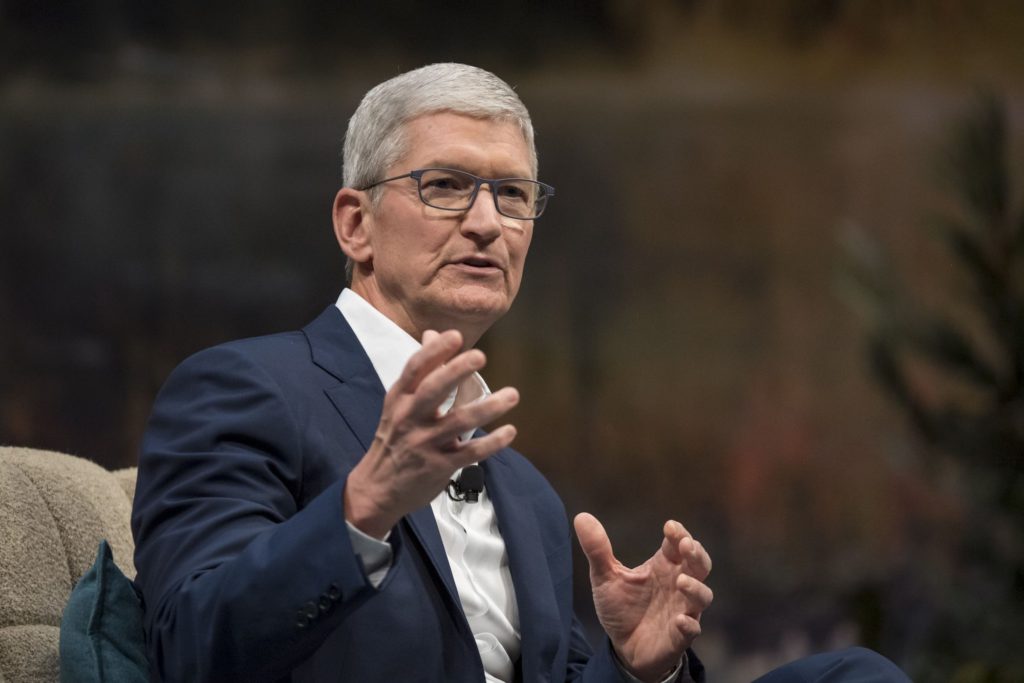
Apple CEO Cook Confirms Made-in-US Chips Push at Arizona Plant

(Bloomberg) — Apple Inc. Chief Executive Officer Tim Cook said Apple will build chips in the US for the first time in nearly a decade, a key step in reducing its reliance on Asia-based manufacturing. 

Cook spoke Tuesday alongside President Joe Biden and executives from chip companies at the site of a Taiwan Semiconductor Manufacturing Co. plant under construction in Phoenix. Cook said Apple will expand its relationship with TSMC, which already produces chips for the iPhone maker, when the US factory opens in 2024. 

“As many of you know, we work with TSMC to manufacture the chips that help power our products all over the world,” the Apple CEO said. “And we look forward to expanding this work in the years to come — as TSMC forms new and deeper roots in America.”

Cook said the Apple silicon chips found in most of its devices will be built at the Phoenix plant. “Thanks to the hard work of so many people, these chips can be proudly stamped ‘Made in America,’” he said.

Initially, the plant will only build chips in small quantities for Apple and may use technology that is inferior to what the company will need for its flagship devices in 2024. Bloomberg News first reported on Apple’s plan to build chips in Arizona last month. 

More stories like this are available on bloomberg.com

©2022 Bloomberg L.P.
Close Bitnami banner
Bitnami