

Bloomberg

Can AI Clean Up One of the Dirtiest Corners of the Corporate World?

(Bloomberg) — Industrial production is one of the dirtiest corners of the corporate world. A startup from former Google engineers thinks it can clean it up with artificial intelligence.

Phaidra, a company based in Seattle, sells AI software to automate building controls for power plants and other industrial giants. It’s relying on the same fix as their former company, DeepMind, Google’s research lab. For several years, DeepMind has let its AI system manage the temperature controls inside Google data centers, ultimately shaving huge chunks off the company’s electricity bill.

Phaidra’s algorithms are designed to select the most efficient temperature for unique facilities, such as a steel mill or a vaccine manufacturer, and identify when equipment starts to lag in performance. Once in place, Phaidra’s system can trim a plant’s energy consumption by up to 30 percent and save considerable amounts of capital, according to the startup. “It can immediately make these companies more profitable,” says Jeremy Brewer, managing partner with Starshot Capital, an investor.

Jim Gao, Phaidra’s chief executive officer, calls manufacturing a sector ignored by Silicon Valley yet ripe for the kind of advanced machine learning cooked up in places like Google. “They’ve been collecting data for so long, but they haven’t been using it,” he says of his new customer base.

Indeed, the industrial sector, which accounts for about a fourth of all US greenhouse gas emissions and continues to expand, is beginning to embrace cutting-edge data science. A report from IOT Analytics forecast revenue from industrial AI to balloon to $72.5 billion by 2025 from $11 billion in 2018.

Still, most of that usage represents basic tasks like digitizing data or creating online dashboards, not tools where algorithms run entire control systems without people tweaking the dials, like the one that Phaidra pitches. Not many manufacturers have the capacity to try that or the budgets and engineering prowess to maintain such a system. “It’s very few and far between,” explains Jon Van Wyck , a BCG managing director. 

Phaidra, which was formed in 2019, says it has several Fortune 100 industrial customers in areas as wide-ranging as pharmaceutical development to paper mills. It declines to name specific clients or financial figures. The startup recently raised $25 million in financing from Starshot and Character, investment firms started by other Google alums. It has also brought on Robert Locke, a 13-year veteran of industrial supplier Johnson Controls, as president. 

Gao formerly worked on the energy team at DeepMind alongside his technical co-founder, Vedavyas Panneershelvam. The engineers are among the few with extensive experience in reinforcement learning, a branch of AI where algorithms are designed to continuously improve. DeepMind’s most famous version of this is AlphaGo, its system for whupping the famously difficult board game, Go. 

While AlphaGo was optimized for winning Go, Katie Hoffman, another Phaidra co-founder, describes her system as one optimized to reduce the kilowatt hours of the plants it plugs into. Hoffman comes from the industrial sector — most recently as a manager with the equipment maker Ingersoll Rand Inc. — and says many of Phaidra’s customers work in “mission-critical” fields, with very specific demands about how their plants should be cooled and operated. They also rely on antiquated, hand-coded software. 

“They’re using what’s been around since the 1950s,” she says. “These industrial systems are incredibly difficult to run on a good day.”

DeepMind’s building control algorithms have continued to tweak dials inside Google’s data centers. And Google has begun to offer a similar service to its cloud customers. But Phaidra’s founders say their approach is tailored to the particularities of the industrial sector, which is lightyears away from the sophistication of a Google building.

Gao didn’t share his company’s prices but says customers pay Phaidra less than the energy savings they earn from its service.

More stories like this are available on bloomberg.com

©2022 Bloomberg L.P.
MTN in Talks to Buy $1.3 Billion-Valued Carrier Telkom

(Bloomberg) — MTN Group Ltd. is in talks to buy smaller domestic rival Telkom SA SOC Ltd. in a deal that would make the combined company the biggest South African mobile-phone operator by number of subscribers. 

MTN proposed to pay for the partially state-owned Telkom in shares or a combination of cash and stock, according to a statement on Friday. Discussions are at an early stage and there is no certainty the transaction will be completed, the carriers said.

Telkom shares surged 33% as of 11:56 a.m. in Johannesburg to 43.52 rand, valuing the company at 22.5 billion rand ($1.3 billion). Bloomberg first reported MTN’s interest in Telkom in November.

MTN is flush with cash — after a multi year asset-disposal program — and is looking to strengthen its position in its core African markets. A combination with Telkom would close the gap with rival Vodacom Group Ltd., South Africa’s market leader controlled by the UK’s Vodafone Group Plc. A recent spectrum auction made the continent’s most-industrialized economy even more attractive to operators.  

While a deal would need to pass certain regulatory and competition concerns, “it makes financial sense to go after all of Telkom given many other undervalued assets” in the company, said Peter Takaendesa, head of equities at Mergence Investment Managers. “I’m sure they have found ways to deal with potential problem areas such as spectrum that may cause regulatory and competition commission issues.”

Effective Duoply

A number of antitrust concerns would have to be worked through as the deal would create an effective duopoly — the fourth and smallest rival only has 12.9 million subscribers. In 2016, Vodacom had to drop a plan for the acquisition of local fixed line operator Neotel, due to regulatory complexities.

“We think South Africa’s Competition Commission would seek to block a transaction,” John Davies, a senior analyst at Bloomberg Intelligence, said in a note. “A deal could reduce mobile networks in the country to three from four and remove one of the price leaders, which has been shown in other countries to work against consumer interests.” 

Another key issue will be what MTN is willing to pay for Telkom, said Takaendesa. “Consensus price targets for Telkom are in the 50 rand to 60 rand range, but an industry acquirer is expected to pay a premium.”

MTN’s shares advanced 3.8%. They have dropped 18% this year. 

(Updates with analyst’s comment in fifth paragraph.)

More stories like this are available on bloomberg.com

©2022 Bloomberg L.P.

China Property Crisis Is Spiraling With Homebuyers’ Boycott

(Bloomberg) — Former UBS Group AG economist Jonathan Anderson once called it “the most important sector in the universe.”

More than a decade on, Chinese property is again grabbing the attention of global investors — this time for all the wrong reasons.

Mounting signs of stress this week in an industry that accounts for about a quarter of the world’s second-largest economy have roiled China’s credit markets, dragged down the nation’s bank stocks and pummeled commodities from iron ore to copper.

After a burst of optimism earlier this year that looser regulatory curbs might stem the industry’s debt crisis, investors are getting spooked by rolling Covid lockdowns and a rapidly escalating homebuyer boycott of mortgage payments on stalled projects. The bigger worry is that a widespread loss of confidence in real estate will put major strain on China’s economy and financial system, which is sitting on 46 trillion yuan ($6.8 trillion) of outstanding mortgages and still has 13 trillion yuan of loans to the country’s beleaguered developers.

“Property has been getting steadily worse the whole time; prices, sales, starts, all terrible,” said Craig Botham, chief China economist at Pantheon Macroeconomics in London. “The chronic deterioration has now taken another step. It was always going to hit the financial sector eventually, given the prevalence of collateral in loan books with large real estate portions.”

What started as trouble with China Evergrande Group is now snowballing into a crisis that risks engulfing the majority of the country’s developers, its biggest lenders and a middle class that has significant wealth tied to the property market. China’s home prices have tumbled 10 months straight, according to data released on Friday. 

“The whole pyramid is collapsing now,” said Anne Stevenson-Yang, co-founder of J Capital Research Ltd. “What’s different is that things are worse now because of the Evergrande crisis a year ago, which is spreading its tentacles throughout the Chinese economy.”

The turmoil has battered what was already one of the world’s most stressed industries. The average yield on Chinese junk dollar debt, which is dominated by developers, has surged to almost 26%. Selling has also spread to investment-grade builders, with a bond issued by China Vanke Co., the second-largest builder by sales, falling to a record-low of 81.6 cents on the dollar this week. 

China’s Covid Zero policy is exacerbating the situation by damping demand for property and depressing economic activity. Lockdowns remain commonplace in China, which continues to stick to a policy of keeping out the virus with stringent curbs. A recent flareup in Shanghai has spurred concern the city could be heading for another lockdown. 

How China’s Property Developers Got Into Such a Mess: QuickTake

Concern that mortgage boycotts will lead to a rise in souring loans sent a gauge of Chinese bank shares tumbling almost 8% this week, its worst loss in more than four years. An index of developer stocks sank 10%, with Country Garden Holdings Co., the nation’s biggest builder, tumbling 27%.

Chinese authorities held emergency meetings with major banks this week to discuss the mortgage boycotts on concern that more buyers may follow suit, according to people familiar with the matter. Some lenders plan to tighten their mortgage lending requirements in high-risk cities, two of the people said.

The housing ministry in Xi’an became one of the first government agencies to address the issue publicly, saying it will penalize developers who cause social incidents due to failure of project delivery.

Homebuyers have stopped mortgage payments on at least 100 projects in more than 50 cities as of Wednesday, according to researcher China Real Estate Information Corp. That’s up from 58 projects on Tuesday and only 28 on Monday, according to Jefferies Financial Group Inc. analysts including Shujin Chen. 

“If more home buyers cease payment, the spreading trend will not only threaten the health of the financial system but also create social issues amid the current economic downturn,” Betty Wang, a senior economist at Australia & New Zealand Banking Group Ltd., wrote in a note Thursday.

Banks are rushing to reassure investors that risks from loans to homebuyers were controllable, with at least 10 firms issuing statements. State-owned Agricultural Bank of China Ltd. said it held 660 million yuan of overdue loans on unfinished homes, while smaller rival Industrial Bank Co. said 1.6 billion yuan of mortgages were impacted, of which 384 million yuan have become delinquent. 

Nomura Holdings Inc. said the refusal to pay mortgages stems from the widespread practice in China of selling homes before they’re built. Confidence that projects will be completed has weakened as developers’ cash woes intensified. 

Nomura economists led by Ting Lu estimate that Chinese developers have only delivered around 60% of homes they presold between 2013 and 2020, while in those years China’s mortgage loans rose by 26.3 trillion yuan. GF Securities Co. expects that as much as 2 trillion yuan of mortgages could be impacted by the boycott.

China’s Credit Market Is Plunging Into a New Phase of Distress

Housing in China has gone from being a sure bet over the past two decades to a growing risk. The government cracked down on leverage in the real estate industry, helping drive up debt refinancing costs for developers and triggering a record wave of defaults. Home sales tumbled 41.7% in May from a year earlier, with investment dropping 7.8%. 

The real estate industry has an oversized impact on the economy. When related sectors like construction and property services are included, real estate accounts for more than a quarter of Chinese economic output, by some estimates. About 70% of household wealth is stored in property, along with 30-40% of bank loan books, while land sales account for 30-40% of local government revenues, according to Pantheon Macroeconomics’ Botham.

The worsening crisis will test authorities’ ability to minimize the fallout. Earlier this year, China was setting up a stability fund to provide support to troubled financial firms as risks to the economy grow. Handling such issues will be also key for President Xi Jinping ahead of a leadership confab widely expected to cement his rule for life.

Data Friday showed China’s economy grew at the slowest pace since the country was first hit by the coronavirus outbreak two years ago. The 0.4% expansion in gross domestic product reported for the three months to June, when dozens of cities including Shanghai and Changchun imposed lockdowns, was the second weakest ever recorded. Goldman Sachs Group Inc. cut its full-year growth forecast for China to 3.3% in the wake of the data. 

The slowdown in construction is also hurting demand for building materials. Iron ore slumped more than 8% on Thursday, falling below $100 a ton for the first time since December, and dipped further on Friday. A year ago, iron ore was trading comfortably above $200 a ton, with China’s wave of Covid-era stimulus feeding a boom for property and the steel market. Futures for steel rebar in construction collapsed in Shanghai to their weakest since 2020. Copper tumbled to a 20-month low.

(Updates with latest data, share prices throughout)

More stories like this are available on bloomberg.com

©2022 Bloomberg L.P.

Behind the Editor’s Desk at Bloomberg Crypto

  • Listen to Bloomberg Crypto on the iHeartRadio App
  • Listen to Bloomberg Crypto on Apple Podcasts
  • Listen to Bloomberg Crypto on Spotify 

(Bloomberg) — Every day, around the world, the reporters and editors who cover crypto at Bloomberg wake up (often at the crack of dawn) and start figuring out how to tackle the biggest and most important news events of the day. Crypto is a 24/7 asset class: It doesn’t stop trading, and it doesn’t take holidays. It’s the news team’s job to assess both the big trends and the small moments, and to figure out how to translate those into stories (and podcast episodes). In this episode, you’ll get to meet three of Bloomberg’s crypto editors, folks who are making decisions all day long about how we approach this asset class: Beth Williams and Dave Liedtka, both based in New York, and Philip Lagerkranser, who’s based in Zurich. 

Follow us on Twitter @crypto, and subscribe to the Bloomberg Crypto Newsletter at https://bloom.bg/cryptonewsletter

More stories like this are available on bloomberg.com

©2022 Bloomberg L.P.

Congress Should Make Privacy Measures a Top Priority, Poll Shows

(Bloomberg) — Most American parents want Congress to pass online privacy legislation, especially to protect children, according to a poll by digital advocacy group Trusted Future.

In a survey of 992 respondents with at least one child under the age of 17, about 63% said that if they could choose one priority for Congress, it would be to increase privacy protections.

Some 75% of Americans believe having a “tech talk” with their children about digital safety is now as important as the “sex talk,” according to the poll.

“That’s a signal to policy makers and tech companies about the importance that parents place on a safe and secure and private digital experience,” said Ken Gude, executive director of Trusted Future, a Washington-based think tank formed late last year that focuses on digital issues, particularly privacy and cybersecurity. 

The group calls for a federal privacy standard, echoing arguments from the technology and telecom industries, which have lobbied for one nationwide criterion rather than a patchwork of state laws.

The US lacks a federal statute on privacy. While 25 states have introduced privacy legislation, only a handful have signed them into law and even fewer have implemented robust standards that prevent tech companies from collecting user data without consent. Recent efforts by Congress to pass a privacy law have stalled amid opposition from key lawmakers, including Senator Maria Cantwell, a Washington State Democrat. 

The Children’s Online Privacy Protection Act, passed in 1998, protects children 13 and younger. Companies including Meta Platforms Inc.’s Facebook, Alphabet Inc.’s Google and ByteDance Ltd.’s TikTok have all paid fines for violations of the law.

Concerns around children’s online safety intensified last year after a Facebook whistle-blower, Frances Haugen, came forward with documents revealing that the company planned to attract more adolescents, while also having research that its products harmed teenage girls’ mental health.

“Parents want to take an active role in safeguarding their children’s privacy, but they can’t always be their own chief information security officer,” said Gude, who spent more than a decade in different positions at the Center for American Progress, a liberal public policy research group.

Trusted Future, which doesn’t disclose its funding, has several people on its board with ties to the tech and telecom industries, including Edward “Smitty” Smith, a former legal adviser to the Federal Communications Commission who now represents several telecom clients, and Maureen Ohlhausen, a former acting chair of the Federal Trade Commission and chair of the telecom-funded group 21st Century Privacy Coalition.

Trusted Future said in a statement it had no relationship with the 21st Century Privacy Coalition, which counts AT&T Inc., Comcast Corp., T-Mobile US Inc. and the broadband association USTelecom as members.

The poll’s margin of error is plus or minus three percentage points. 

When the Supreme Court in June overturned the Roe v. Wade decision, striking down the constitutional right of women to decide whether to terminate a pregnancy, new privacy concerns arose about potential legal consequences if a woman’s health data were to be exposed. The Biden administration in an executive order earlier this month called on the FTC to take steps to protect the sensitive health data of patients seeking abortions.

Advocacy groups have pushed tech companies to increase privacy protections and transparency about how user data is shared, but argue that a strong national standard is still essential.

Some companies are taking steps to protect users. For example, Meta’s Instagram is testing using facial analysis to verify users are over the age of 18. And Google said earlier this month that it would start deleting users’ location history when visiting sensitive locations, like abortion clinics.

Some Republican lawmakers have vowed to make a priority of passing privacy legislation next year if the GOP retakes Congress.

More stories like this are available on bloomberg.com

©2022 Bloomberg L.P.

Fintech Execs Convicted in US After $160 Million Sent to Nigeria

(Bloomberg) — The operators of a Texan payments firm with ties to the UK pleaded guilty in the US to money laundering failures after their business facilitated the shipping of $160 million to Nigeria over about three years.

Anslem Oshionebo, 45, and Opeyemi Odeyale, 43, received 27-month prison sentences for failing to maintain effective anti-money laundering controls and unlicensed money transmitting, according to US legal filings. The Dallas-based company they owned and operated — Ping Express US LLC — faces five years of probation and a fine as high as $500,000 after pleading guilty to a similar charge, while another executive received a 42-month sentence, the Department of Justice said in a July 7 statement. 

Ping Express sent customers’ remittances to Nigeria, Kenya and other African nations. In one three-year period highlighted by the DoJ, the firm failed to flag a single suspicious transaction to regulators despite processing a “significant amount” of them, though it filed a batch of reports later.

One customer used the firm to move funds they made from fake-romance scams, with victims including a woman in Indiana who sent $15,000 to a supposed roughneck oil worker in the Gulf of Mexico, and another who sent $6,300 to a purported Irish sea captain, according to the DoJ’s statement. Another customer moved more than $80,000 in a single month, far more than the company’s $4,500 limit, court filings show.

“Having gone through a very painful three years of legal battle with a monstrous US DoJ, it was time to give in and move on,” Odeyale said in an emailed statement that claimed the case against him had “gross violations,” while he cited his track record with other businesses. “There is a lot of good I can do with the next two to three years than waste it in fighting an insurmountable foe.”

Oshionebo said in an email that “history will be the best judge” but he did not have the resources to continue fighting the case. 

Odeyale also founded and controlled Payzen Ltd., a London-based payments company where Oshionebo has also been a shareholder. The UK Financial Conduct Authority granted Payzen approval to operate in January 2020, two months before federal prosecutors for the Northern District of Texas charged the two men and a number of others with money-laundering crimes, according to US and UK filings. The British business wasn’t mentioned in the US case and hasn’t been accused of any wrongdoing. 

Odeyale ceased to be a controlling shareholder of Payzen in December 2020. The company is today controlled by Adekanmi Adedire, filings at Companies House show. In a LinkedIn message, Adedire said that Payzen is “unrelated” to Ping Express, which is a “totally different entity.”

Payzen still holds an active license as a payments company, with its website listed as ping-express.com, the FCA’s website shows. Ruth Wharram, a spokeswoman for the regulator in London, said she was unable to comment on an individual case. The watchdog takes “all relevant information into account in our supervision of firms,” she added.

The British financial-technology scene has come under scrutiny amid fears that its weak controls are enabling the movement of illicit funds around the world. Transparency International UK has called for tougher supervision after finding that more than one-third of UK-licensed electronic-money institutions show red flags. 

More stories like this are available on bloomberg.com

©2022 Bloomberg L.P.
Fresh Scrutiny of Alibaba Sends China Tech Stocks Into Tailspin

(Bloomberg) — Investors in China’s tech shares just got another reminder that regulatory scrutiny into the sector is unlikely to go away anytime soon despite a concerted effort by authorities to shore up a flagging economy.

On Friday, Alibaba Group Holding Ltd.’s stock tumbled 6% on a report that company executives had been questioned in relation to the country’s largest known cybersecurity breach. The Hang Seng Tech Index slumped 3.2%, taking its weekly drop to 7.7% which was the largest decline for the period in over two months.

The event is the latest indicator to investors that risks abound when it comes to Chinese tech stocks even after the year-long clampdown on private enterprise. Fines levied on Alibaba and Tencent Holdings Ltd. over the weekend for not properly reporting past transactions had sent shares tumbling earlier this week.

Alibaba Probe Report Intensifies Regulation Worries: Street Wrap

“The probe will give investors pause to assess if the reforms are over or still ongoing,” said Justin Tang, head of Asian research at United First Partners. “Given the fragile state of the markets, investors will adopt a sell first and ask questions later approach.” 

Executives from Alibaba’s cloud division were summoned for talks by authorities in Shanghai in connection with the theft of a vast police database, the Wall Street Journal reported, citing people familiar with the matter. The hackers claimed to have stolen data on as many as one billion residents. 

The Nasdaq Golden Dragon China Index fell 2.2% on Thursday.

Scrutiny of Alibaba in Record Breach May Ensnare All China Tech

Not everyone is worried.

The reported probe is not a regulatory issue and executives may only be facilitating the police’s investigations, according to Steven Leung, executive director at UOB Kay Hian in Hong Kong. The slide in US-listed Chinese shares was overdone, he added.

Still, there are reasons to remain skittish on the broader Chinese equities market. Property sector risks and a resurgence of Covid cases onshore are weighing on the economic outlook. Gross domestic product rose 0.4% in the second quarter from a year earlier, the worst performance since early 2020 and below the 1.2% gain forecast, data showed Friday.

A separate report showed new home prices in 70 cities, excluding state-subsidized housing, slipped 0.1% in June, in a 10th month of declines. The authorities also refrained from injecting funds into the banking system, while keeping borrowing costs unchanged.

Meanwhile, China’s benchmark CSI 300 Index fell 1.7%, weighed down by shares of financial firms, as a widening boycott on mortgage payments by homebuyers heightened concerns about a buildup in bad debt. 

(Updates closing levels)

More stories like this are available on bloomberg.com

©2022 Bloomberg L.P.

Memory Chipmaker SK Hynix Weighs Slashing Spending by a Quarter in 2023

(Bloomberg) — SK Hynix Inc. is considering cutting its 2023 capital expenditure by about a quarter to 16 trillion won ($12.2 billion) in response to slower electronics demand than anticipated, people familiar with the matter said. 

The world’s second largest memory maker is sticking largely with plans to spend about 21 trillion won this year building up DRAM and NAND capacity, the people said. But rising uncertainty over dwindling demand for the chips that go into everything from smartphones to servers has forced a rethink of expansions next year, they said, asking not to be identified talking about undisclosed plans.

The Apple Inc. supplier’s move comes as global tech companies sound the alarm over macroeconomic risks from rising interest rates, which is turning consumers off pricey gadgets. Hynix hasn’t made a final decision about capacity expansion plans, the people said.

The company’s shares rose 5% in Seoul on Friday, their biggest gain in four months, after investors bet Hynix’s cut would put a floor under chip prices by reducing an inventory glut. Samsung Electronics Co., the world’s biggest memory producer, was up 4.4%, its biggest single-day climb since December.

Fellow memory maker Micron Technology Inc. said at the start of this month that it plans to slow supply expansion next year and use existing inventory to fill part of the market demand. It expects capex to decline year-on-year. Taiwan Semiconductor Manufacturing Co., the world’s biggest contract chipmaker, said on Thursday it could trim spending on expansion by as much as 9% this year from initial projections.

“We have not decided whether to change our capex plan for next year,” Hynix said in a statement. 

Read more: TSMC Hikes Outlook Yet Delays Spending as Uncertainty Persists

Apple is TSMC’s biggest customer, accounting for an estimated quarter of its revenue. Chief Executive Officer C.C. Wei told analysts on a conference call he was unconcerned about potential inventory buildups of high-end smartphones. In April, the iPhone maker said it was grappling with supply-side constraints that could shave as much as $8 billion off revenue in the June quarter.

“We expect limited supply growth due to memory makers’ disciplined capacity addition, rising difficulties in memory fabrication, tech migration’s decelerating contribution to bit growth, and foresee supply-driven memory recovery throughout 2023E,” Citi analysts wrote in a report.

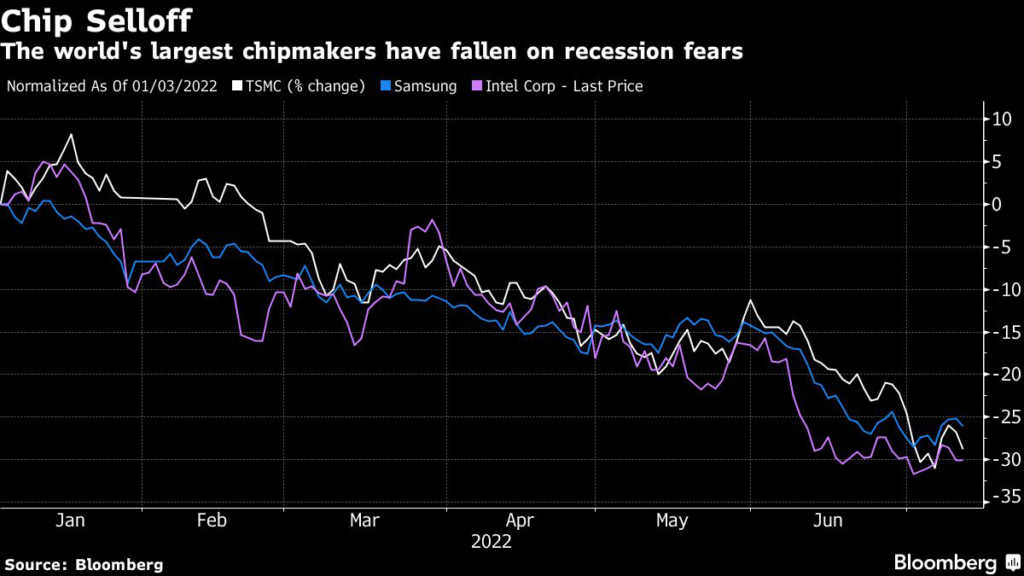
Chip stocks including Hynix, Samsung and Micron have fallen more than 25% this year as companies wrestle with a potential global recession.

But investors have recently bought back Samsung and TSMC, judging them oversold. Last week, Korea’s largest company triggered an Asian stock rally when it reported a better-than-projected 21% jump in revenue. On the flip side, Micron warned of oversupply and gave a surprisingly downbeat forecast for the current quarter.

Read more: Samsung Sparks $30 Billion Tech Rally After 21% Sales Jump

The memory chip industry, which has historically endured repeated boom-and-bust cycles, is particularly sensitive to signs of a glut or shortage in supply. 

Many industry observers regard capacity cuts by major players as a signal that they anticipate slowing demand and are moving to protect prices. Companies like Hynix tend to control supply, to prop them up.

In April, Hynix predicted a bounce-back in PC and smartphone sales in the seasonally stronger second half of 2022, depending on how long China’s Covid-19 lockdowns fare. Curbs across many of the country’s major cities including Shanghai began to relax around June.

The company will report earnings July 27.

(Updates with share price)

More stories like this are available on bloomberg.com

©2022 Bloomberg L.P.

A Solution to Japan’s Overwork: Sleep in an Upright ‘Nap Box’

(Bloomberg) — Japan’s Itoki Corp. and Koyoju Gohan KK are partnering to release vertical “nap boxes” to help bring a healthier office culture to the country.

The partnership was born out of a business-matching event where Tokyo-based Itoki, a furniture specialist, came in contact with plywood supplier Koyoju Gohan from Hokkaido. The two signed a license agreement on Thursday and Koyoju Gohan is now in the design process for the nap box. Pricing and availability haven’t yet been decided.

Overlong office hours are famously an issue among employees in Japan and the country even has a term for people sleeping during the day to make it through a full shift or a long commute: inemuri.

“In Japan, there are a lot of people who will lock themselves up in the bathroom for a while, which I don’t think is healthy. It’s better to sleep in a comfortable location,” said Saeko Kawashima, communications director at Itoki.

The nap box user will sleep in the pod like a flamingo, standing upright. The initial design has been made to ensure that the head, knees and rear are all comfortably supported so that the person will not fall over. With research pointing to restorative rest increasing productivity, this new development may nudge employees in Japan to take short power naps throughout the day.

“I think a lot of Japanese people tend to work continuously with no breaks,” Kawashima said. “We are hoping that companies can use this as a more flexible approach to resting.”

More stories like this are available on bloomberg.com

©2022 Bloomberg L.P.

Pinterest Jumps on Report That Elliott Has Acquired a Stake

(Bloomberg) — Pinterest Inc. shares jumped more than 15% in premarket trading after the Wall Street Journal reported that activist investor Elliott Management has acquired a stake in the struggling social-media company.

Elliott has built a stake of more than 9%, making it the company’s biggest investor, the newspaper reported Thursday, citing unidentified people familiar with the matter. The shareholder has engaged in discussions with Pinterest management, though the nature of those talks wasn’t clear, the Journal said.

The news follows a shake-up at Pinterest last month, when co-founder and Chief Executive Officer Ben Silbermann handed the reins to Google and PayPal Inc. veteran Bill Ready. The San Francisco-based company, which lets users create virtual scrapbooks, has been trying to expand further into e-commerce. 

The company also fielded a takeover approach by PayPal last year, but the digital-payment company said in October that it wasn’t going to pursue such a deal.

The shares fell 4.6% to $17.56 in New York on Thursday and have declined 52% this year. 

What Bloomberg Intelligence Says:

“Pinterest’s turnaround strategy may get help from the Elliott stake, as most social media platforms remain challenged by weak digital-ad spending. We believe comparisons could ease in 2H, and partnerships with e-commerce providers could spark a revival in top-line growth.”

— Mandeep Singh, BI senior technology industry analyst

Click here to read the research

Pinterest had enjoyed a surge in growth during the early days of Covid-19, when locked-down consumers turned to the service. But like other pandemic darlings such as Peloton Technology Inc., Pinterest suffered a slowdown in recent months. Its shares are down in a steeper drop than broader technology indexes.

It’s not the first time Elliott has targeted a well-known technology company in recent years. The firm took a $1.4 billion stake in EBay Inc. in early 2019, and CEO Devin Wenig stepped down later that year.

Elliott then accumulated a stake of more than $1 billion in Twitter Inc., a holding that was made public in early 2020. Twitter CEO Jack Dorsey kept his job for another 20 months, but Elliott’s presence led to aggressive revenue and user growth goals. The company was still struggling to meet those targets by the time Elon Musk showed up with a takeover offer this year — a deal that’s now unraveling.

People familiar with the situation have said they believe Dorsey left his job at Twitter in part because he was worn down by Elliott’s pressure.

(Updates with premarket trading in first paragraph)

More stories like this are available on bloomberg.com

©2022 Bloomberg L.P.

Close Bitnami banner
Bitnami