
Bloomberg

Baggage Chaos Is Getting So Bad Flyers Are Turning to Tracking Devices

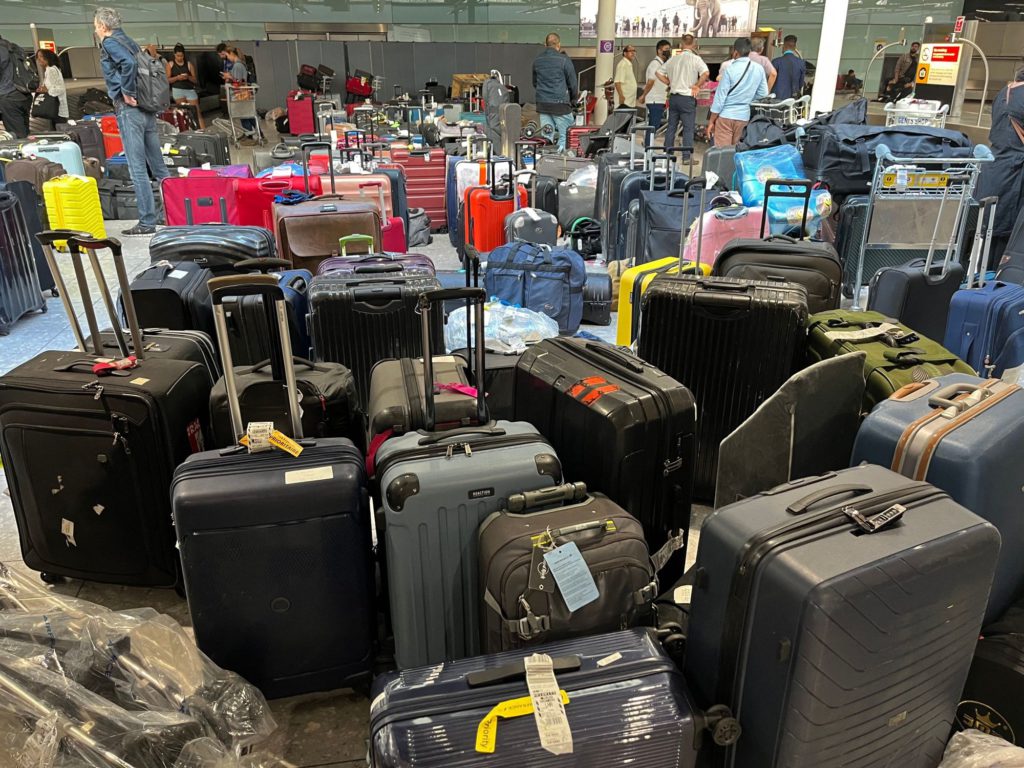
(Bloomberg) — Cory Prenatt’s retirement celebrations didn’t go as planned. Rather than enjoying playing golf with his friends at famous Open courses around the UK, the 47-year-old ended up traipsing across the country trying to locate his bags after they got lost on the journey over from the US. 

Prenatt, from Tampa Bay, Florida, had attached Apple Inc. devices called AirTags to his golf bag and other luggage to track where they were after checking in for his flight. Upon landing in the UK, he saw his bags were still stuck on the tarmac at Newark airport, where they remained for two days. His luggage was eventually sent to a warehouse in Edinburgh, but while driving there to pick it up, he noticed that his clubs were already headed to Aberdeen. His AirTag showed they finally ended up in the West Midlands in England. 

“It’s a mess,” he said.

Prenatt’s experience encapsulates the chaos travelers are facing as airports in Europe, the US and elsewhere are overwhelmed by a surge in passenger traffic — and luggage — because they don’t have enough staff to cope following the mass redundancies that engulfed the aviation industry during the pandemic. 

Travelers are turning to AirTags and similar devices from other companies to keep tabs on their belongings. Apple introduced AirTags in April 2021 with a starting price of $29, while Samsung Electronics Co.’s SmarTag costs $29.99.

The devices, which use short-range Bluetooth, are permissible on planes, with many passengers already flying with gadgets that use similar technology like gaming consoles and headphones.

A British Airways Plc passenger wrote on Twitter this week that her tracker showed her luggage arrived in London Heathrow a day after her flight and has been there for more than 10 days. Last month, a Singapore Airlines Ltd. passenger used his AirTag to locate and collect his bags after they’d been stuck in Melbourne Airport for a week, the Daily Mail reported.

Representatives for British Airways couldn’t immediately comment.

Heathrow, one of the world’s busiest airports, on Tuesday imposed a two-month cap on daily passenger traffic through Sept. 11 because of staff shortages, asking airlines to refrain from selling summer tickets. This week, Delta Air Lines Inc. flew a widebody aircraft without passengers to bring 1,000 lost bags from the London hub back to the US. A Delta spokesperson said the carrier’s teams had “worked a creative solution” to move delayed checked bags on July 11 after a regular scheduled flight had to be canceled.  

Two months since his trip, and after repeated queries to British Airways and courier companies, Prenatt still hasn’t got his golf bag back. He says it contained more than $10,000-worth of equipment, including a $4,000 putter that his son gave him as a retirement gift. 

He rented some clubs, in the end.

(Updates with Delta comment in 9th paragraph.)

More stories like this are available on bloomberg.com

©2022 Bloomberg L.P.

Alphabet’s Wing Develops Fleet of New Drones for More Efficient Package Delivery

(Bloomberg) — Alphabet Inc.’s Wing subsidiary has developed a fleet of new drone prototypes designed to more efficiently deliver packages ranging from small pill bottles to items weighing as much as 7 pounds. 

The two designs — one that looks more like a small plane used by hobbyists and another with a fat belly for additional cargo space — were unveiled Thursday in a blog post. 

For the time being, Wing LLC’s delivery test operation is sticking with its Hummingbird W-B aircraft, a hybrid that can take off like a helicopter and fly horizontally like a plane, Chief Executive Officer Adam Woodworth said in an interview. But engineers built and designed the new aircraft to give the company more flexibility to expand, he said. 

“The intent here is to build a robust R&D pipeline so the company can be prepared with a bunch of different aircraft that can meet different use cases,” he said. 

The prototypes are all based on the Hummingbird, which the company says can carry about 2 pounds (0.9 kilograms) and has made hundreds of thousands of deliveries in Dallas suburbs, Virginia, Australia and Finland. They use many of the same components, such as motors and guidance systems, and follow similar designs. 

The company is also considering building a prototype designed to make flights many times farther than the current 6-mile range and one to deliver goods over shorter distances in urban environments, Woodworth said. 

Wing is a leader among companies trying to revolutionize retail sales by creating a network to deliver goods by small drones. Others include Amazon.com Inc.’s Prime Air, United Parcel Service Inc. and Zipline International Inc., which is working with Walmart Inc.

Currently, drone deliveries in the US are being tested with strict safety limits imposed by the Federal Aviation Administration. Routine deliveries are still likely years away as the industry waits for the agency to draft safety regulations for such deliveries 

More stories like this are available on bloomberg.com

©2022 Bloomberg L.P.

Fox Station Sale in Boston Triggers Fears of Pay-TV Rate Hikes

(Bloomberg) — The transfer of the Fox network’s Boston TV affiliate, WFXT, from one private equity giant to another is raising red flags about the potential for soaring pay-TV bills.

Shortly before it completes its $5.4 billion acquisition of TV station operator Tegna Inc., the private equity firm Standard General LP plans to buy the Boston station from an affiliate of Apollo Global Management Inc., which is helping to finance the larger deal.

According to Altice USA Inc, a major cable operator, the sale of that single station could pave the way for Standard General to increase rates for pay-TV customers in markets far beyond Boston. Public-interest groups are also complaining about the deal.

Fees will climb “much sooner than the next three-year negotiation cycle if these transactions are approved,” the consumer advocates Common Cause and the United Church of Christ of Media Justice Ministry said in a June 22 filing with the US Federal Communications Commission, which must approve the sale. On Tuesday the commission extended the period for outside comments on the deal until Aug. 1.

At issue are the so-called retransmission fees that cable and satellite TV distributors pay station owners for their programming. In some cases when stations are acquired, the buyers can impose higher retransmission fees without renegotiating the deals with distributors.

The Tegna acquisition is unusually complex. Standard General is selling four TV stations it owns to CMG Media, formerly Cox Media Group, before the Tegna deal is consummated, according to merger documents. Apollo, which owns 71% of CMG through one of its funds, is also among those buying $925 million worth of non-voting, preferred stock to help Standard General finance the Tegna deal.

Further complicating matters, Standard General is first buying the Boston station and then adding Tegna’s 64 stations to its lineup.

“Why would applicants go through this many hoops?,” Altice wrote to the FCC. “One possibility is that they seek to apply Cox retransmission consent rates to new Tegna stations — even though Cox isn’t buying Tegna. The argument might be that, technically, Cox’s former Boston station is buying Tegna.”

Standard General said in a response to Bloomberg News that it believes there is “significant untapped potential at Boston’s WFXT station, which has underperformed its local peers over the last several years.” The investment firm said it believes it has the expertise to unlock growth across the Tegna stations. “This transaction is not about retransmission synergies,” Standard General said.

Apollo declined to comment. Tegna did not respond to requests to do so. The parties said in an FCC filing last week that higher retransmission fees wouldn’t necessarily boost consumer cable bills, and that the FCC shouldn’t interfere with fee arrangements that were “freely negotiated.”

Retransmission fees are a big and growing business. Industrywide, fees are projected to rise to almost $14 billion this year, compared with $9.5 billion in 2017, according to data compiled by Bloomberg Intelligence. The contracts between station owners and distributors aren’t public and terms are closely guarded. They normally are set in negotiations every two to three years. 

In 2020 while seeking board seats at Tegna, Standard General said the company’s retransmission fees “have historically lagged” those charged by broadcasters Nexstar Media Group Inc., Sinclair Broadcast Group Inc., and Gray Television Inc. In their filing last week the companies called the proxy contest “completely irrelevant to the transactions at issue.”

It its June 22 filing, Altice said the FCC shouldn’t allow the companies to raise prices “through financial engineering and should condition any approval accordingly.”

In past rulings on broadcast mergers, the agency has declined to act on warnings about possible fee increases.

In 2017 under a Democratic chairman, it found “no apparent reason” to step in to modify the effects of clauses negotiated outside a merger. In 2019 under a Republican leader, the agency said that “we do not believe that an increase” in the rates “is necessarily a public interest harm.”

Tegna shares have traded down in recent weeks and are now about 19% below the $24 in cash price that Standard General agreed to pay, suggesting investors see risk the deal won’t be approved.

The agency is in a 2-to-2 partisan split as a nominee who would give Democrats a majority awaits Senate confirmation. The agency is led by Chairwoman Jessica Rosenworcel, a Democrat selected by President Joe Biden, whose administration has criticized mergers that lead to “excessive concentration.” 

Rosenworcel declined to comment on the Tegna transaction, or to say whether she considered fees charged by broadcasters to be too high, when asked during a June 8 news conference.

More stories like this are available on bloomberg.com

©2022 Bloomberg L.P.
Google Targeted by South Africa Antitrust Group Over Searches

(Bloomberg) — South Africa’s Competition Commission, which has been probing online markets for the past 14 months, has provisionally found that Google’s search-engine practices distort competition in the company’s favor.

Paid-for results that typically appear at the top of a Google search should be prominently labeled as advertising and the top of the page reserved for results based on relevance only, the antitrust group said in a statement. 

The inquiry also recommended the U.S. giant — part of Alphabet Inc. — allows competitors to compete for prominence in a search by having their own specialist units and with no guaranteed positions for Google’s own products. It’s also exploring whether Google Search should remain the default position on South African mobile devices.

Google will review the report, and work “constructively” with the Competition Commission to answer their questions, the company said in an emailed response to questions.  

“Our mission is to organize information and make it universally accessible and useful,” Google said. “That’s why we invest in products like Search, Gmail and Maps to help people in South Africa every day.”

Stakeholders and the public have six weeks to make submissions to the inquiry on the provisional findings and recommendations.

(Updates with comment from Google in the fourth and fifth paragraphs)

More stories like this are available on bloomberg.com

©2022 Bloomberg L.P.
Morgan Stanley Misuse of Personal Devices Costs $200 Million

(Bloomberg) — Morgan Stanley said it expects to pay a $200 million fine related to a broad US investigation into the use of unapproved personal devices.

That amount is based on discussions the firm has had with the Securities and Exchange Commission and the Commodity Futures Trading Commission, who have been probing the matter across Wall Street.

Finance firms are required to scrupulously monitor communications involving their business. That system, already challenged by the proliferation of mobile-messaging apps, was strained further as firms sent workers home shortly after the start of the Covid-19 outbreak. Investigators have been looking into banks including JPMorgan Chase & Co, Citigroup Inc. and Goldman Sachs Group Inc.

Morgan Stanley disclosed the expense number in its second-quarter earnings statement, saying the $200 million was “related to a specific regulatory matter concerning the use of unapproved personal devices and the firm’s record-keeping requirements.” Total non-interest expenses totaled $9.71 billion, higher than the $9.53 billion analysts were expecting.

In December, the SEC and the CFTC imposed $200 million in fines on JPMorgan, saying that even managing directors and other senior supervisors at the bank had skirted regulatory scrutiny by using services such as WhatsApp or personal email addresses for work-related communication. In February, Citigroup said in a filing that it was cooperating with the SEC as the regulator investigated “communications sent over unapproved electronic messaging channels.”

The probe has caused headaches across the banking industry. Deutsche Bank AG’s management board agreed to cut bonuses given for last year’s performance, Bloomberg reported last month. HSBC Holdings Plc fired a trader in London after scrutinizing some staffers’ personal mobile-phone messages on platforms such as WhatsApp.

(Updates with investigation context starting in third paragraph.)

More stories like this are available on bloomberg.com

©2022 Bloomberg L.P.

SEC Asked Musk Last Month About His Comments on Twitter Deal

(Bloomberg) — Elon Musk told regulators last month that a May 17 tweet about his concerns over buying Twitter didn’t require him amending his filings with the US Securities and Exchange Commission. 

In a June 7 letter, Musk’s lawyers said staff of the SEC had raised questions about Musk’s tweet which included the statement that the “deal cannot move forward.”

“Mr. Musk does not believe, however, that the May 17, 2022 social media posts regarding spam and fake accounts on Twitter Inc.’s platform triggered any required amendment to his previously filed Schedule 13D,” Mike Ringler, an attorney with Skadden, Arps, Slate, Meagher & Flom, wrote in the letter. “Despite Mr. Musk’s desire to obtain information to evaluate the potential spam and fake accounts, there was no material change to Mr. Musk’s plans and proposals regarding the proposed transaction at such time.”

The letter is a sign that the SEC was asking questions about Musk’s disclosures around the $44 billion takeover of Twitter. Last week, Musk said he was abandoning the deal and Twitter has filed suit. 

More stories like this are available on bloomberg.com

©2022 Bloomberg L.P.
Europe’s Auto Lobby Exits Reflect Fault Lines in EV Transition

(Bloomberg) —

The auto business isn’t usually as dramatic in Europe, as long as Elon Musk isn’t dropping by. But the last few weeks have played out like a soap opera for the decades-old group charged with lobbying Brussels on behalf of the industry.

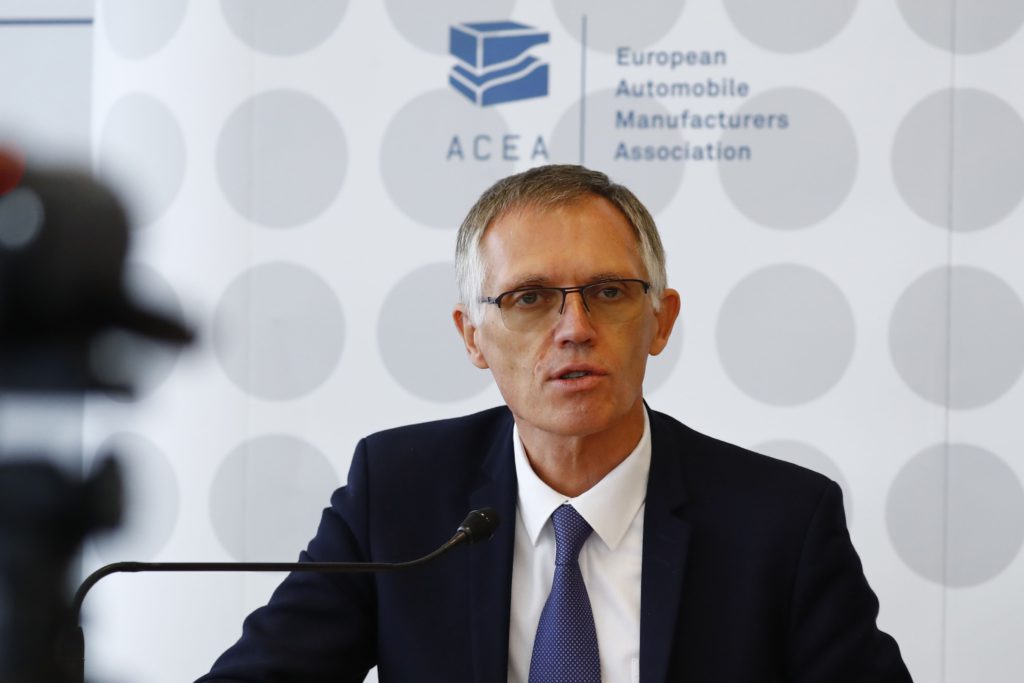
Two carmakers have announced plans in the past month to leave the European Automobile Manufacturers’ Association, or ACEA, by year-end. The departures suggest the sector is fracturing over the transition to electric vehicles.

Stellantis was first to bow out, issuing a statement that didn’t speak to what precipitated its decision. Sweden’s Volvo Cars was clearer last week, saying it’s withdrawing because it believes ACEA’s efforts to combat climate change aren’t aggressive enough.

Tensions seem to have been brewing for some time. Politico reported a year ago that Volkswagen, Europe’s biggest carmaker, was ticking off other manufacturers just as the ACEA needed to form a unified front in dealing with European Union legislation that sought to effectively ban the sale of combustion cars by 2035.

Maintaining harmony is no easy feat for an industry dealing with unprecedented complexity. Weaning the supply base off engines and onto batteries, building charging infrastructure and hoping EV prices drop fast enough to avoid demand destruction and massive job losses will be a high-wire juggling act.

It doesn’t help that Europe’s carmakers long embraced and advocated for diesel powertrains as a means to reduce the amount of CO2 coming out of tailpipes. When it surfaced VW and other manufacturers had flouted emissions tests to conceal just how dirty diesel actually was, the scandal did major damage to the industry’s standing with regulators and policymakers.

Meanwhile Tesla, long laughed off as a shoddy auto assembler on shaky financial footing, proved a mass market exists for stylishly designed, high-performance EVs. Rather than plead with governments to support installation of public plugs, the company went out and built an extensive network of superchargers for itself.

Yes, Europe’s automakers are all going electric now, but they’re doing so at different speeds.

Perhaps out of necessity after dieselgate, VW was among the first to announce its electric push. Volvo Cars is looking to produce only EVs by 2030.

Stellantis isn’t exactly dragging its feet — several of its models are among Europe’s most popular EVs — but executives have at times been critical of how quickly lawmakers want the industry to go all-electric.

For ACEA, speaking with one voice is an almost impossible task. Volvo Cars and Stellantis left for what at least look like diametrically opposed reasons, even if the chief executive of the latter company is reluctant to say so.

“There is nothing negative against ACEA,” Stellantis CEO Carlos Tavares said last month during a factory tour in France. “We are just refocusing our energy and our time on something we believe is more important, and that’s the freedom of mobility.”

So what does this all mean for ACEA? The group set up in 1991 represents 16 members (at least for now) ranging from heavyweights VW, Toyota and Ford, as well as smaller manufacturers like Jaguar Land Rover and Ferrari. Pure-play EV companies including Tesla, Rivian and China’s Nio are notably absent.

The latter recently joined Tesla and Rivian in another EU lobby group, called the European Association for Electromobility, or AVERE, as Berlin-based auto analyst Matthias Schmidt pointed out on Twitter.

With the transition to EVs is in full swing, more upheaval among industry lobbies looks likely.

More stories like this are available on bloomberg.com

©2022 Bloomberg L.P.

Canadian Factory Sales Fall for First Time in Eight Months

 Canada’s manufacturing sales fell for the first time in eight months, driven by semiconductor part shortages and retooling of assembly plants in the auto sector.

(Bloomberg) —

Factory receipts dropped 2% in May, Statistics Canada reported Thursday in Ottawa. That’s in line with economists’ expectations for a decline of 2.4%.

Sales fell in 11 of 21 industries, with motor vehicle, primary metal and miscellaneous manufacturing industries leading the decrease, the statistics agency said. Stripping away prices, factory sales fell 3.9% in volume terms.

Total inventory levels rose 1.6% on the month to a fresh record high, while the inventory-to-sales ratio increased to 1.59 in May, from 1.54 in April.

More stories like this are available on bloomberg.com

©2022 Bloomberg L.P.

AmEx Retools No-Fee Card as Customers Feel Pinch From Inflation

(Bloomberg) — American Express Co. is adding new perks to its no-fee Blue Cash Everyday card as U.S. consumers face historic increases in prices. 

The card — which has long offered cash back for spending at US supermarkets and gas stations — will now also offer rewards for online retail purchases, the company said Thursday in a statement. It will also offer credits toward a Disney streaming subscription and an online meal service. 

AmEx is revamping the card as the Labor Department reported data this week showing the consumer price index rose 9.1% from a year ago, the largest increase since the early 1980s. The average national retail price of gasoline surpassed $5 a gallon for the first time in June before retreating in recent weeks. 

“These are all super-relevant categories that will really resonate,” Anthony Cirri, AmEx’s executive vice president of global lending and cobrand, said in an interview. “It rewards them on everyday items that they’re already spending on in categories that matter most to them.”

More stories like this are available on bloomberg.com

©2022 Bloomberg L.P.

Amazon Seeks Antitrust Truce With EU as Scrutiny Intensifies

(Bloomberg) — Amazon.com Inc. moved a step closer to settling two European Union antitrust probes into how the U.S. ecommerce giant uses rivals’ sales data and whether it unfairly favors its own products, after proposing remedies to appease EU concerns.

The European Commission said on Thursday that it’s asking rivals for their feedback on a proposed deal in two antitrust probes looking into Amazon’s use of non-public data from sellers on its marketplace and “a possible bias” in granting sellers access to its Buy Box and its Prime program.

An EU agreement would take some of the heat off Amazon as national watchdogs in Europe start to ramp up their antitrust scrutiny of the US giant. Germany’s Federal Cartel Office this month said Amazon should be subject to tough new antitrust rules due to its market dominance and Britain’s competition regulator said it’s probing whether Amazon is abusing its dominance in its UK Marketplace. 

The commission said its preliminary view was that rules in place around the way the Buy Box and Prime are run “unduly favor Amazon’s own retail business, as well as marketplace sellers that use Amazon’s logistics and delivery services.” The EU said this “bias” could harm other sellers. 

Amazon’s settlement offer includes a commitment to stop using data on independent sellers on its marketplace for its competing retail business, and “to apply equal treatment to all sellers when ranking their offers for the purposes of the selection of the winner” for a “buy box,” where Amazon highlights sellers of a particular product.

Once adopted, the proposed remedies would be valid for five years and cover all of Amazon’s “current and future marketplaces” in Europe. They would exclude Italy for remedies concerning Buy Box and Prime following a decision by the competition authority there in November. Rivals can comment until Sept. 9 the EU said.

Read more: Amazon Europe Unit Paid No Taxes on $55 Billion Sales in 2021

The Brussels-based commission started probing Amazon in 2019 over concerns the firm’s position allowed it to spot best-selling products and start stocking the same thing itself. It laid out these concerns in more detail in a so-called statement of objections a year later. On the same day, the EU announced a second probe into how Amazon picks products for a prominent “buy box” that drives sales and may push retailers to use its own logistics and delivery services. 

Tech giants such as Amazon are facing sweeping changes to how they operate in the EU with a new law, the so-called Digital Markets Act, that paves the way for multibillion euro fines and acquisition bans for the worst transgressors.

“While we have serious concerns about the Digital Markets Act unfairly targeting Amazon and a few other U.S. companies, and disagree with several conclusions the European Commission made, we have engaged constructively with the Commission to address their concerns,” Amazon said in a statement.


More stories like this are available on bloomberg.com

©2022 Bloomberg L.P.

Close Bitnami banner
Bitnami