Bloomberg

Founder of £1.4 Billion Music Fund Spurns New Music for Old Hits

(Bloomberg) — The music industry has rebounded after more than a decade of piracy and songs have become a serious asset class. But that may not help the upcoming artists of today, as the sector’s biggest investors are mainly interested in old records.

“Our disruptive song management is built around the streaming paradigm, focused on managing and promoting our great hit songs of the past which have high demand rather than focusing on promoting continuous new releases with no track record,” said Hipgnosis Songs Fund’s investment adviser, led by founder Merck Mercuriadis, in its annual report Thursday. “There will never be another ‘Good Times’ by Chic, ‘Sweet Dreams (Are Made Of This)’ by Eurythmics, ‘Heart of Glass’ by Blondie.” 

About half of the London-based investment fund’s portfolio is made up of songs more than a decade old, and the proportion has increased over the last two years, the report said. It pointed to the recent success of Kate Bush’s 1985 ‘Running Up That Hill’ thanks to its inclusion in Netflix Inc. show Stranger Things, though the Hipgnosis summary also called out Ed Sheeran’s 2017 hit ‘Shape of You’.

Bytedance Ltd.’s TikTok has become an increasingly important source of revenues for the company, the report said, often reviving interest in classic songs. A video on the short-form social media platform re-popularized Fleetwood Mac hit ‘Dreams’ in late 2020 – Hipgnosis owns publishing rights from singer Christine McVie and guitarist Lindsey Buckingham. 

The report added that Neil Young’s decision to remove his music from Spotify in protest over its promotion of podcaster Joe Rogan “led to an immediate jump in consumption of Neil’s music” among new and established fans. 

Hipgnosis said its investments’ operative net asset value increased to $2.24 billion, up from $1.81 billion a year ago. It also said it’s reviewing its debt structure to cut interest rate risk after borrowing costs rose since the end of the fiscal year. Shares rose 4.1% at 9:03 am in London.

More stories like this are available on bloomberg.com

©2022 Bloomberg L.P.

TSMC Hikes Outlook Yet Delays Spending as Uncertainty Persists

(Bloomberg) — Taiwan Semiconductor Manufacturing Co. raised its 2022 revenue forecast while warning it will trim spending on expansion by as much as 9% from initial projections, reflecting uncertainty about electronics demand in the face of a potential global recession.

Chief Executive Officer C. C. Wei warned on Thursday it was too early to go into specifics about spending plans or the outlook for semiconductor demand in 2023 should customers delay purchases. But TSMC should still enjoy “a growth year,” the executive said.

The moves from Apple Inc.’s most important chipmaker reflect expectations that demand for everything from phones to cars may remain resilient in 2022, though mounting inflation and waning consumer sentiment may exert an as-yet uncertain impact going into 2023. TSMC’s role as the world’s predominant manufacturer of advanced semiconductors for iPhones and datacenters should likely cushion its profit margins, executives said. 

“We expect our customers will start to take action to decrease their inventory level. A few quarters, at least into the first half of 2023, they’ll continue to do an inventory correction,” Wei told analysts on a conference call. “Our customers’ demand continues to exceed our ability to supply. We expect our capacity to be tight through the end of 2022.”

Click here for a rundown of TSMC’s earnings call.

The world’s largest contract chipmaker is now projecting sales growth in the mid-30% range, up from about 30% previously. It also projected revenue of $19.8 billion to $20.6 billion for the September quarter, beating estimates for roughly $18.5 billion.

But it also plans to delay capital spending, an indicator of its expectations for longer-term demand. TSMC said its capital expenditure should come in at the lower end of a previously targeted range of $40 billion to $44 billion, citing longer times for equipment delivery. Asked how much of that cut will make it into 2023, executives said it was too early to tell. 

The Taiwanese giant stressed it will forge ahead with plans to build overseas plants, including an envisioned $12 billion Arizona base that the Trump administration hailed as a triumph in endeavors to bring advanced chipmaking back to America. But executives warned the costs had proven very high and TSMC needed to find ways to reduce that overhead, including through federal subsidies.

Lawmakers are currently debating a plan to infuse $52 billion of incentives for US chipmaking, an ambitious effort at enhancing research and development to counter China’s growing economic influence. 

Read more: Biden Team, Top Democrat See Slimmer Bill Key to Chips Funding

On Thursday, TSMC booked NT$237 billion ($7.9 billion) in net income for the quarter ended June, surpassing the average estimate of NT$219.8 billion. Revenue jumped 44% to NT$534.1 billion in the second quarter, as previously reported. Its gross margin of 59.1% was the highest in 26 years, based on data compiled by Bloomberg.

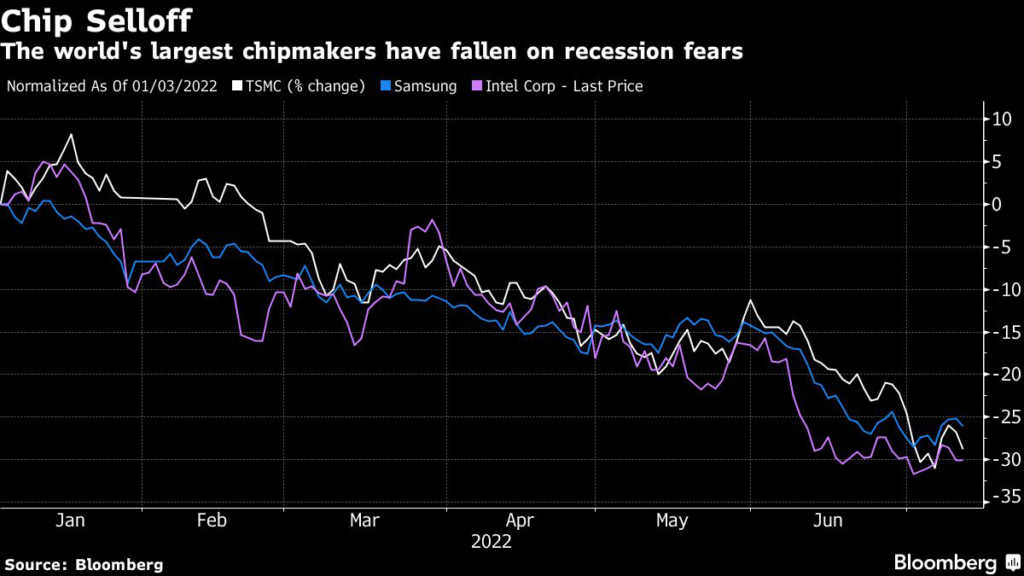
Concerns persist about rising inventories in the $550 billion semiconductor industry and the longer-term impact of a potential global recession. TSMC’s shares are down more than 20% this year alongside a sector-wide selloff. 

But Credit Suisse analysts including Randy Abrams said TSMC remained one of their top picks because of its market share gains and dominant position. 

It has also benefited from its most important customer. Much will depend on how consumers take to Apple’s latest iPhone, expected to hit shelves before the year-end holiday season. On Thursday, Wei said he’s unconcerned about potential inventory buildups of high-end smartphones.

The Taiwanese firm also continues to ride the auto industry’s growing demand for semiconductors as cars become more digitized.

Read more: TSMC Sales Soar 44% in Another Sign of Resilient Tech Demand

More stories like this are available on bloomberg.com

©2022 Bloomberg L.P.

South African Rooibos Tea Industry Pays Out to Indigenous People

(Bloomberg) — South Africa’s rooibos tea industry paid 12.2 million rand ($716,000) to groups representing indigenous people in the country, part of a benefit-sharing agreement to recognize the original cultivators of the plant. 

A levy of 1.5% of the farm gate price of the herbal tea will be paid into a trust each year controlled by the Khoi and San people, the South African Rooibos Council said in a statement. The funds will be used to improve the lives of those communities. 

The move — the result of a lengthy discussions going back to an agreement in 2019 — is the latest example of South African industries and companies acknowledging the rights and contributions of people who lived in the country before Dutch settlers started to arrive in the 17th century. 

The Khoi and San people have also been protesting against the planned new Africa headquarters of US e-commerce giant Amazon.com Inc. in Cape Town, which they say is being built on sacred ground. South Africa’s High Court temporarily halted construction in March pending further engagement with the communities. 

Rooibos is farmed mainly in an area between 200 kilometers (125 miles) and 300 kilometers north of Cape Town and thought to have health and beauty benefits. It is exported to 30 countries and provides employment and income to 5,000 people in South Africa, according to the SARC. In 2014, Rooibos tea was granted geographical indication status in the EU, which gave manufacturers in South Africa full ownership of the name.


More stories like this are available on bloomberg.com

©2022 Bloomberg L.P.

US Futures Dip, Dollar Up as Fed-Hike Bets Harden: Markets Wrap

(Bloomberg) — US equity futures fell, stocks in Europe wavered and the dollar resumed its advance Thursday after high US inflation hardened expectations for more aggressive Federal Reserve monetary tightening that could trigger a recession.

The Stoxx Europe 600 index edged lower, led by telecom and real-estate shares. S&P 500 and Nasdaq 100 contracts retreated ahead of the second-quarter earnings season, kicked off on Thursday by JPMorgan Chase & Co. and Morgan Stanley. An Asian share index dropped for the third time in four days. 

Traders have shifted toward expectations of an historic one percentage-point Fed interest-rate hike later this month after the US consumer-price gauge clocked a 9.1% annual climb. Fed Bank of Atlanta President Raphael Bostic said “everything is in play” to combat price pressures.

“It is clear that central banks around the world are laser-focused on fighting the entrenched inflation they helped to create, growth-be-damned,” said Jeffrey Halley, a senior market analyst at Oanda Asia Pacific Ltd. “US markets are pricing in faster Fed tightening, and a recession is on the way imminently.” 

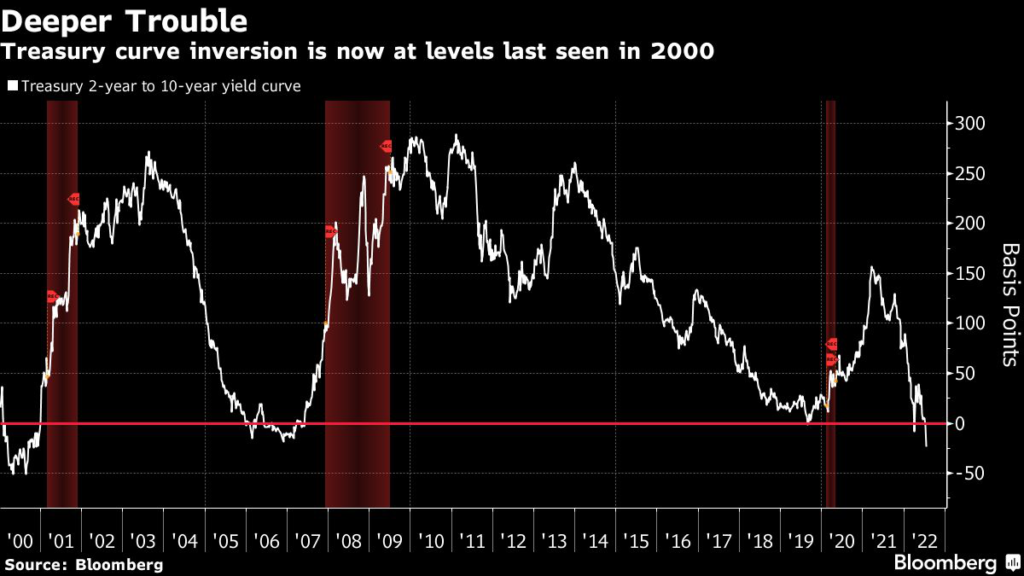
The dollar pushed higher, hovering around the highest level in more than two years. Treasury two-year yields, sensitive to imminent Fed moves, climbed while longer-maturity rates were more stable. The inversion between two-year and 10-year yields — a potential recession indicator — is the deepest since 2000.

The euro fell back toward $1, after briefly dipping below it Wednesday, after Bloomberg reported that the European Commission had cut its growth forecast for the common-currency area. Italy’s 10-year yield climbed more than 10 basis points as the country’s governing coalition appeared to be heading for a break-up.

The yen sank. Brent crude oil held below $100 a barrel. Bitcoin rallied past $20,000, weathering the bankruptcy filing of crypto lender Celsius Network.

The big question for markets is whether the latest US inflation print marks the peak. Commodity prices, pushed up this year in part by supply disruptions related to Russia’s war in Ukraine, have moderated somewhat of late. 

But if higher costs prove to be persistent and come alongside a global economy buckling under rate hikes, that could be toxic for a range of assets already nursing heavy losses in 2022.

At this point, markets may be getting ahead of the Fed, according to Danielle DiMartino Booth, Quill Intelligence chief strategist. “We need to move the discussion onto how long is the recession going to be, how deep it’s going to be,” she added.

Fed Bank of Cleveland President Loretta Mester said in a Bloomberg Television interview the consumer-price report was uniformly bad and that the central bank will need to go well beyond the neutral level of rates. The figures don’t suggest a smaller hike than in June, she added.

Swaps referencing Fed meetings are priced for the policy rate to peak at about 3.7% this December, up from the current target range of 1.50%-1.75%. Traders then expect the Fed to start cutting rates to counter an economic slowdown.

What to watch this week:

  • Earnings due from JPMorgan, Morgan Stanley, Citigroup, Wells Fargo
  • US PPI, jobless claims, Thursday
  • China GDP, Friday
  • US business inventories, industrial production, University of Michigan consumer sentiment, Empire manufacturing, retail sales, Friday
  • G-20 finance ministers, central bankers meet in Bali, from Friday
  • Atlanta Fed President Raphael Bostic speaks, Friday

Will the eurozone avoid a recession or a debt crisis? How will the euro and stocks perform in the next six months? Share your views and participate in the latest MLIV Pulse survey. It only takes a minute, so please click here anonymously.

Some of the main moves in markets:

Stocks

  • The Stoxx Europe 600 fell 0.1% as of 8:22 a.m. London time
  • Futures on the S&P 500 fell 0.4%
  • Futures on the Nasdaq 100 fell 0.4%
  • Futures on the Dow Jones Industrial Average fell 0.3%
  • The MSCI Asia Pacific Index fell 0.5%
  • The MSCI Emerging Markets Index fell 0.2%

Currencies

  • The Bloomberg Dollar Spot Index rose 0.5%
  • The euro fell 0.4% to $1.0016
  • The Japanese yen fell 1% to 138.82 per dollar
  • The offshore yuan fell 0.4% to 6.7508 per dollar
  • The British pound fell 0.4% to $1.1845

Bonds

  • The yield on 10-year Treasuries advanced two basis points to 2.95%
  • Germany’s 10-year yield advanced four basis points to 1.19%
  • Britain’s 10-year yield advanced two basis points to 2.08%

Commodities

  • Brent crude fell 0.6% to $98.95 a barrel
  • Spot gold fell 0.9% to $1,720.43 an ounce

More stories like this are available on bloomberg.com

©2022 Bloomberg L.P.

Bitcoin Correlation With Stocks Near Lowest Level of 2022

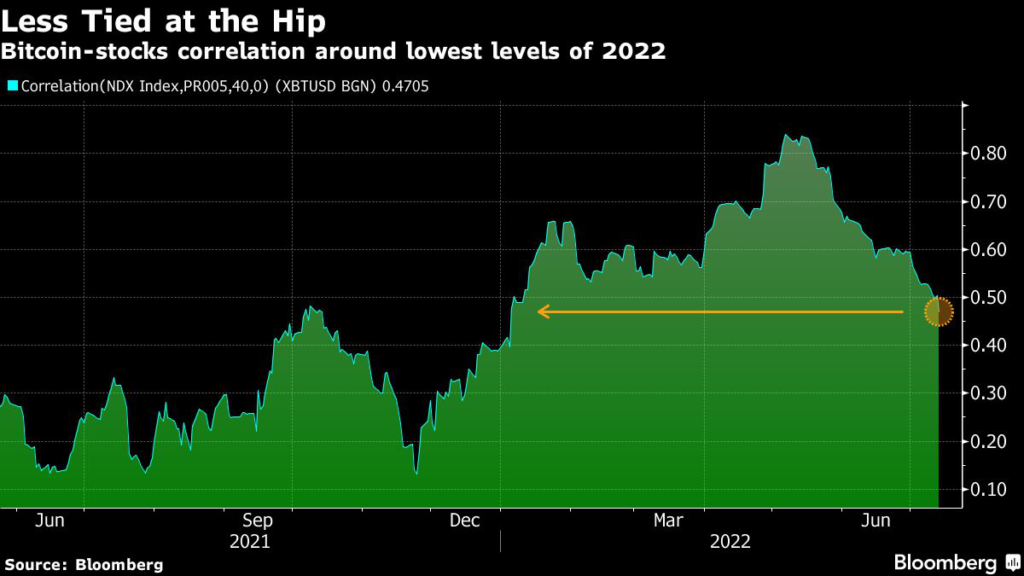
(Bloomberg) — Bitcoin and US stocks are moving less in tandem than at almost any point this year. A 40-day correlation coefficient for the token and the tech-heavy Nasdaq 100 index has fallen below 0.50 to levels last seen in January. If the still-positive tie continues to ebb, that may stir questions about whether beaten-down virtual assets are closer to a nadir and set for a recovery.

More stories like this are available on bloomberg.com

©2022 Bloomberg L.P.

China Convenes Banks on Mortgage Boycott Roiling Markets

(Bloomberg) — Chinese authorities held emergency meetings with banks after growing alarmed that an increasing number of homebuyers across the country are refusing to pay mortgages on stalled projects, according to people familiar with the matter.

The Ministry of Housing and Urban-Rural Development met with financial regulators and major Chinese banks this week to discuss the mortgage boycotts on concern that more buyers may follow suit, said the people, asking not to be identified discussing a private matter.

While there was no immediate solution, regulators asked local watchdogs and banks to report the impact, including property projects affected in their jurisdictions, as soon as possible, the people said. Some banks plan to tighten their mortgage lending requirements in high-risk cities, two of the people said.

The housing ministry didn’t immediately reply to a fax requesting comment.

Reports of rapidly escalating refusals to pay mortgages in recent days have sparked losses in Chinese bank shares and developer bonds, reflecting concerns that the nation’s property crisis may spread to the financial system and trigger social unrest. Chinese lenders already grappling with challenges from liquidity stress among developers now also have to brace for homebuyer defaults. 

Homebuyers have stopped mortgage payments on at least 100 projects in more than 50 cities as of Wednesday, figures from researcher China Real Estate Information Corp. show. That’s up from 58 projects on Tuesday and only 28 on Monday, according to Jefferies Financial Group Inc. analysts including Shujin Chen. 

While it’s not clear how many homebuyers are snubbing repayments, the delayed projects make up about 1% of China’s total mortgage balance, according to Jefferies. Should every buyer default, that would lead to a 388 billion yuan ($58 billion) increase in non-performing loans, Chen said. 

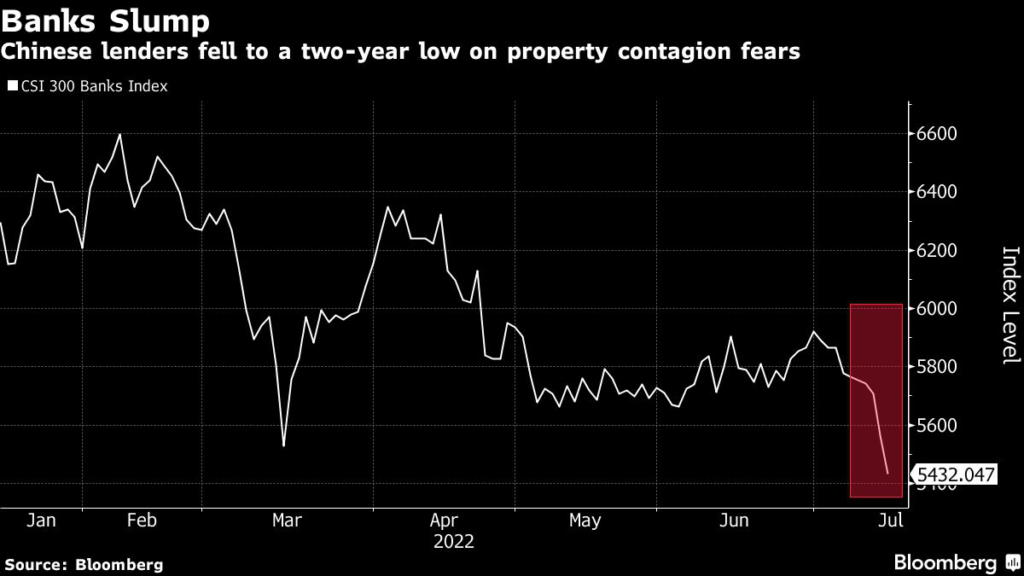
Some major Chinese banks rushed to respond during trading hours on Thursday as the CSI 300 Banks Index fell as much as 3.3%. State-owned Agricultural Bank of China Ltd. said it held 660 million yuan of overdue loans on unfinished homes, while smaller rival Industrial Bank Co. said 1.6 billion yuan of mortgages were impacted, of which 384 million yuan have become delinquent. China Construction Bank Corp., the nation’s largest mortgage lender, said overall risks are controllable as its exposure to delayed projects is small.

Chinese policymakers face a dilemma in dealing with the problem, according to Chen at Jefferies. On one hand, easing lending rules to favor homebuyers waiting for their properties to be completed may encourage more delinquencies. On the other, social stability remains the top priority for the government. Avoiding a deeper property crisis that sends shockwaves across markets and banks is a political necessity ahead of this year’s Communist Party Congress. 

Any move to tighten mortgage lending would put further pressure on already weak home sales as potential buyers balk at higher borrowing costs and longer loan approvals. The outlook for sales — which some say recently bottomed — is also being dimmed by a resurgence in Covid cases and potential restrictions. 

The crisis engulfing Chinese developers is reaching a new phase, with a debt selloff expanding to firms once deemed safe from the cash crunch, including Country Garden Holdings Co., the largest builder by sales.

China high-yield bonds were indicated slightly weaker Thursday as liquidity remained light, according to credit traders, though some Country Garden and CIFI Holdings Group Co. dollar bonds gained. A Bloomberg Intelligence gauge of Chinese developer shares fell as much as 2.7%. 

Nomura Holdings Inc. said the refusal to pay mortgages stems from the widespread practice in China of selling homes before they’re built. Confidence that projects will be completed has weakened as developers’ cash woes intensified. 

“We are especially concerned about the financial impact of the homebuyers’ ‘stopping mortgage repayments’ movement,” Nomura economists led by Ting Lu wrote in a note on Wednesday. “China’s property downturn may finally adversely affect onshore financial institutions after hitting the offshore high-yield dollar bond market.”

Lu estimated that Chinese developers have only delivered around 60% of homes they presold between 2013 and 2020, while in those years China’s mortgage loans rose by 26.3 trillion yuan. GF Securities Co. expected that up to 2 trillion yuan of mortgages could be impacted by the boycott.

Until recently, the nation’s 46 trillion yuan of outstanding mortgages have been considered as the safest banking assets because of high down payments and collateral value. Their non-performing ratio has been steady at around 0.3% for years, the central bank said in April, compared with 1.69% for all loans.

(Updates with bank statements in the eighth paragraph)

More stories like this are available on bloomberg.com

©2022 Bloomberg L.P.

Crypto Exchange OKX Gets Dubai License, Set to Open Hub in City

(Bloomberg) — OKX has received a provisional virtual-asset license in Dubai and plans to set up a regional hub in the city that’s been trying to attract cryptocurrency companies from around the world.

The license will allow OKX — one of the world’s largest cryptocurrency exchanges by trading volume — to provide access to some products and services to investors in the United Arab Emirates. 

“OKX is committed to building out both its team and necessary infrastructure in the UAE,” General Manager Lennix Lai said in a statement, adding that the market had a growing local crypto ecosystem and “a balanced regulatory framework.” 

The UAE is amongst the largest crypto markets in the region, along with Turkey and Lebanon, according to data compiled by Chainalysis. The Gulf nation is seeking to attract some of the world’s biggest crypto and fintech companies — and firms including Binance and FTX have been granted licenses in Dubai. 

More stories like this are available on bloomberg.com

©2022 Bloomberg L.P.

South Africa Antitrust Authorities Hone in on Google’s Practices

(Bloomberg) — South Africa’s Competition Commission, which has been probing online markets for the past 14 months, has provisionally found that Google Search’s practices distorts competition in Google’s favor.

“The inquiry provisionally recommends that paid results are prominently labeled as advertising with borders and shading to be clearer to consumers and that the top of the page is reserved for organic, or natural, search results based on relevance only, uninfluenced by payments,” the commission said in a statement. 

The inquiry also recommended Google allows competitors to compete for prominence in a search by having their own specialist units and with no guaranteed positions for Google specialist units. It’s also exploring whether the default position of Google Search on mobile devices should end in South Africa.

Stakeholders and the public have six weeks to make submissions to the inquiry on the provisional findings and recommendations.

More stories like this are available on bloomberg.com

©2022 Bloomberg L.P.
More Chinese Homebuyers Refuse to Pay Mortgage Loans Amid Contagion Fears

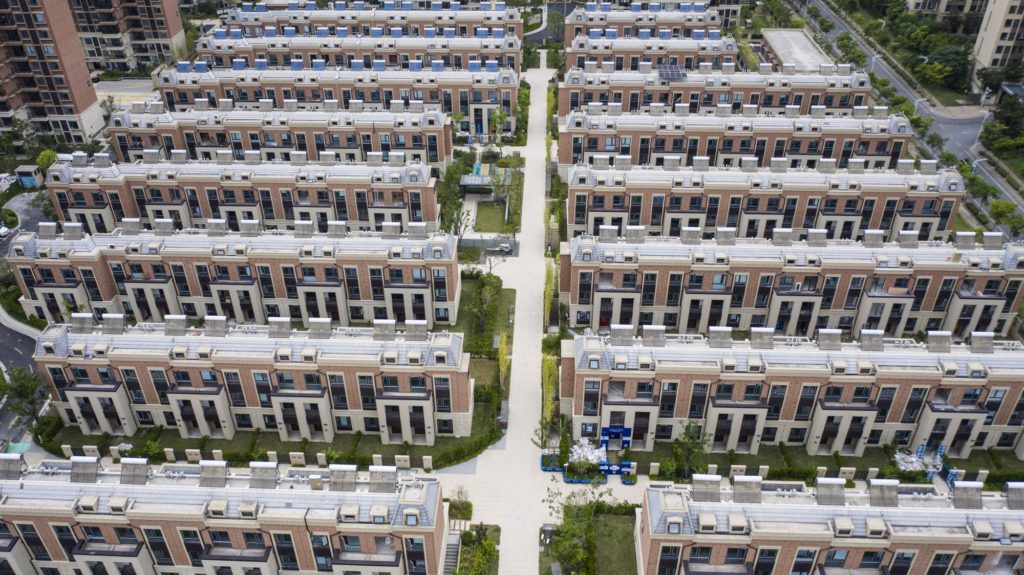
(Bloomberg) — A rapidly increasing number of disgruntled Chinese homebuyers are refusing to pay mortgages for unfinished construction projects, exacerbating the country’s real estate woes and stoking fears that the crisis will spread to the wider financial system.

Homebuyers have stopped mortgage payments on at least 100 projects in more than 50 cities as of Wednesday, according to researcher China Real Estate Information Corp. That’s up from 58 projects on Tuesday and only 28 on Monday, according to Jefferies Financial Group Inc. analysts including Shujin Chen. 

“The names on the list doubled every day in the past three days,” Chen wrote in a note published Thursday. “The incident would dampen buyer sentiment, especially for presold products offered by private developers given the higher risk on delivery, and weigh on the gradual sales recovery.”

The delayed projects make up about 1% of China’s total mortgage balance, according to Jefferies. Should every buyer default, that would lead to a 388 billion yuan ($58 billion) increase in non-performing loans, Chen said. The report didn’t give any estimate for how many buyers are snubbing repayments. 

Some major Chinese banks rushed to respond during trading hours on Thursday as the CSI 300 Banks Index fell as much as 3.3%. State-owned Agricultural Bank of China Ltd. said it held 660 million yuan of overdue loans on unfinished homes, while smaller rival Industrial Bank Co. said 1.6 billion yuan of mortgages were impacted, of which 384 million yuan have become delinquent. China Construction Bank Corp., the nation’s largest mortgage lender, said overall risks are controllable as its exposure to delayed projects is small.

The payment refusals underscore how the storm engulfing China’s property sector is now affecting hundreds of thousands of average citizens, posing a threat to social stability ahead of a Communist Party Congress later this year. Chinese banks already grappling with challenges from liquidity stress among developers now also have to brace for homebuyer defaults. A Bloomberg Intelligence index of Chinese developer stocks slid as much as 2.7%. 


Analysts believe that a drop in home values may be another driver for the refusal to meet mortgage payments. “Investors are concerned about the spread of mortgage payment snubs to buyers, simply due to lower property prices, and the impact on property sales,” Chen wrote.

Average selling prices of properties in nearby projects in 2022 were on average 15% lower than purchase costs in the past three years, Citigroup Inc. analysts said in a note on Wednesday. China’s home prices fell for a ninth month in May, with June figures set for release Friday.   

The crisis engulfing Chinese developers is reaching a new phase, with a debt selloff expanding to firms once deemed safe from the cash crunch, including Country Garden Holdings Co., the largest builder by sales.

While rising non-performing loans for Chinese banks are “manageable” for now, “more risk events are likely to come, at the backdrop of China’s growth slowdown, residents’ expectation of worse future income, and shrinking property sales,” affecting China’s social stability, Jefferies’s Chen said.

Presale Risks

Nomura Holdings Inc. analysts said the refusal to pay mortgages stems from the widespread practice in China of selling homes before they’re built. Confidence that projects will be completed has weakened as developers’ cash woes intensified. 

Even before the crisis, developers only delivered around 60% of homes they presold between 2013 and 2020, while outstanding mortgage loans rose by 26.3 trillion yuan, Nomura analysts including Ting Lu wrote in a note Wednesday. 

“Presales carry mounting risks for developers, homebuyers, the financial system and the macro economy,” Lu wrote. Failure to build homes on time reduces households’ willingness to buy new properties, and rising raw material prices may mean funds from presales are insufficient to construct them. 

“We are especially concerned about the financial impact of the homebuyers’ ‘stopping mortgage repayments’ movement,” Ting wrote. “China’s property downturn may finally adversely affect onshore financial institutions after hitting the offshore high-yield dollar bond market.”

(Updates with bank comments in fifth paragraph.)

More stories like this are available on bloomberg.com

©2022 Bloomberg L.P.

Soon, You Can Scan QR Codes to Pay For Your Southeast Asian Trip

(Bloomberg) — Southeast Asian central banks are targeting to link their payment systems within the year that will let people buy goods and services throughout the region by scanning QR codes.

The linkages aren’t complete yet. Malaysia, Indonesia and Thailand are connected, while Singapore is linked to Thailand and is seeking to add more countries. 

By November, five of the region’s biggest economies, including the Philippines, are set to sign a deal to integrate their network, Bank Indonesia Governor Perry Warjiyo said in a panel on the sidelines of the Group of 20 finance ministers and central bank governors meeting in Bali.

Payments made through the system will use local-currency settlements between the countries, meaning payments transacted in Thailand using an Indonesian app would be directly exchanged between rupiah and baht, bypassing the need for US dollar as intermediary. 

Next, the central banks will seek to link this network with other regional clusters around the world, and bring the same structure to real-time bank transfers and even central bank digital currencies eventually.

“This can be a deeply impactful move that we can build to the rest of the world,” Monetary Authority of Singapore Managing Director Ravi Menon said at the same panel in Bali. “It’s a public good infrastructure which improves financial inclusion, enhances efficiency and creates new business opportunities for all citizens.”

More stories like this are available on bloomberg.com

©2022 Bloomberg L.P.
Close Bitnami banner
Bitnami