Bloomberg

Hong Kong to Raise Taxi Fares for First Time in Five Years

(Bloomberg) — Sign up for the New Economy Daily newsletter, follow us @economics and subscribe to our podcast.

Hong Kong will raise taxi fares on Sunday, the city’s first increase in five years, to help an industry battered by the coronavirus pandemic.

The base fare will increase by HK$3 ($0.38) on July 17, the Transport Department said in a statement on Thursday. That would increase the minimum fare for red urban taxis by 13% to HK$27, while it would go up 15% to HK$23.50 for green cabs in the New Territories and 16% to HK$22 for blue taxis in Lantau island.

Incremental charges will be increased by HK$0.10-HK$0.20 depending on the distance. Surcharges for baggage and pets will remain unchanged at HK$6 and HK$5 respectively.


It’s the first increase in taxi fares since April 2017. Though Hong Kong consistently ranks as one of the most expensive places in the world, cab fares in the financial hub are relatively affordable when compared with other cities in the region, with prices slightly more expensive than in Singapore but cheaper than in Tokyo. 

More stories like this are available on bloomberg.com

©2022 Bloomberg L.P.

Food Delivery Giant Meituan Hires Kuaishou’s Former Global Chief

(Bloomberg) — Kuaishou Technology’s former international business leader Tony Qiu has joined Chinese food delivery titan Meituan, making the switch between internet companies at a time of elevated regulatory and economic challenges for the sector.

Qiu has taken on a provisional role as assistant to Meituan founder and Chief Executive Officer Wang Xing while deciding which business unit of the company he will run, the former Bain Capital executive said in a text message. It’s a common practice for senior officers in China to occupy assistant roles before being assigned a strategic position, such as Alibaba Group Holding Ltd. Chief Financial Officer Toby Xu, who assisted CEO Daniel Zhang before taking the reins of the e-commerce giant’s investment arm.

Qiu’s hire, first reported by local media outlet Late Post, has fueled speculation about Beijing-based Meituan’s ambitions to expand into international markets. Growth in the domestic market has slowed for all of China’s biggest consumer tech firms while nearby regions like Southeast Asia are getting millions of first-time internet users online and increasing demand for connected services.

“Meituan could potentially leverage Tony’s global expertise to explore opportunities overseas, given that he used to help Didi and Kuaishou with their respective international businesses,” said Vey-Sern Ling, senior analyst with Union Bancaire Privee in Singapore.

A representative from Meituan didn’t immediately respond to an inquiry seeking comment.

Qiu, who joined Kuaishou in August 2020 from Didi Global Inc., was charged with taking China’s No. 2 short-video hub to the global stage. He led a seasoned team with experience at Alphabet Inc.’s Google, Netflix Inc. and ByteDance Ltd.’s TikTok in growing Kuaishou’s reach to markets like Southeast Asia, the Middle East and Latin America. In June 2021, Kuaishou reported 180 million monthly users outside China, up from 150 million in April, according to the most recent figures the company has disclosed. At Didi, Qiu also helped the Chinese ride-hailing firm build its presence in Brazil through the acquisition of local startup 99. 

Qiu quit Kuaishou earlier this year citing personal reasons, Bloomberg News reported in March.

More stories like this are available on bloomberg.com

©2022 Bloomberg L.P.

Stocks Climb on China Tech Gains; Dollar Advances: Markets Wrap

(Bloomberg) — Stocks in Asia edged higher, while US equity futures pared declines Thursday as investors assessed the prospect of a recession on hardened expectations for more aggressive Federal Reserve monetary tightening after sizzling US inflation data.

An Asian share erased earlier losses as Chinese technology shares advanced. S&P 500 and Nasdaq 100 contracts shed about 0.2%. A volatile US session ended with modest losses, a resilience possibly rooted in speculation over whether the 9.1% consumer-price reading marks the peak. European contracts rose.

Read: Inflation Is Awful, Stocks Survive: Parsing the Tepid Reaction

Traders shifted toward expectations of an historic one percentage-point Fed interest-rate hike later this month. Fed Bank of Atlanta President Raphael Bostic said “everything is in play” to combat price pressures.

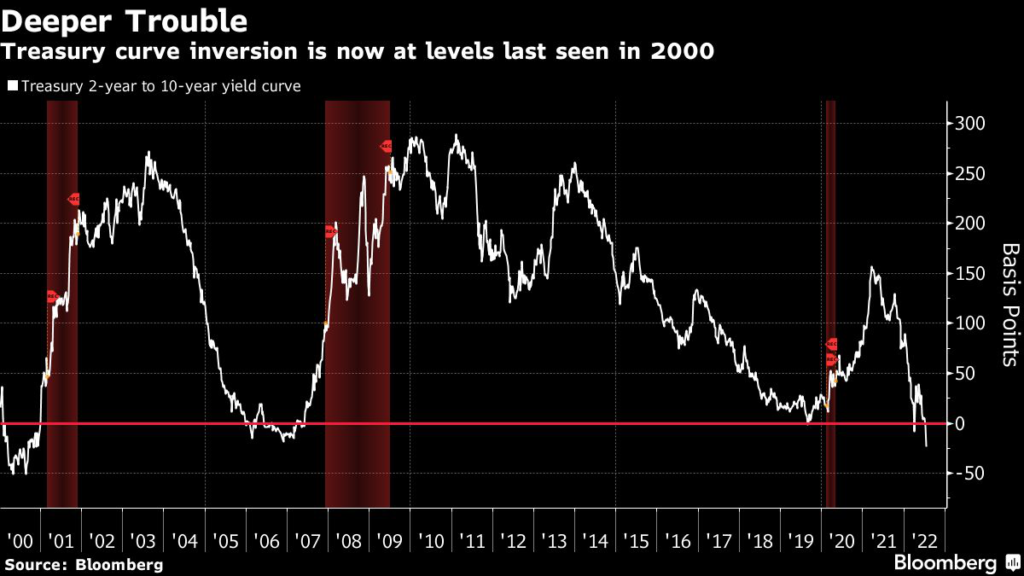
Treasury two-year yields, sensitive to imminent Fed moves, climbed further while longer-maturity rates also went higher. The inversion between two-year and 10-year yields — a potential recession indicator — is the deepest since 2000.

The dollar advanced and the euro fell back toward $1 after briefly dipping below it Wednesday. Oil hovered at $96 a barrel. Bitcoin rallied past $20,000.

In Singapore, the city state’s currency strengthened on an unexpected tightening of monetary settings, part of a global wave of steps to curb the cost of living. Australian bond yields surged on a strong jobs report, which boosted the case for a further increase in borrowing costs.

The big question for markets is whether the latest US inflation print marks the peak. Commodity prices, pushed up this year in part by supply disruptions related to Russia’s war in Ukraine, have moderated somewhat of late. 

But if higher costs prove to be persistent and come alongside a global economy buckling under rate hikes, that could be toxic for a range of assets already nursing heavy losses in 2022.

At this point, markets may be getting ahead of the Fed, according to Danielle DiMartino Booth, Quill Intelligence CEO and chief strategist. “We’ve got a 95 bps baked in ahead of the July 27 announcement,” she said on Bloomberg Television. “Now we need to move the discussion onto how long is the recession going to be, how deep it’s going to be,” she added.

Fed Bank of Cleveland President Loretta Mester said in a Bloomberg Television interview the consumer-price report was uniformly bad and that the central bank will need to go well beyond the neutral level of rates. The figures don’t suggest a smaller hike than in June, she added.

Swaps referencing Fed meeting dates are priced for the policy rate to peak at about 3.7% this December, up from the current target range of 1.50%-1.75%. Traders then expect the Fed to start cutting rates, with more than three quarters of a percentage point of reductions priced in between the expected peak and the end of March 2024.

What to watch this week:

  • Earnings due from JPMorgan, Morgan Stanley, Citigroup, Wells Fargo
  • US PPI, jobless claims, Thursday
  • China GDP, Friday
  • US business inventories, industrial production, University of Michigan consumer sentiment, Empire manufacturing, retail sales, Friday
  • G-20 finance ministers, central bankers meet in Bali, from Friday
  • Atlanta Fed President Raphael Bostic speaks, Friday

Will the eurozone avoid a recession or a debt crisis? How will the euro and stocks perform in the next six months? Share your views and participate in the latest MLIV Pulse survey. It only takes a minute, so please click here anonymously.

Some of the main moves in markets:

Stocks

  • S&P 500 futures slid 0.1% as of 1:18 p.m. in Tokyo. The S&P 500 fell 0.5%
  • Nasdaq 100 futures fell 0.2%. The Nasdaq 100 fell 0.1%
  • Japan’s Topix index added 0.2%
  • South Korea’s Kospi index was steady
  • Australia’s S&P/ASX 200 index added 0.4%
  • China’s Shanghai Composite Index rose 0.3%
  • Hong Kong’s Hang Seng Index climbed 0.2%
  • Hong Kong’s Hang Seng Tech Index surged 1.7%
  • Euro Stoxx 50 futures rose 0.3%

Currencies

  • The Bloomberg Dollar Spot Index rose 0.2%
  • The euro fell 0.3% to $1.0033
  • The Japanese yen was at 138.03 per dollar, down 0.5%
  • The offshore yuan was at 6.7300 per dollar, down 0.1%

Bonds

  • The yield on 10-year Treasuries rose about three basis points to 2.96%
  • Australia’s 10-year bond yield climbed six basis points to 3.45%

Commodities

  • West Texas Intermediate crude was at $96.77 per barrel, up 0.5%
  • Gold fell 0.3% to $1,730.04 an ounce

More stories like this are available on bloomberg.com

©2022 Bloomberg L.P.

Back-to-School Sales Will See a Boost From Rising Prices

(Bloomberg) — Back-to-school shoppers are expected to spend a record amount this year, with consumers facing higher prices and fretting over economic conditions.

Sales for the season are expected to total $34.4 billion, according to a survey released Thursday by Deloitte LLP. That breaks down to $661 per student — an increase of 8% from a year earlier — with 37% expecting to spend more than last year.  

Respondents voiced concern about the economy, with 54% saying they expect it to weaken in the next six months, while 57% are worried about inflation. One in three households say they are worse off compared with a year ago. 

“Despite a pretty challenging economic outlook, parents plan to make this shopping event happen for their kids,” said Stephen Rogers, managing director of Deloitte’s Consumer Industry Center.

Back-to-school sales are crucial for retailers, and competition has intensified with Amazon.com Inc.’s midsummer Prime Day sale. This year, retailers may use the season to try and offload excess inventory that has built up in recent quarters. 

Apparel and school supplies will be the most sought-after items this year as students move away from remote learning and go back into the classroom, according to Deloitte. Clothing spending is expected to rise 18%, while technology spending is set to decline 8%. 

Shoppers are bracing for difficulties finding what they’re looking for, with 63% expecting to encounter out-of-stock items. More than three quarters said they’ll switch brands if their preferred choice isn’t available — a warning that companies have to get inventory right or risk losing sales.  

Companies bulked up stockpiles last year to hedge against transportation bottlenecks, which now has left them with too much merchandise. Walmart Inc. has said it needs “another couple quarters” to sell through its bloated inventory. Meanwhile, Target Corp. said in June it was aggressively clearing out excess products with markdowns, in part so it could refresh offerings in time for the back-to-school season.

‘More Consideration’ 

Some retailers, such as Kohl’s Corp., are marketing their value brands among their back-to-school offerings as shoppers contend with rising prices and a falling stock market.

“Inflation is causing consumers to put more consideration into where and how they spend their money, and are looking for ways to save where they can,” Kohl’s said in an emailed statement. 

The Menomonee Falls, Wisconsin-based chain is highlighting its suite of affordable private-label brands, along with its coupons and customer loyalty program. Gap Inc.’s Old Navy, meanwhile, has pledged to freeze prices on kids clothing during the back-to-school season. 

Credit Use

For parents of college students, 77% said they plan to use credit to finance expenses — up from 70% a year earlier. That’s another sign that inflation is starting to erode the purchasing power of some consumers. 

The back-to-school shopping season is expected to peak by the end of July, as usual. The Deloitte survey took place from May 20 to June 2 and polled 1,200 parents with at least one child in grade school in the US. It polled 950 parents of college students. 

More stories like this are available on bloomberg.com

©2022 Bloomberg L.P.

Philippines’ Surprise Rate Hike Delivered Via Facebook Live

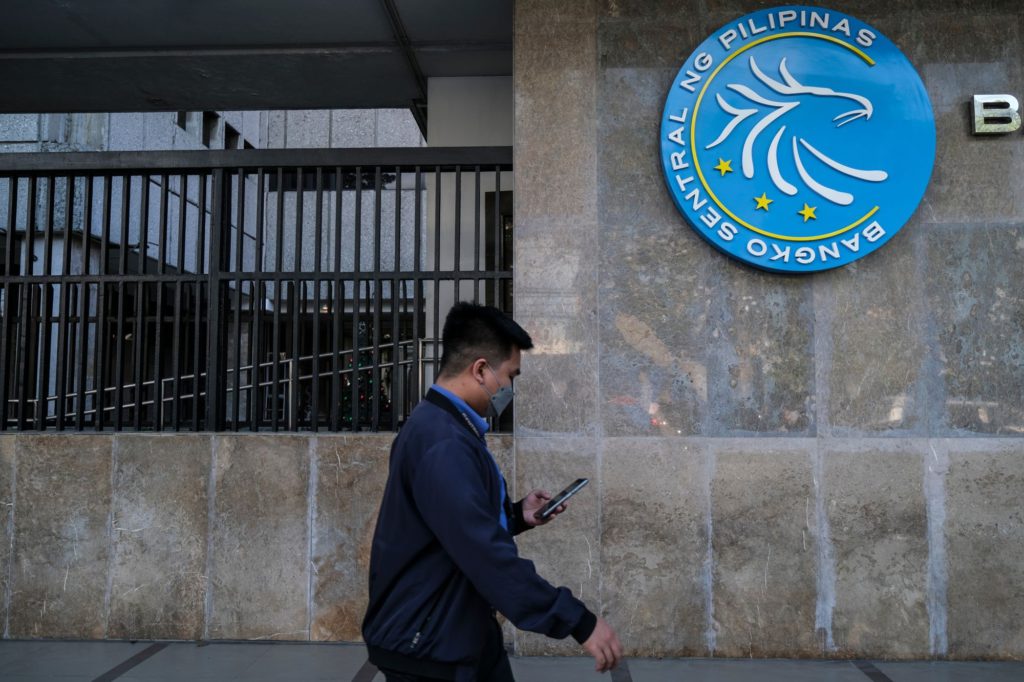
(Bloomberg) — The Philippines’ unexpected 75-basis-point rate hike was delivered in a way that might surprise some central bank watchers: via a four-minute live video on Facebook.

Bangko Sentral ng Pilipinas Governor Felipe Medalla gave a short statement on Thursday in a Zoom broadcast on the monetary authority’s Facebook page, announcing that the key interest rate will rise to 3.25%. The livestream gained 2,000 views in less than an hour and Medalla could be heard speaking casually off-camera before and after the broadcast.

Philippines Surprises With Big rate Hike to Cool Inflation

In much of the world, Facebook isn’t the first place you’d expect an interest rate rise to be announced. But in the Philippines, the social-media platform is commonly used to deliver official news and announcements, including those from the central bank. 

About 83.9 million people in the country use the platform, Rappler reported in April, citing We Are Social. Two-thirds of Filipinos have internet access and they are more active on social media than in other Southeast Asian countries. 

The bank holds a rate-setting meeting every six weeks, with the next scheduled decision due — on Facebook — in August. 

More stories like this are available on bloomberg.com

©2022 Bloomberg L.P.

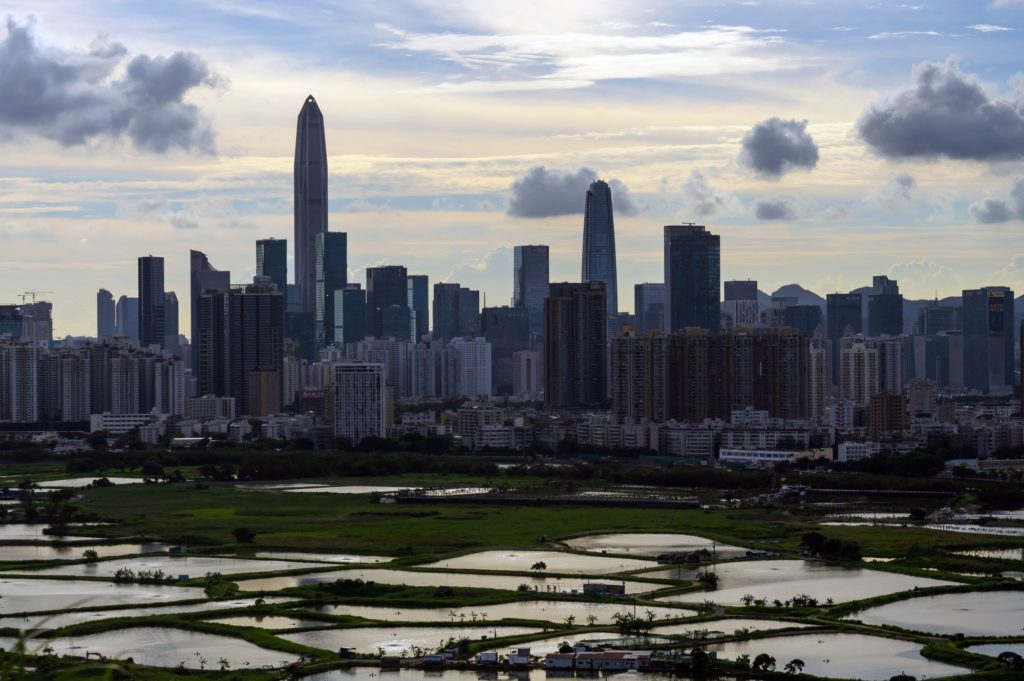
Morningstar Cuts Hundreds of Shenzhen Jobs in China Shift

(Bloomberg) — Morningstar Inc. is slashing a significant portion of its workforce in Shenzhen and relocating jobs to other countries as part of a restructuring exercise in China, a retreat that reflects a growing global ambivalence over doing business in the world’s second largest economy. 

Several hundred people among its 1,000-strong workforce in the southern technology hub have been affected, the Chicago-based financial services company said on Wednesday. 

The roles will be moved to other offices including in Mumbai, Madrid, Toronto and Chicago, with Chinese operations to now focus solely on the domestic market, a company representative said.

The operations to be relocated elsewhere mainly involve the company’s global support team, which provides data and information technology services to different regions across the world, a person familiar with the matter, who asked not to be identified as they’re not authorized to speak publicly, said separately.

“This decision was necessary in the increasingly complex business environment,” Chief Executive Kunal Kapoor wrote in a company memo dated July 11 seen by Bloomberg. “We remain motivated by the potential the China market offers, and we’re in the process of defining a new strategy for China market growth.”

The winding down will take place over the next 12 months, according to the memo. Data specific to the China market will continue to be collected within the country, it said.

Morningstar’s shift out of China is one of the biggest yet among American financial firms operating on the mainland, and comes as Wall Street’s biggest banks struggle with Covid-19 lockdowns, volatile markets and state interference in China. The country’s zero-tolerance approach to the virus is proving particularly disruptive, with businesses at risk of getting caught in a cycle of shutdowns and reopenings, as well as near-constant testing for residents.

The group, which provides services including financial research and investment management, also has operations in other Asian countries such as Singapore and Thailand.

Read more: China Canceled H&M. Every Other Brand Needs to Understand Why

Beyond financial services, the consumer sector is facing a wave of nationalism that’s seen boycotts of foreign companies including Nike Inc. and Hennes & Mauritz AB after both said would stop using cotton from China’s contentious Xinjiang region. Issues ranging from human rights to national security have also led to a deterioration in the relationship between China and many Western countries, and the US has used blacklists to restrict the activities of certain Chinese companies.

Founded in 1984 by Joe Mansueto, Morningstar entered China in 2003 by forming a research firm in Shenzhen and currently also has an office in Shanghai. Its employees across China include technologists, analysts and researchers, and it was one of the first companies to obtain a quantitative fund rating service qualification from China’s securities commission, according to the company. Morningstar’s operations in China represented the group’s largest technology development and data center outside the US, according to a document in 2014.

(Updates with details about Morningstar operations in Asia)

More stories like this are available on bloomberg.com

©2022 Bloomberg L.P.

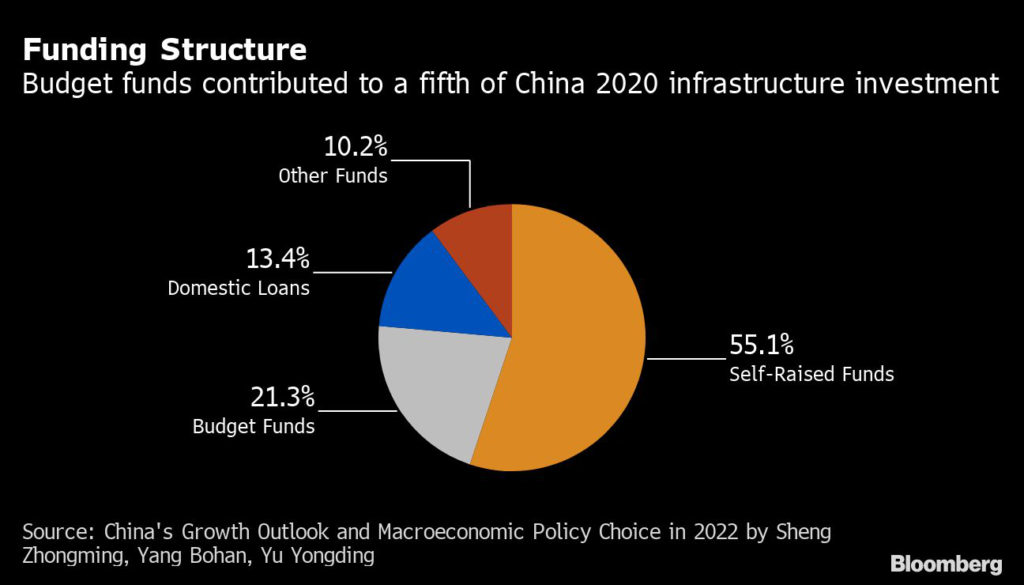
China Readies $1.1 Trillion to Support Xi’s Infrastructure Push

(Bloomberg) — China is making 7.2 trillion yuan ($1.1 trillion) in funds available for infrastructure spending, a decisive shift away from a focus on controlling debt toward supporting a lockdown-ravaged economy.

The figure refers to government-backed funds and is based on Bloomberg News’ analysis of official announcements. It includes an unprecedented 1.5 trillion yuan of “special” bonds, mainly used for infrastructure, that local governments may be allowed to sell in the second half of this year, according to people with knowledge of the discussions. 

With the government expanding its funding support, infrastructure investment in 2022 will likely rise 7.7% from last year, according to Citigroup Inc. That would be a major boost to the world’s second-largest economy as Beijing tries to offset the drag from repeated Covid lockdowns and a slump in the property market. 

“We have entered a new cycle of infrastructure development,” said Yu Xiangrong, chief China economist at Citigroup. “That’ll be a new normal.” 

He estimates overall growth in fixed-asset investment will reach around 6% this year, which would contribute 2 percentage points to China’s gross domestic product growth. “The tendency of shifting away from infrastructure investment due to the deleveraging campaign has come to an end,” he added.

President Xi Jinping has called for an “all out” effort to increase infrastructure spending this year in the hope of fueling economic growth and meeting a GDP growth target of around 5.5%. Local governments have been issuing bonds at a record pace to fund industrial parks, transportation networks, water projects, mobile networks and data centers.

Taking into account financing from private sources and commercial banks, it’s unclear just how much will be spent on infrastructure. Citi’s Yu estimates the number could be 16.5 trillion yuan. Others are more optimistic: Lian Ping, chief economist at ZhiXin Investing Research Institute predicts spending could reach about 19 trillion yuan this year, contributing 3.7 percentage points to China’s GDP growth.

Read More: China Mulls $220 Billion Stimulus With Unprecedented Bond Sale

However, there’s a chance that despite the fiscal largess, overall infrastructure investment growth could still disappoint. First, while Beijing is letting local governments issue more bonds, it’s still telling them to reduce so-called “hidden” debt — off-balance sheet borrowing from banks by state-owned companies, which has financed a large chunk of China’s infrastructure over the last decade.

Second, fiscal funds need to be supplemented by lending from commercial banks and private investors — both of which may be reluctant to lend in a risky environment. Finally, local governments in recent years struggled to find infrastructure projects that could generate returns large enough to repay the special bonds. Some economists estimate local governments left 2 trillion yuan of funds unspent last year. 

While Beijing is telling local authorities to speed up spending, it remains to be seen if attitudes will shift.

“Funds are less of a constraint for infrastructure investment this year, while the bottlenecks lie mainly with project pipelines and government incentives,” Goldman Sachs Group Inc. economists including Xinquan Chen wrote in a note last week. In a sign that the fiscal push is yet to rev up construction, sales of excavators in China have been sinking since April last year. In January-June, the sales plunged 53%.

Most economists think that even with a large infrastructure push, Beijing won’t be able to reach its GDP growth target this year. The second half of the year will likely see continued Covid lockdowns, a property market still in a deep slump, and overseas demand for Chinese goods expected to weaken. The consensus forecast among economists is for growth of 4.1% this year. 

Here’s a deeper look at the funds available for infrastructure spending: 

Fiscal Funds

China’s “general public budget” is forecast to reach 26.7 trillion yuan this year — most of which goes toward paying civil servant salaries and on public services like schools and hospitals. About 8.7% of that amount in 2020 was spent on projects like rural community facilities, roads and railways. Applying the same ratio to this year’s budget means about 2.3 trillion yuan would be available for infrastructure.

Local governments also generate revenue from selling land. About 10% of China’s land sale-related revenue goes into infrastructure, according to a recent report by Chinese researchers including Yu Yongding, a former policy adviser to the People’s Bank of China. However, land sales have plummeted this year due to the slump in property. Based on trends up to the end of May, about 0.7 trillion yuan could be available for infrastructure spending.

Special local government bonds are now the key source of infrastructure funds. Around 60% of the bonds sold by the end of March were spent on infrastructure, according to Bloomberg calculations based on figures provided by Xu Hongcai, a deputy finance minister, at a briefing in April. That means 3.1 trillion yuan could be available for financing infrastructure construction, given this year’s special bond sale quota of 3.65 trillion yuan and the extra issuance being considered.

Other Sources 

China’s policy banks are not officially counted in the government’s budget, but they act as quasi-fiscal entities — their bonds have a similar status to government bonds in the financial system. Those banks will raise a combined 300 billion yuan via bond sales and other methods, mainly for infrastructure projects, the PBOC announced this month. That’s on top of an additional 800 billion yuan of funding policy banks were ordered to provide for infrastructure projects. It’s unclear whether all the funds will be used this year.

The policy bank bonds are especially important as the central government will subsidize interest payment of the notes for two years, meaning the tool can be used for projects whose return on investment is too low to be funded by special local government bonds.

The central bank said the policy lenders will use the 300 billion yuan to set up “financial vehicles” to invest the money as equity capital in major projects, suggesting it expects commercial banks and companies to add to the pool of funds. 

The bonds are expected to account for up to 10% of total investment in relevant projects, Zou Lan, the head of the PBOC’s monetary policy department, said at a Wednesday briefing. That means they could leverage about 2.7 trillion yuan in funds from the banking sector, capital markets and other channels.

Companies owned by the central government — such as China Railway Corp and China Mobile Ltd. — are also key investors of big-ticket projects, with the former allowed to sell 300 billion yuan of railway construction bonds. Private companies can also invest in infrastructure through public-private-partnership projects and newly-launched infrastructure real estate investment trusts. 

More stories like this are available on bloomberg.com

©2022 Bloomberg L.P.

JPMorgan Says Bitcoin Cost of Production May Be Down to $13,000

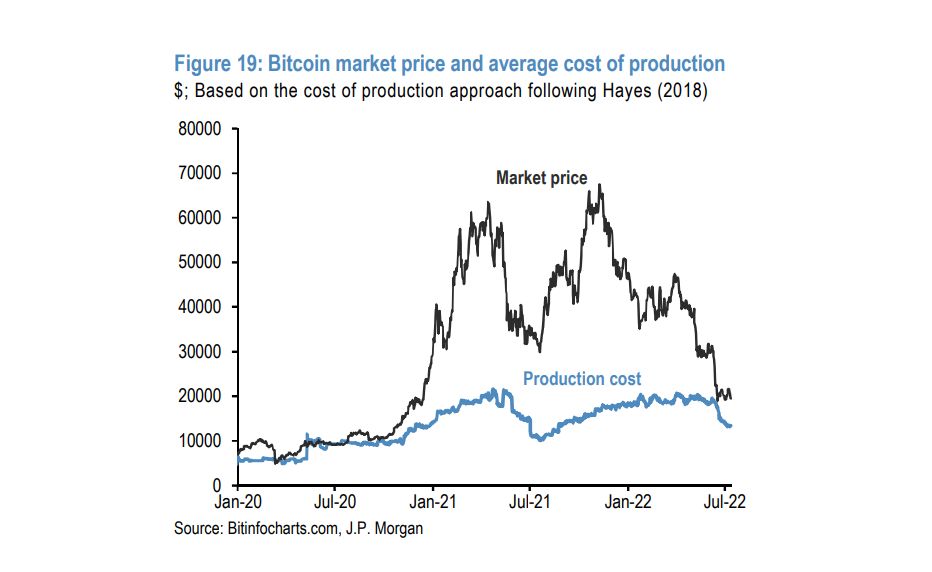
(Bloomberg) — Bitcoin’s cost of production has dropped from about $24,000 at the start of June to around $13,000 now, which may be seen as a negative for pricing, according to JPMorgan Chase & Co.

The drop in the production cost estimate is almost entirely due to a decline in electricity use as proxied by the Cambridge Bitcoin Electricity Consumption Index, strategists led by Nikolaos Panigirtzoglou wrote in a note Wednesday. They posit that the change is consistent with efforts by miners to protect profitability by deploying more efficient mining rigs, as opposed to a mass exodus by less efficient miners. They also say it could be seen as an obstacle to price gains.

“While clearly helping miners’ profitability and potentially reducing pressures on miners to sell Bitcoin holdings to raise liquidity or for deleveraging, the decline in the production cost might be perceived as negative for the Bitcoin price outlook going forward,” the strategists wrote. “The production cost is perceived by some market participants as the lower bound of the Bitcoin’s price range in a bear market.”

Bitcoin has struggled since hitting a high near $69,000 in November. It’s down about 60% year to date as the Federal Reserve hikes interest rates to combat inflation, risk assets struggle and the crypto industry sustains high-profile blowups like Terra/Luna and Three Arrows Capital. The largest token has been rangebound close to $20,000 for about a month. 

Last month, JPMorgan strategists led by Panigirtzoglou said that sales of Bitcoin by miners could pressure the price into the third quarter as the operations boost liquidity, meet costs and possibly deleverage.

A monthly update from miner Core Scientific Inc. last week showed that it dumped most of its Bitcoin holdings in June. Publicly traded miners have struggled along with digital assets themselves. Marathon Digital Holdings Inc. is down 76% year-to-date, Riot Blockchain Inc. has dropped 78% and Core Scientific has tumbled 86%.

More stories like this are available on bloomberg.com

©2022 Bloomberg L.P.

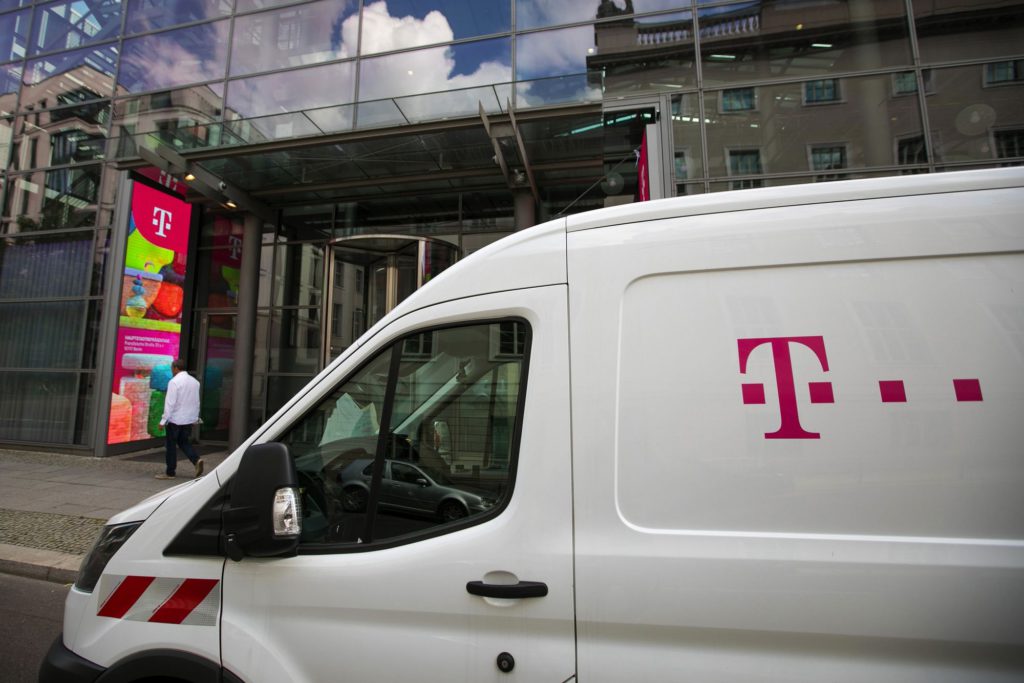
Brookfield, DigitalBridge Reach Deutsche Telekom Towers Stake Deal

(Bloomberg) — Brookfield Asset Management Inc. and DigitalBridge Group Inc. have reached an agreement for a majority stake in Deutsche Telekom AG’s tower business, people with knowledge of the matter said.

Brookfield teamed up with DigitalBridge Group in a last-minute bid for the stake after its previous partner, Cellnex Telecom SA, dropped out, Bloomberg was first to report. The group bypassed the earlier frontrunner, a KKR & Co.-led consortium, said the people, who asked not to be identified because the information was private.

The deal for a 51% stake in the business values the portfolio at about 17.5 billion euros ($17.6 billion), one of the people said.

The sale could be announced as soon as Thursday, said the people, who added that a final agreement hasn’t been reached and might not be. The deal is set to be one of the year’s biggest digital infrastructure transactions, according to data compiled by Bloomberg. 

Representatives Brookfield and DigitalBridge declined to comment. A spokesperson for Bonn-based Deutsche Telekom didn’t immediately respond to a request for comment outside regular business hours.

Europe’s phone carriers used to insist on ownership of their infrastructure including masts and fixed networks, but facing pressure to share the bill for expensive investments into fiber optics and 5G, with large debt piles and stagnant share prices, they’ve started to spin off or sell the businesses.

DigitalBridge, which has a market value of about $3 billion, manages almost $47 billion of assets solely focused on digital infrastructure such as wireless towers, data centers, fiber networks and edge infrastructure, according to its website. 

(Updates with DigitalBridge’s assets in seventh paragraph. Cellnex’s earlier partner was corrected in an earlier version of this story.)

More stories like this are available on bloomberg.com

©2022 Bloomberg L.P.

Thiel-Backed SPAC Weighs $2.5 Billion Circles.Life Deal

(Bloomberg) — Bridgetown Holdings Ltd., the US-listed blank-check company backed by billionaires Peter Thiel and Richard Li, is considering a potential merger with digital telecom services provider Circles.Life, according to people familiar with the matter.

The special purpose acquisition company is holding early talks with Singapore-based Circles.Life to explore a transaction, the people said, asking not to be identified because the matter is private. Bridgetown could seek a valuation for the combined entity of about $1.5 billion to $2.5 billion, the people said.

Considerations are preliminary and there’s no guarantee an agreement could be reached, the people said. Bridgetown could also look at other targets for a merger, while Circles.Life could opt to pursue other transactions, they added.

Founded in 2016, Circles.Life offers digital mobile services including voice, data, roaming and international calls, according to its website. The company reached 5% market share in Singapore in 2019 and also has operations in Taiwan, Australia, Indonesia and Japan. Warburg Pincus LLC made a “substantial investment” in Circles.Life in 2020, without disclosing the financial terms.

Representatives for Bridgetown, Circles.Life and Warburg Pincus declined to comment. Shares of Bridgetown were little changed in New York trading Wednesday.

Enthusiasm for SPACs has waned amid heightened market volatility with a growing number of prominent deals fizzling out. Proposals to change US regulations for blank-check companies have also hurt sentiment in the once-heated sector. Earlier this week, Bill Ackman’s Pershing Square Tontine Holdings Ltd. told investors it’s returning their $4 billion after failing to consummate a merger deal.

Bridgetown raised $595 million in a US initial public offering in 2020 with the goal of finding a target in the technology, financial services or media sectors in Southeast Asia. The SPAC had previously held talks with other targets including Indonesia’s Traveloka, Bloomberg News has reported. It also considered a merger with e-commerce giant PT Tokopedia before the Indonesian firm merged with ride-hailing service provider Gojek, creating the internet firm GoTo Group.

Bridgetown 2 Holdings Ltd., another blank-check company backed by Li and Thiel, merged with real estate marketplace PropertyGuru Pte earlier this year.

(Updates Bridgetown shares in fifth paragraph.)

More stories like this are available on bloomberg.com

©2022 Bloomberg L.P.
Close Bitnami banner
Bitnami