
Bloomberg

Glencore Expands Coal Mining in an Australian Methane Hotspot

(Bloomberg) — Glencore Plc is expanding a coal mine that scientists have estimated leaks so much planet-wrecking methane each year it has the same warming impact as the annual emissions from millions of cars. New activity at the Hail Creek Mine involves digging up coal from gas-rich seams through surface mining — an approach for which the company has said there’s no reliable way to halt fugitive methane from escaping during operation. Steep declines in the dirtiest fossil fuel are needed to meet global climate goals, and activists argue curbs should prioritize the worst methane-spewing mines.“If coal mining companies continue to argue that fugitive methane management is too hard for open-cut coal mines, then the obvious and material solution is to cease opening new mines,” said Naomi Hogan, strategic projects lead with Australasian Centre for Corporate Responsibility Inc. “And for the known very gassy mines to seriously consider early closure options.”Methane is the primary component of natural gas but it’s often produced alongside oil and coal. The invisible, odorless greenhouse gas is extremely potent and traps more than 80 times the heat of carbon dioxide during its first 20 years. Halting leaks and intentional releases of the gas from fossil fuel operations are viewed as some of the lowest hanging fruit in the fight against climate change. New surface mining activity is visible in satellite observations of the mine’s northeast corner, an area for which the mine got approval to expand when it was majority owned by Rio Tinto Group. Rio sold its stake in the mine in 2018 to Glencore, which declined to comment for this story.

An environmental authority amendment application, made in 2014 and approved the following year, for the northeast expansion area on file with Queensland authorities also suggest the site’s coal seams have a high methane content. The document, which sought approval for both new surface and underground mining activities, explains how extensive work would be needed to clear the flammable gas for a potential underground expansion to make it safe for workers.“Given the gaseous nature of the target and deeper underlying coal seams, it is anticipated that drainage of gas prior to, during and after mining activities would be required,” according to the amendment application. The document was obtained by the ACCR through a freedom of information request and shared with Bloomberg News.An environmental authority permit that went into effect March 15 for the Hail Creek mine makes no mention of the methane content of its coal seams.Geologically older, deeper coal deposits typically contain more methane than shallower seams near the surface. Yet, satellite observations are shedding new light on the climate impact from open-cut mines. There are well-known approaches for capturing methane from underground mines through boreholes or ventilation systems, but Glencore told the Financial Times this month there are no practicable technologies or methods for capturing fugitive methane emissions from operating surface mines.That’s particularly problematic for open-cast coal operations in Queensland’s Bowen Basin, in which Hail Creek mine is located, and where satellite data suggests the geology is particularly gaseous. For every ton of coal produced in the region an average of 7.5 kilograms of methane is released, according to an estimate using satellite observations from French geoanalytics Kayrros last year. That’s roughly 40% higher than global levels, based on data from the International Energy Agency. The age of coal is the same across a seam, according to Christian Lelong, director climate solutions at Kayrros, who also has experience working in Australia’s mining sector. Deep coal seams with sufficient incline can get close enough to the surface to be accessible through surface mining.“If the coal seam is gassy in an underground mine, the same coal seam will also be gassy if the mine is open-cast,’’ he said.

Glencore also filed an additional exploration permit linked to Hail Creek in June 2020 that is still being assessed by the Queensland government. That’s raised red flags for environmental groups concerned that more coal mining activity threatens Australia’s 2030 emissions reduction targets and its 2050 net zero pledge.“We have significant public interest concerns with respect to this exploration application,’’ said Carmel Flint, a coordinator for Lock the Gate Alliance, a climate activist group. “Particularly due to the extremely high emissions recorded from the existing mining operations and the incompatibility of further exploration and expansion activities with Glencore’s climate change and emissions reductions commitments.’’

Glencore is targeting a 15% reduction in its emissions by 2026 and a 50% cut by 2035, from 2019 levels. It’s also promised to cap coal production and slowly curtail output until closing the mines by 2050, but the company has given little detail about those plans and how quickly the mines will be phased out. It’s also unclear how those plans could be disrupted if the company’s Australia reserves are emitting far more methane than what is reported. Glencore has leaned into coal production even as many of its rivals have exited the sector amid concern over the fuel’s contribution to climate change. The price of the fossil fuel has surged due to supply disruptions caused by Russia’s invasion of Ukraine. The company’s embrace of coal has the firm on course for bumper profits this year, but there’s also been a softening of investor support for Glencore’s climate plans. Influential advisory firms Glass Lewis & Co. and Institutional Shareholder Services urged shareholders to vote against the company’s climate change strategy at its April investor meeting.The Hail Creek mine spewed between 123,000 and 263,000 metric tons of methane last year, according to an estimate from scientists at the SRON Netherlands Institute for Space Research who also used satellite data. That much methane would have the same short-term warming impact as the annual emissions from anywhere between about 2.2 million and 4.8 million US cars.Hail Creek’s reported emissions don’t come anywhere close to that. Glencore said the mine had net emissions of 503,591 tons of carbon dioxide equivalent in the year ended June 2020. If that figure were translated to just methane emissions, it’d be somewhere between 6,000 and 18,000 tons — far short of the SRON estimate. Glencore has said previously that its Bowen Basin coal business reports emissions in line with Australian requirements and that there are “concerns and questions” about using satellite technology to measure methane emissions from mines. But the basis for many of the emissions reports Australia’s miners file with regulators, which can rely on state-determined emissions factors, are themselves under scrutiny.In February, Australia said it was revising the method used to calculate methane pollution from open-cut coal mines. The change means total national emissions were on average 0.3% higher than previously stated for each year since 1990. That revision was prompted by the emergence of satellite datasets, which “catalysed a departmental review of inventory methods for open-cut coal mines in Queensland,” the government said. 

More stories like this are available on bloomberg.com

©2022 Bloomberg L.P.
Wall Street Is Poised for More Oversight as Barr Confirmed for Fed

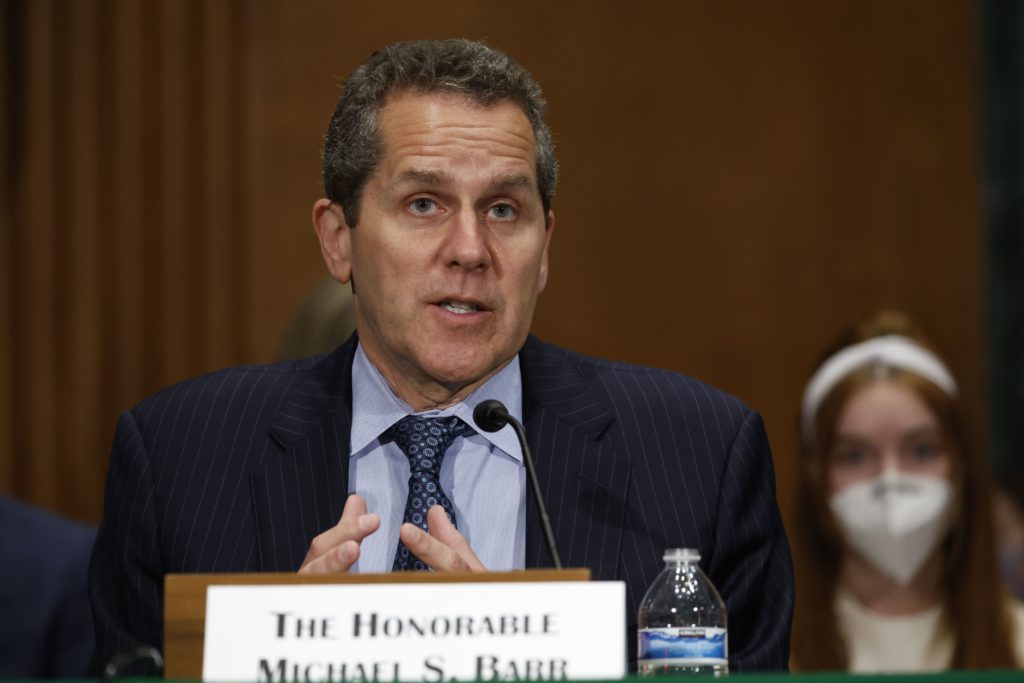
(Bloomberg) — Michael Barr was confirmed by the US Senate on Wednesday as the top bank watchdog at the Federal Reserve, allowing President Joe Biden to further put his stamp on Wall Street oversight. 

Barr, a former senior Treasury Department official who played a key role in shaping the 2010 Dodd-Frank Act, received bipartisan support for the job, with a 66-28 vote. The Federal Reserve vice chair for supervision position has been vacant since late last year.

As the Fed’s chief bank overseer, Barr will be expected to quickly step up day-to-day oversight of the nation’s largest lenders. He’ll also help develop financial regulatory policies for cryptocurrencies and combating climate change — a top priority for the White House.

The central bank’s authority to fight global warming has been a sticking point with Republicans who opposed Biden’s first nominee for the post, Sarah Bloom Raskin, over her past comments on the matter. During his May confirmation hearing, Barr successfully assuaged several GOP lawmakers by saying that the Fed didn’t have the right to tell banks not to lend to the oil and gas industry.

Beyond climate issues, Barr faces pressure from progressive Democrats to ramp up enforcement and supervision of big banks. Wall Street is also watching closely for the Fed to propose new capital standards.

While Barr said during his confirmation hearing that he didn’t think the Fed had the ability to ban mergers across the board, he’s expected to be more reticent to sign off on mergers. The deals have become political lightning rods and Democrats argue that more scrutiny is needed, particularly for combinations of larger regional banks.

Barr had been floated early in the Biden administration as a possible candidate to run the Office of the Comptroller of the Currency, but some vocal progressives arose in opposition. 

A lawyer, Barr is currently dean of the Gerald R. Ford School of Public Policy at the University of Michigan. With his confirmation, the Fed will have a full Board of Governors again after almost a decade.

More stories like this are available on bloomberg.com

©2022 Bloomberg L.P.
Rogers-Shaw Deal Meets Skepticism, Deal Spread Widens

(Bloomberg) — Investors are casting more doubt over Rogers Communications Inc.’s proposed C$20 billion takeover of Shaw Communications Inc. as last week’s national network failure draws increasing scrutiny from Canada’s industry watchdogs.

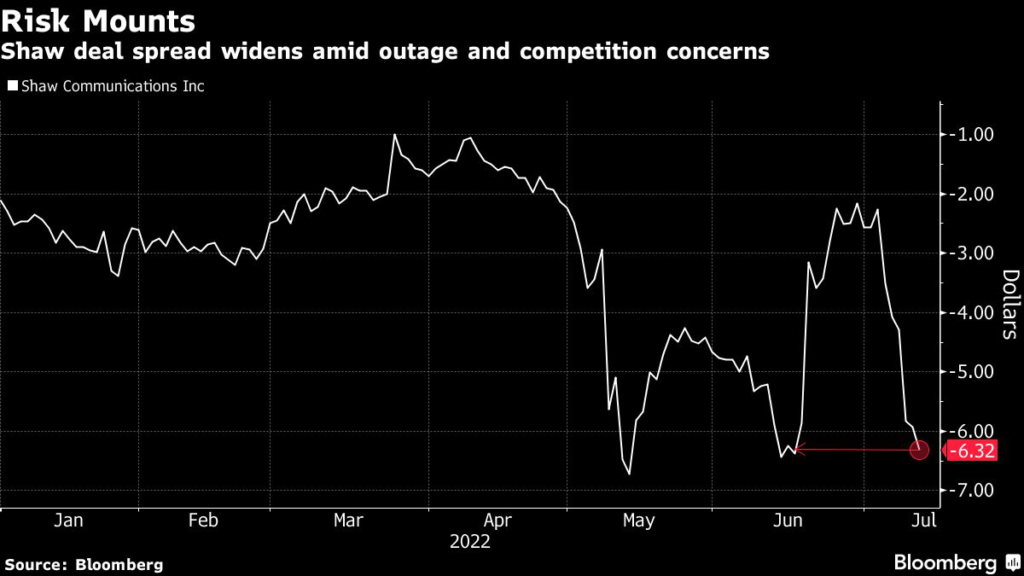
The deal spread, the difference between Shaw’s stock price and C$40.50 a share offer by Canada’s biggest cable and wireless firm, climbed to C$6.32, putting it on pace to close at its widest point in a month. That’s down from less than C$3 at the start of July as investors price in further risk of the transaction collapsing in the wake of an outage that pushed millions of Rogers customers offline. 

Industry Minister Francois-Philippe Champagne, whose department will make the final decision on the deal, called the network problem “unacceptable” and ordered telecommunications companies to agree to emergency roaming and mutual assistance during future outages. The Canadian Radio-television and Telecommunications Commission, the telecom regulator, ordered Rogers on Wednesday “to respond to detailed questions and provide a comprehensive explanation” for the network outage. 

While the controversy throws Rogers into the middle of concerns around network reliability, the debacle could bolster antitrust czar Matthew Boswell’s argument that putting more power in the hands of one company could further harm competition in the nation’s already narrow telecommunications market. The antitrust agency said in May it opposed one of the country’s largest-ever mergers. As the July 31 closing date looms, uncertainty is seeping in and investors are opting out. 

“Boswell and the bureau are taking a pretty hard line publicly on these issues and, given all the jitters around regulators and the relatively consolidated nature of the Canadian markets, this kind of hard line tone on Shaw’s wireless assets has created jitters,” Jonestrading market strategist Cabot Henderson said in an interview. “The outage has not helped in the court of public opinion.”

Rogers shares have slumped about 4.2% since Friday’s outage, while Shaw’s are down almost 6.2%. At least three analysts, those at Royal Bank of Canada, Bank of Montreal and National Bank of Canada, lowered their price targets on Rogers stock as the company plans to reimburse customers to help mitigate churn.

Even so, analysts remain bullish on Rogers’ prospects of closing the deal. The company previously agreed to sell Shaw’s wireless unit Freedom Mobile to rival Quebecor Inc. in an attempt to soothe the bureau’s concerns. By removing mobile services from the transaction, Rogers is essentially acquiring a cable provider by shuffling off its wireless division to a smaller competitor.

“As for the government’s desire to bring about more facilities-based competition to stimulate pricing options and less reliance on the Big 3 networks, we think the best opportunity it’s seen in years has presented itself with the prospect of Quebecor buying Freedom as part of a remedy solution for the proposed Rogers-Shaw merger.,” NBC Financial Markets analyst Adam Shine said in a note to clients.

(Corrects currency denomination and the size and scope of the deal spread in the second paragraph.)

More stories like this are available on bloomberg.com

©2022 Bloomberg L.P.
Stocks Are Back Down After Ugly CPI, Fedspeak: Markets Wrap

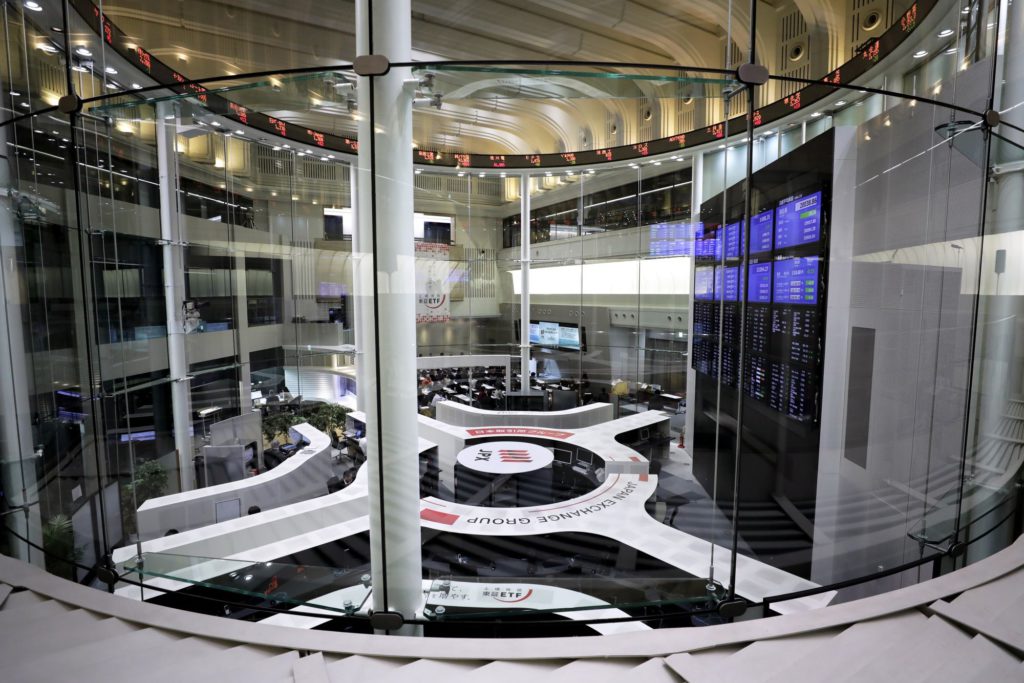
(Bloomberg) — Stocks whipsawed as a shockingly hot US inflation report rattled global financial markets, boosting bets the Federal Reserve could get even more aggressive with its belt-tightening campaign.

In a session of unnerving swings, the S&P 500 failed to stay in the green after a sharp reversal from a 1.6% slide. Also weighing on sentiment were hawkish signals from Fed Bank of Atlanta President Raphael Bostic, who said “everything is in play” to combat price pressures.

Treasury two-year yields, which are more sensitive to imminent Fed moves, climbed. The euro snapped back after briefly falling below $1, while the loonie gained as the Bank of Canada raised rates by a full percentage point.

The biggest surge in US consumer prices since 1981 showed that an inflation peak may still be out of reach. Swap markets indicate that the likely outcome of the July Fed policy meeting is now a coin toss between a 75-basis-point hike and an even larger increase of 100 basis points.

“The June CPI print is ugly across the board,” wrote Krishna Guha, vice chairman at Evercore ISI. “This is bad news for risk assets as it increases the likelihood that the Fed will keep raising rates rapidly and end up overshooting by enough to push the economy into recession.”

Read: Fed Report Says Inflation ‘Substantial’ But Signs of Moderating

Bank of America Corp. economists forecast a “mild recession this year” in the US, saying services spending is slowing and hot inflation is spurring consumers to pull back. They join Wells Fargo Investment Institute and Nomura Holdings Inc. in expecting a contraction in 2022. Deutsche Bank AG sees one starting in mid-2023.

More comments:

  • “Clearly, we’re not out of the inflation woods yet,” said Mike Loewengart, managing director of investment strategy at E*Trade from Morgan Stanley. “We’re likely in for a bumpy ride in the market.”
  • “The June CPI release was an ugly print, no getting around it,” said Cliff Hodge, chief investment officer at Cornerstone Financial. “The Fed has no choice but to follow through on a more aggressive path, which raises the probability of recession next year.”
  • “The only option available to the Fed is to slow economic growth enough to bring domestic demand down to meet constrained supply — possibly tipping the US into recession,” said Richard Flynn, managing director of Charles Schwab UK.
  • “Inflation keeps heating up, defying expectations for a peak to be reached,” said Seema Shah, chief global strategist at Principal Global Investors. “We see rates moving to 4.25% next year as the Fed desperately attempts to recover from its earlier erroneous inflation read.”

The multi-year market mantra of TINA — there is no alternative to equities — is facing a major threat as bond yields are looking more attractive. The percentage of S&P 500 members with a dividend yield higher than the 10-year US Treasury rate has fallen to the lowest since 2007. Payouts are under pressure as companies grapple with fears of recession, historically high inflation and supply constraints.

In corporate news, Delta Air Lines Inc. fell short of profit expectations in the second quarter and said high operating costs will persist through the rest of the year. Spirit Airlines Inc. agreed to delay a planned shareholder vote yet again on a proposed acquisition by Frontier Group Holdings Inc.

Investors fixated on the looming risk of recession are about to get a crucial read on a question that’s been burning a hole through markets for months: whether bank earnings will show cracks forming in the economy. Net interest income for the six largest US lenders is expected to rise by roughly 15%, while at the same time mortgage and investment-banking revenue is projected to decline, according to data compiled by Bloomberg.

Read: Higher Oil Prices Are Poised to Last for Months, If Not Years 

What to watch this week:

  • Earnings due from JPMorgan, Morgan Stanley, Citigroup, Wells Fargo
  • US PPI, jobless claims, Thursday
  • China GDP, Friday
  • US business inventories, industrial production, University of Michigan consumer sentiment, Empire manufacturing, retail sales, Friday
  • G-20 finance ministers, central bankers meet in Bali, from Friday
  • Atlanta Fed President Raphael Bostic speaks, Friday

Will the eurozone avoid a recession or a debt crisis? How will the euro and stocks perform in the next six months? Share your views and participate in the latest MLIV Pulse survey. It only takes a minute, so please click here anonymously.

Some of the main moves in markets:

Stocks

  • The S&P 500 fell 0.3% as of 3:31 p.m. New York time
  • The Nasdaq 100 was little changed
  • The Dow Jones Industrial Average fell 0.5%
  • The MSCI World index fell 0.3%

Currencies

  • The Bloomberg Dollar Spot Index fell 0.2%
  • The euro rose 0.2% to $1.0061
  • The British pound was little changed at $1.1896
  • The Japanese yen fell 0.3% to 137.32 per dollar

Bonds

  • The yield on 10-year Treasuries declined six basis points to 2.91%
  • Germany’s 10-year yield advanced one basis point to 1.15%
  • Britain’s 10-year yield declined one basis point to 2.06%

Commodities

  • West Texas Intermediate crude rose 0.2% to $95.99 a barrel
  • Gold futures rose 0.4% to $1,731.40 an ounce

More stories like this are available on bloomberg.com

©2022 Bloomberg L.P.

Twitter Says It Can Beat Musk’s Claims in Four Trial Days

(Bloomberg) — Twitter Inc. wants a lightning-quick trial to resolve its claim that billionaire Elon Musk wrongfully canceled his proposed $44 billion buyout of the social-media platform.

Lawyers for the San Francisco-based company say they need only four days in Delaware Chancery Court to prove that the world’s richest man should be forced to honor his agreement and pay $54.20 a share for Twitter. The company hopes to start the non-jury case on Sept. 19. Legal experts, however, predict the case will take about two weeks to try.

Unlike some states where it can take several years to get a case to trial, Delaware Chancery Court generally moves quicker. Chancery judges — business law experts — are known for being able to parse through the legal thickets of complex merger and acquisition disputes more quickly and thoroughly than other US courts. Even complex business cases are often argued before a judge within six or seven months of being filed.

The Twitter buyout agreement specifies all legal disputes over the deal must be heard in Delaware, corporate home to more than half of U.S. public companies, including Twitter and Musk’s Tesla Inc.. 

Musk and his lawyers didn’t immediately return emails Tuesday seeking comment on both the suit and whether the case can be tried on Twitter’s schedule. Musk did issue a tweet Tuesday, saying: “Oh the irony lol.”

A judge hasn’t yet been assigned to the case, but Chief Judge Kathaleen St. J. McCormick already has taken on investor suits over the teetering transaction. She may pick up Twitter’s suit as well. McCormick, a Delaware native, is a former legal-aid lawyer and graduate of Notre Dame Law School.

Twitter’s legal team argues it can easily show in less than a week of court time that Musk didn’t have legitimate grounds to nix the $54.20-per-share buyout. Twitter shares rose 8.1% to $36.83 at 3:01 p.m. Wednesday.

“Litigation on the schedule Twitter proposes permits the parties and their experienced counsel ample time to assemble a trial record,” the lawyers wrote.

That would provide enough time for a judge to rule and have the Delaware Supreme Court review the ruling before the Oct. 24 closing date for the transaction, the lawyers said.

Charles Elson, a retired University of Delaware finance professor and former head of the school’s Weinberg Center for Corporate Governance, says don’t bet on it.

“I’d say a four-day trial is way more than optimistic,” Elson said Wednesday in an interview. “There’s a lot of water under the bridge on this deal and I’d say it going to take more like 10 days to try it.”

Last year, Musk traveled to Delaware for over challenge from Tesla investors to his more than $2 billion purchase of renewable-power provider SolarCity, a company he founded with his cousins. That case ate up 10 trial days. A judge ultimately concluded Musk didn’t force an overpriced SolarCity acquisition down the throats of his fellow Tesla directors.

The current  case is Twitter v. Musk, 22-0613, Delaware Chancery Court (Wilmington)

(Updates with professor’s comments about trial time in 10th paragraph)

More stories like this are available on bloomberg.com

©2022 Bloomberg L.P.
Bitcoin Bottom Fishers Eye Long-Term Holder Capitulation Signals

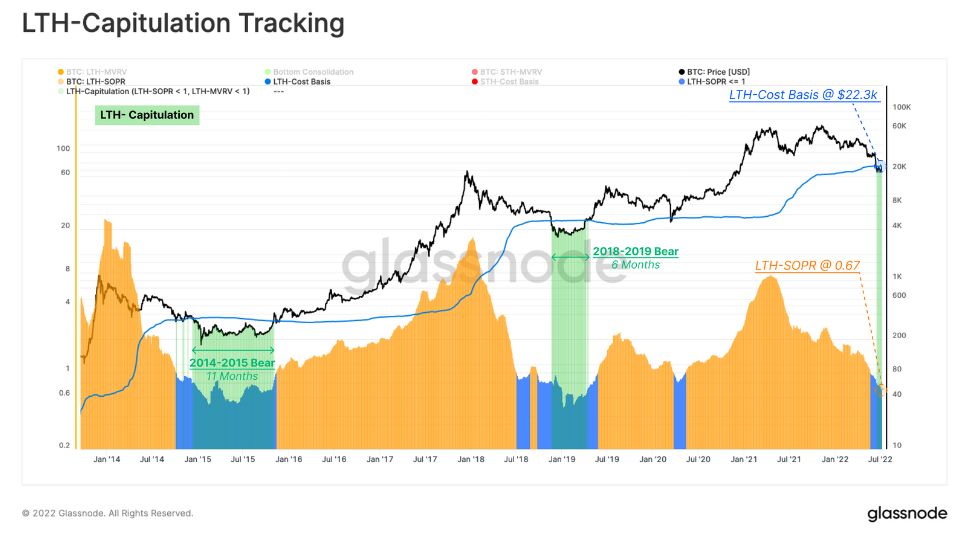
(Bloomberg) — With Bitcoin down over 70% from its November all-time highs, experts search for signs of a bottom as the staunchest of long-term holders are feeling pressured to halt their selling. 

Bitcoin, the largest digital asset by market value, is hovering around $19,000, down from roughly $69,000 at the end of last year. Longstanding investors spending their coins are locking in a 33% loss, data from Glassnode indicates. 

“There is an increased probability that a long-term holder (LTH) capitulation is underway,” the crypto research firm’s analysts wrote in a report.

That could signal a redistribution of coins to new buyers is near. “Bottom formation is often accompanied by LTHs shouldering an increasingly large proportion of the unrealized loss,” the analysts said. “In other words, for a bear market to reach an ultimate floor, the share of coins held at a loss should transfer primarily to those who are the least sensitive to price, and with the highest conviction.”

Elsewhere, an influx of smaller transactions from smaller entities seems to be growing, signaling a potential recovery in demand and speculation, according to the firm’s research. Meanwhile, Bitcoin miners, which can be thought of as an influential source of selling pressure during bear markets, have slowed their spending of late. 

Still, none of these gauges are a definitive read on the market and finding the bottom may prove elusive. During prior bear markets, the supply held by short-term holders was just 3% to 4%, according to Glassnode. Now, with short-term holders still owning roughly 16% of the Bitcoin supply, it could be some time before the coin is largely redistributed to price-insensitive, more confident holders to calm volatility.

“Bitcoin investors are not out of the woods yet,” said Glassnode. 

Calling a bottom on any asset is a fraught venture. Stock-market investors, facing 20% losses this year, are similarly looking for signals the worst of the selling has passed. Bitcoin continues to trade largely in tandem with US equities, and with tech stocks in particular. 

“At the moment, Bitcoin is correlating downward with other risk assets but there isn’t any fundamental reason for it to do that,” said Quantum Economics Founder and Chief Executive Officer Mati Greenspan. “Once it breaks correlation with the stock market, Bitcoin’s price will better reflect its true value.”

More stories like this are available on bloomberg.com

©2022 Bloomberg L.P.

Unity to Buy IronSource in $4.4 Billion Deal for Ad Tech

(Bloomberg) — Unity Software Inc. agreed to buy app monetization company IronSource in an all-stock deal valued at about $4.4 billion to help the gaming platform boost its advertising technology, which has suffered under recent data-privacy changes by Apple Inc. The company also lowered its annual revenue forecast, sending shares plunging 18%. 

The two companies have “some overlap,” Chief Executive Officer John Riccitiello said in an interview, citing the two companies’ ad networks and ability to “collect a lot of data.” However, Riccitiello says it would “take years” for Unity to internally build parts of IronSource’s ad technology, which gives game developers tools to find customers, make their games stickier, and earn money faster. 

Unity’s advertising and monetization products, contained in its Operate Solutions unit, have been under pressure ever since Apple made it harder for companies from Meta Platforms Inc. to Snap Inc. to track ad views across mobile devices. Unity created what it thought was a workaround for Apple’s system, but in its latest earnings report, the company forecast lower revenue figures for the second quarter and this year, disappointing investors and suggesting the system wasn’t working. The stock plunged 30% on the report in May. 

“Buying IronSource may improve Unity’s capabilities in advertising technology — a bigger contributor to revenue than the core tools-subscriptions business,” Eileen Segall, a Bloomberg Intelligence analyst, wrote in a research note. “There’s room for ad-tech players to gain share in mobile in-app advertising amid pressure on walled gardens due to Apple’s recent changes to Identifier for Advertisers, which give advertisers fewer signals for targeting.”

The Iron Source acquisition, Unity’s largest deal yet, adds to the San Francisco-based company’s recent buying spree. Since mid-2021, it has pulled in avatar creation company Ziva Dynamics, real-time collaboration tool company SyncSketch and Weta Digital — a 3D digital tool company for $1.63 billion.

Unity, whose software underpins many popular video games, hasn’t been immune to the economic forces roiling the broader tech sector. Its stock is down more than 75% this year. In addition to the dismal earnings report, Unity last month announced plans to cut 4% of its 5,900 employees internationally. 

The price tag for IronSource also reflects a steep drop in valuation since the company went public through a merger with Thoma Bravo’s blank-check firm last year. At the time, the combined business was valued at $11.1 billion. The Tel Aviv-based company, which helps app developers analyze data on their users and monetize their creations, has dropped about 78% in trading in the last 12 months. 

Read More: Thoma Bravo SPAC Agrees to Take IronSource Public

On Wednesday Unity said it expects full-year revenue of $1.3 billion to $1.35 billion, down from an earlier forecast of as much as $1.43 billion because of “macro trends, product launch and competitive dynamic with our monetization business.” Second-quarter financial results will be “slightly higher than the top end of the guidance range.” 

Unity shares fell to a low of $32.52 in New York on Tuesday. Asked about the stock move, Riccitiello said, “Realistically, I haven’t seen an M&A transaction where the surviving company doesn’t pay a premium the day it’s announced.” 

According to terms of the deal, Unity will exchange 0.1089 shares of common stock for every ordinary share of IronSource. The transaction is expected to close in the fourth quarter. 

Unity will also buy back as much as $2.5 billion of its own shares in the 24 months after the deal closes, the company said. Its two largest investors, Silver Lake and Sequoia, have agreed to invest a combined $1 billion in convertible notes in Unity at closing. 

(Updates with CEO comments in second paragraph)

More stories like this are available on bloomberg.com

©2022 Bloomberg L.P.
Dutch Confirm Talks With US on Chipmaking-Gear Ban on China

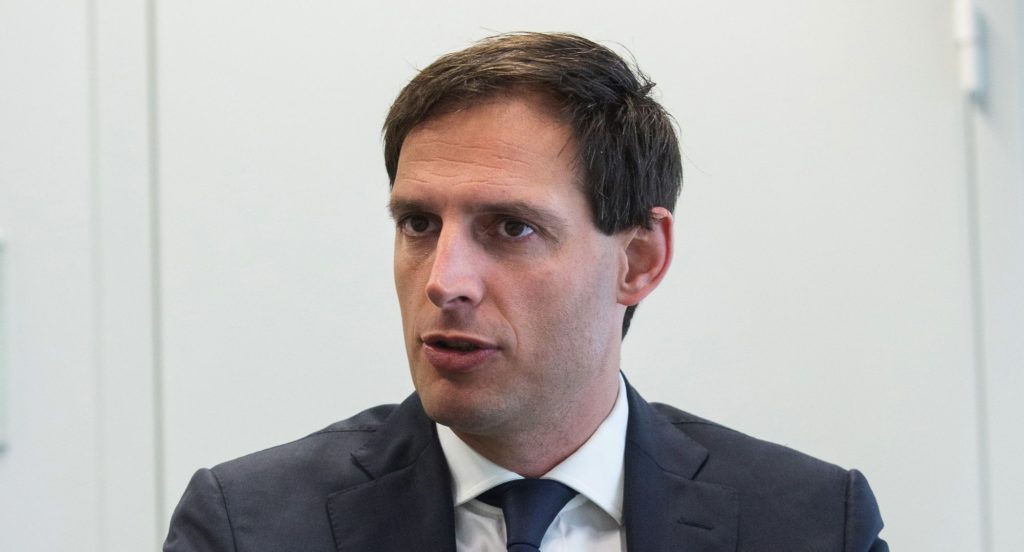
(Bloomberg) — The Dutch foreign minister confirmed that the Netherlands and the US are holding discussions on blocking ASML Holding NV from selling to China technology used in making a large chunk of the world’s chips.

“What I can tell you is that it does make sense that you always liaise with friends when certain goods have broader strategic implications and ramifications across the globe,” Foreign Minister Wopke Hoekstra said in a wide-ranging interview in The Hague on Wednesday with a select group of journalists. “Of course you have conversations about that, and that we do.”

American officials are lobbying their Dutch counterparts to bar ASML from selling some of its older deep ultraviolet lithography, or DUV, systems, Bloomberg reported last week, citing people familiar with the matter. These machines are a generation behind cutting-edge but still the most common method in making certain less-advanced chips required by cars, phones, computers and even robots. Washington is focused on banning sales of the most advanced type of DUV technology, immersion lithography machines, the people said. 

Read: US Pushes for ASML to Stop Selling Chipmaking Gear to China 

The Dutch government, which faces pressure from US officials to expand an existing moratorium on the sale of such systems to the Asian nation, has yet to agree to any additional restrictions. China is the Netherlands’s third-biggest trade partner after Germany and Belgium. 

ASML, on the other hand, opposes a ban on sales of DUV lithography equipment to Chinese customers because it is already a mature technology, Peter Wennink, the company’s chief executive officer, said earlier this year. Chinese-based facilities, run by either domestic or foreign companies, account for 14.7% of ASML’s total revenue in 2021, according to company disclosures and data compiled by Bloomberg.

ASML is the world’s top maker of lithography systems, machines that perform a crucial step in the process of creating semiconductors. ASML’s dominance of the market for that type of equipment means that further cutting China off from access to its products would undermine the Asian country’s ambitions to make itself more self-sufficient in production of the crucial electronic components.

Tensions have heightened in recent years between the US and China, the world top two economies. The US has accused China of human rights abuses in its far western Xinjiang region.  

Commenting on the Dutch government’s stance on alleged human rights abuses in China, Hoekstra said he is “very worried about many of the news reports.” 

“That’s been something I’ve been voicing and many of my colleagues have been voicing vis-a-vis the Chinese,” he said.

China has been accused of running a state-sponsored forced-labor program in Xinjiang under the guise of anti-poverty efforts, sending as many as 1 million Uyghurs to so-called re-education camps. China has repeatedly denied mistreatment of the Uyghurs and says crackdowns in Hong Kong are to prevent insurrection.


More stories like this are available on bloomberg.com

©2022 Bloomberg L.P.

Social Platforms Fail to Keep LGBTQ Users Safe, GLAAD Says

(Bloomberg) — A top LGBTQ advocacy organization, after seeing an escalation of hateful attacks on platforms such as TikTok and Twitter, came up with a score for the social media sites’ safety for vulnerable users. All of the networks received a failing grade.

The top five social networks all scored less than 50 out of 100% on safety for LGBTQ users, a new ranking in the Social Media Safety Index developed by GLAAD, an organization that fights hate against gay, lesbian, bisexual, transgender and queer people. The report, released Wednesday, ranks Instagram the least bad at 48%, followed by Facebook, Twitter, YouTube and TikTok.

“Basically, the entire industry is failing LGBTQ people,” said Jenni Olson, senior director of GLAAD’s social media safety program.

The new scores are based on factors ranging from whether the platform includes gender pronouns on profiles, to content moderation and diversity of their workforces. In the last year, companies have made some improvements, and GLAAD hopes its report will be a catalyst for more change, Olson said.

In February, TikTok updated its Community Guidelines to explicitly prohibit misgendering, deadnaming and misogyny, after prompting by GLAAD and UltraViolet, a female-empowerment organization. Deadnaming is the practice of referring to a trans person by the name they were assigned at birth. GLAAD calls it “an invasion of privacy that undermines the trans person’s identity, and can put them at risk for discrimination, even violence.”

On Twitter last Tuesday, actor Elliot Page’s deadname was trending for 45 minutes before the platform removed it, according to Buzzfeed News, even though deadnaming is explicitly prohibited in Twitter’s hateful conduct policy.

A Twitter Inc. spokesperson said the company already takes feedback from GLAAD and has “engaged with GLAAD to better understand their recommendations and are committed to an open dialogue to better inform our work to support LGBTQ safety.”

A spokesperson for Alphabet Inc.’s Google, which includes YouTube, said the company has made “significant progress in our ability to quickly remove hateful and harassing content, and to prominently surface content in search results and recommendations from authoritative sources.”

A spokesperson for Meta Platforms Inc., which owns Facebook and Instagram, said the company prohibits violent or dehumanizing content directed against LGBTQ people and removes claims about someone’s gender identity upon their request.

“We also work closely with our partners in the civil rights community to identify additional measures we can implement through our products and policies,” the spokesperson said.

A spokesperson for TikTok, owned by ByteDance Ltd., pointed to new tools to promote kindness and policies that prohibit hateful behavior, and said the company “is committed to supporting and uplifting LGBTQ+ voices, and we work hard to create an inclusive environment for LGBTQ+ people to thrive.”  

More than any other group, LGBTQ users face online harassment, according to the Anti-Defamation League, which looks at civil rights broadly, including antisemitism and bias. This year’s results of the group’s annual Online Hate and Harassment survey show 66% of LGBTQ respondents experience harassment, compared to 38% of non-LGBTQ respondents.

This connects to real-world anti-LGBTQ attacks and even legislation, GLAAD says. The group’s report states that Republican lawmakers have proposed 325 bills they consider anti-LGBTQ since the beginning of this year.

“There’s a direct line, in terms of the anti-LGBTQ rhetoric on social media platforms, particularly from powerful right-wing politicians and right-wing media accounts and pundits,” Olson said.

León Powell, bilingual community specialist for nonprofit trans hotline and microgrant organization Trans Lifeline, routinely removes comments from the organization’s social media posts that say things like: “It’s a mental illness,” “All trans people need to kill themselves,” and “You’re grooming children.” Powell, who uses they/them pronouns, spends hours every week deleting and reporting these comments, and estimates that three out of every five posts receives this kind of hate.

When Powell does report harmful comments to social media platforms, they said the platforms often don’t take action, saying the comment was not hate speech but just someone’s opinion.

Powell said seeing these comments is hard, but fortunately they have support resources that not everyone has.

“If you go to YouTube and look for just ‘transgender,’ you’re going to see as many if not more videos against trans people and trying to debunk being transgender as something fake or people pretending,” they said, “And so I can only imagine how heartbreaking and confusing and damaging that can be for a young trans person or a trans person in general trying to come to terms with their identity.”

A YouTube spokesperson said the site surfaces mostly authoritative sources in search results for “transgender” and that if someone searches for “conversion therapy,” YouTube will provide context that it’s a dangerous and discredited practice.

Powell said some Trans Lifeline advertisements on Facebook get flagged as promoting hateful speech because they include the word “transgender.” When that happens, they have to resubmit the advertisement for human review. That’s why Powell thinks social media platforms need more humans monitoring content, versus an artificial intelligence system.

The GLAAD report calls on companies to disclose a training for content moderators that trains them on the needs of vulnerable users. Olson called on companies to strengthen and enforce community guidelines, respect data privacy and improve transparency with algorithm designs.

“There needs to be some kind of regulatory oversight that will actually create accountability for these companies,” Olson said. “At the end of the day, the lack of civil discourse on platforms negatively impacts everyone.”

(Updates with comment in 18th paragraph)

More stories like this are available on bloomberg.com

©2022 Bloomberg L.P.

Stocks See Wild Twists as CPI Boosts Hawkish Bets: Markets Wrap

(Bloomberg) — Stocks whipsawed after a shockingly hot US inflation report rattled financial markets, boosting bets the Federal Reserve could get even more aggressive with its belt-tightening campaign.

In a session of dramatic swings, the S&P 500 erased losses that reached 1.6% earlier Wednesday thanks to gains in giants like Tesla Inc. and Amazon.com Inc. The tech-heavy Nasdaq 100 outperformed.

Other asset classes also came under pressure, with both the dollar and Treasury 10-year yields reversing earlier advances. Two-year rates, which are more sensitive to imminent Fed moves, rose. The euro briefly fell below $1. The loonie climbed as the Bank of Canada hiked by a full percentage point.

The biggest surge in US consumer prices since 1981 showed that a peak may still be out of reach, fueling bets officials could lift rates by 100 basis points in July — raising the odds of a recession. The Fed will likely resort to hawkish rhetoric and further front-loading of tightening as it fights to maintain its credibility, according to Federated Hermes’ Silvia Dall’Angelo.

“The June CPI print is ugly across the board,” wrote Krishna Guha, vice chairman at Evercore ISI. “This is bad news for risk assets as it increases the likelihood that the Fed will keep raising rates rapidly and end up overshooting by enough to push the economy into recession.”

Bank of America Corp. economists forecast a “mild recession this year” in the US, saying services spending is slowing and hot inflation is spurring consumers to pull back. BofA joins Wells Fargo Investment Institute and Nomura Holdings Inc. in expecting a contraction in 2022. Deutsche Bank AG sees one starting in mid-2023.

More comments:

  • “Clearly, we’re not out of the inflation woods yet,” said Mike Loewengart, managing director of investment strategy at E*Trade from Morgan Stanley. “We’re likely in for a bumpy ride in the market.”
  • “The June CPI release was an ugly print, no getting around it,” said Cliff Hodge, chief investment officer at Cornerstone Financial. “The Fed has no choice but to follow through on a more aggressive path, which raises the probability of recession next year.”
  • “The only option available to the Fed is to slow economic growth enough to bring domestic demand down to meet constrained supply — possibly tipping the US into recession,” said Richard Flynn, managing director of Charles Schwab UK.
  • “Inflation keeps heating up, defying expectations for a peak to be reached,” said Seema Shah, chief global strategist at Principal Global Investors. “We see rates moving to 4.25% next year as the Fed desperately attempts to recover from its earlier erroneous inflation read.”

Read: IMF to Cut Global Growth Forecast Again Amid ‘Darkened’ Outlook

The multi-year market mantra of TINA — there is no alternative to equities — is facing a major threat as bond yields are looking more attractive. The percentage of S&P 500 members with a dividend yield higher than the 10-year US Treasury rate has fallen to the lowest since 2007. Corporate payouts are under pressure as companies grapple with fears of recession, historically high inflation and supply constraints.

In corporate news, Delta Air Lines Inc. fell short of profit expectations in the second quarter and said high operating costs will persist through the rest of the year. Spirit Airlines Inc. agreed to delay a planned shareholder vote yet again on a proposed acquisition by Frontier Group Holdings Inc.

Investors fixated on the looming risk of recession are about to get a crucial read on a question that’s been burning a hole through markets for months: whether bank earnings will show cracks forming in the economy. Net interest income for the six largest US lenders is expected to rise by roughly 15%, while at the same time mortgage and investment-banking revenue is projected to decline, according to data compiled by Bloomberg.

Read: Higher Oil Prices Are Poised to Last for Months, If Not Years 

What to watch this week:

  • Earnings due from JPMorgan, Morgan Stanley, Citigroup, Wells Fargo
  • US PPI, jobless claims, Thursday
  • China GDP, Friday
  • US business inventories, industrial production, University of Michigan consumer sentiment, Empire manufacturing, retail sales, Friday
  • G-20 finance ministers, central bankers meet in Bali, from Friday
  • Atlanta Fed President Raphael Bostic speaks, Friday

Will the eurozone avoid a recession or a debt crisis? How will the euro and stocks perform in the next six months? Share your views and participate in the latest MLIV Pulse survey. It only takes a minute, so please click here anonymously.

Some of the main moves in markets:

Stocks

  • The S&P 500 was little changed as of 12:59 p.m. New York time
  • The Nasdaq 100 rose 0.3%
  • The Dow Jones Industrial Average fell 0.3%
  • The MSCI World index was little changed

Currencies

  • The Bloomberg Dollar Spot Index fell 0.3%
  • The euro rose 0.5% to $1.0084
  • The British pound rose 0.3% to $1.1921
  • The Japanese yen fell 0.3% to 137.24 per dollar

Bonds

  • The yield on 10-year Treasuries declined three basis points to 2.94%
  • Germany’s 10-year yield advanced one basis point to 1.15%
  • Britain’s 10-year yield declined one basis point to 2.06%

Commodities

  • West Texas Intermediate crude was little changed
  • Gold futures rose 0.7% to $1,736.10 an ounce

More stories like this are available on bloomberg.com

©2022 Bloomberg L.P.

Close Bitnami banner
Bitnami