Bloomberg

Disney Backs Metaverse Plays in Its Latest Class of Startup Partners

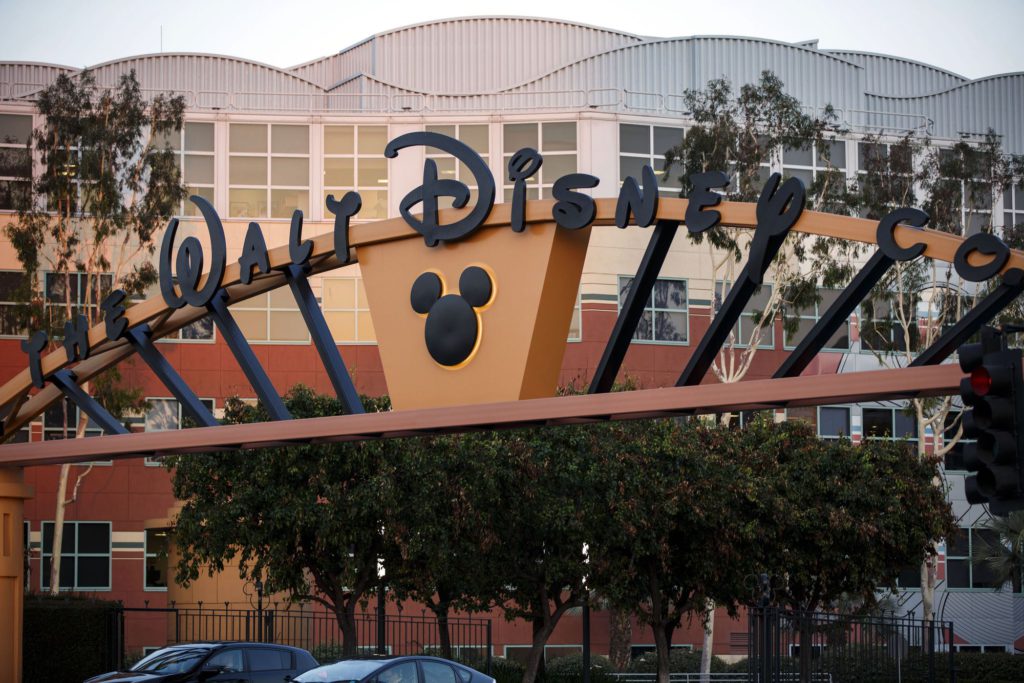
(Bloomberg) — Walt Disney Co. is focusing on the metaverse with the latest class of startups the company is backing.

The Burbank, California-based entertainment giant chose six companies to participate this year in the Disney Accelerator program, and they all involve immersive experiences and technologies, the company said in a statement Wednesday. 

Disney provides the companies with capital, work space at its offices and access to executives and business opportunities. 

Participants in this year’s program include FlickPlay, a social-media app that lets users unlock non-fungible tokens tied to real world locations; Obsess, which helps brands create 3D virtual stores on their websites; and Red 6, which makes a headset that can be used to tap artificial reality experiences in active, outdoor settings.

Previous participants in Disney’s program, launched in 2014, have included Epic Games, maker of the Fortnite game and the Unreal Engine computer graphics tool.

More stories like this are available on bloomberg.com

©2022 Bloomberg L.P.

Celsius Paydowns Take Crypto Lender Into ‘Uncharted Territory’

(Bloomberg) — As Celsius Network Ltd.’s customer withdrawal freeze enters a full month, the beleaguered crypto lender has paid back a string of debts totaling more than $900 million during the same period to decentralized-finance platforms. 

The paydowns have raised the specter of a legal debate on how and in what order should distressed crypto companies pay back creditors — whether they are actual people or platforms governed by computer code referred to as smart contracts. Celsius has made the repayments in stablecoins to DeFi platforms Aave, Compound and Maker since it halted customer withdrawals on June 12, according to Bloomberg’s tally based on blockchain data. 

Because loans from DeFi platforms are often required to be overcollateralized, doing so would allow Celsius to reclaim the extra coins locked at the platform, thus securing more assets on a net basis. 

“Like most things crypto, we are in uncharted territory in terms of who should and ultimately can get paid ahead of other parties, which is complicated by the smart contracts implicated and by the intertwined DeFi lending contractual relationships,” said Thad Wilson, an Atlanta-based partner of financial restructuring at law firm King & Spalding. 

Celsius, one of the crypto lending companies suffering from soured bets in the current bear market, has been exploring options including a restructuring of its liabilities. It hired the law firm of Kirkland & Ellis for advice, people familiar with the matter told Bloomberg. The company, which at one point had more than $20 billion in user assets, hasn’t disclosed its current assets and liabilities figures. 

Regulators in Vermont said they believe Celsius is “deeply insolvent” and lacks the assets and liquidity to meet its obligations. Celsius hasn’t said it was considering bankruptcy. The company did not return a request for comment on the debt repayments. 

Litigation Risk

Legal and credit experts say that while it’s not uncommon for a financially distressed company to repay certain counterparties while not paying others, doing so is not without litigation risk. 

Celsius repaying some debt ahead of a potential bankruptcy raises the issue of so-called preference claims, according to Jared Ellias, a professor who teaches bankruptcy and corporate law at Harvard University. In a Chapter 11 bankruptcy, some creditors aren’t supposed to end up better off than others — and better than they would in an outright liquidation — just because the insolvent company chose to pay them before entering court protection. 

“It’s fair to say that any payments or exchanges made while not allowing creditors to get their money in the ordinary course of business are potentially subject to clawback actions in bankruptcy,” Ellias said. “I would tell everybody getting money from Celsius to consult with an attorney before making decisions that they may regret.”

Under its terms of service, Celsius said the treatment of customers’ digital assets in the event of an insolvency proceeding is “unsettled” and “not guaranteed,” which may result in customers being treated as an unsecured creditor. Meanwhile, collateralization could mean that the DeFi creditors are “secured” with priority over unsecured creditors, though whether they are actually defined as secured creditors under the law will “likely be a contested issue and would likely be litigated,” said Daniel Gwen, an associate in Ropes & Gray’s business restructuring group. 

“Those payments made to the DeFi protocols will be scrutinized,” said Pat Daugherty, partner at Foley & Lardner who leads its blockchain task force. However, he believes that the DeFi platforms are entitled to priority because they are secured creditors, while customers are treated as unsecured creditors in this case.  

Robert Gayda, a partner at law firm Seward & Kissel’s corporate restructuring and bankruptcy group, shared the same assessment. While certain payments made within 90 days of a bankruptcy filing could be challenged in court, if the creditor did have collateral that exceeded its debt, then “they’d be in a good position to survive a challenge to that payment,” Gayda said.

Transparency

Celsius’s repayment to DeFi platforms might ultimately be the right financial decision, but it still raises the question of transparency as it made these decisions without any input from customers while locking up their funds, said Mike Alfred, a private investor who co-founded BrightScope Inc. 

“Celsius paying out loans in DeFi apps before paying off its retail creditors and investors is further evidence that it is being managed as an unregulated high risk hedge fund that was marketed as a low risk savings account to retail investors,” said Simon Dixon, co-founder of BnkToTheFuture and a Celsius shareholder who has been sharing his thoughts on how to save or restructure the business on Twitter.

More stories like this are available on bloomberg.com

©2022 Bloomberg L.P.

For the James Webb Telescope, Now the Real Work Begins

(Bloomberg) — With the help of none other than the president of the United States, the James Webb Space Telescope unveiled its first, full color images this week, overpowering older photos by the Hubble Space Telescope and garnering gasps of wonder from all over the world.

As impressive as those first pictures are, not to mention the telescope’s ability to see almost to the beginning of time, there’s a lot more to the James Webb telescope. On this special episode of Bloomberg’s Giant Leap, we meet five of the many scientists who will be using it to analyze not only the earliest galaxies, but unexplored regions of our own solar system and Earth-like planets orbiting nearby stars that just might support life. 

More stories like this are available on bloomberg.com

©2022 Bloomberg L.P.

Walmart’s Deal With EV Startup Canoo Comes With Strings: No Amazon

(Bloomberg) — Walmart Inc.’s deal backing an electric-vehicle startup has some strings, including a provision preventing sales to rival Amazon.

The retail giant’s agreement to purchase as many as 10,000 battery-powered vans from Canoo Inc. provides a lifeline for the fledging auto manufacturer, whose shares surged more than 50% when the news broke on Tuesday. Walmart could also wind up owning more than one-fifth of Canoo through a warrant issued to the retailer as part of the deal.

The caveat blocking sales to Amazon, as well as details about the warrant, were disclosed in a securities filing Wednesday.

The language says that for the duration of the pact, Canoo “will not enter into any agreement for any services involving the design, manufacture, consult, advice, lease, or sale of EVs to, or issue any equity, equity-linked or debt securities of any type, or enter into any agreement for the purpose of transferring control of the Company to, Amazon.com, Inc., its subsidiaries, or affiliates.” The document also indicated that Walmart’s purchase order is non-binding.

Amazon already has an agreement with another EV startup, Rivian Automotive Inc., to buy as many as 100,000 electric vans that gives it priority over all other potential customers. In striking a similar deal with Canoo, albeit for a fraction of the volumes, Walmart is betting a competing technology wins out in the emerging business for battery-powered delivery fleets. It has also placed an order for EVs with established automaker General Motors Co.

Like Amazon’s equity investment in Rivian for a nearly 18% stake, Walmart also has a option to take a position in Canoo. The startup has granted Walmart a warrant to buy up to 61.2 million shares over a 10-year period at an exercise price of $2.15 a share — and vesting it immediately with 15.3 million common shares, the filing said.

The rest of the shares vest quarterly and in proportion to any payments Walmart makes to Canoo for its vehicles, up to $300 million, at which point all 61.2 million will have vested. Walmart would own more than 20% of Canoo if it exercises all of the shares allotted.

Canoo shares fell 6.8% to $3.39 as of 10:26 a.m. in New York. The stock is down about 57% this year. 

The Walmart project begins with an order for 4,500 vans, with an option for up to 10,000. Canoo recently moved its headquarters to Walmart’s hometown of Bentonville, Arkansas, and had warned in May of substantial doubt about its ability to continue as a going concern.

(Updates with additional details on warrant and potential stake in sixth paragraph.)

More stories like this are available on bloomberg.com

©2022 Bloomberg L.P.

Unity to Buy IronSource in $4.4 Billion Deal to Boost Ad Tech

(Bloomberg) — Unity Software Inc. agreed to buy app monetization company IronSource in an all-stock deal valued at about $4.4 billion to help the gaming platform boost its advertising technology, which has suffered under recent data-privacy changes by Apple Inc. The company also lowered its annual revenue forecast, sending shares plunging 13%. 

Unity’s advertising and monetization products, contained in its Operate Solutions unit, have been under pressure ever since Apple made it harder for companies from Meta Platforms Inc. to Snap Inc. to track ad views across mobile devices. Unity created what it thought was a workaround for Apple’s system, but in its latest earnings report, the company forecast lower revenue figures for the second quarter and this year, disappointing investors and suggesting the system wasn’t working. The stock plunged 30% on the report in May. 

Unity’s Operate Solutions unit, which helps developers earn money through in-game purchases and advertising, accounted for about two-thirds of the company’s revenue in 2021.

“Buying IronSource may improve Unity’s capabilities in advertising technology — a bigger contributor to revenue than the core tools-subscriptions business,” Eileen Segall, a Bloomberg Intelligence analyst, wrote in a research note. “There’s room for ad-tech players to gain share in mobile in-app advertising amid pressure on walled gardens due to Apple’s recent changes to Identifier for Advertisers, which give advertisers fewer signals for targeting.”

The Iron Source acquisition, Unity’s largest deal yet, adds to the San Francisco-based company’s recent buying spree. Since mid-2021, it has pulled in avatar creation company Ziva Dynamics, real-time collaboration tool company SyncSketch and Weta Digital — a 3D digital tool company for $1.63 billion.

Unity, whose software underpins many popular video games, hasn’t been immune to the economic forces roiling the broader tech sector. In addition to the dismal earnings report, Unity last month announced plans to cut 4% of its 5,900 employees internationally. Its stock is down more than 75% this year. The price tag for IronSource also reflects a steep drop in valuation since the company went public through a merger with Thoma Bravo’s blank-check firm last year. At the time, the combined business was valued at $11.1 billion. The Tel Aviv-based company, which helps app developers analyze data on their users and monetize their creations, has dropped about 78% in trading in the last 12 months. 

Read More: Thoma Bravo SPAC Agrees to Take IronSource Public

On Wednesday Unity said it expects full-year revenue of $1.3 billion to $1.35 billion, down from an earlier forecast of as much as $1.43 billion because of “macro trends, product launch and competitive dynamic with our monetization business.” Second-quarter financial results will be “slightly higher than the top end of the guidance range.” 

According to terms of the deal, Unity will exchange 0.1089 shares of common stock for every ordinary share of IronSource. The transaction is expected to close in the fourth quarter. 

Unity will also buy back as much as $2.5 billion of its own shares in the 24 months after the deal closes, the company said. Its two largest investors, Silver Lake and Sequoia, have agreed to invest a combined $1 billion in convertible notes in Unity at closing. 

More stories like this are available on bloomberg.com

©2022 Bloomberg L.P.

Brookfield, DigitalBridge Team Up for German Tower Bid

(Bloomberg) — Brookfield Asset Management Inc. has teamed up with DigitalBridge Group Inc. on a last-minute bid for a stake in Deutsche Telekom AG’s tower business, people with knowledge of the matter said. 

The Canadian investment giant tied up with DigitalBridge after its previous partner, Cellnex Telecom SA, dropped out of the race, according to the people. The new duo is seen as the current favorite to win the bidding, though no final decisions have been made, the people said. 

The consortium is competing with an investor group backed by KKR & Co., Global Infrastructure Partners and Stonepeak Partners. Deutsche Telekom could formally pick a winner as soon as Wednesday, the people said. The tower portfolio could be valued at around $20 billion in any deal, Bloomberg News has reported. 

Deliberations are ongoing, and Deutsche Telekom could also decide to keep the business, the people said. Representatives for Brookfield, DigitalBridge and Deutsche Telekom declined to comment, while a spokesperson for KKR couldn’t immediately comment. 

Fiber, Data Centers

DigitalBridge, which has a market value of about $2.9 billion, was pursuing its own bid for the tower unit earlier in the process and has now re-emerged with Brookfield, the people said. The company manages nearly $47 billion of assets solely focused on digital infrastructure such as wireless towers, data centers, fiber networks and edge infrastructure, according to its website. 

A consortium led by DigitalBridge agreed in May to buy US data-center operator Switch Inc. for about $8.4 billion. The company beat out rival suitors including Brookfield, people familiar with the matter said at the time.

Read more: Brookfield Chases Crisis Deals, Money and Offices in Europe 

Bloomberg News reported earlier this month that the KKR-backed group was emerging as the frontrunner to invest in Deutsche Telekom’s tower portfolio after submitting a more attractive proposal than the Brookfield-Cellnex consortium. This week, Cellnex announced it was no longer participating in the bidding. 

Vodafone Group Plc’s listed infrastructure arm Vantage Towers AG was also among suitors studying the business earlier, people with knowledge of the matter have said. 

Valuable Assets

The sale of a stake in Deutsche Telekom’s tower business is set to rank as one of the largest European infrastructure deals this year, according to data compiled by Bloomberg. 

Europe’s struggling phone carriers once saw ownership of these tower assets assets as a vital part of their business models. Now, under pressure to raise cash and cut the bill for new network investments, they’ve begun to spin off their wireless masts into separate units or sell them outright.

Institutional investors are drawn to such assets because of their ability to generate steady, long-term returns. KKR raised $17 billion for its latest global infrastructure fund earlier this year, while GIP is targeting $25 billion for what would be the world’s biggest pool of capital dedicated to infrastructure investments. 

(Updates with deal context, background on bidders from fifth paragraph.)

More stories like this are available on bloomberg.com

©2022 Bloomberg L.P.

BT Union Says It’s Issuing Strike Notice After Pay Demands Unmet

(Bloomberg) — BT Group Plc workers are set to strike nationwide for the first time in 35 years, the Communication Workers Union said Wednesday. 

Its eligible members voted overwhelmingly in favor of a strike last month and a deadline set by the union for the company to make a better pay offer has now passed. Some 40,000 workers could walk out, the union said at the time.

“BT Group CEO Philip Jansen has turned down our offer of talks to avoid the first national dispute since 1987,” the CWU said in a post to its Twitter account. “We will now prepare to serve notice for strike action.”

A CWU spokesman didn’t immediately respond to a request for further detail. A BT spokesman didn’t immediately respond to a request for comment. 

In April, BT Group increased pay by an average £1,500 ($1,782) for 58,000 of its workers, falling short of compensating for high levels of inflation. Jansen said in a tense internal call last month, reported by Bloomberg, that it couldn’t afford to pay any more.

The walkout could affect BT broadband and telephone installations including signing up new customers. Internet outages could be prolonged because engineers aren’t around to fix them, which could affect people working remotely as well as harm BT’s effort to improve customer service. 

The dispute adds to a growing list across the UK as inflation soars faster than paychecks. Managers at postal service Royal Mail Plc are set to strike next week, and last month the country was hit by the biggest rail strike in more than three decades. Earlier in July a threat from the Unite and GMB unions yielded a better pay deal in talks with British Airways.

More stories like this are available on bloomberg.com

©2022 Bloomberg L.P.

Scams Lurk in Ads on Google Searches for Student Loan Relief

(Bloomberg) — Searching Google for information about student loan forgiveness surfaces advertisements that either appear to violate content policies or lead people to scams, according to a watchdog group, increasing public confusion as the Joe Biden administration mulls actions on student debt.

The Tech Transparency Project, a research arm of the nonprofit Campaign for Accountability, reviewed top searches related to student loans, such as “student loan forgiveness” and “cancel student debt,” to track the ads Google serves up. Of the 242 ads the group reviewed, TTP determined that 29 breached Google’s policies or displayed “scam characteristics,” representing almost 12% of the total.

TTP found that Alphabet Inc.’s Google showed ads for services that charge “questionable fees,” imitate government agencies and request personal data from users for “unclear purposes.”

“We’d like to see them enforce the policies that they do have,” said Katie Paul, director of TTP. “Like we often see with these big tech companies, the statement of that policy is not the enforcement of that policy.”

A Google spokesperson said the company’s rules forbid advertisers from wrongly suggesting they were affiliated with the government, and that there are “strict rules” for ads related to financial services, including a ban on those that fail to disclose fees or push credit repair. “We are committed to combating financial fraud in ads and protecting consumers from scams,” the spokesperson said. “We are reviewing the ads in question and will remove any that breach our policies.”

The advertisements are particularly worrisome at a time of heightened interest in federal student loan relief, when more people are likely to be conducting these searches, TTP said.

Payments on federal student loans have been suspended since March 2020, and President Biden has extended the reprieve through Aug. 31. The break on payments has provided for relief for borrowers but also sparked uncertainty about their future obligations. Today, 45 million people collectively owe nearly $1.7 trillion in student loan debt, according to the Student Borrower Protection Center, a Washington-based nonprofit. 

Federal student loans are serviced by third-party companies, and the poor service that borrowers often receive, coupled with the lack of clarity from the Biden administration about the future of student loan relief, has made them even more vulnerable to scams, said Ben Kaufman, director of research and investigations at the Student Borrower Protection Center.

“The borrowers are just screwed,” he said. “They are made to be catnip for these scammers.” 

In 2015, the Consumer Financial Protection Bureau urged Google, Microsoft Corp., Meta Platforms Inc.’s Facebook and Yahoo! Inc. to take steps to ensure that ads for suspicious services did not appear alongside search results related to student loans. Two years later, the Federal Trade Commission launched an effort with 11 states and the District of Columbia to combat student loan relief scams. The cases remain a focus of enforcement, said Michelle Grajales, a staff attorney in the FTC’s division of financial practices.

“Scammers read the news, too,” Grajales said. “They follow those trends as well and, unfortunately, account for them in their pitches to consumers.”

In its report, the Tech Transparency Project singled out a handful of ads displayed alongside Google search results. A search for “student loan forgiveness” yielded an ad for Modify Student Loans, which the Better Business Bureau says it  investigated in 2021.

On its website, Modify Student Loans encourages visitors to enroll in a “Federal Student Loan Forgiveness Program” and pay $39 a month for support, according to TTP.  The FTC states on its website that it is against the law for companies to charge borrowers before providing assistance.

The TTP report also points to a page on Modify Student Loans’ website indicating that it will soon begin collecting information such as pay stubs and portions of tax returns from users. Under Google policy, advertisers may not collect personal data for “unclear purposes,” according to TTP.

In response to a request for comment from Bloomberg, a representative for Modify Student Loans said the company helps borrowers “get an unbiased look at alternative repayment options” and begins working on clients’ cases “even before a payment is made.”

The report also cites an ad from the Credit & Debt Management Institute touting information about a “new government program.” When users click through, they instead receive an offer for services to improve their credit scores after providing payment upfront, according to TTP. The Credit & Debt Management Institute did not respond to a request for comment.

More stories like this are available on bloomberg.com

©2022 Bloomberg L.P.

Twitter Shares Still Reflect Hope Deal With Musk Gets Done

(Bloomberg) — Twitter Inc. has been put through the wringer by Elon Musk over the past few months. But some investors are still holding onto the stock in hopes that the deal debacle will end favorably.

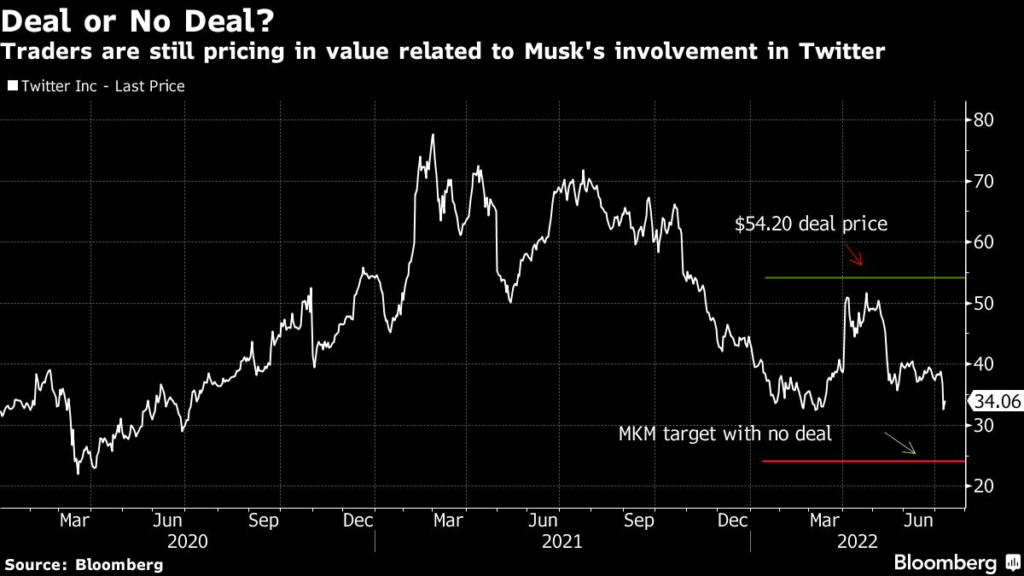
While Twitter plunged further below Musk’s $54.20 bid this week after the billionaire said he wants out of the deal, the shares are still pricing in the possibility that the two sides can agree on a transaction at a lower price. Analysts at MKM Partners said Monday the stock could fall as low as $24 if investors conclude the acquisition won’t happen at all. That would imply a further 30% drop from Tuesday’s $34.06 close.

“We still think that there would be a likely scenario for a decent settlement between the parties for the deal to complete,” said Jean-Francois Comte, managing partner at merger arbitrage firm Lutetia Capital. “The discount could range between 3% and 20%,” based on outcomes of similar situations in the past, said Comte, who holds a small position in Twitter.

One sign that some traders aren’t giving up: Even after Musk said he’s abandoning the $44 billion deal, prompting Twitter to sue him, shares are holding up better than peers in this year’s tech rout. Twitter is down 21%, compared with 51% for Facebook parent Meta Platforms Inc. and a whopping 70% for Snap Inc. 

Hindenburg Research said in a tweet Wednesday it has “accumulated a significant long position in shares of Twitter,” sending Twitter’s stock up as much as 7.2% in early trading. 

Many investors who specialize in merger arbitrage have long believed that Musk’s ultimate goal is to own Twitter, and that his maneuvering over the past few months has been aimed at getting a lower price. There are now various ways the drama could end, from a lightning-quick trial to a protracted court battle or a settlement with a lower price.

Twitter still “could be a good bet,” said Julian Klymochko, founder and chief executive officer of Accelerate Financial Technologies Inc., an investment firm which runs an arbitrage fund. There’s a 40% probability that the deal gets done at a discount and a 10% chance it closes at the original acquisition price, Klymochko said on Tuesday before Twitter filed its suit against Musk.

To be sure, some analysts are now taking the deal out of the equation entirely. “We are now valuing the business on standalone fundamentals,” Piper Sandler analyst Thomas Champion said, slashing his price target to $30 from $54.20. “The path to resolution looks nebulous.”

Even so, Musk’s latest move hasn’t prompted any downgrades, with the vast majority on Wall Street — 32 of the 37 analysts tracked by Bloomberg — rating the stock a hold.

“We maintain our neutral/high risk rating given the continued potential of a transaction,” Citi analyst Ronald Josey wrote in a note, while cutting his target to $36 from $54.20 “to be more in-line with peers.”

Tech Chart of the Day

Shares of Peloton Interactive Inc. have slumped 95% from their peak in January 2021, reducing its market value to $3 billion from $49 billion. The fitness equipment maker that rose in popularity during lockdowns is trying to turn its business around as demand drops sharply. The company announced plans on Tuesday to cease in-house manufacturing and rely solely on partners for production, marking one of the most dramatic steps yet to simplify its operations and reduce costs. Shares of Peloton were trading 3.5% lower on Wednesday. 

Top Tech Stories

  • Alphabet Inc.’s Google plans to slow hiring for the remainder of the year in the face of a potential economic recession, Chief Executive Officer Sundar Pichai said Tuesday in an email to staff.
  • Twitter Inc. sued Elon Musk over his abandoned $44 billion takeover bid, accusing the billionaire of having buyer’s remorse after his fortune declined. After Twitter filed its suit Tuesday, Musk tweeted, “Oh the irony lol.”
  • Amazon.com Inc.’s Prime Day sale is luring bargain hunters looking to stock up on pantry items and cheap electronics despite a dearth of deals.
  • Mubadala Investment Co. is in talks to acquire asset manager Fortress Investment Group from Japanese conglomerate SoftBank Group Corp., people with knowledge of the matter said.
  • China approved its third batch of new games this year, but Tencent Holdings Ltd. again failed to make the list, which traders watch to gauge Beijing’s intentions for the world’s largest mobile entertainment arena.
  • UK financial technology startup Zepz, parent of WorldRemit, has struggled with its accounts and turnover in its senior ranks prior to a potential initial public offering, according to people familiar with the matter.
  • Cybozu Inc., a Japanese provider of enterprise software, will pay out a special allowance to employees around the world to help them deal with sustained inflation.

(Adds Hindenburg Research’s position in company in fifth paragraph.)

More stories like this are available on bloomberg.com

©2022 Bloomberg L.P.
Rogers to Face Financial Hit After Canada Network Failure

(Bloomberg) — Cable and wireless firm Rogers Communications Inc. said it will give customers a credit worth five days of service as compensation for last week’s network failure, which knocked more than 10 million people offline and temporarily choked Canada’s payments system. 

The move is “a first step” to regain the trust of consumers, Rogers spokesperson Chloe Luciani-Girouard said in an emailed statement. “We have been listening to our customers and Canadians from across the country who have told us how significant the impacts of the outage were for them,” she said. 

Rogers shares were little changed at C$60.25 as of 9:49 a.m. in Toronto. 

The company didn’t disclose the financial cost. In the first quarter, Rogers earned C$2.75 billion ($2.1 billion) in service revenue from divisions that provide wireless, cable television and internet service — about C$31 million a day. 

BMO Capital Markets analyst Tim Casey estimated Sunday that the “unprecedented” network collapse, which began Friday morning and stretched into the weekend, would cost the company C$70 million in the third quarter. But that calculation was based on Rogers giving customers a refund for two days of service, not five. 

Industry Minister Francois-Philippe Champagne has called the network problem “unacceptable” and ordered telecommunications companies including Rogers, BCE Inc. and Telus Corp. to reach agreements on emergency roaming and mutual assistance during future outages. There will also be an investigation by Canada’s telecom regulator, the Canadian Radio-television and Telecommunications Commission. 


(Adds share price in third paragraph.)

More stories like this are available on bloomberg.com

©2022 Bloomberg L.P.

Close Bitnami banner
Bitnami