Bloomberg

Crypto Lender BlockFi Stops Accepting GBTC Shares as Collateral

(Bloomberg) — BlockFi Inc. unwound its positions in the Grayscale Bitcoin Trust as collateral and stopped accepting shares of the investment fund as collateral, according to a person with knowledge of the matter. The crypto lender will evaluate the use of Grayscale as collateral in the future.

The move shows how the collapse and subsequent liquidation of crypto hedge fund Three Arrows Capital continues to send shock waves throughout the industry.

BlockFi doesn’t hold any positions in GBTC and is winding down “a couple” of loans where GBTC makes up some of the collateral, the Jersey City, New Jersey-based lender said in a statement following publication of the Bloomberg story.

“We are not saying that we won’t support GBTC as collateral moving forward,” the company said. “Like any collateral, we constantly evaluate appropriate collateral haircut ratios and aim to accept as many types of collateral that our clients hold as possible.”

Grayscale Investments LLC declined to comment. 

Grayscale had exposure to the collapse of Three Arrows, which at one point owned more than 5% of the Grayscale Bitcoin Trust. BlockFi already suffered about $80 million in losses from Three Arrows’ bad debt, which BlockFi Chief Executive Officer Zac Prince said earlier were absorbed by the company and will be part of the disgraced hedge fund’s ongoing bankruptcy case. 

BlockFi reached an agreement at the end of June with FTX US that would give the crypto lender a $400 million revolving credit facility and the option for FTX US to acquire BlockFi for as much as $240 million. Unlike other crypto lenders like Celsius, Babel Finance and Voyager Digital, BlockFi has been able to maintain operations and has not had to suspend withdrawals. 

(Adds comment from BlockFi in the second paragraph.)

More stories like this are available on bloomberg.com

©2022 Bloomberg L.P.

NYC Monkeypox Vaccine Site Is Crashing From High Demand

(Bloomberg) — Less than 30 minutes after New York City released online appointments for the monkeypox vaccine, the site crashed due to high traffic. 

Shortly after the NYC Department of Health and Mental Hygiene opened its vaccine scheduling site on Tuesday at 1 p.m. local time, users online reported that the website had crashed and was inaccessible. By 1:29 p.m. local time, the NYC Health Department confirmed on Twitter that the site was down and it was working on a fix.

The city released 1,250 vaccination appointments online. By the afternoon, all the slots were fully booked, the department said. It will provide another 1,250 slots through direct referrals from providers for higher-risk New Yorkers, according to a press release. Another 620 doses will be directly distributed to people with a suspected or confirmed monkeypox diagnosis, identified by the Health Department through its contact tracing efforts. These shots are the remainder of the 6,000 doses of Bavarian Nordic A/S’s Jynneos vaccine allocated to New York last week.  A person is considered fully vaccinated against monkeypox after receiving two doses of Jynneos, spaced about four weeks apart.

New York City has 223 confirmed cases of monkeypox, a quarter of the 866 confirmed cases nationwide, according to data from the city’s health department as well as the US Centers for Disease Control and Prevention. However, health experts have warned the US is undercounting cases due to limited testing.

Later this week, the city is scheduled to receive another 14,500 doses from the US government. The shots are distributed  proportionally to states and jurisdictions based on case numbers. High-risk groups, such as men who have sex with men or members of the LGBTQ community, are still the CDC’s top priority for vaccination.    

(Updates with slots being fully booked in third paragraph.)

More stories like this are available on bloomberg.com

©2022 Bloomberg L.P.

IMF Cuts Month-Old Forecast for US GDP, Citing Inflation Risks

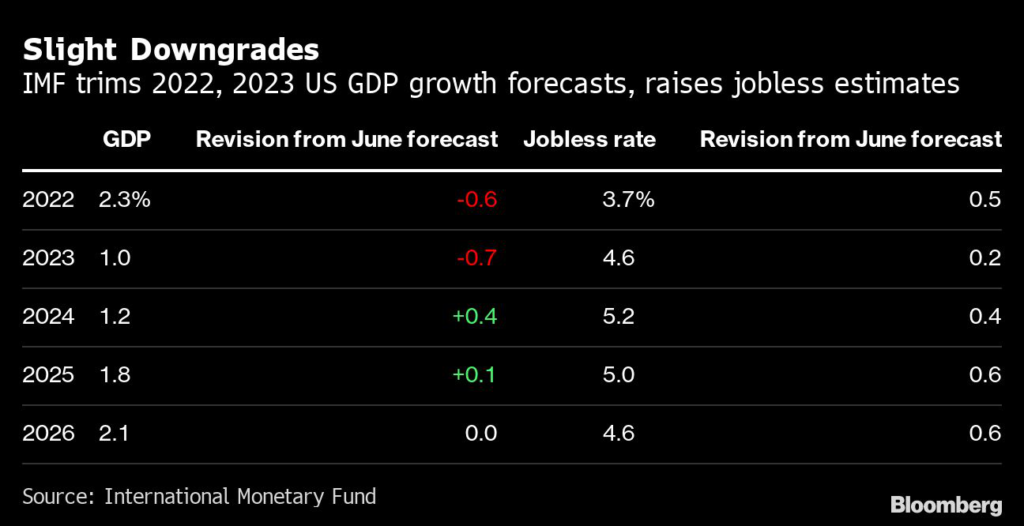
(Bloomberg) — The International Monetary Fund cut its growth projections for the US economy this year and next, and raised its unemployment-rate estimates through 2025, warning that a broad-based surge in inflation poses “systemic risks” to both the country and the global economy.

Gross domestic product in the world’s biggest economy will expand 2.3% this year, the executive board of the Washington-based lender said in its so-called Article IV consultation released Tuesday. That’s less than the 2.9% it projected last month, when its staff concluded a visit for the report. 

The IMF now also sees the jobless rate at 3.7% this year, compared with staff’s earlier 3.2% forecast, and expects the figure to exceed 5% in both 2024 and 2025. 

The IMF didn’t provide any reason for the reduction in its US growth forecast from last month. But its new prediction comes in the wake of the June 30 release of Commerce Department data which showed that inflation-adjusted consumer spending fell in May for the first time this year and which also revised prior months’ expenditures lower.

The Federal Reserve has pivoted aggressively to fight the hottest inflation in 40 years amid criticism it left monetary policy too easy for too long as the economy recovered from Covid-19. 

Policy makers raised interest rates by 75 basis points last month — the single-biggest move since 1994 — and a majority of Fed officials have signaled that another increase of the same magnitude is on the table for July.  

US GDP contracted in the first quarter and trackers of economic activity, such as the popular Atlanta Fed indicator GDPNow, suggest it will do so again in the second quarter when data are release on July 28.

The US’s “policy priority must be to expeditiously slow price growth without precipitating a recession,” the IMF’s executive directors said. Avoiding a recession in the US “is becoming increasingly challenging,” with the Russian invasion of Ukraine, the lingering Covid-19 pandemic and supply-side constraints create additional difficulties, they said.  

Directors recognized that calibrating the response to inflation comes with high stakes and that misjudging the policy mix — in either direction — will result in sizable costs at home and negative spillovers to the global economy, according to the statement.

Article IV consultations are the IMF’s assessment of countries’ economic and financial developments following meetings with lawmakers and public officials. 

(Updates with Commerce Department consumer-spending data in fourth paragraph.)

More stories like this are available on bloomberg.com

©2022 Bloomberg L.P.

IBM’s Red Hat Taps Product and Technology Chief as New Leader

(Bloomberg) — IBM’s Red Hat named Matt Hicks, head of products and technologies, as its new leader, solidifying a bet that hybrid-cloud offerings will fuel the company’s growth.

Hicks takes over as the software unit’s chief executive officer and president from Paul Cormier, who will serve as chairman. “Paul and I have planned this for a while,” Hicks said Tuesday in an interview. “There’ll be a lot of similarities in what I did yesterday and what I’ll be doing tomorrow.”

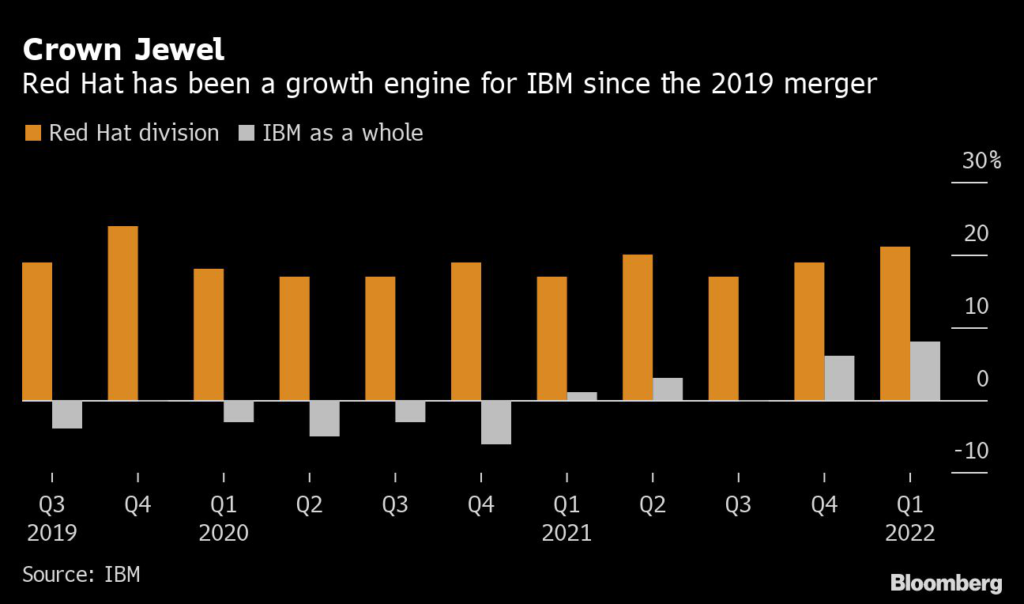
International Business Machine Corp. acquired Red Hat for about $34 billion in 2019 as a central component of Chief Executive Arvind Krishna’s plan to steer the century-old company into the fast-growing cloud-computing market. As a division, Red Hat’s has seen steady revenue growth near 20%, far outpacing IBM as a whole.

IBM hopes to distinguish itself in the crowded cloud market by targeting a hybrid model, which helps clients store and analyze information across their own data centers, private cloud services and servers run by major public providers such as Amazon.com Inc. and Microsoft Corp. IBM has been a rare pocket of stability in the recent stock market meltdown. The shares have gained 4.1% this year, closing at $139.18 Tuesday in New York, compared with a 28% decline for the tech-heavy Nasdaq 100. 

“Together, we can really lead a a new era of hybrid computing,” said Hicks, who joined Red Hat in 2006. “Red Hat has the technology expertise and open source model — IBM has the reach.”

Hicks said demand for hybrid cloud and software services should remain strong despite questions about the global economic outlook, touting recent deals with General Motors Co. and ABB Ltd. The telecommunication and automotive industries are two areas he is targeting for expansion because they require geographically distributed data.

More stories like this are available on bloomberg.com

©2022 Bloomberg L.P.

Stocks Swoon as Treasuries Sound Recession Alarm: Markets Wrap

(Bloomberg) — Stocks dropped before Wednesday’s inflation report, with the Treasury curve inversion deepening to levels last seen in 2007 amid fears that aggressive rate hikes will sink the economy into a recession.

The S&P 500 slid into the close as megacap tech sold off and energy shares joined a plunge in oil. The yield on the 10-year US note dropped as much as 12 basis points below the two-year rate. So-called inversions of the curve are a potential harbinger of an economic contraction.

Read: US Statistics Agency Says Inflation Report on Internet Is Fake

Economists say inflation continued to heat up in June, hitting a pandemic peak that will keep the Federal Reserve geared for another big hike. The consumer price index probably rose 8.8% from a year earlier, the largest jump since 1981, according to the median forecast in a Bloomberg survey.

“The market is showing nervousness as to what this is going to look like,” said Patrick Kaser, portfolio manager at Brandywine Global. “There’s been talk about commodity prices coming down, but we’re not really seeing that flow through yet. We’re still expecting this number to come in pretty high.”

Traders also kept a close eye on the dollar, which fluctuated after hitting the highest since the Covid-19 panic of March 2020. For now, a wall of derivatives bets is keeping the euro from reaching parity with the greenback.

The impacts of the US currency surge will also be highly scrutinized during the earnings season. PepsiCo Inc., one of the first major industry players to report second-quarter results, said demand remained robust despite inflation — but highlighted foreign-exchange translation headwinds.

“In the current environment, dollar strength is a sign of investors’ worries about a global recession since it signals a flight to the relative safety of the world’s reserve currency,” wrote Nicholas Colas, co-founder of DataTrek Research. “Until the dollar starts to weaken, it is difficult to believe the lows are in for US equities in 2022.”

In other corporate news, American Airlines Group Inc. rallied as the carrier stuck with its expectation for a jump in second-quarter sales, highlighting the strength of travel demand. Amazon.com Inc.’s Prime Day sale is luring bargain hunters looking to stock up on pantry items and cheap electronics despite a dearth of deals.

Trading revenue at the five biggest Wall Street banks likely climbed 16% to $27.8 billion in the second quarter, according to analyst estimates compiled by Bloomberg. That surge would come as a result of market swings spurred by recession fears, soaring inflation and global turmoil.

Sam Zell, the billionaire made famous by his real-estate deals, said that central bank actions to flood the market with money in recent years are coming back to bite the economy. He urged Fed Chair Jerome Powell to raise rates by as much as 75 basis points and “break the inflation mentality.”

“The Fed and other central banks are still very focused on bringing back actual inflation, but every other indicator we have of inflation is showing that this should not be our primary concern anymore, and we should be more concerned about slowing growth,” said Brian Nick, chief investment strategist at Nuveen.

Read: Bitcoin Drops for a Fourth Day, Falling Back Below $20,000 Level

What to watch this week:

  • Earnings due from JPMorgan, Morgan Stanley, Citigroup, Wells Fargo
  • New Zealand rate decision, Wednesday
  • US CPI data, Wednesday
  • Federal Reserve Beige Book, Wednesday
  • US PPI, jobless claims, Thursday
  • China GDP, Friday
  • US business inventories, industrial production, University of Michigan consumer sentiment, Empire manufacturing, retail sales, Friday
  • G-20 finance ministers, central bankers meet in Bali, from Friday
  • Atlanta Fed President Raphael Bostic speaks, Friday

Will the eurozone avoid a recession or a debt crisis? How will the euro and stocks perform in the next six months? Share your views and participate in the latest MLIV Pulse survey. It only takes a minute, so please click here anonymously.

Some of the main moves in markets:

Stocks

  • The S&P 500 fell 0.9% as of 4 p.m. New York time
  • The Nasdaq 100 fell 1%
  • The Dow Jones Industrial Average fell 0.6%
  • The MSCI World index fell 0.8%

Currencies

  • The Bloomberg Dollar Spot Index was little changed
  • The euro was little changed at $1.0041
  • The British pound was little changed at $1.1894
  • The Japanese yen rose 0.5% to 136.80 per dollar

Bonds

  • The yield on 10-year Treasuries declined three basis points to 2.96%
  • Germany’s 10-year yield declined 11 basis points to 1.13%
  • Britain’s 10-year yield declined 10 basis points to 2.07%

Commodities

  • West Texas Intermediate crude fell 8% to $95.80 a barrel
  • Gold futures fell 0.4% to $1,724 an ounce

More stories like this are available on bloomberg.com

©2022 Bloomberg L.P.

June Inflation Report Online Is a Fake, Bureau of Labor Statistics Says

(Bloomberg) — The US Bureau of Labor Statistics said Tuesday that a release circulating online purporting to show hotly-anticipated June inflation figures was a forgery. 

“We are aware of a fake version of the June 2022 Consumer Price Index news release that is being circulated online,” BLS spokesperson Cody Parkinson said in an emailed statement.

The Labor Department agency is scheduled to release the June CPI report on Wednesday at 8:30 a.m. in Washington, Parkinson said.

Stocks slumped to session lows around the time the fake release started making the rounds on social media.

The release that circulated online Tuesday attempted to mimic the formatting of the prior month’s CPI report but with different dates and numbers. It included several indications that it was a forgery, including a chart whose numbers failed to match the text.

(Adds stocks move in fourth paragraph.)

More stories like this are available on bloomberg.com

©2022 Bloomberg L.P.

Bitcoin Drops for a Fourth Day, Falling Back Below $20,000 Level

(Bloomberg) — Bitcoin fell back below $20,000 on Tuesday after enjoying its strongest run in more than three months last week, as risk aversion returned to global markets. 

The largest cryptocurrency dropped as much as 5.6% to $19,275, declining for a fourth straight session. It reached $22,472 on Friday amid a broader rally. Second-largest Ether tumbled more than 9% to $1,032. The MVIS CryptoCompare Digital Assets 100 index dropped 5.1%, and traded near session lows.

“I’m not surprised to see prices going down with commodity prices and the overall sense of weakening growth — money being tighter and there’s less money to slosh into crypto,” Brian Nick, chief investment strategist at Nuveen, said in an interview. “That’s not a shock. There’s a lot of volatility.” 

US stocks slumped ahead of a key inflation report, with the Treasury curve inversion deepening to levels last seen in 2007 amid fears that rate hikes will sink the economy into a recession.

Bitcoin has been trading range-bound since its steep drop in June, hovering just around $19,500, its 2017 peak. If the coin breaks below this level, $16,000 to $17,000 may act as the next level of support, the range Bitcoin saw as resistance during the relief rally in early 2018. Or it could move toward $14,000, the coin’s peak in 2019, according to Arcane Research.

If, however, Bitcoin breaks higher, $28,000 may serve as the nearest resistance area, which is the coin’s bottom in 2021, Arcane added.

Still, many investors watching the space aren’t feeling so bullish. Bitcoin is more likely to tumble to $10,000, cutting its value roughly in half, than it is to rally back to $30,000, according to 60% of the 950 investors who responded to a Bloomberg MLIV Pulse survey that ran July 5-8. Forty percent saw it going the other way.

Meanwhile, there’s a sense of hodling — or holding onto investments even during tough times — among the crypto faithful. On-chain data suggests that such investors have been undeterred by recent market dynamics, according to Strahinja Savic at FRNT Financial. The percentage of Bitcoin that hasn’t moved for more than a year reached an all-time high of 66% in June, and has remained steady at around 65% now. 

“The ‘hodl’ mantra has been an important part of Bitcoin culture, and the data suggests that this dedication to the asset has remained intact, despite the asset being,” roughly 70% below its peak, he said. 

(Updates with fresh commentary and prices throughout.)

More stories like this are available on bloomberg.com

©2022 Bloomberg L.P.

Stocks See Late-Day Swoon Before Crucial CPI Data: Markets Wrap

(Bloomberg) — Stocks slumped ahead of a key inflation report, with the Treasury curve inversion deepening to levels last seen in 2007 amid fears that rate hikes will sink the economy into a recession.

The S&P 500 traded near session lows as megacap tech sold off again and energy shares joined a plunge in oil. The yield on the 10-year US note dropped as much as 12 basis points below the two-year rate. So-called inversions of the curve are a potential harbinger of an economic contraction.

Read: Biggest Stock Sell Program in a Week Hits Ahead of Equity Close

Economists say inflation continued to heat up in June, hitting a pandemic peak that will keep the Federal Reserve geared for another big hike. The consumer price index due Wednesday probably rose 8.8% from a year earlier, marking the largest jump since 1981, according to the median forecast in a Bloomberg survey.

“The market is showing nervousness as to what this is going to look like,” said Patrick Kaser, portfolio manager at Brandywine Global. “There’s been talk about commodity prices coming down, but we’re not really seeing that flow through yet. We’re still expecting this number to come in pretty high.”

Traders also kept a close eye on the dollar, which fluctuated after hitting the highest since the Covid-19 panic of March 2020. For now, a wall of derivatives bets is keeping the euro from reaching parity with the greenback for the first time in two decades.

The impacts of the US currency surge will also be highly scrutinized during the earnings season. PepsiCo Inc., one of the first major industry players to report second-quarter results, said demand remained robust despite inflation — but highlighted foreign-exchange translation headwinds.

“In the current environment, dollar strength is a sign of investors’ worries about a global recession since it signals a flight to the relative safety of the world’s reserve currency,” wrote Nicholas Colas, co-founder of DataTrek Research. “Until the dollar starts to weaken, it is difficult to believe the lows are in for US equities in 2022.”

In other corporate news, American Airlines Group Inc. surged as the carrier stuck with its expectation for a jump in second-quarter sales, highlighting the strength of travel demand. Amazon.com Inc.’s Prime Day sale is luring bargain hunters looking to stock up on pantry items and cheap electronics despite a dearth of deals.

Trading revenue at the five biggest Wall Street banks likely climbed 16% to $27.8 billion in the second quarter, according to analyst estimates compiled by Bloomberg. That surge would come as a result of market swings spurred by recession fears, soaring inflation and global turmoil.

Sam Zell, the billionaire made famous by his real-estate deals, said that central bank actions to flood the market with money in recent years are coming back to bite the economy. He urged Fed Chair Jerome Powell to raise rates by as much as 75 basis points and “break the inflation mentality.”

“The Fed and other central banks are still very focused on bringing back actual inflation, but every other indicator we have of inflation is showing that this should not be our primary concern anymore, and we should be more concerned about slowing growth,” said Brian Nick, chief investment strategist at Nuveen.

Elsewhere, Bitcoin fell back below $20,000, following last week’s rally.

What to watch this week:

  • Earnings due from JPMorgan, Morgan Stanley, Citigroup, Wells Fargo
  • New Zealand rate decision, Wednesday
  • US CPI data, Wednesday
  • Federal Reserve Beige Book, Wednesday
  • US PPI, jobless claims, Thursday
  • China GDP, Friday
  • US business inventories, industrial production, University of Michigan consumer sentiment, Empire manufacturing, retail sales, Friday
  • G-20 finance ministers, central bankers meet in Bali, from Friday
  • Atlanta Fed President Raphael Bostic speaks, Friday

Will the eurozone avoid a recession or a debt crisis? How will the euro and stocks perform in the next six months? Share your views and participate in the latest MLIV Pulse survey. It only takes a minute, so please click here anonymously.

Some of the main moves in markets:

Stocks

  • The S&P 500 fell 1% as of 3:28 p.m. New York time
  • The Nasdaq 100 fell 1.1%
  • The Dow Jones Industrial Average fell 0.6%
  • The MSCI World index fell 0.8%

Currencies

  • The Bloomberg Dollar Spot Index was little changed
  • The euro was little changed at $1.0043
  • The British pound was little changed at $1.1888
  • The Japanese yen rose 0.5% to 136.80 per dollar

Bonds

  • The yield on 10-year Treasuries declined four basis points to 2.95%
  • Germany’s 10-year yield declined 11 basis points to 1.13%
  • Britain’s 10-year yield declined 10 basis points to 2.07%

Commodities

  • West Texas Intermediate crude fell 8.2% to $95.60 a barrel
  • Gold futures fell 0.4% to $1,724 an ounce

More stories like this are available on bloomberg.com

©2022 Bloomberg L.P.

‘Succession,’ ‘White Lotus’ Push HBO Past Netflix in Emmy Nods

(Bloomberg) — HBO, the premium TV unit of the newly formed Warner Bros. Discovery Inc., led all TV networks in nominations for Emmy Awards this year thanks to “Succession,” the most nominated show of all. 

The dark satire about a billionaire family in control of a US media dynasty earned 25 nominations and will compete for best drama series against two series from Netflix Inc., “Stranger Things” and “Squid Game,” the first South Korean program up for the prize. HBO received 140 nominations in all.

Netflix surpassed HBO in Emmy nominations a couple of years ago, a sign of its ascendance in Hollywood. But it has ceded share to HBO two years in a row, and its nomination count has slipped by 55 in that stretch as the company faced more competition from services such as Apple Inc. and Walt Disney Co.’s Hulu. 

The streaming industry leader has also stirred up its share of controversy. Social media erupted Tuesday after “The Closer,” a comedy special from Dave Chappelle that was criticized for its jokes about transgender people, scored two nominations, including best pre-recorded variety special.

The Emmys, given out every year by the Television Academy, are the TV industry’s highest honors. This year’s awards, the 74th, will be broadcast live on Sept. 12 on NBC and streamed for the first time on Peacock. Both are owned by Comcast Corp. 

The Emmys have never been as popular with viewers as the Academy Awards, which honor the best movies of the year. But their importance in Hollywood has grown in recent years as the perception of quality on TV has risen and the competition between cable networks and streaming services has escalated.

“We are breaking records with the number of submissions received by the academy this year,” TV Academy Chairman Frank Scherma said Tuesday. “Production is at an all-time high, and the quality of shows we’re watching is also at an all-time high.”

Awards Campaigns

Netflix in particular has increased the amount of money spent in pursuit of awards. But the company’s subscriber loss earlier this year prompted a rout in the shares of entertainment stocks, and has forced many companies to reassess how much they spend on programming.

Streaming and premium cable outlets have long led the awards, thanks to their ability to tell edgier stories that appeal to members of the academy and everyday viewers. “Abbott Elementary,” which debuted on Disney’s ABC, was the only show on broadcast TV to earn a nomination for best comedy series, a category once dominated by sitcoms. It will compete against seven other shows, including HBO’s “Barry,” Hulu’s “Only Murders in the Building” and Apple’s “Ted Lasso.”

“Ted Lasso” took home best comedy award last year, giving Apple the chance for a repeat win. The company earned 51 nominations in all, including 20 for “Ted Lasso” and 14 for “Severance.” 

Hulu also increased its share of nominations, thanks to “Only Murders in the Building,” a comedy featuring Steve Martin and Martin Short, and “The Dropout,” a limited series about disgraced entrepreneur Elizabeth Holmes. “The Dropout” faces stiff competition from HBO’s “White Lotus.”

HBO’s Lead 

HBO released four of the six most-nominated shows, including “Euphoria” and “Hacks.” The stars of those programs, Zendaya and Jean Smart, are up for best actress in their respective categories.

Netflix’s nominations are spread across a large group of shows. “Squid Game,” “Stranger Things” and “Ozark” were the only programs to earn more than 10.

Like the Oscars, the Emmys have struggled to deliver awards to people of color. While the category of lead actress in a comedy features two Black nominees, other categories, such as lead actress in a limited series, were entirely White.

(Updates with Dave Chappelle controversy in fourth paragraph.)

More stories like this are available on bloomberg.com

©2022 Bloomberg L.P.

Bank of America Starts Sounding Out Investors on Citrix Buyout Debt

(Bloomberg) — Bank of America Corp. is reaching out to investors to gauge their interest in part of the $15 billion in debt for the buyout of Citrix Systems Inc., the first step in a multi-week effort to offload the financing.

The bank, leading the syndicate for a $7.05 billion leveraged loan for Citrix, has indicated that pre-marketing for the deal could start next week, potentially leading to an official launch as soon as the following week, according to people with knowledge of the matter.

Bank of America had informal conversations with large investors that would typically put in orders for $250 million or more, according to one of the people, who asked not to be identified when discussing a private transaction. Talks with investors thus far are considered preliminary and subject to change, the people said.

Vista Equity Partners and Elliott Investment Management agreed to take Citrix private in January for $16.5 billion and to combine it with Tibco Software, a company that is already in Vista’s portfolio. Citrix said on Monday that Tom Krause, who stepped down as president of Broadcom Inc.’s software group, will become chief executive officer of the company being formed via its merger with Tibco.

The investment discussions have included few details on how much of the debt will be available for general syndication and at what price, the people said. The financing is seen as one of the most challenging for banks to pass on to investors in the current risk-off environment, potentially costing banks hundreds of millions of dollars in losses.

Read more: Wall Street Faces Billion-Dollar Losses on Sinking Buyout Debt

A representative for Bank of America didn’t immediately respond to a request to comment.

The original financing agreement also includes a $4 billion secured bridge loan and a $3.95 billion unsecured bridge loan, both of which are expected to be replaced by high-yield bonds. 

More stories like this are available on bloomberg.com

©2022 Bloomberg L.P.
Close Bitnami banner
Bitnami