Bloomberg

Bitcoin Miners Shut as Texas Power Grid Nears Brink

(Bloomberg) — Nearly all industrial scale Bitcoin miners in Texas have shut off their machines as the companies brace for a heat wave that is expected to push the state’s power grid near its breaking point. 

Miners such as Riot Blockchain Inc., Argo Blockchain Plc and Core Scientific Inc., who operate millions of energy-intensive computers to secure the Bitcoin blockchain network and earn rewards in the token, flocked to the Lone Star State thanks to its low energy costs and liberal regulations on crypto mining. The state has become one of the largest crypto-mining hubs by computing power in the world. 

“There are over 1,000 megawatts worth of Bitcoin mining load that responded to ERCOTs conservation request by turning off their machines to conserve energy for the grid.” Lee Bratcher, president of Texas Blockchain Council told Bloomberg in an email response. “This represents nearly all industrial scale Bitcoin mining load in Texas and allows for over 1% of total grid capacity to be pushed back onto the grid for retail and commercial use.” 

Miners may see a drop in profitability as the heat wave keeps their machines off by sending energy prices soaring and further stressing the state’s power grid. The miners are already struggling to repay debt and raise additional capital with Bitcoin prices in sharp decline. Shares of public miners have tumbled about 75% this year. 

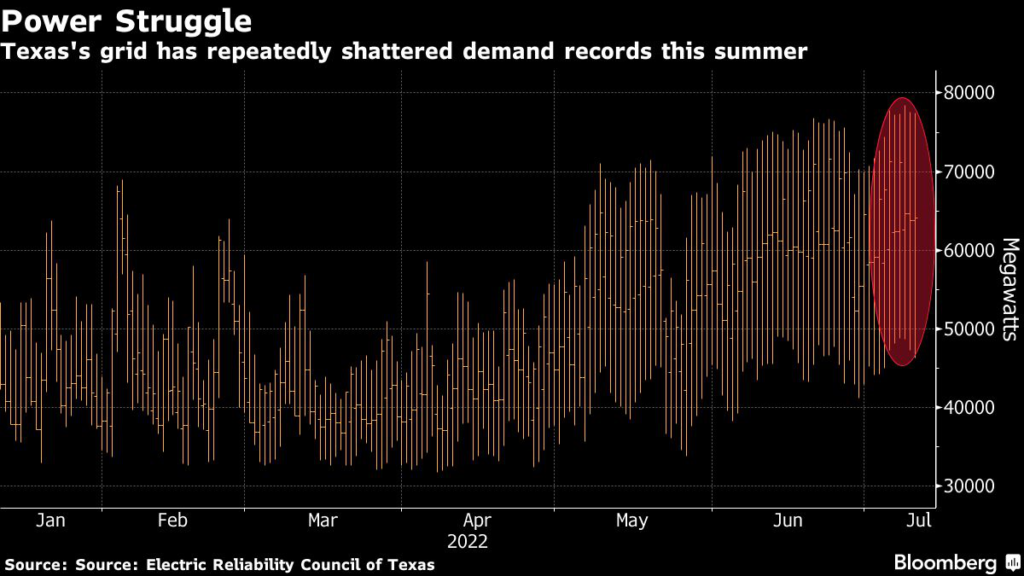
The all-time peak record for energy usage was set Friday with 78,206 megawatts, breaking the previous unofficial all-time peak of 77,460 megawatts that occurred on July 5, according to data from the state’s power operator Electric Reliability Council of Texas. The operator has been working with Bitcoin miners, who are required to turn off their mining machines when the state faces energy shortages. 

While Texas is likely to face more energy shortages in the future, ERCOT expects crypto miners to increase electricity demand by up to six gigawatts by mid-2023, more than enough to power every home in Houston.   

“Currently, 100% of the machines located in Texas have been powered off to provide support for the ERCOT grid,” Core Scientific CEO Mike Levitt said. “In troubled situations including the current Texas heat event, we have been curtailing power and will continue to curtail power as needed.” The company operates in six states, with less than 15% of its production located in Texas, he said.

Riot is participating in ERCOT’s Four Coincident Peak program, in which the company’s Whinstone Facility located in Rockdale, Texas, will curtail energy consumption when called on during the four summer months of peak energy demand, the miner said in an email to Bloomberg. 

(Corrects the name of the trade organization in the third paragraph. The story originally ran Monday.)

More stories like this are available on bloomberg.com

©2022 Bloomberg L.P.

Futures Drop, Bonds Surge; Euro Flirts With Parity: Markets Wrap

(Bloomberg) — US equity futures fell Tuesday as the dollar and sovereign bonds rose, a pattern highlighting pervasive unease about the economic outlook amid high inflation and China’s struggles with Covid.

The S&P 500 and Nasdaq 100 shed about 0.5% each after a Wall Street slide Monday, as traders brace for the second-quarter earnings season which may provide clues on how companies are weathering inflation and recession concerns. PepsiCo Inc., one of the first major industry players to report, rose in premarket trading after lifting its revenue forecast. The soft-drinks maker said demand remained robust despite inflation, though it expected headwinds from the strong dollar.

The dollar pushed toward levels last seen at the height of the 2020 market panic over Covid and the yen strengthened, underlining investor caution. The euro-area’s common currency, meanwhile, came within a whisker of parity with the greenback, sapped by the region’s energy crisis and acute recession fears.

Treasuries extended gains, taking the US 10-year yield to 2.92%. Bonds also rallied in Europe. German bonds surged, sending the benchmark 10-year yield to the lowest since May, after data showed investor confidence plunged to a 2011 low.

Much is riding on upcoming company profit filings and this week’s US inflation data. A brief equity rebound from this year’s rout is already fizzling ahead of the reports. Risk appetite may struggle to digest a darkening earnings outlook alongside stubborn price pressures that point to more monetary tightening.  

Dollar strength will not only “affect this quarter’s earnings, but more likely it’s going to affect the revenue generation outlook for the next couple of quarters and that, I think, is a big problem,” Kimberly Forrest, founder and chief investment officer of Bokeh Capital Partners, said on Bloomberg Radio.

The Stoxx Europe 600 gauge slipped for a second day, though it pared the decline with utilities outperforming as EDF jumped after a report that the French government will pay a premium to take control of the electricity company. An Asian share index headed for its biggest two-day drop in a month. 

Commodities including oil and iron ore were under pressure. Bitcoin dropped below $20,000.

In China, investors are concerned more Covid lockdowns may lie ahead as Beijing continues with a strategy of mass testing and mobility curbs. A government push for stimulus to shore up growth is starting to have an impact: credit jumped last month to the highest on record for June.

Meanwhile, the latest Fed commentary highlighted both the central bank’s hawkishness and the risks that come with aggressive interest-rate hikes.

Fed Bank of Atlanta President Raphael Bostic said the US economy can cope with higher interest rates and repeated his support for another jumbo move this month. Fed Bank of Kansas City President Esther George, who dissented last month against the central bank’s 75 basis-point rate increase, cautioned that rushing to tighten policy could backfire.

Will the eurozone avoid a recession or a debt crisis? How will the euro and stocks perform in the next six months? Share your views and participate in the latest MLIV Pulse survey. It only takes a minute, so please click here anonymously.

What to watch this week:

  • Earnings due from JPMorgan, Morgan Stanley, Citigroup, Wells Fargo
  • Amazon.com Inc. kicks off its Prime Day event, Tuesday
  • South Korea, New Zealand rate decisions, Wednesday
  • US CPI data, Wednesday
  • Federal Reserve Beige Book, Wednesday
  • US PPI, jobless claims, Thursday
  • China GDP, Friday
  • US business inventories, industrial production, University of Michigan consumer sentiment, Empire manufacturing, retail sales, Friday
  • G-20 finance ministers, central bankers meet in Bali, from Friday
  • Atlanta Fed President Raphael Bostic speaks, Friday

Some of the main moves in markets:

Stocks

  • Futures on the S&P 500 fell 0.6% as of 6:34 a.m. New York time
  • Futures on the Nasdaq 100 fell 0.5%
  • Futures on the Dow Jones Industrial Average fell 0.7%
  • The Stoxx Europe 600 fell 0.3%
  • The MSCI World index fell 0.4%

Currencies

  • The Bloomberg Dollar Spot Index rose 0.3%
  • The euro fell 0.3% to $1.0008
  • The British pound fell 0.5% to $1.1836
  • The Japanese yen rose 0.3% to 136.96 per dollar

Bonds

  • The yield on 10-year Treasuries declined seven basis points to 2.92%
  • Germany’s 10-year yield declined 12 basis points to 1.13%
  • Britain’s 10-year yield declined 14 basis points to 2.04%

Commodities

  • West Texas Intermediate crude fell 2.5% to $101.50 a barrel
  • Gold futures were little changed


More stories like this are available on bloomberg.com

©2022 Bloomberg L.P.

Carlyle to Sell Unison Software to Buyout Firm Madison Dearborn

(Bloomberg) — Madison Dearborn Partners is acquiring a majority stake in software company Unison Software Inc. from fellow private equity firm Carlyle Group Inc. 

Carlyle is keeping a minority stake, according to a statement. The transaction values Unison at more than $1 billion, including debt, people familiar with the matter said, who asked to not be identified because the terms are private.

Representatives for Madison Dearborn and Carlyle declined to comment on the terms.

Valuations may have come down in public technology companies, but the decline hasn’t fully hit the steadier market for private tech buyouts.

Carlyle partner Steve Bailey said in an interview that because of the technology company valuation correction in both the private and public markets, there are fewer transactions compared with the record pace seen last year. “But the deals for A+ quality assets are still getting done and at strong valuations,” he said.

Dulles, Virginia-based Unison supports government agencies and contractors, serving all 15 US cabinet-level agencies and more than 200,000 users, according to the statement. 

“Unison sits right at the intersection of our team’s core focus areas, and we look forward to applying our extensive expertise to help drive Unison forward in the service of the US federal government and its key contractors,” Matt Norton, managing director and head of the business and government software and services team at Madison Dearborn, said in the statement. 

It’s the second time Carlyle has sold the company, which was founded in 1983. It first invested in the company in 2005 and sold it five years later to JMI Management Inc.

Financing for the deal is being provided by Antares Capital. The deal is slated to close in the third quarter. 

Robert W. Baird & Co. is advising Unison and Carlyle on the deal while Lincoln International is advising Madison Dearborn. 

More stories like this are available on bloomberg.com

©2022 Bloomberg L.P.

Temasek Turns Cautious on Outlook, Sees More Market Declines

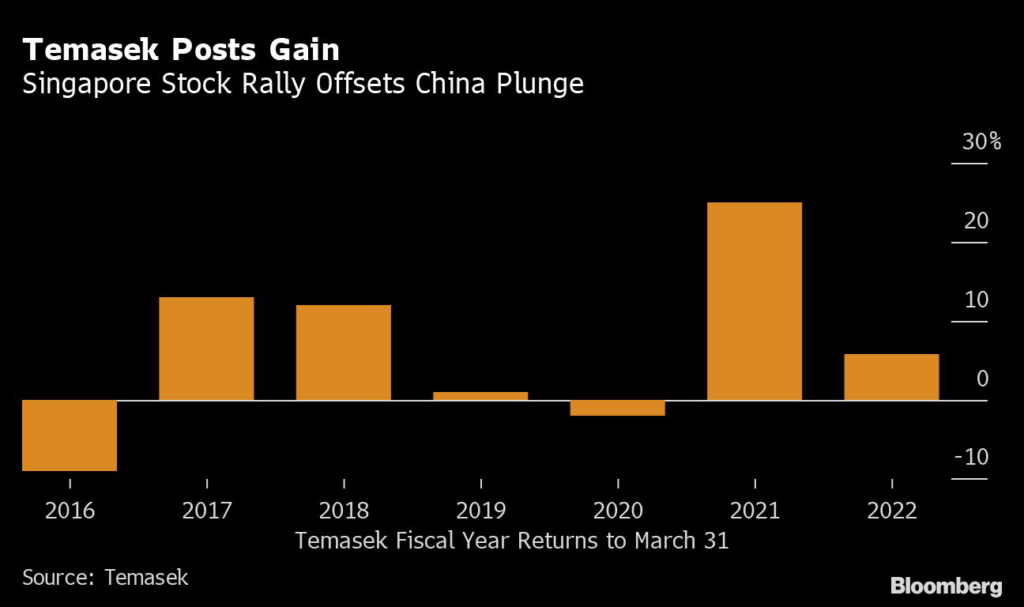
(Bloomberg) — Singapore’s state-owned investor Temasek Holdings Pte said it’s adopting a cautious outlook and sees more market declines after posting a 5.8% return for the fiscal year as gains in domestic stocks offset widespread declines in China.

The $287 billion firm said it will slow the pace of investments given the likelihood of a recession in developed markets. Temasek said the risk of a mild recession in the US into 2023 has risen due to tighter financial conditions and geopolitical uncertainty. China meanwhile faces “challenges” meeting its 2022 growth target of 5.5%.

“The global economy is in a fragile state,” Temasek said in a statement Tuesday. “Rising inflation, surging commodity prices and severe supply chain bottlenecks have uncovered further fault lines in the global marketplace.”

Temasek expects to see continued asset declines this year and possibly into 2023, with the bear market only turning around when the US Federal Reserve indicates it will stop tightening, said Chief Investment Officer Rohit Sipahimalani. 

“Given the Fed’s current stance, we don’t see that happening quickly,” Sipahimalani told reporters.

The U.S. and Europe could see more downside as corporate profit growth slows with rates moving higher, he added in an interview with Bloomberg Television after the release of the annual report.

“The market declines we’ve seen so far have been primarily explained by the rise in rates and I think the next leg down is really downside earnings and earnings downgrades, which we expect to see over the course of this year,” Sipahimalani said.

Temasek’s portfolio rose to S$403 billion ($287 billion) for the year ended March 31, up from S$381 billion a year earlier. The gain is down from 25% the previous year, and brings its 10-year annualized return to 7%. While global markets from New York to Sydney have suffered in 2022, much of the damage took place after Temasek’s fiscal year ended.

The company has increasingly relied on unlisted businesses to bolster returns as public markets decline. These private firms now account for 52% of assets, up from 45% the previous year. The value of these holdings, which include port services company PSA International Pte, Pavilion Energy Pte, and Singapore Power Ltd., has soared four-fold over the last decade to S$210 billion, posting annualized returns of more than 10%.

Publicly listed companies in Singapore also bolstered Temasek’s results. Singapore Telecommunications Ltd. gained 11% for the period including dividends, while DBS Group Holdings Ltd., the country’s biggest bank, returned 29%. 

Temasek has been playing a more active role in its domestic portfolio, providing financial backing for key fundraisings and acquisitions. Those include agreeing to use a wholly-owned subsidiary to facilitate the sale of Keppel Offshore & Marine Ltd. rigs, and providing crucial support to Singapore Airlines Ltd. and Sembcorp Marine Ltd. as they raised funds.

Temasek’s continued growth comes at a critical time for Singapore, which is attempting to shake off the economic effects of the pandemic and is heavily reliant on money from state-owned investors to fund the national budget. Those contributions are among the biggest sources of revenue for the tiny city state.

The domestic investments offset declines in China, where the main stock gauge slumped 16% for the period. Temasek’s stock holdings have included Industrial & Commercial Bank of China Ltd. and Alibaba Group Holding Ltd., which plunged about 50% for the year.

China became Temasek’s biggest source of investments during the 2020 fiscal year, with big bets on the country’s technology giants from Alibaba to ride-hailing service Didi Global Inc. -– many of which have since soured thanks to regulatory crackdowns and economic damage from the pandemic. China now ranks behind Singapore, accounting for 22% of Temasek’s portfolio, from 27% the previous year.

China remains an “important” market, and Temasek was a net investor in the country over the year, said Sipahimalani. He added the reduced China exposure was entirely due to the drop in markets.

“While the second quarter was very bad, that was probably the worst and we probably have upside from here in terms of growth,” he said in the television interview. “Having said that, if there’s a recession in the U.S. and Europe, that would be a strong headwind for China too.”

Temasek sold out of several Chinese technology companies during the year including search giant Baidu Inc. and New Oriental Education and Technology Group Inc. But the firm has remained publicly bullish on the country, predicting as recently as May that China’s growth would revive in the second half of this year. The firm is seeking opportunities in artificial intelligence and deep tech in China.

Sipahimalani sees also potential in blockchain infrastructure, even as prices for cryptocurrencies plunge. Temasek has backed, either directly or via subsidiaries, a range of crypto and blockchain technology businesses like ConsenSys Inc., Binance Asia and Amber Group.

“We’d be less focused on cryptocurrency and more focused on the underlying blockchain technology and its applications,” he said in the interview. “We don’t think blockchain-linked applications is going to go away.”

(Updates with comments from television interview from sixth paragraph)

More stories like this are available on bloomberg.com

©2022 Bloomberg L.P.

Gazprom’s Shunned Nord Stream 2 Wins Spat Over EU Pipeline Rules

(Bloomberg) — Russia’s shunned Nord Stream 2 gas pipeline won a legal boost in its pre-war challenge against European Union rules that subjected all new and existing pipelines involving foreign suppliers to the EU’s energy market-opening requirements, after the bloc’s top court said its appeal can be heard. 

While the ruling is a win for Nord Stream 2, its impact may have been overtaken by events in Ukraine, which led Germany to withdraw its backing for the project.

The Gazprom PJSC-owned pipeline project has been challenging EU legislation from 2019 that extended rules on natural-gas import infrastructure to cover all pipelines to and from the EU, including Nord Stream 2. The EU’s General Court in 2020 had rejected the claims as inadmissible. 

The EU’s lower tribunal “was wrong to hold that Nord Stream 2 AG was not directly concerned by” the contested legislation, the bloc’s Court of Justice ruled Tuesday. It sent the case back to the General Court for a ruling on the substance of the case. 

Nord Stream 2 was slated to double the capacity of the existing undersea route from Russian gas fields to Europe, but has been a major source of friction in trans-Atlantic relations for several years.

It was set to carry as much as 55 billion cubic meters of Russian gas per year to Germany across the Baltic Sea, and was ready to start full-scale deliveries in December despite U.S. sanctions. Approval from the German energy regulator and EU officials were the last hurdles for the project, but Germany reversed its support in February. 

Gazprom said in May it would use part of the Nord Stream 2 infrastructure to serve clients at home. The gas producer said it plans to put the project’s onshore facilities in Russia to work in expanding supplies to customers in the northwest of the country.


More stories like this are available on bloomberg.com

©2022 Bloomberg L.P.

China Tech Stocks Enter Correction as Recent Rebound Fizzles Out

(Bloomberg) — China’s tech stocks unwound recent gains to enter a technical correction on Tuesday, with analysts questioning if fresh probes on internet giants would spark another downturn in the sector.

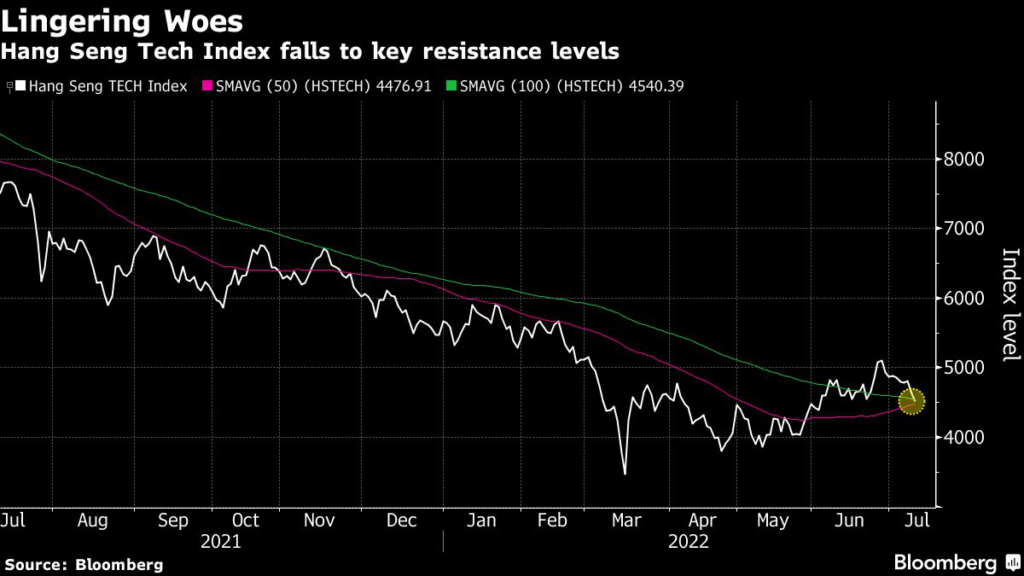
The Hang Seng Tech Index fell 2.1% after tumbling 3.9% on Monday, taking declines from a June peak to 11%. Alibaba Group Holding Ltd. was among the biggest drags as it dropped 5.4% after the authorities levied fines on the firm and Tencent Holdings Ltd. over the weekend.

The losses mark a swift reversal in sentiment toward China’s tech shares, which were recently buoyed by speculation that a crackdown on the sector was easing. The fines on Alibaba and Tencent have revived talk that the authorities may tighten oversight of internet firms again. 

While the fines were “negligible,” said Redmond Wong, a strategist at Saxo Capital Markets, “the penalty reminded investors about regulatory risks over Chinese internet companies.”

Other China stock gauges were also in the red on Tuesday. The CSI 300 Index was down 0.9% while the Hang Seng Index lost 1.3%.

Souring Sentiment

The recent decline in tech shares and the broader Chinese market are a reminder of how quickly sentiment can change, and how difficult it is to find a bottom. Before the losses set in, the tech index had rebounded almost 50% from a March low and the benchmark CSI 300 Index was closing in on a bull market as the authorities eased Covid-19 restrictions.

Bets on the reopening theme are quickly evaporating as a growing outbreak in Shanghai fuels fears of a new lockdown. Concerns of a fresh crackdown on the tech sector have emerged even after the regulator said it will fully support the development of firms that were penalized. 

Against this backdrop, the Hang Seng Tech Index fell past its 100-day moving average on Tuesday. The daily price average had worked as a major resistance for the index since March 2021 when it slipped below that line. 

Some strategists still see value in the sector. For example, Goldman Sachs Group Inc. analysts favor local internet services and e-commerce names in the second half on expectations that profit revisions will stabilize and earnings growth inflect positively from the third quarter, according to a note. 

Next Cue

In the days ahead, investors may look to the current earnings season to assess the impact of recent lockdowns and gauge how companies view the outlook. Some of that thinking is likely to provide the next cue, according to BNP Paribas Asset Management.

“There’s some more conviction that the second quarter is going to be better than expectations,” said Zhikai Chen, head of Asian equities at the French asset manager. “When we look at the second quarter numbers right now, it’s quite clear that some of the companies have been reaching out to sell-side analysts and that’s filtering through to earnings upgrades.”

(Updates throughout)

More stories like this are available on bloomberg.com

©2022 Bloomberg L.P.

Musk Says Trump ‘Too Much Drama,’ Should Sit Out 2024 Race

(Bloomberg) — Elon Musk said Donald Trump should “sail into the sunset” rather than run for president again and predicted Florida Governor Ron DeSantis will easily beat Joe Biden if the two square off in 2024.

In a series of tweets to his more than 100 million followers, Musk pointed out Trump, now 76, would be 82 by the end of a potential second presidential term. That’s “too old to be chief executive of anything, let alone the United States of America,” the Tesla Inc. CEO wrote. Musk also said there was “too much drama” when Trump was in office.

This marks the first time Musk, who’s also CEO of US government contractor Space Exploration Technologies Corp., has said Trump should forgo another campaign. In an interview with Bloomberg News last month, Musk said he was undecided when asked if he’d back Trump, who has strongly hinted at another run.

Musk, 51, has been increasingly vocal about his leanings the last few months after tweeting in September last year that he preferred to stay out of politics. His latest musings were in response to criticism Trump directed at him this past weekend at a rally in Alaska.

Referring to Musk’s recent assertion that he voted Republican for the first time in June, Trump said this contradicted what Musk has told him. The former president used an expletive to describe Musk and took a shot at the merger agreement with Twitter Inc. that he’s now trying to terminate, calling it “rotten.”

Musk was less pointed in his posts about Trump, writing that he doesn’t “hate the man” and calling for Democrats to “call off the attack” on the former president.

During his interview with Bloomberg last month, Musk said he was willing to put roughly $25 million into a political action committee. He tweeted earlier about creating a super PAC to support centrist candidates from all parties. He’s steadily criticized Biden and Democrats for months, claiming the president is beholden to labor unions and the party is undermining his businesses.

Biden has shrugged off Musk’s jabs and gloomy view of the US economy. Last month, he wished the billionaire “lots of luck on his trip to the moon.”

(Updates with Musk previously saying he preferred to stay out of politics in the fourth paragraph. An earlier version of this story corrected the time reference in the last paragraph.)

More stories like this are available on bloomberg.com

©2022 Bloomberg L.P.

Is Crypto’s Volatility an Issue or an Asset? Depends Who You Ask

  • Listen to Bloomberg Crypto on the iHeartRadio App
  • Listen to Bloomberg Crypto on Apple Podcasts
  • Listen to Bloomberg Crypto on Spotify 

(Bloomberg) — Depending on who you ask, crypto’s volatility is either a bug or a feature. Wild and unexpected price swings make this an asset class ill suited to anyone who can’t stomach risk. It’s clear that these gyrations can be challenging, but is there a world in which they’re perceived as a benefit? And if so, what’s the upside?  In this episode, Bloomberg Opinion columnist Lionel Laurent joins us to discuss whether there’s any value to crypto’s volatility. 

Follow us on Twitter @crypto, and subscribe to the Bloomberg Crypto Newsletter at https://bloom.bg/cryptonewsletter


More stories like this are available on bloomberg.com

©2022 Bloomberg L.P.

UFO Speculation Spurs Company to Cut Through Internet ‘Nonsense’

(Bloomberg) — Persistent speculation about sightings of unidentified aerial phenomena, popularly known as UFOs, is drawing attention from the US government — and inspiring a technology startup.

Enigma Labs, registered in Delaware, wants to build a repository to catalog, score and crowdsource incidents, and expose hoaxes.

“The internet is full of nonsense and it’s very hard to get good information,” said Enigma Labs founder Alex Smith, who has a background in data science and aerospace. The company, whose name evokes the German code the UK cracked during World War II, is largely funded by Silicon Valley firms, Smith said, declining to give details.

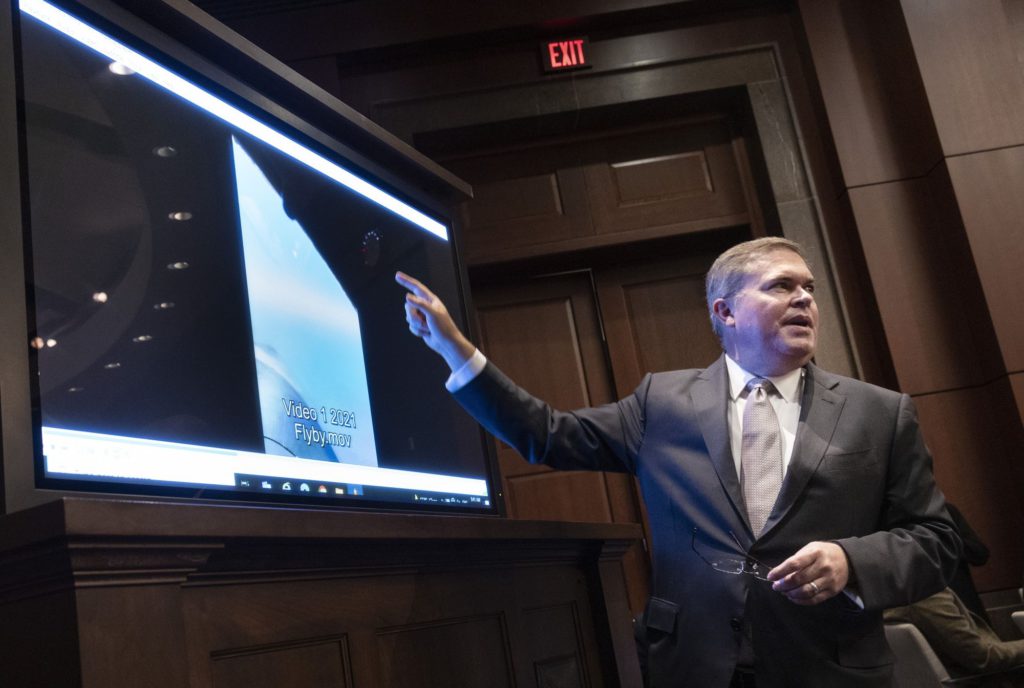
In Washington, Congress and government agencies are dedicating resources and studies into unexplained aerial phenomena after years of skepticism. The House Intelligence Committee in May held the first congressional hearing since the 1960s into unidentified flying objects. The Defense Department wants to remove any shame in reporting suspected UFOs, reasoning that public sightings could represent national security threats such as enemy drones or dangerous debris.

And the National Aeronautics and Space Administration announced in early June that it’s setting up a team in the fall for a scientific study into whether UFOs exist.

Read More: UFO Sightings Aren’t for ‘Kooks’ Anymore, House Panel Chair Says

Enigma’s Smith, who says she isn’t a UFO expert, said the idea for a data repository came in 2020 after talking with pilots. “Something was going on,” Smith said in a phone interview.

“It’s really these F-16, F-18 pilots who are our true North,” Smith said, referring to military pilots who have reported unexplained sightings from their operations or training. Most incidents are observed by US military personnel and also registered on technical sensors, but there still isn’t enough data to allow intelligence analysts to draw meaningful conclusions, Pentagon officials told lawmakers in May.

“There was really no destination for credible information, data and sharing of expertise and insights,” Smith said.

Private Beta Launch

Enigma has launched a private beta test of the project, with a plan to offer a public iPhone application in the fall, chief technology officer Patrick Corbett told Bloomberg Government.

The company’s logo is inspired by the now iconic image of the ‘Gimbal’ UFO, an official US Navy video of an 2015 encounter taken by a fighter jet from the aircraft carrier USS Theodore Roosevelt off the eastern seaboard near the coast of Florida.

At first, Enigma is focusing on vacuuming up all the historical data. So far, it has ingested 270,000 sightings from the last 100 years from around the globe, Smith said. Sightings are indexed and cataloged. Enigma is making them accessible and open to any questions.

Read More: NASA Starts a Scientific Study to Find Out if UFOs Exist

A key feature of the database will be the veracity score, which Smith compares to the Richter scale used for earthquakes. The goal is to remove confounding variables so that the system concentrates on incidents scored 95 and higher on a scale of 100.

“Anything that is identifiable — we use our technology to screen that out,” Smith said.

Civilians reporting these incidents may be looking at the International Space Station, the moon, drones, airplanes, or lighting.

“We can be rational about what people are seeing and focus on those 1-5% that aren’t as identifiable,” she said. In that case, Enigma would check sensor data, other sightings in the area, and radar, Smith added.

Enigma relies on artificial intelligence, programming languages, and “every cutting-edge technology” to screen and verify the sightings, including looking at the metadata of submissions, verifying where the person was, checking the weather, and cross-checking with any existing sensor data submitted in the area, Smith said.

Enigma is in possible contract discussions with a US defense agency for its capabilities, Smith said, declining to comment further as talks are preliminary.

Low-Quality Images

Avi Loeb, an astronomer at Harvard University, said Enigma Labs may have a hard time collecting high-resolution data.

“Even if you have a million cellphone images, they will always be blurry, because the cameras are not great,” Loeb said. “The cameras cannot resolve an object at a distance of mile and that’s why you need telescopes.” Cellphone images can’t produce conclusive or scientific data, Loeb said. He compared the low-quality data collection to a market that only sells plastic jewelry.

“You can buy the best jewelry you can find in that market, but it wouldn’t be high-quality,” Loeb said. “So my point is, let’s produce high-quality jewelry rather than go to that market.”

Galileo Project

Loeb founded the Galileo Project – a privately funded research project using telescopes to gather data. He said he talked to Enigma a couple times about its project. Loeb said the Galileo data will be open for Enigma and anyone else worldwide who might want to use it. “After we get some high-quality data, I will be delighted to collaborate and share ideas with Enigma. I greatly enjoyed my preliminary conversation with them,” he said in an email.

He said the government likely has access to classified high-quality data on unidentified aerial phenomena, but uses it for identifying security threats rather than alien life.

“It’s just not their business,” Loeb said. “It’s the business of scientists to figure out something that is not easily identified as human-made or natural.”

Government Work

The Defense Department last year established an Airborne Object Identification and Management Synchronization Group after a declassified report last June found the government couldn’t explain more than 140 incidents of “Unidentified Aerial Phenomena.”

Congress has also directed the agency to create rapid-response teams made up of Pentagon and intelligence community experts that can respond to sightings and conduct field investigations. Meanwhile, NASA’s study will figure out what UAPs may exist, from national security threats to objects from outside our solar system. It will cost less than $100,000, according to Daniel Evans, the assistant deputy associate administrator for research at NASA’s Science Mission Directorate.

Once Enigma makes its application public, submitters will have drop-down menus to select characteristics such as location and shape of the object, said Corbett. Eventually, submitters could use voice note dials and secure drop, Corbett said.

While downloading the application will be free, Enigma will eventually charge fees for question and answer sessions, and for scientists to use derivative products of the data.

More stories like this are available on bloomberg.com

©2022 Bloomberg L.P.

UFO Buzz Inspires Tech Startup to Track Incidents, Expose Hoaxes

(Bloomberg) — Persistent speculation about sightings of unidentified aerial phenomena, popularly known as UFOs, is drawing attention from the US government — and inspiring a technology startup.

Enigma Labs, registered in Delaware, wants to build a repository to catalog, score and crowdsource incidents, and expose hoaxes.

“The internet is full of nonsense and it’s very hard to get good information,” said Enigma Labs founder Alex Smith, who has a background in data science and aerospace. The company, whose name evokes the German code the UK cracked during World War II, is largely funded by Silicon Valley firms, Smith said, declining to give details.

In Washington, Congress and government agencies are dedicating resources and studies into unexplained aerial phenomena after years of skepticism. The House Intelligence Committee in May held the first congressional hearing since the 1960s into unidentified flying objects. The Defense Department wants to remove any shame in reporting suspected UFOs, reasoning that public sightings could represent national security threats such as enemy drones or dangerous debris.

And the National Aeronautics and Space Administration announced in early June that it’s setting up a team in the fall for a scientific study into whether UFOs exist.

Read More: UFO Sightings Aren’t for ‘Kooks’ Anymore, House Panel Chair Says

Enigma’s Smith, who says she isn’t a UFO expert, said the idea for a data repository came in 2020 after talking with pilots. “Something was going on,” Smith said in a phone interview.

“It’s really these F-16, F-18 pilots who are our true North,” Smith said, referring to military pilots who have reported unexplained sightings from their operations or training. Most incidents are observed by US military personnel and also registered on technical sensors, but there still isn’t enough data to allow intelligence analysts to draw meaningful conclusions, Pentagon officials told lawmakers in May.

“There was really no destination for credible information, data and sharing of expertise and insights,” Smith said.

Private Beta Launch

Enigma has launched a private beta test of the project, with a plan to offer a public iPhone application in the fall, chief technology officer Patrick Corbett told Bloomberg Government.Once Enigma makes its application public, submitters will have drop-down menus to select characteristics such as location and shape of the object, said Corbett. Eventually, submitters could use voice note dials and secure drop, Corbett said.

While downloading the application will be free, Enigma will eventually charge fees for question and answer sessions, and for scientists to use derivative products of the data.

The company’s logo is inspired by the now iconic image of the ‘Gimbal’ UFO, an official US Navy video of an 2015 encounter taken by a fighter jet from the aircraft carrier USS Theodore Roosevelt off the eastern seaboard near the coast of Florida.

At first, Enigma is focusing on vacuuming up all the historical data. So far, it has ingested 270,000 sightings from the last 100 years from around the globe, Smith said. Sightings are indexed and cataloged. Enigma is making them accessible and open to any questions.

Read More: NASA Starts a Scientific Study to Find Out if UFOs Exist

A key feature of the database will be the veracity score, which Smith compares to the Richter scale used for earthquakes. The goal is to remove confounding variables so that the system concentrates on incidents scored 95 and higher on a scale of 100.

“Anything that is identifiable — we use our technology to screen that out,” Smith said.

Civilians reporting these incidents may be looking at the International Space Station, the moon, drones, airplanes, or lighting.

“We can be rational about what people are seeing and focus on those 1-5% that aren’t as identifiable,” she said. In that case, Enigma would check sensor data, other sightings in the area, and radar, Smith added.

Enigma relies on artificial intelligence, programming languages, and “every cutting-edge technology” to screen and verify the sightings, including looking at the metadata of submissions, verifying where the person was, checking the weather, and cross-checking with any existing sensor data submitted in the area, Smith said.

Enigma is in possible contract discussions with a US defense agency for its capabilities, Smith said, declining to comment further as talks are preliminary.

Low-Quality Images

Avi Loeb, an astronomer at Harvard University, said Enigma Labs may have a hard time collecting high-resolution data.

“Even if you have a million cellphone images, they will always be blurry, because the cameras are not great,” Loeb said. “The cameras cannot resolve an object at a distance of mile and that’s why you need telescopes.” Cellphone images can’t produce conclusive or scientific data, Loeb said. He compared the low-quality data collection to a market that only sells plastic jewelry.

“You can buy the best jewelry you can find in that market, but it wouldn’t be high-quality,” Loeb said. “So my point is, let’s produce high-quality jewelry rather than go to that market.”

Galileo Project

Loeb founded the Galileo Project – a privately funded research project using telescopes to gather data. He said he talked to Enigma a couple times about its project. Loeb said the Galileo data will be open for Enigma and anyone else worldwide who might want to use it. “After we get some high-quality data, I will be delighted to collaborate and share ideas with Enigma. I greatly enjoyed my preliminary conversation with them,” he said in an email.

He said the government likely has access to classified high-quality data on unidentified aerial phenomena, but uses it for identifying security threats rather than alien life.

“It’s just not their business,” Loeb said. “It’s the business of scientists to figure out something that is not easily identified as human-made or natural.”

Government Work

The Defense Department last year established an Airborne Object Identification and Management Synchronization Group after a declassified report last June found the government couldn’t explain more than 140 incidents of “Unidentified Aerial Phenomena.”

Congress has also directed the agency to create rapid-response teams made up of Pentagon and intelligence community experts that can respond to sightings and conduct field investigations. Meanwhile, NASA’s study will figure out what UAPs may exist, from national security threats to objects from outside our solar system. It will cost less than $100,000, according to Daniel Evans, the assistant deputy associate administrator for research at NASA’s Science Mission Directorate.

More stories like this are available on bloomberg.com

©2022 Bloomberg L.P.
Close Bitnami banner
Bitnami