

Bloomberg

BlackRock, JPMorgan Face Squeeze on Profits at China Funds

(Bloomberg) — Global asset managers including BlackRock Inc. and JPMorgan Chase & Co. are facing mounting pressures on profitability in China even as they gain a bigger footing in the nation’s fast-growing mutual fund industry.

The hurdles are piling up: higher distribution fees, new entrants stepping into the arena, and a growing war for talent. On top of that, declines in the local stock market imposed deep losses on new funds, even as a recent rally has started to ease the pain. ​ ​

Such challenges are growing more apparent just months after BlackRock became the first global asset manager to launch a fully owned onshore fund business. Fidelity International Ltd. and Neuberger Berman Group are prepared to follow suit. The new reality complicates profit prospects as they deepen their commitment to the 32 trillion yuan ($4.8 trillion) market despite rising geopolitical risks and an economic slowdown. 

Read how BlackRock’s China expansion is outpacing peers

“The potential for increased competition and greater difficulty in attracting talent will add to the challenges for foreign firms when executing on their strategies,” which are key to building the scale needed to break even, said Harry Handley, a senior associate at Shanghai-based consultancy Z-Ben Advisors Ltd. 

While BlackRock has raised billions of yuan from local investors in two funds since September, it’s not pocketing all its management fees. The US giant’s China unit paid more than 48% to distributors in so-called “client maintenance fees” last year, the highest proportion among locally incorporated fund houses, according to data compiled by Wind Information Co. 

Joint ventures of foreign firms including JPMorgan, Morgan Stanley, Credit Suisse Group AG and Prudential Plc paid a higher proportion of fees to distributors last year than the previous year, although those of UBS Group AG and Invesco ceded a slightly lower share, the Wind data show. JPMorgan’s venture, which the US bank is seeking full control of, shared 26.7%, up from 23% in 2020, according to the data.

Bargaining Power

The increase reflects the growing bargaining power of local banks with vast branch networks and online sales platforms. While regulators capped distributors’ share of fees at 50% for retail sales in 2020, funds have since typically been paying close to that level for fresh launches, leaving new players vulnerable.

Overall, distributors’ cut of management fees grew to 28% last year from 26% in 2020, according to Z-Ben.

The common practice of sharing fees in China can be traced back to 2008’s bear market, when fund houses had to sacrifice revenue to incentivize banks to sell their products, according to Xin Hu Wealth Investment Management Co., which also distributes funds. 

Paying higher fees still has its merits for new entrants like BlackRock, which needs distributors to tout its biggest selling point — being a globally renowned asset manager — to more investors, according to Lu Haiyang, vice president of Xin Hu Wealth. BlackRock’s ratio will likely stay high for the near term when the US manager launches new products, Lu added. 

Fund Losses

The BlackRock China New Horizon Mixed Securities Investment Fund, which raised 6.7 billion yuan, shrank to about 5 billion yuan as of March 31 amid losses and investor redemptions, according to its first-quarter report. It was down as much 27.6% in late April since inception, before a market rally trimmed the loss to 8.8% as of July 11. That’s still better than the benchmark CSI 300 Index, which lost about 13% over the same period. 

Its second fund, which was launched in January and focuses on Hong Kong stocks, lost about 7% during the first quarter and managed about 500 million yuan as of March 31. 

Not using distributors is also costly. It takes at least 1 billion yuan in outstanding fund sales for a direct-selling entity to break even, and it’s getting more expensive to attract new clients online, according to Zhou Xiaojie, a marketing director at Shenzhen Dollar Technology Co., which advises money managers.

That said, aware of the growth prospects, global managers are playing the long game. The mutual fund industry already makes up the largest segment of China’s asset management market, with assets exceeding banks’ wealth management products as of March 31, according to Hwabao Securities Co.

“While this year’s market has been incredibly challenging, BlackRock’s progress in establishing its platform, launching funds and building capacity in China will set it up for significant growth over the long term,” said Susan Chan, the firm’s head of Greater China.

China’s asset management market provides “huge room” for growth to both local and foreign managers, said Eddy Wong, chief executive officer of China International Fund Management, JPMorgan’s fund joint venture. 

Morgan Stanley declined to comment. Representatives for Credit Suisse and Prudential didn’t immediately comment.  

Intense Competition

In the near term, global players will need to hunker down. The China Securities Regulatory Commission issued new policies in April to speed up the growth of the industry, encouraging banks, insurers and securities firms to set up fund units and easing controls on the number of licenses they can hold. 

The Asset Management Association of China followed up in June with compensation guidelines, requiring performance pay for senior staff and fund managers to be delayed for at least three years. That will make it even harder for global firms to poach local rivals’ best talent, according to Sun Guiping, an analyst with Shanghai Securities Co.

“Global firms are off to a not-too-bad start, but competition is certainly getting more fierce,” Sun said. “They need to find their own positions and build local brand names and relatively good track records.”

(Updates BlackRock fund’s performance in the 11th paragraph)

More stories like this are available on bloomberg.com

©2022 Bloomberg L.P.

Joffre Capital Seek Financing to Gain Control of Playtika

(Bloomberg) — Joffre Capital, a tech-focused buyout firm started by Chinese dealmakers, is seeking financing to fund a potential bid for control of mobile game developer Playtika Holding Corp., people with knowledge of the matter said. 

The investment firm is considering boosting its Playtika stake to become the majority shareholder, according to the people, who asked not to be identified because the information is private. It is studying a purchase of Chinese online gaming tycoon Shi Yuzhu’s remaining holding in the firm, the people said. 

Joffre Capital has been in talks with several lenders about funding for a potential transaction, the people said. Shares of Playtika pared earlier losses and were down 2.6% at the close Monday in New York, giving the company a market value of about $5.3 billion. The company has lost nearly half its value over the past year. 

The private equity firm agreed last month to acquire 25.7% of Israel-based Playtika from entities related to Shi for $2.2 billion. It’s paying $21 per share for the stake. Shi’s affiliates will still own roughly 34% of Playtika after the transaction, which hasn’t been completed yet. 

Las Vegas 

Playtika said in February it was working with Raine Group on a strategic review that could include a sale or other potential transactions. 

The company makes online and mobile games with Las Vegas themes — including “Caesars Slots” and “Slotomania” — as well as the popular “Bingo Blitz” and “Poker Heat.” It’s based in Herzliya, Israel, a coastal city north of Tel Aviv that’s become a technology hub.

Any deal would add to the $183 billion in private equity takeovers of listed companies this year, according to data compiled by Bloomberg. Deliberations are ongoing, and there’s no certainty Joffre Capital will decide to proceed with a transaction, the people said. 

A representative for Playtika declined to comment. A spokesperson for Giant Network Group Co., the online game developer controlled by Shi, referred to the company’s announcements, without elaborating. Officials at Joffre Capital didn’t respond to emails and LinkedIn messages seeking comment. 

Tech Focus

Joffre Capital’s founding partners include James Lu, a former executive at Chinese search engine Baidu Inc., according to his LinkedIn profile. He was part of the investor group that bought gay-dating app Grindr from Chinese internet company Kunlun Tech Co. in 2020. 

Investing.com, the financial news and data website, and Coins.ph, a provider of crypto wallet services in the Philippines, are among Joffre Capital’s portfolio companies. 

Joffre Capital was started by a group of entrepreneurs and experienced executives in technology and finance who have held senior positions at Amazon Inc., Baidu, Blackstone Inc., Warburg Pincus and Yahoo, according to its website, which doesn’t name any of the management team. 

A press release earlier this year said Joffre Capital has “multiple billion dollars under management,” with a presence across the US, Europe and Asia and a track record in areas including digital media, e-commerce, interactive entertainment, education technology and enterprise software. It didn’t provide further specifics. 

(Updates with deal volumes in seventh paragraph.)

More stories like this are available on bloomberg.com

©2022 Bloomberg L.P.
Rival to Jack Ma’s Ant Seeks Pre-IPO Funding at $3 Billion Value

(Bloomberg) — LianLian DigiTech, a rival to Jack Ma’s Ant Group Co., is in talks to raise as much as 1.5 billion yuan ($223 million) ahead of an initial public offering in Hong Kong as soon as next year, people familiar with the matter say.

The Hangzhou-based startup is working with China International Capital Corp. on the financing round, the people said, asking not to be identified as the information is private. Investment vehicles under the Zhejiang provincial government and a venture arm of China Mobile Ltd. have expressed interest in participating, one of the people said. The fundraising will likely take LianLian’s valuation to about 20 billion yuan, the person said. 

A successful deal could usher in one of the few IPO attempts by a major Chinese fintech company since regulators scrapped Ant’s debut in 2020, which would have been the world’s largest. That triggered a crackdown that engulfed most of the country’s internet sector. Months after Ant halted its IPO, JD.com Inc. founder Richard Liu’s fintech unit also withdrew its listing application from China’s NASDAQ-style Star Market. 

Once new investors are on board, LianLian plans to seek a Hong Kong IPO next year followed by a mainland Chinese listing, the people said. The firm, which specializes in cross-border payments for e-commerce giants including Amazon.com Inc. and Sea Ltd.’s Shopee, is currently valued at roughly 16 billion yuan, they said. It counts major names such as Sequoia Capital China, Boyu Capital and China Everbright Industries Group Ltd. among its backers and has handled more than 5.5 trillion yuan in transactions since its 2009 founding, according to its website.

Read more: China Weighs Reviving Jack Ma’s Ant IPO as Crackdown Eases

Discussions are ongoing and preparations for the listing are at an early stage, so details are subject to change, the people said. LianLian representatives didn’t respond to calls and inquiries sent through their business development hotline. A China Mobile representative didn’t respond to requests for comment.

Requests for comment sent to phone and fax numbers and a general email address listed on the Zhejiang investment agency’s website either went unanswered or bounced back. The Zhejiang government’s foreign affairs office, which often deals with international media, didn’t respond to an email requesting comment.

LianLian’s fundraising talks show investors haven’t ruled out fintech as a promising area, despite the clampdown on Ant and intensified scrutiny of online finance services run by the likes of Tencent Holdings Ltd. Chinese financial regulators have started early-stage discussions on a potential revival of Ant’s listing, Bloomberg News has reported, one of the clearest signs yet that authorities are dialing back a crackdown on the industry.

Under an official framework laid down last year, Ant needs to fold all its financial units into a holding company and be regulated like a bank with more scrutiny on its shareholder structure and tougher capital requirements. The central bank has so far accepted five applications for financial holding firms, and approved two after at least six months of review.

Founded in 2009, LianLian provides bankcard clearing services through a joint venture with American Express Co. and also offers cross-border payments for more than a million e-commerce merchants, according to its website. It has expanded to Southeast Asia, Ireland and Brazil, the company says. At home, it competes with far larger rivals including the state-backed UnionPay network as well as apps operated by Ant and Tencent. 

In 2021, LianLian filed pre-listing supportive documents endorsed by CICC to mainland market watchdogs, revealing very early preparations for an IPO, though it’s unclear why the payments firm didn’t proceed with a listing.

More stories like this are available on bloomberg.com

©2022 Bloomberg L.P.
A Cheap Tech Stock Made the Cut for Europe’s Biggest Value Fund

(Bloomberg) — Europe’s biggest value-oriented fund recently bought its first technology stock.

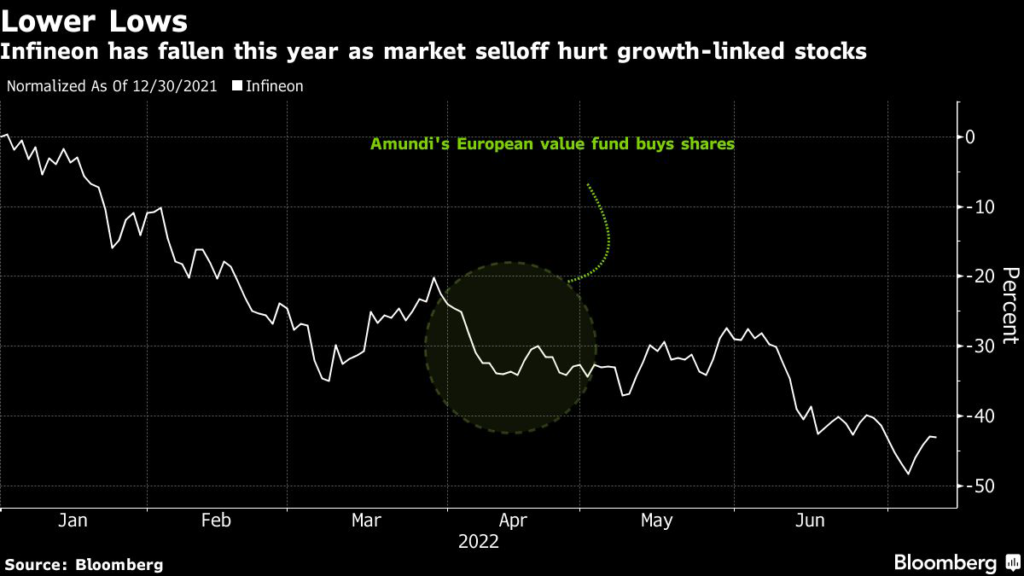
During a brutal equity selloff in the first half, and with technology stocks particularly hard hit amid rate hikes, semiconductor maker Infineon Technologies AG presented a rare opportunity for Andreas Wosol, head of Amundi SA’s equity value fund.

“The margin-of-safety opportunity in this part of the IT segment became so attractive that all of a sudden, a growth stock becomes value,” Wosol said in an interview. The 3.6 billion-euro ($3.6 billion) fund bought shares of Infineon — which is a major supplier of chips for automakers — in April.

This is only the second time in the past two decades that a traditional growth stock has behaved like a value one, Wosol said. The last time was during the 2008 global financial crisis, while valuations came close in the 2020 pandemic-driven rout, he said.

After a 45% slump this year, Infineon is trading at a forward price-to-earnings ratio of 12.4 — near its biggest discount to the Stoxx 600 Technology Index on record. Still, it’s “structurally attractive” due to its focus on energy transition at a time when Europe is seeking to reduce reliance on Russia, Wosol said. Infineon raised its outlook in May, citing strong demand for car chips.

Wosol says his approach to identifying value stocks is different to peers. Where traditional fund managers use relative price multiples to assess the value of a business, Wosol applies an “intrinsic value-driven approach,” in which he calculates a margin of safety — a level below what he sees the business as intrinsically worth — that acts as an entry point for investments. 

“It’s completely irrelevant if the stock is a tech stock, a bank, a cyclical, a consumer and automotive or a pharmaceutical name,” Wosol said. “The question is only how much margin of safety to the intrinsic value of a business I see that makes it attractive to invest.”

Wosol’s fund, which launched in 2008, has lost 13% this year for institutional investors, and 16% for retail investors, while the benchmark Stoxx Europe 600 Index is down 15%, according to data compiled by Bloomberg. Top holdings include HSBC Holdings Plc, Novartis AG, TotalEnergies SE and Shell Plc, according to data from Amundi.

More stories like this are available on bloomberg.com

©2022 Bloomberg L.P.
Sinch Plunge Wipes Out $1.3 Billion After Second-Quarter Warning

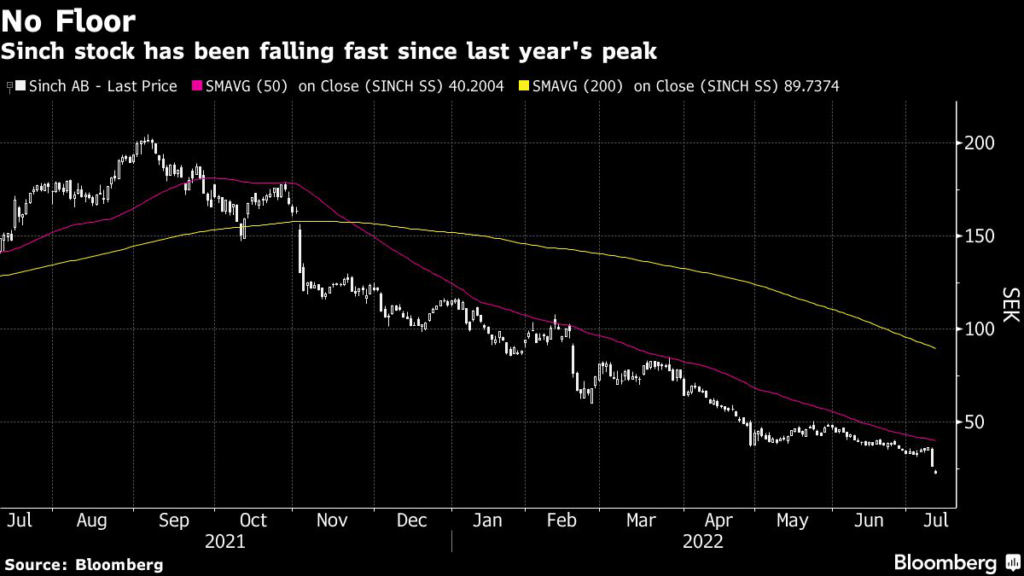
(Bloomberg) — Sinch AB shares plunged for a second day, erasing in total about $1.3 billion of market value, as the Swedish cloud-based platform provider warned that a “reassessment” of certain historical costs will hit second-quarter profit.

The stock fell as much as 25% in Stockholm, extending a 28% drop on Monday which traders had attributed to a tweet on Sinch’s financial statements from an account called NingiResearch.

The company said Tuesday that the reassessment of cost of goods sold for past periods will negatively affect second-quarter earnings by 162 million Swedish kronor ($15.3 million). It said it decided to issue a statement in light of “the unusually strong share price movement” on Monday, even though remaining parts of the results have not yet been finalized ahead of their July 21 release.

“Whilst the third-party analysis does not discuss reassessment of cost of goods sold, the analysis claims that revenues for 2021 are overstated, which is something that Sinch strongly opposes,” it said in the statement.

NingiResearch didn’t respond to a request for comment.

Describing Sinch’s statement as a “profit warning,” Svenska Handelsbanken AB analyst Daniel Djurberg said that while uncertainty is high, that should be fully discounted in the stock price by now.

Following Tuesday’s drop, Sinch shares are down 82% year-to-date.

More stories like this are available on bloomberg.com

©2022 Bloomberg L.P.

Unilever-Backed Venture Firm Cathay Raising 1 Billion-Euro Fund

(Bloomberg) — Cathay Innovation, a venture capital group backed by consumer conglomerate Unilever Plc and energy giant TotalEnergies SE, is raising 1 billion euros ($1 billion) to back tech startups.

The venture arm of investment firm Cathay Capital Group, is putting together its third fund, which will focus on sectors including digital health and financial technology companies, co-founder Denis Barrier said in an interview. 

The group is going up against an environment that’s slashed tech valuations as rising interest rates and inflation fears sparked a market-wide collapse. Klarna Bank AB closed a funding round that shrank its valuation to $6.7 billion from $45.6 billion, the Swedish buy-now-pay-later company said in a statement on Monday. Tech investor SoftBank Group Corp. has has said it will scale back on deals. 

“Valuation is lower in the market, so if you believe in tech, if you believe in the power and growth of digital platforms, for sure this is a very good time to invest,” Barrier said.

The company — which has more than $2 billion in assets under management and has made over 120 investments in companies including Spanish delivery app Glovo and fintech Chime — will make investments in the range of 5 million euros to 80 million euros. 

Other corporate backers for Cathay Innovation including the likes of luxury conglomerate Kering SA and pharmaceutical firm Sanofi, according to its website. Along with providing capital, the corporate investors also collaborate with portfolio companies.

More stories like this are available on bloomberg.com

©2022 Bloomberg L.P.

Musk Says Trump ‘Too Much Drama,’ Should Sit Out 2024

(Bloomberg) — Elon Musk said Donald Trump should forget about running for president in 2024 and instead should “sail into the sunset,” presumably to make way for Florida Governor Ron DeSantis, whom he supports.

In a series of tweets to his 100 million followers, Musk pointed out Trump, now 76, would be 82 at the end of a second term, and “that is too old to be chief executive of anything, let alone the United States of America.” He also said there was “too much drama” when Trump was in office.

This marks the first time Musk, the chief executive officer of Tesla Inc., has said Trump should forgo another campaign. In an interview with Bloomberg News last month, Musk said he was undecided about whom to support when asked if he’d back Trump, who has strongly hinted at another run.

He added that DeSantis, who’s running for re-election and has shown growing strength in early polls among Republican 2024 hopefuls, would “win easily” against President Joe Biden.

Musk’s tweets came in response to criticism directed at him by Trump during a rally in Alaska on Saturday.

Referring to Musk’s assertion that he’d never voted Republican until this June, Trump said that contradicted what Musk had told him. The former president followed with an expletive description of the world’s richest man and voiced his judgment on the Twitter Inc. acquisition agreement that Musk struck but is now trying to walk away from, calling it “rotten.”

Although Musk has been keen to share his political opinions, nearly all of the focus on him in recent days has been on the Twitter drama. Twitter Chairman Bret Taylor said the company would pursue legal action to close the transaction “on the price and terms agreed by Mr. Musk.”

Twitter has hired merger-law heavyweight Wachtell, Lipton, Rosen & Katz and aims to file suit early this week, according to people familiar with the company’s plans, who asked not to be identified because the matter is private.

In the Bloomberg interview, Musk said he was willing to put a “non-trivial” amount of as much as $25 million in a super political action committee.

He has been steadily escalating his criticisms of Biden, saying that the president is too beholden to labor and that Democrats have given his businesses the cold shoulder.

Biden, in turn, has shrugged off Musk’s jabs and negative comments about the economy. Last month, he wished the billionaire “lots of luck on his trip to the moon.”

(Corrects time reference in the last paragraph.)

More stories like this are available on bloomberg.com

©2022 Bloomberg L.P.

Renault Sales Plunged 30% as Carmaker Pulled Out of Russia

(Bloomberg) — Renault SA sales dropped nearly 30% in the first half after the carmaker’s forced withdrawal from the Russian market and persisting parts shortages dented shipments.

Renault sold around 1 million vehicles in the first six months of the year, it said Tuesday. That’s less than half of what it shipped during the same period four years ago, when the company was on an expansion course. The decline narrows to 12% excluding Russia, which was the firm’s second-biggest market thanks to the popular Lada brand.

Renault fell as much as 2.4% in Paris. The shares are down around a quarter this year.

The French automaker was forced to pull out of Russia because of the war in Ukraine, transferring its plant near Moscow and its AvtoVaz venture for a symbolic sum. Like all automakers, Renault is also wrestling with a global shortage of semiconductors that has curbed output of new vehicles, leaving consumers waiting months for deliveries. 

Executives said they’re expecting production of Renault models to rise in the second half as some supply issues improve.

Higher Output

Output over the past weeks reached last year’s levels or higher, and “this will accelerate over the next months,” Fabrice Cambolive, chief operating officer of the main Renault brand, said on a call with reporters. “We are forecasting a second half significantly higher in terms of production that the first half.”

Renault boosted the share of sales to private buyers — transactions that usually are more profitable — to 66% from 53% in the five main European auto markets.

The company also sold 12% more SUV-style cars, a key part of Chief Executive Officer Luca de Meo’s turnaround plan. Sales of no-frills Dacia vehicles rose 5.9%.

The order backlog in Europe stood at a “high level” of 4.1 months of sales at the end of last month, the company said.


(Updates with shares in third paragraph.)

More stories like this are available on bloomberg.com

©2022 Bloomberg L.P.
Stocks, US Futures Decline as Caution Spurs Dollar: Markets Wrap

(Bloomberg) — Stocks and US equity futures fell Tuesday as the dollar and sovereign bonds rose, a pattern highlighting pervasive unease about the economic outlook amid high inflation and China’s struggles with Covid.

The Stoxx Europe 600 gauge slipped for a second day, dragged lower by the tech sector and carmakers. Utilities outperformed as EDF jumped after a report that the French government will pay a premium to take control of the electricity company. S&P 500, Nasdaq 100 shed over 0.5% after a Wall Street slide Monday. An Asian share index headed for its biggest two-day drop in a month. 

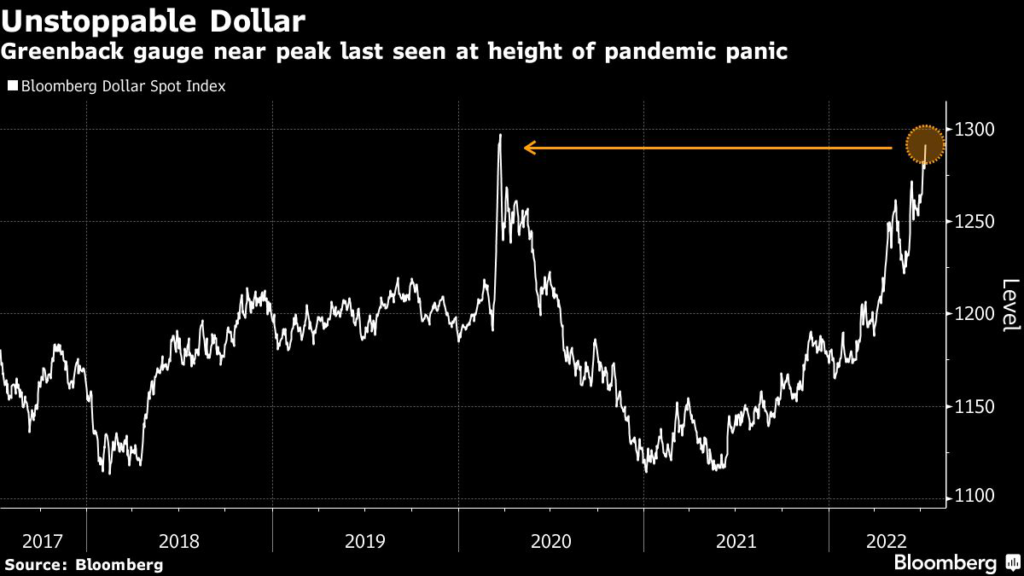
The dollar pushed toward levels last seen at the height of the 2020 market panic over Covid and the yen strengthened, underlining investor caution. The euro-area’s common currency, meanwhile, is in sight of parity with the greenback, sapped by the region’s energy crisis and acute recession fears.

Treasuries extended gains, taking the US 10-year yield to 2.93%. Bonds also rallied in most of Europe. Commodities including oil and iron ore were under pressure. Bitcoin dropped below $20,000.

Much is riding on upcoming company profit filings and this week’s US inflation data. A brief equity rebound from this year’s rout is already fizzling ahead of the reports. Risk appetite may struggle to digest a darkening earnings outlook alongside stubborn price pressures that point to more monetary tightening.  

Dollar strength will not only “affect this quarter’s earnings, but more likely it’s going to affect the revenue generation outlook for the next couple of quarters and that, I think, is a big problem,” Kimberly Forrest, founder and chief investment officer of Bokeh Capital Partners, said on Bloomberg Radio.

In China, investors are concerned more Covid lockdowns may lie ahead as Beijing continues with a strategy of mass testing and mobility curbs. A government push for stimulus to shore up growth is starting to have an impact: credit jumped last month to the highest on record for June.

Meanwhile, the latest Fed commentary highlighted both the central bank’s hawkishness and the risks that come with aggressive interest-rate hikes.

Fed Bank of Atlanta President Raphael Bostic said the US economy can cope with higher interest rates and repeated his support for another jumbo move this month. Fed Bank of Kansas City President Esther George, who dissented last month against the central bank’s 75 basis-point rate increase, cautioned that rushing to tighten policy could backfire.

Will the eurozone avoid a recession or a debt crisis? How will the euro and stocks perform in the next six months? Share your views and participate in the latest MLIV Pulse survey. It only takes a minute, so please click here anonymously.

What to watch this week:

  • Earnings due from JPMorgan, Morgan Stanley, Citigroup, Wells Fargo
  • BOE Governor Andrew Bailey discusses the economic landscape, Tuesday
  • Amazon.com Inc. kicks off its Prime Day event, Tuesday
  • South Korea, New Zealand rate decisions, Wednesday
  • US CPI data, Wednesday
  • Federal Reserve Beige Book, Wednesday
  • US PPI, jobless claims, Thursday
  • China GDP, Friday
  • US business inventories, industrial production, University of Michigan consumer sentiment, Empire manufacturing, retail sales, Friday
  • G-20 finance ministers, central bankers meet in Bali, from Friday
  • Atlanta Fed President Raphael Bostic speaks, Friday

Some of the main moves in markets:

Stocks

  • The Stoxx Europe 600 fell 0.5% as of 8:16 a.m. London time
  • Futures on the S&P 500 fell 0.7%
  • Futures on the Nasdaq 100 fell 0.7%
  • Futures on the Dow Jones Industrial Average fell 0.6%
  • The MSCI Asia Pacific Index fell 1.4%
  • The MSCI Emerging Markets Index fell 1.4%

Currencies

  • The Bloomberg Dollar Spot Index rose 0.3%
  • The euro fell 0.3% to $1.0012
  • The Japanese yen was little changed at 137.32 per dollar
  • The offshore yuan fell 0.3% to 6.7466 per dollar
  • The British pound fell 0.3% to $1.1854

Bonds

  • The yield on 10-year Treasuries declined seven basis points to 2.92%
  • Germany’s 10-year yield declined five basis points to 1.19%
  • Britain’s 10-year yield declined five basis points to 2.13%

Commodities

  • Brent crude fell 2% to $105 a barrel
  • Spot gold was little changed


More stories like this are available on bloomberg.com

©2022 Bloomberg L.P.

Delta, Amazon, Wells Fargo Join Effort to Push for More US Computer Education

(Bloomberg) — Executives of Walmart Inc., Delta Air Lines Inc., Wells Fargo & Co. and Amazon.com Inc. are among more than 500 who have joined an effort by Code.org urging governors and state education officials to ensure that all US elementary and high school students have the chance study computer science as demand rises for workers in computer programming, cybersecurity and data science. 

The letter is timed to coincide with a meeting this week of the National Governors Association where Arkansas Gov. Asa Hutchinson will ask his colleagues to bolster computer education for K-12 students across the nation. Hadi Partovi, chief executive officer of Code.org, said he’s hoping for commitments from all 50 states. Just 5% of US high school students now study computer science while the country has 700,000 vacant computer jobs, according to the organization, which was founded almost 10 years ago to boost access to computer science education, particularly for young women and members of underrepresented groups. 

Microsoft Corp. co-founder Bill Gates and CEO Satya Nadella, Amazon’s Jeff Bezos and CEO Andy Jassy and Meta Platforms Inc.’s Mark Zuckerberg are among those who have signed the letter — although that’s not surprising, Partovi said. But as computers and software are now critical to every company, business leaders from a variety of sectors outside tech want US schools to catch up. 

“Every industry has become a technology industry — even farming has become a high tech sector,” Partovi said in an interview. “Manufacturing is a high-tech sector. Autos are a high-tech sector. In Detroit the hardest to hire job type is software. No matter what field you’re in, you need to figure out how are you going to satisfy your your needs for technical talent. 

Computer science access has been increasing and the issue has bipartisan support — since Code.org’s founding, 51% of K-12 schools now offer access to computer science education compared with 10% about a decade ago, Partovi said, 

But more is needed particularly to address groups who have been left out — the biggest gap is among Native American students on tribal lands. Lower-income neighborhoods and those with larger populations of Black and Latinx students, as well rural areas, are also less likely to offer computer science education. Girls are still less likely to take the courses even when offered, according to the group.

More stories like this are available on bloomberg.com

©2022 Bloomberg L.P.

Close Bitnami banner
Bitnami
