Bloomberg

Brands Apologize Quickly to China Consumers, Except on Xinjiang

(Bloomberg) — Amid a rising wave of nationalism, Chinese shoppers have mounted at least 78 boycotts of foreign companies since 2016, more than six times the number seen in the preceding eight years, a new study found.

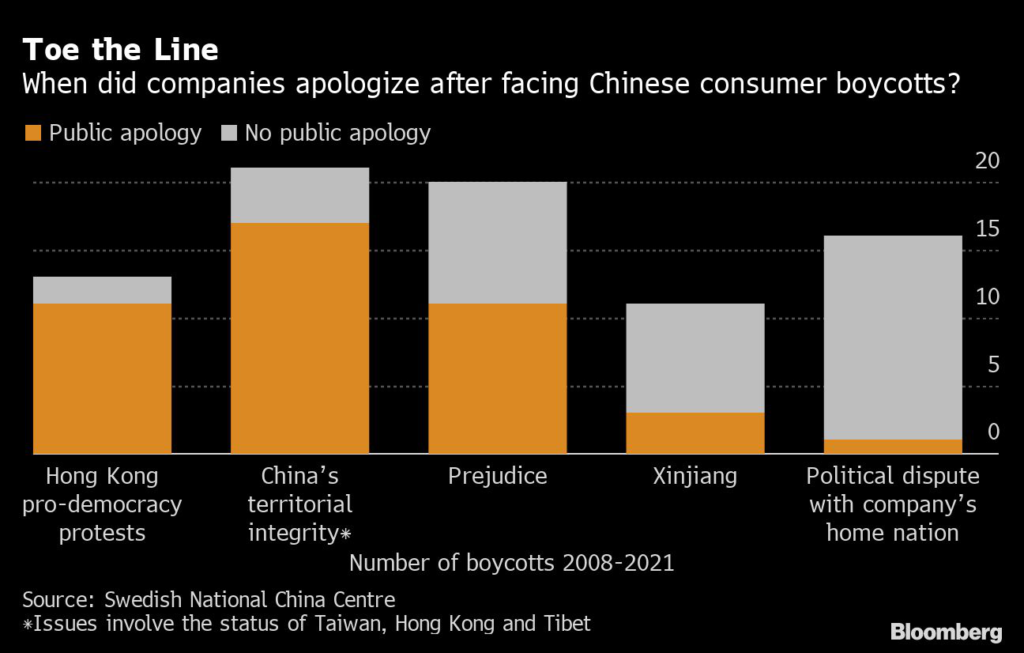
And while consumer brands all face the same complex operating environment in China, how they get out of hot water differs depending on the issue, according to research by the Swedish National China Centre. In general, companies quickly apologize when they’re being boycotted for issues around territory China considers sovereign, but far less frequently when it comes to the topic of alleged human rights violations.

More than 80% of companies apologized upon facing backlash for actions or advertising seen as infringing on China’s territorial integrity, such as the status of Taiwan and Tibet or the pro-democracy protests in Hong Kong. By contrast, only about a quarter of firms expressed regret after making a stance against sourcing products from Xinjiang — the province where China is accused of human rights violations against the ethnic Uyghur group — stirred social media furore. 

The varying degree of sensitivity at play is reflected in how the same company responded differently to boycott threats. Walmart Inc. apologized in 2018 over a signboard in one of its Chinese stores that listed Taiwan, and not China, as the origin of some products, but did not in 2021 amid social media allegations that Xinjiang-sourced products were taken off shelves, according to the study.

The findings underscore how China’s 1.4 billion shoppers have gone from untapped goldmine to potential minefield for global consumer brands. With Asia’s biggest economy facing off with the US and others on everything from trade to cybersecurity and human rights to origins of the coronavirus pandemic, Chinese shoppers have become an economically powerful arm of Beijing’s political agenda, hurting revenue growth for companies from Nike Inc to Hennes & Mauritz AB. 

Domestic Alternatives

“The emergence of alternative domestic products in China and a rise in online nationalism are putting a lot of pressure on global brands,” said Hillevi Parup, co-author of the study in an email interview. “Consumer boycotts are on the rise in China and this trend doesn’t appear to be going away anytime soon.”

Despite the hostile atmosphere, nearly half of the targeted companies weathered controversies without a public apology, according to the study. H&M — the biggest corporate target in the Xinjiang-related boycott wave last year — didn’t apologize, stating that it has always respected Chinese consumers and was devoted to its long-term growth in the country. The clothing brand is still canceled on nearly all e-commerce platforms to date.

The researchers also found that the public reaction to company apologies “appears arbitrary.” In some cases, an apology led to further backlash with social media users calling out firms such as Hugo Boss AG for being “two-faced.” 

“An apology isn’t a safe bet,” Parup said. “Based on our observations, the best option may be to try to avoid the public eye altogether.”

Intense Scrutiny

The varying apology rate could be due to intense scrutiny on Xinjiang’s forced labor issue in Europe and North America. While firms may be able to stomach the reputational cost of being less supportive of Taiwan’s sovereign claim, for example, “it is much harder to imagine that they would be comfortable with accusations of being implicated in what some western parliaments and governments have labeled genocide,” the study said.

Intel Corp. apologized in December 2021 after its opposition to Xinjiang labor sparked a backlash in China. Soon after, then-White House Press Secretary Jen Psaki said that “American companies should never feel the need to apologize for standing up for fundamental human rights or opposing repression.” 

The study also found that the economic payoff of toeing China’s line was unclear. Both Hugo Boss and Burberry faced Chinese consumers’ ire for statements related to Xinjiang. Hugo Boss apologized and Burberry declined to comment but neither saw a significant drop in sales, it said.

The think tank examined boycott incidents between 2008 and 2021. Besides the general intensification since 2016, researchers found that boycotts reached a peak in 2019, when the US-China trade war was playing out. 

The Swedish National China Centre was established last year and is largely funded by the Swedish government to inform policy makers and businesses about China.

Other key findings from the study:

  • Companies from the US, Japan and France were the most frequently targeted
  • Those in the food and beverage, luxury goods and automotive sectors — especially ones with local Chinese alternatives — faced the most boycott calls
  • Firms should avoid “switching positions,” which is typically met with more severe criticism

The targeted attacks by Chinese consumers in recent years have also displayed evidence of state support, according to the study. State-run media, for example, supported a 2019 campaign against luxury brands, including Coach, Versace and Givenchy, for failing to respect China’s territorial integrity.

“We have found evidence of state support in nearly a third of all boycotts,” Parup said. “But this figure likely underestimates the true level of state involvement.”

(Adds study author’s comments in the sixth paragraph.)

More stories like this are available on bloomberg.com

©2022 Bloomberg L.P.

China’s Suspected IP Thieves Targeted by Twins’ Utah Startup

(Bloomberg) — Oak Ridge National Laboratory in Tennessee has for decades been a hotbed of US nuclear experimentation. It’s also a target for countries seeking to steal American secrets. More than 1,700 technologies developed in the lab are in China’s crosshairs, according to three-year-old startup Strider Technologies Inc. The list includes ion beams, nuclear power equipment and energy storage materials.

Using custom software to scour widely available sources of information on China’s internet, Strider executives said they identified two postdoctoral researchers in nanotechnology who, while working at Oak Ridge, were recruited into China’s Youth Thousand Talents Program. The researchers were lured by perks including a grant of 500,000 yuan (about $75,000) apiece and other subsidies worth up to 3 million yuan (about $450,000), the executives said. Both relocated to China and are now employed by university labs with ties to China’s defense industry, they said.

This is the potential power of Strider, which uses open-source data from China to identify technologies most at risk of being stolen—and to spot the people who might be tempted to steal them. The company’s pitch coincides with a debate in the US over how to investigate Chinese industrial espionage while protecting civil liberties, and follows a decision by the Justice Department to shut down a program targeting crimes involving China amid allegations that the agency was targeting people based on their ethnicity.

The brainchild of globetrotting American twin brothers, Strider, which is based in suburban Salt Lake City, used Oak Ridge only as an example of its prowess; the lab isn’t a client.

“Companies around the world have been dealing with nation-state threats and IP theft for a decade or more, with little to no tools,” said Eric Levesque, Strider’s chief operating officer. “Governments can’t solve for this and there is huge unmet demand in the market. We’re enabling companies to get ahead of the threat rather than just react to issues post-incident.”

For its part, Oak Ridge said it has strict policies to “protect US scientific research and technological innovation from exploitation by foreign governments while continuing to recognize international cooperation as a bedrock value.” Employees are required to disclose any “perceived participation” in foreign recruitment programs, and foreign nationals are subject to background checks and restrictions on work they can perform, the lab said.

China’s Ministry of Foreign Affairs didn’t immediately respond to requests for comment on Strider’s claims about Oak Ridge. Regarding allegations of IP theft involving China, a spokesperson for the ministry said, “Statements about the Chinese side’s so-called stealing of intellectual property ignore basic facts and are entirely malicious slandering and smearing against China. We firmly oppose this.”

China’s scientific achievements were “fought for through the intelligence and sweat of the Chinese people,” the spokesperson said.

Founded in 2019 by Greg and Eric Levesque, Strider has raised $57 million from DataTribe, Koch Disruptive Technologies and Valor Equity Partners, an early investor in Tesla Inc. and Space Exploration Technologies Corp., at a valuation of more than $200 million.

Company executives said they have dozens of Fortune 500 customers, including semiconductor, aerospace and defense, and oil and gas companies, but declined to name any, citing confidentiality agreements.

One customer that Bloomberg was able to identify—the US Air Force—has used the technology since 2020 to vet its suppliers for potentially problematic ties to China, according to procurement records and two people involved with the work, who requested anonymity because they weren’t authorized to discuss the project publicly.

In a statement, the Air Force confirmed that the Defense Department has contracted with Strider “to build a more robust assessment of adversarial foreign ownership, control and influence risk.” “DoD ran several pilots with Strider over the past 18 months,” according to the Air Force statement. “These pilots provided innovative approaches to identify risk at scale across several DoD research programs.”

The Levesque brothers, who are from Augusta, Maine, credit early international travel for developing language skills and foreign exposure that has informed their work. Greg Levesque became fluent in Mandarin Chinese during a mission for the Mormon church to Taipei, Taiwan, and Eric Levesque served his mission in Yekaterinburg, Russia, becoming fluent in Russian.

When they decided to start a company together, Greg was a Washington-based consultant on national security and China. Eric was in Oman, researching tech investments for the Middle Eastern country’s sovereign wealth fund.

Greg’s work revealed that there was a huge amount of data on the Chinese internet detailing Beijing’s programs to recruit engineers and scientists, potentially signaling efforts to acquire foreign technologies. That information, the brothers concluded, could be helpful for organizations trying to protect their trade secrets.

A third founder, Mike Brown, the former chief technology officer for Comscore Inc., the digital media-measurement company, has led the development of Strider’s algorithms. He said they use techniques from the online advertising industry to identify targets of recruitment and correlate their activities across multiple large datasets.

National security officials say that Chinese IP theft causes billions of dollars in losses each year, and FBI Director Christopher Wray said earlier this month that the Chinese government poses the “biggest long-term threat to our economic and national security.”

In 2018, under the Trump administration, the Justice Department launched what it called the “China Initiative” to investigate a range of crimes connected to China, focused especially on corporate espionage and cases involving “non-traditional collectors” of sensitive information, including university researchers.

But the Justice Department shut down the program in February after it was accused of stoking discrimination and more than a half dozen cases against academics failed in court or were withdrawn. The agency rebranded its efforts to no longer focus specifically on China, and improved oversight of cases involving academics — the types that prompted much of the criticism of the China Initiative.

Several China scholars said they were concerned that Strider’s technology could represent a “privatizing” of the China Initiative and stigmatize people without their knowledge, a characterization that Strider rejects.

“Once you’re flagged, that’s going to shape your career trajectory,” said Abigail Coplin, an assistant professor at Vassar College whose focus is technology and China. “Even if they don’t fire you, when in doubt, an HR manager is not going to put people on these lists on sensitive projects. That level of opacity is deeply alarming.”

Jim Dempsey, a civil liberties expert and lecturer on cybersecurity at the University of California Berkeley School of Law, said Strider’s data has the potential to be abused if employers use it to justify targeting employees based on ethnicity. But investigations involving China are complicated, in part because Beijing focuses recruitment efforts on Chinese nationals living abroad, he said.

“The Chinese government has made ethnicity an issue: the Chinese government is targeting individuals of Chinese background,” Dempsey said. “The ethnicity element is unavoidable, but that’s not to say there’s nothing to worry about here.”

Greg Levesque, Strider’s chief executive officer, said his company’s algorithms look for connections between people and Chinese government programs for recruiting engineers and scientists. The data the company compiles include lists of invited speakers to Chinese universities and government-sponsored conferences, and membership rosters of talent programs offering grants and other incentives to work in China, he said.

The company doesn’t consider ethnicity nor does it accuse anyone of committing a crime—it highlights only that they are being targeted by a foreign government and could be susceptible to its inducements, he said. A link on Strider’s website allows a way for people to request the data the company holds about them and delete it if desired.

Greg Levesque said that despite the setbacks caused by the China Initiative, the vast majority of prosecutions involving China in recent decades have been successful, underscoring the need for organizations to protect themselves.

The Justice Department declined to provide comprehensive numbers. But a database kept by Nick Eftimiades, a senior fellow at the Atlantic Council, shows that since the 1990s, 683 people have been charged with espionage, theft of trade secrets, illegally exporting military technologies and other alleged crimes involving China. Most of the cases are in the US, he said. Of those, 461 people have been convicted, and most of the others are pending or involve people who are fugitives, said Eftimiades, who previously worked at the Defense Department and Central Intelligence Agency. Fewer than 10 percent have resulted in acquittals or the government dropping charges, he said.

Another Strider customer that Bloomberg was able to identify is a large US technology company, which government records show has incurred billions of dollars in losses as a result of IP theft by China. Strider’s data has provided crucial insights into potential insider threats that would otherwise be difficult to obtain, according to an executive employed by the company, who agreed to discuss its use of Strider on the condition that it not be named.

The company has safeguards in place to prevent abuse, the person said. Workers flagged by Strider are assessed by the security team, which determines how serious of a potential risk each one represents, the person said. The most concerning cases are forwarded to the legal department, which then decides which—if any—can be investigated using measures including accessing their e-mail and monitoring activities on the corporate network, the person said.

Strider has uncovered previously unknown information, the person said. The company had investigated an engineer who worked on a sensitive technology for suspected trade secret theft—a probe that was limited and ultimately inconclusive, the person said. But Strider found evidence that the company had missed, showing that Chinese officials had approached the engineer about recruitment to a talent program that came with lucrative financial benefits, the person said. Not long after the approach, the engineer resigned and joined a different company in the same industry, the person said.

While not evidence of a crime, the person said, the information gave the security team what it needed to resurrect the investigation into whether the engineer stole IP while employed by the company—a probe that remains ongoing.

More stories like this are available on bloomberg.com

©2022 Bloomberg L.P.

Microsoft Cuts Jobs in Structural Adjustment, Plans More Hiring

(Bloomberg) — Microsoft Corp. cut some jobs on Monday as it realigned business groups and roles after the close of its fiscal year on June 30. It said it plans to keep hiring for other roles and finish the current fiscal year with increased headcount.

The layoffs, affecting less than 1% of the 180,000-person workforce, spanned a variety of groups including consulting and customer and partner solutions and were dispersed across geographies, the Redmond, Washington-based company said. 

“Today we had a small number of role eliminations. Like all companies, we evaluate our business priorities on a regular basis, and make structural adjustments accordingly,” Microsoft said in an emailed statement. “We will continue to invest in our business and grow headcount overall in the year ahead.”

In recent years, Microsoft has typically announced job cuts shortly after the July 4 holiday in the US as it makes changes for the new fiscal period. The company said the layoffs were not spurred by the worsening economic picture, but in May it also slowed hiring in the Windows and Office groups.

More stories like this are available on bloomberg.com

©2022 Bloomberg L.P.
China Tech Stocks Drop on Regulatory Fines, Broad Sector Decline

(Bloomberg) — China’s tech stocks headed for a second day of declines as concerns over further regulatory probes into the country’s internet giants and losses in the broader sector dampened sentiment. 

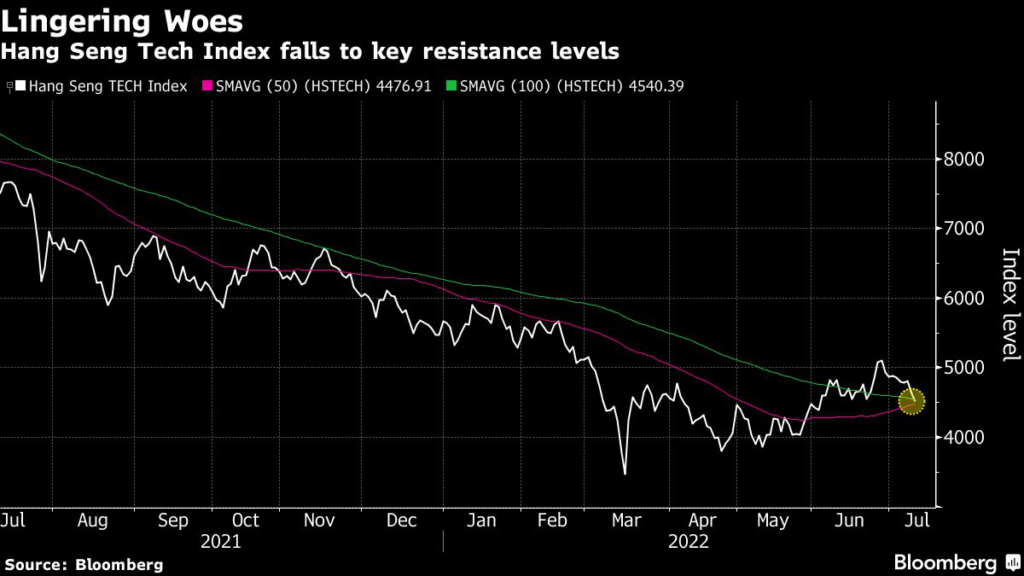
The Hang Seng Tech Index fell as much as 2.8% after tumbling 3.9% on Monday, taking declines from a June peak to 12%. Alibaba Group Holding Ltd. was among the biggest drags on the gauge, down as much as 6.1%. A regional gauge of tech stocks was down as much as 2.3%. 

Fines on Alibaba as well as Tencent Holdings Ltd. over the weekend have revived worries that a year-long crackdown on private enterprise may still have legs. A fresh virus outbreak in Shanghai is adding to the pressure as traders brace for new restrictions just weeks after the city exited a lockdown.

While the fines were “negligible,” said Redmond Wong, a strategist at Saxo Capital Markets, “the penalty reminded investors about regulatory risks over Chinese internet companies.”

The Hang Seng Tech Index is on track to enter into a technical correction and test its 100-day moving average. The daily price average had worked as a major resistance for the index since March 2021 when it slipped below that line.

Investors will likely be keeping tabs on the upcoming earnings season to figure out the extent of recent lockdowns on the mainland on the bottom line. Still, this week’s quick pullback – some of which traders attributed to profit taking – shows that investors remain cautious on the sector.

Other China stock gauges were also in the red on Tuesday. The CSI 300 Index was down as much as 1.3% while the Hang Seng Index lost 1.6%

More stories like this are available on bloomberg.com

©2022 Bloomberg L.P.

Bitcoin Traces an Ominous Chart Pattern Evoking Plunge in June

(Bloomberg) — The latest Bitcoin chart pattern suggests cryptocurrency speculators should brace for more losses.

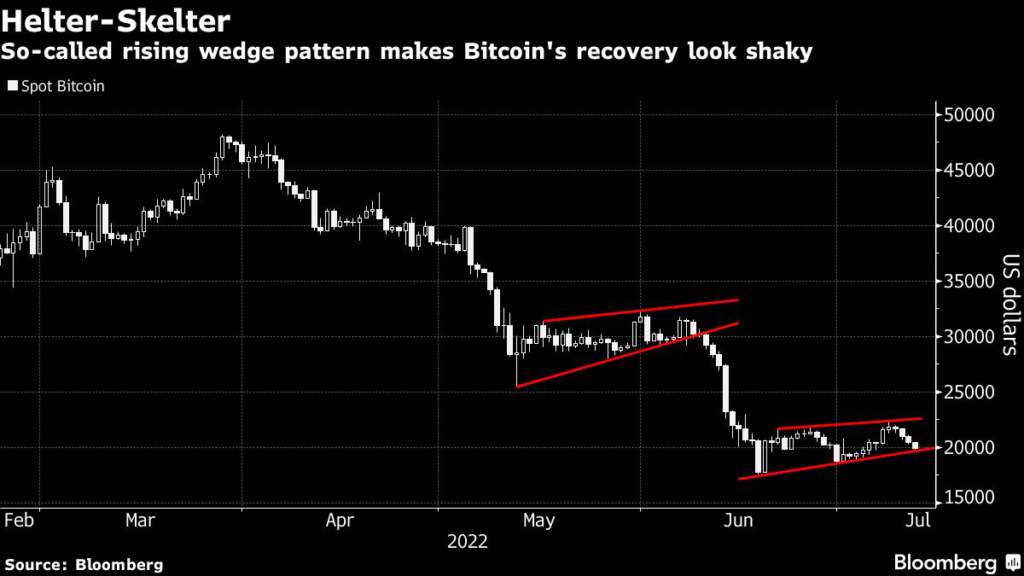
The largest digital token has traced a so-called rising wedge, which technical analysts view as a kind of calm before the storm — a temporary hiatus in episodes of often intense downward pressure on an asset’s price.

A rising wedge also formed between May and June, snapping an earlier sharp retreat in Bitcoin, only to give way to a 42% slump that took the virtual coin to $17,600 from more than $30,000.

Opinion is split on whether the token has found a floor around $20,000 after a 57% plunge this year sparked by tightening monetary policy, the implosion of leveraged crypto outfits and a glum mood in global markets.

The latest MLIV Pulse survey sides with the bears: most respondents said the token is more likely to tumble to $10,000 than to hit $30,000. It shed about 2.4% to reach $19,927 as of 12:10 p.m. in Singapore on Tuesday.

“Not only is the broader market environment not in its favour, even if the occasional bear-market rally inspires some hope, but the crypto community isn’t exactly buzzing either,” Craig Erlam, a senior market analyst at Oanda, wrote in a note.

More stories like this are available on bloomberg.com

©2022 Bloomberg L.P.

Wefox Sees Valuation Jump 50% to $4.5 Billion in Funding Round

(Bloomberg) — Wefox, an insurance-technology firm founded by former Groupon Inc. and Deutsche Bank AG staff, raised $400 million in a funding round that values the company at $4.5 billion.

That’s a 50% boost from a previous round a year ago when it was valued at $3 billion, the company said in a statement on Tuesday. Mubadala Investment Co., the Abu Dhabi-based sovereign wealth fund, led the round. 

The funds will be put toward expanding into new markets — including the Netherlands, France, Spain and the UK — and building out the platform, Wefox said. They’ll also give the company an opportunity to add employees, targeting those that competitors have let go in a recent round of layoffs in Europe’s tech sector. 

“We are seeing a lot more, high-quality profiles available now,”  Wefox Chief Executive Officer Julian Teicke said in an interview. “The crisis gives us many opportunities that weren’t there beforehand.” 

Berlin-based Wefox is planning to add 700 employees by the end of the year. 

Teicke, a former Groupon sales manager, started the business in 2015 alongside Fabian Wesemann, a former Deutsche Bank analyst, and investor Dario Fazlic. The startup provides insurance products for users in Germany, Austria, Italy, Switzerland and Poland. 

The company provides car, household, liability and health insurance products and is looking to expand into accident, building and e-bike insurance this year. 

More stories like this are available on bloomberg.com

©2022 Bloomberg L.P.
Dye & Durham Mulls Walking Away From Link Deal

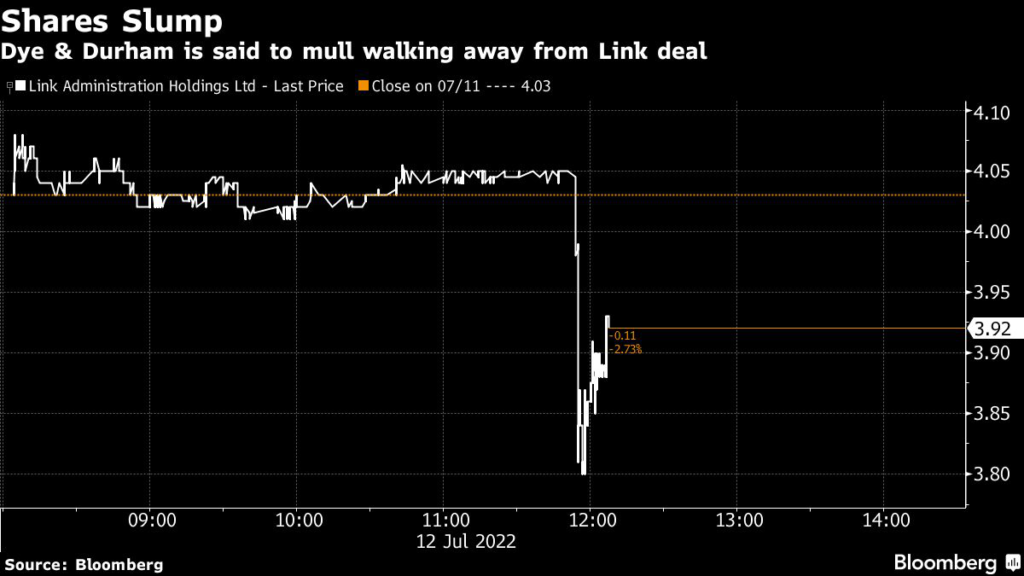
(Bloomberg) — Software firm Dye & Durham Ltd. is weighing walking away from pursuing Australian data-services outfit Link Administration Holdings Ltd., according to people familiar with the matter, potentially ending a deal that was once worth C$3.2 billion ($2.5 billion).

The Toronto-based firm may not table a new offer for the Australian pension fund management platform after its revised bids were rejected, according to the people, who asked not to be identified as the matter remained confidential.

No final decision has been made and Dye & Durham could still proceed with its pursuit of Link, the people said. Representatives for Dye & Durham and Link declined to comment.

Shares of Link slumped as much as 5.7% in their biggest decline in nearly four weeks after the Bloomberg News report, giving it a market value of about $1.3 billion.

Link has rejected Dye & Durham’s takeover offer for the second time in as many weeks after the Canadian company attempted to revise down the price of an earlier agreed deal dating back to December for A$5.50 per share.

Dye & Durham has been trying to cut the price after a global selloff in technology and software stocks, including a 28% drop this year in the shares of real-estate conveyancing unit Pexa Group Ltd., of which Link is the major shareholder.

The Canadian suitor would be liable for a reverse break fee of A$28.62 million if it chooses to terminate the deal, according to an earlier agreement.

(Updates with Link shares in fourth paragraph.)

More stories like this are available on bloomberg.com

©2022 Bloomberg L.P.
Texas Power Grid Holds Up Under Strain of Blistering Heat Wave

(Bloomberg) — The Texas electric grid avoided blackouts Monday despite a searing heat wave that depleted electricity supplies in America’s second most populous state.

The Electric Reliability Council of Texas on Monday night lifted its call for conservation that it had imposed over a potential power shortage.

While electrical use on the grid hit an unofficial record of 78.3 gigawatts, it came in below earlier estimates, an Ercot spokeswoman said. Residents and businesses appeared to heed the state’s request to limit power use, giving the grid enough of a cushion to avoid more drastic measures.

Power grids around the globe are facing severe tests this summer as climate change drives temperatures to record highs and Russia’s war in Ukraine has strained fuel supplies. In the US, officials have warned that a vast swath of the nation, from the Great Lakes to the West Coast, is at risk of blackouts. Texas has already set at least six records for power demand this year.

Heat will continue to blanket Texas on Tuesday, with Dallas and Fort Worth forecast to hit 104 degrees Fahrenheit (40 degrees Celsius), according to the National Weather Service. The cities will likely see highs above 100 degrees through Thursday.

Cryptocurrency miners were among those that answered the call to conserve Monday. Almost all of the major mining operators had scaled back operations, allowing about 1 gigawatt of capacity to flow back to the grid, according to the Texas Blockchain Association. Crypto mining has taken off in Texas in the past year, leading to concerns that the power-intensive operations would tax the state’s energy systems. A gigawatt is enough to power about 200,000 Texas homes.

Texas’s power grid remains under scrutiny more than a year after the system collapsed during a winter storm, leaving much of the state without power for days. More than 240 people died, and the true economic costs topped $50 billion. Officials enacted a raft of reforms following the crisis, but critics warn the system remains vulnerable.

More stories like this are available on bloomberg.com

©2022 Bloomberg L.P.

Bitcoin Falls a Fourth Day to About $20,000 Amid Dollar Strength

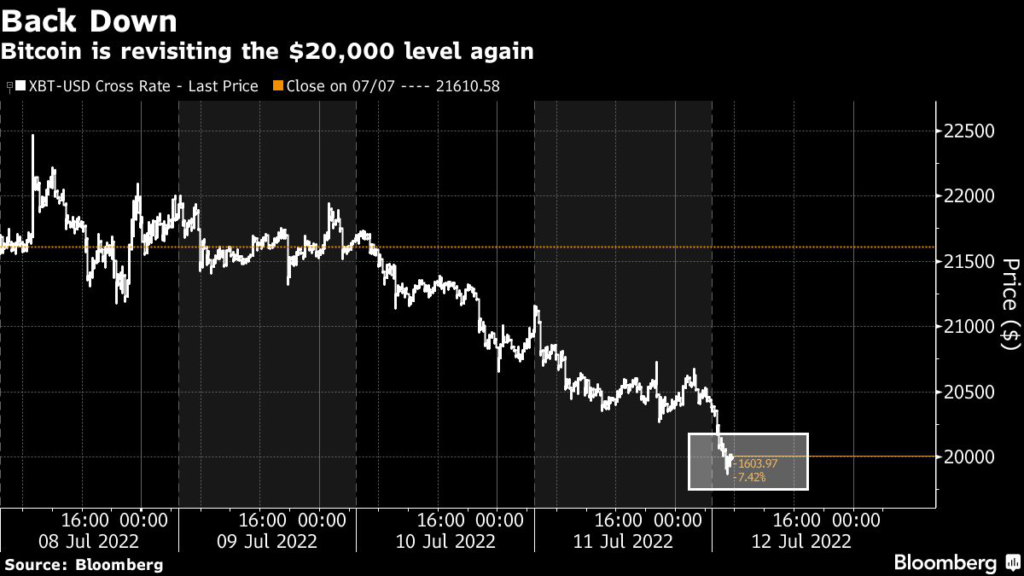
(Bloomberg) — Bitcoin fell back below $20,000 on Tuesday after enjoying its strongest week in more than three months last week, as a surge in the greenback rippled through global markets.

The largest cryptocurrency dropped as much as 2.6% to $19,870, declining for a fourth straight day ahead of US consumer-price data Tuesday. It hit $22,472 on Friday as risk appetite returned to broader assets. Second-largest Ether slid as much as 4.1% to $1,090.94. The MVIS CryptoCompare Digital Assets 100 index dropped as much as 2.6%.

“Expect apathetic back-end vol and basis flows in another summer trading week with CPI likely to be the main event on July 13,” Genesis’s Noelle Acheson and Gordon Grant said in a note Monday. “Notwithstanding a modicum of fireworks around last Friday’s weekly options expiry that saw Bitcoin blow through $22,000 and touch the 200-week moving average, with Ether pushing toward $1,300 in sympathy, the weekend session saw a resumption of choppy, downwardly oriented price action that has characterized recent months.”

The dollar jumped on Monday ahead of the CPI, which could offer insight into the Federal Reserve’s potential rate-hike path. Bitcoin and other cryptocurrencies have struggled as the central bank works to combat high inflation readings, and have tended to trade along with risk assets for the past couple of years. 

Bitcoin is more likely to tumble to $10,000, cutting its value roughly in half, than it is to rally back to $30,000, according to 60% of the 950 investors who responded to an MLIV Pulse survey that ran July 5-8. Forty percent saw it going the other way.

More stories like this are available on bloomberg.com

©2022 Bloomberg L.P.
Canadian Pension Giant Snaps Up New Zealand Phone Towers Stake

(Bloomberg) — Spark New Zealand Ltd. is selling a majority stake in its mobile-phone tower assets to Canadian pension fund Ontario Teachers’ Pension Plan Board in a NZ$900 million ($550 million) deal.

The fund, which invests globally to deliver retirement income for current and retired teachers in Ontario, will acquire 70% of Spark’s TowerCo business, the Auckland-based telecommunications company said Tuesday. 

The transaction, which is subject to New Zealand Overseas Investment Office approval, values TowerCo at NZ$1.18 billion and Spark expects net cash proceeds of NZ$900 million. Completion is anticipated in the first half of the 2023 financial year.

The proceeds will enable “direct shareholder returns and investment in future growth opportunities that will accelerate Spark’s transition from traditional telecommunications to higher growth digital services,” Spark Chair Justine Smyth said in a statement. The company intends to release an updated capital management policy at its full-year results on Aug. 24, she said.

Spark shares rose 1.3% to NZ$4.96 at 11:07 a.m. in Wellington.

Telecommunications companies around the world are separating so-called passive assets such as mobile-phone towers and looking for specialist investors. Spark competitor Vodafone New Zealand is also seeking buyers for its wireless phone towers, while Australia’s Telstra Corp. last year raised capital from the sale of a stake in its towers and planned to return some of that to shareholders.

Spark said that under the terms of the deal with Ontario Teachers’, it has entered into a 15-year agreement with TowerCo, plus rights of renewal, to secure access to existing and new towers, with a build commitment of 670 sites over the next 10 years.

Spark will continue to determine how its mobile network is developed, including where and when capacity investments occur, with TowerCo then designing and deploying these build programs.

When assessing the most appropriate use of the proceeds, Spark said it will consider three key pillars — maximizing returns to shareholders, investment in future growth and maintaining financial flexibility through an appropriate investment grade debt rating. The updated capital management policy will provide clarity on the proportion of proceeds allocated to each of these areas.

More stories like this are available on bloomberg.com

©2022 Bloomberg L.P.

Close Bitnami banner
Bitnami