Bloomberg

NASA’s James Webb Telescope Captures New Detail of Distant Galaxy Cluster

(Bloomberg) — President Joe Biden revealed one of the first full-color images from the James Webb Space Telescope, marking the first time human beings have seen a distant galaxy cluster as it appeared more than 4 billion years ago in such vivid detail. 

“It’s a new window into the history of our universe, and today we’re gonna get a glimpse of the first light to shine through that window,” Biden said Monday during an event at the White House. “It’s astounding to me.”

The images are the highest-resolution view of the universe ever captured, and demonstrate the capabilities of the $10 billion observatory designed to view deep into space and time. It depicts the galaxy cluster SMACS 0723 as it appeared 4.6 billion years ago, according to NASA, and shows tiny, faint structures in distant galaxies that have never been seen before.

“If you held a grain of sand on the tip of your finger at arm’s length that is the part of the universe that you’re seeing,” NASA administrator Bill Nelson said. “That light that you are seeing on one of those little specks has been traveling for over 13 billion years.”

NASA is set to unveil additional images Tuesday that Biden said “will be a historic moment for science and technology, for astronomy and space exploration, for America and all of humanity.”

“These images are going to remind the world that America can do big things,” he said. 

The satellite telescope — the largest ever launched — was sent into orbit roughly a million miles from Earth late last year, and has been undergoing months of tests, calibrations and alignments. The image released Monday at the White House is the first of a batch that are expected to be unveiled by NASA and the European Space Agency this week, depicting details of star formations, galaxy clusters, and distant planets.

Read more: Massive Webb Telescope May See Close to the Beginning of Time

The satellite uses infrared light, allowing it to see farther than any previous telescope — including the Hubble telescope, which it is replacing. Scientists hope Webb will provide new revelations about what the early universe looked like, how galaxies and black holes evolve, and the life cycles of stars and planetary systems.

“Today represents an exciting new chapter in the exploration of our universe,” Vice President Kamala Harris said, adding that the telescope “will enhance what we know about the origins of our universe, our solar system, and possibly life itself.”

More stories like this are available on bloomberg.com

©2022 Bloomberg L.P.

‘Thor’ Tops Box Office, Improving Disney’s 2022 Record

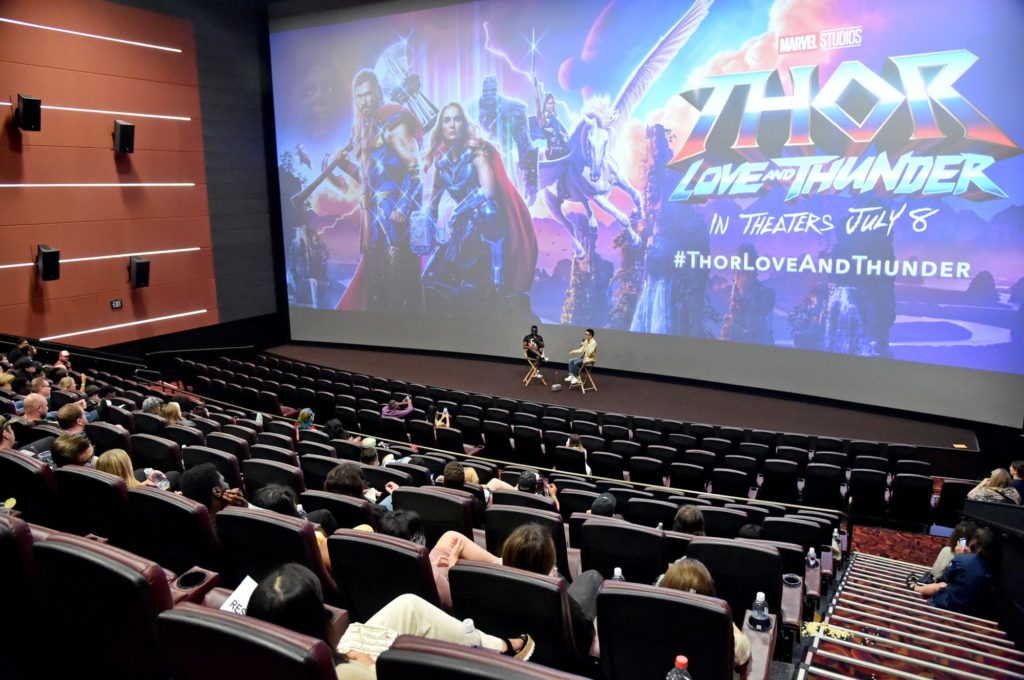
(Bloomberg) — “Thor: Love and Thunder,” the second major Marvel movie to debut in 2022, topped the domestic box office in its first weekend in theaters, bolstering Walt Disney Co.’s return to the big screen two years into the Covid-19 pandemic.

  • “Love and Thunder” generated $144.2 million in ticket sales over the weekend, researcher Comscore Inc. said Monday. That’s Disney’s second-best domestic debut this year and in line with the $135 million to $165 million researcher Boxoffice Pro had forecast. The studio also projected ticket sales within that range.
  • The movie helped Disney shake off the poor performance of its last theatrical debut, Pixar’s “Lightyear,” which slid to seventh place over the weekend.

Key Insights

  • “Love and Thunder” tells the story of the comic-book character, a superhero based off the Norse mythology. It’s the fourth film in a series that began with “Thor” in 2011. Chris Hemsworth returns in the title role, while the movie also stars Tessa Thompson, Natalie Portman and Christian Bale.
  • The movie was a middle-of-the-road debut for a Marvel project. It had a smaller domestic opening than “Doctor Strange in the Multiverse of Madness,” which took in $187 million in May. But it did better than the last film focused on the character, “Thor: Ragnarok,” which opened to $123 million in November 2017. “Love and Thunder” has a 67% approval rating from critics on Rotten Tomatoes, on a par with “Ragnarok.”
  • Disney has had a patchy return to theaters, after sending many of its new movies straight to its Disney+ streaming service during the pandemic. Last month its animated film “Lightyear,” opened in second place with $51 million in ticket sales, a far weaker debut than analysts expected.
  • “Minions: Rise of Gru,” which broke a Fourth of July record in its opening weekend, fell to second place this week. It made $46.1 million, Comscore said. The movie has become popular on TikTok, helping drive ticket sales.

Get More

  • Read how “Minions” became a TikTok star.
  • See the schedule for upcoming releases.
  • See Boxoffice Pro’s long-range forecast.

More stories like this are available on bloomberg.com

©2022 Bloomberg L.P.

Heinz Says New Steelers Stadium Deal Was ‘Significantly More Than We Could Justify’

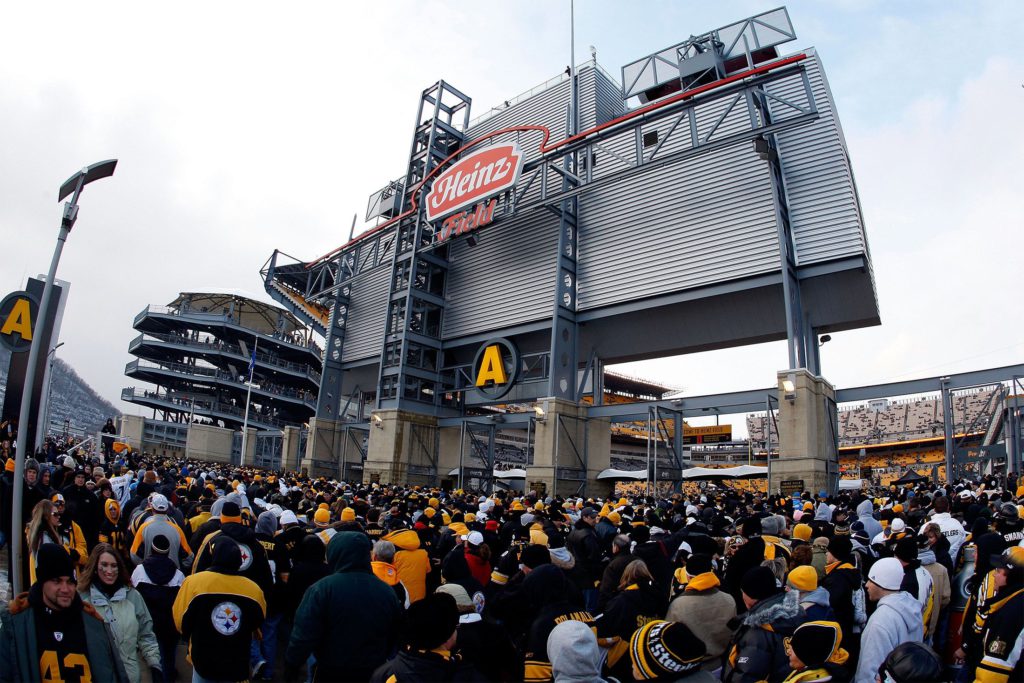
(Bloomberg) — After 21 years and more than $57 million, the Pittsburgh Steelers will no longer be playing in Heinz Stadium. 

Acrisure, a privately-held insurance company, signed a 15-year deal for the naming rights of the NFL team’s stadium in Pennsylvania. The firm declined to give financial terms, but a spokesman for Kraft Heinz Company said it was too rich for the ketchup-maker. 

“For 2022, while we worked diligently with the Steelers for several months around a new naming rights deal, they found a new partner willing to pay significantly more than we could justify,” Alex Abraham, a Kraft Heinz representative, said in an email.

It’s the latest in a series of stadium renaming deals. Last year, Crypto.com took over the naming rights for the Los Angeles Lakers’ stadium in a deal reported to be worth more than $700 million over the span of 20 years, while cryptocurrency exchange FTX inked a 10-year, $17.5 million deal to rebrand the Cal Golden Bears football field. In 2019, Oracle bought the naming rights to the  San Francisco Giants’ stadium for more than $200 million in a 20-year deal. 

Kraft Heinz has deep roots in Pittsburgh — H.J. Heinz was born and launched his brand there, and it remains the co-headquarters of the modern company. Acrisure has no such connection. While co-founder and Chief Executive Officer Greg Williams is a “lifelong Steelers fan,” according to the press release, the insurance company is based in Grand Rapids, Michigan. For Acrisure, renaming the stadium is an opportunity to raise the company’s national profile.  

 “Through Acrisure Stadium, we will increase awareness of the extraordinary advantage Acrisure brings our clients while conveying our strong sense of community,” Williams said in the release. 


More stories like this are available on bloomberg.com

©2022 Bloomberg L.P.

Rogers Faces Probe of Network Failure as Shaw Investors Shaken

(Bloomberg) — The network failure at Rogers Communications Inc. will be investigated by Canada’s telecommunications regulator, heaping more pressure on the company as its tries to gain approval of its acquisition of Shaw Communications Inc. 

Rogers Chief Executive Officer Tony Staffieri and other telecom executives met Monday with Canadian Industry Minister Francois-Philippe Champagne in the aftermath of a network collapse that shut down wireless and internet service for 12 million people. The problems, which began Friday, affected access to 911 emergency services, financial payment systems, government offices and even caused the postponement of events such as a concert by The Weeknd. 

Champagne said the Rogers network failure was “unacceptable” and that immediate steps were needed to fix reliability issues. The minister ordered companies including Rogers, BCE Inc. and Telus Corp. to reach agreements on emergency roaming and mutual assistance during outages and said there would be a probe of the events by the communications regulator, the Canadian Radio-television and Telecommunications Commission. 

Staffieri apologized again and defended his company’s C$20 billion ($15.4 billion) proposal to buy Shaw as a way to improve the communications system. The company has said the transaction will free up capital for network investment. 

“We very much remain committed to the Shaw transaction,” Staffieri said Monday in an interview on BNN Bloomberg Television. “That transaction has always been about expanding our network capabilities, attaining more redundancy and coverage across the nation that can only help in situations like this.” 

But the shares of both companies tumbled as investors grow more concerned that the deal could fall apart. Champagne’s department has the final say on approvals the transaction.

Shaw fell 4.3% to C$34.67, its lowest close since June 17 and 14% below the Rogers takeover offer of C$40.50 a share. Rogers fell 4.6%. 

“This is a significant test for the leadership of the Rogers organization,” Robert McFarlane, former chief financial officer of Telus, said on BNN Bloomberg. “They need to take concrete actions so it never happens again. And they need to compensate or do actions that engender loyalty.”

The country’s antitrust body, known as the Competition Bureau, opposes the Shaw deal and Friday’s outage could provide the regulator with more ammunition in its battle to stop the merger.

The “unprecedented” failure “is likely to introduce incremental regulatory risk to the Shaw transaction, heightens investor concerns regarding Rogers’ ability to execute on deal synergies and counters a constructive industry narrative on network performance,” BMO Capital Markets analyst Tim Casey said in a note Monday.

Casey estimated Rogers will take a C$70 million hit to revenue and to earnings before interest, taxes, depreciation and amortization in the third quarter because of the problems. He lowered his estimate for revenue and Ebitda by C$150 million this year and next. 

(Updates with new information from first paragraph.)

More stories like this are available on bloomberg.com

©2022 Bloomberg L.P.

Twitter Lawyers Call Musk’s Deal Termination ‘Wrongful’

(Bloomberg) — Twitter Inc.’s lawyers called Elon Musk’s termination of his $44 billion buyout agreement “invalid and wrongful” in a letter to the billionaire’s attorneys, a preliminary step by the social network in the looming legal battle over the deal.

Twitter lawyer William Savitt, of Wachtell, Lipton, Rosen & Katz, wrote to Musk’s lawyers at Skadden Arps Slate Meagher & Flom LLP, saying that backing out of the deal “constitutes a repudiation of their obligations under the agreement,” according to a copy of the July 10 letter filed with the Securities and Exchange Commission. Musk agreed to buy Twitter for $54.20 per share in late April. 

“Twitter has breached none of its obligations under the agreement, and Twitter has not suffered and is not likely to suffer a company material adverse effect,” Savitt wrote. “Twitter reserves all contractual, legal, and other rights, including its right to specifically enforce the Musk parties’ obligations under the agreement.”

On July 8, Musk said he was terminating his agreement to take the San Francisco-based company private. The billionaire alleges that Twitter misrepresented user data, claiming the number of spam bots on the platform is much higher than the company has disclosed.

Musk has not offered any evidence of this claim, and Twitter has repeatedly denied this assertion. The social media company reiterated last week that the number of bots on the service was well under 5% of its total daily active users, but Musk said he has been unable to confirm this claim using the data Twitter has provided him.

Twitter Chairman Bret Taylor tweeted Friday that the company would “pursue legal action” to force Musk to complete the merger agreement. The social media company aims to file suit early this week, people familiar with the matter said on July 10.

The fight sent Twitter shares down 11% to $32.65 at Monday’s close, the worst one-day decline in more than 14 months.

The buyout agreement specifies any legal dispute over the deal must be heard in Delaware. By close of business Monday, no suit had been filed by either side over the teetering transaction.

Read more about the coming legal fight over Musk’s Twitter deal

(Updates with details on the deal starting in second paragraph.)

More stories like this are available on bloomberg.com

©2022 Bloomberg L.P.

Musk’s Debt Bankers Would Avoid Steep Losses If Deal Fails

(Bloomberg) — Banks are usually upset when large leveraged buyouts fall apart because of the hefty fees they generate. But Elon Musk’s decision to back out of a $44 billion bid for Twitter Inc. may mean dodging steep losses from underwriting the debt. 

Credit markets have tumbled since banks first agreed to raise $13 billion to finance the deal in April. The riskiest piece of the debt package alone would have caused losses of between $150 million and $200 million at current market levels, according to Bloomberg calculations. 

When banks commit buyout debt, they provide temporary financing that’s replaced by high-yield bonds and leveraged loans. They agree to cap the cost of the new debt, which is sold to investors. 

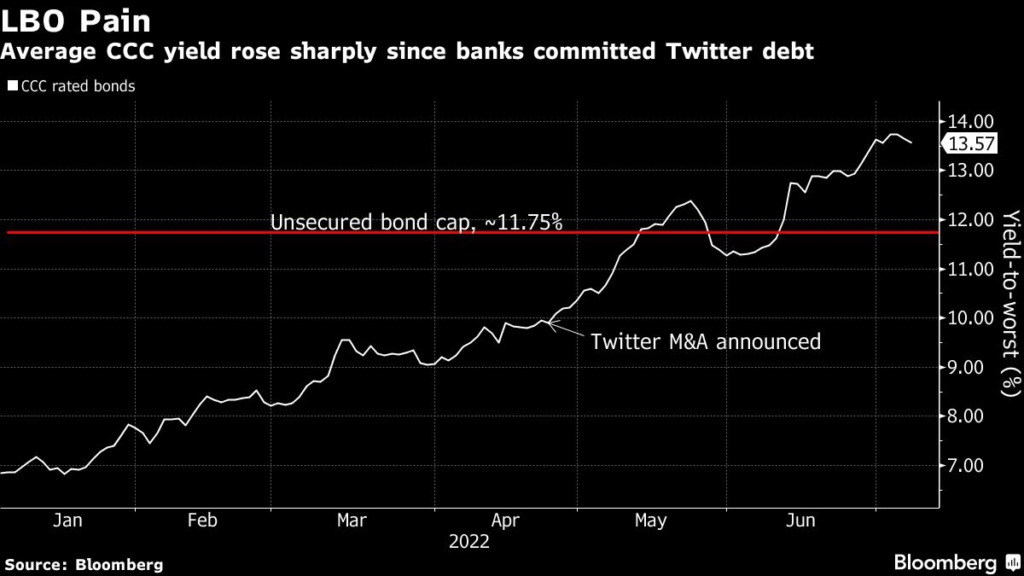
Banks had promised that the riskiest Twitter buyout debt — $3 billion of unsecured bonds to be rated CCC, the lowest rung of junk — would cost no more than about 11.75%. That compares to a market average of about 13.6% on comparably-rated bonds, up from 9.9% when the deal was announced, according to data compiled by Bloomberg.

If the debt yields more than 11.75%, banks eat into fees. They would incur outright losses if the rate exceeds 12.125%. 

At a fixed 11.75% coupon, and assuming an eight-year maturity, banks selling the unsecured bonds today would have to offer a discounted price of about 91 cents on the dollar to reach an all-in yield of about 13.6%. That would result in a loss of between $150 million and $200 million, net of underwriting fees banks typically earn for selling unsecured debt.

The Twitter financing package — one of the largest in recent memory — also includes $6.5 billion of leveraged loans and $3 billion of secured junk bonds. Those types of debt have held up better than unsecured bonds — though the loan market has dropped significantly — and it’s unclear how much of a loss, if any, banks would take at current market levels.

Underwriting losses may be at least partly offset for Morgan Stanley, Bank of America Corp., and Barclays Plc, which would be expected to receive fees for providing M&A advisory services to Musk. Four other banks that only provided the debt — MUFG Bank, Mizuho, BNP Paribas SA, and Societe Generale SA — risk going deeply into the red if the deal goes ahead.

Representatives at Morgan Stanley, Bank of America, Barclays, MUFG, Mizuho, BNP Paribas and Societe Generale declined to comment.  

The entire situation is in flux because Twitter’s board plans to sue to force Musk to complete the acquisition. If that happens and debt markets rally, banks may be able to fund the deal without losses. 

In a letter to Musk on Sunday, Twitter’s lawyers said the billionaire’s purported termination of the merger agreement is “invalid and wrongful” and that equity and debt commitments for the deal remain in effect.

Read more: Why Banks Face Billions in ‘Hung Debt’ as Deals Cool: QuickTake

Twitter isn’t the only LBO threat to banks. The biggest pain point is the upcoming $15 billion package helping to fund the buyout of Citrix Inc., signed in late January, which could leave banks on the hook for about $1 billion of losses.

Elsewhere in credit markets:

Americas

The founders of bankrupt crypto hedge fund Three Arrows Capital haven’t been cooperating in the firm’s liquidation process and their whereabouts were unknown as of Friday, according to court papers

  • The asset-backed security market is set to kick into high gear after companies piled in with early marketing efforts late last week
  • Two companies are selling bonds in the US investment-grade primary market following a strong US employment report on Friday
  • For deal updates, click here for the New Issue Monitor
  • For more, click here for the Credit Daybook Americas

EMEA

Two issuers sold bonds in the primary, while the European Union’s 8 billion-euro ($8.06 billion) two part NGEU sale is likely to boost issuance volumes tomorrow. 

  • Corporate bond issuance is likely to shrink in coming months due to its high cost compared to bank loans
  • Banks face big potential losses from about $80 billion in acquisition debt that they promised to raise to facilitate mergers and leveraged buyouts when financial conditions were better
  • Rising interest rates and the end of easy money are causing pain for vast swathes of the economy, but for the real estate sector the drying up of central bank largesse threatens an entire way of doing business
    • An index of real-estate bonds has lost more than 17% since the start of the year, the worst performing sector in the region’s high-rated debt market

Asia

China Evergrande Group suffered its first rejection from local creditors to extend a bond payment, a development that may result in a landmark onshore default and encourage investors to take a tougher stance against other developers battered by the nation’s property debt crisis.   

  • Meanwhile, Japanese megabank MUFG is marketing dollar debt in an otherwise subdued session Monday for such deals from Asia
  • A risk-off mood hung over most markets in the region as concerns about the global economy dragged down raw materials including oil
    • Japan was the exception after the ruling coalition expanded its majority in an upper house election
  • Spreads on Asian investment-grade dollar bonds, which have tightened about 2bps over the last fortnight, were little changed Monday, according to a trader

(Updates with Twitter letter to Musk in eleventh paragraph. A previous version of this story corrected size of potential losses in second paragraph and bond price in sixth paragraph.)

More stories like this are available on bloomberg.com

©2022 Bloomberg L.P.

Wall Street Sours on Stocks in Anemic Trading Day: Markets Wrap

(Bloomberg) — Stocks slumped, with traders positioning for a hot inflation reading and the start of a key earnings season that may provide clues on whether the economy is headed toward a recession. The dollar climbed.

A selloff in megacaps like Tesla Inc. and Apple Inc. weighed heavily on the equity market — which saw its lowest trading volume of 2022. Twitter Inc. plunged 11% as Elon Musk walked away from his $44 billion deal to buy the company, setting the scene for a legal battle. The euro edged closer toward parity with the greenback, while 10-year US yields dropped below 3%.

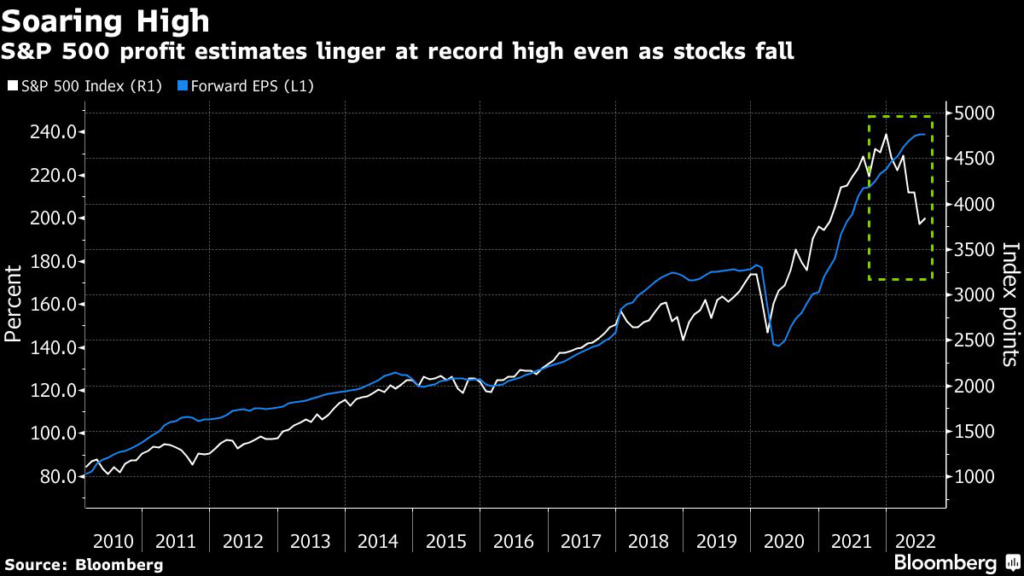
Amid a pervasive confluence of economic challenges, investors are waiting to see if profits are holding up or if companies will cut forecasts significantly. One reason for caution is the dichotomy between two major Wall Street forces. Analysts are betting Corporate America is resilient enough to pass on higher costs to consumers at a time when many strategists aren’t really convinced that’s the case.

“The stock market has NOT already priced in any possible upcoming decline in earnings estimates from this year (or next),” wrote Matt Maley, chief market strategist at Miller Tabak. “Even if earnings estimates stay stable and especially if they decline, the stock market is going to have to fall further before we see an important bottom.”

Maley noted that stocks are trading at valuation levels that are seen as highs — not lows. The current price-to-sales metric, for instance, is at the same level of market tops in 2020, 2018 and at the tech bubble in 2000, he added.

Read: BlackRock Warns Against Dip Buying as High-Volatility Era Dawns

Read: Bostic Confident US Economy Can Handle Another Jumbo Rate Hike

Price pressures, a wave of monetary tightening and a slowing economy continue to keep investors on the sidelines even after an $18 trillion first-half wipeout in global equities. A US inflation reading on Wednesday is expected to get closer to 9%, buttressing the Federal Reserve’s case for a jumbo rate boost in July.

Steep Fed hikes and recession fears have lifted the greenback to the highest levels since March 2020. The dollar surge will be a “massive headwind” for profits at many large US firms and another reason to expect a dimming earnings outlook, wrote Michael Wilson, chief US equity strategist at Morgan Stanley.

Billionaire investor Leon Cooperman said that a stronger dollar is indeed “negative for corporate profits.” In fact, several firms like giants Microsoft Corp., Costco Wholesale Corp. and Salesforce Inc. have also bemoaned the impacts of the US currency’s meteoric ascent.

For Wilson, the S&P 500’s bear market will continue, and he sees fair value at 3,400-3,500 in case of a soft landing and 3,000 in a recession — a 22% downside from Monday’s close.

“A stagflationary stall is as probable as an outright recession,” wrote Lisa Shalett, chief investment officer at Morgan Stanley Wealth Management.

Read: Gross Favors T-Bills Over Stocks, Bonds as Recession Looms Large

Meantime, Citigroup Inc. strategists pointed out that there’s a strong correlation between the Fed’s rate trajectory and earnings growth. They said it’s been common for profits to rise as the Fed tightens its policy, and to contract when the central bank switches to easing in response to economic weakness.

That means corporate earnings should remain resilient to surging inflation and slowing growth, paving the way for battered US stocks to rally in the remainder of 2022, they added.

As big banks kick off the earnings season this week, traders will be looking for clues about the health of the consumer and spending trends as well as lending to businesses and corporate confidence. Real-estate valuations and lending may also be key for market direction, along with thoughts on the state of capital markets.

Results from the FAANG cohort of megacaps like Facebook owner Meta Platforms Inc. and Google’s parent Alphabet Inc. won’t come out until later this month. But investors are getting ready for heightened volatility as profit cuts by industry analysts have been lagging, leaving room for big surprises and dramatic post-earnings moves.

Elsewhere, Bitcoin fell again — and Wall Street expects the cryptocurrency’s selloff to get a whole lot worse. The token is more likely to tumble to $10,000, cutting its value roughly in half, than it is to rally back to $30,000, according to 60% of the 950 investors who responded to the latest MLIV Pulse survey. The tally also showed that 40% saw it going the other way.

Crude declined amid a renewed increase in China’s virus cases, while a court order allowed the crucial CPC terminal on Russia’s Black Sea coast to stay operational — easing some supply concerns. Chicago corn futures climbed as US forecasts point to a heat wave during the crop’s key development period. 

Read: Commodity Bull Case Intact After Selloff, Hedge Fund Boss Says

What to watch this week:

  • Earnings due from JPMorgan, Morgan Stanley, Citigroup, Wells Fargo
  • BOE Governor Andrew Bailey discusses the economic landscape, Tuesday
  • Amazon.com Inc. kicks off its Prime Day event, Tuesday
  • South Korea, New Zealand rate decisions, Wednesday
  • US CPI data, Wednesday
  • Federal Reserve Beige Book, Wednesday
  • US PPI, jobless claims, Thursday
  • China GDP, Friday
  • US business inventories, industrial production, University of Michigan consumer sentiment, Empire manufacturing, retail sales, Friday
  • G-20 finance ministers, central bankers meet in Bali, from Friday
  • Atlanta Fed President Raphael Bostic speaks, Friday

Some of the main moves in markets:

Stocks

  • The S&P 500 fell 1.2% as of 4 p.m. New York time
  • The Nasdaq 100 fell 2.2%
  • The Dow Jones Industrial Average fell 0.5%
  • The MSCI World index fell 1.3%

Currencies

  • The Bloomberg Dollar Spot Index rose 1%
  • The euro fell 1.4% to $1.0044
  • The British pound fell 1.1% to $1.1895
  • The Japanese yen fell 1% to 137.41 per dollar

Bonds

  • The yield on 10-year Treasuries declined nine basis points to 2.99%
  • Germany’s 10-year yield declined 10 basis points to 1.25%
  • Britain’s 10-year yield declined six basis points to 2.18%

Commodities

  • West Texas Intermediate crude fell 1.3% to $103.44 a barrel
  • Gold futures fell 0.6% to $1,731 an ounce

More stories like this are available on bloomberg.com

©2022 Bloomberg L.P.

Broadcom’s Krause Named CEO of New Citrix-Tibco Combination

(Bloomberg) — Tom Krause, who stepped down Monday as president of Broadcom Inc.’s software group, has been named chief executive officer of the company being formed via the merger of Citrix Systems Inc. and Tibco Software.

Citrix said Monday that Krause is to become CEO after that deal closes, confirming a report by Bloomberg News. The transaction is slated to close in the third quarter. 

Krause, 44, was one of the chief negotiators in Broadcom’s $61 billion acquisition of cloud-computing company VMware Inc. He joined Broadcom in 2012 and became its chief financial officer in 2016. Since 2020, he’s led the chip firm’s six software divisions.

Elliott Investment Management and Vista Equity Partners agreed to buy Citrix in January for about $13 billion, with plans to merge it with Vista portfolio company Tibco. 

“Tom is the right leader for the combined company, bringing decades of deep industry experience and an unparalleled track record of building companies and setting them up for sustainable growth and value creation,” Elliott’s head of North American private equity David Kerko, said in a statement. 

Vista Equity Partners Managing Director John Stalder said the firm has the “highest confidence in Tom’s ability to lead the combined teams.” 

Citrix makes software that workers use to log onto to their corporate programs virtually. Tibco is an enterprise data management firm. The combination will create one of the world’s largest software providers, serving 400,000 customers, according to a statement announcing the merger. 

“I am excited to partner with the leadership teams and talented employees from Citrix and Tibco around the world to drive growth and ensure a successful path forward for the combined company,” Krause said. 

(Updates with confirmation from press releases started in first paragraph)

More stories like this are available on bloomberg.com

©2022 Bloomberg L.P.

US-Listed Chinese Stocks Fall on Regulatory Fines and Covid Risks

(Bloomberg) — US-listed Chinese stocks fell sharply on Monday as authorities hit tech giants with regulatory fines and Covid outbreaks renewed concern over lockdowns, sparking investor jitters about the outlook on the group.

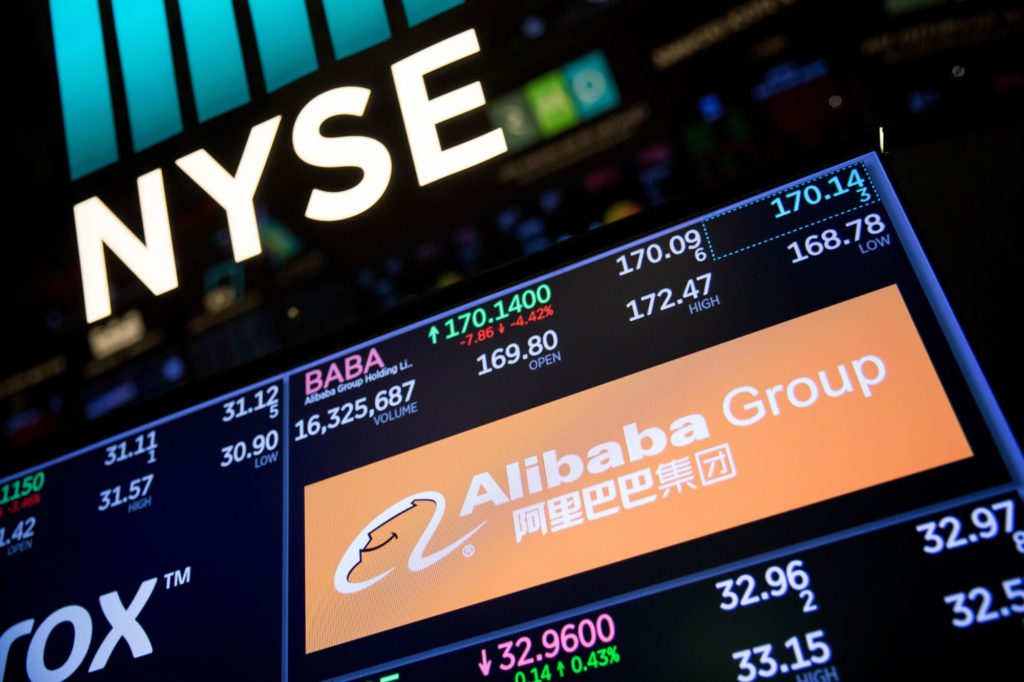
The Nasdaq Golden Dragon China Index tumbled 7.1%, the most since May. Alibaba Group Holding Ltd. was among top decliners, plunging 9.4% after regulators fined the company for not properly reporting past transactions. Tech peers JD.com Inc. and Baidu Inc. slid 3.9% and 5.7% respectively, while travel stock Trip.com sank 6.3%.

In June, the Nasdaq Golden Dragon index staged its best month since early 2019 with a 16% rally, but that has taken a pause recently amid a two-week losing streak as investors rushed to take profit.

China’s antitrust watchdog handed out a 2.5 million yuan ($373,000) fine to Alibaba’s subsidiaries for skipping reports on five deals, according to a statement, while Tencent Holdings Ltd. was also fined. Still, the regulator said it will fully support the development of the companies involved.

“I would view this as part of the final rectification process the authorities alluded to in recent speeches,” said Adam Montanaro, investment director at Abrdn. “Clearly there has been some fast money taking profits but the fundamentals remain attractive.”

Uncertainty around the government’s crackdown on the tech industry has been a key risk preventing investors from adding exposure to Chinese stocks. On Friday, Full Truck Alliance Co. and three other trucking service platforms were summoned by China’s Ministry of Transport over issues including illegal price-cutting, leading to an intraday drop of 9.3% in the company.

There’s some speculation that the yearlong crackdown on Chinese internet firms might be receding. Bloomberg Intelligence analyst Catherine Lim said fines may be nominal and the government has indicated that it aims to close cases on companies such as Alibaba and Tencent. 

Covid flare-ups in Shanghai also weighed on sentiment. The city found its first case of the BA.5 omicron variant sub-strain and daily new cases climbed to the highest since late May. Shanghai is imposing more rounds of mass testing, two weeks after officials declared victory over Covid.

(Updated with share moves at close and chart)

More stories like this are available on bloomberg.com

©2022 Bloomberg L.P.
Bitcoin Miners Shut Off Rigs as Texas Power Grid Nears Brink

(Bloomberg) — Nearly all industrial scale Bitcoin miners in Texas have shut off their machines as the companies brace for a heat wave that is expected to push the state’s power grid near its breaking point. 

Miners such as Riot Blockchain Inc., Argo Blockchain Plc and Core Scientific Inc., who operate millions of energy-intensive computers to secure the Bitcoin blockchain network and earn rewards in the token, flocked to the Lone Star State thanks to its low energy costs and liberal regulations on crypto mining. The state has become one of the largest crypto-mining hubs by computing power in the world. 

“There are over 1,000 megawatts worth of Bitcoin mining load that responded to ERCOTs conservation request by turning off their machines to conserve energy for the grid.” Lee Bratcher, president of Texas Blockchain Association told Bloomberg in an email response. “This represents nearly all industrial scale Bitcoin mining load in Texas and allows for over 1% of total grid capacity to be pushed back onto the grid for retail and commercial use.” 

Miners may see a drop in profitability as the heat wave keeps their machines off by sending energy prices soaring and further stressing the state’s power grid. The miners are already struggling to repay debt and raise additional capital with Bitcoin prices in sharp decline. Shares of public miners have tumbled about 75% this year. 

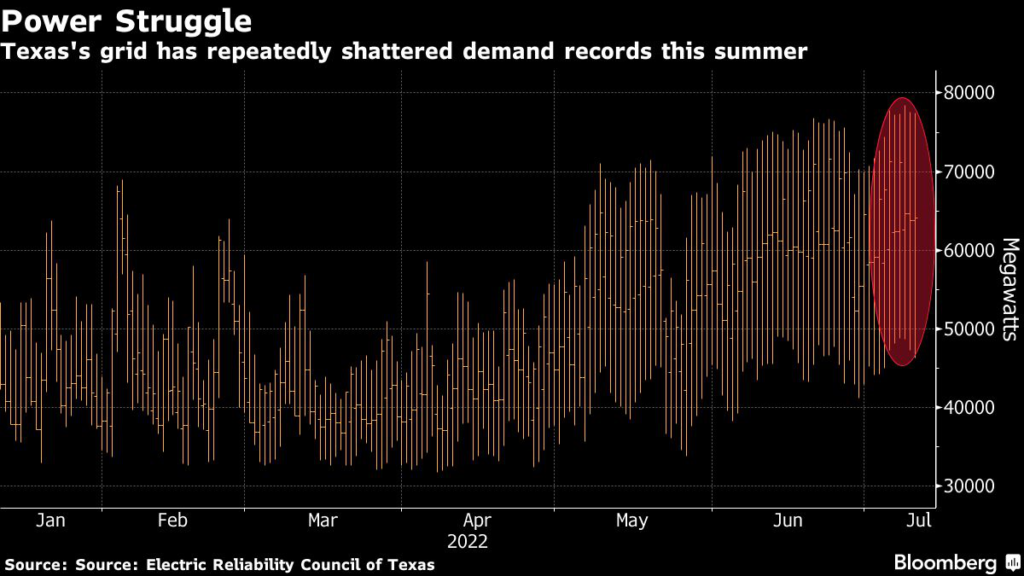
The all-time peak record for energy usage was set Friday with 78,206 megawatts, breaking the previous unofficial all-time peak of 77,460 megawatts that occurred on July 5, according to data from the state’s power operator Electric Reliability Council of Texas. The operator has been working with Bitcoin miners, who are required to turn off their mining machines when the state faces energy shortages. 

While Texas is likely to face more energy shortages in the future, ERCOT expects crypto miners to increase electricity demand by up to six gigawatts by mid-2023, more than enough to power every home in Houston.   

“Currently, 100% of the machines located in Texas have been powered off to provide support for the ERCOT grid,” Core Scientific CEO Mike Levitt said. “In troubled situations including the current Texas heat event, we have been curtailing power and will continue to curtail power as needed.” The company operates in six states, with less than 15% of its production located in Texas, he said.

Riot is participating in ERCOT’s Four Coincident Peak program, in which the company’s Whinstone Facility located in Rockdale, Texas, will curtail energy consumption when called on during the four summer months of peak energy demand, the miner said in an email to Bloomberg. 

(Adds comment from Core Scientific and Riot in the final two paragraphs.)

More stories like this are available on bloomberg.com

©2022 Bloomberg L.P.
Close Bitnami banner
Bitnami