
Bloomberg

Musk’s Debt Bankers Would Avoid Steep Losses If Deal Falls Apart

(Bloomberg) — Banks are usually upset when large leveraged buyouts fall apart because of the hefty fees they generate. But Elon Musk’s decision to back out of a $44 billion bid for Twitter Inc. may mean dodging hundreds of millions of dollars in losses from underwriting the debt.   

Credit markets have tumbled since banks first agreed to raise $13 billion to finance the deal in April. The riskiest piece of the debt package alone would have caused losses exceeding $300 million at current market levels, according to Bloomberg calculations. 

When banks commit buyout debt, they provide temporary financing that’s replaced by high-yield bonds and leveraged loans. They agree to cap the cost of the new debt, which is sold to investors. 

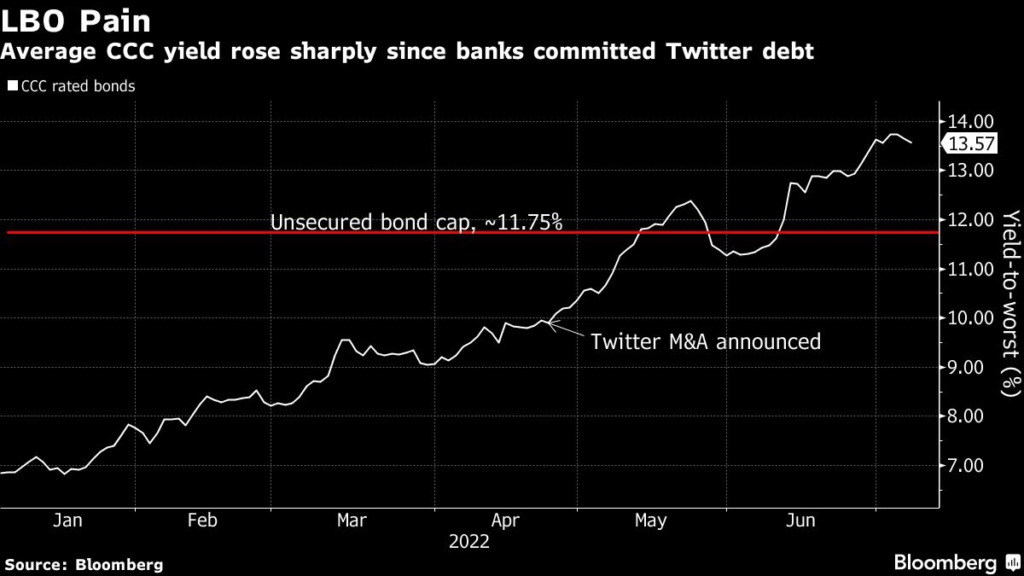
Banks had promised that the riskiest Twitter buyout debt — $3 billion of unsecured bonds to be rated CCC, the lowest rung of junk — would cost no more than about 11.75%. That compares to a market average of about 13.6% on comparably-rated bonds, up from 9.9% when the deal was announced, according to data compiled by Bloomberg.

If the debt yields more than 11.75%, banks eat into fees. They would incur outright losses if the rate exceeds 12.125%. 

At a fixed 11.75% coupon, and assuming an eight-year maturity, banks selling the unsecured bonds today would have to offer a discounted price of about 85 cents on the dollar to reach an all-in yield of about 13.6%. That would result in a loss of more than $300 million, net of underwriting fees banks typically earn for selling unsecured debt.

The Twitter financing package — one of the largest in recent memory — also includes $6.5 billion of leveraged loans and $3 billion of secured junk bonds. Those types of debt have held up better than unsecured bonds — though the loan market has dropped significantly — and it’s unclear how much of a loss, if any, banks would take at current market levels.

Underwriting losses may be partly offset for Morgan Stanley, Bank of America Corp., and Barclays Plc, which would be expected to receive fees for providing M&A advisory services to Musk. Four other banks that only provided the debt — MUFG Bank, Mizuho, BNP Paribas SA, and Societe Generale SA — risk going deeply into the red if the deal goes ahead. 

Representatives at Morgan Stanley, Bank of America, Barclays, MUFG, Mizuho, BNP Paribas and Societe Generale declined to comment.  

The entire situation is in flux because Twitter’s board plans to sue to force Musk to complete the acquisition. If that happens and debt markets rally, banks may be able to fund the deal without losses. 

Read more: Why Banks Face Billions in ‘Hung Debt’ as Deals Cool: QuickTake

Twitter isn’t the only LBO threat to banks. The biggest pain point is the upcoming $15 billion package helping to fund the buyout of Citrix Inc., signed in late January, which could leave banks on the hook for about $1 billion of losses.

Elsewhere in credit markets:

Americas

The founders of bankrupt crypto hedge fund Three Arrows Capital haven’t been cooperating in the firm’s liquidation process and their whereabouts were unknown as of Friday, according to court papers

  • The asset-backed security market is set to kick into high gear after companies piled in with early marketing efforts late last week
  • Two companies are selling bonds in the US investment-grade primary market following a strong US employment report on Friday
  • For deal updates, click here for the New Issue Monitor
  • For more, click here for the Credit Daybook Americas

EMEA

Two issuers sold bonds in the primary, while the European Union’s 8 billion-euro ($8.06 billion) two part NGEU sale is likely to boost issuance volumes tomorrow. 

  • Corporate bond issuance is likely to shrink in coming months due to its high cost compared to bank loans
  • Banks face big potential losses from about $80 billion in acquisition debt that they promised to raise to facilitate mergers and leveraged buyouts when financial conditions were better
  • Rising interest rates and the end of easy money are causing pain for vast swathes of the economy, but for the real estate sector the drying up of central bank largesse threatens an entire way of doing business
    • An index of real-estate bonds has lost more than 17% since the start of the year, the worst performing sector in the region’s high-rated debt market

Asia

China Evergrande Group suffered its first rejection from local creditors to extend a bond payment, a development that may result in a landmark onshore default and encourage investors to take a tougher stance against other developers battered by the nation’s property debt crisis.   

  • Meanwhile, Japanese megabank MUFG is marketing dollar debt in an otherwise subdued session Monday for such deals from Asia
  • A risk-off mood hung over most markets in the region as concerns about the global economy dragged down raw materials including oil
    • Japan was the exception after the ruling coalition expanded its majority in an upper house election
  • Spreads on Asian investment-grade dollar bonds, which have tightened about 2bps over the last fortnight, were little changed Monday, according to a trader

More stories like this are available on bloomberg.com

©2022 Bloomberg L.P.

Rivian Plans Hundreds of Job Cuts Following Surge in Staffing

(Bloomberg) — Rivian Automotive Inc. is planning hundreds of layoffs to trim its workforce in areas where the electric-vehicle maker has grown too quickly, according to people familiar with the matter.

The cuts will focus on nonmanufacturing roles, including teams with duplicate functions, said the people, who asked not to be identified discussing private information. The actions could be announced in the coming weeks, the people said.

The company, which has more than 14,000 employees, could target an overall reduction of around 5%, the people said. The layoffs are still in the planning stage and nothing has been decided. Rivian has operations in California, Michigan and Illinois, where its plant operates, as well as a presence in the UK and Canada.

Rivian didn’t immediately comment.

The company is pulling back after roughly doubling its headcount over the past year to support a ramp-up in production. Rivian, which makes electric pickups and SUVs in addition to delivery vans, notched one of the biggest-ever US initial public offerings in November as it emerged as a leading challenger to market leader Tesla Inc.

Rivian has stumbled as it grappled with global supply-chain breakdowns and parts shortages. Automakers now face broader hurdles as vehicle sales, including those of EVs, soften with consumers put off by high sticker prices.

Rivian’s shares tumbled about 69% this year through Friday’s close.

The Irvine, California-based manufacturer is poised to join companies across corporate America pruning their operations amid growing worries about an economic downturn. Tesla is cutting 10% of its salaried workforce, while protecting manufacturing jobs, after Chief Executive Officer Elon Musk said he sees a recession as inevitable.

As of the end of March, Rivian had almost $17 billion in cash and restricted cash on its balance sheet to help weather the storm. The fledgling EV maker is backed by investors including Amazon.com Inc. and Ford Motor Co. Rivian has a contract with Amazon to build 100,000 battery-electric delivery vans by the end of the decade.

More stories like this are available on bloomberg.com

©2022 Bloomberg L.P.

China Stimulus Unlikely to Reverse Global Metals Meltdown

(Bloomberg) — Commodity investors looking to China to reverse the rout in global metals markets may be disappointed, with Beijing unable to deliver the kind of investment splurge that powered past bull markets.

Base metals had their worst quarter since 2008 in the three months to June, and the retreat deepened in July. Copper plunged briefly below $7,500 a ton in intraday trading last week, its lowest since late 2020, and is down about 29% from a March record. Iron ore is down about a third from its highest this year, and aluminum is about 40% lower.

Chinese authorities are mulling a plan to let local governments sell 1.5 trillion yuan ($220 billion) of special bonds in the second half, according to people familiar with the matter. This potential boost for infrastructure spending helped commodities pare some of their steep losses in recent weeks.

While past waves of Chinese stimulus played a role in rescuing industrial commodities from slumps in global demand — after the 2008 financial crisis, from late 2015, and arguably again in 2020 — there is much more caution this time. Extra funds will likely be used to plug Covid-era budget gaps and won’t tackle the bigger issue for metals demand: a subdued property market and a still-struggling manufacturing sector.

“Yes, China’s economy is going to revive in the second half, but modestly,” Caroline Bain, chief commodities economist at Capital Economics Ltd., said by phone. “That’s possibly a little bit more positive for metals, but we don’t see China being able to spark a new rally.”

While Goldman Sachs Group Inc. says China’s policies could eventually halt the bear market in metals, there’s generally caution over prospects for demand in a nation that accounts for about half of the world’s consumption of everything, from zinc to aluminum. Chinese copper demand will eke out only a small amount of growth this year, says researcher Wood Mackenzie Ltd.

Growth Challenge

The headwinds in China are many. Real estate is still in the grip of a long downturn, the scale of infrastructure spending is uncertain, and export demand is hitting headwinds. The economy probably shrank in the second quarter, and repeated virus outbreaks will make President Xi Jinping’s growth goal of 5.5% this year ever more challenging.

“We haven’t yet seen any of the demand pick-up we were supposed to see after the Covid lockdowns,” said Fan Rui, analyst at Guoyuan Futures Co. Downstream users are “not buying copper at all” amid slumping prices, an indication they expect further declines, she said.

Read more: China data show economy is shrinking in challenge to Xi’s goals

China continues to see sporadic outbreaks of Covid-19 virus. Rising cases in Shanghai have prompted more rounds of mass testing in the financial hub, and the emergence of new sub-variants provides a constant challenge to the country’s zero-tolerance approach to the virus.

Xi ordered an all-out effort to boost infrastructure earlier this year. The plan for local government bonds under consideration by the Ministry of Finance would add to 1.1 trillion yuan in infrastructure support announced in recent weeks.

No Reversal

“The scale and impact from this year’s stimulus will be certainly weaker than the previous ones, as this round we purely count on infrastructure spending,” Xu Xiangchun, analyst with researcher Mysteel, said by phone. “The property sector is in the process of building a bottom, and is not expecting a policy reversal.”

This is a big shift from previous growth cycles that leaned heavily on credit flows to warm the property market. The sector is important not just for construction activity, but for generating wealth for consumers to spend on metal-intensive goods like cars and consumer goods. 

China’s last property cycle peaked in the first half of 2021 as the government’s move to deleverage the sector began to bite. That also ended an unprecedented steel boom from which the market still hasn’t recovered.

There are some signs of an easing in property woes: land transactions and housing sales picked up in June, for example. But the head of China’s No. 2 builder warned the recovery will be slow. Debt issues in the sector remain an issue.

Also, the type of infrastructure being rolled out is different from the past. To put it crudely: Cloud computing, 5G networks and data centers are less materials-intensive than the airports, bridges and high-speed railways that dominated previous cycles.

Grind Lower

Some analysts strike a more optimistic note. Goldman Sachs said it expects policy-led demand to start ramping up this quarter, helping to draw in metal from the rest of the world and push prices higher again. Its last forecast put copper at $10,500 by the year’s end. 

On Monday, the metal fell 2.8% to $7,584.50 a ton on the London Metal Exchange as of 6:01 p.m. local time. Aluminum and zinc fell, by 2.3% and 1.8% respectively. Lead and nickel saw gains near 1.2%. Tin lead gains at 3.5%.

Citigroup Inc. said it’s cautious on copper “with a timely and decisive rollout of stimulus measures” above those already announced needed to support prices at recent levels. “Without it, prices will grind lower,” the bank said in a research note.

Steelmakers in China, which have been disappointed by weak demand so far this year, are also sounding the alarm. One major producer called a meeting this week to discuss a response to the sector’s rapid downturn, and warned of a crisis lasting five years.


(Updates copper price in 16th paragraph)

More stories like this are available on bloomberg.com

©2022 Bloomberg L.P.
Big Tech Sinks Stocks as Clock Ticks on Earnings: Markets Wrap

(Bloomberg) — Stocks fell across the board, with traders bracing for a key inflation reading and the start of the earnings season for clues on whether the economy is headed for a recession. The dollar rallied.

All major groups in the S&P 500 retreated, with losses in megacaps like Tesla Inc. and Apple Inc. weighing heavily on trading. Twitter Inc. plunged after Elon Musk walked away from his $44 billion deal to buy the company, setting the scene for a disruptive legal battle. The euro edged closer toward parity with the greenback, which climbed as much as 1.1%. Treasury 10-year yields dropped below 3%.

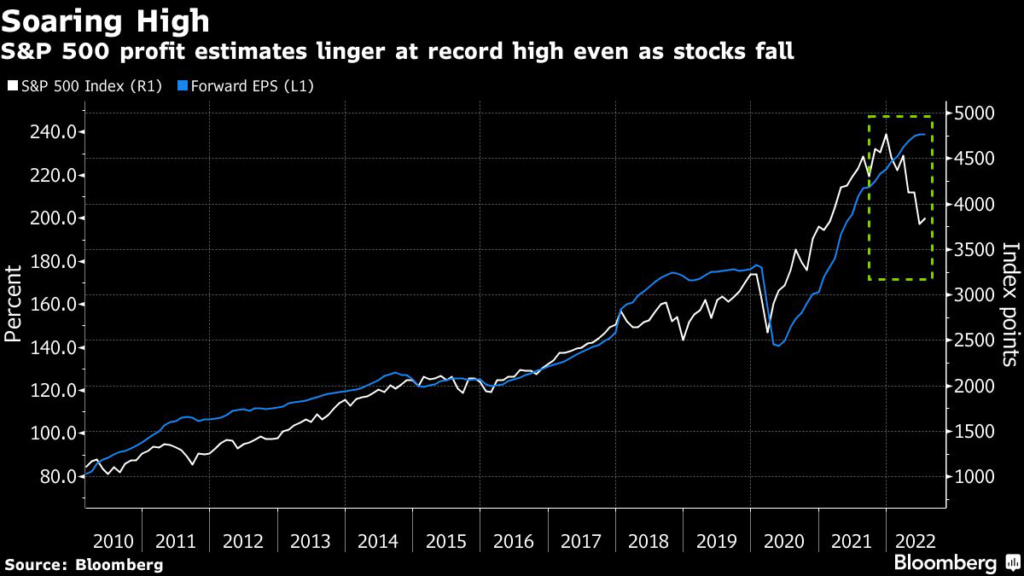
Amid a pervasive confluence of economic challenges, investors are waiting to see if profits are holding up or if companies will cut forecasts. One reason for caution is the dichotomy between two major Wall Street forces. Analysts are betting Corporate America is resilient enough to pass on higher costs to consumers at a time when many strategists aren’t really convinced that’s the case.

“The stock market has NOT already priced-in any possible upcoming decline in earnings estimates from this year (or next),” wrote Matt Maley, chief market strategist at Miller Tabak. “Even if earnings estimates stay stable and especially if they decline, the stock market is going to have to fall further before we see an important bottom for this bear market.”

In fact, Maley noted that stocks are trading at valuation levels that are seen as highs — not lows. The current price-to-sales metric, for instance, is at the same level of market tops in 2020, 2018 and at the tech bubble in 2000, he added.

Read: BlackRock Warns Against Dip Buying as High-Volatility Era Dawns

Price pressures, a wave of monetary tightening and a slowing global economy continue to keep investors on the sidelines even after an $18 trillion first-half wipeout in global equities. A US inflation reading on Wednesday is expected to get closer to 9%, buttressing the Federal Reserve’s case for a jumbo July rate increase.

A combination of steep Fed hikes and economic growth fears have lifted the greenback to the highest levels since March 2020. The dollar surge will be a “massive headwind” for profits at many large US firms and another reason to expect a dimming earnings outlook, wrote Michael Wilson, chief US equity strategist at Morgan Stanley.

Billionaire investor Leon Cooperman said that a stronger dollar is indeed “negative for corporate profits.” In fact, several firms like giants Microsoft Corp., Costco Wholesale Corp. and Salesforce Inc. have also bemoaned the impacts of the US currency’s meteoric ascent.

For Wilson, the S&P 500’s bear market will continue, and he sees fair value at 3,400-3,500 in case of a soft landing and 3,000 in a recession — a 23% downside from Friday’s close.

“Markets are moving at lightening speed to discount a rollover in inflation rates, a reversal of Fed tightening and an outright recession,” wrote Lisa Shalett, chief investment officer at Morgan Stanley Wealth Management. “A stagflationary stall is as probable as an outright recession.”

Meantime, Citigroup Inc. strategists point out that there’s a strong correlation between the Fed’s rate trajectory and earnings growth. They say it’s been common for earnings to rise as the Fed tightens its policy and to contract as the central bank switches to easing in response to economic weakness.

As big banks kick off the earning season later this week, traders will be looking for clues about the health of the consumer and spending trends as well as lending to businesses and corporate confidence. Real-estate valuations and lending may also be key for market direction, along with thoughts on the state of capital markets.

Elsewhere, Bitcoin fell again — and Wall Street expects the cryptocurrency’s selloff to get a whole lot worse. The token is more likely to tumble to $10,000, cutting its value roughly in half, than it is to rally back to $30,000, according to 60% of the 950 investors who responded to the latest MLIV Pulse survey. The tally also showed that 40% saw it going the other way.

Crude declined amid a renewed increase in China’s virus cases, while a Russian court allowed a crucial export route for Kazakh oil to keep operating — easing some supply concerns. 

Read: Commodity Bull Case Intact After Selloff, Hedge Fund Boss Says

What to watch this week:

  • Earnings due from JPMorgan, Morgan Stanley, Citigroup, Wells Fargo
  • BOE Governor Andrew Bailey discusses the economic landscape, Tuesday
  • Amazon.com Inc. kicks off its Prime Day event, Tuesday
  • South Korea, New Zealand rate decisions, Wednesday
  • US CPI data, Wednesday
  • Federal Reserve Beige Book, Wednesday
  • US PPI, jobless claims, Thursday
  • China GDP, Friday
  • US business inventories, industrial production, University of Michigan consumer sentiment, Empire manufacturing, retail sales, Friday
  • G-20 finance ministers, central bankers meet in Bali, from Friday
  • Atlanta Fed President Raphael Bostic speaks, Friday

Some of the main moves in markets:

Stocks

  • The S&P 500 fell 1% as of 12:13 p.m. New York time
  • The Nasdaq 100 fell 1.9%
  • The Dow Jones Industrial Average fell 0.4%
  • The MSCI World index fell 1.2%

Currencies

  • The Bloomberg Dollar Spot Index rose 0.8%
  • The euro fell 1.1% to $1.0077
  • The British pound fell 1.1% to $1.1899
  • The Japanese yen fell 0.9% to 137.35 per dollar

Bonds

  • The yield on 10-year Treasuries declined 10 basis points to 2.98%
  • Germany’s 10-year yield declined 10 basis points to 1.25%
  • Britain’s 10-year yield declined six basis points to 2.18%

Commodities

  • West Texas Intermediate crude fell 1.3% to $103.40 a barrel
  • Gold futures fell 0.4% to $1,735.80 an ounce

More stories like this are available on bloomberg.com

©2022 Bloomberg L.P.

Texas Power Grid Nears Breaking Point as Heat Drives up Demand

(Bloomberg) — The Texas power grid is facing its biggest test of the year as scorching temperatures threaten to drive demand for electricity beyond the system’s breaking point. 

With electricity consumption projected to climb to an all-time high of almost 80 gigawatts, the state’s grid operator is asking residents and businesses to limit energy usage Monday afternoon. That’s driving up power prices as temperatures climb to more than 100 degrees Fahrenheit (38 Celsius).

Power grids around the globe are facing severe tests this summer as climate change drives temperatures to record highs and Russia’s war in Ukraine has strained fuel supplies. In the US, officials have warned that a vast swath of the nation, from the Great Lakes to the West Coast, is at risk of blackouts. Texas has already set new records for power demand six times this year, most recently on Friday as a heat wave engulfs the state. 

The region is facing “the most serious kind of heat,” with the worst conditions likely to remain across central Texas through Tuesday, according to Andrew Quigley, a National Weather Service meteorologist in New Braunfels, which covers the Austin and San Antonio area. Temperatures should drop from being 100 to 110 degrees closer to the upper 90s to low 100s later in the week. “There will be slight improvement, but the operative word there is slight.” 

Also See: Summer Blackout Fears Fuel 300% Jump in Gauge of US Power Profit

The call for conservation lasts from 2 p.m. to 8 p.m. local time, according to the Electric Reliability Council of Texas, the main grid operator. No system-wide outages are expected for now. High demand will be compounded by low wind speeds, which are keeping the state’s massive fleet of turbines at less than 10% of their potential output.

Day-ahead power prices for Monday afternoon soared to $2,084 a megawatt-hour.

The tightest period Monday will be about 2 p.m. local time, when demand is projected to slightly exceed available generating capacity, according to data from Ercot. Temperatures across Texas, including in Austin, San Antonio, Waco, and Abilene could set records for the date, and Houston could get close with a high of 102 Fahrenheit, according to the US Weather Prediction Center. 

Almost all of the major cryptocurrency mining operations have scaled down operations, allowing about 1 gigawatt of capacity to flow back to the grid, according to the Texas Blockchain Association. Crypto mining has taken off in Texas in the past year, leading to concerns that the power-intensive operations would tax the state’s energy systems. 

Texas’s power grid remains under scrutiny more than a year after the system collapsed during a winter storm, leaving much of the state without power for days. More than 240 people died, and the true economic costs topped $50 billion. Officials enacted a raft of reforms following the crisis, but critics warn the system remains vulnerable.

Ercot and state regulators asked industrial power users to prepare to curtail their usage voluntarily on Monday, especially when prices surge, said Katie Coleman, an attorney for the Texas Association of Manufacturers, who described the communication as typical for summertime events. 

“There have been no directives for any industrials to curtail involuntarily,” she said.

The biggest companies operating in Texas include Exxon Mobil Corp., Tesla Inc., Apple Inc. and American Airlines Group Inc., and two Major League Baseball teams currently playing their seasons. The NASA Johnson Space Center is in Houston.

The fate of Texas’s power grid has significant political implications for Governor Greg Abbott, who is up for reelection this year and has insisted the reforms that he and his fellow Republicans enacted following the deadly winter storm have fixed the system.

Abbott’s Democratic opponent in November’s election, Beto O’Rourke, seized on the alert to criticize the governor over his management of the electricity grid. “The governor of the 9th largest economy on earth — the energy capital of the world — can’t guarantee the power will stay on,” the former congressman from El Paso said in a tweet.

(Updates with day-ahead power prices)

More stories like this are available on bloomberg.com

©2022 Bloomberg L.P.

Houston Agencies Told to Prepare for Power Outages as Temperatures Soar

(Bloomberg) — The mayor of Texas’ largest city asked officials to be prepared for a possible power-grid failure due to the extreme heat.

Houston Mayor Sylvester Turner said late Sunday that the city’s emergency departments, including fire and police, are checking fuel supplies and generators after the state’s electric-grid operator asked Texans to conserve energy during peak hours of demand from 2pm to 8pm Monday.

Texans are suffering from long periods of extremely high temperatures this summer, with consecutive days of over 100 degrees Fahrenheit (38 degrees Celsius) that have put increased strain on the electric grid. With the 2021 winter freeze and ensuing blackouts fresh in Texans’ memory, state and local officials are issuing warnings and taking precautions in case of power failures. 

Austin Emergency Management sent out tips to conserve energy and directed residents to cooling centers to escape heat index readings that could reach 115 degrees. Dallas and San Antonio have opened up city facilities to residents who need a place to stay cool.

The resilience of the electric grid will be a test for Governor Greg Abbott, who is up for reelection this November and has faced scrutiny over his handling of the power failure last year during winter storm Uri. 

More stories like this are available on bloomberg.com

©2022 Bloomberg L.P.
BOE’s Bailey Says Cryptoassets May Have Some ‘Extrinsic’ Value

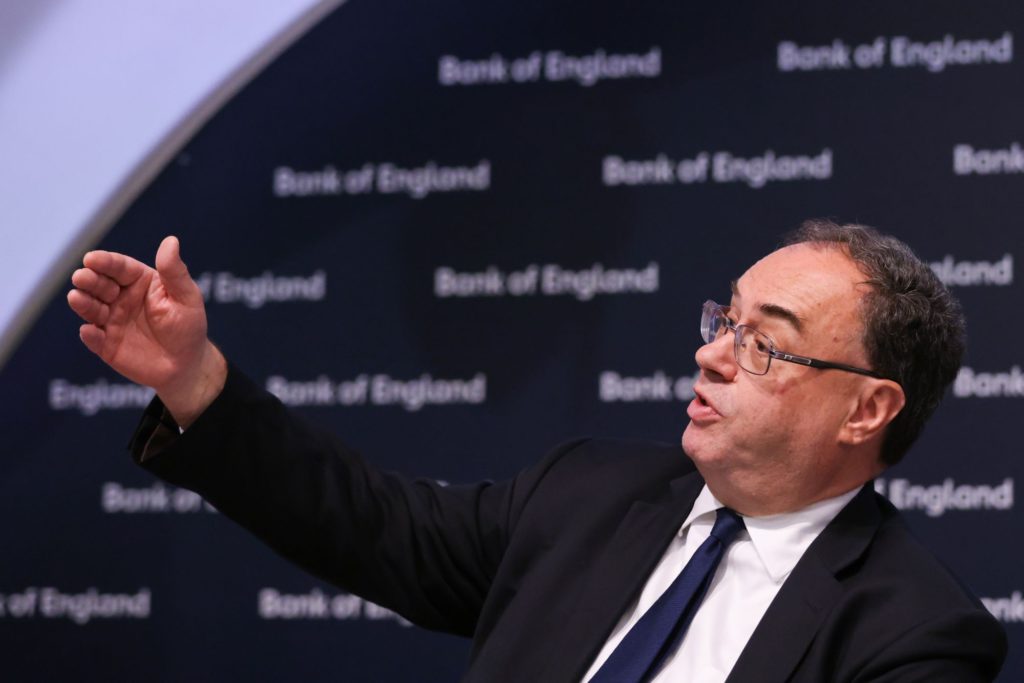
(Bloomberg) — Cryptoassets may have some “extrinsic” value thanks to people’s desire to collect the tokens, Bank of England Governor Andrew Bailey said, reiterating his critique that they lack “intrinsic” worth.

Bailey, who has in the past been a vocal critic of crypto, made the comments in testimony to UK lawmakers on Monday. While the tone was more positive than some of his historical views, he once again repeated his assertion that unbacked cryptoassets are a “very high risk.”

The BOE chief was discussing the bank’s Financial Stability Report, which last week warned a a $2 trillion plunge in the value of cryptoassets underscores vulnerabilities in the market and the need for tougher law enforcement and regulation.

Regulators in the UK and Europe have been hardening their rhetoric against the industry, saying they’re concerned that contagion from the crypto market could damage the broader financial system.

The BOE said the recent volatility in crypto markets so far isn’t posing a risk to the overall system. But without action, systemic risks would emerge if cryptoassets activity and its connection to banks and other markets continues to grow.

“This underscores the need for enhanced regulatory and law enforcement frameworks to address developments in these markets,” the BOE said.

More stories like this are available on bloomberg.com

©2022 Bloomberg L.P.

Klarna’s Valuation Slashed by $39 Billion Amid Fintech Rout

(Bloomberg) — Klarna Bank AB’s valuation has been slashed to $6.7 billion in its latest funding round, in a dramatic reversal for one of Europe’s most high-profile startups. 

The buy-now-pay-later giant said it raised $800 million from new and existing investors, according to a statement Monday. Its new valuation is down from the $45.6 billion it achieved in June 2021, with Klarna reducing its ambitions several times during the latest talks with investors. 

Once one of the world’s most valuable startups, Klarna was discussing valuations as high as $60 billion as recently as February. That was before the war in Ukraine and rising rates helped to spark a market-wide collapse. 

Technology-focused businesses have suffered a rout this year as investors turned away from what they see as risky and potentially overpriced assets. Tech specialists such as SoftBank Group Corp. — which backed Klarna last year, but wasn’t named as a supporter this time — have been left sitting on billions of dollars of losses. 

Chief Executive Officer Sebastian Siemiatkowski said in a series of Tweets that while Klarna isn’t immune to the stock downturn, and that now is the time to focus on a return to profitability, he finds the lower valuation “odd considering all the things achieved, how much larger and better and stronger we are now.” 

“What does not kill you, makes you stronger,” he said. 

Klarna is also exposed to downturns in consumer finances. It offers interest-free loans to spread payments for purchases over multiple installments, making money by charging retailers a small fee on every transaction and from interest on longer-term loans.

Read More: Klarna Customers Seek Loans for Groceries, Gas as Debt Risk Rises

While its customer numbers are growing rapidly, its own debt costs and losses are also piling up, and the business is burning through hundreds of millions of dollars per quarter. It posted an operating loss of 2.54 billion kronor ($245 million) in the first quarter, and 6.58 billion kronor last year. The lender, which is regulated by the Swedish Financial Supervisory Authority, also recently cut staff in an effort to curb costs. 

Existing investors who backed the funding round include Sequoia, Bestseller, Silver Lake, and Commonwealth Bank of Australia. New investors included Mubadala Investment Co. and Canada Pension Plan Investment Board. 

Klarna’s decline is almost perfectly mirrored by its US-listed rival Affirm Holdings Inc., whose market value has tumbled from a $46.8 billion peak in November to about $6.1 billion.

Consumer credit startups are contending with their first experiences of soaring inflation, higher rates and looming recession pressures that could cause defaults to spike. Unlike more established banks, they do not have other income sources such as trading desks or home loans to counterbalance a fall in discretionary spending. Buy now, pay later firms are also facing increased regulatory scrutiny. 

Klarna has 147 million global active users and 400,000 retail partners, including Nike Inc., Ikea, Sephora and Expedia Group Inc, according to its website. The new funds will target its expansion in the US, where the company has about 30 million customers, with volumes more than tripling in a year, Klarna said in the statement. 

“It’s a testament to the strength of Klarna’s business that, during the steepest drop in global stock markets in over fifty years, investors recognized our strong position,” Siemiatkowski said in the statement. 


(Updates with chart, additional background from third paragraph.)

More stories like this are available on bloomberg.com

©2022 Bloomberg L.P.
UK Security Probe Asks for More Details on Drahi’s BT Stake

(Bloomberg) — The UK has stopped the clock in a probe to request more information about French billionaire Patrick Drahi’s stake-building at BT Group Plc, under a new law which could let officials impose conditions or even block the tycoon.

The government, which had initially set a deadline of last week for the investigation, has requested more information about the BT deal, according to people with knowledge of the process, who asked not to be identified because it’s confidential. The precise reasons and length of time required for the information notice couldn’t be immediately discovered.

Drahi’s deal for an 18% stake in Britain’s former phone monopoly is being scrutinized under the National Security and Investment Act, which came into effect in January and gives ministers the options of clearing or blocking deals, imposing conditions or even unpicking them retrospectively. These early probes are seen as important test cases as the UK takes a closer interest in major industries.

The government has also delayed an assessment of the Chinese-led takeover of the country’s biggest microchip factory. Originally due last week, a probe into Nexperia Holding’s acquisition of Welsh chipmaker Newport Wafer Fab has been officially extended for another 45 working days, BEIS said, giving officials until the first week of September for that transaction. This official extension is a different mechanism to the BT information request.  

“The Business Secretary has powers under the National Security & Investment Act to intervene in acquisitions where necessary,” a spokesman for the department for Business, Energy and Industrial Strategy said by email. 

Representatives for BT and Drahi’s investment vehicle, Altice UK, declined to comment, while a representative for Nexperia didn’t respond to requests for comment.

Nexperia, a subsidiary of China’s Wingtech Technologies Co., bought Newport Wafer Fab last year, a month after telecom tycoon Drahi revealed his surprise stake in the country’s biggest broadband operator BT via Altice. 

In May, Business Secretary Kwasi Kwarteng announced probes into both deals. Kwarteng has remained in his Cabinet post despite a mass exodus of fellow ministers and the resignation of Prime Minister Boris Johnson. After one extension the government can request more time to investigate deals, but only with the buyer’s agreement. 

The sale of Truphone Ltd., a smaller British telecom firm backed by sanctioned Russian billionaire Roman Abramovich, has also been halted pending a UK security review, and the buyers have challenged the decision, a separate person familiar with the matter had said. The bidding group believes that review is linked to a commercial agreement with BT.

(Updates with government comment in fifth paragraph)

More stories like this are available on bloomberg.com

©2022 Bloomberg L.P.
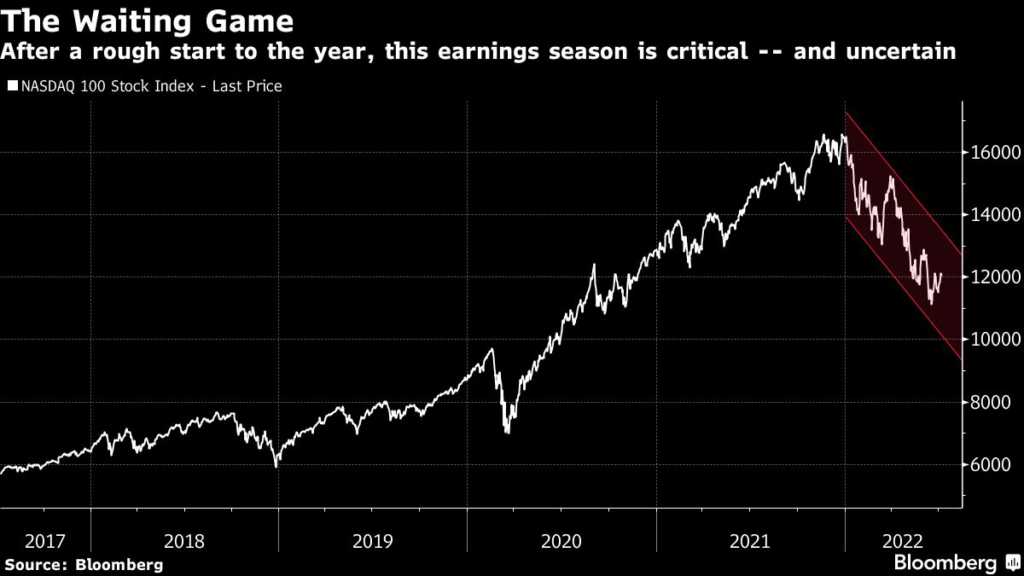
Nail-Biting Tech Earnings Season Ahead After Nasdaq Rout

(Bloomberg) — With technology stocks on track for their biggest annual decline on record, the earnings season has a lot riding on it.

A tumultuous first half wiped out $5.6 trillion in market value from the Nasdaq 100 Index through the end of June, with rate hikes hitting stocks valued on future earnings, inflation driving up costs, and the threat of recession weighing. At the same time, earnings estimate cuts by analysts have been lagging, leaving room for big surprises and dramatic post-earnings moves.

Traders are bracing for price swings of anywhere from 4% to 13% in the FAANG cohort after they report second-quarter results, according to data compiled by Bloomberg. The five megacaps account for about 16% of the S&P 500 Index’s daily performance.

The Nasdaq 100 Index fell 2.1% on Monday, a retreat after a five-day gain.

Among factors investors will focus on are company comments on consumer demand, the impact of inflation on margins, the hit from a strong dollar and ongoing supply chains woes.

“There will be different dynamics at play, depending on the sector. Anything consumer related is likely to be very challenged,” said Aaron Dunn, a portfolio manager at Eaton Vance Management. “Pricing is another major question. If you have strong pricing power, your trough valuation will be better in this environment.”

Estimates Vs. Reality

A 27% selloff in the tech-heavy Nasdaq 100 Index this year has lowered stock valuations, but apparent bargains may be a mirage if poor results prompt analysts to slash earnings forecasts.

Earnings estimates have started to come down for some companies, including Amazon.com Inc. and Alphabet Inc., but maybe not enough, according to Eaton Vance’s Dunn, who oversees more than $4 billion.

“We’re going to need some kind of recalibration,” he said, referring to earnings outlooks this season.

Wall Street expects tech earnings to rise almost 13% this year — a consensus that hasn’t changed much in recent months despite growing economic headwinds. If estimates fall dramatically, stocks will look expensive, underlining their downside potential in a slowdown.

Demand for Tech

Investors parsing results for clues on consumer and enterprise demand have so far received mixed signals. Micron Technology Inc.’s disappointing outlook pointed to weaker trends for phones and computers, while a beat from Samsung Electronics Co. was more reassuring.

The hardware group has “the most downside risk” if there’s a bigger downturn in demand, Goldman Sachs analyst Rod Hall wrote in a report last week, picking out Apple Inc. and Hewlett Packard Enterprise Co. as those most at risk.

Beyond hardware, investors are bracing for a chip cycle downturn and expect the market for online advertising — the primary source of revenue for companies like Meta Platforms Inc. — to soften.

Cloud computing and cybersecurity look more resilient, with Morgan Stanley pointing to a “durable security spending environment” against an uncertain macro backdrop.

Margins and Inflation

Costs are soaring while intermittent lockdowns in China are exacerbating an already-strained supply chain. Investors will be closely watching how much of these pricing pressures companies can pass on to customers, and the impact on margins.

Bloomberg Intelligence data indicates that tech’s operating margins will be around 31% this year, a forecast that remained steady through this year, but that may come down after companies start to report.

Strong Dollar

The surging US dollar has already been flagged as a big issue for tech this quarter, with Microsoft Corp. and Salesforce Inc. both citing currency in recent guidance cuts. 

Bloomberg Intelligence analyst Anurag Rana sees this as a “recurring theme” for large software companies, as most generate over one-third of their sales outside the US. 

And it’s also being felt by hardware firms, with Apple recently raising the price of iPhones and iPads in Japan to account for the yen’s drop against the dollar.

Interest Rates

The Federal Reserve’s battle against inflation and the accompanying surge in Treasury yields have weighed heavily on technology stocks this year. Its next interest rate decision will be on July 27, just as the megacap earnings season gets into full swing. 

Any surprise from the Fed has the potential to roil stocks. Most on Wall Street expect the committee to hike its benchmark rate by 75 basis points, although there has been speculation that the recent decline in oil and other commodity prices could give the Fed more leeway — potentially good news for tech stocks.

Tech Chart of the Day

Twitter Inc. tumbled after Elon Musk said he plans to walk away from his deal to buy the social media company for $44 billion, setting the scene for a legal battle. It’s the latest in a rollercoaster ride for Twitter investors. The stock jumped in April on Musk’s plans to buy the company, only to slump after the billionaire complained that the number of spam bots on the service was much higher than Twitter disclosed.

Top Tech Stories

  • Twitter Inc. shares tumbled after Elon Musk walked away from his $44 billion deal to buy the company, with a disruptive legal battle ahead. Analysts said the shares could drop below $30 if Musk’s offer falls through. Tesla Inc. rose.
    • Twitter has hired merger law heavyweight Wachtell, Lipton, Rosen & Katz as it races to sue Elon Musk for moving to dump his takeover of the company, according to people familiar with the matter.
    • Musk will need to make his case before a judge in Delaware that Twitter failed to uphold its side of a merger deal reached in April. If history is a guide, his job won’t be easy. The billionaire issued a humorous late-night response to Twitter’s preparations to sue.
  • Uber Technologies Inc. attempted to lobby politicians and flouted laws as part of efforts to expand globally from 2013 to 2017, according to newspaper reports based on leaked documents.
  • Chinese tech stocks fell sharply Monday, led by a selloff in Alibaba Group Holding Ltd. and Tencent Holdings Ltd. after the two firms received a regulatory fine on past transactions.
  • Qiming Venture Partners raised $3.2 billion across two new funds, joining Sequoia China and IDG in securing fresh capital as investors grow more sanguine about the country’s startup arena.
  • Rogers Communications Inc.’s chief executive officer will face Canada’s industry minister to account for a nationwide network failure that left millions of households and businesses without wireless and internet service.

(Updates to market open.)

More stories like this are available on bloomberg.com

©2022 Bloomberg L.P.

Close Bitnami banner
Bitnami
